
物价

Search documents
广发宏观:高频数据下的3月经济:价格篇
GF SECURITIES· 2026-04-01 07:54
Price Index Trends - The Business Price Index (BPI) rose significantly in March, reaching 1103 points, a month-on-month increase of 16.4% compared to the end of February[3] - The energy index increased by 25.3%, while the chemical index surged by 32.4%, but the non-ferrous index fell by 9.5% month-on-month[4] Commodity Price Movements - In the week of March 16-20, five energy commodities saw price increases of over 5%, accounting for 35.7% of the monitored items[4] - The average price of coal in the Bohai Rim region increased by 1.7%, while the chemical price index surged by 33.8% month-on-month[5] Real Estate Market - As of March 23, the second-hand housing price indices in Beijing, Shanghai, Guangzhou, and Shenzhen decreased by 1.0%, 1.8%, 1.4%, and 0.8% respectively[5] - The second-hand housing prices in these cities have seen significant highs over the past year, with peaks recorded at 159.44, 192.67, 181.71, and 251.13 points[6] Emerging Industries - The photovoltaic industry composite index fell by 13.2% in March, with significant declines in prices for battery cells and polysilicon[6] - Lithium carbonate futures prices decreased by 4.9% month-on-month, while DRAM spot prices fell between 5.3% and 8.9%[9] Shipping and Logistics - The China Container Freight Index (CCFI) rose by 9.0% in the fourth week of March, with significant increases in shipping rates to Los Angeles and New York[7] - The Baltic Dry Index (BDI) decreased by 5.1% month-on-month, indicating a mixed outlook for shipping costs[8] Food Prices - The average wholesale price of pork fell by 12.7% in March, while key vegetable prices dropped by 10.9%[9] - The price index for non-food items, represented by the ICPI, decreased slightly to 99.67, reflecting a month-on-month decline of 0.2%[10]
国内高频 | 生产走势分化(申万宏观·赵伟团队)
申万宏源证券上海北京西路营业部· 2026-03-30 02:13
Core Viewpoint - The article discusses the current trends in industrial production, particularly focusing on the stability of blast furnace operations and the recovery of steel consumption, alongside the performance of various sectors such as construction and petrochemicals [6][16][28]. Group 1: Industrial Production - The blast furnace operating rate remains stable, with a week-on-week increase of 1.2% and a year-on-year maintenance at 1.5% [6]. - Steel apparent consumption has shown a week-on-week increase of 2.2%, but a year-on-year decline of 0.9 percentage points to 4.1% [6]. - Social steel inventory has decreased by 1.7% compared to the previous week [6]. Group 2: Petrochemical Sector - In the petrochemical chain, the soda ash operating rate decreased by 4.5% week-on-week but increased by 1.2 percentage points year-on-year to -1.4% [16]. - The PTA operating rate increased by 3.6% week-on-week and rose by 5.7 percentage points year-on-year to 3% [16]. - Downstream consumption in the polyester filament sector saw a week-on-week decrease of 0.9% and a year-on-year decline of 2.2 percentage points to -5.3% [16]. Group 3: Construction Industry - In the construction sector, the national grinding operating rate increased by 2.1% week-on-week and rose by 2.6 percentage points year-on-year to 14.1% [28]. - The cement shipment rate increased by 7.3% week-on-week and rose by 0.2 percentage points year-on-year to 0.8% [28]. - The cement inventory ratio has increased by 0.9% week-on-week and by 3 percentage points year-on-year to 7.3% [28]. Group 4: Glass and Asphalt Production - Glass production has remained flat compared to the previous week, with a year-on-year decline of 0.3 percentage points to -7.5% [40]. - The apparent consumption of glass decreased by 5.7% week-on-week and fell by 5.7 percentage points year-on-year to 6.6% [40]. - The asphalt operating rate, reflecting infrastructure investment, increased by 0.7% week-on-week but saw a year-on-year decline of 0.1 percentage points to -6.4% [40]. Group 5: Real Estate and Transportation - The average daily transaction area of commercial housing in 30 major cities increased by 14.8% week-on-week and saw a year-on-year increase to 25.5% [52]. - The railway freight volume related to domestic demand decreased by 3.2 percentage points year-on-year to 4.3% [64]. - The number of domestic and international flights increased by 0.5% and 1.2% week-on-week, respectively, with year-on-year increases of 7.7% and 2.2% to 10.2% and 7.1% [76]. Group 6: Price Trends - Agricultural product prices are generally weak, with pork, vegetables, and fruit prices decreasing by 1.3%, 0.9%, and 0.7% respectively [106]. - The industrial product price index decreased by 0.2% week-on-week, with the energy and chemical price index increasing by 1.2% and the metal price index decreasing by 0.6% [118].


如何看待当前物价与利率?
GOLDEN SUN SECURITIES· 2026-03-09 09:46
Report Industry Investment Rating - No information provided in the report Core Viewpoints - The current price increase has not driven corporate profit improvement, and monetary policy has difficulty responding to exogenous price changes, so the overall impact on interest rates is limited. The bank - led allocation market is still the main trend, which may be more obvious after the end of the quarter [5][30] Summary by Related Content CPI Analysis - In February, affected by the Spring Festival misalignment effect, CPI increased significantly. The year - on - year increase expanded by 1.1 percentage points to 1.3%, the highest in nearly three years, and the month - on - month increase was 1.0%, the highest in nearly two years. After excluding the Spring Festival factor, the CPI year - on - year growth rate was 0.7%, showing that inflation was stable. Whether the CPI can continue to rise in March needs further observation [1][8] - The price of gold still has a significant impact on CPI. In February, the other supplies and services industry increased by 15.4% year - on - year. The continuous high growth of this item may be supported by the rising gold price. After excluding this item, the year - on - year CPI and core CPI in February were 0.9% and 1.1% respectively [1][10] - Affected by the Spring Festival, food prices rose, but the month - on - month increase was lower than the seasonal level. In February, food prices increased by 1.7% from a 0.7% decline in the previous month, affecting the CPI to rise by about 0.30 percentage points year - on - year. The month - on - month increase affected the CPI to rise by about 0.33 percentage points [16] - Affected by the concentrated release of consumer demand during the long Spring Festival holiday, service prices rose significantly. In February, non - food CPI increased by 1.3% year - on - year, the highest since October 2022, and the service price increased by 1.6% year - on - year, affecting the CPI to rise by about 0.75 percentage points [18] PPI Analysis - The recovery speed of industrial product prices is still high, mainly due to the rising prices of imported non - ferrous metals and crude oil. In February, the prices of non - ferrous metal mining and dressing, and non - ferrous metal smelting and rolling processing industries increased by 7.1% and 4.6% month - on - month respectively. The prices of the domestic oil and gas extraction, refined petroleum products manufacturing, and organic chemical raw materials manufacturing industries increased by 5.1%, 0.7%, and 1.3% respectively. The prices of computing - related industries also continued to rise [2][20][21] - In February, the year - on - year decline of PPI for means of livelihood narrowed by 0.1 percentage point to 1.6%. Among them, the price of clothing decreased by 1.0% year - on - year, the price of general daily necessities decreased by 1.8% year - on - year, the price of durable consumer goods decreased by 1.6% year - on - year, and the price of food decreased by 1.8% year - on - year [21] Impact on the Bond Market - The market is concerned that the sharp rise in oil prices caused by the US - Iran conflict will push up inflation from the cost side, affect monetary policy, and form adjustment pressure on the bond market. Brent crude oil prices soared from $71.1 per barrel at the end of February 2026 to $94.4 per barrel on March 6, with a weekly increase of more than 30% [3][23] - The current K - shaped price increase may not have an obvious impact on interest rates. On the one hand, the price increase is concentrated in a few industries such as non - ferrous metals, and corporate profits have not improved, so the financing demand has not increased accordingly. On the other hand, the domestic monetary policy has limited ability to adjust to this input - type price change and may not tighten [4][27] - The current changes in oil prices and prices have limited impact on the bond market. The bank - led allocation market is the main trend, which may be more obvious after the end of the quarter. The lack of financing demand and high savings willingness lead to an increase in deposits and a decrease in loan growth. Banks are still in an environment short of assets, which will lead to loose funds and limit the upper limit of interest rates [5][30]
国内高频 | 人流出行延续高位(申万宏观·赵伟团队)
赵伟宏观探索· 2026-03-04 16:03
Group 1: Industrial Production Tracking - The industrial production shows a divergence, with the construction sector experiencing a slight recovery in activity [2] - The blast furnace operating rate remains resilient, with a week-on-week increase of 0.1% and a year-on-year rise of 0.1 percentage points to 2.3% [2] - Steel apparent consumption has decreased, showing a year-on-year decline of 3.5 percentage points to -6.4% compared to the week before the Spring Festival [2] - The social inventory of steel has increased significantly, rising by 9.6% week-on-week [2] Group 2: Demand Tracking - The national real estate transaction volume has improved, particularly in second-tier cities, with a year-on-year increase in average daily transaction area to 106.8% [50] - First-tier cities saw a year-on-year increase in transactions of 47.9%, while second and third-tier cities experienced even larger increases of 137.8% and 97.4% respectively [50] - Freight volume and port cargo throughput related to domestic demand have both increased, with railway freight volume rising by 2.1 percentage points to 3.1% year-on-year [62] - The national migration scale index has increased by 36.8 percentage points to 52.7% [74] Group 3: Price Tracking - Agricultural product prices have generally declined, with egg and vegetable prices dropping by 3.4% week-on-week [104] - The industrial product price index has shown a mixed trend, with the Nanhua industrial price index decreasing by 0.5% week-on-week [116] - The energy and chemical price index fell by 1.1%, while the metal price index increased by 0.4% [116]

金融数据开门红,国产AI密集炸场|一周热点回顾
Di Yi Cai Jing· 2026-02-14 05:30
Economic Indicators - In January, the Consumer Price Index (CPI) increased by 0.2% month-on-month and year-on-year, with the annual growth rate dropping by 0.6 percentage points compared to December [2] - The core CPI, excluding food and energy, rose by 0.8% year-on-year, marking the highest increase in six months [2] - The Producer Price Index (PPI) increased by 0.4% month-on-month, continuing a four-month upward trend, with the growth rate expanding by 0.2 percentage points from the previous month [2] Monetary Policy - As of the end of January, the broad money supply (M2) reached 347.19 trillion yuan, growing by 9% year-on-year, exceeding market expectations [4] - The total social financing stock was 449.11 trillion yuan, with an annual growth rate of 8.2%, indicating a stable growth in credit [4] - The central bank plans to maintain a moderately loose monetary policy, utilizing various tools to ensure ample liquidity and relatively loose financing conditions [4] Internet Platform Regulation - The State Administration for Market Regulation released the "Antitrust Compliance Guidelines for Internet Platforms," outlining four categories of antitrust risks and providing examples of potential violations [5][6] - The guidelines serve as a non-binding action guide for platforms, aiming to promote fair competition and transparency in the industry [6] AI Industry Developments - Major Chinese companies like ByteDance and Alibaba have launched flagship AI models, leading to significant market enthusiasm and stock price increases [7][8] - The Seedance 2.0 model from ByteDance supports multi-modal input and has reduced video generation costs significantly, showcasing advancements in video generation technology [7] - The release of these models indicates a competitive push in the AI sector, with potential implications for global AI market dynamics [8] Low-altitude Economy Policies - A series of policy documents supporting the low-altitude economy were released, aiming to enhance infrastructure and insurance services by 2027 [9][10] - The policies are expected to facilitate the growth of the low-altitude economy, transitioning it towards a more systematic and standardized development phase [10] Pharmaceutical Regulation - The National Health Commission revised the "National Essential Medicines Directory Management Measures," establishing a rigid adjustment cycle for the essential medicines list [11] - The new measures emphasize the clinical value of drugs and aim to align the essential medicines directory with healthcare policies and practices [11]
债市 进一步走强动力不足
Qi Huo Ri Bao· 2026-02-12 09:16
Group 1 - The bond market has shown a pattern of "narrow yield fluctuations, long-end leading gains, and synchronized strength in futures and spot markets" since February, supported by a reasonably ample liquidity environment and weak financing demand during the production off-season [1] - The central bank's recent actions, including a net injection of 100 billion yuan through a three-month reverse repurchase agreement and the resumption of 14-day reverse repos, have stabilized liquidity in the interbank market, providing support for the bond market [1] - The issuance of government bonds has surged in early February, while the equity market has stabilized, limiting the downward space for yields and making it difficult for the bond market to achieve a trend breakthrough [1] Group 2 - The central bank's monetary policy report indicates that the effects of the moderately accommodative monetary policy implemented in 2025 are gradually becoming evident, with significant impacts on stabilizing economic growth and financial market operations [2] - The report emphasizes the continuation of a supportive monetary policy stance, with a focus on expanding domestic demand and optimizing supply, while indicating a low probability of short-term reserve requirement ratio (RRR) cuts or interest rate reductions [2] - The central bank is expected to maintain a "protective" policy tone, avoiding abrupt changes, which will help the bond market maintain a strong oscillating pattern and prevent large fluctuations [3] Group 3 - Consumer prices (CPI) rose by 0.2% year-on-year in January, with core CPI (excluding food and energy) increasing by 0.8% year-on-year, indicating a moderate rise in service and industrial consumer goods prices [4] - The Producer Price Index (PPI) decreased by 1.4% year-on-year in January, but the decline has narrowed compared to the previous month, with a month-on-month increase of 0.4%, suggesting a bottoming out and recovery in industrial product prices [4] Group 4 - The bond market has entered a recovery phase due to multiple factors, but the recent drop in the 10-year government bond yield below 1.8% and the cooling of short-term interest rate cut expectations indicate insufficient driving forces for further declines, leading to a lack of momentum for a trend breakthrough [5]
问道2026——第一财经首席经济学家调研年度经济展望
Di Yi Cai Jing· 2026-01-21 12:50
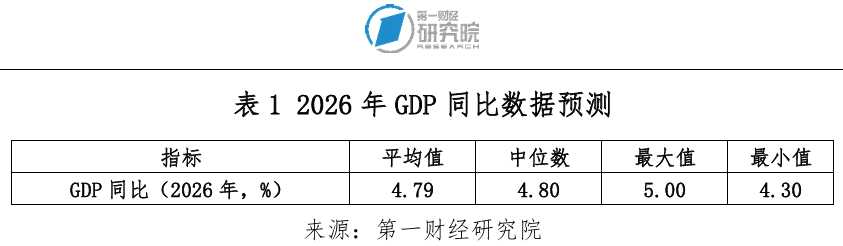
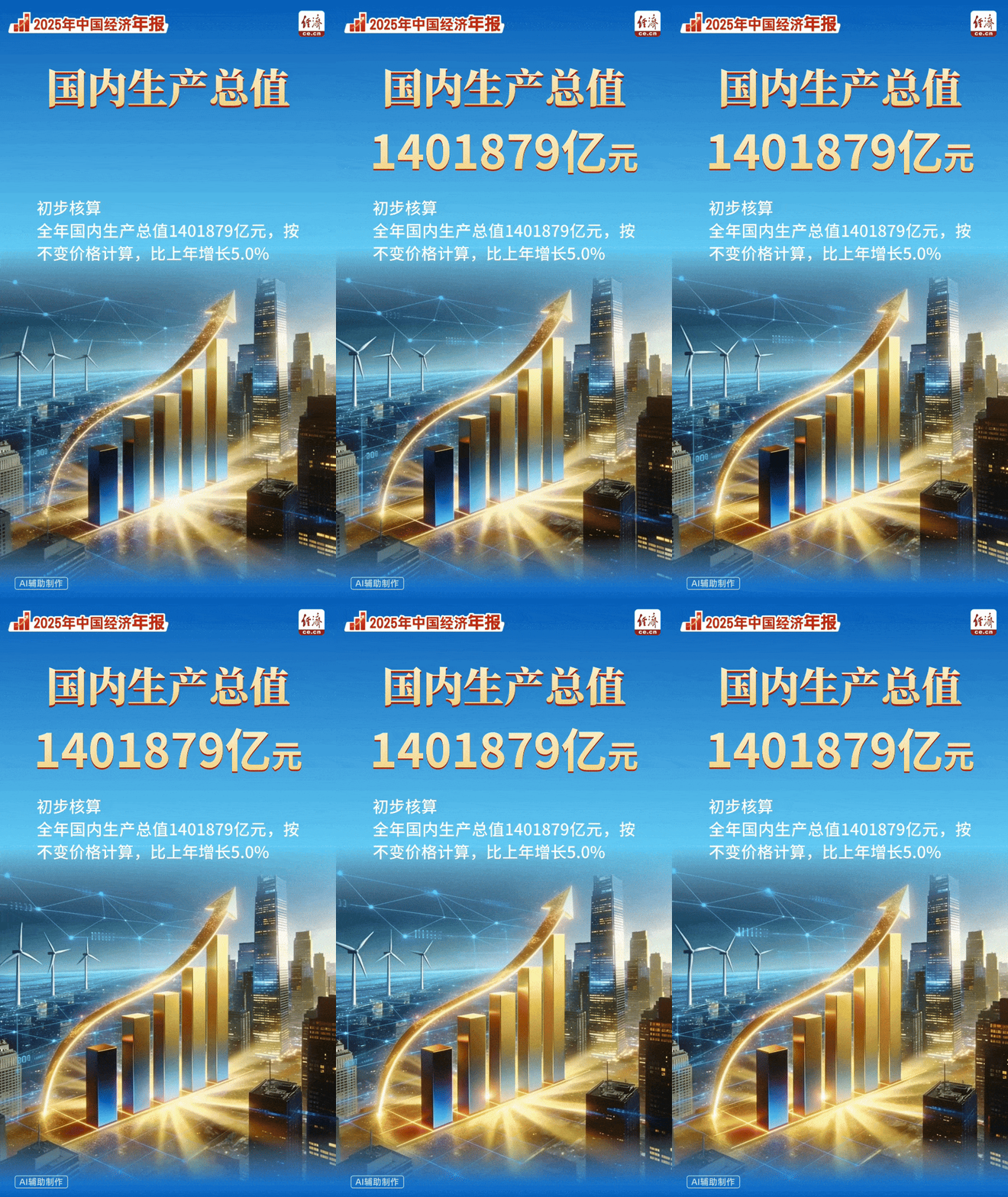
Economic Outlook - In 2025, China's GDP reached 140.19 trillion yuan, growing by 5.0% year-on-year, achieving the set target for the year [3] - Economists predict a GDP growth of approximately 4.79% for 2026, with a median forecast of 4.80% [2][3][4] - The focus for 2026 will be on enhancing internal demand and implementing new measures to stimulate growth [3][4] Inflation Trends - In 2025, the Consumer Price Index (CPI) showed no year-on-year change, while the Producer Price Index (PPI) decreased by 2.6% [6] - For 2026, CPI is expected to rise by 0.4%, while PPI is projected to decline by 1.1% [7][6] Industrial and Consumption Growth - The industrial added value is forecasted to grow by 5.14% in 2026, while retail sales of consumer goods are expected to increase by 4.05% [9][10] - Service consumption is anticipated to outpace goods consumption, reflecting a shift in consumer preferences [10][11] Investment Trends - Fixed asset investment is expected to recover slightly in 2026, with a projected growth rate of 2.17% [14] - The real estate market is predicted to remain in a downtrend, with a forecasted decline of 8.03% in real estate development investment [14][16] Foreign Trade - China's foreign trade is expected to maintain stable growth, with exports projected to increase by 3% to 4% in 2026 [20][21] - The trade surplus for 2026 is estimated at approximately $1.25 trillion [18] Key Economic Highlights - The economic highlights for 2025 include resilience in external demand and accelerated domestic industrial upgrades [21][22] - Future focus areas include expanding domestic demand and fostering innovation [21][22]
速览2025年主要经济数据
Zhong Guo Jing Ji Wang· 2026-01-19 03:46
Economic Overview - The national economy in 2025 faced pressures but achieved high-quality development, successfully meeting major goals for economic and social development, marking a successful conclusion to the "14th Five-Year Plan" [1] Industrial Performance - The industrial added value of enterprises above designated size increased by 5.9% compared to the previous year [5] Service Sector - The added value of the service industry grew by 5.4% year-on-year [11] Consumer Spending - The total retail sales of consumer goods reached 501.202 billion yuan, reflecting a growth of 3.7% from the previous year [16] Investment Trends - Total fixed asset investment (excluding rural households) was 485.186 billion yuan, a decrease of 3.8% year-on-year; excluding real estate development investment, fixed asset investment fell by 0.5% [21] Trade Performance - The total value of goods imports and exports amounted to 454.687 billion yuan, representing a growth of 3.8% compared to the previous year [25] Price Levels - The Consumer Price Index (CPI) remained stable compared to the previous year, while the Producer Price Index (PPI) for industrial producers decreased by 2.6% [29][30] Employment Statistics - The average urban survey unemployment rate was 5.2% for the year [32] Income Growth - The per capita disposable income of residents was 43,377 yuan, showing a nominal increase of 5.0%, with a real growth of 5.0% after adjusting for price factors [34]
国内高频指标跟踪(2026年第2期):开年经济温和回暖
Haitong Securities International· 2026-01-13 09:18
Economic Overview - The economy is showing moderate recovery at the beginning of the year, supported by resilient domestic demand and improvements in external demand and production[1] - High-frequency data indicates that automotive consumption is boosted by trade-in subsidies, while service consumption has weakened marginally post-New Year[3] Investment Insights - Special bond issuance has been advanced, potentially stabilizing infrastructure investment in Q1, although the real estate sector remains weak[3] - In the first two weeks of January, special bonds worth CNY 110.2 billion were issued, compared to zero in the same period last year, indicating a shift in issuance pace[7] Trade and Production - External trade conditions are improving, with both export volume and price rising; port operation data shows a year-on-year increase in most metrics[7] - Production is generally recovering, with operating rates in the steel, petrochemical, and chlor-alkali sectors rising[7] Pricing Trends - Consumer prices are weak, with the iCPI index decreasing by 0.53% month-on-month; however, industrial prices are mostly rising, particularly in the non-ferrous metals and lithium carbonate sectors[7] - The price of lithium carbonate has surged by 74.5% year-on-year due to tight supply and demand from emerging industries[10] Liquidity and Interest Rates - Funding rates have slightly increased, with R007 rising by 6.3 basis points and DR007 by 4.4 basis points compared to the previous week[8] - The 10-year government bond yield increased by 3.1 basis points to 1.88%, while the one-year yield decreased by 4.9 basis points to 1.28%[8] Risks - There are uncertainties regarding trade conditions and the potential for domestic demand recovery to fall short of expectations[12]
物价:回顾2025,展望2026:2025年12月通胀数据点评
Huachuang Securities· 2026-01-11 03:43
Group 1: Inflation Overview - In December 2025, CPI increased year-on-year from 0.7% to 0.8%, while core CPI remained stable at 1.2%[2] - PPI narrowed its year-on-year decline from -2.2% to -1.9%[2] - The GDP deflator index for Q4 2025 is expected to be around -0.4%, with earlier quarters at -0.8%, -1.2%, and -1%[2] Group 2: CPI Analysis - The cumulative CPI increase for 2025 is 0.8%, a significant recovery compared to the average -0.1% in 2023-24[5] - Food prices rose by 1.1% in 2025, driven by increases in fruits, vegetables, and beef[5] - Gold jewelry prices surged by 68.5%, contributing to the overall CPI improvement[5] Group 3: PPI Trends - In the first half of 2025, PPI experienced a monthly average decline of -0.3%, compared to -0.2% in 2023 and 2024[6] - The second half of 2025 saw PPI stabilize with a monthly average of 0%, indicating a recovery in various industry chains[6] - Factors influencing PPI include global recession fears due to U.S. tariff policies and ongoing adjustments in the domestic real estate market[6] Group 4: 2026 Outlook - CPI is projected to rise by approximately 0.8% in 2026, with a technical adjustment of 0.1 percentage points due to base effects[10] - PPI is expected to decline by about -1%, with an upward adjustment of 0.4 percentage points due to price increases in the non-ferrous sector[10] - Potential upward risks for CPI include increased consumer subsidies and improved service supply in the economy[10]