
反内卷

Search documents
黑色金属日报-20260107
Guo Tou Qi Huo· 2026-01-07 11:59
Report Industry Investment Ratings - Thread steel: ★☆☆ [1] - Hot-rolled coil: ★☆☆ [1] - Iron ore: ★★★ [1] - Coke: ★☆☆ [1] - Coking coal: ★☆☆ [1] - Silicon manganese: ★★☆ [1] - Ferrosilicon: ★★☆ [1] Core Views - The steel market is expected to remain strong in the short term as the market sentiment warms up and the steel price follows the cost center upward, but the overall domestic demand is still weak [2]. - The iron ore market has a relatively loose fundamental situation, and there is a risk of increased high-level volatility in the future, although there is still some rigid replenishment demand [3]. - The coke and coking coal markets face certain fundamental pressures after the price correction, but the market has certain expectations for stimulus policies, leading to intensified capital games on the disk [4][6]. - The silicon manganese market is recommended to buy on dips, with attention paid to the "anti-involution" impact [7]. - The ferrosilicon market is relatively strong, and it is also recommended to buy on dips, with attention paid to the "anti-involution" impact [8]. Summaries by Related Catalogs Steel - The steel futures market rebounded significantly today. In the off-season, the apparent demand for thread steel declined, production increased, and inventory continued to decline. The demand for hot-rolled coil recovered, production increased synchronously, and inventory continued to decrease, but the pressure still needs to be relieved. The steel mill's profit margin has been repaired, the blast furnace production reduction has slowed down significantly, and the molten iron has stabilized and rebounded in the short term. The overall domestic demand is still weak, and steel exports remain high [2]. Iron Ore - The iron ore futures market rose significantly today. On the supply side, global shipments declined seasonally, and the domestic arrival volume increased month-on-month. The port inventory continued to accumulate. On the demand side, the terminal demand was weak in the off-season, and although the steel mill's profitability improved recently, there was no obvious resumption of production in the short term. The steel mill's imported ore inventory increased but remained at a low level, and there was still some rigid replenishment demand in the future [3]. Coke - The coke price hit the daily limit today. The coking profit is average, and the daily production decreased slightly. The coke inventory increased slightly. Currently, downstream buyers purchase on demand in small quantities, and traders have average purchasing intentions. Overall, the carbon element supply is abundant, and although the downstream molten iron is at a seasonal low, the demand for raw materials remains resilient. The steel mill still has a strong intention to suppress raw material prices [4]. Coking Coal - The coking coal price hit the daily limit today. The Mongolian coal customs clearance volume decreased, and the negative pressure on the price decreased slightly. The coking coal mine production decreased slightly. At the end of the year, some coal mines reduced or stopped production due to factors such as safety production and the completion of the annual production task. The spot auction transactions were okay, and the transaction price increased slightly. The terminal inventory increased slightly, and the total coking coal inventory increased slightly while the production-side inventory decreased slightly [6]. Silicon Manganese - The silicon manganese futures market fluctuated upward today. Driven by the rebound of the futures market, the spot price of manganese ore increased. Currently, there is a structural problem with the manganese ore port inventory, and the balance is relatively fragile. The silicon manganese smelting end pursues the most cost-effective option and changes the manganese ore formula for the furnace. The iron water production decreased seasonally on the demand side, the weekly silicon manganese production decreased slightly, and the silicon manganese inventory decreased slightly [7]. Ferrosilicon - The ferrosilicon futures market fluctuated upward today. Affected by relevant policy documents, the price was relatively strong. The market's expectation of coal mine supply guarantee increased, leading to a certain expectation of a decline in electricity costs and blue carbon prices. On the demand side, the iron water production rebounded to a high level, the export demand decreased to over 20,000 tons, and the marginal impact was not significant. The metal magnesium production increased month-on-month, and the secondary demand increased marginally. The ferrosilicon supply decreased significantly, and the inventory decreased slightly [8].
反内卷加速供需重塑,重视新技术、新场景
Tai Ping Yang Zheng Quan· 2026-01-07 10:46
Group 1 - The "anti-involution" trend is reshaping supply and demand in the photovoltaic industry, with price recovery expected as the market stabilizes. The introduction of energy storage at parity in key markets is accelerating, alleviating pressure on the grid from rapid increases in photovoltaic installations. The long-term demand outlook is optimistic due to rising computing power needs and breakthroughs in photovoltaic technology for space applications [2][12][14]. Group 2 - The penetration of low-silver and silver-free technologies is expected to increase rapidly, with leading companies likely to recover profitability faster than the industry average. The rise in silver prices is driving the adoption of these technologies, which are crucial for cost reduction [3][38][43]. Group 3 - The auxiliary material sector, under pressure for over three years, is expected to see a recovery in profitability as companies diversify their business models. Leading firms are preparing for a second growth phase, which will enhance their revenue streams [4][63]. Group 4 - Beneficiary analysis indicates that companies leading in low-silver and silver-free technology, such as Longi Green Energy and JinkoSolar, are well-positioned to benefit from cost advantages. Companies actively investing in energy storage, like Trina Solar and JA Solar, are also expected to see early recovery in profitability [5][73]. Group 5 - Global demand for photovoltaic installations is projected to grow, with an estimated 600 GW and 610 GW of new installations in 2025 and 2026, respectively. However, growth rates may slow due to market saturation in core regions like China and Europe [8][14]. Group 6 - The supply side is experiencing overcapacity, with significant production increases expected in silicon materials and components. The "anti-involution" movement is leading to reduced capital expenditures, which may help manage supply effectively [12][30]. Group 7 - The photovoltaic industry is witnessing a shift towards new technologies and applications, such as space photovoltaics and perovskite solar cells, which are expected to expand market opportunities significantly [49][54].





一周一刻钟,大事快评(W139):补贴政策受益分析;小鹏、零跑、长城销量解读
Shenwan Hongyuan Securities· 2026-01-07 10:29
Investment Rating - The report maintains an "Overweight" rating for the automotive industry, indicating a positive outlook compared to the overall market performance [10]. Core Insights - The 2026 new energy vehicle (NEV) purchase tax subsidy policy has shifted from a flat-rate model to a tiered proportional subsidy, resulting in a slight decrease in per-vehicle subsidy amounts. Companies with a higher proportion of low-end models, such as Geely and BYD, will experience a more significant subsidy reduction, while high-end brands will be less affected [2][3]. - The adjustment in subsidy policy is expected to reshape the sales structure of NEVs in 2026, with a decline in demand for low-end models and a relative advantage for mid-to-high-end models [2]. Summary by Relevant Sections Subsidy Policy Analysis - The new subsidy policy will lead to a 19% reduction for Geely and a 14% reduction for BYD, while companies like Xiaopeng, Great Wall, and Leap Motor will see a smaller impact of around 10% due to their higher proportion of mid-to-high-end models [2]. - The demand for A0 and A00 level low-end models, which previously relied heavily on subsidies, is expected to decrease significantly [2]. Sales Analysis of Key Companies - Xiaopeng Motors delivered nearly 430,000 vehicles in 2025, a 126% year-on-year increase. However, the average selling price (ASP) dropped from approximately 190,000 yuan in 2024 to 160,000 yuan in the first half of 2025 due to changes in product mix [3]. - Leap Motor achieved a delivery volume of 597,000 vehicles in 2025, doubling from 290,000 in 2024. The company plans to launch two high-end models in 2026 and aims for a sales target of 1 million vehicles [4]. - Great Wall Motors sold 1.32 million vehicles in 2025, with a 7% year-on-year growth. The company has set a sales target of 1.8 million vehicles for 2026, reflecting a 40% increase [5]. Investment Recommendations - The report suggests focusing on new energy vehicle companies with advantages in AI and robotics, such as Xiaopeng, NIO, and Li Auto, as well as component manufacturers like Yinchuan, Fuda, and Shuanghuan, which are expected to benefit from the new subsidy policies [6].

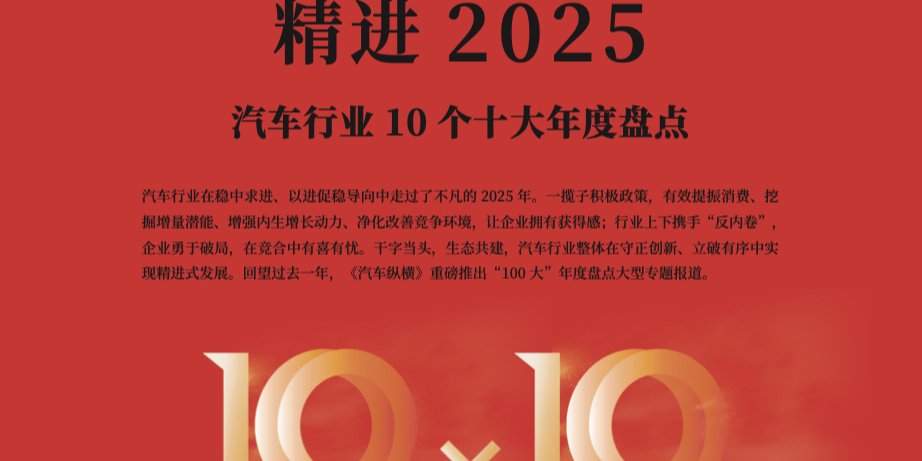
2025汽车行业十大年度金句 | 精进2025——汽车行业10个十大年度盘点
Jing Ji Guan Cha Wang· 2026-01-07 09:32
Core Insights - The automotive industry in 2025 has experienced significant growth driven by proactive policies that enhance consumption, tap into incremental potential, and improve the competitive environment, leading to a collaborative effort to combat unhealthy competition [2] - The "Cover Story" titled "Progress 2025 - Ten Major Annual Reviews of the Automotive Industry" has been launched, marking the sixth consecutive year of such comprehensive reporting [2] Group 1: Industry Trends - The automotive sector is focusing on innovation and collaboration to achieve steady progress while addressing challenges such as unhealthy competition [2] - A series of ten thematic reports have been published, covering various aspects of the automotive industry, including annual highlights, new policies, personnel changes, and significant events [2] Group 2: Leadership Perspectives - Industry leaders emphasize the importance of face-to-face interactions to reduce misunderstandings and foster collaboration, as highlighted by Chery's chairman [6] - The call for open communication among industry leaders is seen as essential for addressing challenges and promoting a healthy competitive environment [6][7] Group 3: Safety and Technology - Geely's establishment of a world-class safety center aims to enhance automotive safety through shared resources and data accumulation, reflecting a commitment to industry-wide safety standards [7][8] - The focus on safety is underscored by the need for responsible innovation that prioritizes user safety over mere technological advancement [10][11] Group 4: Market Dynamics - BYD's chairman advocates for a leadership role that respects competitors while pushing for technological excellence, emphasizing the importance of consumer trust and respect within the industry [9][10] - The shift towards a more collaborative industry ethos is seen as vital for fostering innovation and maintaining a competitive edge [10] Group 5: Innovation and Responsibility - The automotive industry is urged to prioritize necessary technological advancements that align with user safety and regulatory requirements, as articulated by Great Wall's chairman [11] - The call for innovation driven by real user needs rather than mere technological prowess reflects a shift towards more responsible and inclusive practices in the industry [13] Group 6: Global Trade and Cooperation - BMW's chairman stresses the importance of open markets and clear rules over trade barriers, advocating for mutual support in the face of geopolitical challenges [15][16] - The emphasis on cooperation and shared prosperity highlights the need for a unified approach to global trade within the automotive sector [16] Group 7: Strategic Reflections - Volkswagen's CEO acknowledges the need for self-reflection and adaptability in response to industry changes, emphasizing the importance of proactive engagement [17][18] - Toyota's chairman highlights the significance of preparing for uncertainties rather than making predictions, advocating for a responsive strategy to market changes [18][19]




一周一刻钟,大事快评(W139):补贴政策受益分析,小鹏、零跑、长城销量解读
Shenwan Hongyuan Securities· 2026-01-07 09:13
Investment Rating - The industry investment rating is "Overweight" indicating that the industry is expected to outperform the overall market [12]. Core Insights - The 2026 new energy vehicle purchase tax subsidy policy has shifted from a "one-size-fits-all" model to a tiered proportional subsidy, resulting in a slight decrease in per-vehicle subsidy amounts. Companies with a higher proportion of low-end models, such as Geely and BYD, will experience a more significant subsidy reduction, while high-end brands are largely unaffected [2][3]. - The adjustment in subsidy policy is expected to significantly reshape the sales structure of new energy vehicles in 2026, with demand for low-end models likely to decline, benefiting mid-to-high-end models and companies with higher average selling prices (ASP) [3]. Summary by Sections Subsidy Policy Analysis - The 2026 subsidy policy will lead to a reduction in subsidies for companies with a higher share of low-end models, with Geely facing a 19% reduction and BYD a 14% reduction. In contrast, companies like Xiaopeng, Great Wall, and Leap Motor will see a reduction of around 10% due to their higher proportion of mid-to-high-end models [3][4]. Sales Analysis of Key Companies - **Xiaopeng Motors**: Projected delivery volume for 2025 is approximately 430,000 units, a 126% increase year-on-year. December deliveries were 37,500 units, showing a decline due to subsidy reductions. The ASP is expected to drop from nearly 190,000 yuan in 2024 to 160,000 yuan in the first half of 2025. Xiaopeng plans to launch seven dual-power models in 2026, which are expected to benefit from the policy changes [4][5]. - **Leap Motor**: Expected to deliver 597,000 units in 2025, doubling from 290,000 units in 2024. The growth is driven by new models and overseas market expansion. Despite the introduction of lower-priced models, Leap Motor has maintained its gross margin due to effective cost control. The 2026 sales target is set at 1 million units [5][6]. - **Great Wall Motors**: Anticipated sales for 2025 are 1.32 million units, a 7% increase. The company has optimized its internal structure, with new models compensating for declines in older models. The sales target for 2026 is set at 1.8 million units, reflecting a 40% year-on-year growth expectation [6]. Investment Recommendations - The report suggests focusing on new energy vehicle companies that have advantages in AI and robotics, such as Xiaopeng, NIO, and Li Auto, as well as key Tier 1 suppliers. It also recommends second-hand car companies and component manufacturers with low valuations and growth potential, such as Yinchuan, Fuda, and others [2][6].
2026,预见|固收篇:双轨叙事——在“AI狂潮”与“财政发力”中捕捉结构红利
Xin Lang Cai Jing· 2026-01-07 08:21
Group 1: Global Economic Trends - The world economy in 2026 is characterized by a "dual performance" driven by AI and fiscal expansion, with AI-related investments contributing nearly 1% to the US GDP [3][19] - Global trade growth is expected to slow significantly to 0.5% in 2026, down from a predicted 2.4% in 2025, due to high tariffs and declining overall demand [3][19] - Major central banks are entering a rate-cutting cycle, with the Federal Reserve expected to cut rates 3-4 times in 2026, while the European Central Bank maintains its rate at 2.0% [3][19] Group 2: China's Economic Narrative - 2026 marks the beginning of the "15th Five-Year Plan," with a target of maintaining an average annual GDP growth rate of around 4.4% to double per capita GDP by 2035 [4][20] - The "involution" issue stems from a bottleneck in growth models and a singular evaluation standard, leading to overcapacity and competition among local governments [5][21] - The central government's focus on national resource allocation efficiency contrasts with local governments' emphasis on local value, tax revenue, and employment, complicating the "anti-involution" process [5][21] Group 3: Policy Coordination - The macroeconomic policy approach emphasizes fiscal expansion while monetary policy plays a supportive role, with expectations of rapid government bond issuance in early 2026 [6][22] - There is potential for increasing the narrow deficit ratio, special government bonds, and local government special bonds to address fiscal pressures [6][22] - The central bank is expected to ensure adequate liquidity, potentially through interest rate cuts and increased bond purchases [6][22] Group 4: Interest Rate Bonds - The interest rate bond market in 2026 is anticipated to exhibit a "strong oscillation" pattern, with ten-year government bond yields expected to fluctuate within a defined range [7][23] - The lower boundary of this range is supported by a gradual decline in economic growth and moderate inflation, necessitating a conducive environment for fiscal and monetary policies [7][23] - The market structure is evolving, with insurance funds increasingly purchasing long-term government bonds, while brokerages and funds are net sellers [7][23] Group 5: Credit Bonds - The credit bond market is expected to enter a "high spread normalization" phase in 2026, with stable supply-demand dynamics leading to high volatility in credit spreads [9][25] - The supply structure is changing, with a significant increase in industrial bonds, particularly in the technology sector, contributing to a net supply increase of approximately 400 billion yuan [9][25] - The trend of "deposit migration" continues, with wealth management products reaching 32.13 trillion yuan, providing stable funding for credit bonds [9][25] Group 6: Convertible Bonds - The convertible bond market may experience a unique situation of "tight supply and expanding demand" in 2026, with over 100 convertible bonds delisted in 2025 [11][27] - The supply structure is highly concentrated in five industries, which may lead to increased dependence on these sectors for future convertible bond performance [11][27] - Public funds are becoming the main holders of convertible bonds, with their share rising from approximately 34% to 42% [11][27]
碳酸锂行情日报:强撸十四万,拉涨特靠谱
鑫椤锂电· 2026-01-07 06:58
ICC锂电结算指导价: | 品名 | 1月6日 | 1月7日 | 环比上涨 | 上月均价 | | --- | --- | --- | --- | --- | | 锂精矿 | 1700 | 1800 | 100 | 1249 | | (6.0%) | | | | | | 电池级碳酸锂 | 12. 7 | 13.7 | 1 | 10. 2 | | (99.5%/辉石) | | | | | | 氢氧化锂 | 10. 3 | 11. 3 | 1 | 8. 58 | | (56.5%相颗粒) | | | | | | 磷酸铁锂 | 4. 71 | 4. 71 | 0 | 4. 05 | | (动力型) | | | | | | 三元材料 | 17.5 | 17.5 | 0 | 16. 76 | | (811) | | | | | 关注公众号,点击公众号主页右上角" ··· ",设置星标 "⭐" ,关注 鑫椤锂电 资讯~ 本文来源:鑫椤锂电、封面:图虫创意 行情变化: 1月7日,ICC电池级碳酸锂(99.5%)现货结算指导价格为 137000 元 /吨 ,较上一工作日 上涨 10000 元 ;电池级氢氧化锂( 56.5%粗颗 ...
煤炭行业2026年策略报告:将反内卷进行到底-20260107
Shanxi Securities· 2026-01-07 06:55
煤炭 煤炭行业 2026 年策略报告 领先大市-A(维持) 【山证煤炭】煤炭进口数据拆解:25 年 11 月进口煤价继续提升 2025.12.30 【山证煤炭】煤炭月度供需数据点评 11 月:煤价环比上涨,反内卷初心未变 2025.12.17 胡博 执业登记编码:S0760522090003 邮箱:hubo1@sxzq.com 程俊杰 执业登记编码:S0760519110005 邮箱:chengjunjie@sxzq.com 将反内卷进行到底 2026 年 1 月 7 日 行业研究/行业年度策略 投资要点: 首选股票 评级 反内卷扭转煤炭市场预期。2025 年以来,煤炭股受累于煤价下 降,108 号文流向市场后,煤炭股悲观预期随即得到显著缓释。从 核心宏观目标来说,反内卷主要是为了扭转通缩趋势,传导链条为 "通缩→反内卷→盈利提升→通胀"。对煤炭而言,短期看供给控 制,中长期看需求复苏。反内卷需要上下游维持合理利润。"政策 顶"和"政策底"推动合理煤价中枢逐步形成。2016 年供给侧改革 和 2024 年山西查三超是反内卷运动的可比事件,底层驱动影响调 控效果,供给侧改革是债务驱动,山西查三超是安全生产驱动。 ...




知情人士:今日召开动力和储能电池行业座谈会仍围绕“反内卷”
Feng Huang Wang· 2026-01-07 06:36
智通财经记者从多个信源获悉,今日多部门联合召开动力和储能电池行业座谈会,有参会企业方透露, 会议主要内容还是围绕行业"反内卷",包括控产能、管价格战、保护专利等相关内容。 ...
光大证券:“反内卷”加速供给侧出清 石化化工龙头竞争力有望提升
智通财经网· 2026-01-07 06:29
Core Viewpoint - The Chinese government is focusing on "anti-involution" and steady growth, with the Ministry of Industry and Information Technology (MIIT) set to launch a work plan for the petrochemical industry, which is expected to promote the elimination of outdated capacity and lead to healthier industry development [1] Group 1: Policy and Industry Outlook - The "anti-involution" policy aims to accelerate the clearance of high-energy-consuming industries due to cost constraints, with the MIIT planning to implement a new round of work plans for key industries including petrochemicals [2][3] - The work plan for the petrochemical industry (2025-2026) targets an average annual growth of over 5% in added value, stabilization of economic benefits, and significant enhancement of technological innovation capabilities [1][2] Group 2: Industry Specifics - In the calcium carbide sector, total production capacity in China is projected to be 41.66 million tons by 2025, a decrease of 7.1% from the peak in 2022, with the top six companies holding only 23.5% of the market share [3] - The liquid alkali industry is expected to see a total production capacity of 51.66 million tons by 2025, with a low industry concentration of 12.9% among the top six companies, indicating a fragmented market [4] - The PVC industry, heavily tied to the construction and real estate sectors, is projected to have a consumption volume of approximately 18.66 million tons in 2025, reflecting a 7.1% decline from 2020 due to low demand [5][6]
