
AI泡沫

Search documents
华尔街见闻早餐FM-Radio | 2025年11月10日
Hua Er Jie Jian Wen· 2025-11-09 22:53
Economic Indicators - China's October CPI increased by 0.2% year-on-year, with core CPI reaching the highest level since March 2024 at 1.2% [14][19] - PPI saw its first month-on-month increase of the year, rising by 0.1% [14] - The increase in core CPI is attributed to rising upstream raw material prices stabilizing consumer goods prices, active fiscal policies boosting demand, and imported inflation effects [14] Semiconductor Industry - The Chinese Ministry of Commerce stated that the source of the current global semiconductor supply chain chaos lies with the Netherlands [15] - China has agreed to discussions with the Dutch economic department regarding the semiconductor issue [15] Cryptocurrency Market - A stablecoin, USDX, has significantly de-pegged, causing a crisis in the DeFi sector, with its price dropping to $0.11 [15] - The overall cryptocurrency market saw a decline of approximately 20% since reaching a peak market cap of nearly $4.4 trillion on October 6, leaving only a 2.5% increase year-to-date [15] U.S. Market Conditions - The U.S. Treasury is set to auction $125 billion in government bonds, which may strain market liquidity [15][27] - The Federal Reserve's potential interest rate decisions are under scrutiny due to the lack of official data, as the release of the CPI report has been postponed [16][27] AI and Technology Sector - Microsoft is experiencing its longest losing streak since 2011, with its stock down over 8% in the past eight days, leading to a market cap loss of over $300 billion [35] - Concerns over AI investments are impacting technology stocks, with significant losses reported among AI-related companies [26][35] Agricultural Technology - The Ministry of Agriculture and Rural Affairs has released guidelines for building a standard system for smart agriculture, aiming for a comprehensive framework by 2030 [37] - The smart agriculture market in China is expected to exceed 100 billion yuan by 2024, driven by policy support and technological advancements [37] Commercial Space Industry - Chinese private space companies are making strides in developing reusable rockets, with successful launches and plans for future missions [39] - The competitive landscape in commercial space is intensifying, with projections that Chinese rockets may surpass SpaceX's capabilities in the coming years [39]


沪指4000点强势震荡,A股年末平稳无忧
AVIC Securities· 2025-11-09 15:18
Market Overview - The Shanghai Composite Index (沪指) is experiencing strong fluctuations around the 4000-point mark, indicating a resilient A-share market as the year-end approaches[2] - Following the hawkish interest rate cut by the Federal Reserve in October, market expectations for a December rate cut have cooled, with the US dollar index briefly surpassing 100 points, leading to declines in major global stock markets[2] Economic Factors - Recent trade negotiations between China and the US have led to a consensus on tariff issues, which may improve trade relations and boost market risk appetite[2] - The upcoming Central Economic Work Conference in December is expected to set the tone for macroeconomic policies and key tasks for the following year, influencing investment strategies[2] Performance Correlation - Historical analysis from 2014 to 2023 shows that from November onwards, the correlation between stock price performance and the current year's earnings significantly decreases, while the correlation with the next year's earnings increases[10] - The correlation between stock prices and next year's earnings continues to rise from November to April, suggesting a shift in investment focus towards future performance[10] Investment Recommendations - Investors are advised to consider sectors with high earnings growth and relatively low valuations for 2026, such as marine equipment, precious metals, medical services, and industrial metals[6] - The military industry is expected to remain a strategic focus during the 14th Five-Year Plan, with trends towards cost reduction, automation, and globalization[6] Risk Considerations - Market participants should remain cautious due to uncertainties surrounding the Federal Reserve's monetary policy and potential impacts on global markets[2] - The ongoing concerns regarding the AI bubble and its effects on large tech stocks in the US may also pose risks to market stability[2]
美联储印钱机器失控!华尔街爆雷,金融系统血崩,AI泡沫要炸?
Sou Hu Cai Jing· 2025-11-09 14:15
Core Insights - A severe liquidity crisis erupted in the U.S. financial markets in November, causing global market turmoil and significant asset sell-offs [3][5][12] - The crisis is attributed to the Federal Reserve's inability to continue its quantitative easing policies, leading to a lack of trust in U.S. debt and a tightening of liquidity [7][12][29] Group 1: Market Reactions - The liquidity crisis led to a dramatic sell-off in global markets, with Japan's stock market dropping 4% and South Korea's by 5% on the same day [5][12] - U.S. financial institutions began liquidating assets in Asia to recover cash, resulting in a surge in the U.S. dollar and a sell-off of other currencies like the yen and won [5][7] Group 2: Underlying Issues - The U.S. faces three major challenges: excessive national debt raising doubts about repayment, government shutdowns reducing market liquidity, and the emergence of stablecoins diverting funds from traditional banks [13][19][21] - Bank reserves have fallen below $3 trillion, nearing a critical threshold identified by Federal Reserve officials, indicating a severe liquidity crunch [15][17] Group 3: Government and Political Dynamics - The government shutdown is a result of political conflicts over healthcare spending, with implications for market stability and potential impacts on the upcoming elections [25][27] - If the government resumes spending, it could temporarily inject $700 billion into the market, but this would not address the underlying issues of fiscal sustainability [27][29] Group 4: Future Implications - The current trajectory of U.S. fiscal policy, including potential tax cuts and increased spending, could exacerbate the national deficit and undermine confidence in the dollar [29][31] - Investment in sectors like AI, while promising, may not translate into broader economic benefits, risking the creation of financial bubbles similar to past crises [31][33] Group 5: Global Context - The liquidity crisis in the U.S. is not just a national issue but poses a significant challenge to the global financial order, with potential repercussions for international markets [36][37]

有色及贵金属周报合集-20251109
Guo Tai Jun An Qi Huo· 2025-11-09 13:45
国泰君安期货·有色及贵金属 周报合集 国泰君安期货研究所·有色及贵金属团队 王 蓉 投资咨询从业资格号:Z0002529 wangrong2@gtht.com 季先飞 投资咨询从业资格号:Z0012691 jixianfei@gtht.com 刘雨萱 投资咨询从业资格号:Z0020476 liuyuxuan@gtht.com 王宗源 (联系人)从业资格号:F03142619 wangzongyuan@gtht.com 2025年11月09日 Guotai Junan Futures all rights reserved, please do not reprint 1 CONTENTS 01 锡:基本面钝化 Special report on Guotai Junan Futures 2 2 07 02 03 铜:供应紧张逻辑弱化,但消费长期逻辑仍强,预计价格震荡 铝:故事性启动,年内上方空间仍可期 氧化铝:2800上下一线仍形成支撑,得益于铝厂冬储及交易面 04 铸造铝合金:临近首次交割,价格短期震荡 05 锌:供应减产,需求较弱,价格宽幅震荡 06 铅:供应增加,消费暂稳,价格震荡 锡周报 国泰君安期货 ...
资产配置年终观点:迷雾中航行:在全球分化与数据真空下的资产抉择-20251109
Guoxin Securities· 2025-11-09 12:58
Core Insights - By the end of 2025, the market will continue to be overshadowed by the "data vacuum" and "policy divergence" in the US. The relatively certain macro trends before the end of the year are: 1) The Federal Reserve has shifted to a loose monetary policy, benefiting US Treasuries and gold; 2) The oil market is facing oversupply, negatively impacting oil prices; 3) China's policy remains stable, favoring the bond market and providing thematic opportunities for A-shares; 4) Europe and Japan lack endogenous growth momentum, with Japan's "high market trading" peaking and Europe's economy stagnating [3][5]. Stock Market - Increasing Divergence, Seeking Structural Oases - A-shares are currently in a phase of negotiation between policy expectations and economic realities, with market performance highly dependent on signals from the upcoming Central Economic Work Conference. The focus is shifting from "monetary easing" to "fiscal expectations," with expectations for a shift towards greater fiscal stimulus aimed at expanding domestic demand and building a modern industrial system [6]. - The US stock market's strong performance is primarily driven by a few tech stocks, contrasting with the deteriorating data vacuum and macroeconomic realities, facing significant correction pressure before the end of the year. The Federal Reserve's recent dovish actions have increased policy uncertainty, negatively affecting risk asset valuations [8][14]. - The Japanese stock market, driven by new Prime Minister's fiscal policies, has shown signs of fatigue, with recent profit-taking leading to a decline. The market is returning to fundamentals, and any global risk aversion, especially in the AI sector, could lead to significant volatility [16]. - European stock markets are lacking upward catalysts due to economic stagnation and a neutral central bank stance, with core economies like Germany and France facing growth challenges [21]. Bond Market - Turning Interest Rate Cycle, Seeking Balance of Safety and Yield - The US Treasury market is entering a rate-cutting cycle, with the yield curve showing a "non-typical" steepening, highlighting the value of long-term bonds. The Federal Reserve's recent dovish shift signals a significant opportunity for long-term US Treasuries [31][32]. - In the domestic bond market, the People's Bank of China is maintaining a "moderately loose" monetary policy, providing stable support for the bond market. The low correlation of Chinese bonds with global indices makes them a valuable safe haven amid geopolitical risks [37]. Commodity Market - The Game of Hedging and Oversupply - Gold prices are expected to recover after a healthy correction following a record high, with the long-term bullish logic remaining intact due to declining real interest rates and ongoing central bank purchases [41][43]. - The oil market is under pressure from oversupply, with prices expected to remain weak. The increase in production from OPEC+ and non-OPEC countries has led to a significant oversupply, overshadowing geopolitical risks [47][49]. Overall Asset Allocation Summary - The report suggests prioritizing assets that benefit from the clearest macro trends, such as US Treasuries and gold, while avoiding assets affected by uncertainties like the US data vacuum and AI bubble. The recommended allocation order is: 1) Safe assets benefiting from Fed easing (US Treasuries, gold); 2) Structurally independent opportunities (domestic bonds, Indian stocks); 3) Markets awaiting catalysts (Vietnam); 4) Risk assets facing stagnation or bubble peaks (US, Japanese, European stocks); 5) Cyclical commodities under supply pressure (oil) [52][53].
投资策略周报:资金宽松,11月是有利于“中小市值+主题投资”的月份-20251109
HUAXI Securities· 2025-11-09 12:52
Market Review - Global stock indices showed mixed performance, with Brazil and China seeing gains while Japan, South Korea, and the US Nasdaq index led the declines. A-shares experienced a volatile week, with the Shanghai Composite Index fluctuating around the 4000-point mark, reflecting a return to a "barbell structure" in market style, where micro-cap stocks and dividend indices outperformed. Key sectors leading the gains included power equipment, coal, oil and petrochemicals, steel, and chemicals, while beauty care, computers, and pharmaceuticals lagged behind [1][2][4]. Market Outlook - November is expected to favor "small-cap + thematic investments" due to a historical trend where small-cap stocks have a higher probability of rising compared to large-cap stocks during this month. This phenomenon is attributed to A-shares being in a performance and macro event "vacuum period," leading to increased activity in thematic investments based on next year's performance expectations and industry trends. The recent margin trading volume has remained above 10% of A-share turnover, indicating sustained market enthusiasm and relatively loose micro liquidity [2][3][4]. Domestic Factors - A-shares are currently in a performance and macro event "vacuum period," with a three-month earnings vacuum and reduced necessity for incremental policy measures despite a slight slowdown in economic growth. The upcoming key macro events include the December Politburo meeting and the Central Economic Work Conference, which will set the tone for next year. The market's trading heat remains high, as evidenced by a net inflow of 11.6 billion yuan in financing transactions over the past three weeks, with margin trading accounting for over 10% of A-share turnover [3][4][5]. Style and Sector Allocation - In terms of market style, small-cap stocks are expected to outperform in November, with historical data from 2016-2024 showing that the China 2000 and China 1000 indices had an 80% probability of rising, compared to 60% and 50% for the CSI 300 and SSE 50 indices, respectively. This trend is linked to the earnings vacuum period in A-shares. Additionally, public funds have accelerated their focus on TMT sectors, which may lead to a quicker rotation in market styles [4][5]. Sector Focus - The report suggests focusing on themes related to the "14th Five-Year Plan," such as AI applications, robotics, energy storage, domestic substitution, new materials, and future industries. It also highlights sectors benefiting from the "anti-involution" trend, such as chemicals, and suggests monitoring Hong Kong's innovative pharmaceuticals for signals relevant to A-shares [5].
被大空头狙击的明星AI股Palantir,华尔街怎么看
Di Yi Cai Jing Zi Xun· 2025-11-09 12:38
Core Viewpoint - The recent surge in skepticism regarding artificial intelligence (AI) has led to a decline in major stock indices, with the S&P 500 down 1.6% and the Nasdaq down 3%, marking the worst weekly performance since April [1] Group 1: Market Performance and Reactions - The stock prices of AI-focused companies Palantir and Nvidia have faced significant short-selling pressure, with Palantir experiencing a maximum drawdown of approximately 18% and Nvidia 16% from their highs, contributing to the overall poor performance of tech stocks [1] - Despite Palantir's stock price increasing nearly 200% over the past year, its static price-to-earnings (P/E) ratio reached as high as 1000 times, raising concerns about its valuation amidst strong growth in AI and data analytics [2] - Following a strong third-quarter earnings report, Palantir's stock saw a decline of nearly 9% as investors took profits, despite the company reporting revenue of $1.181 billion, a 63% year-over-year increase, and adjusted net income of $477 million, up 220% [2] Group 2: Valuation Concerns - Analysts have raised concerns about Palantir's valuation, with reports indicating that its valuation is over 200 times expected earnings for 2025 and sales multiples exceeding 80 times [2] - The company has adjusted its revenue expectations for 2025 from approximately $4.14–4.15 billion to about $4.4 billion, projecting an average annual revenue growth of around 25% and an earnings per share (EPS) growth of approximately 26%–30% [4] - Despite the strong growth projections, the high valuation poses challenges for Palantir to reduce its P/E ratio from 80 times to a more typical range of 30-40 times, which could take around three years [5] Group 3: Institutional Perspectives - Amidst market pessimism, some investment banks have raised their target prices for Palantir, with Bank of America increasing its target from $215 to $255, citing Palantir's unique AI solutions and strong growth in both government and commercial sectors [4] - In contrast, Citigroup maintains a neutral stance with a target price of $190, acknowledging the strong quarterly performance but highlighting the high expectations and extreme valuation reflected in the post-earnings stock price movement [4] - Overall, institutional sentiment remains cautiously optimistic about tech stocks, with expectations for a year-end "Santa Rally" despite recent volatility [6][7]
华尔街观察|被大空头狙击的明星AI股Palantir,华尔街怎么看
Di Yi Cai Jing· 2025-11-09 11:49
Core Viewpoint - The skepticism surrounding AI investments is intensifying, with concerns about high spending and low returns, leading to significant declines in major indices like the S&P 500 and Nasdaq [1] Group 1: Market Performance and Reactions - The S&P 500 index fell by 1.6% and the Nasdaq index dropped by 3%, marking the worst weekly performance since April [1] - Short selling of AI stocks, particularly Palantir and Nvidia, has heightened market panic, with Palantir and Nvidia experiencing maximum drawdowns of approximately 18% and 16% from their highs [1] - Despite strong quarterly earnings, Palantir's stock saw a nearly 9% drop as investors took profits [3] Group 2: Company Performance and Valuation - Palantir's stock price surged nearly 200% over the past year, with a static PE ratio reaching as high as 1000 [3] - The company reported Q3 revenue of $1.181 billion, a 63% year-over-year increase, and adjusted net profit of $477 million, up 220% year-over-year, exceeding expectations [3] - Palantir's valuation is considered extremely high, with reports indicating a PE ratio exceeding 200 times projected earnings for 2025 and a sales multiple over 80 times [3][5] Group 3: Analyst Opinions and Target Prices - Amid market pessimism, Bank of America raised Palantir's target price from $215 to $255, citing the company's strong growth and unique AI solutions [5] - Citigroup maintains a neutral stance with a target price of $190, acknowledging strong quarterly performance but highlighting extreme valuations [5] - Palantir's revenue forecast for 2025 was raised to approximately $4.4 billion, with expected annual revenue growth of about 25% and EPS projected to grow at a compound annual growth rate of 26%-30% [5] Group 4: Market Sentiment and Future Outlook - Despite recent volatility, institutions remain optimistic about the tech sector, anticipating a "Santa Claus rally" by year-end [8] - Goldman Sachs noted that the recent market fluctuations are primarily due to profit-taking, with core drivers like financial conditions and economic growth still supporting upward price trends [8] - Morgan Asset Management emphasized that while there are doubts about the AI market, the overall narrative remains intact, suggesting that market adjustments could attract long-term investments [8]

海外扰动下的布局思路
Ge Long Hui· 2025-11-09 09:54
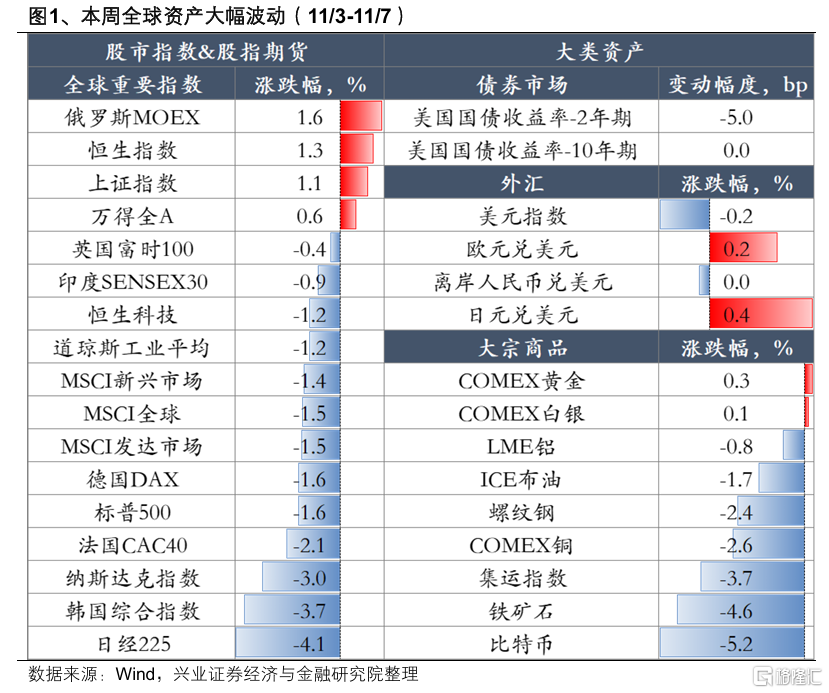
本文来自格隆汇专栏:兴证策略张启尧;作者:张启尧 胡思雨等 一、海外扰动下的布局思路 受海外流动性收紧担忧及 "AI 泡沫" 叙事影响,本周全球风险资产大幅波动。一方面,经济数据缺位、美联储频繁发表鹰派言论,市场对 12 月降息预期 趋于谨慎,叠加美国政府停摆、财政持续抽水导致货币市场流动性压力上升,美元走强压制全球股市与商品价格。另一方面,美股科技巨头持续加码资本 开支下,近期海外关于 "AI 泡沫" 的讨论逐步升温,加剧了投资者对科技股估值的担忧,科技占比较高的日经225、韩国股指及纳斯达克指数本周领跌全 球市场。 | 股市指数&股指期货 | | 大类资产 | | | --- | --- | --- | --- | | 全球重要指数 | 涨跌幅, % | 债券市场 | 变动幅度, bp | | 俄罗斯MOEX | 1.6 | 美国国债收益率-2年期 | -5.0 | | 恒生指数 | 1.3 | 美国国债收益率-10年期 | 0.0 | | 上证指数 | 1.1 | 外汇 | 涨跌幅,% | | 万得全A | 0.6 | 美元指数 | -0.2 | | 英国富时100 | -0.4 | 欧元兑美元 | 0 ...





美股AI八巨头市值一周蒸发5.6万亿,高盛:未来1至2年市场或回撤20%
2 1 Shi Ji Jing Ji Bao Dao· 2025-11-09 09:24
Group 1: Market Performance - The Nasdaq index, primarily composed of technology stocks, experienced a weekly decline of over 3%, marking its worst performance since April, while the S&P 500 index fell by 1.6%, ending a three-week upward trend [1] - Eight leading companies closely associated with AI saw a combined market value drop of approximately $800 billion, with U.S. companies related to AI losing nearly $1 trillion in market capitalization [1][2] Group 2: Company-Specific Impacts - Nvidia, which recently became the world's most valuable company, saw its stock drop over 7%, resulting in a market value loss of about $350 billion [2] - Microsoft experienced a decline of over 4%, leading to a market value reduction of more than $150 billion [2] - Oracle's stock fell nearly 8%, resulting in a loss of over $66 billion in market capitalization [2] Group 3: AI Market Concerns - There is growing concern among investors regarding the sustainability of the AI "myth" in the U.S. capital markets, as the reliance on building General Artificial Intelligence (AGI) is seen as costly and uncertain [3] - A survey indicated that 95% of companies utilizing generative AI have not yet turned a profit from the technology, suggesting a bubble driven by narrative rather than solid financial performance [3] - Prominent investor Michael Burry is reportedly positioning to short the AI bubble, citing excessive spending and low returns as factors that could lead to the collapse of leading AI companies [3] Group 4: Competitive Landscape - The U.S. investment community is increasingly aware of the competitive threat posed by China, which produces nearly half of the world's AI talent [4] - Unlike the U.S. focus on uncertain AGI investments, China's AI strategy is driven by practical applications, providing it with cost and application advantages in global markets [4] - Analysts from Goldman Sachs and Morgan Stanley predict a potential 10% to 20% market correction in U.S. tech stocks over the next 1-2 years, while expressing optimism about the Chinese market, particularly in AI, electric vehicles, and biotechnology [4] Group 5: Cryptocurrency Market - The cryptocurrency market has seen a significant downturn, erasing nearly all gains accumulated over the first ten months of the year within just over a month [5] - As of November 9, major cryptocurrencies like Bitcoin and Ethereum continued to decline, with trading volumes dropping by 40% to 50% in the last 24 hours, leading to over 130,000 liquidations [6] - The demand for Bitcoin from institutional investors has reportedly fallen below the rate of new coin mining, indicating a retreat from large buyers and a prevailing risk-averse sentiment in the market [6]
