
避险情绪

Search documents
【黄金期货收评】中美关税再现波澜黄金震荡偏多 沪金涨1.48%
Jin Tou Wang· 2025-09-30 08:32
Core Viewpoint - The recent U.S. export control measures against Chinese companies have heightened market volatility and increased risk aversion, leading to a potential rise in gold prices as a safe-haven asset [1][2]. Group 1: Market Data - On September 30, the closing price of Shanghai gold futures was 874.40 yuan per gram, reflecting a daily increase of 1.48% with a trading volume of 226,548 lots and an open interest of 256,876 lots [1]. - The spot price of gold in Shanghai on the same day was quoted at 872.95 yuan per gram, indicating a discount of 1.45 yuan per gram compared to the futures price [1]. Group 2: Regulatory Impact - The U.S. Department of Commerce has implemented new export control rules that affect subsidiaries of companies listed on the U.S. "Entity List" if they hold more than 50% ownership, which has been criticized by China as a severe infringement on legitimate business rights [1][2]. - China has expressed strong opposition to these measures, stating that they undermine international trade order and disrupt global supply chains, and has vowed to take necessary actions to protect its companies [1][2]. Group 3: Market Sentiment and Recommendations - The renewed tensions in U.S.-China trade relations, coupled with expectations of interest rate cuts by the Federal Reserve and a declining U.S. dollar index, are expected to support gold prices in the short term [2]. - It is suggested that investors consider reducing positions ahead of the holiday period to manage risks associated with potential market fluctuations [2].
政府停摆风险下 贵金属多头格局明确
Jin Tou Wang· 2025-09-30 08:07
Market Overview - The US dollar index experienced fluctuations and fell below the 98 mark, closing down 0.24% at 97.94 due to concerns over a potential government shutdown [1][2] - Spot gold surged past the $3800 mark during Asian trading and reached a new historical high above $3830 during US trading, ultimately closing up 1.95% at $3833.76 per ounce [1][2] - Spot silver also saw an increase during Asian trading but entered a range-bound phase, closing up 1.84% at $46.91 per ounce [1][2] Economic Indicators - The National Association of Realtors reported that the existing home sales index rose by 4% in August, reaching 74.7, significantly exceeding market expectations and marking the highest level in five months [3] - Cleveland Fed President Loretta Mester indicated inflationary pressures, particularly in the service sector [3] - European Central Bank Governing Council member Gabriel Makhlouf stated that the ECB's rate-cutting cycle is nearing its end, emphasizing the need for vigilance regarding the full impact of US tariffs on EU imports [3] - Bank of Japan Policy Board member Asahi Noguchi noted that Japan is steadily moving towards its 2% inflation target, increasing the necessity for policy rate adjustments [3] Trading Strategies - The imminent risk of a US government shutdown has heightened market risk aversion, while the long-term outlook remains bullish for gold due to expected Fed rate cuts, expanding global government debt cycles, and a weakening dollar [4] - The bullish sentiment for silver is reinforced by its commodity and financial attributes, with tightening liquidity leading to potential short squeeze risks in COMEX silver contracts [4] - The Shanghai silver VIX index surged to a new high since May, indicating increased volatility in the silver market [4]
金价飙升中!2025年9月30日各大金店黄金价格多少钱一克?
Sou Hu Cai Jing· 2025-09-30 07:19
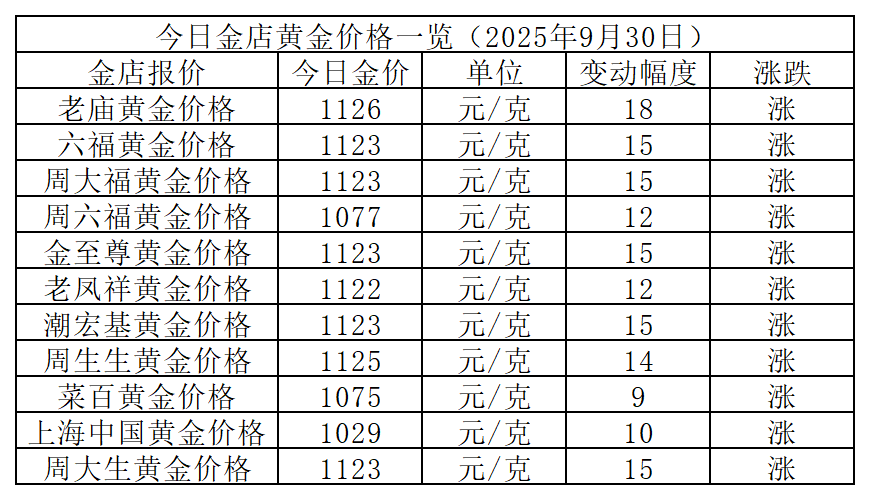
9月30日,国内黄金价格还在冲高,大多涨幅在15元/克。其中老庙黄金上涨18元/克,报1126元/克,为新的最高价金店;上 海中国黄金上涨10元/克,报价1029元/克,还是最低价金店。今日黄金高低价差扩大至97元/克。 昨日金价冲高主要是美国政府停摆危机以及俄乌紧张局势,推动市场避险情绪升温,金价也随之冲高。 以下是各大品牌金店详细报价: | | | 今日金店黄金价格一览(2025年9月30日) | | | | --- | --- | --- | --- | --- | | 金店报价 | 今日金价 | 单位 | 变动幅度 | 涨跌 | | 老庙黄金价格 | 1126 | 元/克 | 18 | 涨 | | 六福黄金价格 | 1123 | 元/克 | 15 | 涨 | | 周大福黄金价格 | 1123 | 元/克 | 15 | 涨 | | 周六福黄金价格 | 1077 | 元/克 | 12 | 涨 | | 金至尊黄金价格 | 1123 | 元/克 | 15 | 涨 | | 老凤祥黄金价格 | 1122 | 元/克 | 12 | 涨 | | 潮宏基黄金价格 | 1123 | 元/克 | 15 | 涨 | | 周生 ...

贵金属数据日报-20250930
Guo Mao Qi Huo· 2025-09-30 03:04
Group 1: Report Industry Investment Rating - No information provided Group 2: Core Viewpoints of the Report - On September 29, the main contract of Shanghai gold futures closed up 1.35% to 866.52 yuan/gram, and the main contract of Shanghai silver futures closed up 3.92% to 10,939 yuan/kilogram [5]. - Recently, geopolitical tensions in Russia and the Middle East, and the possible shutdown of the US government have boosted risk - aversion sentiment, pushing up precious metal prices. The continuous expectation of interest rate cuts also supports precious metal prices. For silver, the good performance of US economic data strengthens the expectation of a soft landing of the US economy after preventive interest rate cuts, which is beneficial to the industrial attribute of silver, leading to an accelerated rise in silver prices [5]. - In the long - term, the Fed still has room to cut interest rates this year, global geopolitical uncertainties continue, the US debt is unsustainable, and great - power games intensify, which will increase the credit risk of the US dollar in the long - term. The continuation of global central bank gold purchases will likely push the long - term center of gold prices higher [5]. - In the short - term, with the approaching of China's National Day holiday, investors are advised to be cautious about chasing up and hold light positions during the holiday, while enterprises are advised to do a good job in hedging to avoid possible sharp fluctuations during the holiday [5]. Group 3: Summary by Relevant Catalogs Price Tracking - **Precious Metal Prices**: On September 29, compared with September 26, London gold spot rose 2.0% to 3816.09 dollars/ounce, London silver spot rose 3.9% to 46.93 dollars/ounce, COMEX gold rose 1.9% to 3845.50 dollars/ounce, COMEX silver rose 3.7% to 47.12 dollars/ounce, AU2510 rose 1.3% to 863.60 yuan/gram, AG2510 rose 3.0% to 10912.00 yuan/kilogram, AU (T + D) rose 1.2% to 861.90 yuan/gram, and AG (T + D) rose 2.9% to 10880.00 yuan/kilogram [3]. - **Price Spreads and Ratios**: On September 29, compared with September 26, the gold TD - SHFE active spread was - 1.7 yuan/gram (up 193.1%), the silver TD - SHFE active spread was - 32 yuan/kilogram (up 68.4%), the gold (TD - London) spread was - 10.29 yuan/gram (up 148.4%), the silver (TD - London) spread was - 1098 yuan/kilogram (up 13.1%), the SHFE gold - silver main ratio was 79.14 (down 1.7%), the COMEX main ratio was 81.61 (down 1.7%), AU2512 - 2510 was 2.92 yuan/gram (down 16.1%), and AG2512 - 2510 was 27 yuan/kilogram (down 28.9%) [3]. Position Data - **ETF and Non - commercial Positions**: From September 25 to September 26, the gold ETF - SPDR rose 0.89% to 1005.72 tons, the silver ETF - SLV fell 0.18% to 15361.84024 tons. For COMEX gold non - commercial positions, the long positions rose 1.85% to 332808 contracts, the short positions rose 9.43% to 66059 contracts, and the net long positions rose 0.13% to 266749 contracts. For COMEX silver non - commercial positions, the long positions rose 0.97% to 72318 contracts, the short positions fell 0.21% to 20042 contracts, and the net long positions rose 1.43% to 52276 contracts [3]. Inventory Data - **SHFE and COMEX Inventories**: From September 26 to September 29, SHFE gold inventory rose 4.26% to 68628.00 kilograms, and SHFE silver inventory rose 2.71% to 1189648.00 kilograms. From September 25 to September 26, COMEX gold inventory rose 0.06% to 39946410 troy ounces, and COMEX silver inventory rose 0.08% to 530344533 troy ounces [3]. Other Related Data - **Dollar Index, Bond Yields, etc.**: From September 26 to September 29, the dollar index fell 0.09% to 98.19, the 2 - year US Treasury yield fell 0.27% to 3.63%, the 10 - year US Treasury yield fell 0.27% to 4.20%, NYMEX crude oil rose 0.48% to 6643.70, the dollar/yuan central parity rate fell 8.66% to 7.11, VIX fell 0.05% to 15.29, and the S&P 500 rose 0.59% to 65.19 [4].
张尧浠:关门风险加10月降息预期、金价多头转强再指3880
Sou Hu Cai Jing· 2025-09-30 01:42
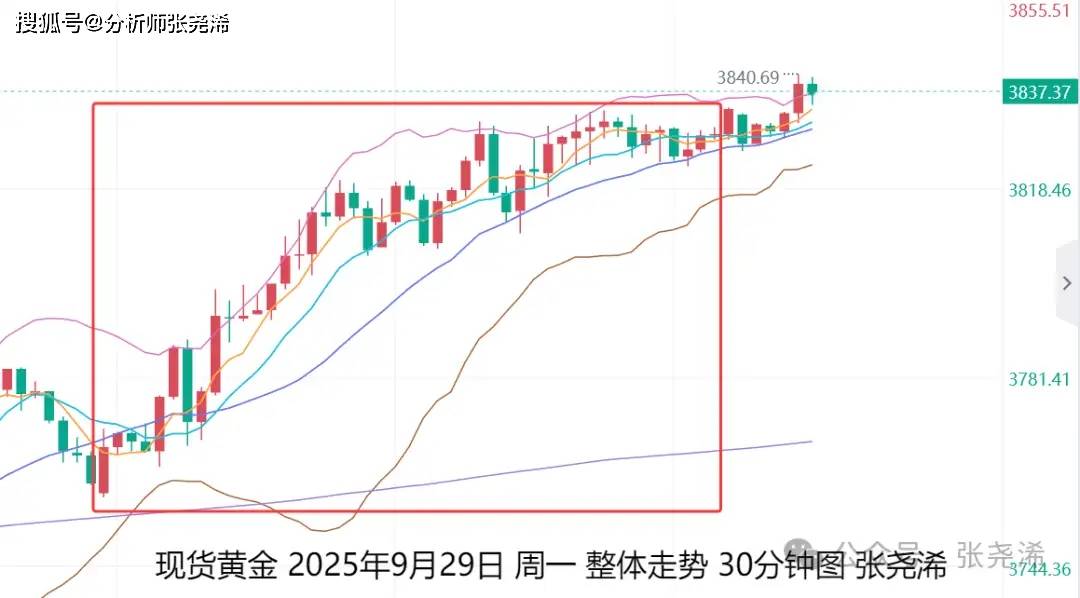
Core Viewpoint - The international gold price has shown strong upward momentum, driven by expectations of a government shutdown in the U.S. and a potential interest rate cut by the Federal Reserve in October, with a target price of $3880 [1][5][10]. Group 1: Market Performance - On September 29, gold opened at $3758.15 per ounce, reached a low of $3756.83, and then surged to a high of $3833.94, closing at $3833.71, marking a daily increase of $71.26 or 1.896% from the previous close of $3762.45 [3]. - The gold price is expected to maintain a bullish outlook, with support at the $3800 level, and any pullbacks are seen as buying opportunities [3][10]. Group 2: Economic Indicators - Key economic data to watch includes the U.S. FHFA House Price Index, S&P/CS 20-City Composite Home Price Index, JOLTs Job Openings, and the Conference Board Consumer Confidence Index, which are anticipated to be favorable for gold prices [3][6]. - The potential government shutdown could delay the release of critical economic reports, including the non-farm payroll data and consumer price index, which would impact investor sentiment and the dollar [6]. Group 3: Technical Analysis - The gold price has consistently tested and rebounded from the mid-band support level of the Bollinger Bands, indicating a strong upward trend, despite potential pullback risks [8]. - The daily chart shows that gold has broken through previous resistance levels and is now positioned for further gains, with key support levels at $3818 and $3800, and resistance levels at $3850 and $3880 [10][11].
黄金ETF持有量增加
Dong Zheng Qi Huo· 2025-09-30 01:06
Group 1: Macro Strategy (Gold) - The amount of gold held in ETFs has increased by 0.60%, or 6.01 tons, reaching a total of 1011.73 tons as of September 29 [11] - Gold prices continue to rise, driven by market risk aversion due to the potential government shutdown in the U.S. and ongoing political disagreements [12][14] - The fundamental reason for long-term bullish sentiment on gold is the deteriorating fiscal situation and high government debt burden [12][14] Group 2: Macro Strategy (Government Bonds) - The National Development and Reform Commission announced a new policy financial tool with a total scale of 500 billion yuan aimed at stabilizing economic growth and promoting effective investment [15] - The bond market is expected to experience short-term fluctuations, but the probability of sustained adjustments is low, with recommendations to build long positions on dips [15] Group 3: Agricultural Products (Soybean Meal) - Brazil's new crop planting rate has reached 3.2%, higher than the same period last year [20] - The U.S. soybean harvest rate is at 19%, in line with market expectations, with a good quality rating of 62% [21] - Domestic demand for soybean meal remains strong, with a decrease in inventory at oil mills [22] Group 4: Black Metals (Rebar/Hot Rolled Coil) - The Ministry of Water Resources expects investment in water conservancy construction during the 14th Five-Year Plan to exceed 5.4 trillion yuan, which is 1.6 times that of the previous plan [25] - Steel prices are expected to remain under pressure due to high iron water production and inventory accumulation, with recommendations for light positions ahead of the holiday [26][27] Group 5: Nonferrous Metals (Zinc) - The nonferrous metals industry has released a stable growth work plan, emphasizing orderly project construction and resource development [40][44] - Domestic zinc ingot inventory has decreased to 141,400 tons, indicating a tightening supply situation [45] - The market sentiment for zinc is cautiously optimistic, with potential for short-term price stabilization [46] Group 6: Energy Chemicals (Soda Ash) - The liquid alkali market in Shandong has seen a slight decline, with general market demand being weak ahead of the holiday [47] - The price of liquid alkali has decreased due to insufficient downstream purchasing activity [48] Group 7: Energy Chemicals (PVC) - The domestic PVC powder market has shown a slight decline, with prices fluctuating between 0-10 yuan/ton [51] - The overall market remains weak, but low valuations may limit further price declines [52] Group 8: Energy Chemicals (Urea) - The utilization rate of compound fertilizer production capacity has decreased to 35.27%, indicating a reduction in production activity [53] - Urea prices are expected to remain under pressure due to high inventory levels and weak demand [54]

多重因素驱动贵金属持续走强
Jing Ji Ri Bao· 2025-09-29 22:27
Core Viewpoint - The precious metals sector has experienced a dramatic rise amidst a generally weak global financial market, driven by strong demand for gold and silver as safe-haven assets and inflation hedges, with prices increasing across the board [1][2]. Group 1: Price Movements - Gold prices have surged nearly 43% year-to-date, breaking through the $3,700 per ounce mark, while silver has reached a 14-year high of over $46 per ounce [1][2]. - Platinum and palladium prices have also hit significant highs, with platinum reaching a 12-year peak [1]. - The precious metals sector has outperformed other popular assets like U.S. stocks and cryptocurrencies, making it the best-performing asset class in the first three quarters of 2025 [1]. Group 2: Market Drivers - The rise in precious metals is attributed to multiple factors, including supply-demand dynamics, market risk aversion, and macroeconomic monetary policies [1][2]. - Geopolitical tensions and the U.S. government's new tariffs on imports have bolstered market risk aversion, further supporting precious metal prices [2]. - Concerns over high valuations in the U.S. stock market and economic uncertainties have prompted investors to seek refuge in precious metals [2]. Group 3: Supply and Demand Dynamics - The World Gold Council reported a rapid increase in global gold ETF holdings, reaching 3,779.4 tons, the highest since August 2022 [2][4]. - Structural imbalances in supply and demand are evident across various precious metals, with strong demand from central banks for gold and increasing industrial demand for silver [3][4]. - Silver's supply is constrained due to rising demand in sectors like photovoltaics and electronics, while platinum is expected to face a supply shortfall of 85,000 ounces by 2025 [3]. Group 4: Monetary Policy Impact - The macroeconomic environment, particularly expectations of Federal Reserve rate cuts and a weaker dollar, has significantly enhanced the attractiveness of precious metals [3][4]. - The anticipated easing of monetary policy has led to increased inflows of investment and speculative funds into the precious metals market [3]. Group 5: Future Outlook - Investment institutions remain optimistic about the future of precious metals, with expectations of further price increases driven by ongoing geopolitical tensions and U.S. debt risks [5]. - Despite high current silver prices, the underlying logic supporting gold's rise also applies to silver, with persistent supply gaps likely to drive silver prices higher [5]. - The outlook for platinum remains positive due to its safe-haven appeal and supply vulnerabilities, while palladium faces downward pressure from shifting demand dynamics in the automotive industry [6].
避险情绪增加,节前管控风险
Ning Zheng Qi Huo· 2025-09-29 09:03
Report Industry Investment Rating - The strategy recommendation is "oscillating with a bullish bias" [5] Core View of the Report - International risk aversion has increased, with geopolitical factors and tariff disruptions leading to a rise in market risk aversion. The Fed's independence and internal disagreements have added more uncertainties, increasing the risk aversion factors and making precious metals oscillate with a bullish bias. However, due to the large increase in precious metals prices in the previous period, there is a need to be vigilant about external market fluctuations during the National Day holiday [2][31] Summary by Relevant Catalogs Chapter 1: Market Review - After the implementation of US tariffs and the Fed's interest rate cut, the US dollar index rose significantly, and precious metals corrected to some extent. The market is currently pricing in two more interest rate cuts by the Fed this year, totaling 50 basis points. Subsequently, gold and silver may rise simultaneously driven by the expectation of consecutive Fed interest rate cuts. The upward trend of silver also needs to pay attention to the short - term fluctuations of gold [10] Chapter 2: Overview of Important News - Trump announced new high - tariff policies on multiple imported products starting from October 1, but will adhere to the 15% tariff ceiling for trade partners with existing agreements. The Trump administration is considering a $550 billion investment fund for infrastructure construction, with priority in semiconductor and key mineral fields [14] - In August, the US core PCE price index met expectations, and real consumer spending exceeded expectations. The Fed cut interest rates by 25 basis points, and the market expects a high probability of another cut in October. The US PPI inflation unexpectedly declined in August, providing support for the Fed's potential interest rate cut [16][17] - The number of initial jobless claims in the US last week decreased, but the number of continued claims remained above 1.9 million, indicating pressure in the labor market [16] Chapter 3: Analysis of Important Influencing Factors 3.1 US Economy and Policy - The preliminary value of the University of Michigan Consumer Confidence Index in September was at a low since May, and the 5 - year inflation expectation rebounded. The ISM manufacturing index in August was below expectations, and the output index fell into the contraction range. The second - quarter GDP and core PCE price index were revised, showing that the US economic downward pressure is increasing [18] 3.2 International Economy and Geopolitics - China and the US will hold talks in Spain. Trump mentioned sanctions on Russia, asked Europe to put economic pressure on China, and announced tariffs on semiconductor companies. After China's military parade, the geopolitical situation has become tense again [22] 3.3 Other Financial Markets - US non - farm payrolls in August were far lower than expected, and the unemployment rate reached a new high since 2021. The US economic downward pressure has increased, indicating the need for interest rate cuts. The US stock market, copper, and crude oil may strengthen, but the upward momentum of crude oil is limited [24] 3.4 RMB Exchange Rate - The RMB exchange rate tracks the US dollar index. With the increasing expectation of Fed interest rate cuts, the US dollar index is expected to decline, and the RMB has a certain appreciation expectation. The impact of the RMB exchange rate on gold is limited [28] Chapter 4: Market Outlook and Investment Strategy - International risk aversion has increased, and precious metals are expected to oscillate with a bullish bias. However, due to the large previous increase in precious metals prices, attention should be paid to external market fluctuations during the National Day holiday [31]
avatrade爱华平台今日动向超级数据周来袭 9月非农备受瞩目
Sou Hu Cai Jing· 2025-09-29 08:33
Group 1 - Market focus is on Trump's new tariffs, key US economic data, and commodity volatility, with investors observing the Federal Reserve's actions and risk sentiment [1] - Electronic Arts saw a significant increase of approximately 15% due to acquisition rumors, sparking speculation and merger interest in the gaming sector [10] - Boeing's stock rose by around 4% following reports that the FAA may ease some production restrictions on the 737 MAX and 787 aircraft, improving delivery prospects [10] - NIO's stock declined by about 6% due to ongoing losses and pricing pressures in the Chinese electric vehicle market, overshadowing optimistic policy support [10] Group 2 - The market is digesting the tariffs announced by Trump, with investors seeking clarity on whether the new taxes will be broadly applicable or subject to trade agreement exemptions [10] - Upcoming macro data, including key US inflation (PCE), consumer confidence, and manufacturing data, will test market confidence in the Federal Reserve's next steps [10] - Risk appetite appears cautious ahead of the US inflation data release, with the VIX remaining firm above recent lows as traders process policy and tariff uncertainties [10]

降息预期+避险,贵金属再度拉涨!
Xin Hua Cai Jing· 2025-09-29 08:26
Core Viewpoint - Precious metals prices continue to rise significantly due to sustained investment demand and increasing risk aversion amid the looming U.S. government shutdown and challenges to the Federal Reserve's independence [1][2][4]. Group 1: Precious Metals Price Movements - As of September 29, international spot gold prices have reached a historic high above $3,800, while silver prices have also surged past $47 [1]. - Silver prices have increased approximately 5% within two trading days, breaking the $46 per ounce mark, and further rising to over $47 per ounce [2]. - Platinum has seen a nearly 10% increase over three trading days, surpassing $1,600 per ounce [3]. Group 2: Economic Factors Influencing Prices - Despite hawkish comments from several Federal Reserve officials, the probability of a rate cut in October remains around 90% due to low inflation pressures indicated by the August PCE price index [2]. - The risk of a U.S. government shutdown, exacerbated by the Senate's rejection of a temporary funding bill, is contributing to rising gold prices alongside ongoing central bank gold purchases and investment demand [3][4]. Group 3: Market Sentiment and Future Outlook - The uncertainty surrounding Federal Reserve personnel and potential market disruptions is bolstering risk aversion, leading to increased buying of precious metals as a hedge [4]. - Analysts suggest that while the bullish momentum for gold and silver is expected to continue, profit-taking may occur following the release of key global economic indicators [5][6]. - Historical data indicates that revisions to non-farm payroll figures often occur in October, which could amplify market volatility if any contrary signals arise [7].