
供需失衡

Search documents
港股异动 | 芯片股逆市走高 中芯国际营收创单季度新高 大摩称存储领域或出现供需失衡
智通财经网· 2025-11-17 01:57
Group 1 - Chip stocks are rising against the market trend, with Shanghai Fudan up 6.09% to HKD 41.48, Huahong Semiconductor up 3.69% to HKD 80.1, Jingmen Semiconductor up 2.17% to HKD 0.47, and SMIC up 1.43% to HKD 74.55 [1] - SMIC reported a record high revenue of CNY 17.162 billion for Q3 2025, with a quarter-on-quarter increase of 6.9% and a year-on-year increase of 9.9% [1] - SMIC's net profit attributable to shareholders reached CNY 1.517 billion, marking a year-on-year growth of 43.1% and a quarter-on-quarter increase of 60.64% [1] Group 2 - SMIC's CEO Zhao Haijun indicated that the fourth quarter is expected to be strong, with revenue guidance flat to a 2% increase, and production lines remaining fully loaded [1] - The global DRAM market is experiencing shortages, leading to rising prices for DRAM modules and a challenging supply situation [1] - Morgan Stanley's report suggests that the memory chip industry may enter a "super cycle" next year due to potential supply-demand imbalances in the storage sector [1]

金信期货日刊-20251117
Jin Xin Qi Huo· 2025-11-17 01:29
金信期货日刊 本刊由金信期货研究院撰写 2025/11/17 GOLDTRUST FUTURES CO.,LTD 玻璃期货下跌:供需失衡下的弱势延续 ibaotu.com 热点聚焦 11月14日,玻璃期货2601合约结算价报1041元/吨,单日下跌20元,跌幅1.90%,盘中最低触及1030元/ 吨,延续近期弱势格局。此次下跌并非偶然,核心驱动力仍是供需失衡与市场预期转弱的共振。 感谢您下载包图网平台上提供的PPT作品,为了您和包图网以及原创作者的利益,请勿复制、传播、销售,否则将承担法律责任!包图网将对作品进行维权,按照传播下载次数进行十倍的索取赔偿! 供应端刚性犹存,全国浮法玻璃日熔量维持高位,虽部分产区有短期限产,但新增产能释放与冷修减少支 撑供应,难以形成有效收缩。 需求端疲软是关键矛盾,房地产竣工面积同比下滑拖累核心需求,深加工企业订单同比降25%,叠加季节 性需求转淡预期,采购意愿低迷。 高库存压力进一步压制价格,当前全国浮法玻璃库存同比增幅近30%,远超均衡区间,去库进程缓慢。资 金面同样偏空,主力合约净空持仓扩大,技术面均线失守后弱势难改。 短期来看,供需矛盾未改,价格易跌难涨,但成本支撑与政 ...
纯碱、顺酐——大宗商品热点解读
2025-11-16 15:36
Summary of Key Points from Conference Call Records Industry Overview - The records focus on the soda ash and phthalic anhydride industries, highlighting significant trends and forecasts for both sectors [1][2][3]. Phthalic Anhydride Market Insights - **Supply and Demand Imbalance**: The phthalic anhydride market is experiencing a severe supply-demand imbalance, with production capacity expected to expand significantly from 2024, reaching a total capacity of 3.57 million tons by 2025, a 187.9% increase from 2021's 1.24 million tons [1][2]. - **Low Operating Rates**: Due to the oversupply, factory operating rates are generally low, with expectations that this trend will continue, leading to sustained pressure on market prices [1][3]. - **Price Trends**: Phthalic anhydride prices are projected to remain lower in 2025 compared to 2024, with many factories facing severe losses and only experiencing brief periods of profitability [1][5][7]. - **Export Growth**: Despite domestic challenges, exports of phthalic anhydride are expected to rise, with total exports surpassing 170,000 tons in the first nine months of 2025, potentially exceeding 200,000 tons for the year [4][8]. Soda Ash Market Insights - **Rapid Capacity Expansion**: The domestic soda ash capacity is set to increase by over 10 million tons from 2020 to 2025, reaching a total capacity of 44.5 million tons, primarily driven by natural soda projects [1][9][12]. - **Regional Concentration**: Major production capacities are concentrated in Henan, Inner Mongolia, and Jiangsu, accounting for nearly three-quarters of the national total [11]. - **Cost Advantages**: Natural soda ash production has a significant cost advantage over synthetic methods, which are subject to greater price fluctuations [13][14]. - **Operating Rates and Demand**: The operating rate for soda ash is expected to fluctuate in 2025, influenced by seasonal maintenance and changes in downstream demand, particularly for heavy soda ash [15][22]. - **Price Variations**: There are notable price differences across regions, with higher prices in South China and Northeast regions due to limited local supply [16]. Future Outlook - **Continued Supply-Demand Challenges**: Both the phthalic anhydride and soda ash markets are expected to face ongoing supply-demand challenges, with potential for further capacity expansions and limited downstream demand growth [8][23]. - **Technological Innovation and Market Expansion**: Companies are encouraged to enhance technological innovation and explore international markets to achieve sustainable growth amidst competitive pressures [23]. - **Environmental Regulations**: Stricter environmental policies may lead to the exit of high-cost, low-efficiency production facilities, with future capacity additions likely to focus on more sustainable methods [14][18]. Additional Considerations - **Impact of Global Events**: The global market dynamics, including the effects of geopolitical events like the Russia-Ukraine conflict, have influenced pricing and supply chains, particularly for soda ash exports [20][21]. - **Long-term Demand Trends**: The demand for soda ash is expected to grow moderately, driven by sectors such as photovoltaic glass, although growth rates may slow down [22][23]. This summary encapsulates the critical insights and forecasts from the conference call records, providing a comprehensive overview of the current state and future expectations for the soda ash and phthalic anhydride industries.
核心CPI向上 物价拐点何时到来
经济观察报· 2025-11-16 05:36
Core Insights - The continuous expansion of the core CPI for six months is seen as a positive sign, but it is insufficient to determine whether a true turning point in China's economic prices has been reached, requiring further evaluation of upcoming data [1][14]. Economic Performance - In October, the total retail sales of consumer goods increased by 2.9% year-on-year, marking a decline in growth rate for five consecutive months [2]. - The core CPI rose by 1.2% year-on-year in October, with the growth rate expanding for the sixth consecutive month, indicating a potential turning point in price trends and a signal of recovering consumer demand [2][3]. Consumption Trends - The decline in retail sales growth is attributed to a "supply-demand imbalance," highlighting the need for enhanced consumer demand [3]. - Consumption has become the primary driver of GDP growth this year, with various policies introduced to stimulate consumption, such as "trade-in" programs [3]. Price Dynamics - The core CPI's rise is influenced by factors such as the consumption boost from the National Day and Mid-Autumn Festival holidays and a surge in gold prices [7]. - Service prices have been gradually recovering since March, with notable increases in airfares and hotel accommodation prices [7]. Future Outlook - Experts suggest that while the core CPI's growth reflects improving terminal consumer demand, it also indicates underlying pressures on food and energy prices [14]. - The overall CPI is expected to remain low, with projections indicating that achieving a 2% or 3% year-on-year CPI growth next year will require multiple favorable factors, including a recovery in real estate prices and improvements in median income growth [15].


成本驱动叠加供需失衡,硫酸价格暴涨
Xuan Gu Bao· 2025-11-12 15:05
Core Insights - Sulfuric acid prices have surged significantly, currently at 773 RMB/ton, marking a 111% increase from 366 RMB/ton on January 21, 2023, a 405% increase from 153 RMB/ton on January 31, 2024, and a 740% increase from 92 RMB/ton on May 26, 2023, reaching a ten-year high [1] Industry Analysis - The price increase of sulfuric acid is attributed to multiple factors, primarily driven by cost and supply-demand imbalance [1] - The demand for sulfuric acid has surged due to the growth in the new energy sector, particularly in lithium iron phosphate batteries and semiconductors [1] - Traditional sulfur supply, which is a byproduct of petrochemicals, is constrained due to "dual carbon" targets, exacerbating the supply-demand mismatch [1] Company Implications - Relevant A-share concept stocks include Huayltai and Hengguang Co., which may benefit from the rising sulfuric acid prices [1]
甲醇或继续偏弱运行
Qi Huo Ri Bao· 2025-11-10 23:15
Core Viewpoint - The domestic methanol market is currently characterized by "high supply, high inventory, and weak demand," leading to a bearish trend in methanol futures prices, with the 2601 contract price falling to around 2100 yuan/ton [1]. Supply and Production - Domestic methanol production capacity has steadily increased, reaching 112.55 million tons in 2024, a year-on-year growth of 6.0%, with production rising to 91.82 million tons, up 9.3% year-on-year [2]. - The average operating rate for methanol plants remains high at 84.63%, with a month-on-month increase of 4.25% and a year-on-year increase of 2.35% [2]. - Weekly average methanol production has reached 1.9921 million tons, showing a significant year-on-year increase of 96,300 tons [2]. Import Dynamics - Methanol imports remain elevated, with September 2025 imports at 1.4269 million tons, a significant month-on-month decrease of 332,900 tons but a year-on-year increase of 178,100 tons [3]. - Despite temporary production halts in Iran, overall supply expectations remain robust, with port inventories continuing to accumulate [3]. Demand and Inventory Pressure - The demand side for methanol is weak, particularly in the methanol-to-olefins (MTO) sector, which faces risks of declining operating rates [4]. - Traditional downstream industries, such as formaldehyde, are operating at around 30% capacity, contributing to the overall weak demand [4]. - As of November 7, methanol inventories at ports in East and South China reached 1.2861 million tons, a significant year-on-year increase of 251,800 tons, indicating a growing inventory pressure that constrains price recovery [4]. - The current inventory situation, especially in coastal ports, has reached historically high levels, exacerbating downward pressure on the market [4].
不锈钢月报:库存压力偏大,低价资源拉动价格下行-20251107
Wu Kuang Qi Huo· 2025-11-07 14:36
Report Industry Investment Rating - Not provided in the document Core Viewpoints - In October, steel mill production schedules increased slightly month-on-month, but post-festival demand contracted. With the continuous increase in resource arrivals, the contradiction in the supply-demand structure became increasingly prominent. The 300-series stainless steel production line has not planned large-scale maintenance, and the supply pressure persists, suppressing prices. Terminal demand release fell short of expectations, and market trading activity remained sluggish. Downstream purchases were mainly driven by rigid demand, with strong resistance to high-priced resources. Market transactions were concentrated in the low-price range, further restricting price upside potential. With the continuous accumulation of inventory pressure, traders' willingness to support prices weakened significantly, and most adopted price-cutting strategies to promote sales and accelerate turnover to relieve capital occupation pressure. In the short term, the core driving factor for the market will focus on the price adjustment policies of leading steel mills, but in the medium term, the imbalance between supply and demand will remain difficult to change [11][12] Summary by Directory Monthly Assessment and Strategy Recommendation - **Monthly Key Points Summary**: On November 7, the average price of cold-rolled stainless steel coils in Wuxi was 12,800 yuan/ton, a month-on-month decrease of 1.16%; the ex-factory price of 7%-10% ferronickel in Shandong was 920 yuan/nickel, a month-on-month decrease of 1.08%; the average price of scrap stainless steel was 8,600 yuan/ton, a month-on-month decrease of 1.15%. The closing price of the stainless steel main contract on Friday afternoon was 12,590 yuan/ton, a month-on-month decrease of 1.06%. The Foshan Delong market quotation was about -90 yuan (+40) higher than the main contract; the Wuxi Hongwang market quotation was about 10 yuan (+30) higher than the main contract. The disk position was 190,304 lots, a month-on-month increase of 10.75%. In October, domestic cold-rolled stainless steel production was scheduled to be 1.4714 million tons. In September, the crude steel output was 3.0661 million tons, a month-on-month increase of 163,300 tons, and the cumulative year-on-year increase from January to September was 6.48%. According to MYSTEEL sample statistics, the estimated crude steel output of the 300-series stainless steel in September was 1.4834 million tons, a month-on-month increase of 3.47%; the cold-rolled output of the 300-series in September was 0 tons, a month-on-month decrease of 100.00%. From January to September 2024, the cumulative sales area of commercial housing in China was 658.3479 million square meters, a year-on-year decrease of 5.50%; in September, the single-month sales area of commercial housing was 85.3087 million square meters, a year-on-year decrease of 11.89%. In September, the year-on-year changes in the output of refrigerators, household freezers, washing machines, and air conditioners were -7%, -2%, -3%, and 5.6% respectively; the cumulative year-on-year increase in the fuel processing industry in September was 20.7%. Last week, the total social inventory of stainless steel was 1.034 million tons, a month-on-month increase of 0.29%; the inventory of futures warehouse receipts last week was 74,200 tons, a month-on-month decrease of 15,537 tons. Last week, the social inventories of the 200/300/400-series stainless steel were 191,400 tons, 639,500 tons, and 203,100 tons respectively, among which the inventory of the 300-series decreased by 1.90% month-on-month; last week, the floating volume of stainless steel was 68,800 tons, a month-on-month increase of 26.69%, and the unloading volume was 90,500 tons, a month-on-month increase of 37.92%. Last week, the ex-factory price of 7%-10% ferronickel in Shandong was 925 yuan/nickel, a month-on-month decrease of 10 yuan/nickel, and the iron mills in Fujian were currently losing 104 yuan/nickel [11] - **Fundamental Assessment**: The 10-month steel mill production schedules increased slightly month-on-month, but post-festival demand contracted. With the continuous increase in resource arrivals, the contradiction in the supply-demand structure became increasingly prominent. The 300-series stainless steel production line has not planned large-scale maintenance, and the supply pressure persists, suppressing prices. Terminal demand release fell short of expectations, and market trading activity remained sluggish. Downstream purchases were mainly driven by rigid demand, with strong resistance to high-priced resources. Market transactions were concentrated in the low-price range, further restricting price upside potential. With the continuous accumulation of inventory pressure, traders' willingness to support prices weakened significantly, and most adopted price-cutting strategies to promote sales and accelerate turnover to relieve capital occupation pressure. In the short term, the core driving factor for the market will focus on the price adjustment policies of leading steel mills, but in the medium term, the imbalance between supply and demand will remain difficult to change [12] Futures and Spot Market - On November 7, the average price of cold-rolled stainless steel coils in Wuxi was 12,800 yuan/ton, a month-on-month decrease of 1.16%; the ex-factory price of 7%-10% ferronickel in Shandong was 920 yuan/nickel, a month-on-month decrease of 1.08%; the average price of scrap stainless steel was 8,600 yuan/ton, a month-on-month decrease of 1.15%. The closing price of the stainless steel main contract on Friday afternoon was 12,590 yuan/ton, a month-on-month decrease of 1.06%. The Foshan Delong market quotation was about -90 yuan (+40) higher than the main contract; the Wuxi Hongwang market quotation was about 10 yuan (+30) higher than the main contract. The disk position was 190,304 lots, a month-on-month increase of 10.75%. The spread between consecutive contracts 1 and 2 was reported at -20 (+20), and the spread between consecutive contracts 1 and 3 was reported at -50 (+15) [11][16][19][22] Supply Side - In October, domestic cold-rolled stainless steel production was scheduled to be 1.4714 million tons. In September, the crude steel output was 3.0661 million tons, a month-on-month increase of 163,300 tons, and the cumulative year-on-year increase from January to September was 6.48%. In September, the stainless steel net export volume was 298,200 tons, a month-on-month decrease of 9.83% and a year-on-year decrease of 10.42%; from January to September, the cumulative net export volume was 1.0809 million tons, a 65.78% increase compared to the same period last year. It is estimated that the monthly output of stainless steel in Indonesia in September was 430,000 tons, a month-on-month increase of 7.50%; in September, China's imports of stainless steel from Indonesia reached 95,800 tons, a month-on-month increase of 0.49% [11][26][29][32] Demand Side - From January to September 2024, the cumulative sales area of commercial housing in China was 658.3479 million square meters, a year-on-year decrease of 5.50%; in September, the single-month sales area of commercial housing was 85.3087 million square meters, a year-on-year decrease of 11.89%. In September, the year-on-year changes in the output of refrigerators, household freezers, washing machines, and air conditioners were -7%, -2%, -3%, and 5.6% respectively; the cumulative year-on-year increase in the fuel processing industry in September was 20.7%. In September, the output of elevators, escalators, and lifts was 135,000 units, a month-on-month increase of 13.45% and a year-on-year increase of 1.50%; in September, the automobile sales volume was 3.2264 million units, a month-on-month increase of 12.94% and a year-on-year increase of 14.86% [11][39][42][45] Inventory - Last week, the total social inventory of stainless steel was 1.034 million tons, a month-on-month increase of 0.29%; the inventory of futures warehouse receipts last week was 74,200 tons, a month-on-month decrease of 15,537 tons. Last week, the social inventories of the 200/300/400-series stainless steel were 191,400 tons, 639,500 tons, and 203,100 tons respectively, among which the inventory of the 300-series decreased by 1.90% month-on-month; last week, the floating volume of stainless steel was 68,800 tons, a month-on-month increase of 26.69%, and the unloading volume was 90,500 tons, a month-on-month increase of 37.92% [11][49][52] Cost Side - In September, the nickel ore import volume was 6.1145 million wet tons, a month-on-month decrease of 3.51% and a year-on-year increase of 34.43%; currently, the nickel ore quotation for Ni:1.5% nickel ore is 56.0 US dollars/wet ton, and the port inventory is 14.791 million wet tons, a month-on-month decrease of 1.26%. Last week, the ex-factory price of 7%-10% ferronickel in Shandong was 925 yuan/nickel, a month-on-month decrease of 10 yuan/nickel, and the iron mills in Fujian were currently losing 104 yuan/nickel. Last week, the chromium ore quotation was 55 yuan/dry ton, a month-on-month increase of 0 yuan/dry ton; the high-carbon ferrochrome quotation was 8,200 yuan/50 base tons, a month-on-month decrease of 100 yuan/50 base tons. In terms of output, the high-carbon ferrochrome output in October was 825,000 tons, a month-on-month increase of 1.54%. The current gross profit of the self-produced high-nickel ferronickel production line is -828 yuan/ton, and the profit margin reaches -6.08% [56][59][62][65]
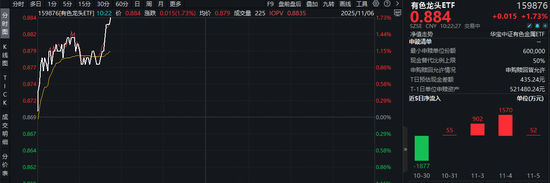
反内卷起舞!铝业领涨,南山铝业涨停,中国铝业涨超4%!有色龙头ETF(159876)涨超1.7%,近4日连续吸金
Xin Lang Ji Jin· 2025-11-06 02:36
Group 1 - The core viewpoint of the news highlights the ongoing bullish trend in the non-ferrous metals sector, particularly driven by the performance of the Non-Ferrous Metal Leaders ETF (159876), which has seen a price increase of 1.73% and a total inflow of 25.79 million yuan over the past four days [1][3] - The aluminum sector is leading the gains, with notable performances from companies such as Nanshan Aluminum, which hit the daily limit, and China Aluminum, which rose over 4% [1] - The supply of aluminum is expected to remain tight due to China's production capacity reaching its limit and limited growth in Indonesia's capacity, which is anticipated to elevate long-term profit margins in the industry [3] Group 2 - Analysts suggest that instead of focusing on a single metal, investors should consider a broader allocation across the entire non-ferrous metals sector, as it presents a rare investment opportunity [5] - Key factors driving this opportunity include global monetary easing, supply-demand imbalances, and favorable policy incentives that could lead to a comprehensive recovery in the sector [5][6] - The Non-Ferrous Metal Leaders ETF (159876) and its associated funds provide a diversified investment approach, with significant weightings in copper (27.7%), aluminum (14.4%), gold (13.2%), rare earths (10.2%), and lithium (9.1%), which helps mitigate risks compared to investing in a single metal [8]

马云预言正在应验?明年的房价,3个真信号已悄悄出现
Sou Hu Cai Jing· 2025-11-05 05:14
Core Viewpoint - The current real estate market reflects a stark contrast between high-priced urban areas and low-priced regions, highlighting a significant divide in housing affordability and demand dynamics [1][3]. Population Structure - The primary demographic supporting the housing market, individuals aged 25-44, has decreased from 40.2% in 2010 to 31.8% currently, with a continued decline expected over the next decade [4]. - The population of the post-90s and post-00s generations is 120 million less than that of the post-80s generation, facing challenges such as slowing income growth and historically low marriage rates [4]. - The aging population, with over 310 million individuals aged 60 and above, exacerbates demand shrinkage, leading to increased housing supply due to vacant homes left by deceased elderly individuals [4]. Supply and Demand Imbalance - Over the past two decades, developers have constructed 600 million housing units, sufficient for 3 billion people, while China's population is only 1.4 billion, indicating a surplus of over 100% [6]. - The planned construction of 6 million affordable housing units by 2025 will further pressure the market for commercial housing [6]. - High inventory levels are evident, with 760 million square meters of unsold commercial housing in third and fourth-tier cities, leading to aggressive pricing strategies by developers [6]. Policy Shift - The government is shifting its focus towards affordable housing, planning to build 6 million units over five years, which will divert demand from the commercial housing market [8]. - Financial leverage is tightening, with first-time home loan rates dropping to a historical low of 3.05%, but lending standards becoming stricter, effectively closing off speculative avenues for investors [9]. - The introduction of a property tax trial is anticipated, which will increase holding costs and further diminish the investment appeal of real estate [9]. Urban Differentiation - The real estate market is experiencing irreversible differentiation, with core areas in first-tier cities like Shanghai and Shenzhen seeing slight price increases due to their scarcity and high demand [11]. - Conversely, non-core cities are facing significant price declines, with some areas experiencing a drop of up to 50% from peak values, primarily due to population outflows [11]. - This differentiation indicates a shift from the era of guaranteed profits in real estate to a more selective approach in choosing cities and locations for investment [11]. Conclusion - The debate surrounding the rationalization of housing prices raises questions about whether real estate can still symbolize wealth as it loses its financial attributes, prompting a potential shift towards viewing housing primarily as a necessity rather than an investment [13].

大成食品:前三季度亏损约1468万元,同比盈转亏
Ge Long Hui A P P· 2025-10-31 09:17
Core Viewpoint - Dachen Foods (3999.HK) reported a revenue of approximately 4.495 billion yuan for the first three quarters of 2025, reflecting a year-on-year increase of 4.1%. However, the company experienced a shareholder loss of approximately 14.68 million yuan, a significant decline from a net profit of 36.91 million yuan in the same period last year, primarily due to a substantial drop in chicken prices caused by supply and demand imbalances, leading to significant losses in its slaughtering business [1]. Financial Performance - Revenue for the first three quarters of 2025 was approximately 4.495 billion yuan, representing a year-on-year growth of 4.1% [1]. - The company reported a shareholder loss of approximately 14.68 million yuan, compared to a net profit of 36.91 million yuan in the same period last year, indicating a shift from profit to loss [1]. Market Conditions - The decline in profitability is attributed to a significant drop in chicken prices, which reached near five-year lows due to supply and demand imbalances [1]. - The adverse market conditions have resulted in considerable losses in the company's slaughtering operations [1].