
反内卷政策

Search documents
恒力石化(600346):公告点评:实控人首次增持公司股份,彰显未来发展信心
EBSCN· 2026-02-04 14:28
2026 年 2 月 4 日 公司研究 实控人首次增持公司股份,彰显未来发展信心 ——恒力石化(600346.SH)公告点评 要点 事件:公司发布《关于实际控制人首次增持暨增持公司股份的进展公告》, 2026 年 2 月 3 日,公司实际控制人之一陈建华先生以自有资金,采取集中竞价交易 方式首次增持公司股份 13,447,369 股,占公司总股本的 0.19%,累计增持金额 为 32,997.02 万元(不含佣金、过户费等交易费用)。 点评: 实控人首次增持公司股份,彰显未来发展信心。公司 2025 年 4 月 9 日发布《关 于实际控制人增持公司股份计划的公告》,实际控制人之一陈建华先生计划自 2025 年 4 月 9 日起 12 个月内,以自有资金或自筹资金通过上海证券交易所交 易系统以集中竞价交易方式增持本公司股份,增持金额不低于人民币 5 亿元,不 超过人民币 10 亿元。2026 年 2 月 3 日,公司实际控制人首次增持公司股份。 公司作为国内领先的民营炼化一体化企业,其实际控制人之一陈建华先生此次增 持未导致公司控制权结构发生变化,公司治理结构保持稳定。自 2025 年 7 月中 下旬以来,随着 ...

宏观经济深度报告:反内卷系列一:将反内卷进行到底
Guoxin Securities· 2026-02-04 09:51
证券研究报告 | 2026年02月04日 (1)政策演进分为三个阶段,2023 年初-2024 年 6 月,中央点明相关风险, 2024 年 7 月-2025 年 6 月中央首次提出防范"内卷式"恶性竞争,部分行业 开展自律探索但缺乏协同与刚性约束,2025 年 7 月至今为系统化实施期。 (2)核心定位方面,反内卷核心是破解地方保护主义与市场分割导致的资 源错配,与统一大市场形成双向支撑,前者为后者扫清不当竞争障碍,后者 为前者提供制度框架,共同服务于高质量发展。 实施特征看: (1)实施特征方面,呈现部委协同治理、行业自律为基、产能价格双控、 甄别标准多元四大特点。 (2)行业治理模式方面,煤炭、钢铁等传统上游行业以行政干预为主,多 晶硅、光伏等新兴及下游领域以行业自律为主,部分领域采用行政与自律结 合的模式。 (3)典型案例方面,光伏产业作为新兴产业内卷代表,经历"自律失败-政 策加力-实质推进"历程,2025 年政策加码后通过多重举措规范竞争,但下 游并网增速下滑、终端需求疲软导致硅料等环节提价压力难以传导,制约政 策效果。 宏观经济深度报告 反内卷系列一:将"反内卷"进行到底 反内卷政策是决策层针对 ...
宏观经济深度报告:反内卷系列一:将“反内卷”进行到底
Guoxin Securities· 2026-02-04 09:51
Policy Evolution - The anti-involution policy has evolved through three stages: risk warning (early 2023 to June 2024), direction clarification (July 2024 to June 2025), and systematic implementation (July 2025 to present) [2] - The core focus is to address local protectionism and market segmentation, which leads to resource misallocation, supporting the construction of a unified national market [2] Implementation Characteristics - The implementation features include inter-ministerial collaborative governance, industry self-discipline, dual control of capacity and prices, and diverse identification standards [3] - Traditional upstream industries like coal and steel rely mainly on administrative intervention, while emerging sectors like polysilicon and photovoltaics emphasize industry self-discipline [3] Major Obstacles - Since the second half of 2025, the Producer Price Index (PPI) has gradually rebounded, but fixed asset investment growth has sharply declined, particularly in manufacturing [4] - Current demand insufficiency is the primary driver of PPI trends, contrasting with the supply-side structural reform period in 2015 [4] Stage Effects - The PPI is expected to turn positive in the first half of 2026, aided by a five-year weight adjustment and the potential for demand stabilization [5] - The cumulative year-on-year fixed asset investment is down by 3.80%, while the monthly retail sales growth is at 0.90% [6] Market Trends - The anti-involution policy has led to a tightening of supply, which has reduced the rate of decline in PPI, indicating a gradual recovery in the price system [34] - However, the decline in investment in excess capacity sectors and the insufficient new investment in emerging fields pose challenges to growth [34]
有色金属月度策略-20260204
Fang Zheng Zhong Qi Qi Huo· 2026-02-04 05:37
1. Report Industry Investment Rating No information provided in the content. 2. Core Views of the Report - The non - ferrous metals sector experienced a sharp decline and then a partial recovery. After a period of rapid rise in non - ferrous precious metals, the profit - taking pressure increased. The nomination of Fed Chairman candidate Wash and the geopolitical situation in Iran led to a strong rebound in the US dollar, triggering profit - taking in the market. However, as market sentiment was digested, the leading non - ferrous metals showed resistance, driving the sector to repair and consolidate [12][13]. - After significant adjustments, the non - ferrous metals sector is expected to see opportunities for long - position entry based on the strength of fundamentals after the adjustment pressure is fully released. Traders still need to pay attention to the pressure release from the precious metals sector, the sustainability of the US dollar's rebound, and geopolitical changes [13]. 3. Summary by Relevant Catalogs 3.1 First Part: Non - ferrous Metals Operating Logic and Investment Recommendations - **Macro Logic**: The non - ferrous metals sector adjusted rapidly after a sharp rise. The nomination of Wash led to a rebound in the US dollar. Economic data in the US and the eurozone showed certain characteristics, such as the US 12 - month PPI exceeding expectations and the eurozone's Q4 GDP growth being higher than expected. Trump planned a $12 billion investment in strategic mineral reserves. After the adjustment, as the market sentiment was digested, the sector showed signs of recovery [12]. - **Non - ferrous Metals Strategy**: - **Copper**: Affected by the sharp decline in the gold and silver markets, copper prices initially fell but rebounded in the afternoon. Trump's plan for a strategic mineral reserve may bring a premium to copper. The rise in copper prices in January was mainly due to valuation repair, and the fundamentals had limited positive effects. The Fed's policy and the long - term downward trend of the US dollar index are favorable for copper. In the short - term, the supply of copper concentrates is tight globally, but the domestic supply is still abundant. The demand is in a seasonal off - peak, and inventories are expected to increase. It is recommended to gradually go long on copper at low prices, with a short - term upper pressure range of 108,000 - 110,000 yuan/ton and a lower support range of 98,000 - 99,000 yuan/ton [3][14][15]. - **Zinc**: The decline in zinc prices converged. The geopolitical situation in Iran and the low inventory of LME zinc supported the external market. The domestic mine TC was stable, and imports slightly decreased. Downstream demand was weak, and inventories were likely to accumulate. It is recommended to consider going long on zinc at low prices if it stabilizes, with a short - term support range of 24,000 - 24,300 and a pressure range of 25,000 - 25,500 [4][15]. - **Aluminum Industry Chain**: Copper's rebound slightly improved the sentiment in the non - ferrous metals sector. For aluminum, it is recommended to wait and see or go long at low prices, with an upper pressure range of 26,000 - 27,000 and a lower support range of 22,000 - 23,000. For alumina, it is recommended to wait and see, with an upper pressure range of 2,900 - 3,000 and a lower support range of 2,300 - 2,600. For recycled aluminum alloys, it is recommended to wait and see, with an upper pressure range of 24,000 - 26,000 and a lower support range of 21,000 - 21,500 [5][15]. - **Tin**: The weak performance of the tin market improved, and it is expected to stabilize. It is recommended to wait and see, with an upper pressure range of 450,000 - 460,000 and a lower support range of 330,000 - 350,000 [6][7][15]. - **Lead**: The decline in non - ferrous metals slowed down. The supply and demand of lead were in a state of increasing supply and weak demand. It is expected to maintain a volatile pattern and weaken temporarily. It is recommended to go long on lead at low prices if the adjustment pressure in the sector is further alleviated, with a short - term support range of 16,400 - 16,600 and an upper pressure range of 17,000 - 17,300 [8][16]. - **Nickel and Stainless Steel**: The decline in non - ferrous metals slowed down. The US Treasury's inventory plan for nickel and the expected adjustment of Indonesia's nickel ore quota affected the market. The cost of nickel products increased, and the inventory of LME nickel was above 280,000 tons. It is recommended to go long on nickel and stainless steel at low prices after the adjustment is sufficient. For nickel, the upper pressure range is 138,000 - 140,000 yuan, and the lower support range is 125,000 - 128,000 yuan. For stainless steel, the upper pressure range is 13,800 - 14,000, and the lower support range is 13,000 - 13,400 [9][16]. 3.2 Second Part: Non - ferrous Metals Market Review The closing prices and price changes of various non - ferrous metal futures were presented, such as copper closing at 104,500 with a 6.01% increase, zinc closing at 24,960 with a 1.82% increase, etc. [17] 3.3 Third Part: Non - ferrous Metals Position Analysis The latest position analysis of the non - ferrous metals sector was provided, including the price changes, net long - short strength comparison, net long - short position differences, changes in net long and net short positions, and influencing factors of various varieties [21] 3.4 Fourth Part: Non - ferrous Metals Spot Market The spot prices and price changes of various non - ferrous metals were listed, such as the Yangtze River Non - ferrous copper spot price at 101,420 yuan/ton with a 0.27% increase, and the Yangtze River Non - ferrous 0 zinc spot average price at 25,050 yuan/ton with a 0.44% increase [22] 3.5 Fifth Part: Non - ferrous Metals Industry Chain Graphs related to the industry chain of various non - ferrous metals were provided, including copper, zinc, aluminum, alumina, tin, lead, nickel, and stainless steel, such as the change in copper inventory in exchanges and the change in zinc concentrate processing fees [24][25] 3.6 Sixth Part: Non - ferrous Metals Arbitrage Graphs related to the arbitrage of various non - ferrous metals were provided, such as the change in the copper Shanghai - London ratio and the change in the zinc Shanghai - London ratio [49][52] 3.7 Seventh Part: Non - ferrous Metals Options Graphs related to the options of various non - ferrous metals were provided, such as the historical volatility of copper options and the weighted implied volatility of zinc options [68][70]
机械股走强,中国重汽、三一国际再创历史新高
Ge Long Hui· 2026-02-04 02:55
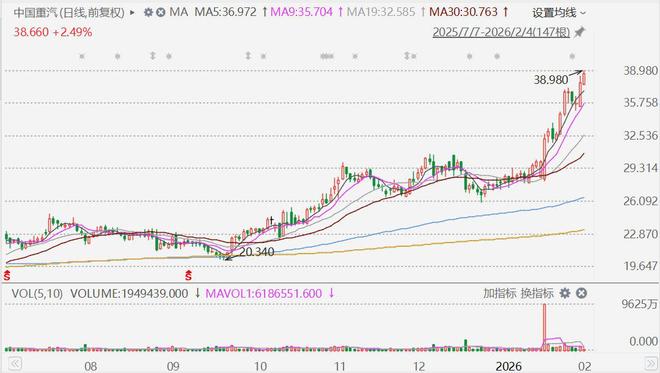
Group 1 - The core viewpoint of the article highlights the strong performance of heavy machinery stocks in the Hong Kong market, particularly China National Heavy Duty Truck Group and SANY International, which have reached historical highs with year-to-date increases of over 40% and 52% respectively [1] - According to a recent report by Credit Lyonnais, three key driving forces are emerging in the Chinese industrial sector amid the ongoing anti-involution policies, including rising demand for mining equipment, maturity of the supply chain for humanoid robots, and consolidation in the express delivery industry [1] - The report anticipates that the equipment replacement cycle will continue, alongside record investments in power grids and renewable energy, which are expected to drive excavator sales growth by approximately 10% [1] Group 2 - First-tier suppliers are prepared to commence mass production of humanoid machinery in the second half of the year [1] - The strong performance and price increases in the lithium-related sector are expected to lead to a year-on-year recovery in automation demand of about 5% [1]


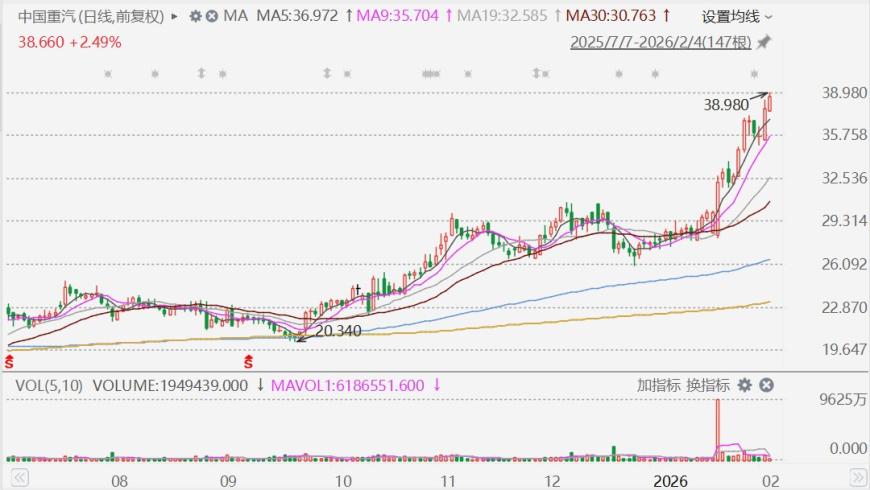
港股异动丨机械股走强,中国重汽、三一国际再创历史新高
Ge Long Hui· 2026-02-04 02:40
Group 1 - The Hong Kong stock market sees a strong performance in heavy machinery stocks, with China National Heavy Duty Truck Group and SANY International reaching historical highs; China National Heavy Duty Truck has increased over 40% year-to-date, while SANY International has risen over 52% year-to-date [1] - According to a recent report by Credit Lyonnais, three key driving forces are emerging in the Chinese industrial sector amid the ongoing anti-involution policies, including rising demand for mining equipment, maturity of humanoid robot supply chains, and consolidation in the express delivery industry [1] - The report anticipates that the equipment replacement cycle will continue, along with record investments in power grids and renewable energy, which will drive excavator sales growth by approximately 10% [1] Group 2 - First-tier suppliers' overseas factories are ready to commence mass production of humanoid machinery in the second half of the year [1] - Driven by strong performance and rising prices in the lithium-related sectors, automation demand is expected to recover by approximately 5% year-on-year [1]
化工板块全线反攻!“反内卷”政策催化行业新起点,化工ETF(516020)涨超4%!
Xin Lang Cai Jing· 2026-02-03 06:39
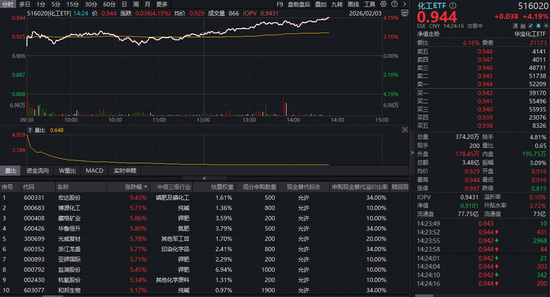
Group 1 - The chemical sector experienced a significant rebound on February 3, with the Chemical ETF (516020) rising by 4.19% during the trading day [1][2][6] - Key stocks in the sector, including phosphate chemicals, soda ash, and potash, saw notable gains, with Hongda Co. surging over 9% and several others, such as Boyuan Chemical and Hualu Hengsheng, increasing by more than 5% [1][7][9] Group 2 - Huafu Securities indicated that the chemical industry has undergone a bottoming process in profitability and valuation, with expectations for a recovery in earnings in 2026, driven by supply-side reforms and new production capabilities represented by AI computing and advanced manufacturing [1][9] - Zhongyin Securities projected that the current round of industry expansion is nearing its end, and measures like "anti-involution" are expected to catalyze a recovery in industry profitability, particularly benefiting new materials due to rapid downstream demand growth [3][9] - Investors are advised to focus on low-valuation industry leaders and the impact of "anti-involution" on supply-side dynamics, as well as companies in the electronic materials sector that are increasingly critical in the context of self-sufficiency [3][9] Group 3 - The Chemical ETF (516020) tracks the CSI sub-sector chemical industry theme index, covering popular themes such as AI computing, anti-involution, robotics, and new energy [3][9] - Investors can also consider the Chemical ETF linked funds (Class A 012537/Class C 012538) for exposure to the chemical sector [3][9]
A股化工板块“春潮”涌动
Zhong Guo Hua Gong Bao· 2026-02-03 03:34
Group 1 - The chemical industry is experiencing a strong rebound in prices, with the basic chemical index rising by 12.72% year-to-date as of January 30, driven by supply-side maintenance, recovering export demand, and policy-driven structural tightness [1] - Aromatic products have shown significant price increases, with pure benzene prices in East China rising by 18.3% and styrene by 15.5% in January [1] - The price surge is attributed to multiple factors, including rising international oil prices, unexpected maintenance of chemical facilities, and a favorable market outlook for low-valuation chemical products [1] Group 2 - PX social inventory is expected to decrease rapidly starting in the second half of 2025, with a projected drop to 1.67 million tons by the end of 2025, supporting PX spot price increases [2] - The price of caprolactam has also rebounded, with prices rising from 9,325 yuan/ton to 9,600 yuan/ton in January, driven by reduced industry operating rates [2] - The pesticide industry is benefiting from rising core raw material prices and new export tax regulations, leading to price increases for products like glyphosate [2] Group 3 - The pesticide industry is undergoing supply-side structural reforms driven by policy changes, including the implementation of a new registration policy and the cancellation of export tax rebates for certain products [3] - The chemical industry is approaching a cyclical turning point, with stricter standards for energy consumption, carbon emissions, and safety processes expected to accelerate the elimination of outdated production capacity [3]
建材行业周报:涨价预期提升,关注节后需求复苏落地情况
China Post Securities· 2026-02-03 02:24
Investment Rating - The industry investment rating is "Outperform the Market" and is maintained [1] Core Viewpoints - The report indicates that the construction materials sector is showing strong performance, with expectations for price increases in various categories such as waterproofing, coatings, and cement due to improving demand and economic conditions in 2026. The report emphasizes the importance of monitoring post-Spring Festival demand recovery and price adjustments [4][5] - The cement market is entering a seasonal downturn, with a notable decline in demand, particularly in the housing market. However, mid-term prospects suggest that production capacity may decrease under policies limiting overproduction, potentially leading to improved profit margins [4][9] - The glass industry is facing ongoing demand pressures, with traditional peak season orders showing limited improvement. Supply-side adjustments are expected to keep prices low in the short term [5][16] - The fiber glass sector is experiencing a demand boost driven by the AI industry, with expectations for significant growth in both volume and price [5] - The consumer building materials sector is anticipated to see a bottoming out of profits, with strong price increase demands following years of competitive pricing [5] Summary by Sections Cement - The national cement market is entering a seasonal downturn, with December 2025 production at 144 million tons, a year-on-year decline of 6.6%. Demand is expected to weaken further due to seasonal factors and the upcoming Spring Festival [9] Glass - The glass industry is under pressure, with high inventory levels among intermediaries and limited demand recovery. Recent supply-side adjustments have not alleviated the overall supply-demand imbalance, leading to expectations of continued low price fluctuations [16] Fiber Glass - The fiber glass sector is benefiting from demand related to the AI industry, with expectations for a significant increase in both volume and price as the industry evolves [5] Consumer Building Materials - The sector is expected to see a recovery in profitability, with several categories like waterproofing and coatings announcing price increases, indicating a potential turnaround in 2026 [5]
建材行业报告(2026.01.26-2026.02.01):涨价预期提升,关注节后需求复苏落地情况
China Post Securities· 2026-02-03 01:23
Investment Rating - The industry investment rating is "Outperform the Market" and is maintained [1] Core Views - The cyclical sector performed well recently, with price increase expectations rising. The construction materials sector is expected to see significant valuation elasticity in 2026, with waterproofing, coatings, and cement entering a phase of improved prosperity. Various categories such as gypsum boards, pipes, and glass are anticipated to reach price turning points in 2026, supported by expectations of recovery in real estate and the economy. Short-term demand is currently weak, with a focus on post-Spring Festival demand and price increases [4][5] - Cement demand is entering a seasonal downturn, with overall demand still declining. The housing market remains weak, while infrastructure demand shows significant regional differentiation driven by policy. The civil market exhibits relatively rigid demand. In the medium term, cement production capacity is expected to decline under policies limiting overproduction, leading to a significant increase in capacity utilization and profit elasticity [4][5] - The glass industry is experiencing sustained demand pressure due to real estate impacts, with traditional peak season orders showing limited improvement. Supply-side adjustments, including cold repairs of production lines, have occurred, but overall supply-demand pressures remain, leading to expectations of price stability at low levels [5][16] Summary by Sections Cement - National cement demand is gradually entering a seasonal downturn, with a 6.6% year-on-year decline in December 2025 production, totaling 144 million tons. The housing market remains weak, and infrastructure demand is regionally differentiated, with civil market demand being relatively rigid [9] Glass - The glass industry is under pressure, with traditional peak season orders showing limited improvement and high inventory levels among intermediaries. Despite recent cold repairs of production lines, supply-demand pressures persist, leading to expectations of continued low price fluctuations [5][16] Fiberglass - The fiberglass sector is seeing weak demand as manufacturers focus on cash flow. However, the electronic yarn segment is experiencing growth driven by AI industry demand, with expectations for a significant increase in both volume and price [5] Consumer Building Materials - The industry has reached a profitability bottom, with no further downward price space. The sector is strongly advocating for price increases, with waterproofing, coatings, and gypsum boards issuing price increase notices. Profitability improvements are expected for leading companies in 2026 [5]