适度宽松的货币政策

Search documents
央行:引导银行稳固信贷支持力度
Zhong Guo Zheng Quan Bao· 2026-02-10 20:21
Core Viewpoint - The People's Bank of China (PBOC) emphasizes the continuation of a moderately accommodative monetary policy to stabilize economic growth and ensure reasonable price recovery, while monitoring liquidity and financial market changes [1][2]. Group 1: Monetary Policy Implementation - The PBOC aims to integrate incremental and stock policies to create a conducive monetary environment for stable economic growth and price recovery [1]. - The report highlights the importance of analyzing liquidity supply and demand in the banking system and utilizing various monetary policy tools to maintain ample liquidity [1][2]. - In early 2026, the PBOC plans to introduce a package of monetary measures to support high-quality economic development, leveraging both incremental and stock policies [1]. Group 2: Financial Support for Key Areas - The report outlines a focus on optimizing re-lending for technological innovation and transformation, aligning financial services with high-quality economic development [2]. - It emphasizes the need for financial institutions to enhance support for expanding domestic demand, technological innovation, and small and micro enterprises [2]. - The PBOC is committed to improving the pension financial system and supporting the development of the silver economy [2]. Group 3: Liquidity and Financing Conditions - Recent trends show a slowdown in deposit growth among residents and enterprises, while the scale of wealth management products has increased significantly [3]. - The PBOC has provided substantial liquidity to the banking system, with a net injection of 6 trillion yuan through open market operations in 2025 [3]. - Changes in asset allocation by residents do not indicate a significant shift in overall liquidity, as most funds redirected to wealth management products will eventually return to the banking system [4].
人民银行:适度宽松货币政策效果逐步显现
Bei Jing Shang Bao· 2026-02-10 16:54
Group 1 - The core viewpoint of the articles is that the People's Bank of China (PBOC) is implementing a moderately loose monetary policy to support stable economic growth and financial market stability in 2025, with a GDP growth target of 5% [1][4]. Group 2 - In 2025, the PBOC is utilizing various monetary policy tools, including adjusting the reserve requirement ratio and open market operations, to maintain ample liquidity and support effective credit demand in the real economy [2][4]. - The PBOC is also focused on reducing the overall financing costs in society by lowering policy interest rates and specific loan rates, which will help in supporting key sectors and strategic areas [2][4]. Group 3 - By the end of 2025, the total social financing scale and broad money supply (M2) are expected to grow by 8.3% and 8.5% year-on-year, respectively, significantly outpacing nominal GDP growth [3]. - The interest rates for newly issued corporate loans and personal housing loans are projected to be around 3.1% by December 2025, indicating a decline in financing costs [3]. - The loan structure is improving, with significant year-on-year growth in loans for technology (11.5%), green projects (20.2%), inclusive finance (10.9%), elderly care (50.5%), and digital economy (14.1%) [3]. Group 4 - The PBOC plans to continue its moderately loose monetary policy, focusing on promoting stable economic growth and reasonable price recovery while adjusting the implementation of policies based on domestic and international economic conditions [4]. - There will be an emphasis on enhancing the interest rate adjustment framework and improving the transmission mechanism of market interest rates to lower bank funding costs [4]. Group 5 - The PBOC aims to maintain the stability of the RMB exchange rate through a managed floating exchange rate system, ensuring it remains at a reasonable and balanced level while preventing excessive fluctuations [5]. - The central bank will also enhance its macro-prudential and financial stability functions to maintain market stability and prevent systemic financial risks [5]. Group 6 - Experts indicate that the cumulative effects of the previous year's moderately loose monetary policy will continue to manifest, and new measures introduced in early 2026 will work in conjunction with existing policies to foster a conducive monetary environment for stable economic growth [6].
央行最新报告定调 适度宽松货币“不换挡”!
Bei Jing Shang Bao· 2026-02-10 14:58
Core Viewpoint - The People's Bank of China (PBOC) is committed to implementing a moderately loose monetary policy to support stable economic growth and financial market stability in 2025, with a GDP growth target of 5% for the year [1]. Monetary Policy Implementation - In 2025, the PBOC employed various monetary policy tools, including reserve requirement ratios and open market operations, to maintain ample liquidity and support effective credit demand from the real economy [3]. - The PBOC aims to lower the overall financing costs in society by reducing policy interest rates and specific loan rates, thereby enhancing support for key sectors and strategic areas [3]. Financial Indicators - By the end of 2025, the total social financing scale and broad money supply (M2) grew by 8.3% and 8.5% year-on-year, respectively, significantly outpacing the nominal GDP growth rate [4]. - The new corporate loan and personal housing loan rates were approximately 3.1% in December 2025, indicating a decline in financing costs [4]. - Key loan categories such as technology loans, green loans, and loans for the elderly industry saw significant year-on-year growth rates, with technology loans increasing by 11.5% and loans for the elderly industry by 50.5% [4]. Future Policy Directions - The PBOC plans to continue its moderately loose monetary policy, focusing on promoting stable economic growth and reasonable price recovery while adjusting the implementation of policies based on domestic and international economic conditions [5]. - There will be an emphasis on improving the interest rate adjustment framework and enhancing the transmission mechanism of market interest rates to lower financing costs further [6]. - The PBOC aims to maintain the stability of the RMB exchange rate while expanding financial support for key areas such as domestic demand, technological innovation, and small and micro enterprises [6].

央行发布重要报告 继续实施好适度宽松的货币政策
Zhong Guo Zheng Quan Bao· 2026-02-10 14:53
Core Viewpoint - The People's Bank of China emphasizes the continuation of a moderately accommodative monetary policy to stabilize economic growth and ensure reasonable price recovery, while adapting to domestic and international economic conditions [1][2]. Monetary Policy Implementation - The report advocates for the effective implementation of a moderately accommodative monetary policy, utilizing various tools such as reserve requirement ratio (RRR) cuts and interest rate reductions [1][2]. - It highlights the importance of guiding banks to maintain robust credit support and ensuring that the growth of social financing and money supply aligns with economic growth and price level expectations [1][2]. Financial Support for Key Areas - The report stresses the need for financial institutions to enhance support for expanding domestic demand, technological innovation, and small and medium-sized enterprises (SMEs) [2]. - It calls for the optimization of re-loans for technological innovation and the establishment of a comprehensive financial service system covering the entire lifecycle of technology [2]. Direct Financing Development - The report indicates a significant increase in government bond financing, corporate bond net financing, and domestic stock financing in 2025, with over 1.5 trillion yuan in technology innovation bonds issued [3]. - The capital market is evolving, with a new ecosystem forming that better meets the financing needs of high-growth and research-intensive sectors [4]. Price Trends - The report notes positive changes in price trends, with the Consumer Price Index (CPI) rising by 0.8% year-on-year in December 2025, reaching its highest level since March 2023 [5]. - Core CPI, excluding food and energy, increased by 1.2%, while the Producer Price Index (PPI) saw a year-on-year decline of 1.9%, indicating a narrowing of the decline compared to earlier in the year [5]. Liquidity and Asset Management - The report discusses the merging of asset management products and bank deposits to better assess liquidity conditions, highlighting a shift in the asset allocation of residents and enterprises towards wealth management and asset management products [6][7]. - It emphasizes that despite changes in deposit structures, overall liquidity remains stable, supported by the central bank's operations that injected 6 trillion yuan into the market in 2025 [6][7].
央行重要发布
Zhong Guo Ji Jin Bao· 2026-02-10 14:50
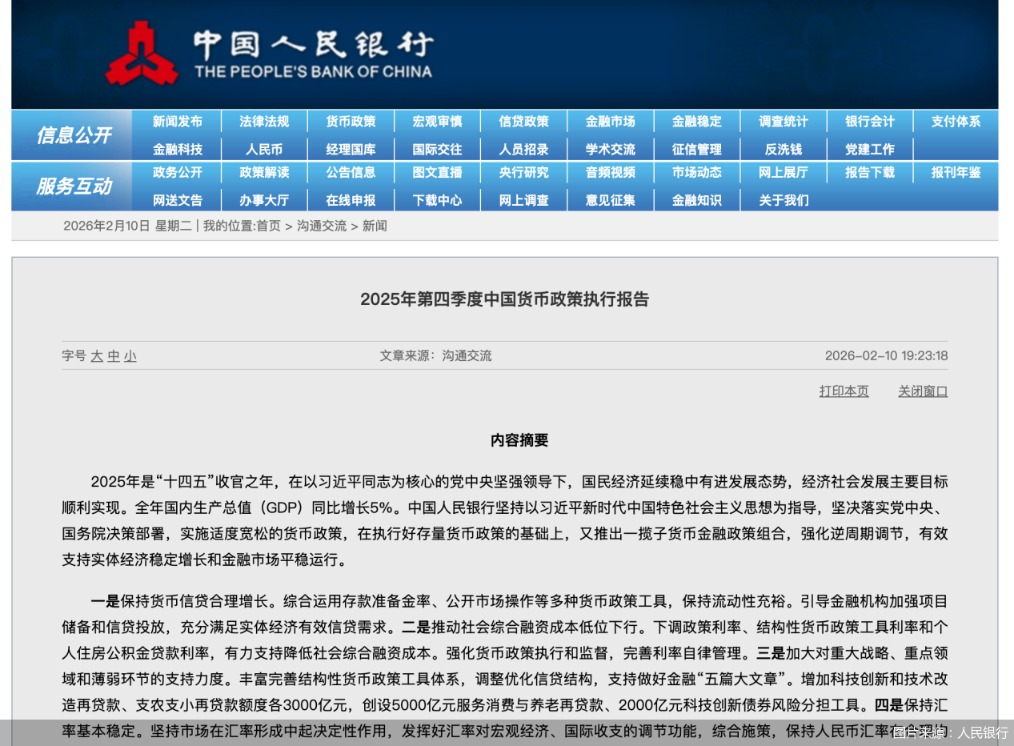
一是保持货币信贷合理增长。综合运用存款准备金率、公开市场操作等多种货币政策工具,保持流动性 充裕。引导金融机构加强项目储备和信贷投放,充分满足实体经济有效信贷需求。 2025年是"十四五"收官之年,在以习近平同志为核心的党中央坚强领导下,国民经济延续稳中有进发展 态势,经济社会发展主要目标顺利实现。全年国内生产总值(GDP)同比增长5%。中国人民银行坚持 以习近平新时代中国特色社会主义思想为指导,坚决落实党中央、国务院决策部署,实施适度宽松的货 币政策,在执行好存量货币政策的基础上,又推出一揽子货币金融政策组合,强化逆周期调节,有效支 持实体经济稳定增长和金融市场平稳运行。 2025年第四季度中国货币政策执行报告 二是推动社会综合融资成本低位下行。下调政策利率、结构性货币政策工具利率和个人住房公积金贷款 利率,有力支持降低社会综合融资成本。强化货币政策执行和监督,完善利率自律管理。 三是加大对重大战略、重点领域和薄弱环节的支持力度。丰富完善结构性货币政策工具体系,调整优化 信贷结构,支持做好金融"五篇大文章"。增加科技创新和技术改造再贷款、支农支小再贷款额度各3000 亿元,创设5000亿元服务消费与养老再贷 ...
央行,最新发布!下一阶段货币政策思路明确
券商中国· 2026-02-10 14:49
Core Viewpoint - The People's Bank of China (PBOC) emphasizes the importance of coordinating monetary and fiscal policies to stimulate domestic demand and enhance macroeconomic governance effectiveness in the upcoming period [2][6]. Group 1: Monetary Policy Implementation - The report indicates that the effects of the moderately loose monetary policy in 2025 are gradually becoming evident, with ample liquidity in the banking system, a decrease in loan rates, and a rapid increase in money supply and social financing scale [4]. - In 2025, there was a significant increase in government bond financing, corporate bond financing, and non-financial corporate domestic stock financing compared to the previous year, indicating a shift towards direct financing models that align with high-growth sectors [4]. Group 2: Coordination of Fiscal and Monetary Policies - The report outlines three main ways to strengthen the coordination between fiscal and monetary policies: maintaining market liquidity through open market operations, optimizing financial resource allocation via "re-lending + fiscal subsidies," and enhancing risk-sharing through guarantees [7]. - The collaboration between fiscal and monetary policies is expected to amplify the effects of macroeconomic support for structural transformation and upgrading [7]. Group 3: Asset Allocation and Liquidity - Recent trends show a slowdown in the growth of household and corporate deposits, while the scale of wealth management and asset management products has increased significantly. This shift is viewed as a change in the structure of bank deposits rather than a significant alteration in overall liquidity [8]. - The report suggests that the ongoing development of financial markets and the acceleration of direct financing will lead to a more diversified allocation of household savings between bank deposits and asset management products, impacting the structure of bank liabilities [8]. Group 4: Future Monetary Policy Directions - The PBOC plans to implement counter-cyclical and cross-cyclical adjustments to enhance macroeconomic governance and support the "14th Five-Year Plan" for a good start [9]. - The focus will be on maintaining reasonable growth in financial totals, optimizing credit policies to support key areas such as domestic demand and technological innovation, and ensuring the stability of the RMB exchange rate [10].

事关货币政策!央行发布报告!
Xin Lang Cai Jing· 2026-02-10 13:52
2月10日,央行官网发布《2025年第四季度中国货币政策执行报告》(以下简称《报告》)。 《报告》指出,2025年是"十四五"收官之年,在以习近平同志为核心的党中央坚强领导下,国民经济延 续稳中有进发展态势,经济社会发展主要目标顺利实现。全年国内生产总值(GDP)同比增长5%。中 国人民银行坚持以习近平新时代中国特色社会主义思想为指导,坚决落实党中央、国务院决策部署,实 施适度宽松的货币政策,在执行好存量货币政策的基础上,又推出一揽子货币金融政策组合,强化逆周 期调节,有效支持实体经济稳定增长和金融市场平稳运行。 价格方面,健全市场化的利率形成、调控和传导机制,理顺政策利率向各类市场利率的传导关系,进一 步做好明示贷款综合融资成本工作,推动规范融资中间费用,促进社会综合融资成本低位运行。综合施 策、稳定预期,保持人民币汇率在合理均衡水平上的基本稳定。 根据央行披露数据,2025年金融总量保持较快增长,年末社会融资规模存量、广义货币供应量(M2) 同比分别增长8.3%和8.5%,明显高于名义GDP增速。人民币贷款还原地方化债影响后也在7%左右,信 贷支持力度持续加强。社会综合融资成本低位下行,2025年12月新 ...
中国人民银行报告:继续实施好适度宽松的货币政策
Xin Hua Wang· 2026-02-10 13:25
Core Viewpoint - The People's Bank of China (PBOC) will continue to implement a moderately accommodative monetary policy, focusing on promoting stable economic growth and reasonable price recovery, while adjusting the policy's intensity, rhythm, and timing based on domestic and international economic conditions [1][2]. Group 1: Monetary Policy Implementation - The PBOC's report for the fourth quarter of 2025 indicates that it will introduce a comprehensive monetary and financial policy package to strengthen counter-cyclical adjustments, effectively supporting stable growth in the real economy and smooth operation of financial markets [1]. - By the end of 2025, the total financial volume is expected to maintain rapid growth, with the social financing scale and broad money supply (M2) increasing by 8.3% and 8.5% year-on-year, respectively, significantly outpacing nominal GDP growth [1]. Group 2: Credit Structure and Support - After adjusting for local government debt impacts, RMB loans are projected to grow by around 7%, indicating sustained strong credit support [1]. - The credit structure continues to optimize, with technology loans, green loans, inclusive loans, elderly care industry loans, and digital economy industry loans growing by 11.5%, 20.2%, 10.9%, 50.5%, and 14.1% year-on-year, respectively, all exceeding the overall loan growth rate [1]. Group 3: Future Monetary Tools and Support - In 2025, the PBOC increased the quotas for re-loans for technological innovation and agricultural support by 300 billion yuan each, established 500 billion yuan for consumer services and elderly care re-loans, and created a 200 billion yuan risk-sharing tool for technology innovation bonds [2]. - The PBOC aims to effectively implement various structural monetary policy tools, enhance financial support for key areas such as domestic demand expansion, technological innovation, and small and micro enterprises, while also improving macro-prudential and financial stability management tools [2].
中国货币政策执行报告:适度宽松货币政策效果逐步显现
Zhong Guo Xin Wen Wang· 2026-02-10 13:23
报告强调,要继续实施好适度宽松的货币政策,根据国内外经济金融形势和金融市场运行情况,把握好 政策实施的力度、节奏和时机,灵活高效运用降准降息等多种政策工具,保持流动性充裕和社会融资条 件相对宽松。 (文章来源:中国新闻网) 报告显示,金融总量保持较快增长,年末社会融资规模存量、广义货币供应量(M2)同比分别增长8.3% 和8.5%,明显高于名义GDP增速;人民币贷款还原地方化债影响后增长7%左右,信贷支持力度持续较 强;社会综合融资成本进一步下行,12月新发放企业贷款利率、个人住房贷款利率均在3.1%左右;信 贷结构持续优化,年末科技贷款、绿色贷款、普惠贷款、养老产业贷款、数字经济产业贷款分别同比增 长11.5%、20.2%、10.9%、50.5%、14.1%,均保持两位数增长,持续高于全部贷款增速。 此外,人民币汇率在复杂形势下保持基本稳定,2025年末,人民币对美元汇率收盘价为6.9890元,较 2024年末升值4.4%,中国外汇交易中心(CFETS)人民币汇率指数为97.99,较2024年末贬值3.4%。 业内专家表示,上年适度宽松的货币政策具有累积效应,存量政策效果还会持续显现。2026年初,中国 央 ...
央行最新报告:发挥增量和存量政策集成效应!
证券时报· 2026-02-10 13:14
Core Viewpoint - The People's Bank of China (PBOC) emphasizes the coordination between monetary and fiscal policies to support domestic demand expansion and enhance macroeconomic governance effectiveness in the upcoming stages [1][7]. Group 1: Monetary Policy Execution in 2025 - In 2025, the banking system maintained ample liquidity, with a notable increase in social financing scale, including significant growth in government bonds, corporate bonds, and non-financial corporate domestic stock financing compared to the previous year [4]. - The cumulative effects of the moderately loose monetary policy from the previous year are expected to continue impacting the financial structure, with a decrease in traditional bank credit proportion [4]. Group 2: Coordination of Fiscal and Monetary Policies - The report identifies three main ways to enhance the coordination between monetary and fiscal policies: 1. Maintaining market liquidity through open market operations to support efficient government bond issuance [7]. 2. Utilizing "re-lending + fiscal subsidies" to optimize financial resource allocation [7]. 3. Sharing risk costs through guarantees to increase financing support for enterprises [7]. Group 3: Asset Allocation and Liquidity - Recent trends show a slowdown in growth of household and corporate deposits, while the scale of wealth management and asset management products has increased significantly [9]. - The shift in asset allocation does not imply a significant change in overall liquidity, as most funds are expected to return to the banking system [9]. Group 4: Future Monetary Policy Directions - The PBOC plans to implement counter-cyclical and cross-cyclical adjustments, maintaining a moderately loose monetary policy while ensuring reasonable growth in financial totals [11]. - The focus will be on enhancing financial support for key areas such as domestic demand, technological innovation, and small and medium-sized enterprises [11]. - The report emphasizes the importance of maintaining a stable RMB exchange rate and advancing interest rate marketization reforms [12].