
避险需求

Search documents
金价飙升品牌金饰克价首破千元, 市场解读供需失衡推高消费热度
Sou Hu Cai Jing· 2025-07-02 04:35
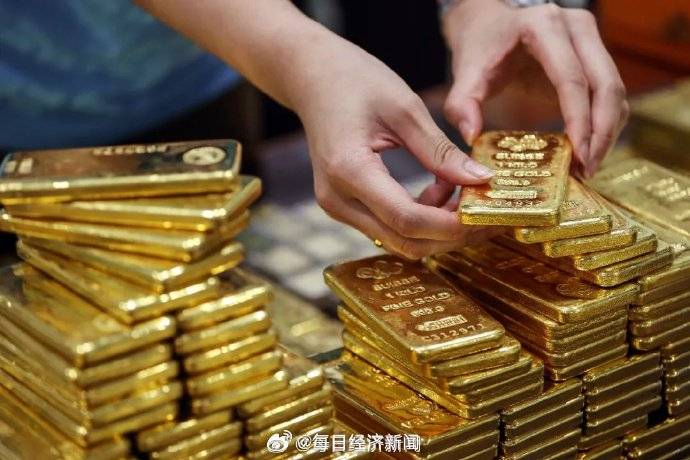
Group 1: Latest Gold Price Dynamics - The current gold prices as of July 1 show significant increases, with brands like Chow Sang Sang at 1000 CNY/gram, Chow Tai Fook at 998 CNY/gram, and Lao Miao Gold at 995 CNY/gram, reflecting a daily increase of 15 CNY, 9 CNY, and 11 CNY respectively [1] - Compared to June 30, there was a notable rebound after a drop of 50 CNY in mid-June [1] Group 2: International Gold Price Movement - The spot gold price is reported at 3321.53 USD/ounce, showing an increase of 0.57%, while COMEX gold futures are at 3333.3 USD/ounce, up by 0.77% [2] Group 3: Reasons for Price Increase - The anticipated interest rate cuts by the Federal Reserve, driven by pressure from Trump, have weakened the USD, enhancing gold's attractiveness [4] - A significant 95% of global central banks plan to increase their gold reserves, with China purchasing 244 tons in Q1, providing long-term support for gold prices [5] - Renewed demand for safe-haven assets due to geopolitical tensions and trade uncertainties has led to a return of funds into gold [6] - A technical rebound occurred after gold prices fell below 3300 USD, triggering algorithmic buying [7] Group 4: Consumer and Market Reactions - Investors are showing a strong willingness to cash out at high prices, with notable transactions such as a man in Wenzhou selling 8 kg of gold for a profit of 3.12 million CNY [8] - Essential consumers are shifting towards smaller gold jewelry or rental models, with increased sensitivity to processing fees, while demand for traditional wedding gold has decreased [8] - There is a segment of the market waiting for a price correction to 600-700 CNY/gram, perceiving current prices as inflated [8] Group 5: Practical Recommendations - For essential purchases, it is advisable to choose markets like Shenzhen Shui Bei with lower processing fees or bank gold bars with a premium of about 3% [13] - Non-essential buyers should monitor the technical support level at 3250 USD, with potential declines to 3100 USD [13] - It is recommended to keep physical gold as 5%-10% of household assets and consider dollar-cost averaging into gold ETFs [13]

国际金价上半年涨超25% 避险需求支撑下或继续走高
Zheng Quan Ri Bao· 2025-07-01 16:41
Core Viewpoint - The gold price has seen a significant increase in the first half of 2025, driven by geopolitical tensions, a weakening dollar, and central bank purchases, with expectations for continued upward movement in the second half of the year [1][2]. Group 1: Gold Price Trends - In the first half of 2025, the London spot gold price rose by 25.7%, marking the largest semi-annual increase since the second half of 2007 [1]. - The international gold price reached a historical high of $3,500 per ounce in April 2025, followed by a period of fluctuation in May and June [1]. - Currently, gold prices are oscillating between $3,200 and $3,400 per ounce, with increasing market competition between bulls and bears [1]. Group 2: Factors Influencing Gold Prices - The decline in confidence in the US dollar, with a 10.7% drop in the dollar index in the first half of 2025, has provided strong support for rising gold prices [1]. - Geopolitical conflicts have heightened market risk aversion, maintaining high demand for gold as a safe-haven asset [1][2]. - Central banks globally have shown a strong demand for gold reserves, with a net purchase of 256 tons in the first four months of 2025 [2]. Group 3: Central Bank Activities - As of the end of May 2025, China's gold reserves stood at 7,383 million ounces (approximately 2,296.37 tons), reflecting a month-on-month increase of 6,000 ounces (about 1.86 tons) [2]. - A survey by the World Gold Council indicated that 95% of central banks expect to continue increasing their gold holdings over the next 12 months, with nearly 43% planning to add to their reserves within the year [2].
翁富豪:7.2 黄金晚间能否再创新高?晚间回调做多解析
Sou Hu Cai Jing· 2025-07-01 15:52
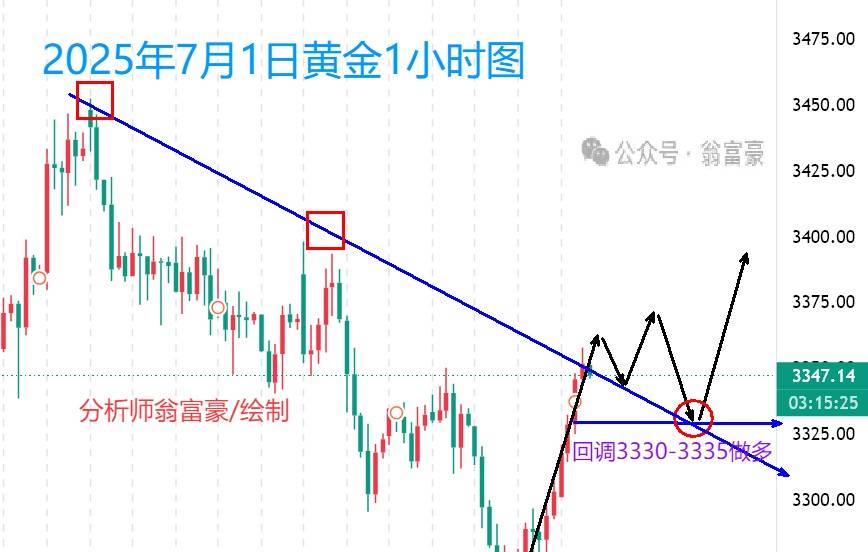
Group 1 - The core viewpoint of the articles highlights the rising value of gold due to a weakening dollar, increasing uncertainty around U.S. trade agreements, and heightened expectations for interest rate cuts by the Federal Reserve [1][3] - Gold prices reached a three-day high of 3357.88, driven by global economic uncertainties and the market's anticipation of at least two rate cuts by 2025 [1] - The upcoming U.S. employment report is expected to influence U.S. Treasury yields, with potential implications for gold prices [1] Group 2 - Technical analysis indicates a bullish short-term trend for gold, with MACD showing a bottom divergence and prices moving above previous resistance levels [3] - The suggested trading strategy includes buying gold on dips around the 3330-3335 range, with a stop loss at 3327 and a target of 3350-3360 [4] - Market participants are advised to monitor geopolitical risks that may drive safe-haven demand for gold [3]
汇丰上调今明两年黄金价格预期:地缘政治叠加财政风险驱动避险需求
智通财经网· 2025-07-01 13:48
Group 1 - HSBC has significantly raised its gold price forecast for 2025 from $3015 to $3215 per ounce, and for 2026 from $2915 to $3125, reflecting a 7.2% increase [1] - The bank attributes the long-term value of gold to the evolving global risk landscape and rising sovereign debt, noting that gold's role as a safe-haven asset increases during economic uncertainty and geopolitical tensions [1] - As of July 1, 2023, international gold prices are fluctuating around $3360 per ounce, with expectations that prices will range between $3100 and $3600 for the remainder of 2025, and a target price of $3175 by the end of 2025 [1] Group 2 - The report highlights a significant correlation between gold price movements and central bank purchasing behavior, indicating that if gold prices exceed $3300, central banks may slow their buying pace [2] - If gold prices retreat to around $3000, it could trigger a new wave of reserve asset allocation, while sustained prices above $3500 may lead to demand pressures in major consumer markets like India and China [2] - The market is closely monitoring U.S. policy developments, including potential tax reform and trade tensions, which could inject further uncertainty into the gold market [2]
市场主流观点汇总-20250701
Guo Tou Qi Huo· 2025-07-01 11:41
Report Summary 1. Report Industry Investment Rating No information provided regarding the report industry investment rating. 2. Core View of the Report The report aims to objectively reflect the research views of futures companies and securities companies on various commodity varieties, track hot - spot varieties, analyze market investment sentiment, and summarize investment driving logics. It is based on the publicly - released research reports of institutions in the current week, and the closing price data is from last Friday, with the weekly change calculated as the change in the closing price from the previous Friday [2]. 3. Summary by Relevant Catalogs 3.1行情数据 - **Commodities**: From June 23 to June 27, 2025, commodities such as coke, copper, and iron ore had price increases, with coke rising 2.67%, copper rising 2.47%, and iron ore rising 1.92%. Commodities like corn, gold, and palm oil had price decreases, with corn falling 1.04%, gold falling 1.56%, and palm oil falling 1.87%. Crude oil had a significant drop of 12.02% [3]. - **A - shares**: During the same period, the CSI 500 rose 3.98%, the SSE 50 rose 1.27%, and the CSI 300 rose 1.95% [3]. - **Overseas Stocks**: The Nikkei 225 rose 4.55%, the Nasdaq Index rose 4.25%, and the S&P 500 rose 3.44% [3]. - **Bonds**: The 5 - year Chinese Treasury bond rose 0.64%, the 10 - year Chinese Treasury bond rose 0.30%, and the 2 - year Chinese Treasury bond rose 0.19% [3]. - **Foreign Exchange**: The euro - US dollar exchange rate rose 1.69%, the US dollar index fell 1.52%, and the US dollar central parity rate fell 0.09% [3]. 3.2大宗商品观点汇总 3.2.1宏观金融板块 - **Stock Index Futures**: Among 8 institutions' views, 2 were bullish, 1 was bearish, and 5 were for a sideways market. Bullish factors included rising Fed rate - cut expectations, a low risk - premium rate of the CSI 300, increased issuance of equity - oriented public funds, and sufficient bottom - supporting funds. Bearish factors included short - term difficulty in improving corporate fundamentals, the central bank's change in monetary policy stance, and over - heated market sentiment [4]. - **Treasury Bond Futures**: Among 7 institutions' views, 3 were bullish, 1 was bearish, and 3 were for a sideways market. Bullish factors included net liquidity injection by the central bank, weak credit and inflation data, and strong demand for bond allocation. Bearish factors included the central bank's change in monetary policy stance, the stock - bond seesaw effect, and rising long - term interest rates [4]. 3.2.2能源板块 - **Crude Oil**: Among 9 institutions' views, 3 were bullish, 2 were bearish, and 4 were for a sideways market. Bullish factors included falling US and Cushing crude oil inventories, reduced Russian exports, and geopolitical tensions. Bearish factors included the decline in geopolitical premiums, expected OPEC production increases, and weak terminal demand [5]. - **Eggs**: Among 8 institutions' views, 2 were bullish, 2 were bearish, and 4 were for a sideways market. Bullish factors included postponed peak - season stocking, approaching stocking season, potential egg - price increases, and reduced supply due to heat. Bearish factors included limited decline in laying - hen inventory, high chick - replenishment volume, high new - production capacity, and postponed downstream stocking [5]. 3.2.3有色板块 - **Copper**: Among 7 institutions' views, 5 were bullish, 0 were bearish, and 2 were for a sideways market. Bullish factors included rising Fed rate - cut expectations, improved risk appetite, and falling global visible inventories. Bearish factors included the substitution effect of recycled copper, weakening downstream procurement, and weakening terminal demand [6]. - **Methanol**: Among 7 institutions' views, 0 were bullish, 1 was bearish, and 6 were for a sideways market. Bullish factors included limited port - available goods, expected low port inventories, and increased downstream demand. Bearish factors included expected increases in Iranian imports, port inventory accumulation, potential MTO device maintenance, and a loosening supply - demand pattern [6]. 3.2.4贵金属 - **Gold**: Among 7 institutions' views, 4 were bullish, 1 was bearish, and 2 were for a sideways market. Bullish factors included rising Fed rate - cut expectations, a downward trend in real interest rates, and the strengthening of gold's safe - haven property. Bearish factors included reduced safe - haven demand, capital flowing to risky assets, and technical - level sell - offs [7]. 3.2.5黑色板块 - **Iron Ore**: Among 8 institutions' views, 2 were bullish, 2 were bearish, and 4 were for a sideways market. Bullish factors included increased molten - iron production, expected decline in overseas shipments, and improved macro sentiment. Bearish factors included rising port inventories, increased global shipments, weakening demand for five major steel products, and narrowing basis [7].
7月2日银价展望:白银困守36.51 市场谨慎等待ISM/JOLTS
Jin Tou Wang· 2025-07-01 09:50
北京时间周三(7月2日)欧盘时段,白银从周一低点3540美元延续反弹至盘中高点36.50美元,在市场 情绪日益谨慎的情况下,贵金属受到避险需求增加的支撑。现货白银上涨0.71%至36.35美元/盎司上 方;白银t+d突破1.24%收于8805元/千克,白银期货大幅收涨于1.11%,报8810元/千克。市场等待美国 ISM制造业采购经理人指数和职位空缺和劳动力周转率调查的发布,以在北美时段晚些时候获得一些动 力。然而,焦点仍将集中在备受关注的美国月度就业细节上,即周四的非农就业人数报告。 美国参议院以微弱优势批准了一项程序性投票,以公开辩论特朗普的全面"一个大美丽法案",该法案将 在未来十年内使联邦赤字增加约3.3万亿美元。这应该会让美元在本周美国关键宏观经济数据发布之前 保持守势,并支持大宗商品进一步升值的前景。 特朗普抱怨与日本的贸易谈判缺乏进展,财政部长斯科特·贝森特威胁要在7月9日引入关税,尽管谈判 正在进行中,这再次引发了对全球贸易前景的担忧,并抑制了投资者的风险偏好。 欧洲央行政策制定者鲍里斯·武伊契奇周二表示,该央行"面临新通胀冲击的可能性"。他进一步指 出,"更高的国防开支将在一定程度上加剧通胀 ...
2025下半年黄金走势引发市场热议, 国内现货千元目标能否实现?
Sou Hu Cai Jing· 2025-07-01 06:06
Core Viewpoint - The article discusses the potential for gold prices to reach 1000 yuan per gram in the second half of 2025, analyzing current market dynamics, core driving factors, and risks involved [1]. Group 1: Factors Supporting Gold Price Increase - Continued demand for safe-haven assets due to ongoing geopolitical conflicts, such as the Middle East situation and the Russia-Ukraine conflict, which maintain gold's appeal as a traditional safe-haven asset [1]. - Global central banks are accelerating "de-dollarization," with 95% planning to increase gold reserves by 2025, driving up demand for gold [1]. - Expectations of monetary policy easing, particularly a potential interest rate cut by the Federal Reserve in the second half of 2025, which would weaken the dollar and benefit gold [2]. - Resilience of inflation, where persistent global inflation would highlight gold's anti-inflation properties [3]. - Supply-demand imbalance, with limited gold reserves that can be mined for about 16 years and a slow increase in mined gold, while investment demand surged, with a 29% increase in global gold ETF holdings in 2024 and a 24.54% year-on-year increase in domestic gold bar consumption [4]. Group 2: Risks Pressuring Gold Price Increase - Short-term correction pressure due to technical adjustments, as evidenced by a drop of over 160 USD in international gold prices in June 2025, leading to a nearly 50 yuan per gram decline in domestic gold jewelry prices [5]. - Market sentiment reversal could occur if geopolitical tensions ease or if U.S. economic data exceeds expectations, potentially triggering profit-taking [6]. - Policy expectations may not materialize; if inflation remains sticky, the Federal Reserve might delay interest rate cuts, negatively impacting gold prices [7]. - Weak physical consumption, with domestic gold jewelry consumption expected to decline by 24.69% year-on-year in 2024, as high gold prices suppress demand [8]. Group 3: Feasibility Analysis for 1000 yuan/gram Target - Historical reference indicates a medium probability (50%) for gold prices to exceed 1000 yuan per gram if the Federal Reserve cuts rates, geopolitical tensions escalate, and central bank purchases exceed expectations [9]. - A high probability (40%) scenario suggests gold prices will fluctuate between 780-950 yuan per gram, driven by policy and sentiment [9]. - A low probability (10%) scenario indicates a deep correction if global risks diminish and the dollar strengthens [9]. Group 4: Strategies for Ordinary Investors - Conservative households should allocate 5%-10% of their assets to gold, equating to 5,000 to 10,000 yuan for a 1 million yuan asset base [12]. - Avoid chasing high prices, as current gold prices are at historical highs, presenting greater risks than rewards [13]. - Suggested investment tools include physical gold bars for long-term inflation protection, gold ETFs for swing trading, and paper gold for short-term leveraged operations, each with associated risks [14]. - Recommended operational discipline includes staggered buying if gold prices drop below 750 yuan per gram and setting stop-loss orders at a 10% decline while locking in profits at every 10% increase [15]. Conclusion - A breakthrough to 1000 yuan per gram requires multiple favorable conditions to align, with optimistic scenarios suggesting a temporary touch of this price point but unlikely to sustain [16]. - A more neutral outlook indicates a likely range of 800-950 yuan per gram with volatility exceeding 25% warranting caution [17].
现货黄金盘中站上3320美元/盎司,黄金ETF(518880)成交额突破12亿
2 1 Shi Ji Jing Ji Bao Dao· 2025-07-01 04:00
Group 1 - The spot gold price reached $3320 per ounce on July 1, with a year-to-date increase of over 25% as of June 30 [1] - The gold ETF (518880) showed active performance, rising 0.68% with a trading volume exceeding 1.2 billion yuan, leading among similar products [1] - A report from Galaxy Securities predicts that the COMEX gold price may steadily break through $3300 per ounce, with a potential to reach $3500 per ounce under extreme risk scenarios [1] Group 2 - Ping An Securities indicates that the precious metals market will continue to differentiate in the second half of the year, with gold prices expected to rise due to weakened dollar credit and increased safe-haven demand [2] - Industrial metals like copper and aluminum are expected to benefit from a loose monetary environment and tight supply-demand dynamics, leading to amplified price elasticity [2] - The demand resilience in sectors like new energy vehicles and photovoltaics will support energy metals, despite being in a clearing cycle [2]
三大需求支撑 黄金短期回调提供买入机会
Qi Huo Ri Bao· 2025-06-30 23:09
Core Viewpoint - The long-term bullish trend for gold is expected to continue due to core factors such as safe-haven demand, reserve demand, and allocation demand, with limited short-term adjustment space providing opportunities for low-level buying [1][2][3] Group 1: Safe-Haven Demand - The uncertainty in the global trade environment and ongoing geopolitical tensions have heightened market risk aversion, positively impacting the demand for gold as a safe-haven asset [2] - The geopolitical situation shows signs of easing, but overall tensions remain, contributing to sustained high levels of risk aversion in the market [3] Group 2: Reserve Demand - There is a noticeable decline in the credit quality of global assets, prompting central banks to increase their gold reserves to mitigate potential credit crises, which boosts effective demand for gold and instills market confidence [2] - The ongoing process of reshaping the global monetary order under loose monetary policies is accelerating the demand for gold as a reserve asset [2] Group 3: Allocation Demand - Gold's low correlation with other assets makes it an effective tool for optimizing investment portfolios and hedging institutional risks, especially in the current uncertain economic, policy, and political environment [2] - The continued loose monetary and fiscal policies, along with rising government debt, further support the demand for gold through reserve and allocation channels [2] Group 4: Price Support Levels - The first support level for international gold is identified at $3170 to $3200 per ounce, with a core support level at $3000 per ounce, indicating limited downside potential [1][3] - A breakout above $3500 per ounce could lead to new historical highs for gold prices [3]
贵金属周度报告:国际金价短线承压,银价上涨不可持续-20250630
Zhao Shang Qi Huo· 2025-06-30 05:34
1. Report Industry Investment Rating - Not provided in the document 2. Report's Core View - International gold prices are under short - term pressure, and the rise in silver prices is unsustainable. International gold prices are oscillating under pressure, and international silver prices are tending to weaken. Platinum and palladium first rose and then fell, with palladium's decline more obvious than platinum's. The price decline space of gold is limited, the high price of silver is unsustainable, and platinum and palladium prices may experience sharp rises and falls [1][8][11][27][28][29] 3. Summary According to the Catalog 3.1 Price Fluctuation Driving Factors - On June 24, 2025, the cease - fire agreement between Iran and Israel and its supporters led to a rapid decline in international gold prices. On June 26, Trump's consideration of announcing Powell's successor might weaken the US dollar in the short - term, causing international gold prices to strengthen slightly. On June 27, the cease - fire between Israel and Iran further reduced market uncertainty, resulting in a rapid decline in gold prices [6] 3.2 Market Price Trends - International gold prices are oscillating under pressure, and international silver prices are tending to weaken. Platinum and palladium first rose and then fell, with palladium's decline more obvious than platinum's [8][11] 3.3 Market - Related Important Data - COMEX gold inventory continues to decline, while SHFE gold inventory keeps rising. China's central bank has increased its gold holdings for 7 consecutive months since November 2024, and as of the end of May 2025, its gold reserves reached 73.83 million ounces (about 2296.37 tons). The gold - buying actions of central banks around the world are an important support for international gold prices [18][24] 3.4 Market Short - term Outlook - The price decline space of gold is limited as the cease - fire between Israel and Iran eases the situation in the Middle East and reduces global risk - aversion sentiment. The recent rise in silver is mainly driven by speculative funds and lacks industrial fundamentals support, so the high price is unsustainable. Platinum and palladium belong to a more segmented precious metals market, and their prices are more sensitive to capital inflows and outflows, so sharp rises and falls need to be prevented [27][28][29]