
加息预期

Search documents
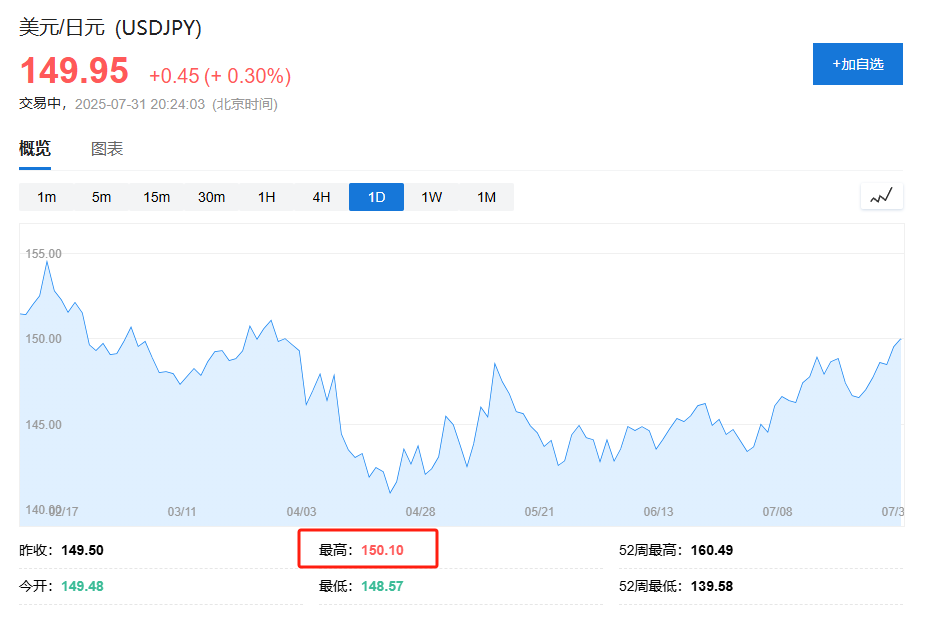
植田和男淡化通胀风险,日元创四月来最大跌幅重返150关口
Hua Er Jie Jian Wen· 2025-07-31 13:46
Core Viewpoint - The Bank of Japan (BOJ) maintained its interest rates while raising inflation expectations, but the comments from Governor Kazuo Ueda were perceived as not sufficiently hawkish, leading to a significant depreciation of the yen [1][3]. Group 1: Interest Rate Policy - The BOJ's decision to keep interest rates unchanged was influenced by an increase in consumer inflation expectations, primarily driven by rising food prices [3][4]. - Market expectations for a rate hike have diminished, with the probability of a rate increase this year now at 66%, up from 59% prior to the US-Japan trade agreement [4]. Group 2: Currency Impact - Following the BOJ's meeting, the yen initially strengthened but then reversed course, dropping 0.4% to 150.04, marking a new low since April 2 [3][4]. - The lack of a hawkish stance from the BOJ has weakened market confidence in the likelihood of a near-term rate hike, contributing to the yen's decline [4]. Group 3: Trade Agreement Implications - The recent trade agreement between Japan and the US, which includes a 15% tariff imposed by the US, complicates the BOJ's policy-making process [5]. - Governor Ueda indicated that while the agreement reduces uncertainty regarding future tariff impacts, it does not eliminate the high level of uncertainty surrounding external trade policies [5]. Group 4: Political Stability - Domestic political instability in Japan, particularly following the ruling coalition's loss of a majority in the upper house, has raised concerns about potential increases in government spending [6]. - This political uncertainty has contributed to the yen's weakness and has led to rising yields on ultra-long-term government bonds [6].

日央行本周继续“按兵不动”?贸易条件改善 何时加息成最大看点
Hua Er Jie Jian Wen· 2025-07-30 09:37
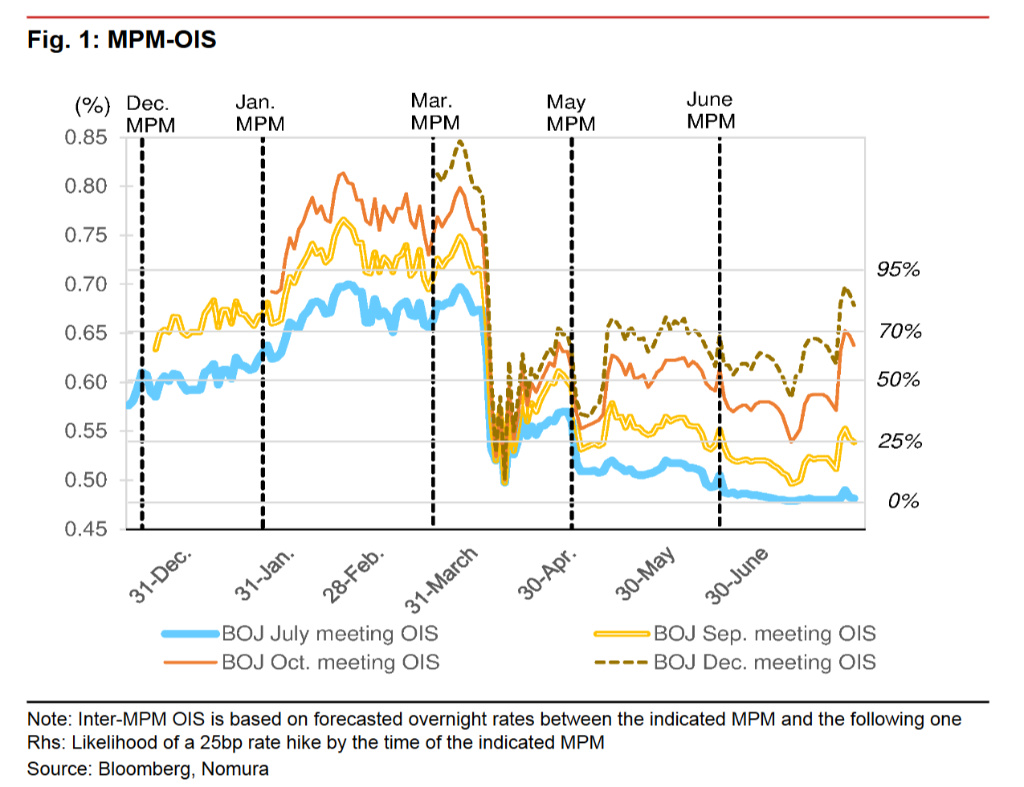
Core Viewpoint - The Bank of Japan is expected to maintain its interest rate at 0.5% during the upcoming monetary policy meeting, with a potential upward revision of inflation forecasts for the current fiscal year due to improved US-Japan trade uncertainties [1][14]. Group 1: Interest Rate Expectations - Market pricing indicates an approximately 80% chance of an interest rate hike by the end of the year, with October emerging as a favored time for the next increase [2][9]. - Following the US-Japan trade agreement, expectations for a rate hike have significantly rebounded, with a 65% probability for the October meeting and 80% for December [5][10]. - Despite the increased expectations, some analysts, including Goldman Sachs, caution that the Bank of Japan may adopt a wait-and-see approach due to ongoing negotiations and the absence of urgent inflationary pressures [8][9]. Group 2: US-Japan Trade Agreement - The US-Japan trade agreement has notably reduced uncertainties, with the US agreeing to impose a 15% tariff on Japanese goods, including automobiles, down from a previous 25% [3][4]. - Japan has committed to establishing a fund of up to $550 billion for direct investment in the US as part of the trade deal [3]. Group 3: Inflation Outlook - The Bank of Japan is likely to revise its short-term inflation forecast upward, anticipating a core CPI increase from 2.2% to approximately 2.5% for the fiscal year 2025 due to rising food prices [15][16]. - Despite the short-term adjustments, the medium-term inflation trajectory is expected to remain stable, with projections indicating a return to below 2% by the fiscal year 2026 [16]. Group 4: Bond Market Dynamics - Political uncertainties in Japan are currently pushing up long-term yields, but these premiums are expected to gradually ease as political clarity improves [17][18]. - The 10-year Japanese government bonds remain attractive, with expected holding and rolling yields surpassing capital losses, even with anticipated interest rate hikes [18].
日本两年期国债拍卖创9个月新高,收益率接近2008年高位引资金入场
Zhi Tong Cai Jing· 2025-07-29 06:16
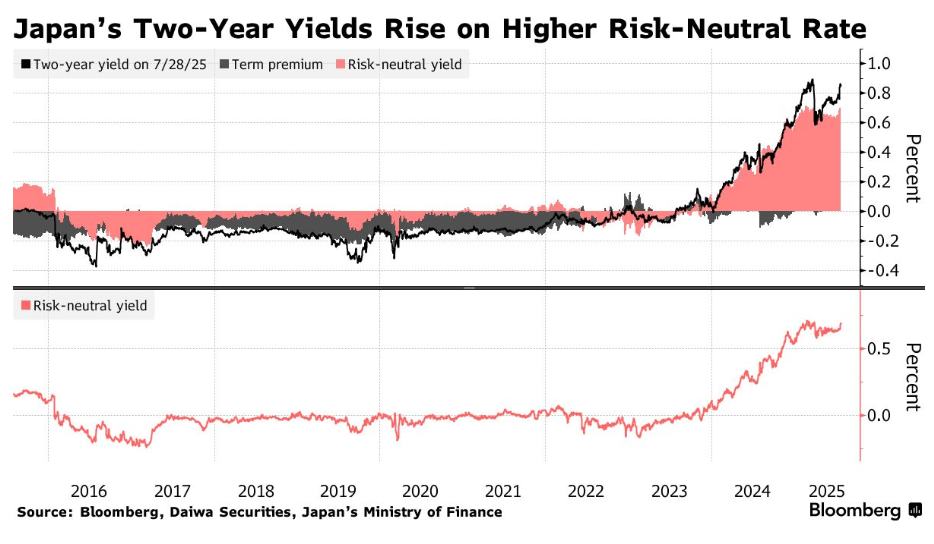
Group 1 - The auction of two-year Japanese government bonds achieved the highest demand level since October last year, indicating a significant increase in investor participation amid rising short-term bond yields [1] - The average bid-to-cover ratio for this auction reached 4.47, higher than last month's 3.90 and the 12-month average of 3.99, reflecting strong demand [1] - The tail price spread narrowed to 0.005, an improvement from the previous auction's 0.012, further indicating robust demand [1] Group 2 - Following the auction, two-year government bond prices rose, leading to a slight decrease in yields by two basis points to 0.82%, contrasting with the overall upward trend in recent short- and long-term bond yields [1] - Market pricing shows that the "risk-neutral yield," which measures future short-term interest rate expectations, has climbed to 0.7%, the highest in nearly four months, aligning with expectations of a potential interest rate hike by the Bank of Japan [4] - The probability of a rate hike by the Bank of Japan by the end of the year has increased from 57% at the beginning of the month to approximately 75% [4] Group 3 - The auction results validate market expectations for monetary policy normalization and reflect investor demand during a rising short-rate cycle [5] - Political uncertainties remain, but the recent trade agreement and clearer expectations for central bank rate hikes are driving the Japanese bond market into a new pricing phase [5]
汇率双周报 | 政治漩涡中的“弱势”日元?(申万宏观·赵伟团队)
赵伟宏观探索· 2025-07-28 12:45
Group 1 - The article discusses the divergence between the Japanese stock market and the yen, highlighting that while the Nikkei 225 index has approached historical highs, the yen has depreciated significantly [3][9][71] - Since June, the Nikkei 225 has surged by 9.2%, with foreign capital inflows totaling $5.11 billion, while the yen has weakened by 2.4% during the same period [3][9][71] - The article notes that this divergence is not uncommon in Japan, as currency depreciation can improve corporate earnings, particularly for companies with significant overseas revenue [18][71] Group 2 - The article identifies low inflation expectations and a cooling of interest rate hike predictions as key factors contributing to the yen's weakness [32][72] - Japan's core CPI has been influenced more by imported factors, and inflation has consistently fallen short of expectations, leading to a reduction in market expectations for interest rate hikes from 0.7 times to 0.6 times per year [32][72] - The article also mentions that unsuccessful trade negotiations between the US and Japan, along with political turmoil from recent Senate elections, have exacerbated the yen's weakness [4][41][72] Group 3 - Following the recent trade agreement between the US and Japan, market expectations for a Bank of Japan interest rate hike in October have increased from 42.1% to 68.1% [5][51][72] - However, the article warns that insufficient inflation persistence may still hinder significant interest rate increases by the Bank of Japan [5][51][72] - The focus moving forward will be on the upcoming leadership election within the ruling Liberal Democratic Party and potential fiscal expansion, which could lead to concerns about a "debt and currency double whammy" [58][72]

贵金属日评20250728:美欧达成关税贸易协议,美日达成关税协议提高日本央行加息预期-20250728
Hong Yuan Qi Huo· 2025-07-28 06:04
1. Report Industry Investment Rating No relevant information provided. 2. Core View of the Report The passage of the US stablecoin - related bill allowing pension funds to invest, the increased probability of the Fed's September rate - cut due to Trump's pressure, continuous gold - buying by central banks globally, and unresolved geopolitical risks may limit the downside of precious metal prices. It is recommended that investors mainly lay out long positions on dips. Specific support and resistance levels are provided for London gold, Shanghai gold, London silver, and Shanghai silver [1]. 3. Summary of Relevant Information 3.1 Precious Metal Market Data - **Gold**: - **Shanghai Futures Gold**: The closing price was 777.32 on 2025 - 07 - 21, 778.74 on 2025 - 07 - 25, and 781.70 on 2025 - 07 - 24, with a change of - 4.38 compared to the previous day and - 1.42 compared to the previous week. The trading volume and open interest also showed corresponding changes, and the inventory (in ten - gram units) increased by 900 from 28857 to 30258 [1]. - **COMEX Gold Futures**: The closing price was 3371.30 on 2025 - 07 - 17, 3338.50 on 2025 - 07 - 25, and 3345.40 on 2025 - 07 - 24, with a change of - 32.80 compared to the previous day and - 6.90 compared to the previous week. The trading volume, open interest, and inventory (in troy ounces) also had corresponding fluctuations [1]. - **London Gold Spot**: The price was 3318.50, with a change of 25 compared to the previous day [1]. - **Silver**: - **Shanghai Futures Silver**: The closing price was 9392.00 on 2025 - 07 - 21, 121.00 on 2025 - 07 - 25, and 9386.00 on 2025 - 07 - 24, with a change of 6 compared to the previous day. The trading volume, open interest, and inventory (in ten - gram units) changed accordingly [1]. - **COMEX Silver Futures**: The closing price was 38.33 on 2025 - 07 - 17, 39.29 on 2025 - 07 - 25, and 38.44 on 2025 - 07 - 24, with a change of - 0.96 compared to the previous day and - 0.11 compared to the previous week. The trading volume, open interest, and inventory (in troy ounces) also showed corresponding changes [1]. - **London Silver Spot**: The price was 38.74, with a change of - 0.29 compared to the previous day [1]. 3.2 Price Ratios and Spreads - **Gold - to - Silver Price Ratio**: The ratios of Shanghai gold/Shanghai silver, New York gold/New York silver, and London gold/London silver had different values and changes [1]. - **Spread and Basis**: The spreads between near - month and far - month contracts and the basis between spot and futures prices for gold and silver also had corresponding changes [1]. 3.3 Other Commodity and Financial Market Data - **Crude Oil**: INE crude oil was at 512.90 yuan/barrel, ICE Brent crude oil was at 68.53 dollars/barrel, and NYMEX crude oil was at 65.07 dollars/barrel, with corresponding price changes [1]. - **Copper**: Shanghai copper futures were at 79250 yuan/ton, and LME spot copper was at 9867 dollars/ton, with price fluctuations [1]. - **Steel and Iron Ore**: Shanghai rebar was at 3356 yuan/ton, and Dalian iron ore was at 802.50 yuan/ton, with price changes [1]. - **Interest Rates**: Shanghai Interbank Offered Rates (SHIBOR) for overnight and one - year terms, US 10 - year Treasury nominal and TIPS yields, and inflation - breakeven rates had different values and changes [1]. - **Exchange Rates**: The US dollar index, the central parity rates of the US dollar against the Chinese yuan, and the euro against the Chinese yuan had corresponding fluctuations [1]. - **Stock Indices**: Major global stock indices such as the Shanghai Composite Index, S&P 500, UK FTSE 100, French CAC40, German DAX, Nikkei 225, and South Korean Composite Index had different price movements [1]. 3.4 Important News - **Trade Agreements**: The US and the EU reached a 15% tariff trade agreement, with the EU increasing investment in the US by 600 billion dollars and purchasing 750 billion dollars of energy products. The US and Japan reached an agreement, and the Bank of Japan may restart interest rate hikes this year [1]. - **Legislation**: The US House of Representatives passed a stablecoin - related bill allowing pension funds to invest in gold and digital currencies [1]. - **Inflation and Unemployment**: Import tariffs pushed up US consumer - end inflation in June, and the initial jobless claims were 217,000, lower than expected [1]. - **Central Bank Policies**: The European Central Bank paused rate cuts in July, the Bank of England cut the key rate in May, and the Bank of Japan raised interest rates in January and may reduce bond purchases in 2026 [1].
关税谈判“投降”、石破茂辞职,为何日股暴涨、日债下跌?
Hua Er Jie Jian Wen· 2025-07-23 05:50
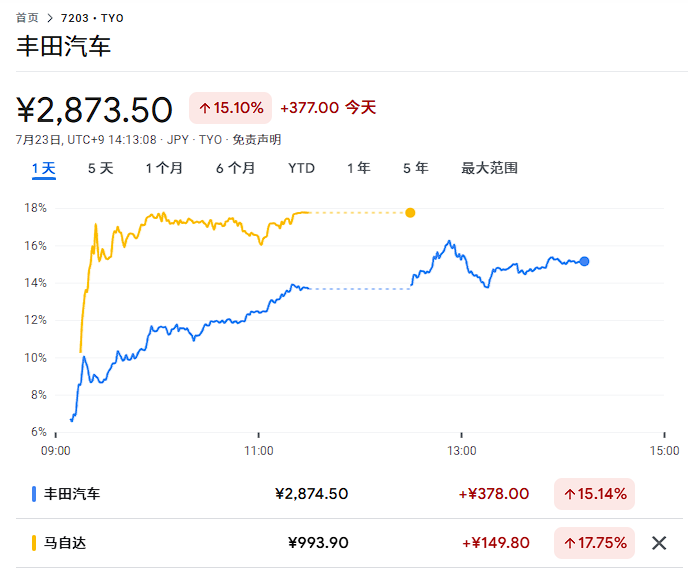
Group 1 - The core viewpoint of the news is that the announcement of a trade agreement between the US and Japan has led to a significant rise in the Japanese stock market and a drop in government bond prices, reflecting investor optimism regarding tariff uncertainties and political leadership changes [1][3][4] - The trade agreement includes a 15% tariff on Japanese cars, which is lower than the previously feared 25%, and Japan's commitment to invest $550 billion in the US [1][5][8] - Following the announcement, Japan's benchmark stock indices, including the TOPIX and Nikkei 225, rose by over 3%, with notable gains in the automotive sector, particularly Mazda and Toyota, which saw stock price increases of 18% and over 15% respectively [1][5][6] Group 2 - The rise in bond yields is attributed to increased expectations of a rate hike by the Bank of Japan, with the 10-year government bond yield rising by 9.5 basis points to 1.595%, nearing its highest level since 2008 [3][9] - The resignation rumors surrounding Prime Minister Shizo Abe have added to market optimism, as investors believe a leadership change could positively impact Japan's fiscal policy direction [3][6] - The market's focus is expected to shift back to Japan's fiscal outlook, with concerns about potential capital outflows due to the $550 billion investment commitment to the US, which could negatively affect the Japanese economy in the long term [7][9]
为何日本国债收益率攀升
2 1 Shi Ji Jing Ji Bao Dao· 2025-07-14 13:12
Group 1: Economic Indicators - Japan's 10-year government bond yield reached a near two-month high of 1.55%, indicating a pessimistic outlook on the economy [2] - The 30-year bond yield rose by 6.5 basis points to 3.111%, while the 20-year yield increased to 2.56% [2] - Japan's core consumer inflation hit 3.2% in January, the highest in 19 months, surpassing the Bank of Japan's 2% target [2] Group 2: Economic Assessment - The Japanese government downgraded its economic assessment to "deteriorating" for the first time in five years, signaling potential recession [2] - Factors contributing to the economic downturn include inflation, tariffs, and a significant drop in rice production [3] Group 3: Rice Shortage - Japan is experiencing a rice shortage due to a combination of short-term factors like last summer's heat and long-term policies that reduced rice planting area [3] - Rice production decreased by over 600,000 tons from 2020 to 2023, with 2023's harvest at a historical low of 6.61 million tons [3] Group 4: Political Landscape - The upcoming Senate election on July 20 will focus on key issues such as rising prices and tariff challenges, with the ruling coalition aiming to maintain a majority [4] - Different proposals to address inflation include a one-time cash payment from the ruling coalition and a consumption tax cut from the opposition [4] - The ruling coalition faces challenges in balancing opinions and maintaining support amid rising inflation and economic concerns [4]
欧元兑日元逼近年内高点,美元指数创1973年来最大跌幅
Sou Hu Cai Jing· 2025-07-03 08:02
Group 1 - The euro to Japanese yen exchange rate is rising, nearing a one-year high, driven by the continued weakness of the yen [1] - The US dollar index has significantly declined, marking the largest drop for the same period since 1973, with non-US currencies strengthening, particularly the euro, which has seen a cumulative increase of 13.86% against the dollar in the first half of 2025 [1] - The Bank of Japan maintains a loose monetary policy with a benchmark interest rate between 0 and 0.1%, indicating that the current financial environment will continue unless there is a significant price trend change [1] Group 2 - The Japanese authorities' intervention expectations regarding exchange rate fluctuations add uncertainty to the market, with the Bank of Japan conducting checks on the euro to yen exchange rate [2] - The euro to yen exchange rate reached 175.43, a new high since the euro's introduction in 1999, and if it approaches 180, intervention by Japanese authorities is likely [2] - Investors are closely monitoring the Bank of Japan's policy meetings for potential changes in bond purchase scales and interest rate decisions, which could impact the currency market [2]
野村:日本取消关税希望已破灭,美国或先加税
Hua Er Jie Jian Wen· 2025-07-03 03:32
Group 1 - The core viewpoint of the articles indicates that the stagnation in US-Japan trade negotiations poses significant pressure on the Japanese market, with potential tariffs of 30-35% threatening investor sentiment [1][2] - Analysts predict that the trade talks may be delayed until after the Japanese Senate elections, with a possible compromise emerging only after both sides escalate their positions [2][5] - The Japanese government may face political risks, including increased defense spending as a concession to the US and potential electoral backlash against the ruling Liberal Democratic Party (LDP) due to perceived negotiation failures [5][6] Group 2 - Despite a bleak outlook for manufacturing, the Bank of Japan's Tankan survey reveals resilience in the non-manufacturing sector, suggesting a possibility of interest rate hikes within the year, with a 40% probability for October [3][6] - The Japanese stock market is expected to remain under pressure from a strong yen and trade negotiation deadlock, making it an unfavorable environment for stock purchases [6] - Conversely, the bond market may find support from the weak stock market, with a shift in investor interest towards long-term and ultra-long-term bonds [6]

大宗商品周度报告:流动性和需求均承压商品短期或震荡偏弱运行-20250630
Guo Tou Qi Huo· 2025-06-30 13:49
1. Report Industry Investment Rating No relevant content provided. 2. Core Viewpoints - The commodity market may oscillate weakly in the short term due to pressure on liquidity and demand. After the easing of the Israel-Iran conflict, market risk appetite has been continuously recovering, and it is waiting for new domestic and foreign policy signals [1]. - Precious metals maintain a high - level volatile trend in the short term, but the medium - and long - term support logic remains unchanged. Non - ferrous metals continue the upward trend, and black metals' prices are rising again. Energy and chemical sectors show a weak performance, and agricultural products are on a weak track [1][2][3][4]. 3. Summary by Categories 3.1 Market Overview - Last week, the overall commodity market declined by 2.00%. The energy and chemical sector fell by 4.23%, agricultural products and precious metals dropped by 1.31% and 0.36% respectively, while black and non - ferrous metals rose by 1.29% and 2.71% respectively [1][6]. - The top - rising varieties were industrial silicon, coking coal, and zinc, with increases of 8.66%, 6.60%, and 3.39% respectively. The top - falling varieties were crude oil, fuel oil, and LU, with decreases of 12.02%, 10.73%, and 8.09% respectively [1][6]. - There was a small outflow of funds, with little overall change [1][6]. 3.2 Outlook - After the Israel - Iran conflict eased, the market's risk preference is continuously recovering. The market is waiting for new policy signals at home and abroad [1]. 3.3 Specific Commodity Analysis 3.3.1 Precious Metals - They maintain a high - level oscillating trend. Gold is caught between the Fed's high - interest - rate stance and the slight slowdown of US core inflation. Although the US dollar index's strength suppresses gold prices to some extent, geopolitical tensions and central banks' strong gold - buying intentions support gold prices. Silver is affected by its industrial nature, and its short - term trend follows gold [2]. 3.3.2 Non - ferrous Metals - They continue the upward trend. The increase in market risk preference and the Fed's policy adjustment boost the metal sector. Copper prices are supported by low overseas inventories and strong domestic demand, and short - term factors like South American mine maintenance increase supply - tightening expectations. Aluminum prices benefit from rising alumina prices and power - rationing expectations [2]. 3.3.3 Black Metals - Their prices are rising again. Steel futures are firm, driven by the strength of iron ore and expectations of policy support. Iron ore inventories at ports are decreasing, and coke prices are stabilizing, with some areas starting a new round of price increases [3]. 3.3.4 Energy - The overall performance is weak. International oil prices are falling after high - level oscillations, mainly due to the cooling of macro - risk aversion, repeated Fed interest - rate hike expectations, an unexpected increase in US commercial crude oil inventories, and doubts about OPEC +'s production - cut implementation [3]. 3.3.5 Chemicals - They continue the weak trend. Most chemical varieties are adjusting. Methanol, PVC, and PTA prices are falling due to supply - side recovery and downstream procurement hesitation. High port inventories and import pressure exacerbate the supply - demand contradiction in the methanol market [3]. 3.3.6 Agricultural Products - The overall trend is weak, with oils and fats falling significantly. The improved weather in South American soybean - producing areas and high domestic soybean inventories suppress the prices of soybean oil and palm oil. Rapeseed meal is weak due to weak aquaculture demand and the price advantage of substitutes [4]. 3.4 Commodity Fund Overview - Gold ETFs generally declined last week, with the total scale increasing by 0.95% and the total trading volume increasing by 12.65%. The energy - chemical ETF and the soybean - meal ETF fell by 4.41% and 4.29% respectively, while the non - ferrous metal ETF rose by 2.19%, and the silver fund rose by 0.83% [35].