
去库存

Search documents
2025年7月工业企业利润点评:工业企业盈利水平持续好转,去库存加速
KAIYUAN SECURITIES· 2025-08-28 12:44
1. Report Industry Investment Rating No relevant content provided. 2. Core Viewpoints of the Report - In the second half of 2025, the economic growth rate is not expected to decline significantly, and structural issues such as prices are trending towards improvement [10]. - The allocation between stocks and bonds continues to shift, with bond yields and the stock market expected to rise continuously [10]. - Against the backdrop of revised economic expectations, bond yields are expected to rise trend - wise [9]. 3. Summary by Relevant Catalogs Profit - The cumulative and monthly year - on - year declines in industrial enterprise profits have both narrowed. From January to July, the profits of above - scale industrial enterprises decreased by 1.7% year - on - year, an increase of 0.1 percentage points compared to January - June. In July, the profits of above - scale industrial enterprises decreased by 1.5% year - on - year, an increase of 2.8 percentage points compared to June, indicating continuous improvement in corporate profitability [5]. - Analyzing industrial enterprise profits from the aspects of volume, price, and profit margin, from January to July, the added value of above - scale industries increased by 6.3% year - on - year, and the PPI of all industrial products decreased by 2.9% year - on - year, both decreasing by 0.1 percentage points compared to January - June. The profit margin of above - scale industrial revenue decreased by 4.63% year - on - year, an increase of 0.18 percentage points compared to January - June. The recovery of the profit margin drove the narrowing of the decline in industrial profits [5]. Structure By Industry Category - From January to July, the total profit of the mining industry decreased by 31.6% year - on - year, the profit of the manufacturing industry increased by 4.8% year - on - year, and the profit of the public utilities industry increased by 3.9% year - on - year. The expansion of the profit decline in the mining industry was due to anti - involution and frequent extreme summer weather, while the expansion of the profit increase in the public utilities industry was affected by the widespread high - temperature weather in July [6]. - In July, the profit of the manufacturing industry increased by 6.8% year - on - year, a 5.4 - percentage - point increase compared to June, driving the growth rate of the profits of above - scale industrial enterprises to accelerate by 3.6 percentage points compared to June. The profit of high - tech manufacturing changed from a 0.9% decline in June to an 18.9% increase, driving the growth rate of the profits of above - scale industrial enterprises to accelerate by 2.9 percentage points compared to June [6]. By Enterprise Nature - From January to July, the profits of state - owned enterprises decreased by 7.5% year - on - year, the profits of joint - stock enterprises decreased by 2.8% year - on - year, the profits of foreign - invested and Hong Kong, Macao, and Taiwan - invested enterprises increased by 1.8% year - on - year, and the profits of private enterprises increased by 1.8% year - on - year [7]. - In July, the profits of medium - sized enterprises above designated size increased by 1.8% year - on - year, and the profits of small enterprises increased by 0.5% year - on - year, showing significant improvement in efficiency. The monthly profit of private enterprises increased by 2.6% year - on - year, 4.1 percentage points higher than the average level of the profits of above - scale industrial enterprises [7]. By Industrial Chain Position - From January to July, the proportion of the cumulative profit of upstream raw material mining in the profits of above - scale industrial enterprises was 12.3%, the proportion of mid - stream material manufacturing was 15.4%, the proportion of downstream equipment manufacturing was 38.0%, the proportion of downstream consumer goods manufacturing was 21.1%, the proportion of other manufacturing was 0.6%, and the proportion of public utilities was 12.5% [7]. - Inventory destocking accelerated. At the end of July, the nominal and real inventory year - on - year were 2.4% and 6.0% respectively, both decreasing by 0.7 percentage points. The overall asset - liability ratio of industrial enterprises at the end of July was 57.9%, remaining flat month - on - month [7]. Market - The industrial enterprise profit data was released at 9:30. Although the cumulative and monthly year - on - year declines in industrial enterprise profits both narrowed, the bond market did not trade based on this data, and bond yields fluctuated within a narrow range. After the mid - day break, the A - share market rose first and then fell back, with heavy trading volume and a decline. Under the stock - bond seesaw effect, bond yields first rose and then fell. At the end of the session, due to redemption factors, funds changed from buying to selling, and coupled with tightening funds, bond yields rose again [8].
天味食品(603317):去库存后逐步恢复,并购协同效应显现
Guoxin Securities· 2025-08-28 09:28
Investment Rating - The investment rating for the company is "Outperform the Market" [5][3][12] Core Views - The company is gradually recovering after destocking, with the effects of acquisitions becoming evident. In the first half of 2025, total revenue was 1.391 billion yuan, a year-on-year decrease of 5.24%, while net profit attributable to shareholders was 190 million yuan, down 23.01% [1][7] - The second quarter of 2025 saw a significant recovery, with total revenue reaching 749 million yuan, a year-on-year increase of 21.93%, and net profit attributable to shareholders increasing by 62.72% to 115 million yuan [1][7] - The company is benefiting from the integration of new subsidiaries, with online sales showing high growth, particularly in the second quarter, where online revenue increased by 66.7% [2][9] Summary by Sections Financial Performance - In the first half of 2025, the company achieved total revenue of 1.391 billion yuan, a decrease of 5.24% year-on-year, and a net profit of 190 million yuan, down 23.01% [1][7] - The second quarter of 2025 showed a recovery with total revenue of 749 million yuan, up 21.93% year-on-year, and net profit of 115 million yuan, up 62.72% [1][7] Revenue Channels - The company reported offline and online channel revenues of 540 million yuan and 200 million yuan respectively in the second quarter of 2025, with year-on-year increases of 9.5% and 66.7% [2][9] - The core categories, such as hot pot and recipe seasonings, saw revenue increases of 29.0% and 17.8% respectively in the second quarter [1][9] Profitability Improvement - The gross margin for the second quarter of 2025 was 37.0%, an increase of 3.7 percentage points year-on-year, driven by a higher proportion of high-margin products [2][9] - The selling and administrative expense ratios were reduced to 10.0% and 6.0%, respectively, indicating improved efficiency in a competitive environment [2][9] Future Outlook - The company has adjusted its revenue forecasts for 2025-2027, expecting total revenues of 3.654 billion yuan, 3.960 billion yuan, and 4.269 billion yuan, with year-on-year growth rates of 5.1%, 8.4%, and 7.8% respectively [3][12] - The expected net profits for the same period are 680 million yuan, 739 million yuan, and 796 million yuan, with growth rates of 8.8%, 8.7%, and 7.7% [3][12]

如何看待反内卷预期驱动的单月利润增速改善的持续性
2025-08-27 15:19
Summary of Conference Call Records Industry Overview - The conference call discusses the industrial sector's performance, particularly focusing on the midstream raw materials industry, fuel processing, and black processing sectors, which benefited from rising prices of coal and steel products [1][4]. Key Points and Arguments - **Profit Improvement in July**: Industrial enterprises saw a marginal improvement in profit growth in July, primarily driven by the midstream raw materials sector, while revenue growth showed a slight decline [3][4]. - **Downstream Consumer Goods Sector**: The downstream consumer goods sector faced challenges due to the automotive manufacturing industry's price wars and a lull in government subsidies, leading to a noticeable drop in revenue and profit growth [5][10]. - **Inventory Trends**: There was a significant acceleration in inventory reduction in July, indicating a conservative market demand outlook. Different industries exhibited varying inventory cycles, with upstream resource sectors starting to actively reduce inventory from June [7][8]. - **Midstream Raw Materials Performance**: The midstream raw materials sector showed notable profit growth, particularly in fuel processing and black processing industries, benefiting from price increases in coal and steel products [4][11]. - **Future Outlook for Downstream Consumer Goods**: Attention is needed on the rollout of government subsidies and the potential shift from goods consumption to service consumption, which may impact corporate profitability [9][13]. Additional Important Insights - **Weak Demand Impact**: The weak demand environment has resulted in longer accounts receivable collection periods and higher inventory turnover days, constraining business operations [12]. - **Potential Risks**: The call highlighted potential risks from external factors such as U.S. tariffs and the impact of changing consumer behavior on domestic demand, which could disrupt industrial profit trends [2][13]. - **Sector-Specific Observations**: The call noted that while the midstream raw materials sector transitioned to active inventory reduction, the upstream sector had been in a passive accumulation phase until June [11]. This summary encapsulates the key insights and trends discussed in the conference call, providing a comprehensive overview of the industrial sector's current state and future outlook.
上半年光伏产业困境依旧 行业深度调整或仍未结束
Xin Hua Cai Jing· 2025-08-27 07:18
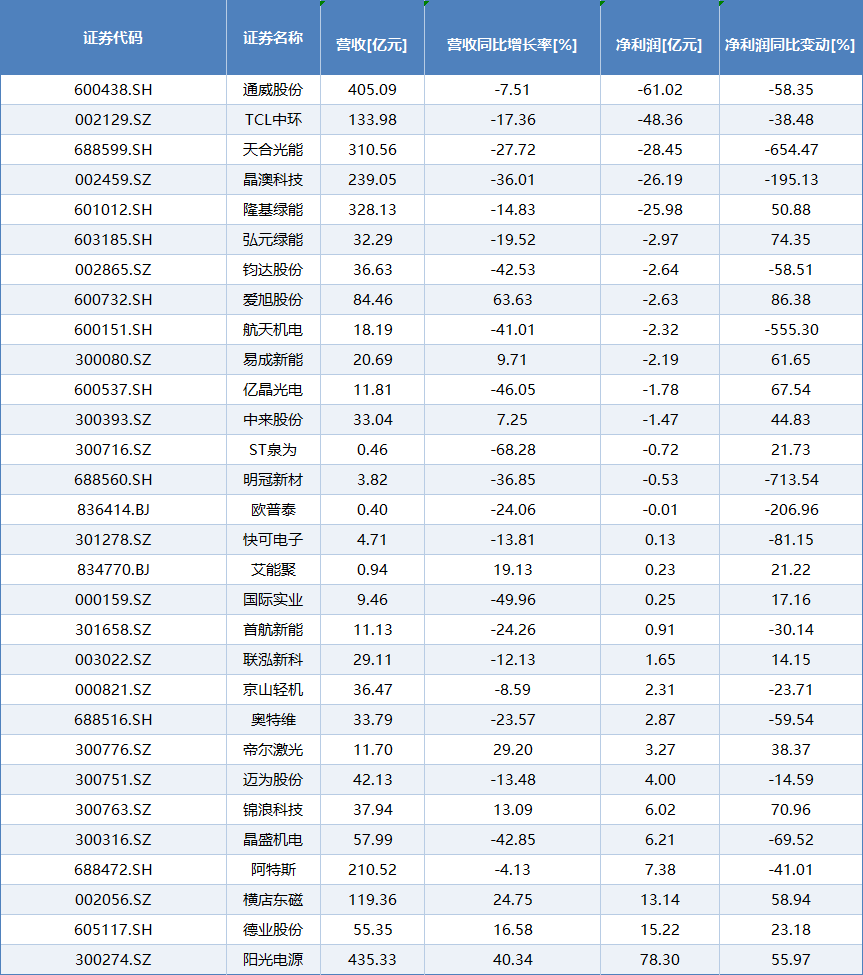
Core Viewpoint - The photovoltaic industry continues to face significant challenges, with many companies reporting losses in their 2025 semi-annual reports, indicating that the industry's deep adjustment may not be over yet [1][3][6]. Industry Performance - As of August 26, 30 listed photovoltaic companies have released their 2025 semi-annual reports, with 20 companies experiencing a year-on-year decline in revenue and 15 companies reporting net losses [3][4]. - Notable companies such as Longi Green Energy reported a revenue decline of 14.83% and a net loss of 2.569 billion yuan, while Tongwei reported a revenue decline of 7.51% and a net loss of 4.955 billion yuan [3][4]. Market Dynamics - The industry has seen some positive effects from self-regulation efforts initiated in the second half of last year, with prices for polysilicon and silicon wafers stabilizing [8]. - However, the pace of inventory reduction remains below expectations, and the overall market demand is showing signs of slowing down due to the end of the "rush installation" trend [8][9]. Demand and Supply Challenges - The demand side is expected to face negative impacts from demand exhaustion as the "rush installation" trend subsides [6][8]. - The industry is experiencing a significant decline in production growth rates, with battery cell and module production growth dropping below 15% [8]. International Market Uncertainties - The global photovoltaic market is slowing down, with traditional overseas markets shrinking and emerging markets like Latin America and the Middle East growing but not significantly impacting overall growth [9][10]. - Recent changes in U.S. clean energy policies have raised concerns among companies about expanding into international markets [10]. Technological Innovation - Companies are increasingly relying on technological innovation to navigate the industry's challenges, with some focusing on next-generation photovoltaic technologies like perovskite [11][12]. - However, the current low profit margins and intense competition in the crystalline silicon market are hindering the promotion and application of new technologies [12]. Regulatory and Market Support - Industry insiders emphasize the need for stronger regulatory measures to address issues like "virtual power" and "lowering quality control," which are detrimental to innovation [12]. - There is a call for government intervention to facilitate market consolidation and support the exit of outdated production capacities [12].

上半年光伏产业困境依旧,行业深度调整或仍未结束
Xin Hua Cai Jing· 2025-08-27 07:09
Group 1 - The core issue facing the photovoltaic industry is ongoing losses, with many leading companies reporting significant declines in revenue and net profit for the first half of 2025 [1][2][4] - As of August 26, 2025, 30 listed photovoltaic companies have released their semi-annual reports, with 20 companies experiencing a year-on-year revenue decline and 15 companies reporting net losses [2][3] - Notable losses include Longi Green Energy with a revenue decline of 14.83% and a net loss of 2.569 billion yuan, Tongwei with a revenue decline of 7.51% and a net loss of 4.955 billion yuan, and JA Solar with a revenue decline of 36.01% and a net loss of 2.58 billion yuan [2][3] Group 2 - Despite some leading companies showing signs of reduced losses, the industry is still undergoing deep adjustments, with a potential negative impact from demand exhaustion in the second half of the year [4][5] - The photovoltaic industry has seen some stabilization in prices for polysilicon and silicon wafers due to self-regulation efforts, but the pace of inventory reduction remains below expectations [5][6] - The industry faces challenges from a lack of mandatory self-regulation, especially during critical times for companies, leading to concerns about pricing strategies and market share [6][7] Group 3 - As the domestic photovoltaic market approaches saturation, companies are increasingly looking for growth opportunities overseas, but external uncertainties are causing hesitation [7][8] - Recent changes in U.S. clean energy policies have raised concerns among companies about the feasibility of expanding into international markets, particularly in Southeast Asia and the Middle East [7][8] - The ongoing geopolitical tensions and trade policies are reshaping supply chains and complicating international collaborations in photovoltaic technology [8][9] Group 4 - Companies are exploring new technologies such as perovskite solar cells and advanced silicon products (TOPCon, HJT, BC) to overcome current industry challenges, but consensus on the best technological path is lacking [9][10] - The low profit margins in the industry are hindering innovation in supporting sectors, and the competitive pressure from leading companies is affecting smaller firms' ability to invest in new technologies [9][10] - There is a call for stronger government regulation to address issues like false power ratings and quality control, which are seen as critical for fostering innovation and ensuring market stability [10]
大行评级|花旗:上调越秀地产目标价至6.2港元 维持“买入”评级
Ge Long Hui· 2025-08-27 03:19
Core Viewpoint - Citigroup has a positive outlook on Yuexiu Property, noting a year-on-year sales growth of 11% in the first half of the year, achieving 51% of its annual target [1] Sales Performance - The company ranked first in sales in Beijing and second in Guangzhou, with accelerated sales in Shanghai and Hangzhou [1] Land Acquisition and Financials - Yuexiu Property has supplemented its high-quality land reserves, maintained a stable gross profit margin, and successfully reduced inventory [1] - The financing cost has decreased to 3.16%, leading to an upgrade in credit rating outlook [1] Dividend and Management - The company maintains a stable dividend payout ratio of 40% [1] - Despite recent management changes, the company's strategic direction remains consistent [1] Investment Rating - Citigroup maintains a "Buy" rating on Yuexiu Property, raising the target price from HKD 5.45 to HKD 6.2 [1]

今世缘(603369):2025年中报点评:放下报表,思路清晰
Huachuang Securities· 2025-08-26 03:43
Investment Rating - The report maintains a "Strong Buy" rating for the company with a target price of 75 yuan [2][7]. Core Views - The company reported a revenue of 6.95 billion yuan for H1 2025, a decrease of 4.8% year-on-year, and a net profit attributable to shareholders of 2.23 billion yuan, down 9.5% year-on-year. In Q2 alone, revenue was 1.85 billion yuan, down 29.7%, and net profit was 580 million yuan, down 37.1% [2][7]. - The report indicates that the company is actively managing its inventory and has begun a phase of destocking, which is expected to relieve pressure in the coming year. The company is focusing on deepening market penetration in provincial areas and expanding its presence in key markets outside the province [7][8]. - The report highlights that the company has increased its marketing and promotional expenses, which has impacted profitability. The gross margin for Q2 was 72.8%, a slight decrease of 0.2 percentage points year-on-year [7][8]. Financial Summary - The total revenue forecast for 2025 is 10.11 billion yuan, reflecting a year-on-year decline of 12.4%. The net profit forecast for 2025 is 2.89 billion yuan, down 15.5% year-on-year [3][7]. - The earnings per share (EPS) for 2025 is projected to be 2.31 yuan, with a price-to-earnings (P/E) ratio of 19 times [3][7]. - The company’s total assets are estimated to reach 25.71 billion yuan by 2025, with a debt-to-equity ratio of 10.6% [3][7].

计划外装置停车增加 9月PTA去库存预期较强、现货基差或继续走强
Xin Hua Cai Jing· 2025-08-25 02:19
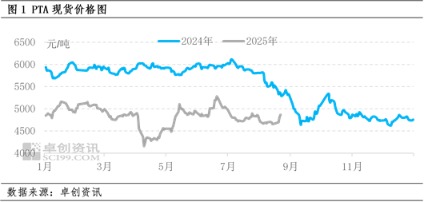
Core Viewpoint - The PTA spot market has risen to a monthly high in late August due to destocking expectations combined with cost support, with a strong expectation for further destocking in September [1][3]. Group 1: Market Dynamics - In late August, the domestic PTA spot market reached a monthly high, driven by destocking expectations and cost support [1]. - The restart of a 2.2 million ton PTA plant in East China followed by its shutdown, along with unplanned shutdowns of a 5 million ton PTA plant in South China, led to a decrease in estimated PTA production to around 6.15 million tons, accelerating destocking [1][3]. - Market rumors about potential reductions in naphtha production in South Korea have positively influenced PX prices, indirectly supporting PTA prices [1]. Group 2: September Outlook - Despite uncertainties regarding the duration of shutdowns in South China, there is a strong overall expectation for PTA destocking in September [3]. - Current September offers are priced at a premium of 20-40 yuan per ton over futures, confirming market speculation [3]. - Two scenarios for PTA production in September are outlined: if the South China plant shuts down for over a month, production could be estimated at 6.23 million tons with a destocking of 370,000 tons; if it shuts down for two weeks, production could be 6.46 million tons with a destocking of 140,000 tons [3]. Group 3: Cost and Demand Factors - As of August 21, the average PTA processing fee for August was 196 yuan per ton, indicating production losses, with expectations for further unplanned maintenance in September [3]. - The downstream polyester market is transitioning from a demand off-season to a peak season, with expectations for demand recovery during the "golden September and silver October" period, despite potential reductions in FDY production by major manufacturers [3][5]. - The future price increase of PTA is expected to be influenced by cost factors, particularly the negotiations between the US and Russia regarding oil prices, which could limit the extent of PTA price increases [5].
洋河股份(002304):2025年中报点评:优化调整,静待破晓
Changjiang Securities· 2025-08-23 15:03
Investment Rating - The investment rating for the company is "Buy" and is maintained [6]. Core Views - In the first half of 2025, the company reported operating revenue of 14.796 billion yuan, a year-on-year decline of 35.32% - The net profit attributable to shareholders was 4.344 billion yuan, down 45.34% year-on-year [2][4]. - In Q2 2025, the company achieved operating revenue of 3.729 billion yuan, a decrease of 43.67% year-on-year, with net profit of 707 million yuan, down 62.66% year-on-year [2][4]. Financial Performance - The company's revenue from outside the province was 7.392 billion yuan, a decline of 43% year-on-year, while revenue from within the province was 7.121 billion yuan, down 26% year-on-year [8]. - Revenue from mid-to-high-end liquor was 12.672 billion yuan, a decrease of 37% year-on-year, primarily due to the company's strategy of controlling volume and stabilizing prices for key products [8]. - The net profit margin for the first half of 2025 decreased by 5.38 percentage points to 29.36%, with a gross margin decline of 0.33 percentage points to 75.02% [8]. Cost and Expenses - The company's expense ratio increased, with the selling expense ratio rising by 3.1 percentage points and the management expense ratio increasing by 1.73 percentage points [8]. - Advertising and promotional expenses amounted to 1.45 billion yuan, a decrease of 21.03% year-on-year, mainly due to reduced advertising costs and rebates [8]. Future Outlook - The company is actively controlling inventory, which has shown initial results, and the prices of core products remain stable [8]. - The company is expected to see marginal improvements in performance as inventory is gradually reduced, alongside a strong dividend capability [8]. - The estimated EPS for 2025 and 2026 is projected to be 3.19 yuan and 3.41 yuan, respectively, corresponding to a valuation of 23 and 22 times [8].

舍得酒业二季度净利润增长140%去库存已接近尾声
Xin Lang Cai Jing· 2025-08-22 21:10
Core Insights - Shede Liquor achieved a revenue of 2.701 billion yuan and a net profit of 443 million yuan in the first half of 2025, with a significant performance in the second quarter [1] - The company reported a recovery in performance, with a net profit of 346 million yuan in the first quarter, surpassing the total for the previous year, and a net profit of 97.17 million yuan in the second quarter, marking a year-on-year increase of 139.5% [1] - Inventory levels have returned to rational levels, with total assets increasing by 5.12% compared to the end of the previous year, and net cash flow from operating activities turning positive [1] Financial Performance - In the first half of 2025, Shede Liquor's revenue was 2.701 billion yuan, with a net profit of 443 million yuan [1] - The second quarter saw a revenue of 1.1 billion yuan, contributing significantly to the overall performance [1] - The net profit margin improved significantly, with a year-on-year increase of nearly five percentage points [1] Strategic Initiatives - The company implemented a strategy focusing on "downstream channels, upstream branding, and a comprehensive approach to consumers," achieving notable results in the incremental market [1] - E-commerce and live streaming channels were emphasized, with e-commerce sales reaching 336 million yuan, a year-on-year growth of 31% [1] - The company is targeting the banquet market, with products like "Taste Shede" and "Shezhi Dao" performing well, leading to double-digit growth in the banquet market [1] Product Development - Shede Liquor is launching its first low-alcohol drink, "Shede Zizai," on August 30, which is a 29-degree aged liquor aimed at enhancing the product structure and expanding the white liquor market [2] - The company is focusing on the T68 product line, which has seen rapid growth in sales and market presence, ranking among the top three in the high-end bottled liquor category [2]
