
流动性宽松

Search documents
国诚投顾:美联储降息预期再升温,矿冶博弈刺激铜价上涨
Sou Hu Cai Jing· 2025-12-04 08:52
Market Overview - As of November 28, the Shanghai Composite Index increased by 1.40% to 3888.6 points, while the CSI 300 Index rose by 1.64% to 4526.66 points. The SW Nonferrous Metals Industry Index saw a significant increase of 3.37% to 7396.64 points [1] - Within the nonferrous metals sector, the sub-industries of industrial metals, precious metals, minor metals, energy metals, and new metal materials experienced changes of 3.46%, 4.86%, 4.20%, 0.91%, and 4.49% respectively [1] Key Metal Price Data - Last week, the prices for copper, aluminum, zinc, lead, nickel, and tin on the Shanghai Futures Exchange were 87,430 CNY/ton, 21,610 CNY/ton, 22,425 CNY/ton, 17,090 CNY/ton, 117,080 CNY/ton, and 305,040 CNY/ton, with changes of 1.66%, 0.68%, -0.31%, -0.64%, 1.99%, and 4.19% respectively [2] - Gold and silver prices were reported at 953.92 CNY/gram and 12,727 CNY/kilogram, reflecting increases of 2.00% and 6.56% respectively [2] - Prices for praseodymium neodymium oxide, terbium oxide, dysprosium oxide, and sintered neodymium iron boron N35 were 568,000 CNY/ton, 6,505,000 CNY/ton, 1,470,000 CNY/ton, and 142.5 CNY/kilogram, with changes of 3.56%, -0.31%, -1.01%, and 3.64% respectively [2] - Battery-grade lithium carbonate, industrial-grade lithium carbonate, battery-grade lithium hydroxide, and Australian lithium concentrate were priced at 93,500 CNY/ton, 91,500 CNY/ton, 84,000 CNY/ton, and 1,000 USD/ton, with changes of 0.54%, 1.10%, 1.20%, and -8.26% respectively [2] - Domestic electrolytic cobalt, cobalt tetroxide, and cobalt sulfate prices were 405,500 CNY/ton, 347,500 CNY/ton, and 89,500 CNY/ton, with changes of 0.75%, 0.00%, and 0.00% respectively [2] Investment Insights - Recent dovish comments from the New York Fed President Williams regarding increased risks of employment downturn and reduced inflation risks have led to a renewed expectation of a rate cut by the Federal Reserve in December, with market probabilities exceeding 80% [3] - The ongoing rate cut cycle and liquidity pressures may continue to support rising prices for gold and silver [3] - Global copper production is expected to face significant uncertainty due to frequent accidents at major copper mines, leading to a downward revision of production forecasts [3] - Codelco, the world's largest copper producer, has proposed a substantial increase in the annual contract premium for refined copper to Chinese smelters, rising from 89 USD/ton in 2025 to 335-350 USD/ton in 2026, marking an increase of over 275% [3] - The China Smelters Purchase Team (CSPT) has agreed to reduce copper concentrate production capacity by over 10% for 2026, aiming to improve the supply-demand balance [3] - Potential tariffs on copper by the U.S. and the ongoing liquidity expansion by the Federal Reserve are expected to further drive copper prices upward [3]


美股真正的风险
虎嗅APP· 2025-12-04 00:14
Core Viewpoint - The recent fluctuations in the US stock market are primarily influenced by the Federal Reserve's monetary policy, with significant attention on the potential for interest rate cuts in December [2][12]. Group 1: Market Reactions and Influences - The market's sentiment shifted dramatically following comments from New York Fed President Williams, raising the probability of a December rate cut from approximately 35% to 70%, which led to a rebound in the Nasdaq [2]. - The Nasdaq index recovered from a significant drop, but the divergence in the market remains, particularly highlighted by Michael Burry's criticism of the AI bubble and his short positions against Nvidia and Palantir [3][4]. Group 2: AI Narrative and Valuation Concerns - AI remains a central theme driving the current market, with major tech companies like Nvidia, Microsoft, and Google contributing over half of the Nasdaq's gains in 2025 [6]. - Nvidia's market dominance is attributed to its leading position in AI training and inference technologies, but concerns about the sustainability of its high valuation and growth rates have emerged [7]. - The market is witnessing a potential bubble in AI valuations, with the S&P 500's price-to-earnings ratio at historical highs, indicating a disconnect between investment and actual returns [7][8]. Group 3: Liquidity and Economic Indicators - Liquidity conditions are crucial for short-term stock performance, with tightening liquidity leading to immediate price reactions, including forced deleveraging and valuation compression in tech stocks [12][15]. - The 10-year US Treasury yield serves as a key indicator of global liquidity, with rising yields reflecting tighter conditions and potential market volatility [12][13]. - The Federal Reserve's policies, including interest rate expectations and quantitative easing/tightening, significantly influence liquidity and market dynamics [15][16]. Group 4: Inflation and Economic Outlook - The primary concern for the market is the risk of stagflation, where high inflation persists alongside economic weakness, complicating the Federal Reserve's policy responses [18][19]. - Current economic indicators suggest that the US is not yet in a severe stagflation scenario, with core CPI growth at approximately 3.1% and unemployment at 4.2%, indicating a "quasi-stagflation" environment [20][22]. - The future trajectory of the stock market will depend heavily on inflation trends, particularly core CPI and PCE, as well as the Federal Reserve's ability to manage monetary policy effectively [22].

浙商证券李超:2026年市场“直观云帆济沧海”,动态配置两大主线
Xin Lang Zheng Quan· 2025-12-01 05:37
Core Insights - The 2025 Analyst Conference highlighted optimism for the A-share market, predicting a significant influx of global capital and a bull market ahead [1] Group 1: Economic Analysis Framework - Li Chao emphasized a four-tier analytical framework for understanding China's economy, which includes US-China relations, social stability, structural transformation, and economic growth [3] - The framework suggests that maintaining economic growth is contingent upon addressing the first three layers, with a focus on leveraging export advantages to sustain growth [3] Group 2: Investment Strategy - The primary investment focus is on sectors benefiting from declining interest rates, specifically technology stocks and dividend stocks [4] - Technology stocks are expected to see increased valuations as investors become more willing to price future cash flows favorably in a low-interest environment [4] - Dividend stocks are positioned as attractive alternatives in a low-yield bond market, providing stability and potential for value re-evaluation [4] Group 3: Market Outlook - Li Chao expressed a positive outlook for the capital market in 2026, driven by liquidity and structural opportunities, urging investors to adopt an optimistic stance [5]


帮主郑重:12月A股金股地图,券商重点推荐的三大方向
Sou Hu Cai Jing· 2025-12-01 03:11
Core Viewpoint - The A-share market has experienced declines in November, with the Shanghai Composite Index down 1.67%, the Shenzhen Component Index down nearly 3%, and the ChiNext Index down over 4%. As December approaches, various brokerages have released their recommended stocks for the month, revealing interesting trends in investment preferences [1]. Group 1: Popular Stocks - Midea Group is highlighted as a "popular stock" for December, being included in the recommendation lists of four brokerages. The company shows strong fundamentals in its home appliance business, rapid growth in its new energy and industrial technology sectors, and recent advancements in AI and robotics [3]. - Zhongji Xuchuang is also recommended by three brokerages, having increased by over 8% in November, with a current stock price of 514.5 yuan. The company has a clear technological advantage in the optical module field and is seeing a steady increase in overseas orders [4]. - Not all recommended stocks performed well; for instance, Goldwind Technology saw a decline of 1.85% in November, which may present a better entry opportunity for investors [4]. Group 2: Hot Investment Sectors - The cyclical sector is favored by multiple brokerages, particularly in the basic chemicals and industrial technology fields. Analysts suggest that the end-of-year policy window may validate a "policy bottom," potentially serving as a catalyst for economic growth in 2026 [5]. - The consumer sector is also noted, with a focus on previously lagging consumer stocks that tend to perform better during market fluctuations. The trend of consumption upgrading continues, especially among leading high-end and essential consumer goods, which exhibit strong defensive characteristics and stable long-term returns [5]. - The technology growth sector is advised to focus on less crowded areas. After adjustments in October, concerns regarding AI have largely dissipated, making sectors like gaming, media, and computing more attractive in terms of valuation [5]. Group 3: Mid to Long-term Investment Strategies - A combination of cyclical stocks and policy bottom strategies is recommended, with a focus on monitoring end-of-year policy developments, especially in fiscal and industrial policies, targeting leading companies in chemicals and industrial technology [6]. - Differentiated investments in the technology sector are advised, avoiding overheated AI stocks and concentrating on reasonably valued segments like gaming, media, and computing, with a patient approach to waiting for rotation opportunities [7]. - A balanced allocation strategy is suggested, with 30% in high-dividend, low-volatility financial and consumer leaders as a stabilizing force, and 70% in cyclical and technology growth sectors for aggressive positioning [8]. - A global perspective is encouraged to capture opportunities in resource commodities like gold and copper, as well as in manufacturing sectors benefiting from overseas interest rate cuts, preparing for a potential global economic recovery [8].

流动性与科技双驱动的资本市场
Sou Hu Cai Jing· 2025-12-01 01:20
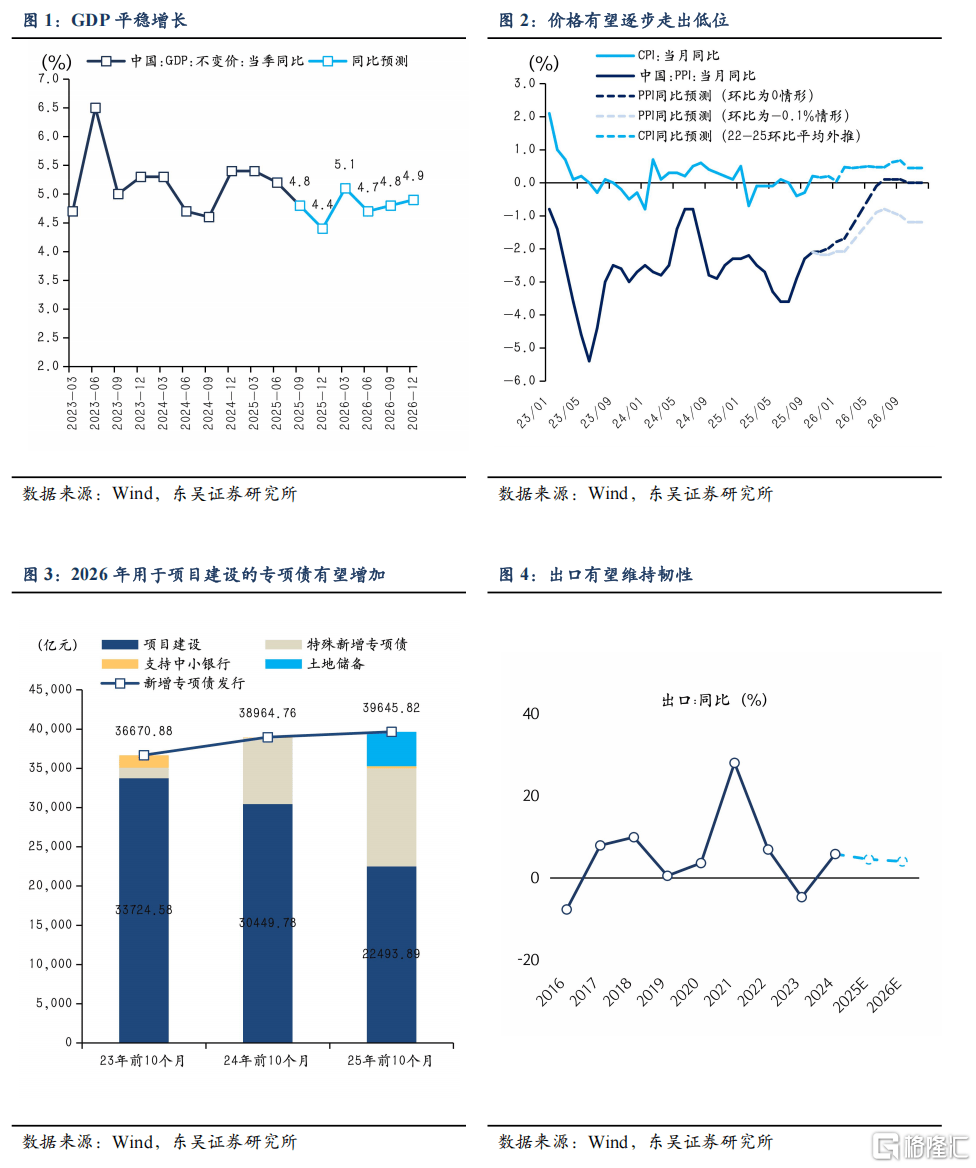
Macro Economic Outlook - The domestic economy is expected to grow steadily at 4.9% in 2026, with infrastructure investment accelerating and manufacturing investment maintaining at 6% [1][6] - Consumer spending is anticipated to be supported by subsidy policies, while export growth may be driven by demand from the US due to its easing monetary policies [6][18] - CPI is projected to have a slight positive growth of 0.5%, while PPI's decline is expected to narrow to -0.9% [1][6] Global Environment - Short-term, US-China relations are entering a relatively stable phase, but long-term trends indicate a gradual decoupling in key sectors [1][18] - Global liquidity is expected to ease, with the Federal Reserve potentially initiating four rate cuts from late 2025 to 2026 [1][18] Asset Allocation Outlook for 2026 Bonds - The bond market is expected to focus on defensive strategies, with 10-year rates projected to fluctuate between 1.70% and 2.0%, and 30-year rates between 1.90% and 2.30% [2][21] - Short-duration high-quality credit bonds and medium-duration rate bonds are recommended for defensive positioning [2][21] Currency - The RMB is expected to appreciate gradually, potentially reaching around 6.80 by the end of 2026, with annualized volatility remaining low at 3.0%-4.0% [3][23] Commodities - The "green inflation" narrative is expected to benefit metals like copper and aluminum due to demand from AI and new energy sectors, with a long-term price increase anticipated [3][26][30] - The "反内卷" (anti-involution) policy is expected to influence commodity markets significantly, particularly in sectors facing overcapacity [3][30] Gold - Gold prices are projected to maintain a range of $4000-$4200 per ounce until the end of 2025, with an upward trend expected post-2026 due to easing liquidity [3][32] A-shares - The A-share market is entering the next phase of an "innovation bull," driven by recovering inflation and improving corporate earnings, with a focus on technology and core manufacturing sectors [3][39][41] - The market is expected to see continued inflows from foreign, institutional, and individual investors, enhancing liquidity and supporting valuations [3][47][48] US Stocks - The US stock market is anticipated to reach new highs, benefiting from a favorable macro environment and AI industry narratives, although high valuations may increase volatility [4][18]
股指:牛市新阶段,关注IC机会
Hua Tai Qi Huo· 2025-11-30 11:29
Report Industry Investment Rating No relevant content provided. Core Viewpoints - In 2026, the domestic and overseas macro - liquidity is expected to maintain a resonant and loose state, with sufficient market capital. The stock market has become an important outlet for funds, and the liquidity support for the stock market will be further strengthened. The securitization rate increase will be one of the core drivers [6]. - It is necessary to pay attention to the profit repair progress in the second stage of the bull market. The profit bottom of the entire A - share market is expected to appear at the end of 2025 or the beginning of 2026, and the market may shift from the previous structural differentiation to full - scale spread, driving the four major indexes upward. The Shanghai Composite 50 and CSI 300 indexes are expected to rise steadily, while the CSI 500 and CSI 1000 indexes may have stronger performance - driven market conditions [6]. - Under the guidance of the capital market policies promoted by the new "Nine - National - Point Plan", the stock index market will tend to the mid - and large - cap style in the long term. In 2026, the market driven by profit and industry policies will focus on the cycle and technology sectors, and the performance of the CSI 500 index will be more prominent [7]. Summary by Directory I. Internal and External Liquidity Remains Abundant 1. The US is Expected to Continue Cutting Interest Rates - The US labor market is weak, with indicators such as the continuous rise in the number of initial jobless claims and a peak in corporate lay - offs in October 2025. The unemployment rate of high - skilled groups has reached a new high since 2022 [12]. - The deterioration of the labor market has strengthened the Fed's expectation of interest rate cuts. The current round of interest rate cuts may last until the end of 2026, with the target rate possibly falling below 1%, and the cumulative rate cut may exceed 300 basis points [13]. 2. Domestic Liquidity Remains Ample - The domestic economy faces pressure in investment, export, and consumption, but still maintains a stable and progressive overall trend. New productive forces are growing, and the necessity of continuing loose monetary and active fiscal policies in 2026 is more prominent [17]. - The central bank has ensured reasonable and ample liquidity through various tools. The policy interest rate has remained stable, and the market interest rate has run at a low level. The M1 - M2 scissors - gap has continued to narrow, indicating an improvement in the activation of funds [23]. 3. The Ranking of Stock Index Investment Rises - The yields of traditional assets such as bonds and real estate have declined, while the performance of the equity market has been excellent. The gap in yields between traditional and equity assets has widened [26]. - Policy guidance, such as encouraging insurance funds to increase equity allocation and optimizing the investment scope of public funds, has accelerated the flow of funds into the equity market. Various types of funds are increasing their equity market allocation [27]. II. Focus on Profits in the Second Stage of the Bull Market 1. System Optimization Consolidates the Foundation for a Long - Term Bull Market - The new "Nine - National - Point Plan" in 2024 is a milestone for the capital market to turn to fundamental investment. In 2025, the regulatory authorities further optimized the system in terms of investment and financing reform, market stability, and opening - up [48]. 2. The Profit Inflection Point is Approaching - China's economic growth is expected to remain at around 4% in 2026, providing support for the capital market. The market is transitioning from a liquidity - driven to a fundamentals - driven stage, and corporate profit repair is the core concern [53]. - The prices of upstream industrial products and inflation levels are key factors. Metal prices have strengthened, and PPI is expected to enter a mild repair channel in 2026. The profit repair of the cycle sector is highly certain [54]. - The profit of the entire A - share market (excluding finance and petroleum and petrochemical sectors) is expected to bottom out at the end of 2025 or the beginning of 2026. The performance of the CSI 500 and CSI 1000 indexes may be stronger [62]. 3. Stock Index Investment Tends Towards Large - Cap Indexes - The "Buffett Indicator" of the A - share market shows that there is still room for the securitization rate to increase. The market investment style is tilting towards large - cap stocks, and the performance of the CSI 500 index may be more prominent in 2026 [68].
股指期货:开盘“V”型反转后震荡至收盘
Nan Hua Qi Huo· 2025-11-28 12:44
Report Summary 1. Report Industry Investment Rating No relevant content provided. 2. Core Viewpoint The stock index opened with a "V" - shaped reversal, then maintained a narrow - range oscillation until the close. Small and medium - cap stock indexes were relatively strong, and the trading volume of the two markets shrank to about 1.5 trillion yuan. The market is currently in a game between profit - taking pressure on funds and expectations of policy benefits. Due to the dull news, the upper pressure and lower support have both weakened, and the trading sentiment has cooled down. It is expected to maintain an oscillation in the short term, and the logic of valuation repair driven by loose liquidity in the medium and long term remains unchanged. The recommended strategy is to hold positions and wait and see [4]. 3. Summary by Related Catalogs Market Review - Today, except for the Shanghai Stock Exchange 50, all other stock indexes closed up, with small and medium - cap stock indexes being relatively strong. The trading volume of the two markets decreased by 123.997 billion yuan. In the futures index market, IH declined with shrinking volume, while other varieties rose with shrinking volume [2]. Important Information - The State Council Information Office released a white paper stating that emerging fields such as outer space, the Internet, and artificial intelligence are new high - grounds for human development, new focal points for strategic security, and new frontiers for global governance. - Regarding the comments of the leader of the Japanese opposition party on Kōichi Hayashi's statement during the party leader's debate, the Chinese Foreign Ministry Spokesperson Guo Jiakun responded that "not mentioning" and "withdrawing" wrong remarks are two different things, and the Chinese side will never accept Japan's attempt to downplay, prevaricate, and cover up the serious wrong remarks [3]. Stock Index Futures Market Observation | | IF | IH | IC | IM | | --- | --- | --- | --- | --- | | Main contract intraday gain/loss (%) | 0.14 | - 0.05 | 0.95 | 0.95 | | Trading volume (10,000 lots) | 9.0267 | 3.8726 | 10.6633 | 17.4822 | | Trading volume change compared to the previous period (10,000 lots) | - 1.0626 | - 0.3771 | - 0.6343 | - 0.8621 | | Open interest (10,000 lots) | 25.8622 | 8.9179 | 24.868 | 35.9979 | | Open interest change compared to the previous period (10,000 lots) | - 0.5574 | - 0.3106 | - 0.589 | - 0.4064 | [5] Spot Market Observation | Name | Value | | --- | --- | | Shanghai Composite Index gain/loss (%) | 0.34 | | Shenzhen Component Index gain/loss (%) | 0.85 | | Ratio of rising to falling stocks | 3.46 | | Trading volume of the two markets (100 million yuan) | 15857.96 | | Trading volume change compared to the previous period (100 million yuan) | - 1239.97 | [6]
2026年度展望:大类资产:流动性与科技双驱动的资本市场
Soochow Securities· 2025-11-28 07:02
Economic Outlook - China's economy is expected to grow at 4.9% in 2026, with infrastructure investment accelerating and manufacturing investment maintaining at 6%[11] - CPI is projected to have a slight positive growth of 0.5%, while PPI's decline is expected to narrow to -0.9%[12] - Fiscal policy will remain expansionary, with an increase of 620 billion yuan in incremental funds compared to 2025[13] Asset Allocation - The overall preference for asset allocation is ranked as follows: stocks > commodities (industrial) > gold > currency > bonds[7] - 10-year bond yields are expected to fluctuate between 1.70%-2.0%, while 30-year yields are projected to be in the range of 1.90%-2.30%[32] - The RMB is anticipated to gradually appreciate, potentially reaching around 6.80 by the end of 2026, with annualized volatility maintained at 3.0%-4.0%[35] Stock Market Insights - A-shares are entering the next phase of an "innovation bull market," driven by inflation recovery and liquidity supporting valuation increases[3] - The overall A-share market has seen a 73.4% increase from February 2024 to November 2025, with valuation recovery being a significant driver[51] - A-share earnings are expected to rise significantly in 2026, supported by improved PPI and the implementation of "anti-involution" policies[52] Commodity Market Trends - Commodities like copper and aluminum are expected to benefit from increased demand driven by AI and new energy sectors, indicating a long-term price increase[39] - The "green inflation" narrative is expected to continue, with supply constraints and demand from new economic sectors driving prices higher[43] - The "anti-involution" policy is anticipated to stabilize commodity markets by addressing overcapacity in certain industries[41] Gold Market Outlook - Gold prices are projected to oscillate between $4,000-$4,200 per ounce through the end of 2025, with an upward trend expected in 2026 due to liquidity easing[50] - The historical bull market in gold has been supported by central bank purchases and a weakening of global sovereign currency credit[44]
流动性宽松无虞,年末利率或窄幅震荡下行
Southwest Securities· 2025-11-17 04:12
1. Report Industry Investment Rating No relevant content provided. 2. Core Views - The monetary policy will maintain its supportive stance and continue to safeguard liquidity. The central bank may shift its focus from "preventing capital idling" to "stabilizing financing" and "promoting demand," and continue to protect inter - bank liquidity. The new mention of "strengthening interest rate policy implementation and supervision to reduce bank liability costs" in the third - quarter monetary policy report may create more room for the overall decline of the bond market [4][94]. - From November to December, the market may show a narrow - range oscillatory downward trend before the loose expectation significantly boosts the bond market. Short - term liquidity disturbances have passed, and liquidity is expected to be loose within the year. The market's expectation of overall loosening may gradually rise, but it is difficult to form a "synergy" to drive the bond market down before it significantly increases. The lower limits of the yields of 30 - year and 10 - year (old bonds) treasury bonds are conservatively estimated to be around 1.9% and 1.7% respectively [2][95]. 3. Summary According to the Directory 3.1 Important Matters - The central bank aims to restrict "involution - style competition" in the financial industry and maintain a reasonable profit margin. It will conduct an 800 - billion - yuan 6 - month (182 - day) buy - back repurchase operation on November 17, 2025, with a net investment of 50 billion yuan [7]. - In October 2025, the year - on - year decline in credit data was significant. From January to October, the cumulative increase in social financing scale was 30.9 trillion yuan, 3.83 trillion yuan more than the same period last year. However, the increase in RMB loans to the real economy was 1.16 trillion yuan less year - on - year [10]. - The third - quarter monetary policy report was released on November 11, 2025. Compared with the second - quarter report, it removed the statement about "preventing capital idling" and emphasized "maintaining relatively loose social financing conditions." It also added the mention of "strengthening interest rate policy implementation and supervision to reduce bank liability costs" [4][14]. 3.2 Money Market 3.2.1 Open Market Operations and Fund Rate Trends - From November 10 to 14, 2025, the central bank injected 112.2 billion yuan through 7 - day reverse repurchase operations, with 49.58 billion yuan due, resulting in a net injection of 62.62 billion yuan. From November 17 to 21, it is expected that 124.2 billion yuan of base currency will be withdrawn, including 112.2 billion yuan from reverse repurchase and 12 billion yuan from treasury cash deposits [19]. - Due to the tax period, the fund rate fluctuated last week. As of November 14, R001, R007, DR001, and DR007 were 1.430%, 1.495%, 1.373%, and 1.467% respectively, with changes of 3.80BP, 2.68BP, 4.08BP, and 5.43BP compared to November 7 [25]. 3.2.2 Certificate of Deposit (CD) Rate Trends and Repurchase Transaction Volume - In the primary market, the issuance scale of inter - bank CDs last week was 710.22 billion yuan, with a maturity scale of 751.84 billion yuan and a net financing scale of - 41.62 billion yuan. As of the 46th week of 2025, the cumulative issuance scale of inter - bank CDs for the year reached 29.74 trillion yuan [30]. - The issuance rate of inter - bank CDs increased last week. The average issuance rates of 3 - month and 1 - year CDs of state - owned banks were 1.59% and 1.64% respectively, with changes of 1.75BP and 0.58BP compared to the previous week [34]. - In the secondary market, the yields of inter - bank CDs of all maturities continued to rise. The yield of 1 - month AAA - rated CDs rose 2.28BP to 1.49%, and the 1Y - 3M spread was at the 52.95% quantile level [36]. 3.3 Bond Market 3.3.1 Primary Market - Last week, the supply of discount treasury bonds and long - term and ultra - long - term treasury bonds increased. The number of interest - rate bond issuances was 96, with an actual issuance amount of 726.866 billion yuan and a net financing amount of 403.531 billion yuan. From January to November, the net financing rhythm of local government bonds was faster than that of treasury bonds. As of November 14, the cumulative net financing scale of various treasury bonds in 2025 was about 6.09 trillion yuan, and that of local bonds was about 6.67 trillion yuan [38]. - Last week, the supply scale of local bonds increased significantly. The number of treasury bond issuances was 6, with an actual issuance amount of 309.32 billion yuan and a net financing amount of 244.32 billion yuan; the number of local bond issuances was 73, with an actual issuance amount of 285.066 billion yuan and a net financing amount of 256.001 billion yuan; the number of policy - bank bond issuances was 17, with an actual issuance amount of 132.48 billion yuan and a net financing amount of - 96.79 billion yuan [45]. 3.3.2 Secondary Market - Affected by the tax period, the volatility of the fund market increased, and interest rates showed an oscillatory trend. The liquidity premium of active bonds was generally stable. The average spread between the active and sub - active bonds of 10 - year China Development Bank bonds was about - 6BP [38]. - The 10 - year - 1 - year treasury bond term spread narrowed slightly to 40.36BP, at the 30.17% quantile level since 2022; the 30 - year - 1 - year treasury bond term spread narrowed 1.59BP to 73.77BP, at the 36.60% quantile level since 2022 [61]. - The long - term local - treasury spread narrowed, while the ultra - long - term local - treasury spread widened. As of November 14, the spread between 10 - year local bonds and 10 - year treasury bonds was 15.60BP, narrowing 4.98BP compared to the previous week and at the 30.64% quantile level since 2022; the spread between 30 - year local bonds and 30 - year treasury bonds was 22.19BP, widening 2.00BP compared to the previous week and at the 73.53% quantile level since 2022 [63]. 3.4 Institutional Behavior Tracking - Last week, the scale of leveraged trading declined, with an average of about 7.44 trillion yuan. In the cash - bond market, the buying intensity of state - owned banks continued to weaken, with a buying scale of 46.28 billion yuan for treasury bonds within 5 years. Rural commercial banks were at the buying - selling critical point, preferring to increase holdings of treasury bonds over 5 years and 5 - 10 - year policy - bank bonds. The承接 forces of insurance and funds weakened, and their preferences for duration became more differentiated. Insurance increased its net buying of local bonds over 10 years, accounting for 92% of the net buying of interest - rate bonds, while funds mainly increased holdings of policy - bank bonds within 5 years [65][77]. - The current average position - adding cost of major trading desks is generally below 1.825% (except for funds). The position - adding costs of rural commercial banks, securities firms, funds, and other products are about 1.823%, 1.822%, 1.831%, and 1.824% respectively [65][78]. 3.5 High - Frequency Data Tracking - Last week, the settlement price of rebar futures decreased 0.55% week - on - week, the settlement price of wire rod futures remained unchanged, the settlement price of cathode copper futures increased 1.27%, the cement price index increased 0.03%, and the Nanhua Glass Index decreased 5.41%. The CCFI index increased 3.39%, and the BDI index decreased 1.28%. The wholesale price of pork decreased 0.93%, and the wholesale price of vegetables decreased 0.35%. The settlement prices of Brent crude oil futures and WTI crude oil futures decreased 0.97% and 1.77% respectively. The central parity rate of the US dollar against the RMB was 7.08 [88]. 3.6 Future Outlook - The monetary policy will maintain its supportive stance and continue to safeguard liquidity. The central bank may shift its focus to "stabilizing financing" and "promoting demand," and continue to protect inter - bank liquidity. The new mention of reducing bank liability costs may create more room for the bond market to decline. The weakening financial data in October also indicates the necessity of maintaining a supportive monetary policy [94]. - From November to December, the market may show a narrow - range oscillatory downward trend before the loose expectation significantly boosts the bond market. Short - term liquidity disturbances have passed, and liquidity is expected to be loose within the year. The market's expectation of overall loosening may gradually rise, but it is difficult to form a "synergy" to drive the bond market down before it significantly increases. The lower limits of the yields of 30 - year and 10 - year (old bonds) treasury bonds are conservatively estimated to be around 1.9% and 1.7% respectively [2][95].

央行连续6个月加码中期流动性,8000亿买断式逆回购明日落地
Di Yi Cai Jing· 2025-11-16 07:39
Group 1 - The People's Bank of China (PBOC) will conduct a 800 billion yuan reverse repurchase operation on November 17, with a six-month term, to maintain ample liquidity in the banking system [1] - In November, there will be a net increase of 500 billion yuan in reverse repos, marking a 100 billion yuan increase compared to the previous month, indicating a continuous expansion for two months [1] - The PBOC has injected medium-term liquidity into the market through reverse repos for six consecutive months [1] Group 2 - The issuance of 500 billion yuan in local government bonds is expected to increase significantly in November, which will tighten liquidity in the banking system, necessitating support from the PBOC [2] - The PBOC's monetary policy report emphasizes maintaining ample liquidity and creating a suitable monetary financial environment, reflecting a policy intention to support liquidity [2] - The market anticipates a slight increase in the MLF (Medium-term Lending Facility) as 900 billion yuan is set to mature in November, with expectations for the PBOC to continue injecting medium-term liquidity [2][3]