
反内卷政策

Search documents
国投期货综合晨报-20250829
Guo Tou Qi Huo· 2025-08-29 02:37
1. Report Industry Investment Ratings No industry investment ratings are provided in the given content. 2. Core Views of the Report - Crude oil may shift to a volatile trend before geopolitical risks further intensify, and short - selling opportunities after the peak season should be watched [2]. - Precious metals are in a volatile trend, and a mid - term strategy of buying on dips is recommended [3]. - For various metals and industrial products, their prices are influenced by factors such as supply - demand relationships, policy changes, and seasonal factors, and different trading strategies are suggested accordingly [4][5][6]. - For agricultural products, their prices are affected by factors like weather, trade policies, and supply - demand expectations, and corresponding investment outlooks are provided [34][35][36]. - In the financial market, the stock index is in a stage of considering geopolitical and economic risks, and a style of increasing allocation to technology - growth sectors is maintained; the yield curve of treasury bonds is expected to steepen [46][47]. 3. Summaries by Related Catalogs Energy - **Crude Oil**: Overnight international oil prices rose, with Brent's October contract up 0.82%. Last week, US EIA crude oil inventories unexpectedly decreased by 2.392 million barrels. Before geopolitical risks further intensify, crude oil may turn to a volatile trend [2]. - **Fuel Oil & Low - Sulfur Fuel Oil**: After a sharp decline in oil prices, fuel - related futures also fell. As of the end of July, Singapore's marine fuel sales and China's bonded marine fuel filling demand decreased year - on - year, but domestic refinery production enthusiasm was also low. The overall fundamentals are relatively more positive [21]. - **Natural Gas**: No relevant content. Metals - **Copper**: Overnight copper prices declined. The market is still cautious about the economic performance. High - level short positions should be held [4]. - **Aluminum**: Overnight, Shanghai aluminum followed the overall decline of non - ferrous metals. It is expected to remain volatile in the short term, with resistance at the 21,000 - yuan area [5]. - **Zinc**: Fundamentally, supply increases while demand is weak. Although the short - term downside space is limited, one should wait for short - selling opportunities at high levels [8]. - **Nickel and Stainless Steel**: Shanghai nickel's rebound was blocked and it fell back. The overall inventory is still high, and one should look for short - selling positions [10]. - **Tin**: Overnight, both domestic and international tin prices broke through the integer - level resistance and expanded their gains. It is expected that tin prices still have the potential to rise in the short term [10]. - **Lithium Carbonate**: The futures price of lithium carbonate corrected, and the market trading volume shrank. It is expected to be strongly volatile in general [11]. Industrial Products - **Industrial Silicon**: The industrial silicon futures closed slightly lower. The short - term market sentiment led to the weakening of the futures price. One should pay attention to the support at 8,300 yuan/ton [12]. - **Polysilicon**: The polysilicon futures are approaching the lower limit of the volatile range. It is recommended to wait and see for now [13]. - **Rebar & Hot - Rolled Coil**: Night - session steel prices were weakly volatile. The market is under negative feedback pressure, but the overall inventory level is relatively low. The short - term price is still under pressure [14]. - **Iron Ore**: The iron ore futures were volatile overnight. The overall supply - demand situation is gradually weakening, and it is expected to be weakly volatile [15]. - **Coke and Coking Coal**: Their prices decreased during the day. The prices are greatly affected by the "anti - involution" policy expectations, and short - term volatility is high [16][17]. Agricultural Products - **Soybeans and Soybean Meal**: Affected by the auction of imported soybeans, the price of Dalian soybean meal continued to fall. The market is cautiously bullish on Dalian soybean meal in the medium - to - long - term [34]. - **Soybean Oil and Palm Oil**: They showed a volatile adjustment. One can consider buying on dips in the medium - to - long - term, but short - term attention should be paid to soybean policy guidance [35]. - **Rapeseed Meal and Rapeseed Oil**: The domestic rapeseed sector is in a short - term volatile consolidation pattern [36]. - **Corn**: The Dalian corn futures rebounded last night. Given the good growth of US corn and the expected domestic harvest, the futures may continue to be weakly traded at the bottom [38]. - **Hogs**: The spot and futures prices of hogs are both weak. It is expected that the hog price will remain weak in the medium - term [39]. - **Eggs**: The egg futures continued to set new lows with increased positions. One can consider buying futures contracts for the first half of next year on dips [40]. - **Cotton**: The international cotton market lacks strong positive factors and is expected to be volatile in the short term. Zhengzhou cotton should be bought on dips [41]. - **Sugar**: The international sugar supply is sufficient, and the domestic sugar has insufficient positive factors. Sugar prices are expected to remain volatile [42]. - **Apples**: The futures price increased with increased positions. The short - term price may continue to rise, but there is a lack of positive factors on the supply side in the medium - to - long - term [43]. Financial Products - **Stock Index**: The stock index is in a stage of considering geopolitical and economic risks. The strategy of increasing allocation to technology - growth sectors is maintained [46]. - **Treasury Bonds**: Treasury bond futures closed up across the board. The yield curve is expected to steepen [47].
长江期货市场交易指引-20250829
Chang Jiang Qi Huo· 2025-08-29 02:20
Report Industry Investment Ratings - **Macro Finance**: Bullish on stock indices in the medium to long term, recommend buying on dips; neutral on government bonds, recommend holding a wait - and - see stance [1][5] - **Black Building Materials**: Neutral on coking coal and rebar, recommend range trading; bearish on glass, expect weak performance [1][7][8] - **Non - ferrous Metals**: Bullish on copper at low levels, recommend moderate long positions; neutral on aluminum, recommend buying on dips; bearish on nickel, recommend waiting or shorting on rallies; neutral on tin, silver, and gold, recommend range trading [1][10][11][14][15] - **Energy and Chemicals**: Neutral on PVC, expect weak oscillations; neutral on caustic soda, expect oscillations; neutral on styrene, expect weak oscillations; neutral on rubber, expect oscillations; neutral on urea and methanol, expect oscillations; neutral on polyolefins, expect wide - range oscillations; recommend shorting 01 and going long on 05 for soda ash [1][17][19][21][22][24][26][27][29] - **Cotton and Textile Industry Chain**: Neutral on cotton and cotton yarn, expect oscillations; bullish on apples, expect strong oscillations; neutral on jujubes, expect oscillations [1][32][33] - **Agriculture and Animal Husbandry**: Bearish on hogs and eggs, recommend shorting on rallies; neutral on corn, expect range oscillations; neutral on soybean meal, expect limited upside; neutral on oils and fats, expect high - level oscillations [1][35][38][40][42][44] Core Views - The A - share market is expected to remain strong in the short term due to favorable fundamentals, regulatory support, and reasonable valuations. The bond market is affected by the stock - bond seesaw effect and short - end constraints, and investors should wait for market pressure to ease [5] - The black building materials market is affected by factors such as production resumption, demand recovery, and inventory levels, and most varieties are expected to maintain an oscillatory pattern [7][8] - The non - ferrous metals market is influenced by macro policies, supply - demand relationships, and seasonal factors. Some varieties have upward potential, while others are affected by supply surpluses and should be traded according to market conditions [10][11][14] - The energy and chemicals market is affected by factors such as cost, supply, demand, and policies. Most varieties are expected to oscillate, and some varieties need to pay attention to policy and cost disturbances [17][19][21] - The cotton and textile industry chain is affected by global supply - demand changes, seasonal factors, and new crop production expectations. Cotton prices are expected to be strong in the short term but face downward pressure in the future [32] - The agriculture and animal husbandry market is affected by factors such as supply and demand, production capacity, and seasonal consumption. Some varieties are under pressure, while others are expected to oscillate [35][38][40] Summary by Directory Macro Finance - **Stock Indices**: On Thursday, the A - share market rose, and the market is expected to remain strong in the short term. It is recommended to buy on dips in the medium to long term [5] - **Government Bonds**: The bond market was weak on Thursday, and the curve shape is flat. Short - term investors should pay attention to redemption and wait for market pressure to ease [5] Black Building Materials - **Coking Coal**: Coal prices continued to decline, and production resumed after rainfall. The market is expected to oscillate in the short term, and range trading is recommended [7] - **Rebar**: Affected by the steel industry's growth - stabilization plan, rebar prices rose. The supply - demand situation is weak in reality, and it is expected to oscillate in the short term, with range trading recommended [7][8] - **Glass**: Glass futures continued to be weak. High inventory is the main factor suppressing prices. Near - month contracts may decline slightly, and the main 01 contract should be observed [8] Non - ferrous Metals - **Copper**: The Jackson Hole meeting and domestic policies boosted copper prices. The demand is expected to increase in the future, and it is recommended to hold long positions at low levels [10][11] - **Aluminum**: The supply of domestic bauxite is tightening, and the demand is in the off - peak to peak season transition. It is recommended to buy on dips for electrolytic aluminum and cast aluminum alloy, and wait and see for alumina [10][11][12] - **Nickel**: The nickel industry has a long - term supply surplus, and nickel prices are expected to oscillate weakly [14] - **Tin**: The supply of tin ore is improving limitedly, and the demand is weak. It is recommended to conduct range trading [15] - **Silver and Gold**: Powell's dovish speech and trade negotiation results supported precious metal prices. It is recommended to buy on dips [15][16] Energy and Chemicals - **PVC**: PVC has high supply, weak demand, and high inventory. It is expected to oscillate weakly in the short term [17][18][19] - **Caustic Soda**: The spot price increase slowed down, and the market is expected to oscillate. Pay attention to downstream stocking and export [20][21] - **Styrene**: The chemical market weakened, and styrene's supply - demand is under pressure. It is expected to oscillate weakly [21][22] - **Rubber**: The new rubber release is slow, and the inventory is decreasing. The rubber price is expected to oscillate strongly within the range [22][23] - **Urea**: The supply of urea is increasing, and the demand is scattered. The price is expected to be weak first and then strong [24] - **Methanol**: The supply of methanol is increasing, and the port inventory is accumulating. The price is expected to oscillate weakly [26] - **Polyolefins**: The supply of polyethylene decreased, and the demand increased slightly. Polyolefins are expected to oscillate, and the L - PP spread is expected to widen [27][28] - **Soda Ash**: The spot market is weak, and the supply is surplus. It is recommended to short 01 and go long on 05 [30][31] Cotton and Textile Industry Chain - **Cotton and Cotton Yarn**: Global cotton supply - demand is improving, but new crop production may put downward pressure on prices. Hedging preparations are recommended [32] - **Apples**: Early - maturing apples have strong prices, and the market is expected to remain strong [33] - **Jujubes**: Xinjiang jujubes are entering the sugar - increasing stage. The price is expected to remain stable in the short term [33] Agriculture and Animal Husbandry - **Hogs**: The spot price is weak, and the supply is large. It is recommended to short on rallies and pay attention to arbitrage opportunities [35][37] - **Eggs**: The egg price may rebound slightly in the short term, but the supply is high in the long term. It is recommended to short on rallies [38][39] - **Corn**: The supply is sufficient, and the new crop may face selling pressure. It is recommended to short on rebounds [40][41][42] - **Soybean Meal**: The domestic supply is abundant in September - October, and the price is under pressure but supported by cost [42][43][44] - **Oils and Fats**: The three major oils are expected to oscillate at high levels. It is recommended to conduct range trading and gradually exit the palm oil 1 - 5 spread long strategy [44][45][49]
大越期货玻璃早报-20250829
Da Yue Qi Huo· 2025-08-29 01:54
大越期货投资咨询部 胡毓秀 从业资格证号:F03105325 投资咨询证号:Z0021337 联系方式:0575-85226759 重要提示:本报告非期货交易咨询业务项下服务,其中的观点和信息仅作参考之用,不构成对任何人的投资建议 。 我司不会因为关注、收到或阅读本报告内容而视相关人员为客户;市场有风险,投资需谨慎。 玻璃早报 2025-8-29 交易咨询业务资格:证监许可【2012】1091号 每日观点 玻璃: 1、基本面:玻璃生产利润回落,行业冷修速度放缓,开工率、产量下降至历史同期低位;深加工 订单不及往年同期,终端需求偏弱;偏空 2、基差:浮法玻璃河北沙河大板现货1060元/吨,FG2601收盘价为1174元/吨,基差为-114元,期 货升水现货;偏空 3、库存:全国浮法玻璃企业库存6256.60万重量箱,较前一周减少1.64%,库存在5年均值上方运 行;偏空 4、盘面:价格在20日线下方运行,20日线向下;偏空 5、主力持仓:主力持仓净空,空减;偏空 6、预期:玻璃基本面疲弱,短期预计震荡偏弱运行为主。 影响因素总结 利多: 1、"反内卷"政策影响下,浮法玻璃行业存产能出清预期。 利空: 1、地产终 ...
宝城期货动力煤早报-20250829
Bao Cheng Qi Huo· 2025-08-29 01:38
投资咨询业务资格:证监许可【2011】1778 号 宝城期货动力煤早报(2025 年 8 月 29 日) ◼ 品种观点参考 时间周期说明:短期为一周以内、中期为两周至一月 | | | 备注: 1.有夜盘的品种以夜盘收盘价为起始价格,无夜盘的品种以昨日收盘价为起始价格,当日日盘收盘 价为终点价格,计算涨跌幅度。 2.跌幅大于 1%为下跌,跌幅 0~1%为震荡偏弱,涨幅 0~1%为震荡偏强,涨幅大于 1%为上涨。 (仅供参考,不构成任何投资建议) 获取每日 期货观点 推 送 服 务 国 家 走 向 世 界 知 行 合 一 专 业 敬 业 诚 信 至 上 合 规 经 营 严 谨 管 理 开 拓 进 取 扫码关注宝城期货官方微信·期货咨询尽在掌握 专业研究·创造价值 1 / 2 请务必阅读文末免责条款 3.震荡偏强/偏弱只针对日内观点,短期和中期不做区分。 ◼ 主要品种价格行情驱动逻辑—商品期货黑色板块 品种:动力煤现货 日内观点: 中期观点: 参考观点:震荡 核心逻辑:随着淡季临近,电煤需求将进入季节性下滑的阶段,而非电端并无实质性利好出现, 动力煤需求侧不确定性有限,市场博弈焦点仍在于供应端。特别是在当前"反内卷 ...
宝城期货煤焦早报-20250829
Bao Cheng Qi Huo· 2025-08-29 01:38
Report Summary 1) Report Industry Investment Rating No information provided. 2) Report's Core View - For both Jiao Coal (JM) and Coke (J), the short - term, medium - term, and overall reference views are "oscillation". The intraday view is "oscillation weakening", and the medium - term view is "oscillation strengthening" [1][5][6]. 3) Summary by Related Catalogs Jiao Coal (JM) - **Price Trend**: In the short - term, medium - term, and intraday, it shows an oscillatory trend. The intraday view is oscillatory weakening, and the medium - term view is oscillatory strengthening [1][5]. - **Core Logic**: The fundamentals of Jiao Coal have no obvious changes. Super - production verification and heavy rainfall in Shanxi still suppress supply. Before the 9.3 parade, coking plants and steel mills are affected by environmental protection restrictions, so short - term demand also faces pressure. Although the impact of the "anti - involution" policy has been released, the coal industry will still respond to relevant policies, which may bring new positive news. Currently, long and short factors are intertwined, and the futures main contract oscillates within a range. Considering the "anti - involution" impact, the callback space may be limited [5]. Coke (J) - **Price Trend**: In the short - term, medium - term, and intraday, it shows an oscillatory trend. The intraday view is oscillatory weakening, and the medium - term view is oscillatory strengthening [1][6]. - **Core Logic**: The eighth round of price increase for Coke has been blocked, and the game between upstream and downstream of the black industry chain has intensified, with the spot market temporarily stable. In the futures market, with the fermentation of the "anti - involution" theme, the market has entered the verification stage from the strong cost - side expectation. The long - short game has become more intense. Considering that the coal industry may further cooperate with the "anti - involution" policy, the cost - side news is still expected to form a positive support. After a short - term correction, Coke may show a characteristic of being easy to rise and difficult to fall in the long - term [6].
私营企业利润增速加快 多地加力支持民营经济发展壮大
Di Yi Cai Jing· 2025-08-28 16:40
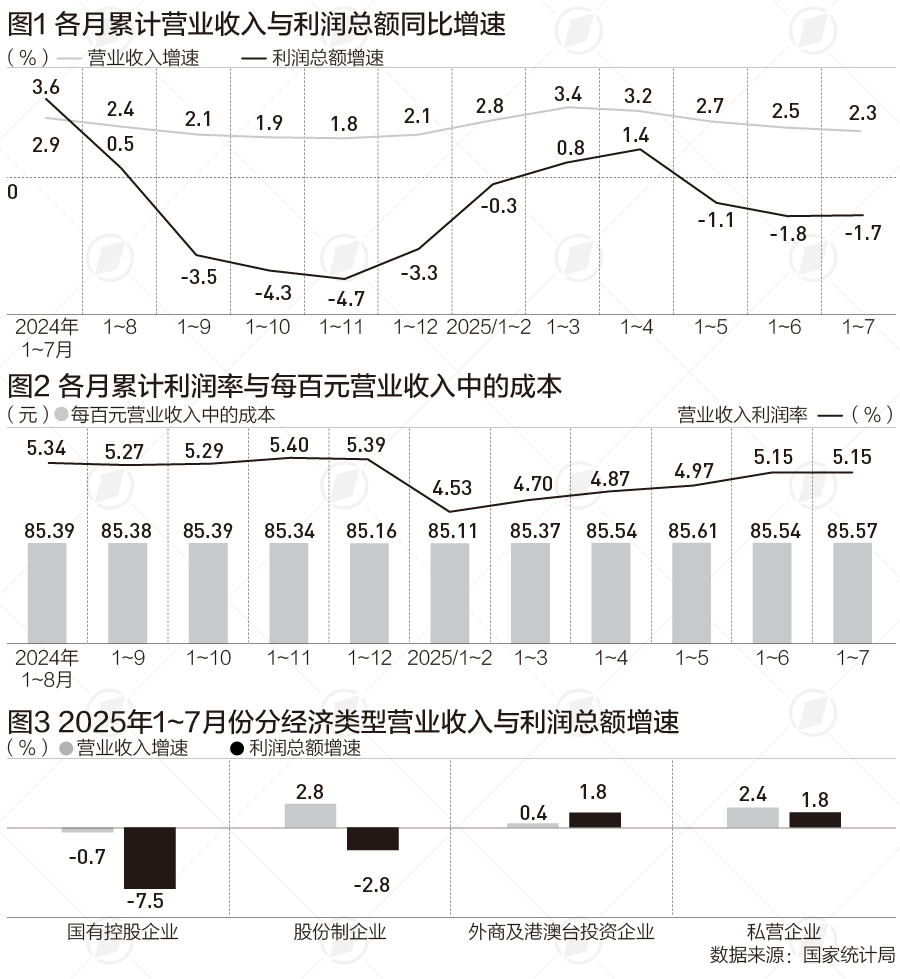
Core Insights - The profitability of industrial enterprises has shown positive improvement due to the implementation of various policies aimed at promoting the private economy and countering "involution" [1][5] Group 1: Industrial Profitability - In July, profits of industrial enterprises above designated size decreased by 1.5% year-on-year, a reduction in the decline by 2.8 percentage points compared to June 2025 [1] - From January to July, cumulative profits of industrial enterprises fell by 1.7%, with a slight narrowing of the decline by 0.1 percentage points compared to the first half of the year [1] - Medium and small-sized enterprises saw a turnaround in profits in July, with increases of 1.8% and 0.5% respectively, compared to declines of 7.8% and 9.7% in June [1] Group 2: Revenue and Cost Dynamics - Industrial enterprise revenue grew by 1.1% year-on-year in July, although this represented a decline of 0.5 percentage points from the previous month [2] - The Producer Price Index (PPI) remained unchanged at -3.6% year-on-year, while the industrial added value decreased by 1.1 percentage points compared to the previous month [2] - Industrial costs increased by 1.2% year-on-year in July, a decrease of 0.8 percentage points from the previous month [2] Group 3: Sector-Specific Performance - Manufacturing and public utilities saw profit growth in July, with manufacturing profits increasing by 6.6% year-on-year, a rise of 5.2 percentage points from June [2] - The mining sector experienced a significant profit decline of 39.2%, worsening by 3.0 percentage points compared to the previous month [2] - High-tech manufacturing profits rose by 18.9%, contributing 2.9 percentage points to the overall improvement in industrial profits [3] Group 4: Private Enterprises - From January to July, private enterprises achieved a total profit of 111.837 billion yuan, growing by 1.8%, with July profits increasing by 2.6%, surpassing the average growth of all industrial enterprises by 4.1 percentage points [5] - Recent policies aimed at enhancing the business environment and providing financial support have positively impacted the profitability of private enterprises [5] - Various local governments have introduced measures to promote the high-quality development of the private economy, signaling a commitment to improving the business environment and stimulating market vitality [5][6]

造纸行业仍然承压
Zheng Quan Ri Bao· 2025-08-28 16:06
Core Insights - The paper industry in A-shares is under pressure, with only 4 out of 16 listed companies reporting positive net profit growth in the first half of 2025, highlighting the cyclical nature of the industry [1] - Shandong Sun Paper Industry Co., Ltd. leads the industry with a revenue of 19.113 billion and a net profit of 1.78 billion [1] - The industry is experiencing structural adjustments in capacity expansion, cost optimization, and export growth, but still faces supply-demand pressures and profit differentiation [1] Company Strategies - Sun Paper is implementing a differentiated strategy across raw materials, processes, and products, focusing on self-manufactured pulp to reduce fiber costs and improve production efficiency [1] - The company has achieved cost reductions in energy, raw materials, and maintenance during the reporting period, ensuring stable operational performance [1] - Mudanjiang Hengfeng Paper Co., Ltd. reports steady growth in core business profitability due to lean management practices, optimizing supply chain management, and controlling procurement costs [1] Industry Challenges - The paper industry faces significant cost pressures primarily from raw materials and energy, with uncertainties in their price trends impacting overall industry costs [2] - The financial attributes and price volatility of pulp used in cultural paper, along with rising costs of waste paper for packaging due to weather factors, contribute to these challenges [2] - The "anti-involution" policy is expected to accelerate structural adjustments in the industry, with a shift towards high-end and differentiated production necessary for overcoming current market challenges [2] Future Outlook - Sun Paper's "integrated forestry, pulp, and paper" strategy is set to advance with the completion of its Nanning base projects, enhancing operational synergy [2] - The packaging paper market is anticipated to see a slowdown in capacity expansion by 2025, with a need for transformation towards high-end products [2] - The industry is expected to achieve supply-demand balance through market mechanisms, with a potential turning point for paper prices by 2026 as the "anti-involution" policy continues [2]

中国巨石20250828
2025-08-28 15:15
Summary of the Conference Call for China Jushi (2025 H1) Industry Overview - The glass fiber yarn production in China increased by 4.9% year-on-year in H1 2025, despite approximately 510,000 tons of capacity being offline due to maintenance of magnetic kiln production lines [2][3] - The global glass fiber industry is undergoing consolidation, with major players like OCR and PPG exiting the market, and the closure of the largest glass fiber plant in the UK, enhancing the competitiveness of Chinese companies [2][3] Market Demand - Significant growth in various segments: - Wind power installed capacity increased by 18% globally, with China's wind power capacity surging by 98.9% [2][5] - Total automobile production rose by 10.8%, with new energy vehicle production up by 36.2% [2][5] - Retail sales of home appliances grew by 30.7% [2][5] - Infrastructure investment increased by 4.6%, while real estate investment declined by 11.2% [2][5] Company Performance - The company adopted a "volume + added value" strategy, achieving sales of 1.5822 million tons of yarn and products, a nearly 4% increase [2][6] - Revenue reached 9.109 billion yuan, a 17.7% increase; total profit was 2.119 billion yuan, up 83%; net profit was 1.758 billion yuan, up 78%; and net profit attributable to shareholders increased by 170% [2][7] - Operating cash flow was 1.4 billion yuan, with total assets of 53.7 billion yuan and a debt-to-asset ratio below 40% [2][7] Strategic Focus - The company plans to focus on "one increase, one decrease, four enhancements, and one optimization" in H2 2025, emphasizing sales priority, cost reduction, innovation, and strengthening competitive advantages [2][9] - The company anticipates stable to rising glass fiber prices, supported by policies regulating local government investments and a slowdown in new entrants [2][10][11] Competitive Landscape - The company noted that new entrants are slowing down their investments due to poor profitability, indicating a more rational supply environment [2][12] - The gross profit per ton of yarn has recovered to over 900 yuan, with overseas factories showing good profitability and expansion plans [2][13] Financial Management - The company has strengthened investor relations, with major shareholders increasing their stakes by 1.6 billion yuan, and plans to implement a mid-term dividend of 600 million yuan [2][8] - The company aims to enhance its market value management by improving operational performance and engaging with investors [2][22][23] Future Outlook - The company is optimistic about the future demand for glass fiber, particularly in wind power and automotive sectors, while maintaining a stable supply capacity [2][24] - Plans for expansion in both domestic and international markets are underway, with a focus on high-end electronic fabrics and special products [2][18][21] Conclusion - The overall sentiment is positive, with the company positioned to capitalize on market growth while managing risks associated with competition and pricing strategies. The focus on innovation and efficiency is expected to drive future performance.

圆通速递20250828
2025-08-28 15:15
Summary of YTO Express Conference Call Company Overview - **Company**: YTO Express - **Industry**: Express Delivery and Logistics Key Points and Arguments Financial Performance - In Q2 2025, YTO Express achieved a total express delivery volume of **8.084 billion** pieces, a year-on-year increase of **21.84%** [2] - The company reported revenue of **18.823 billion** yuan, up **9.84%** year-on-year, with a net profit attributable to shareholders of **974 million** yuan [2] - The express delivery business contributed **1.038 billion** yuan to net profit, while air freight and international business losses narrowed to **64 million** yuan [2] Cost and Revenue Metrics - Average revenue per piece decreased by **0.14** yuan to **2.12** yuan, while average cost per piece fell by **0.10** yuan to **1.95** yuan, resulting in a gross profit per piece of **0.17** yuan, down **0.05** yuan [7] - Cost control measures were effective, with significant reductions in collection, delivery, transportation, and operational costs per piece [7] Industry Dynamics - The State Post Bureau's anti-involution initiative is expected to positively impact express companies by stabilizing pricing and improving network stability, particularly in Guangdong and Zhejiang provinces, which account for nearly **50%** of national business volume [8][9] - The company anticipates that the anti-involution policy will lead to a more stable pricing environment and potentially higher profitability [8] Artificial Intelligence (AI) Integration - YTO Express is advancing its AI strategy, applying technologies such as machine vision, voice technology, and digital twins across various operational areas [10] - AI applications have improved cost control, service quality, and customer experience, with a **25%** increase in customer service efficiency due to AI systems [12] - AI-generated code accounted for **24%** of total code produced in the first half of 2025, indicating significant progress in AI programming [12] Capital Expenditure and Future Investments - The company plans to increase capital expenditures for land, transfer center construction, equipment purchases, and vehicle updates to enhance competitiveness and address industry changes [5][27] - YTO Express aims to close the gap with competitors like ZTO Express, which has significantly higher cumulative capital expenditures [27] Market Outlook and Growth Projections - Despite an expected decline in industry growth rates, YTO Express aims to maintain growth above the industry average, driven by effective cost management and service quality improvements [22] - The company is focusing on enhancing operational efficiency and reducing costs in the last-mile delivery segment through technology and AI applications [30] Challenges and Risks - The impact of social security policies on operational costs is significant, particularly for smaller express companies, necessitating improved efficiency and resource optimization [5][13] - The competitive landscape remains challenging, with ongoing price competition despite the introduction of minimum pricing [28] Strategic Focus - YTO Express is prioritizing AI and digital capabilities as key differentiators in the market, with a focus on enhancing customer experience and operational efficiency [31] - The company is also exploring international expansion, particularly in Central Asia, while maintaining a cautious approach to the Southeast Asian market [29] Additional Important Insights - The company is leveraging AI to optimize reverse logistics processes, addressing the rising costs associated with increased return rates from e-commerce [25] - The integration of smart delivery systems and self-service lockers is expected to improve last-mile delivery efficiency and reduce labor costs [26][21]

中国石化(600028):增储上产成效显著 “反内卷”下龙头优势凸显
Ge Long Hui· 2025-08-28 12:08
Group 1 - The company reported a revenue of 1,409.05 billion yuan in H1 2025, a year-on-year decrease of 10.60%, and a net profit attributable to shareholders of 21.48 billion yuan, down 39.83% year-on-year [1] - In Q2 2025, the company achieved a revenue of 673.70 billion yuan, a year-on-year decline of 14.31%, with a net profit of 8.22 billion yuan, down 52.73% year-on-year [1] - The company's oil and gas equivalent production increased to 131.84 million barrels in Q2 2025, reflecting a year-on-year growth of 2.3% and a quarter-on-quarter increase of 0.7% [1] Group 2 - The average selling price of crude oil for the company in H1 2025 was 3,415 yuan per ton, a decrease of 12.9% year-on-year due to falling oil prices [1] - The exploration and production segment's EBIT (Earnings Before Interest and Taxes) was 11.89 billion yuan in Q2 2025, down 25.9% year-on-year and 12.8% quarter-on-quarter [1] - The company's refining segment processed 57.84 million tons of crude oil in Q2 2025, a decrease of 8.8% year-on-year, leading to a significant drop in profits [2] Group 3 - The refining segment's EBIT was 0.89 billion yuan in Q2 2025, a decline of 62.89% quarter-on-quarter due to lower product prices and reduced inventory profits [2] - The chemical segment reported an EBIT loss of 2.77 billion yuan in Q2 2025, an increase in losses of 2.24 billion yuan year-on-year and 1.45 billion yuan quarter-on-quarter [2] - The Ministry of Industry and Information Technology is expected to introduce a growth stabilization plan for the petrochemical industry, which may benefit the company by eliminating outdated production capacity [2] Group 4 - The company adjusted its profit forecast, expecting net profits of 45.97 billion yuan, 50.22 billion yuan, and 53.26 billion yuan for 2025, 2026, and 2027 respectively, with corresponding PE ratios of 15.35X, 14.05X, and 13.25X [3]
