
宽货币

Search documents
债市日报:5月12日
Xin Hua Cai Jing· 2025-05-12 09:45
Market Overview - The bond market continued to show weakness, with long-term bonds experiencing larger adjustments, leading to a decline in government bond futures across the board [1][2] - The interbank bond yield rose by approximately 2 basis points, indicating a general upward trend in yields [1][2] Monetary Policy - The central bank conducted a net injection of 43 billion yuan in the open market, with a focus on maintaining liquidity and flexibility in monetary policy [1][5] - The monetary policy report emphasized the need for a moderately loose monetary policy to stimulate consumption and support economic growth [5][6] Yield Movements - The yields on various government bonds increased, with the 10-year government bond yield rising by 2 basis points to 1.7175% and the 30-year government bond yield increasing by 2.6 basis points to 1.902% [2] - In the North American market, U.S. Treasury yields showed mixed results, with the 2-year yield rising by 0.87 basis points to 3.889% while the 10-year yield fell by 0.98 basis points to 4.382% [3] Economic Indicators - The Consumer Price Index (CPI) in China showed a slight increase of 0.1% month-on-month, while the Producer Price Index (PPI) decreased by 0.4% month-on-month, indicating ongoing deflationary pressures [7] - The core CPI remained stable, with a year-on-year increase of 0.5%, suggesting limited inflationary pressures in the economy [7] Institutional Insights - Institutions like Huatai and Zhongjin expressed cautious views on the global economy, highlighting risks from tariffs and market volatility, while maintaining a neutral outlook on the domestic economy [8] - The expectation of further monetary easing is prevalent, with potential for a new round of interest rate cuts to support economic growth [8]
国泰海通|政策研究:宽货币、稳市场、抵冲击、提信心——对5.7“一揽子金融政策支持稳市场稳预期”发布会的点评
国泰海通证券研究· 2025-05-07 15:01
Core Viewpoint - The article discusses a series of financial policies introduced by Chinese authorities to stabilize the market and manage expectations, emphasizing the implementation of a loose monetary policy and measures to support the stock market [1][2]. Summary by Sections Recent Financial Market Assessment - The financial market is currently operating smoothly, supported by a series of monetary policy adjustments including a 0.5 percentage point reduction in the reserve requirement ratio, expected to inject approximately 1 trillion yuan into the market [2]. - Policy interest rates will be lowered by 0.1 percentage points, while structural monetary policy tools and personal housing fund loan rates will see a reduction of 0.25 percentage points [2]. - New structural monetary policy tools will be created to support technology innovation, expand consumption, and promote inclusive finance [2]. Measures to Stabilize the Capital Market - Key measures include encouraging listed companies to repurchase shares to enhance investor returns and stabilize stock prices [2]. - The Central Huijin Investment will act as a "stabilization fund" [2]. - There will be an increase in the scale and proportion of medium to long-term funds entering the market, with plans to approve an additional 60 billion yuan for insurance funds to invest long-term [2]. Response to Tariff Increases - The China Securities Regulatory Commission has proposed a toolkit for addressing tariff impacts, focusing on "precise relief," "strengthening resilience," and enhancing capital market services [2]. - The National Financial Regulatory Administration has suggested measures for strong relief, stabilizing exports, and expanding domestic sales [2]. Confidence in Stock Market Stability - The stability of the stock market is supported by strong leadership from the central government and a commitment to maintaining market stability [3]. - The implementation of a "1+N" policy system in the capital market has led to significant structural changes [3]. - The "technology narrative" in the A-share market is becoming clearer, with increasing aggregation effects [3]. - The valuation levels in the A-share market remain relatively low, providing a favorable environment for investment [3].


“三部门”组合拳再现,这次不一样
HUAXI Securities· 2025-05-07 11:07
Monetary Policy Measures - The central bank announced a comprehensive monetary policy package, including a 50 basis point (bp) reserve requirement ratio (RRR) cut, releasing approximately 1 trillion yuan in liquidity[3] - The 7-day reverse repurchase rate was lowered by 10bp to 1.40%, with the Loan Prime Rate (LPR) also adjusted downwards by 10bp[13] - The new re-lending policies include an increase of 1.1 trillion yuan in quotas, with 300 billion yuan allocated for technological innovation and 500 billion yuan for agriculture and small enterprises[4] Economic Outlook and Market Response - The interest rate cuts were less than previously anticipated, with expectations of 30-40bp reductions over the year, but the first cut was only 10bp, implemented quickly on May 8[2] - The current monetary policy reflects a cautious approach towards external uncertainties, particularly regarding US-China negotiations, leaving room for future adjustments[2] - The bond market showed a steepening yield curve, with short-term rates declining by 1-3bp while long-term rates increased by 1-3bp, indicating a shift in investor sentiment[7] Structural Support and Future Implications - The meeting emphasized the importance of structural monetary tools, with a focus on supporting consumption and technological innovation, indicating a shift from broad-based measures to targeted interventions[5] - The central bank's actions are seen as preemptive measures against external shocks, suggesting that the recent cuts may only be the beginning of a broader easing cycle rather than a conclusive end[5] - The emphasis on long-term capital market support aims to stabilize market expectations and prevent prolonged downturns, with a focus on enhancing the participation of institutional investors[9]
央行“双降”释放流动性,银行板块盘中活跃,国企红利ETF(159515)涨近1%
Sou Hu Cai Jing· 2025-05-07 05:48
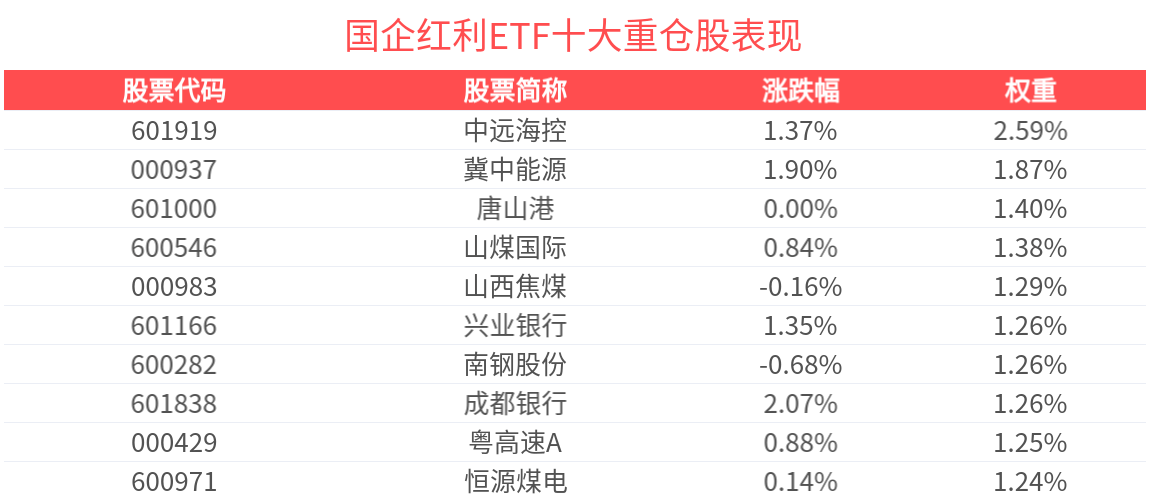
Group 1 - The core viewpoint of the news is the performance and growth of the State-Owned Enterprise Dividend Index and its related ETF, indicating a positive trend in the market for state-owned enterprises [1][2] - As of May 7, 2025, the State-Owned Enterprise Dividend Index (000824) increased by 0.68%, with notable gains from constituent stocks such as Everbright Bank (up 2.39%) and Qingdao Port (up 2.31%) [1] - The State-Owned Enterprise Dividend ETF (159515) saw a growth of 0.85%, with the latest price reported at 1.07 yuan, reflecting strong investor interest [1] Group 2 - The State-Owned Enterprise Dividend ETF experienced a significant increase in scale, growing by 3.2029 million yuan over the past two weeks, ranking it in the top half among comparable funds [1] - The ETF's share count also rose by 3.3 million shares in the same period, indicating robust demand [1] - The People's Bank of China announced a 0.5 percentage point reduction in the reserve requirement ratio, injecting approximately 1 trillion yuan into the market, which is expected to positively impact the banking sector [2] Group 3 - The top ten weighted stocks in the State-Owned Enterprise Dividend Index as of April 30, 2025, include COSCO Shipping Holdings and Jizhong Energy, collectively accounting for 15.18% of the index [3] - The index is designed to reflect the overall performance of high dividend yield securities from state-owned enterprises, focusing on companies with stable dividends and significant liquidity [2]




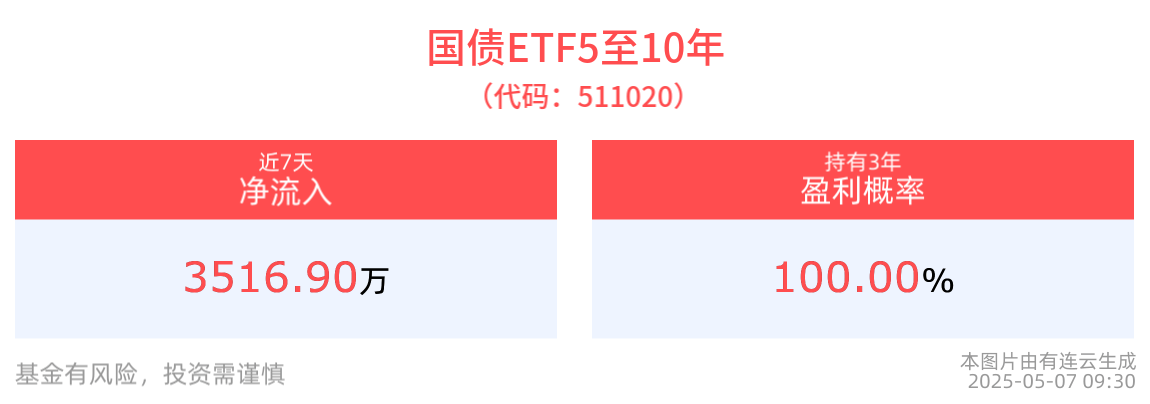
降准降息!公司债ETF(511030)、国债ETF5至10年(511020)开盘上涨6bp
Sou Hu Cai Jing· 2025-05-07 02:22
截至2025年5月7日 09:30,公司债ETF(511030)上涨0.06%,最新价报105.6元。拉长时间看,截至2025年5月6日,公司债ETF近半年累计上涨1.10%。 流动性方面,公司债ETF盘中换手0%,成交0.00元。拉长时间看,截至5月6日,公司债ETF近1月日均成交16.14亿元。 规模方面,公司债ETF最新规模达133.58亿元,创近1年新高。 资金流入方面,公司债ETF最新资金流入流出持平。拉长时间看,近7个交易日内,合计"吸金"9817.72万元。 消息面上,中国人民银行行长潘功胜5月7日在国新办举行的新闻发布会上宣布,降准0.5个百分点,向市场提供长期流动性约1万亿元,并降低政策利率0.1个 百分点。 华西证券此前表示,5 月债市资金面是偏多表现的根基,缴税压力缓解对债市有利。需关注央行态度是否软化及关税调整带来的基本面变化,若基本面数据 超预期转弱,做多情绪会被放大。货币政策具有弹性,"宽货币" 组合拳可能推出,5 月或是重要窗口期,新一轮大行存款降息可能性提升,将带动广义利率 中枢下行,当前债市胜率较高。短端品种胜率更高,适合作为 5 月策略基础持仓,同时建议保留久期仓位,以防错 ...
【财经分析】5月债市如何演绎?机构判断利率有望“再下一城”
Xin Hua Cai Jing· 2025-05-06 14:43
Core Viewpoint - After the "May Day" holiday, analysts believe that the bond market will continue to experience pressure from the fundamentals, with monetary policy easing being a likely direction, indicating that the logic for bullish positions in the bond market remains unchanged, and institutions can continue to adopt a "buy on dips" strategy [1] Group 1: Market Trends - As of April 30, the interbank bond market showed slight fluctuations in yield rates, with the 3-month government bond yield down 2 basis points to 1.47%, the 2-year yield down 1 basis point to 1.45%, and the 10-year yield stable around 1.62% [2] - In April, the bond market exhibited a pattern of "initial decline followed by fluctuations," with the 10-year government bond yield dropping by 18.9 basis points to 1.62% [2] - The first trading day after the "May Day" holiday saw the yield rates continue to show narrow fluctuations, with the 3-month yield rising 1 basis point to 1.48%, the 2-year yield stable at 1.45%, and the 10-year yield up 1 basis point to 1.63% [2] Group 2: Future Expectations - Analysts maintain a relatively optimistic outlook for the bond market in May, noting that historically, bond prices tend to decline in May compared to April, with the 10-year government bond yield typically decreasing by around 10 basis points [3] - Key factors to watch for a potential breakout in the market include external shocks such as unexpected monetary easing and the verification of existing bullish or bearish factors related to the fundamentals [4] - The liquidity situation is expected to support a bullish performance in the bond market, with tax payment pressures likely easing in May compared to April [4] Group 3: Investment Strategies - The current market conditions suggest that short-term instruments, particularly those with a maturity of 3 years or less, are more favorable for investment strategies in May [6] - There is an accumulation of bullish momentum in the bond market, with mid-term positive support from the fundamentals, and long-term bonds may follow suit for a rebound [6] - In the context of ongoing monetary easing expectations, the probability of declining yields and spreads in credit bonds is also considered high, especially given the weak supply of credit bonds in May [6]
流动性月报:宽货币的路径选择-20250506
SINOLINK SECURITIES· 2025-05-06 11:09
Report Industry Investment Rating No relevant content provided. Core View of the Report The central bank's attitude has eased, with increased reverse repurchase and MLF投放, and falling interest rates. The downward space for funds is greater than the upward space. The central bank's response to the tariff shock has been calm, and the decline in interest rates has been limited. The weakening fundamentals may drive interest rates down further. There are two possible "broad money" models, and the second model is more likely, with the negative impact of monetary factors on the bond market decreasing [5][6][37]. Summary by Relevant Catalogs 4 - Month Review: Lowered Fund Center, but Weak Expectations for Interest Rate Cuts - **Central Bank's Attitude**: The central bank's attitude in April was "stable with a slight easing." Net 7 - day reverse repurchase was 320.8 billion yuan, and 1 - year MLF had a net injection of 50 billion yuan, with a total open - market operation injection of 820.8 billion yuan. However, the net withdrawal of outright reverse repurchase was 50 billion yuan. The central bank's current attitude towards the funds remains stable, but has eased compared to the beginning of the year [2][12]. - **Fund Price**: The central level of fund interest rates for all terms decreased in April compared to March. DR001 and DR007 decreased by 10bp and 15bp to 1.67% and 1.73% respectively; R001 and R007 decreased by 15bp and 19bp to 1.71% and 1.77% respectively. The spread between DR007 and the 7 - day reverse repurchase rate narrowed to 23bp [3][13]. - **Certificate of Deposit**: In April, the issuance volume and price of certificates of deposit decreased. The total issuance volume of inter - bank certificates of deposit by state - owned and joint - stock banks dropped from 2.7 trillion yuan to 1.7 trillion yuan. The weighted average issuance rates of state - owned and joint - stock banks' inter - bank certificates of deposit decreased by 23bp and 22bp respectively, and the yields to maturity of 3M, 6M, and 1Y certificates of deposit decreased by 21bp, 21bp, and 19bp respectively [3][14]. - **Interest Rate Cut Expectations**: The market has not restarted "interest rate cut trading." From the perspectives of IRS:FR007 and FR007 spread, floating - rate and fixed - rate bond YTM spread, and the monetary tightness and looseness expectation index, the expectation of interest rate cuts in the bond market in April was volatile, mainly affected by changing tariff policies and the "determination" of domestic monetary policy [4][15]. 5 - Month Outlook: External and Internal Pressures Cause Disturbances, and There May Be Room for Funds to Go Down - **Central Bank's Attitude and Interest Rate Space**: Compared with the "abnormally high" fund - policy spread in Q1, the central bank's attitude has eased, with increased reverse repurchase and MLF投放, and falling interest rates for two consecutive months. The downward space for funds is greater than the upward space [5][25]. - **Tariff Impact**: The central bank has been "calm" in the face of the tariff shock. The decline in interest rates since the trade friction has been limited compared to historical shock events. From March to April, the spread between DR007 and the policy rate only narrowed by 39bp [5][25][26]. - **Fundamentals**: The fundamentals do not support a trend of rising fund prices. The PMI and building materials composite index have declined, and the negative impact of trade friction on the economy has been reflected in multiple dimensions. If the fundamentals weaken, it may drive interest rates down further [5][29]. - **Government Bond Financing**: In May, the net financing scale of government bonds is expected to increase significantly compared to April. The estimated net financing scale of national bonds is about 970 billion yuan, and that of local bonds is about 450.3 billion yuan, with a total of about 1.4 trillion yuan [32]. - **Liquidity Gap**: The liquidity gap in May may narrow slightly compared to April, mainly due to the lower maturity of outright reverse repurchase. However, attention should be paid to the disturbance of government bond issuance [33][34]. - **Broad Money Path**: There are two possible "broad money" models for the central bank. The second model (first compressing the spread and then cutting the policy rate) shows more signs of implementation, and the negative impact of monetary factors on the bond market is decreasing [6][37].
5月,长端利率或挑战前低
HUAXI Securities· 2025-05-05 08:21
Group 1 - The report indicates that the bond market experienced a rapid bull run in early April, followed by a period of stabilization, with the 10-year treasury yield fluctuating between 1.62% and 1.67% during this consolidation phase [1][11][12] - In May, the funding environment is expected to remain supportive for the bond market, with a historical trend showing that funding rates typically ease further in May compared to April, aided by a reduction in tax payment pressures [2][20][28] - The report highlights three key factors influencing the bond market in May: tariffs, economic fundamentals, and policy responses, with a focus on the ongoing US-China tariff negotiations and their potential impact on market sentiment [3][35][52] Group 2 - The report notes that the central bank's stance has softened since April, leading to a return of funding rates to a "reasonable state," which is expected to support the bond market [2][28][31] - It is projected that government bond supply will significantly increase in May, with net issuance expected to reach 1.53 trillion yuan, nearly doubling from April, which may create short-term fluctuations in funding costs [2][31][32] - The report outlines three scenarios for investment strategies in May, emphasizing the importance of selecting short-term bonds as the most favorable option, while also considering longer-duration positions to capitalize on potential rate cuts [5][54][56]
政府债发行提速带来多大缺口?——5月流动性展望【陈兴团队•财通宏观】
陈兴宏观研究· 2025-05-01 00:47
Core Viewpoint - The central bank's "loose monetary" signal is becoming clearer, and the liquidity remains balanced and loose. The issuance of special government bonds has begun, and the issuance of special bonds is accelerating, leading to increased government debt supply pressure in May [2][5] Group 1: Changes in Central Bank Attitude and Liquidity - In April, funding rates decreased, aligning closer to policy rates, with R007 and DR007 average monthly rates down by 19 basis points and 15.4 basis points to 1.77% and 1.72% respectively [6][7] - The central bank shifted from net absorption to net injection in mid-April, releasing supportive signals, with a net injection of 500 billion yuan through MLF in late April [7][10] - The 10-year government bond yield fell by 18.9 basis points to 1.62% by the end of April, reflecting a strong bond market amid rising expectations for loose monetary policy [10][19] Group 2: Government Debt Supply Pressure - In May, the issuance of ordinary government bonds is expected to reach 1.12 trillion yuan, with special long-term bonds at 227 billion yuan, totaling approximately 1.34 trillion yuan in government bonds, with a net financing scale of around 763 billion yuan [3][20] - Local government debt issuance is projected at 840 billion yuan in May, with a net financing scale of about 620 billion yuan, reflecting a significant increase in government debt supply [26] Group 3: Maintaining Loose Liquidity - The liquidity gap in May is estimated to be around 490 billion yuan, indicating increased pressure compared to April, primarily due to the significant rise in government debt net financing [4][36] - The central bank's proactive stance is evident with a slight increase in MLF maturity to 125 billion yuan and a decrease in reverse repo maturity to 900 billion yuan, suggesting a potential for maintaining balanced liquidity [4][36] - Historical trends indicate that May typically sees net fiscal spending, with an expected fiscal deficit of approximately 830 billion yuan, further influencing liquidity dynamics [28]
PMI回到去年8月
HUAXI Securities· 2025-04-30 11:20
Group 1: PMI Overview - In April 2025, the manufacturing PMI fell to 49.0%, below the expected 49.8% and previous value of 50.5%[1] - The non-manufacturing PMI decreased to 50.4%, down from 50.8%[1] - The April PMI levels are comparable to those from August 2024, indicating a significant external impact on the economy[1] Group 2: Manufacturing Sector Insights - New orders and production indices dropped by 2.6 and 2.8 percentage points, contributing to a 0.8 and 0.7 percentage point decline in manufacturing PMI, respectively[2] - New export orders fell by 4.3 percentage points to 44.7%, marking the lowest level since early 2023[2] - The strategic emerging industries' EPMI decreased by 10.2 percentage points to 49.4%, while high-tech manufacturing PMI remained above the threshold at 51.5%[2] Group 3: Construction and Services Sector Analysis - The construction sector's business activity index fell by 1.5 percentage points to 51.9%, with new orders and employment indices dropping to 39.6% and 37.8%, respectively[3] - The service sector's PMI slightly decreased to 50.1%, with new orders down by 1.2 percentage points to 45.9%[4] - Both construction and service sectors are experiencing price declines, with construction prices down 0.3 percentage points to 47.2% and service prices down 0.1 percentage points to 46.5%[4] Group 4: Economic Projections - The comprehensive PMI for April is at 50.2%, indicating a slowdown compared to the averages of 51.27% in Q4 2024 and 50.87% in Q1 2025[5] - The GDP growth rate for Q2 2025 is expected to slow down from 5.4% in Q1 2025, but a significant downturn is not anticipated[5] - The report suggests that upcoming counter-cyclical policy adjustments, particularly in monetary and fiscal areas, may influence market conditions positively[7]