
通胀

Search documents
美联储会议纪要:“大多数”官员预计12月后适合继续降息,部分主张“一段时间”按兵不动
Sou Hu Cai Jing· 2025-12-30 20:53
Core Viewpoint - The Federal Reserve's December meeting minutes reveal internal divisions regarding interest rate cuts, with most officials supporting further cuts if inflation trends downward as expected, while some advocate for a pause in rate cuts for a period of time [1][2]. Group 1: Interest Rate Decisions - Most participants at the meeting believe that if inflation gradually decreases as anticipated, further rate cuts may be appropriate [1][2]. - A minority of participants expressed that a pause in rate cuts might be necessary to assess the impact of recent policy changes on the labor market and economic activity [1][3]. - The minutes indicate that there was significant internal disagreement, with seven officials opposing the decision to cut rates, marking the largest division in 37 years [1][5]. Group 2: Economic Indicators - The minutes highlight that inflation has risen since the beginning of the year and remains at a high level, while economic activity is expanding at a moderate pace [2]. - Employment growth has slowed, and the unemployment rate has slightly increased as of September, with rising downside risks to employment noted by participants [2][3]. - Some officials expressed concerns about the potential for inflation to become entrenched, emphasizing the need for confidence in returning inflation to the 2% target [2][4]. Group 3: Risk Management - Most participants believe that lowering rates could help prevent deterioration in the labor market, while acknowledging high inflation risks [4][5]. - The minutes reflect a consensus that stable long-term inflation expectations are crucial for achieving the Federal Reserve's dual mandate [4][5]. - The decision to initiate the Reserve Management Program (RMP) was based on the assessment that reserve balances had fallen to adequate levels, prompting the purchase of short-term government securities [5].
美联储 12 月会议纪要:通胀仍高于目标,就业下行风险上升
Sou Hu Cai Jing· 2025-12-30 19:38
Core Viewpoint - The Federal Reserve's December meeting minutes indicate moderate growth in the U.S. real GDP this year, with a cooling labor market and wage growth comparable to the same period last year [1] Economic Growth - Economic activity in the third quarter showed robust performance, but the average growth rate for the first three quarters of the year remains moderate, below previous expectations for 2024 [1] - The anticipated government shutdown is expected to negatively impact short-term GDP [1] Labor Market - The labor market continues to cool, with expectations that the unemployment rate will gradually decline [1] - Participants in the meeting generally believe that risks related to the labor market are skewed to the downside [1] Inflation Outlook - Inflation is expected to face short-term pressure but is projected to return to 2% by 2028, with overall uncertainty remaining high [1] - There is a general consensus among participants that inflation risks are tilted to the upside [1] Future Economic Conditions - It is expected that with improving financial conditions and the gradual reduction of tariff impacts, economic growth will slightly exceed potential levels after 2025 [1]
【美联储会议纪要关注点】1、对利率政策的讨论情况。2、对通胀和就业问题的看法。3、对持续时间创历史最长纪录的美国政府关门事件影响的讨论。
Sou Hu Cai Jing· 2025-12-30 14:28
Group 1 - The discussion on interest rate policy is a key focus of the Federal Reserve meeting minutes [1] - The perspectives on inflation and employment issues are highlighted [1] - The impact of the historically longest U.S. government shutdown is also discussed [1]
Market resilience is encouraging amid AI weakness, says Baird's Mayfield
Youtube· 2025-12-30 12:17
Market Overview - The S&P 500 has shown a strong performance, up over 17% on a price basis in 2025, although it is currently flat compared to levels from two months ago [1] - The market is characterized by a rotation rather than a sell-off, with a focus on cyclical real economy stocks [2] Investment Sentiment - The market's resilience in the face of AI skepticism is viewed positively, indicating a healthy market environment [2] - There is a notable lack of volatility, which could pose risks to market sentiment in the first quarter [4] Sector Performance - There is a potential revival for lagging categories such as quality and value stocks, alongside the continued leadership of AI-related stocks [5] - Recent weeks have seen a rebound in discretionary spending, suggesting a more favorable consumer outlook than previously anticipated [6] Global Market Dynamics - The market's strength is not limited to the US, with positive performance observed in Japan, Europe, and emerging markets [6] - Global participation in the market is considered under-discussed, yet it plays a significant role in the overall market dynamics [3] Interest Rates and Economic Outlook - Interest rates are expected to remain sticky above 4%, which necessitates a focus on quality investments, especially in value sectors [8] - Concerns regarding fiscal issues and inflation pressures are influencing the long end of the yield curve, with expectations that the 10-year yield may approach 5% in 2026 [10][11]

美媒:美国企业破产申请创15年新高
Sou Hu Cai Jing· 2025-12-30 11:49
Group 1 - The number of bankruptcy filings by U.S. companies has surged to the highest level in 15 years, with at least 717 companies filing for bankruptcy by the end of November, according to S&P Global Market Intelligence data [1][7] - The increase in bankruptcies is most pronounced in the industrial sector, including manufacturing, construction, and transportation, heavily impacted by fluctuating U.S. trade policies and tariffs [1][7] - Over 70,000 jobs were cut in the U.S. manufacturing sector within a year, highlighting the severe impact of these economic pressures [7] Group 2 - Inflation and rising interest rates are cited as significant factors contributing to the financial distress of many companies, alongside the disruptive effects of U.S. trade policies on supply chains and costs [1][7] - There is a notable increase in bankruptcies among large companies, with 17 bankruptcy cases involving firms with assets exceeding $1 billion reported in the first half of 2025, marking the highest number since 2020 [7] - Companies are struggling to pass on increased costs to consumers due to fears of losing customers, leading to a market shakeout where weaker firms may be eliminated [7]
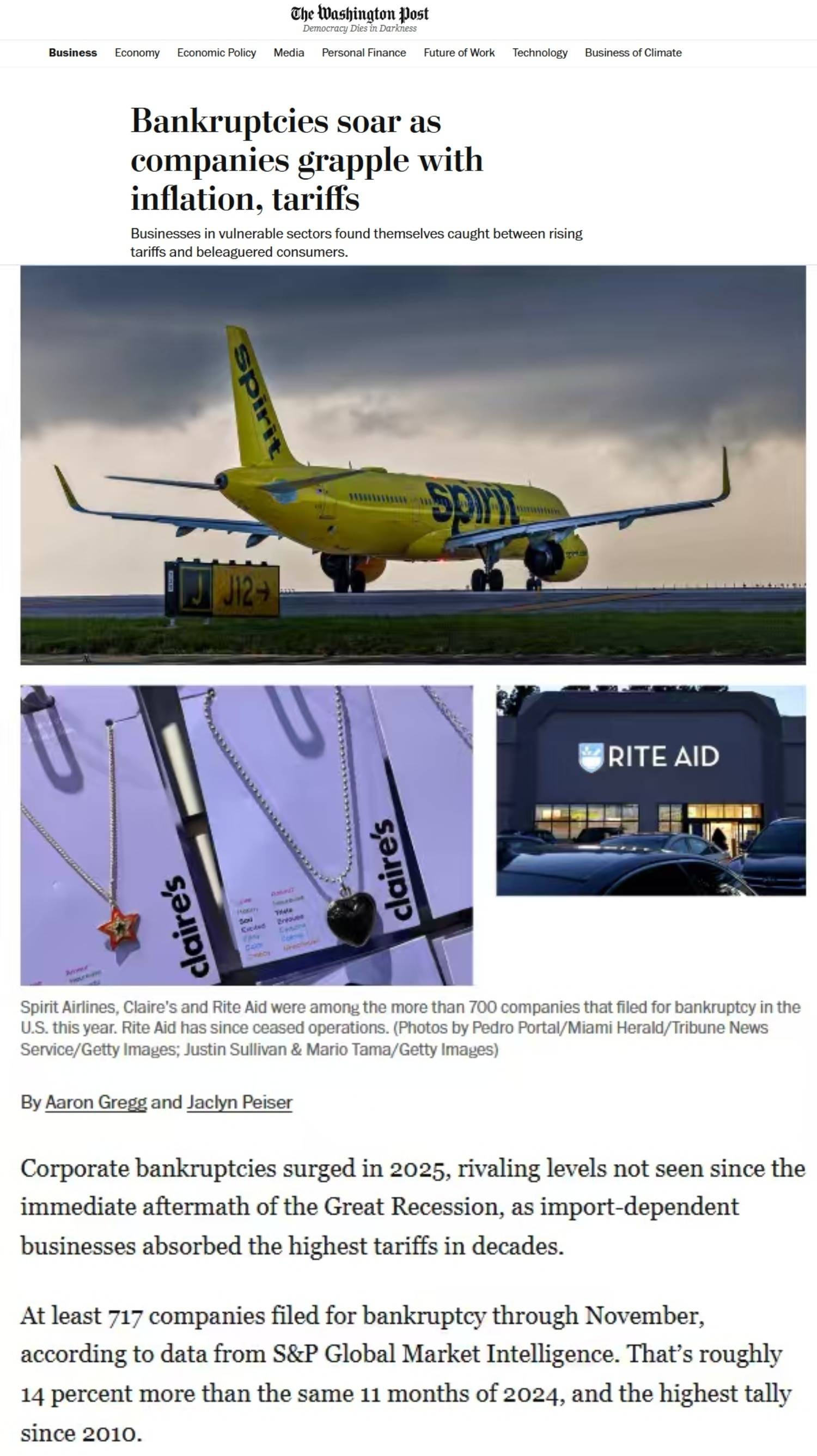
ATFX:本周热点分析FOMC会议纪要来袭 黄金站在历史高位的关键抉择点
Xin Lang Cai Jing· 2025-12-30 10:37
Core Viewpoint - The global financial market's focus is shifting back to the Federal Reserve's policy signals as the FOMC meeting minutes are set to be released, particularly after gold prices have reached historical highs, which will influence short-term sentiment and trend continuity [1] Economic Environment - The U.S. economy is showing clear signs of a post-cycle phase, with inflation significantly cooling compared to mid-year but still not reaching the Fed's 2% target. Core PCE remains around 2.8%, and November CPI year-on-year is approximately 2.7%, indicating progress in the disinflation process, although service sector inflation remains sticky [2] - The job market is showing signs of cooling, with the unemployment rate rising to 4.6% in November, the highest in four years, and non-farm payrolls adding only about 64,000 jobs, reflecting a continued slowdown in hiring. Despite a high GDP growth rate of 4.3% in Q3, the market expects Q4 growth to normalize as cost of living increases and fiscal disturbances fade [2] Federal Reserve Policy - The Federal Reserve has lowered the federal funds rate range to 3.50%–3.75% after three consecutive rate cuts in the second half of 2025. However, during the December meeting, despite a 25 basis point cut, the Fed signaled a cautious approach to further easing [3] - The December meeting minutes are crucial in revealing whether the Fed's pause is a cautious response to inflation risks or a strategy to retain policy flexibility in light of further data weakness. Notably, three officials expressed dissent, which is rare, indicating a split on whether inflation is stable enough to warrant further easing or if larger cuts are needed to mitigate employment downturns [3] Gold Market Analysis - Technically, gold is in a clear medium-term uptrend, having steadily risen since November along an upward trend line. Recent price corrections have not broken this trend line, suggesting that selling pressure is primarily from profit-taking rather than a trend reversal [6] - Key support levels for gold are identified at the 4,328–4,305 range, which overlaps with previous consolidation and the upward trend line. If this area is breached, gold may test the second support zone around 4,230. Conversely, resistance is noted at 4,460–4,480, where if gold can stabilize, it may challenge previous highs and continue its upward trend [6] Market Sentiment Ahead of FOMC Minutes - Ahead of the FOMC minutes release, gold is in a state of "trend unbroken but entering a digestion phase." If the minutes lean hawkish, emphasizing inflation risks and maintaining a stable rate stance, gold prices may test support levels for a technical correction. However, as long as the correction remains within the upward structure, it could be seen as a setup for the next upward movement [7] - Conversely, if the minutes are dovish, the market may refocus on future rate cuts, allowing gold to stabilize near trend lines and potentially push upward again, with historical high regions becoming a focal point [7]

中国资产2026年具备全球配置吸引力!招商基金朱红裕最新发声
券商中国· 2025-12-30 09:35
Core Viewpoint - The A-share market has undergone a cyclical rise, with certain sectors and styles remaining undervalued, making Chinese assets attractive for global allocation in 2026. Key investment opportunities are identified in four main areas: globally competitive manufacturing leaders, industries with improving supply-demand dynamics, sectors with low valuations and potential for significant fundamental changes, and long-term high-return industries with mismatched valuations [2][4]. Group 1: Market Overview - The current A-share market is experiencing active trading volumes and turnover rates, but there is a notable differentiation among stocks, presenting both opportunities and risks. Some stocks are becoming expensive, while others, particularly in real estate and domestic demand, remain undervalued [3]. - The investment strategy for equities should focus on safety margins and certainty, avoiding blind speculation on volatility. The U.S. economy is not performing well, and potential monetary easing could occur in response to the upcoming mid-term elections, which may influence domestic fiscal policies [3]. Group 2: Investment Opportunities - Four key investment opportunities for 2026 are highlighted: 1. Long-term focus on globally competitive manufacturing leaders, including sectors like power equipment, batteries, electric vehicles, home appliances, chemicals, and machinery. Observations from Southeast Asia indicate a significant gap in infrastructure and supply chains compared to China, reinforcing confidence in China's manufacturing competitiveness [5]. 2. Industries with improving supply-demand dynamics, such as real estate, aquaculture, chemicals, and light industry, are expected to enhance their global market positions and profitability [5]. 3. Sectors with low valuations and potential for substantial fundamental changes, such as chemicals, are noted for their past performance shifts, similar to coal, steel, and non-ferrous metals in previous years [6]. 4. Long-term high-return industries with severe valuation mismatches, including airport and airline services, insurance, and non-liquor food sectors, are highlighted for their high return on equity (ROE) despite low stock attention [6]. Group 3: Risks and Considerations - Potential risks include persistent inflation and sector-specific risks. The undervaluation of the RMB may pressure export industries, and inflation could pose significant risks to the stock market in the latter half of the year. Additionally, long-term risks associated with AI, including its impact on labor and technological competition, warrant attention [6].

ATFX:本周热点分析,FOMC会议纪要来袭,黄金站在历史高位的关键抉择点
Sou Hu Cai Jing· 2025-12-30 09:17
Core Viewpoint - The global financial market's focus is shifting back to the Federal Reserve's policy signals as the FOMC meeting minutes are set to be released, particularly after gold prices have reached historical highs, making the details of the minutes crucial for short-term sentiment and trend continuation [1] Macroeconomic Environment - The U.S. economy is showing clear signs of a post-cycle phase, with inflation cooling significantly but still above the Fed's 2% target, as core PCE remains around 2.8% and November CPI year-on-year is approximately 2.7%, indicating progress in the disinflation process [2] - The job market is showing signs of cooling, with the unemployment rate rising to 4.6% in November, the highest in four years, and non-farm payrolls adding only about 64,000 jobs, reflecting a slowdown in hiring momentum [2] - Despite a high GDP growth rate of 4.3% in Q3, the market expects a return to normal growth rates in Q4, as rising living costs and the fading of fiscal disturbances lead to a moderation in growth momentum [2] Federal Reserve Policy - The Federal Reserve has cut interest rates three times in the second half of 2025, bringing the federal funds rate range down to 3.50%–3.75%, but the December meeting signaled a cautious approach to further easing [3] - The minutes from the December meeting are significant in revealing whether the Fed's pause is a cautious response to inflation risks or a strategy to maintain policy flexibility amid weakening data [3] - Notably, three officials opposed the recent rate cut, indicating a rare division within the Fed, with some believing inflation is not stable enough for further easing, while others advocate for larger cuts to mitigate employment downturns, highlighting policy uncertainty [3] Technical Analysis of Gold - Gold is currently in a clear medium-term uptrend, having steadily risen since November along an upward trend line, with previous downward trends effectively broken and converted into medium-term support [5] - Key support levels for gold are identified between 4,328 and 4,305, which coincide with previous consolidation platforms and the upward trend line, while a failure to hold this area could lead to further testing of the second support zone around 4,230 [5] - The upper resistance zone is noted between 4,460 and 4,480, corresponding to previous highs, and if gold can stabilize in this area, it may challenge previous highs and continue its medium-term upward trend [5] Market Sentiment Ahead of FOMC Minutes - Ahead of the FOMC minutes release, gold is in a state of "trend unbroken but entering a digestion phase," where hawkish language emphasizing inflation risks could lead to a downward test of the trend line and support zones, while remaining within the upward structure may be seen as a space for the next rally [6] - Conversely, if the minutes lean dovish, the market may refocus on future rate cuts, allowing gold to stabilize near the trend line and potentially push upward again, with historical high points becoming a central target [6]

特朗普全国讲话“变脸”!罕见读稿不嬉笑,内容却让核查员崩溃?
Sou Hu Cai Jing· 2025-12-30 07:24
Core Viewpoint - Trump's recent national address marks a significant shift in his speaking style, moving from a spontaneous and passionate approach to a more serious and scripted delivery, reflecting the pressures his administration is currently facing [1][3]. Group 1: Speech Style and Context - On December 17, Trump's 18-minute address was broadcasted live by major TV networks, contrasting sharply with his usual informal style, as he read from a script with a serious demeanor [3]. - The change in style is attributed to the high stakes of the address, typically reserved for major policy announcements or national crises, amid significant governance challenges [4]. Group 2: Economic Challenges - Recent polls indicate that only 33% of American adults support Trump's economic policies, marking the lowest approval rating since his second term began, with a notable 8% drop among his core supporters since April [4]. - The unemployment rate rose to 4.6% in November, the highest since October 2021, with 7.83 million unemployed, highlighting the economic difficulties faced by the administration [4]. Group 3: Speech Content and Controversies - Trump attributed the current economic struggles to the previous Biden administration, claiming he inherited a "mess" and is working to fix it, despite being in office for nearly a year [6]. - He attempted to reassure the public about economic recovery, claiming "inflation has stopped" and promising significant improvements by 2026, although these statements were met with skepticism and fact-checking [8]. - The introduction of the "warrior bonus" plan, which proposes $1,776 payments to 1.45 million military personnel funded by tariffs, has raised concerns about the legality of the tariffs being challenged in court [9]. Group 4: Policy Focus - The speech largely avoided foreign policy issues, focusing instead on domestic economic concerns, including a brief mention of ending eight wars since taking office [11]. - Trump's push for a new Federal Reserve chair to lower interest rates aligns with his desire for a more accommodative monetary policy to stimulate the economy [13]. - The administration's approach to the national debt leans towards increased spending and revenue generation through tariffs, contrasting with traditional views advocating for debt reduction [15].
深圳湾的魔幻周日
3 6 Ke· 2025-12-30 06:09
Core Viewpoint - The recent launch of the Xinyue Bay project in Shenzhen has led to a staggering sales figure of 10 billion yuan within just two hours, indicating a significant surge in luxury real estate demand in the region, despite broader market challenges [2][9]. Group 1: Market Dynamics - The opening of Xinyue Bay set a new price ceiling in Shenzhen's luxury market, with an average price of 244,000 yuan per square meter and a peak price of 380,000 yuan per square meter, surpassing previous records [2][4]. - The luxury real estate market in Shenzhen has seen a rapid increase in activity, with several high-profile projects, including the recent sales of 13 billion yuan at the Shenzhen Bay Luanxi and 5.3 billion yuan at the GCC Lian Tai Chao Zong Wan, contributing to a total of nearly 30 billion yuan in just one month [4][9]. Group 2: Historical Context - The Xinyue Bay site was previously owned by Kaisa Group, which acquired it for 5.8 billion yuan in 2013, but faced financial difficulties that nearly left the project abandoned [5][6]. - The "service trust" model employed by creditors, such as CITIC, has allowed for the restructuring of the project, isolating previous debts and enabling a profitable sale, which necessitated high pricing to cover costs [7]. Group 3: Buyer Behavior - Wealthy buyers are aggressively purchasing luxury properties not necessarily due to confidence in the real estate market, but as a hedge against inflation and currency devaluation, viewing these properties as a safe haven for their capital [11]. - The recent lifting of the "70/90" policy has made it easier for buyers to purchase larger units without the complications of dual ownership requirements, further fueling demand for high-end properties [8][10].