
债券市场

Search documents
十年国债ETF(511260)近5日净流入超6亿元,债市情绪回暖或受内外因素推动
Sou Hu Cai Jing· 2025-11-07 07:09
Group 1 - The core viewpoint indicates a significant contraction in domestic demand in October, with the manufacturing PMI dropping to 49.0, reflecting a short-term impact on the economy due to uncertainties in China-US trade relations [1] - New orders and production indices have declined sharply, suggesting that while high growth in export activities may continue, the situation of insufficient domestic demand is unlikely to improve significantly [1] - The real estate sector is expected to take a longer time to reach the bottom, and the process of lowering mortgage rates may be relatively mild [1] Group 2 - In the bond market, expectations of the central bank resuming bond purchases have led to a decline in yields, with short-term rates falling significantly and the yield curve becoming steeper, although the mid-term adjustment process may not be over yet [1] - The Ten-Year Treasury ETF (511260) has consistently achieved new net value highs since its inception, with historical performance remaining robust; as of the end of Q2, the one-year return rate reached 5.88%, the three-year return rate was 16.13%, the five-year return rate was 22.41%, and the cumulative return since inception was 36.68% [1] - The Ten-Year Treasury ETF has maintained positive returns every year since its establishment, making it a potential asset allocation tool for navigating bull and bear cycles [1]
市场流动性充裕和政策预期回暖下,30年国债ETF(511090)盘中成交超12亿,最新规模达328.54亿
Sou Hu Cai Jing· 2025-11-07 03:00
Core Viewpoint - The 30-year Treasury ETF (511090) has shown positive performance with a recent increase of 0.07%, indicating a recovery in the bond market supported by improved liquidity and favorable policy expectations [1][2]. Group 1: Market Performance - As of November 7, 2025, the 30-year Treasury ETF has a trading volume of 3.93% and a transaction value of 1.294 billion yuan, with an average daily transaction of 9.544 billion yuan over the past month [1]. - The latest scale of the 30-year Treasury ETF reached 32.854 billion yuan, with a total of 275 million shares [1]. - The ETF has experienced continuous net inflows over the past three days, totaling 847 million yuan, with a peak single-day net inflow of 527 million yuan [1]. Group 2: Market Sentiment and Expectations - The bond market is expected to maintain a warming trend towards the end of the year, driven by ample liquidity and a recovery in market sentiment [1]. - Historical patterns suggest that the fourth quarter typically sees better performance in the bond market, supported by expectations of interest rate cuts and proactive positioning by institutions [2]. - The People's Bank of China has indicated a resumption of government bond buying operations, which is expected to positively influence market sentiment [2]. Group 3: Index and Investment Characteristics - The 30-year Treasury ETF closely tracks the China Bond 30-Year Treasury Index, which includes publicly issued 30-year government bonds [2]. - This index serves as a benchmark for performance comparison and investment in long-term government bonds [2].

每日债市速递 | 央行公开市场单日净回笼2498亿
Wind万得· 2025-11-06 22:35
Open Market Operations - The central bank announced a 7-day reverse repurchase operation of 92.8 billion yuan at a fixed rate of 1.40% on November 6, with a total bid amount of 92.8 billion yuan and a successful bid amount of 92.8 billion yuan. On the same day, 342.6 billion yuan of reverse repos matured, resulting in a net withdrawal of 249.8 billion yuan [1] Funding Conditions - The interbank funding conditions remained loose, with overnight repurchase rates for deposit-taking institutions hovering around 1.31%. The overnight quotes in the anonymous X-repo system also remained around 1.3%, indicating ample supply. Non-bank institutions' pledging of certificates of deposit and credit bonds for overnight funding maintained quotes around 1.4%. Traders noted that there were few disruptive factors at the beginning of the month, and liquidity remained stable and loose, with no concerns for the future market outlook following the central bank's actions [3] Interbank Certificates of Deposit - The latest transaction rate for one-year interbank certificates of deposit among major national and joint-stock banks was around 1.63%, showing a slight decline from the previous day [8] Government Bond Futures - The closing prices for government bond futures showed a decline, with the 30-year main contract down by 0.28%, the 10-year main contract down by 0.09%, the 5-year main contract down by 0.03%, and the 2-year main contract up by 0.01% [11] Real Estate Sector Financing - In October, the total bond financing in the real estate sector reached 51.24 billion yuan, representing a year-on-year increase of 76.9%. Among this, credit bond financing accounted for 32.7 billion yuan, up 50.7% year-on-year, making up 63.8% of the total. The average bond financing interest rate in October was 2.56%, down by 0.42 percentage points year-on-year and 0.13 percentage points month-on-month [13] Global Economic Indicators - South Korea's central bank reported a record high current account surplus of 13.47 billion USD in September, up from 9.15 billion USD the previous month. This marked the largest current account surplus recorded for September and the second-largest monthly surplus overall [15] - The global manufacturing purchasing managers' index for October was reported at 49.7%, remaining stable compared to the previous month and indicating a slow recovery in the global economy [15] Green Finance - Five banks have joined the "trillion club" for green credit, with the total scale of green bonds nearing 2 trillion yuan [16] Debt Restructuring - Country Garden achieved a significant breakthrough in its debt restructuring, with plans to reduce overseas debt by approximately 84 billion yuan. Additionally, Sunac completed a second restructuring of both domestic and overseas debts, reducing debt by nearly 60 billion yuan [16] Bond Market Trends - The global bond issuance boom has led to a record sales figure of 5.94 trillion USD this year [17]

十年国债ETF(511260)昨日净流入超5.4亿元,四季度债券市场或更乐观
Sou Hu Cai Jing· 2025-11-06 08:48
Group 1 - The bond market outlook for the fourth quarter is optimistic due to two main reasons: the central bank's plan to restart government bond trading operations and the noticeable volatility in short-term yields, which is linked to the central bank's previous "buy short, sell long" strategy [1] - The current yield curve is steeper compared to the past, with the yield spread between ten-year and five-year government bonds reaching the 79th percentile, indicating a historically attractive level for investment [1] - The Ten-Year Government Bond ETF (511260) has shown strong historical performance, with a one-year return of 5.88%, a three-year return of 16.13%, a five-year return of 22.41%, and a cumulative return of 36.68% since its inception [1] Group 2 - The Ten-Year Government Bond ETF (511260) tracks the Shanghai Stock Exchange 10-Year Government Bond Index, selecting bonds with a remaining maturity of 7 to 10 years listed on the exchange, maintaining a constant duration [1] - Since its establishment, the Ten-Year Government Bond ETF has achieved positive returns every year over the past seven complete natural years, positioning it as a potential asset allocation tool that can withstand market fluctuations [1]
资讯早班车-2025-11-06-20251106
Bao Cheng Qi Huo· 2025-11-06 03:00
Report Industry Investment Rating No relevant content provided. Core Viewpoints of the Report - Macroeconomic indicators show mixed trends, with some signs of slowdown and others indicating growth potential. For example, GDP growth slowed slightly in Q3 2025, while export and import values increased year - on - year [1]. - The commodity market is influenced by various factors such as political events, supply - demand dynamics, and corporate strategies. Gold prices rose due to concerns about the US economy, and oil prices fell on fears of oversupply [4][9]. - The financial market is affected by central bank policies, government debt management, and international economic relations. The bond market continues to be volatile, and the stock market shows different performances in different regions [12][29]. Summary According to Relevant Catalogs 1. Macro Data Overview - GDP growth in Q3 2025 was 4.8% year - on - year, down from 5.2% in the previous quarter [1]. - The manufacturing PMI in October 2025 was 49.0%, lower than the previous month and last year [1]. - The non - manufacturing PMI in October 2025 was 50.1%, slightly higher than the previous month but lower than last year [1]. - Social financing scale and money supply indicators showed different trends, with M1 growth accelerating and M2 growth slowing [1]. - CPI and PPI were both in negative territory in September 2025, indicating weak inflationary pressures [1]. - Fixed - asset investment decreased in September 2025, while social consumption and foreign trade showed growth [1]. 2. Commodity Investment Reference Comprehensive - China's October S&P services PMI was 52.6, and the composite PMI was 51.8, both slightly lower than the previous month [2]. - China announced measures to implement the consensus of the China - US economic and trade consultations in Kuala Lumpur, including tariff adjustments and relaxation of export controls [2]. - The US Supreme Court debated the legality of Trump's large - scale tariff policy, and a decision may be announced in December [2]. - On November 5, 2025, 34 domestic commodity varieties had positive basis, and 35 had negative basis [3]. Metals - International precious metal futures generally rose on November 5, 2025, due to concerns about the US government shutdown and economic outlook [4]. - Industrial and Commercial Bank of China plans to open a precious metal warehouse at Hong Kong International Airport [5]. - Anhui Province released a draft plan for the high - quality development of the gold industry from 2025 - 2027 [5]. - London Metal Exchange inventory data on November 4 showed changes in tin, lead, zinc, and other metal inventories [6]. Coal, Coke, Steel, and Minerals - The Shanghai Futures Exchange adjusted the trading limits and margin ratios for alumina futures contracts [7]. - Tongling Nonferrous Metals Group won the exploration rights for a copper - gold - molybdenum mine [7]. - The EU will investigate the sale of a nickel mine business to China Minmetals [7]. Energy and Chemicals - On November 5, 2025, US and Brent crude oil futures fell due to concerns about oversupply and increased US crude oil production [9]. - Libya plans to increase oil and gas production and is in talks with Chevron and Egyptian companies [9]. - Poland is negotiating to import more US LNG for Ukraine and Slovakia [9]. - Saudi Aramco set the official selling price for Arabian Light crude oil to Asia in December [9]. Agricultural Products - Chinese and US officials discussed agricultural trade, and China hopes the US will create a favorable environment for cooperation [10]. - The pig industry is facing challenges such as low prices, overcapacity, and high debt, and industry self - regulation is needed [10][11]. 3. Financial News Compilation Open Market - On November 5, 2025, the central bank conducted 655 billion yuan of 7 - day reverse repurchase operations, with a net withdrawal of 4922 billion yuan [12]. Key News - China announced measures to implement the China - US economic and trade consultation consensus [13]. - The US Supreme Court debated the legality of Trump's tariff policy [13]. - China's October S&P services and composite PMIs decreased [13]. - Premier Li Qiang emphasized China's commitment to high - quality development and opening - up [13]. - Chinese and US officials discussed agricultural trade cooperation [14]. - The Chinese Foreign Ministry responded to the US Treasury Secretary's remarks [14]. - China and Russia agreed to strengthen macro - economic policy coordination [14]. - The central bank's 10 - month bond - buying operation resumed but was lower than expected [15]. - The Ministry of Finance established a Debt Management Department [16]. - The US Treasury announced its quarterly refinancing plan [17]. - Indonesia issued offshore RMB bonds in Hong Kong [17]. - Global bond sales reached a record high in 2025 [17]. - The US government shutdown continued, potentially affecting the economy [17]. - US ADP employment data was better than expected in October [18]. - There were various bond - related events, including debt restructuring, rating changes, and issuance cancellations [18][19]. Bond Market Summary - The Chinese bond market continued to fluctuate weakly, with limited impact from the central bank's bond - buying [20]. - Bond prices in the exchange market showed different trends, and interest rates in the money market had mixed changes [20][21]. - Yields of European and US bonds generally rose [24]. Foreign Exchange Market - The on - shore RMB against the US dollar depreciated slightly, while the offshore RMB appreciated [25]. - The US dollar index fell slightly, and non - US currencies showed different performances [25]. Research Report Highlights - Shenwan Fixed - Income believes that the probability of interest rate cuts may marginally increase, and the bond market may shift from a duration strategy to a carry - trade strategy [26]. - Yangtze River Fixed - Income expects the bond market to continue its recovery in Q4, with 10 - year Treasury bond yields likely to decline [27]. Today's Reminders - On November 6, 2025, a large number of bonds will be listed, issued, paid, and have their principal and interest repaid [28]. 4. Stock Market Key News - A - shares opened lower and closed higher, with the energy storage and new energy sectors leading the gains [29]. - The Hong Kong Hang Seng Index fell slightly, and the Southbound funds had a large net purchase [29][30].
流动性预期改善债券市场情绪转暖
Jing Ji Wang· 2025-11-06 02:30
Core Viewpoint - The monetary market continues a loose tone into November, with the bond market sentiment gradually recovering, supported by stable fiscal spending and reduced medium to long-term liquidity pressure [1][2]. Group 1: Monetary Market Conditions - The liquidity supply-demand relationship in November shows significant improvement compared to October, with a decrease in medium to long-term liquidity pressure by approximately 100 billion yuan and a reduction in tax payment scale by about 800 billion yuan [2]. - Historical patterns indicate that November is typically a relatively stable period for liquidity, with short-term interest rates expected to remain below policy rates [2][4]. - The central bank is anticipated to continue a gentle "supportive" approach, maintaining a stable and loose liquidity stance through operations like reverse repos and medium-term lending facilities (MLF) [2][4]. Group 2: Bond Market Sentiment - The improvement in liquidity is gradually transmitting to the bond market, with the 30-year government bond futures price rebounding from a low of 113 yuan to above 116 yuan since mid-October, indicating a clear recovery in market sentiment [3][4]. - The recent drop in short-term funding rates, particularly the 1-year interbank certificate of deposit rate to around 1.63%, reflects a stable short-term funding price, which supports the bond market's recovery [4][5]. Group 3: Year-End Market Outlook - Multiple institutions express cautious optimism regarding the overall year-end bond market, predicting that short-term configuration value will stand out while long-term bonds have room for recovery [5][6]. - The current low funding rates and limited funding stratification suggest that institutional demand for configuration will be steadily released, contributing to a gradually improving trading sentiment [5][6].
流动性预期改善 债券市场情绪转暖
Shang Hai Zheng Quan Bao· 2025-11-05 18:41
Core Viewpoint - The monetary market continues a loose tone into November, with the bond market sentiment gradually recovering, supported by stable fiscal spending and reduced medium to long-term liquidity pressure [1][2]. Group 1: Liquidity and Monetary Policy - November is expected to maintain a loose liquidity stance, with a significant improvement in liquidity supply-demand dynamics compared to October, including a decrease in medium to long-term liquidity pressure by approximately 100 billion yuan [1][2]. - The central bank's resumption of government bond trading operations is injecting longer-term, more stable funds into the market, enhancing market confidence [1][2]. - Historical patterns indicate that November typically experiences relatively stable liquidity, with short-term interest rates expected to remain below policy rates [1][2]. Group 2: Bond Market Recovery - The improvement in liquidity is gradually transmitting to the bond market, with the 30-year government bond futures price rebounding from a low of 113 yuan to above 116 yuan since mid-October, indicating a clear recovery in market sentiment [3][4]. - The recent drop in short-term funding rates, particularly the 1-year interbank certificate of deposit rate to around 1.63%, reflects a stable short-term funding price, supporting the bond market's recovery [4][5]. Group 3: Year-End Market Outlook - Multiple institutions express cautious optimism regarding the overall year-end bond market, predicting that short-term configuration value will stand out while long-term bonds have room for recovery [5][6]. - The current low funding rates and limited funding stratification suggest a steady release of institutional configuration demand, with trading sentiment gradually warming [5][6]. - Investment strategies should focus on a balanced approach, emphasizing high-elasticity bonds and short-term bonds, while being prepared for profit-taking as the year-end approaches [6].




央行10月恢复公开市场国债买卖 净投放200亿元
Sou Hu Cai Jing· 2025-11-04 09:58
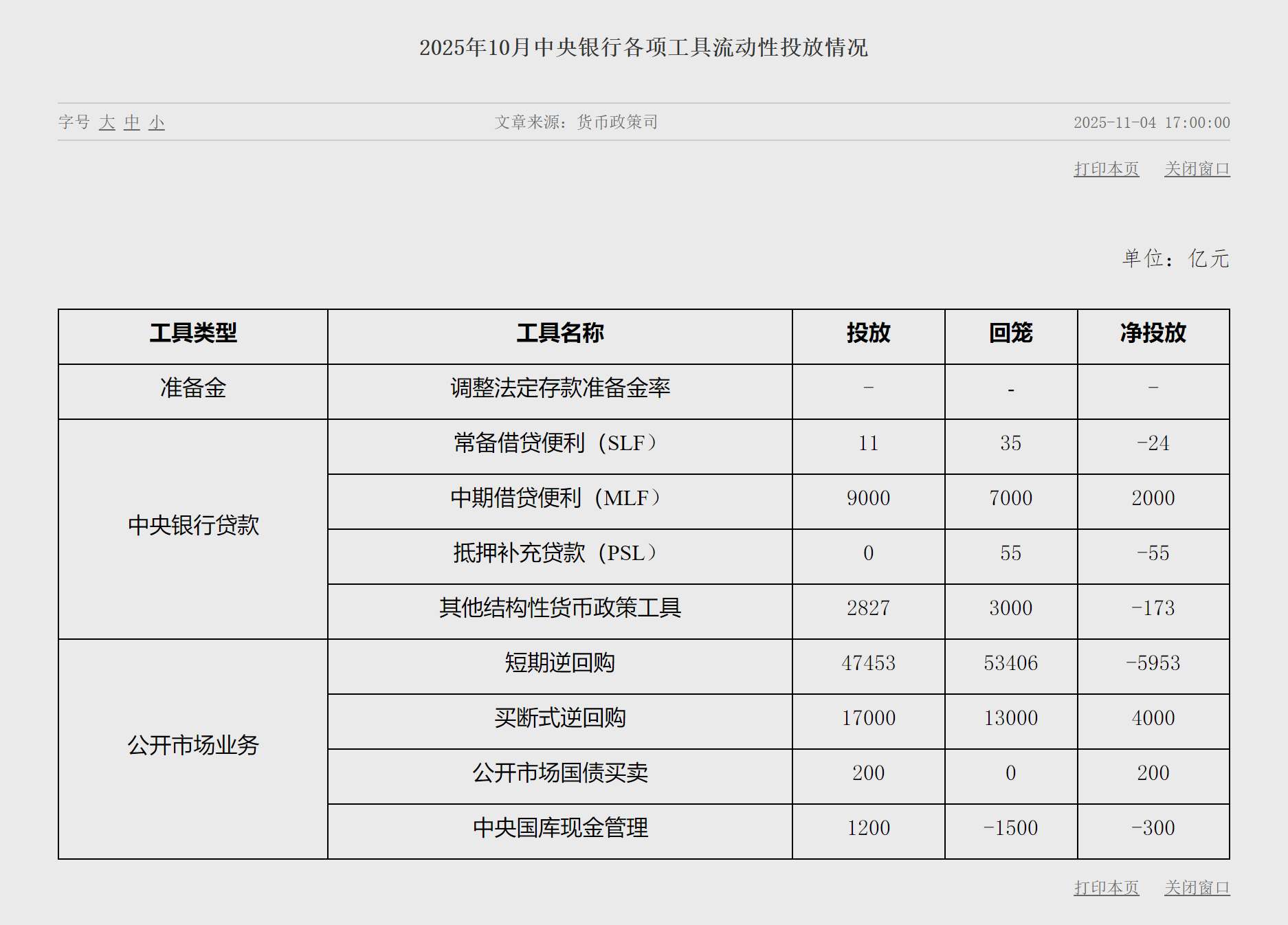
Core Points - The People's Bank of China (PBOC) resumed open market operations for government bonds in October 2025, with a net injection of 20 billion yuan [1] - In October, the PBOC conducted a net withdrawal of 595.3 billion yuan through short-term reverse repos, while net injections included 400 billion yuan from buyout reverse repos and 200 billion yuan from medium-term lending facilities (MLF) [1] - PBOC Governor Pan Gongsheng highlighted the importance of flexible operations in government bond trading to ensure smooth monetary policy transmission and stable financial market operations [3][4] Summary by Category Monetary Policy Tools - The PBOC has a variety of monetary policy tools, including reserve requirement adjustments, standing lending facilities (SLF), medium-term lending facilities (MLF), pledged supplementary lending (PSL), and other structural monetary policy tools [3] - Open market operations include short-term reverse repos, buyout reverse repos, government bond trading, and central treasury cash management [3] Market Conditions - The PBOC had previously suspended government bond trading due to significant imbalances in bond market supply and demand, as well as accumulated market risks [3] - Currently, the bond market is operating well, prompting the PBOC to resume government bond trading operations [3] Strategic Importance - The initiation of government bond trading in the secondary market is seen as a significant step to enrich the monetary policy toolkit, enhance the financial function of government bonds, and improve the pricing benchmark role of the government bond yield curve [4] - This move is also expected to facilitate the reform and development of China's bond market and enhance the market-making and pricing capabilities of financial institutions [4]
大类资产早报-20251104
Yong An Qi Huo· 2025-11-04 01:34
1. Global Asset Market Performance - The latest yields of 10 - year government bonds in major economies: US 4.111, UK 4.434, France 3.443, Germany 2.666, Italy 3.409, Spain 3.168, Switzerland 0.102, Greece 3.283, Japan 1.663, Brazil 6.085, China 1.791, South Korea 3.083, Australia 4.336, New Zealand 4.085 [1] - The latest yields of 2 - year government bonds in major economies: US 3.606, UK 3.790, Germany 2.004, Japan - (not provided), Italy 2.172, China (1Y yield) - (not provided), South Korea 2.661, Australia 3.591 [1] - The latest exchange rates of the US dollar against major emerging - economy currencies: Brazil 5.359, South Africa zar 17.319, South Korean won 1430.950, Thai baht 32.463, Malaysian ringgit 4.200 [1] - The latest values of on - shore RMB 7.121, off - shore RMB 7.127, RMB central parity rate 7.087, RMB 12 - month NDF 6.975 [1] - The latest values of major economies' stock indices: S&P 500 6851.970, Dow Jones Industrial Average 47336.680, NASDAQ 23834.720, Mexican stock index 62153.300, UK stock index 9701.370, French CAC 8109.790, German DAX 24132.410, Spanish stock index 16037.000, Japanese Nikkei 26158.360, Hang Seng Index 26158.360, Shanghai Composite Index 3976.521, Taiwan stock index 28334.590, South Korean stock index 4221.870, Indian stock index 8275.084, Thai stock index 1308.860, Malaysian stock index 1622.420, Australian stock index 9182.495, emerging - economy stock index 1410.430 [1] - The credit bond indices of major economies are not provided (all values are -) [1] 2. Stock Index Futures Trading Data - Index performance: A - share closing price 3976.52, up 0.55%; CSI 300 closing price 4653.40, up 0.27%; SSE 50 closing price 3016.35, up 0.16%; ChiNext closing price 3196.87, up 0.29%; CSI 500 closing price 7333.60, up 0.04% [2] - Valuation: PE (TTM) of CSI 300 is 14.20 (with a 0.09环比 change), SSE 50 is 11.84 (0.07环比 change), CSI 500 is 33.39 (- 0.01环比 change), S&P 500 is 28.50 (0.04环比 change), German DAX is 19.96 (0.14环比 change) [2] - Risk premium: 1/PE - 10 - year interest rate of S&P 500 is - 0.60 (- 0.04环比 change), German DAX is 2.34 (- 0.07环比 change) [2] - Fund flow: The latest value of A - share fund flow is - 150.03, main board is - 63.81, ChiNext is - 32.07, CSI 300 is 0.06; the 5 - day average values are - 516.08, - 413.23, - 51.63, - 96.92 respectively [2] 3. Transaction Data of Stock Index Futures and Treasury Bond Futures - Transaction amount: The latest transaction amount of Shanghai and Shenzhen stock markets is 21071.31, with a - 2106.61环比 change; CSI 300 is 5576.03 (- 1231.09环比 change), SSE 50 is 1346.37 (- 346.49环比 change), small - and - medium - sized board is 4159.15 (- 433.18环比 change), ChiNext is 5358.02 (- 557.27环比 change) [3] - Main contract basis: IF basis is - 18.60 (- 0.40%), IH basis is 0.25 (0.01%), IC basis is - 94.00 (- 1.28%) [3] - Treasury bond futures: T2303 closing price is 108.68 (0.00% change), TF2303 is 106.05 (- 0.01% change), T2306 is 108.41 (- 0.01% change), TF2306 is 106.00 (- 0.01% change) [3] - Fund rates: R001 is 1.3646% (- 13.00 BP change), R007 is 1.4604% (- 3.00 BP change), SHIBOR - 3M is 1.5950% (0.00 BP change) [3]
积极发展直接融资 更好服务实体经济
Zhong Guo Zheng Quan Bao· 2025-11-03 20:11
Group 1 - The core viewpoint emphasizes the importance of developing direct financing through equity and bonds to optimize financing structure and reduce costs, thereby stimulating market vitality and enabling high-quality economic development [1][2] - Experts suggest that during the "14th Five-Year Plan" period, efforts should be made to increase the proportion of direct financing in social financing, promoting a dual-driven approach of equity and bonds to provide more flexible and diverse financing channels for enterprises [1][2] - The Chinese equity financing market is experiencing a new phase with the development of multi-tiered capital markets like the Sci-Tech Innovation Board, Growth Enterprise Market, and Beijing Stock Exchange, which offer inclusive and efficient financing platforms for various types of enterprises [1][2] Group 2 - There is a call for enhancing the inclusiveness of the capital market by deepening reforms in the Sci-Tech Innovation Board and Growth Enterprise Market, focusing on supporting innovative and specialized enterprises through capital market financing [2][3] - The construction of a favorable ecosystem is essential, with an emphasis on improving the professional service capabilities of intermediary institutions and establishing differentiated listing standards and valuation systems for technology enterprises [2][3] - The development of private equity and venture capital funds is encouraged to broaden the sources of patient capital and enhance capital circulation efficiency, particularly focusing on hard technology sectors [2][3] Group 3 - The bond market is recognized as a crucial component of direct financing, with suggestions to improve the multi-tiered bond market system and promote the development of technology and green bonds to better serve the real economy [3][4] - There is a focus on developing a multi-layered bond market framework to enhance market efficiency and safety, as well as to diversify bond products to meet various financing needs [3][4] - The promotion of green bonds is highlighted, with recommendations to establish standards for identifying and certifying green technologies to guide bond funds towards supporting low-carbon technology innovations [4][5] Group 4 - The synergy between equity and bond markets is seen as a way to optimize risk-sharing and financing structures, enabling high-risk startups to secure funding while helping mature companies reduce financing costs [4][5] - The exploration of more technology-themed bonds is anticipated, with efforts to facilitate financing for eligible enterprises through technology bonds to lower the cost of capital for technology innovation [4][5] - The development of real estate investment trusts (REITs) is encouraged, particularly in new infrastructure and technology innovation sectors, to promote asset revitalization and support the digital transformation of traditional infrastructure [5]