
通胀

Search documents
特朗普突然发声,美联储大消息!
天天基金网· 2025-12-25 01:09
Group 1 - The latest data on initial jobless claims in the U.S. indicates a lower than expected number, which may reduce the probability of a rate cut by the Federal Reserve in January [2][4][5] - Trump has expressed a clear desire for a Federal Reserve chair who will lower interest rates when the economy is performing well, indicating his preference for a more accommodative monetary policy [3][7] - The labor market remains strong, with initial jobless claims dropping to 214,000, suggesting no significant pressure on employment despite some corporate layoffs [4][5] Group 2 - According to CME's "FedWatch," the probability of a 25 basis point rate cut by the Federal Reserve in January 2026 is 15.5%, while the probability of maintaining the current rate is 84.5% [6] - BlackRock strategists note that the Fed is nearing a neutral interest rate level, and further rate cuts will be limited unless there is a sharp deterioration in the labor market [6] - The U.S. economy grew at an annualized rate of 4.3% in Q3, exceeding expectations, but the Fed's pace of rate cuts is considered slow compared to other central banks [8][9] Group 3 - Gold and silver prices have reached historical highs, driven by expectations of future rate cuts and geopolitical tensions, with gold surpassing $4500 per ounce [11][12] - The increase in gold prices is attributed to rising demand from central banks and ETFs, with predictions of further price increases in 2026 [12]


美国失业担忧上升,家庭债务创纪录
第一财经· 2025-12-25 00:00
Core Viewpoint - The article discusses the emerging "no firing, no hiring" trend in the U.S. job market as 2025 comes to a close, highlighting concerns over job stability amid rising household debt and economic uncertainty [3]. Employment Stability Risks - According to a Mercer survey, job stability has become the second biggest concern for U.S. workers in 2025, following the ability to cover monthly living expenses [4]. - The fear of unemployment has surged from the seventh position in 2023 to the second position in 2025, indicating a significant shift in worker priorities [4]. - Despite a reported GDP growth of 4.3% in Q3, there is a disconnect between macroeconomic data and individual experiences, with many feeling economic pressure due to high inflation and market volatility [5]. Household Debt Reaches New Highs - U.S. household debt reached a record high of $18.6 trillion in Q3 2025, complicating the Federal Reserve's monetary policy decisions [8]. - The Federal Reserve is expected to lower interest rates only once or twice in 2026, which may not provide significant relief for indebted Americans [8]. - The largest portion of household debt is mortgage debt, totaling $13.07 trillion, while credit card debt stands at $1.23 trillion and auto loans at $1.66 trillion [8]. Economic Outlook and Consumer Sentiment - The unemployment rate rose to 4.6% in November, the highest in four years, with a concentration of new jobs in the healthcare sector [6]. - Consumer confidence has declined significantly, with a nearly 30% drop in the consumer confidence index compared to the same period in 2024 [6]. - A survey indicated that 63% of respondents expect unemployment to rise further in the coming year, reflecting a pessimistic outlook on the economy [6].

加息阴云笼罩+供给压力!日本两年期国债标售恐遇冷
Zhi Tong Cai Jing· 2025-12-24 23:55
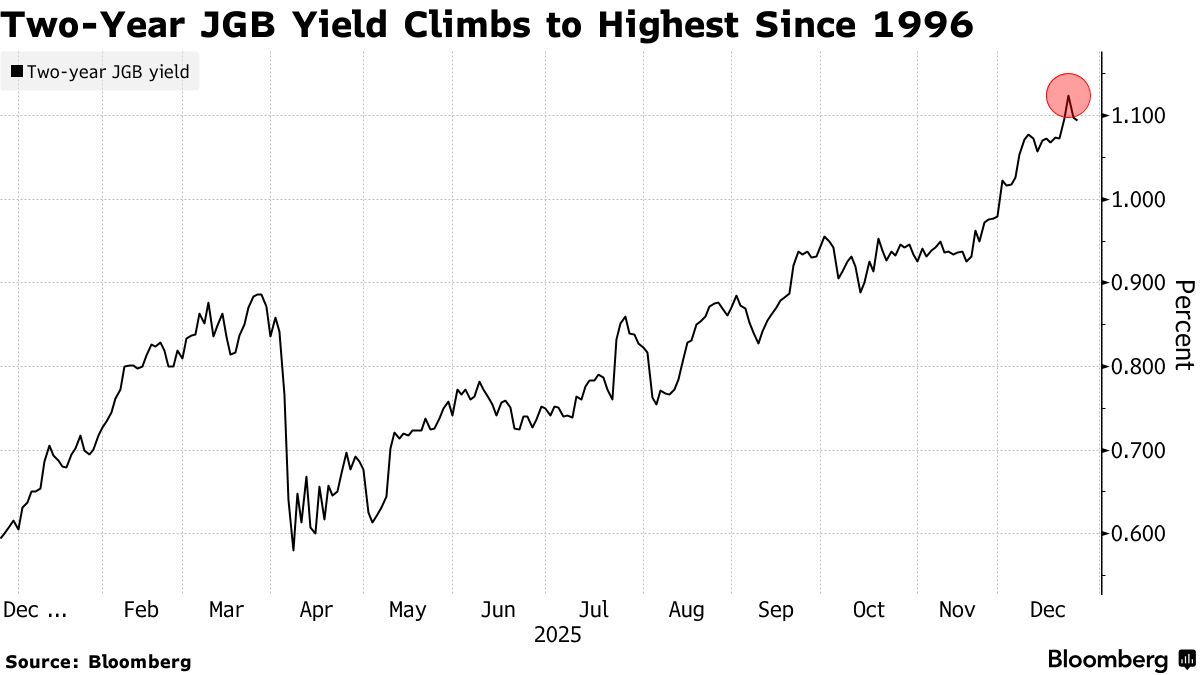
Group 1 - The market is anticipating a significant increase in interest rates by the Bank of Japan to curb inflation and support the yen, with a two-year government bond auction scheduled soon after the central bank raised policy rates to a 30-year high [1][3] - The two-year government bond yield has reached its highest level since 1996, reflecting heightened sensitivity to monetary policy expectations, while the 10-year breakeven inflation rate has also surged to its highest since 2004 [1] - Concerns about the Bank of Japan lagging behind in policy adjustments and rising inflation expectations have created unease in the market regarding the upcoming bond auction, which is seen as a key indicator of market sentiment towards the central bank's stance [3] Group 2 - The upcoming auction is expected to be the first issuance of two-year bonds with yields exceeding 1%, although there are doubts about its performance following the recent rate hike by the Bank of Japan [3] - Investors are worried about the government's bond issuance plan related to the fiscal year 2026 budget, which is anticipated to exceed the initial plan for the current fiscal year [3] - The auction results will be closely monitored for the bid-to-cover ratio and the 'tail' difference, which indicates demand and pricing dynamics in the bond market [4]
国际金融市场早知道:12月25日
Sou Hu Cai Jing· 2025-12-24 23:38
Group 1 - The U.S. Treasury Secretary confirmed that the government is actively interviewing candidates for the next Federal Reserve Chair, emphasizing the need to reduce the Fed's functions and end the era of "permanent quantitative easing" to reshape the monetary policy framework [1] - Japan plans to significantly reduce the issuance of ultra-long-term government bonds, with monthly issuance of 20, 30, and 40-year bonds each cut by 1 trillion yen, leading to an expected total issuance of approximately 17 trillion yen for the next fiscal year, the lowest level since 2017 [1] - The average interest rate for 30-year fixed-rate mortgages in the U.S. has dropped to 6.18%, marking a decline for the second consecutive week, although homebuyer response remains sluggish despite lower financing costs [1] Group 2 - As of the week ending December 19, the number of initial jobless claims in the U.S. was 214,000, significantly below the expected 224,000, indicating resilience in the labor market [2] - Russia's industrial output fell by 0.7% year-on-year in November, reversing a previous trend of growth, highlighting weakened economic momentum potentially due to external pressures and structural factors [2] Group 3 - The Dow Jones Industrial Average rose by 0.6% to 48,731.16 points, the S&P 500 increased by 0.32% to 6,932.05 points, and the Nasdaq Composite gained 0.22% to 23,613.31 points [3] Group 4 - COMEX gold futures decreased by 0.01% to $4,505.4 per ounce, while COMEX silver futures increased by 1.04% to $71.875 per ounce [4] - The main contract for U.S. oil rose by 0.03% to $58.4 per barrel, while Brent oil fell by 0.05% to $61.84 per barrel [4] - The yield on 2-year U.S. Treasury bonds fell by 2.45 basis points to 3.506%, and the yield on 30-year bonds decreased by 2.94 basis points to 4.795% [4] - The U.S. dollar index increased by 0.06% to 97.95, with the euro and pound both declining against the dollar [4]
深夜!特朗普,突然发声!事关美联储!
Xin Lang Cai Jing· 2025-12-24 23:26
Group 1: Economic Indicators - The number of initial jobless claims in the U.S. for the week ending December 20 fell to 214,000, lower than the expected 224,000, indicating a stable labor market [2][10] - The U.S. labor market continues to show low levels of layoffs, despite some companies like Pepsi and HP announcing job cuts [2][10] Group 2: Federal Reserve's Interest Rate Outlook - The probability of the Federal Reserve lowering interest rates by 25 basis points in January 2026 is 15.5%, while the probability of maintaining rates is 84.5% [3][11] - Market expectations suggest that the Fed will implement limited rate cuts in 2026, with a cumulative 25 basis point cut probability of 42.2% by March 2026 [3][11] - The Fed has already cut rates by 175 basis points in the current cycle, nearing neutral rate levels, limiting further cuts unless the labor market deteriorates significantly [3][11] Group 3: Trump's Influence on Federal Reserve - Trump expressed a desire for his nominated Federal Reserve chair to lower rates during economic upturns, indicating a preference for a dovish monetary policy [4][12] - Trump's comments reflect his political pressure to address voter concerns about affordability, suggesting that lower rates could benefit the housing market [4][12] Group 4: Gold and Silver Market Trends - Gold prices reached a new high of $4,525.83 per ounce, while silver also hit a record high of $72.7 per ounce, driven by expectations of future rate cuts and geopolitical tensions [7][16] - Gold has increased over 71% this year, supported by central bank purchases and inflows into exchange-traded funds (ETFs) [7][16] - Predictions from Goldman Sachs and other banks indicate that gold prices may continue to rise, with a target of $4,900 per ounce by 2026 [8][17]
买不起成热议焦点,多张图表揭示背后缘由
Xin Lang Cai Jing· 2025-12-24 15:02
Core Insights - The issue of consumer payment capacity has become the top concern for both consumers and politicians [1] - Despite a decrease in inflation rates from the peak in 2022, prices for essential goods such as housing, food, and electricity have significantly increased since before the COVID-19 pandemic [1][21] - Surveys indicate that high prices and living costs have led to a more pessimistic consumer sentiment, influencing recent electoral outcomes in favor of the Democratic Party [1][12] Inflation and Consumer Prices - The annual Consumer Price Index (CPI) shows that inflation peaked at 9.1% in 2022, the highest in about 40 years, and has since decreased to 2.7% in November 2025 [21] - However, the prices of everyday goods remain significantly higher than pre-pandemic levels, with a cumulative increase of 26% over the past six years [21][24] - Certain essential items have seen price increases that exceed the overall inflation rate, including housing, groceries, and utilities [24][27] Consumer Sentiment and Political Impact - A recent poll indicated that approximately 46% of respondents attribute their poor financial situation to high prices, the highest level recorded since the late 1970s [27] - The political divide is evident, with 82% of voters for Kamala Harris acknowledging rising living costs, compared to only 45% of Trump voters [29] - The Democratic Party's focus on consumer payment capacity has been a key factor in their electoral successes in recent elections [12][30] Economic Factors Influencing Prices - The rapid increase in prices is attributed to a combination of factors, including supply-demand imbalances exacerbated by the COVID-19 pandemic and subsequent economic stimulus measures [33][35] - The ongoing geopolitical tensions, such as the conflict in Ukraine, have further contributed to rising energy and food prices [35] - Economic indicators suggest that while high-income households have benefited from stock market gains, low-income groups have not experienced similar financial relief [35][36]

美国消费者信心指数连续五个月走低,通胀与就业仍存隐忧
Sou Hu Cai Jing· 2025-12-24 12:53
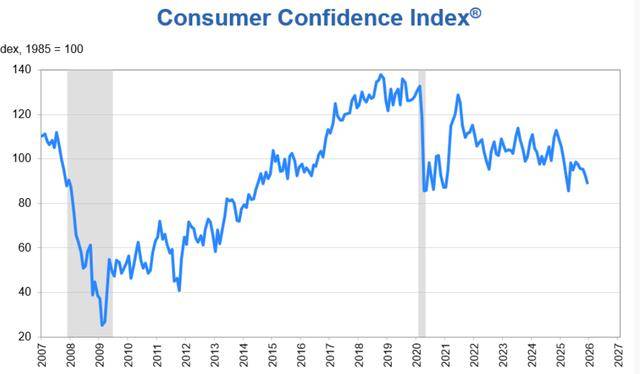
Core Insights - The consumer confidence index in the U.S. dropped from a revised 92.9 in November to 89.1 in December, marking the lowest level since April and reflecting a negative outlook on the business environment and increasing concerns about employment and income [1][4] Group 1: Consumer Confidence Index - The consumer confidence index has declined for five consecutive months, indicating growing uncertainty among consumers regarding the future economic outlook [1][4] - Four out of five components of the consumer confidence index decreased, with the only remaining component showing significant weakness [1] - The consumer expectations index, which reflects short-term income prospects, business, and employment market conditions, remained low at 70.7, significantly below the critical threshold of 80, which is a key indicator of potential economic recession [3][5] Group 2: Economic Implications - The decline in consumer confidence is a critical indicator for the U.S. economy, as consumer spending is a major pillar of economic activity [4] - There are concerns that the U.S. economy may enter a "soft recession," characterized by low growth, slowing employment, and persistent inflationary pressures [3][5] - The rigid nature of current inflation is expected to further erode wage growth, impacting consumer confidence and spending [4]
2026年海外宏观展望:美国AI投资拉动内需,货币财政双宽托底
Dongxing Securities· 2025-12-24 12:04
Economic Overview - The US economy is in the later stages of a soft landing following a high inflation and interest rate cycle, with internal momentum weakening[4] - Consumer spending is showing signs of weakness compared to last year, while AI investments are supporting overall investment levels[4] - The labor market is cooling, with credit growth for households and businesses at low levels, indicating characteristics of a potential economic downturn[4] Labor Market - The employment rate has dropped to levels comparable to 2009, with voluntary resignation rates falling to 2008 levels, while layoffs remain low[5] - The unemployment rate is gradually rising but remains at a relatively reasonable level, particularly affecting younger demographics[5] - A significant portion of the unemployed is concentrated among younger individuals, indicating a need for substantial interest rate cuts[5] Inflation and Monetary Policy - Short-term inflation pressures are low, but medium to long-term inflation risks persist, with the Fed expected to cut rates by 50-75 basis points in 2026[6] - Tariffs are acting similarly to consumption and intermediate goods taxes, suppressing consumption and investment, with their effects expected to diminish by mid-2026[6] - The Fed's current monetary policy is neutral and insufficient to alleviate rising unemployment rates[6] Fiscal Policy and Investment - The US is expected to experience a dual easing of monetary and fiscal policies, which may help avoid a full-blown recession[7] - The capital market is seeing a decrease in the correlation between the 10-year Treasury yield and policy rates, indicating a belief that rate cuts may be nearing their end[7] - AI investments are significantly boosting fixed investments, counteracting the suppressive effects of high interest rates on overall investment[4] Stock Market Outlook - The US stock market is currently viewed as being in a bubble, with the S&P 500 exceeding its long-term trend by 41%[8] - Despite the bubble, the short-term risks to the stock market are considered low due to the easing of regulations and the AI investment boom[8] - Caution is advised in maintaining long-term positions, with close monitoring of liquidity flows recommended[8]
布米普特拉北京投资基金管理有限公司:美国经济第三季度加速扩张 但通胀隐忧仍存
Sou Hu Cai Jing· 2025-12-24 10:54
Economic Growth - The U.S. economy demonstrated unexpected growth resilience in Q3, with a seasonally adjusted annualized GDP growth rate of 4.3%, significantly above the market forecast of 3.3% [1] - This growth rate not only surpassed the previous quarter's 3.8% but also marked the fastest expansion in nearly two years [1] Key Drivers of Growth - Consumer spending, exports, and public spending were the main drivers of economic growth in the quarter [3] - Consumer spending, a core economic driver, had an annualized growth rate of 3.5%, outperforming the previous quarter [3] - Increases in exports and public spending provided solid support for growth, while private fixed investment continued to decline, though the rate of decline has narrowed [3] Inflation Concerns - Despite strong economic growth, inflation pressures remain persistent, with the core Personal Consumption Expenditures (PCE) index rising by 2.8% year-on-year in Q3, exceeding previous values [4] - The core PCE inflation rate recorded an increase of 2.9%, significantly above the long-term target set by the Federal Reserve [4] Labor Market Dynamics - The U.S. labor market may be entering a phase of reduced activity, with companies showing cautious hiring intentions, potentially influenced by policy uncertainties and a sustained high-interest rate environment [8] - Recent employment data indicated that the unemployment rate has risen to a high level in recent years, although the number of new non-farm jobs added was slightly better than expected [6][8] Future Outlook - Economists suggest that recent employment growth data may be subject to downward revisions in the future [8] - Market participants are closely monitoring corporate pricing behavior in response to changes in the global trade environment, assessing potential impacts on overall price levels and adding uncertainty to future inflation and economic trends [8]

金丰来:2026年金银牛市未竟 技术资产或成助燃剂
Xin Lang Cai Jing· 2025-12-24 10:37
Core Viewpoint - The ongoing bull market for gold is expected to continue despite potential short-term corrections in Bitcoin, AI, and the overall tech sector by 2026. The current weakness in crypto assets may actually drive upward momentum for silver [1][4]. Group 1: Gold and Bitcoin Analysis - The BOLD index created by ByteTree provides a framework for rebalancing gold and Bitcoin, two uncorrelated assets, to capture their complementary nature in volatile market conditions [1][4]. - Predictions suggest that gold prices could reach $7,000 per ounce by 2030, a forecast that is gaining credibility given the recent $2,500 increase in gold prices over the past five years [1][4]. - The expansion of the money supply and persistent fiscal deficits are expected to lead to inevitable inflation when these funds flow into the real economy [1][4]. Group 2: Silver Potential - If gold reaches its target price and the gold-silver ratio falls to around 40, silver prices could theoretically reach $175 [5]. - Gold serves as a reserve asset linked to macroeconomic indicators, while Bitcoin acts as a digital reserve tied to technology stocks and internet development, highlighting their distinct roles in asset allocation strategies [5]. Group 3: Market Dynamics - Bitcoin is currently in an oversold condition, while gold and silver show strong signs of being overbought, although historical data indicates that these conditions may extend further [5]. - The AI and internet sectors are showing signs of overvaluation after a prolonged period of enthusiasm, with concerns about capital expenditures and returns on investment [5]. - The current market is experiencing a stock momentum bubble not seen in at least 25 years, and as the internet sector adjusts, capital flows will redefine asset performance [5]. Group 4: Institutional Investment and Sentiment - Mainstream institutions have a very low allocation to Bitcoin, particularly in North America and Europe, indicating significant growth potential for the asset [6]. - Silver, once dismissed as "dirt," is making a comeback as the gold-silver ratio declines, suggesting a shift in investor sentiment [6]. - The absence of large inflows into mining ETFs and prevailing public skepticism about gold as a "barbarous relic" signal that the gold bull market is not yet over [6].
