
新消费

Search documents
均衡布局大科技赛道,景顺长城成长优选来了
Xin Lang Cai Jing· 2026-01-13 03:54
Core Insights - The technology sector in China has shown remarkable performance, with the communication and electronics industries rising by 84.75% and 47.88% respectively in 2025, significantly outperforming the CSI 300 index which increased by 17.66% [1][7] - The technology sector remains a focal point for 2026, with institutions suggesting that investors should focus on well-rounded "big tech players" as the market experiences increased volatility [1][7] Investment Strategy - The investment approach of the fund manager, Nong Bingli, emphasizes understanding industry trends rather than merely chasing short-term high-growth opportunities. This strategy involves identifying companies with non-linear growth potential across various emerging industries, including technology [3][9] - Nong Bingli has demonstrated strong performance in his fund management, with the fund "Invesco Great Wall Quality Evergreen A" achieving a net value growth rate of 63.29% over the past year, significantly outperforming its benchmark [3][9][10] Focus Areas - The fund manager is particularly focused on sectors such as computing power, consumer electronics, the internet, and new consumption trends. This includes a strong emphasis on companies that are innovating in hardware and AI applications [4][10] - The investment strategy for the newly launched fund "Invesco Great Wall Growth Preferred" allows for a diversified approach across A-shares and Hong Kong stocks, enhancing the potential for identifying unique investment opportunities [5][11] Future Outlook - Nong Bingli maintains an optimistic outlook for the equity market in 2026, citing stable growth logic driven by industry trends, macroeconomic policies, and company performance. The focus will be on sectors with clear profit growth potential [5][10] - The fund's fee structure is designed to align the interests of the fund manager and investors, with performance-based fees that incentivize long-term holding [12]
国信证券:消费行业2026年聚焦新消费与困境反转 看好四大细分赛道
智通财经网· 2026-01-13 03:54
Core Viewpoint - Guosen Securities maintains an "outperform" rating for the consumer sector, anticipating potential rebounds in 2025 due to policy support and structural opportunities in specific sub-sectors like gold jewelry, beauty care, offline retail, and cross-border e-commerce [1] Group 1: 2025 Market Review - In 2025, the SW retail index increased by 11.6%, underperforming the CSI 300 index by 6.1 percentage points, as the market adjusted after significant gains in 2024 [2] - The SW beauty care index rose by 0.4%, lagging behind the CSI 300 index by 17.35 percentage points, with a notable decline in the second half of the year due to a shift in market focus towards technology [2] - The overall consumer sector showed stable fundamentals in 2025, with emerging structural highlights and strong rebound potential supported by clearer consumption-promoting policies [2] Group 2: 2026 Outlook - The new consumption trend is expected to continue into 2026, driven by changes in consumer sentiment among younger demographics and the successful market entry of new consumption companies [3] - Traditional consumption leaders are facing operational challenges but are adapting by innovating and adjusting their retail channels, leading to potential recovery starting from late 2024 [3] Group 3: Investment Recommendations - **Gold Jewelry**: The sector is entering a peak consumption season with overall valuations at low levels, and companies with strong product offerings are expected to see growth [4] - **Beauty Care**: The sector is returning to low levels, with traditional leaders showing signs of recovery and new product launches driving growth [4] - **Offline Retail**: The end of the year marks a sales peak, with potential positive impacts from CPI recovery and ongoing adjustments in supermarket operations [4] - **Cross-Border E-commerce**: Market sensitivity to external tariffs is decreasing, and leading companies are expected to benefit from the upcoming overseas consumption peak [4]

港股通50ETF(159712)涨超2%,多重驱动因素或支撑港股前景
Mei Ri Jing Ji Xin Wen· 2026-01-13 02:40
Core Viewpoint - The Hong Kong stock market is expected to experience three driving factors by 2026: international capital allocation, inflow of Chinese capital, and recovery of China's economic fundamentals [1] Group 1: International Capital - A weakening US dollar index is anticipated to drive capital inflow into the Hong Kong stock market [1] Group 2: Chinese Capital - The appreciation of the Renminbi is likely to attract Chinese capital that has been held overseas to invest in Hong Kong stocks, helping to avoid foreign exchange costs and benefit from asset recovery [1] Group 3: Economic Fundamentals - The expected rebound in CPI and PPI in 2026 may lead to a weak recovery in corporate profits, with potential for a strong recovery if combined with debt reduction policies [1] Group 4: Industry Insights - The Hang Seng Technology Index is expected to benefit from the "Davis Triple Play," with a high probability of success in AI application sectors [1] - The dividend yield of Hong Kong stocks, supported by tax advantages for insurance capital, is projected to continue outperforming that of A-shares [1] - The convergence of prices between innovative drugs in China and the US presents growth opportunities [1] - New consumption trends are expected to replicate the core asset bull market seen from 2019 to 2021 [1] Group 5: ETF Information - The Hong Kong Stock Connect 50 ETF (159712) tracks the Hong Kong Stock Connect 50 Index (930931), which selects the 50 largest listed companies within the Stock Connect framework, covering 18 industries including finance and information technology, reflecting the overall performance of large-cap leaders in both new and traditional economies, characterized by high growth and low valuation [1]
港股开盘 | 三大指数集体高开 机构:港股整体配置维持哑铃策略
智通财经网· 2026-01-13 01:45
Market Overview - The Hong Kong stock market opened strongly on January 13, with the Hang Seng Index rising by 1.32%, the Hang Seng Tech Index increasing by 1.93%, and the China Enterprises Index up by 1.25% [1] - Notable gains were seen in tech stocks, with Alibaba rising nearly 5% and AI application stocks like Zhiyuan increasing by nearly 6%. The storage chip leader, Zhaoyi Innovation, saw its H-shares surge over 45% on its first trading day [1] Foreign Investment Outlook - According to Wind data, net inflows from southbound funds reached approximately HKD 32.694 billion, marking the highest weekly inflow in over a month and a half [2] - Major foreign institutions, including Goldman Sachs, Morgan Stanley, and UBS, have released positive market outlooks for 2026, driven by expectations of accelerated corporate profit growth, coordinated macro policies, and RMB appreciation [2] - The core drivers for the Chinese stock market's rise are shifting from "valuation recovery" in 2025 to "profit growth" in 2026, as per foreign institutions [2] Sector Recommendations - CITIC Securities suggests that the Hong Kong stock market could experience a second round of valuation recovery and performance revival in 2026, with a focus on sectors such as technology, healthcare, resources, consumer staples, paper, and aviation [2] - Western Securities highlights three factors driving the Hong Kong stock market's rebound: a weaker dollar encouraging international capital allocation to Hong Kong, RMB appreciation attracting Chinese capital back, and a recovery in the Chinese economy supported by inflation and potential debt relief policies [2] Market Sentiment and Trends - Huaxi Securities notes that the Hong Kong market has been underperforming compared to the A-share market, with a need for time to restore investor sentiment. The market has shown signs of recovery since late December, but the consensus for bullish sentiment remains to be solidified [3] - Huatai Securities indicates that the market sentiment index has entered a panic zone, historically leading to a significant increase in the probability of price rises in the following month [3] - ZheShang International maintains a cautious optimism regarding the market's mid-term outlook, despite a weak fundamental backdrop and a slight decline in the funding environment [3] Investment Opportunities - Industrial Securities recommends focusing on leading companies in the AI sector and dividend-paying assets in a low-interest-rate environment, including insurance, banking, energy, property management, and public utilities [4] - ZheShang International is optimistic about sectors benefiting from policy support, such as new energy, innovative pharmaceuticals, and AI technology, as well as low-valuation state-owned enterprises [4] - The 2026 spring performance of the Hong Kong market is expected to be driven by "AI applications, PPI improvement, and expanded domestic demand," with a focus on quality stocks in these areas [4] Company News - Rongchang Biopharmaceutical (09995) signed an exclusive licensing agreement with AbbVie for RC148, receiving an upfront payment of USD 650 million and potential milestone payments up to USD 4.95 billion [9] - WuXi AppTec (02359) forecasts a net profit of CNY 19.151 billion for 2025, representing a year-on-year increase of approximately 103% [9] - Dongfeng Motor Group (00489) reported cumulative vehicle sales of 1.8962 million units for 2025, a slight increase of 0.01% year-on-year [9] - Q Technology (01478) expects camera module sales to reach 45.938 million units for 2025, a year-on-year increase of 43.6% [9]
外媒关注2026开年中国消费市场新趋势——中国消费迎来“开门红”(国际论道)
Xin Lang Cai Jing· 2026-01-12 14:51
Core Insights - The Chinese consumer market is experiencing a significant transformation, shifting from quantity to quality, driven by increased consumer confidence and innovative policies [6][9][10]. Consumer Activity - During the New Year holiday, 142 million domestic trips were made in China, with total spending reaching 84.789 billion yuan, indicating a robust recovery in consumer activity [6][14]. - Hainan's duty-free sales on January 1 reached 251 million yuan, a year-on-year increase of 93.8%, showcasing the growing appeal of domestic tourism and shopping [7][14]. Market Trends - The rise of "China Shopping" alongside "China Travel" reflects a shift in consumer preferences, with tourists increasingly purchasing high-tech products and cultural items rather than traditional souvenirs [7][8]. - The Z-generation in China is gravitating towards new domestic products and services that blend tradition with modern technology, enhancing the appeal of local brands [7][8]. Policy Support - The Chinese government is implementing a series of policies aimed at stimulating consumption, including financial incentives and support for green technology products [9][10]. - The Central Economic Work Conference emphasized the continuation of proactive fiscal policies in 2026 to maintain high growth rates, focusing on boosting consumer spending and investment [9][10]. Economic Resilience - China's consumer market is not only recovering but also reflecting structural optimization and enhanced internal dynamics, contributing to economic resilience [11][19]. - The retail sales of consumer goods increased by 4% year-on-year in the first eleven months of 2025, indicating a steady release of consumer demand [11][19]. Global Perspective - International media highlight the opportunities for global businesses to adapt to the evolving Chinese market, particularly in sectors like retail and services, where consumer preferences are shifting towards local and value-driven products [12][19]. - The focus on service experiences among younger consumers presents significant opportunities for foreign companies in sectors such as tourism, cultural events, and entertainment [12][19].



商贸零售行业1月投资策略:政策支持有望进一步加码,板块龙头蓄势待发
Guoxin Securities· 2026-01-12 13:43
Investment Rating - The report maintains an "Outperform" rating for the retail sector [3][56]. Core Insights - The retail sector is expected to benefit from increased policy support, with leading companies poised for growth [1][3]. - The overall consumption environment in 2025 is projected to be stable, with structural highlights emerging, particularly as consumption policies become clearer [1][12]. - The report identifies two main trends for 2026: the continuation of new consumption trends and the anticipated reversal of challenges faced by traditional consumption [2][20]. Summary by Sections Market Performance Review - In 2025, the SW retail index increased by 11.6%, underperforming the CSI 300 index by 6.1 percentage points, while the beauty care index rose by only 0.4%, lagging behind the CSI 300 by 17.35 percentage points [1][16]. - The retail sector's performance was initially strong in the first half of 2025 but faced a decline in the second half due to a shift in market focus towards technology [1][16]. Investment Recommendations - The report suggests several sectors for investment: 1. **Gold and Jewelry**: The sector is entering a consumption peak, with low valuations and expected growth in same-store sales and channel expansion. Recommended companies include潮宏基, 菜百股份, and 周大福 [3][56]. 2. **Beauty and Personal Care**: The sector is returning to low valuations, with traditional leaders showing signs of recovery. Recommended companies include 上美股份 and 珀莱雅 [3][56]. 3. **Offline Retail**: The end of the year is a peak sales period, with potential positive impacts from CPI recovery. Recommended companies include 名创优品 and 永辉超市 [3][56]. 4. **Cross-border E-commerce**: Companies are expected to benefit from reduced external tariff impacts, with recommendations including 小商品城 and 安克创新 [3][56]. Key Company Earnings Forecasts - The report provides earnings forecasts and investment ratings for key companies, all rated "Outperform" for 2025 and 2026, including 潮宏基, 上美股份, and 珀莱雅, with respective PE ratios indicating growth potential [5][59]. Recent Industry Data Tracking - As of November 2025, the total retail sales of consumer goods reached 43,898 billion yuan, with a year-on-year growth of 1.3%. The growth was influenced by high base effects and the timing of promotional events [26][30]. - Online retail sales for the first 11 months of 2025 reached 144,582 billion yuan, growing by 9.1%, with physical goods online retail accounting for 25.9% of total retail sales [28][30]. Policy Support and Future Outlook - Recent policy initiatives emphasize the importance of boosting consumer spending, with a focus on increasing the consumption rate and stabilizing demand through various measures [13][24]. - The report anticipates that traditional consumption leaders will gradually improve their performance as they adapt to new market conditions and innovate their product offerings [24][20].




消费领域的“超额捕手”!富国基金周文波:也能欣赏“老登股”,但投资心态不“老登”
聪明投资者· 2026-01-12 12:14
Core Viewpoint - The article emphasizes the importance of understanding consumer behavior and market trends, particularly focusing on the potential of the Z generation in the consumption market, as demonstrated by the performance of the fund managed by Zhou Wenbo, which has outperformed its peers in recent years [2][3]. Group 1: Investment Strategy - Zhou Wenbo adopts an investment philosophy of "bottom-up, maintaining integrity while being innovative," focusing on companies with strong performance and long-term growth potential, while also seeking opportunities that can yield significant changes and excess returns [4][9]. - A four-layer investment framework is established, which includes "good business, good company, growth stage, and reasonable valuation," allowing for the identification of investment opportunities in both traditional and new consumption trends [4][5]. Group 2: Market Insights - Zhou Wenbo identifies three categories of store-based businesses based on their sales per square meter (坪效): those below 20,000 yuan are generally mediocre; those between 20,000 and 30,000 yuan may have growth potential depending on their expansion stage; and those above 30,000 yuan are likely to be excellent businesses worth significant attention [5][21][22]. - The current consumption sector, despite experiencing adjustments, still presents opportunities, particularly in traditional consumption sectors with low valuations and new consumption areas like trendy toys, beauty products, and jewelry retail, which continue to show growth potential [5][24]. Group 3: Future Opportunities - The investment opportunities in 2025 are expected to be primarily driven by new consumption, while traditional consumption leaders may remain relatively flat due to market conditions [27]. - There is a belief that as the market stabilizes, traditional consumption companies, which currently have dividend yields of 4%-7%, could see positive returns if the overall environment improves [28]. Group 4: Consumer Behavior and Research - Zhou Wenbo emphasizes the importance of grassroots research and staying curious about new trends, which helps in identifying investment opportunities and validating existing judgments [29][30]. - The article highlights the significance of understanding the logic behind consumer behavior, particularly in the context of the Z generation, and the need to avoid a stagnant mindset when approaching investment in consumer stocks [31][32].

2025年主观私募分红超百亿!日斗投资断崖式领跑!喜世润、复胜等业绩居前!
私募排排网· 2026-01-12 12:00
Core Viewpoint - The performance of subjective private equity funds significantly improved in 2025, leading to a notable increase in dividend distributions, with a total of 990 dividends amounting to 11.47 billion yuan across 772 products [2][3]. Summary by Category Overall Performance - By the end of 2025, 5,777 products showed performance, with subjective private equity funds distributing dividends 990 times, totaling 11.47 billion yuan [2]. - The distribution amounts for different scales of private equity are as follows: 0-5 billion yuan: 2.98 billion yuan; 5-10 billion yuan: 2.23 billion yuan; 10-20 billion yuan: 1.37 billion yuan; 20-50 billion yuan: 2.16 billion yuan; 50-100 billion yuan: 0.37 billion yuan; 100 billion and above: 2.36 billion yuan [3]. Performance by Scale - **100 billion and above**: 39 dividends with a total of 2.36 billion yuan, average return of 31.23% [4]. - **50-100 billion**: 27 dividends totaling 0.37 billion yuan, average return of 3.24% [3]. - **20-50 billion**: 124 dividends amounting to 2.16 billion yuan, average return of 40.10% [8]. - **10-20 billion**: 87 dividends totaling 1.37 billion yuan, average return of 33.45% [12]. - **5-10 billion**: 161 dividends amounting to 2.23 billion yuan, average return of 35.48% [15]. - **0-5 billion**: 552 dividends totaling 2.98 billion yuan, average return of 40.30% [17]. Top Performing Products - The top three dividend products in 2025 were from 喜世润投资, 复胜资产, and 睿扬投资, with significant returns [5][6]. - Notable products include: - 喜世润黄金增强1号A类份额 with a dividend of approximately *** million yuan and a return of ***% [6]. - 复胜正能量八号 with a dividend of approximately *** million yuan and a return of ***% [7]. - 北京禧悦私募's 禧悦三石A类份额 with a total dividend of approximately *** million yuan and a return of ***% [10][11]. Investment Strategies - 复胜资产 focused on "new consumption" as a major investment logic in 2025, with plans to continue this focus in 2026, alongside interests in non-ferrous metals and traditional industries [7]. - 北京禧悦私募 emphasizes a value investment philosophy based on research and valuation [11]. Conclusion - The data indicates a robust recovery in the private equity sector in 2025, with increased dividend distributions and strong performance across various scales of funds, highlighting potential investment opportunities in the sector [2][3].

华安基金消费女神“翻车”,重仓传统赛道致大幅亏损
Sou Hu Cai Jing· 2026-01-12 11:36
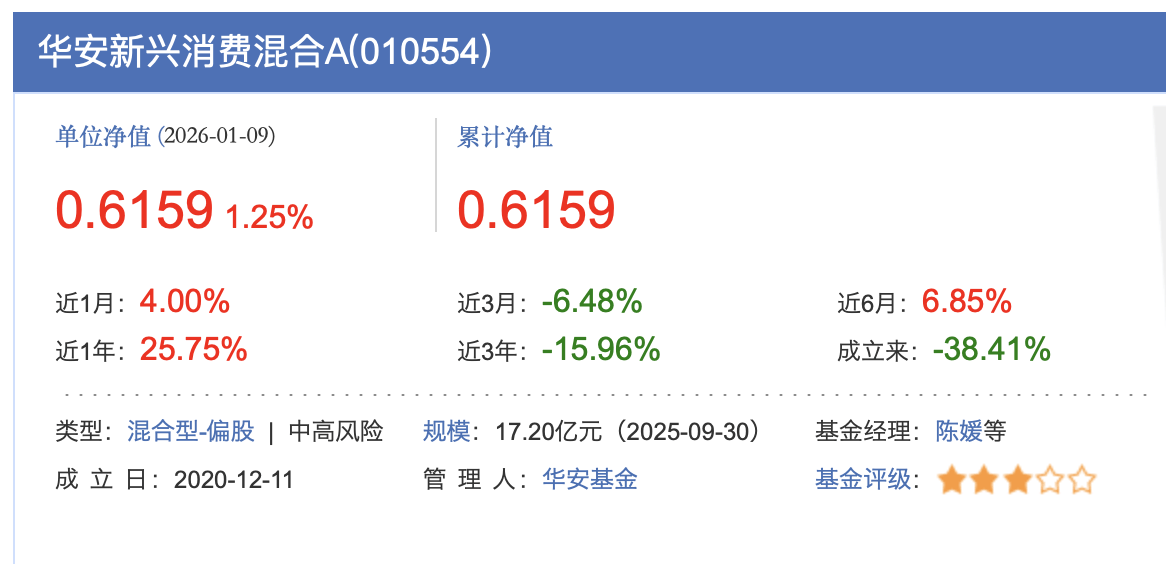
Core Viewpoint - The A-share market has experienced a strong rally, with major indices rising due to the rotation of heavyweight stocks and popular sectors, leading to significant net value growth for many funds. However, some products managed by Chen Yuan of Huaan Fund have notably underperformed compared to the overall market trend [1][4]. Fund Performance - Huaan New Consumption Mixed A, established on December 11, 2020, raised 6.268 billion yuan during its issuance and has a current unit net value of 0.6159 yuan as of January 9, 2026, reflecting a return of -38.41% since inception, ranking low among peers [1][2]. - The fund has accumulated losses exceeding 2 billion yuan since its inception, with its scale shrinking to 1.72 billion yuan as of September 30, 2025 [2][4]. Manager Background - Chen Yuan began her career at Huaan Fund after graduating from Shanghai Jiao Tong University in 2008, rising from researcher to fund manager. She gained the title "Consumption Goddess" after achieving a 35.01% annualized return while managing Huaan Ecological Priority Mixed Fund [3][4]. Recent Performance Trends - Chen Yuan's funds have shown overall weak performance, with Huaan New Consumption Mixed A's return of -38.41% significantly lagging behind the average return of 20.72% for similar funds since its inception [4]. - Huaan Quality Life Mixed Fund, established in February 2020, has also underperformed with a return of -12.75% [4]. Investment Strategy Issues - Investment missteps include poor timing in stock purchases, such as buying China Duty Free Group shares at a high price, which subsequently fell by 35%, and similar losses with other stocks like Anjuke Food and Jiumaojiu [6][9]. - The fund's high concentration in traditional consumer brands, which account for 65% of its top ten holdings, contrasts with the emerging trend of new consumption preferences among younger consumers [6][7]. Market Dynamics - The investment logic in the consumer sector is undergoing fundamental changes, with new consumption patterns emerging that require more refined research rather than simple industry allocation [7][8]. - The high concentration of Huaan New Consumption Mixed A in the emerging consumption sector has led to amplified net value fluctuations during market corrections, lacking diversification to offset losses [8][12]. Competitive Landscape - Other fund managers are exploring new investment paths, focusing on emerging consumer brands that resonate with younger generations, achieving significant returns compared to traditional consumer-focused funds [10][12].
外媒关注2026开年中国消费市场新趋势——中国消费迎来“开门红”
Ren Min Ri Bao· 2026-01-12 06:51
Core Insights - The Chinese consumer market is experiencing a significant transformation, moving from quantity to quality, which presents substantial opportunities for global markets [1][2][6] Group 1: Consumer Trends - During the New Year holiday, 142 million domestic trips were made in China, with total spending reaching 84.789 billion yuan, indicating strong consumer activity [1] - The "ice and snow tourism" has become a key driver of winter consumption, with record visitor numbers to ski resorts and hot springs [2] - The shopping preferences of travelers to China are evolving, with a shift towards high-tech products and cultural items, reflecting the diversity and quality of Chinese products [2][3] Group 2: Policy Support - China's 14th Five-Year Plan emphasizes promoting consumption as a key strategy for balanced economic growth [5] - The Central Economic Work Conference highlighted the implementation of proactive fiscal policies to stimulate consumption and investment in 2026 [4] - Recent policies aim to enhance consumer confidence through measures like consumption subsidies and improved social security systems [5][6] Group 3: Economic Resilience - The retail sales of consumer goods in China increased by 4% year-on-year in the first eleven months of 2025, showcasing the steady recovery of consumer demand [6] - The focus on domestic consumption is expected to drive sustainable economic growth, shifting the emphasis from investment and exports to services and consumption [5][6] - The resilience of the Chinese economy is further supported by targeted measures to expand domestic demand and enhance social security [6] Group 4: Global Market Opportunities - Global brands are encouraged to adapt their strategies to align with the evolving preferences of Chinese consumers, particularly in terms of value and local tastes [7] - There is significant potential for investment in China's smaller cities, where daily consumer spending shows remarkable resilience [7] - The younger generation in China is increasingly spending on experiences, such as travel and cultural events, presenting opportunities for service-oriented businesses [7]