
通缩

Search documents
关键数据反弹,背后是什么信号?
大胡子说房· 2025-09-11 12:07
Group 1 - The core viewpoint of the article is that while CPI continues to decline, PPI shows signs of stabilization, indicating the effectiveness of recent anti-involution measures on upstream prices [3][9][12] - In August, the CPI decreased by 0.4% year-on-year, while the core CPI, excluding food and energy, increased by 0.9%, marking the fourth consecutive month of growth [3][6] - The average CPI from January to August this year is down 0.1% compared to the same period last year, suggesting a persistent deflationary environment [6][7] Group 2 - Food prices fell by 4.3% year-on-year in August, with a larger decline than the previous month, contributing to a greater downward impact on CPI [8] - PPI's year-on-year decline has narrowed for the first time since March, and the month-on-month data has ended an eight-month downward trend, indicating a potential recovery [10][15] - The article emphasizes that while PPI shows improvement, both CPI and PPI remain negative, making it premature to declare a shift from deflation to inflation [15][16] Group 3 - The article discusses the need to stimulate demand alongside supply-side adjustments to effectively combat deflation [17][18] - It highlights that the capital market is currently being leveraged to increase liquidity and drive asset prices up, which is crucial for reversing deflationary trends [20][21] - The article suggests that the key to increasing investment lies in raising asset prices, particularly in the stock market, which requires less capital than real estate [25][27] Group 4 - The current capital market environment is seen as a critical factor in addressing the issue of insufficient investment, which is identified as a core reason for deflation [21][22] - The article posits that a rise in stock prices can lead to a quicker recovery in CPI and PPI data, thus benefiting the overall economic environment [29][30] - It anticipates that the capital market will experience another upward trend following potential interest rate cuts by the Federal Reserve, which could enhance liquidity and market sentiment [33][34]


李迅雷专栏 | 失温时为何会感受到“热”
中泰证券资管· 2025-09-10 11:32
Core Viewpoint - The article draws a parallel between human hypothermia and economic conditions, suggesting that when the economy is "hypothermic," it may create a false sense of warmth, leading to misinterpretations of economic health [1][4]. Economic Data vs. Perception - Economic data often lags behind real-time events, leading to a disconnect between actual economic conditions and public perception [4]. - Japan's economic stagnation over 30 years post-bubble burst is highlighted as a case study, where the Consumer Price Index (CPI) only increased by 7.5% from 1991 to 2021, averaging an annual growth of just 0.25% [4][6]. Japan's Economic Decline - Japan's per capita GDP in 1991 was $28,666, peaking at $38,467 in 1994, but by 2024, it is projected to be only $32,420, indicating a significant decline when adjusted for inflation [6][9]. - The Nikkei 225 index peaked at 38,900 points in 1989 but fell to around 8,700 points by 2012, illustrating the prolonged economic downturn [9][11]. Policy Misjudgments - Japanese authorities underestimated the impact of the real estate bubble's collapse, leading to ineffective economic policies [11][12]. - The Bank of Japan's delayed response in shifting from tight to loose monetary policy contributed to the prolonged economic stagnation [12]. Ineffective Fiscal Policies - Japan's fiscal policies oscillated between expansion and contraction, lacking coherence and effectiveness, which hindered economic recovery [12][25]. - Public works spending was often misallocated, focusing on low-impact infrastructure projects in declining regions, leading to wasted resources [15][25]. Lessons from Japan's Experience - The article emphasizes the importance of targeted investment in emerging industries to avoid economic stagnation, as Japan failed to capitalize on new sectors like technology and renewable energy [19][20]. - Japan's experience serves as a cautionary tale about the dangers of misallocated public spending and the need for coherent economic policies to foster growth [27][28].

消失的不仅是成交量 | 谈股论金
Sou Hu Cai Jing· 2025-09-10 10:58
Core Viewpoint - Guizhou Moutai has emerged as a significant market driver, influencing index movements and stock performances in recent days [1][2][4]. Group 1: Guizhou Moutai and Market Influence - Guizhou Moutai's stock price increased from 1496 CNY to 1529.95 CNY, significantly impacting the market and causing other stocks like Wuliangye to struggle [3][4]. - The stock's performance has led to a shift in market dynamics, with a notable increase in the number of declining stocks compared to advancing ones after Moutai's rise [4]. Group 2: Sector Performance and Stock Reactions - The communications equipment sector, led by stocks like Xinyisheng and Zhongji Xuchuang, saw significant gains, with increases of 6.13% and 7.16% respectively, contributing 41.5 points to the Shenzhen Composite Index [2][3]. - Industrial Fulian's stock reached its limit up, driven by expectations surrounding Apple's product releases, indicating strong market sentiment towards tech-related stocks [3]. Group 3: Market Conditions and Economic Indicators - The overall market showed a decline in trading volume, with a total turnover of only 19,781 billion CNY, indicating a lack of investor enthusiasm [4][6]. - Recent economic data revealed a stable consumer market, with the Consumer Price Index (CPI) remaining flat month-on-month and a year-on-year decrease of 0.4%, suggesting ongoing deflationary pressures [5][6].

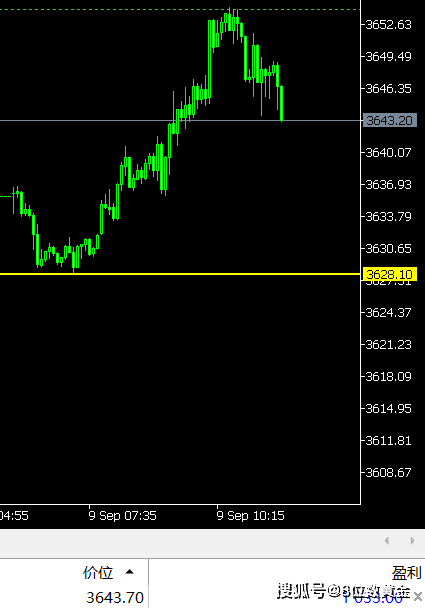
9.10黄金突发跳水55美金 冲高大跌探3600
Sou Hu Cai Jing· 2025-09-10 07:17
Market Overview - Gold prices have experienced significant volatility, reaching a historical high before a sharp decline of $55, testing the $3600 support level [1][15] - After hitting a high near $3658, gold prices faced another drop, indicating a bearish trend in the short term [2][14] Recent Performance - Gold broke previous highs, continuing its upward trend before experiencing a sudden drop during the U.S. trading session [6][7] - The market saw a vertical decline over two hours, with a drop of $50, reflecting heightened market instability [8] Technical Analysis - Current support levels are being tested at $3614 and $3578, with potential for a rebound [13][14] - Resistance levels are identified at $3648 and $3675, where short positions may be considered [10][14] Influencing Factors - The recent escalation of conflict in the Middle East, particularly an airstrike in Qatar, has increased risk aversion, contributing to gold's price surge [15] - U.S. non-farm payroll data showed a significant decline, indicating a weakening labor market and supporting expectations for a Federal Reserve rate cut [15] Economic Indicators - Upcoming economic data, including the U.S. PPI and wholesale sales figures, are expected to impact market sentiment and gold prices [17] - The CPI results have shown negative figures, indicating ongoing deflationary pressures in the economy [18][19]
广发期货: 中东地缘风险重燃多头高位止盈 贵金属盘中冲高回落
Jin Tou Wang· 2025-09-10 07:15
Group 1: Gold Market - The Shanghai gold futures price is currently at 833.82 CNY per gram, with an increase of 0.26% [1] - The opening price for the day was 834.06 CNY per gram, with a high of 840.82 CNY and a low of 827.26 CNY [1] Group 2: Macro News - The U.S. annual non-farm payroll data has been revised down by a record 911,000, indicating a significant weakening of the U.S. economy [4] - The geopolitical risk in the Middle East has escalated following an attack on Hamas leadership in Qatar [2] Group 3: Institutional Views on Gold - The renewed geopolitical risks in the Middle East and the downward revision of U.S. non-farm data have increased calls for a rate cut by the Federal Reserve, leading to profit-taking by gold bulls [5] - The international gold price opened at a high of 3,673.95 USD and closed at 3,625.04 USD per ounce, reflecting a decline of 0.3% [5] Group 4: Silver Market - The silver market is experiencing overall downward pressure due to economic slowdown concerns [7] - The international silver price has fallen below 41 USD, closing at 40.857 USD per ounce, down by 1.07% [8]
周周芝道 - 黄金和欧债怎么看?
2025-09-07 16:19
Summary of Key Points from Conference Call Industry Overview - The conference call discusses the performance and outlook of the Chinese stock market, global sovereign debt, gold, and the impact of U.S. monetary policy on overseas assets [1][2][6][7]. Core Insights and Arguments 1. **Chinese Stock Market Trends** - The Chinese stock market has rebounded after a short-term decline, with a strong confidence in the market's core logic of risk recovery and exiting deflation [1][6]. - Despite recent volatility, the underlying logic of the market remains intact, and confidence among investors is strong [6]. 2. **U.S. Monetary Policy Impact** - The Federal Reserve's monetary easing policy continues to dominate overseas asset pricing, with increasing expectations for interest rate cuts impacting U.S. stocks and bonds [2][7]. - Recent non-farm payroll data falling below expectations has further fueled rate cut anticipations, leading to a rebound in U.S. stocks and a decline in bond yields [2][7]. 3. **Global Sovereign Debt Concerns** - The rise in long-term bond yields in Europe and Japan has raised concerns about potential sovereign debt risks, but these fears are deemed manageable and not indicative of a full-blown crisis [4][10]. - Current fluctuations in sovereign debt rates are attributed to changes in fiscal policies post-pandemic, with high fiscal dependency exacerbating debt risk concerns [8][10]. 4. **Gold Market Dynamics** - Gold has shown strong performance due to increased demand for safe-haven assets amid international capital allocation [5][13]. - The primary drivers for the gold market in 2025 are expected to be inflows from European and American ETFs and the impacts of trade wars, creating a seesaw effect between U.S. stocks and gold [13][14]. 5. **Renminbi Exchange Rate Outlook** - The pace of Renminbi appreciation may slow down due to various factors, including U.S.-China relations and domestic economic conditions [3][17]. - Short-term rapid appreciation is unlikely, and the currency's movements will be influenced by macroeconomic factors and central bank policies [18][19]. Other Important Insights - The relationship between the U.S. dollar index and gold prices is complex, with no direct correlation; factors such as liquidity and economic conditions play a significant role in gold pricing [22]. - Future capital market flows will be influenced by differences in risk-free interest rates across countries, reflecting a shift from the low inflation and low interest rate environment seen from 2008 to 2019 [11]. - The gold pricing factors have evolved over the past few years, with geopolitical tensions and trade wars becoming significant influences [16]. This summary encapsulates the key points discussed in the conference call, providing insights into market trends, monetary policy impacts, and the dynamics of gold and currency markets.
中国经济、资本市场的下一阶段:走出通缩
Hu Xiu· 2025-09-02 03:02
Group 1 - The previous phase of the Chinese economy has stabilized by breaking deflation expectations, leading to stabilized commodity prices, a recovering stock market, and an increase in retail sales of consumer goods [1] - The next phase of the Chinese economy and capital markets is under discussion, focusing on what to expect in the future [1]
宏观国债月报:通缩压力有所缓和,内需仍为主要矛盾-20250901
Zhe Shang Qi Huo· 2025-09-01 08:32
Report Investment Rating - Not provided in the given content Core Views - **10 - year Treasury Bonds**: Expected to trade in a range of [107, 108.5] for the T2512 contract. The reasons include the "stock - bond seesaw" effect leading to a rise in risk appetite, more redemptions of bond funds driving up interest rates, moderately loose monetary policy with the central bank maintaining neutral - to - loose liquidity, and the economic slowdown in June with weak domestic demand and external shocks. Key data to watch are the August economic data [7]. - **2 - year Treasury Bonds**: Forecasted to trade in a range of [102, 102.7] for the TS2512 contract. Logic involves improved liquidity with the central bank conducting outright reverse repurchase operations, the moderately loose monetary policy stance set by the Politburo meeting in July, and the "stock - bond seesaw" impact on risk appetite and bond fund redemptions. Data to focus on are central bank LPR rate changes, central bank monetary policy shifts, and August economic data [7]. - **5 - year Treasury Bonds**: Predicted to trade in a range of [104.6, 106.1] for the TF2512 contract. The factors are improved liquidity, the moderately loose monetary policy from the July Politburo meeting, and the "stock - bond seesaw" effect. Key data includes central bank monetary policy operations, central bank LPR rate changes, and August economic data [12]. - **30 - year Treasury Bonds**: Expected to trade in a range of [114, 118] for the TL2512 contract. Reasons are the "stock - bond seesaw" effect, moderately loose monetary policy, and the economic slowdown in June with weak domestic demand and external shocks. The key data to monitor is the August economic data [12]. Summary by Directory Economic Situation - **Consumption**: Short - term consumption declined slightly. In July, the total retail sales of consumer goods were 3.878 trillion yuan, a 3.7% year - on - year increase. Excluding automobiles, it was 3.4931 trillion yuan, a 4.3% increase. From January to July, the total retail sales of consumer goods were 28.4238 trillion yuan, a 4.8% increase, and excluding automobiles, it was 25.7014 trillion yuan, a 5.3% increase [23]. - **Investment**: Investment growth slowed. From January to July 2025, national fixed - asset investment (excluding rural households) was 28.8229 trillion yuan, a 1.6% year - on - year increase. Private fixed - asset investment decreased by 1.5%. Manufacturing investment grew by 6.2%, infrastructure investment (excluding electricity, heat, gas, and water production and supply) increased by 3.2%, and real estate development investment was 535.8 billion yuan, a 12.0% decrease. In July, manufacturing investment growth dropped to 6.2%, a 1.3% decline from the previous month, and high - tech service industries also declined [23][27]. - **Exports and Imports**: In July 2025, China's total import and export value increased by 6.7% year - on - year, accelerating for two consecutive months. Exports in US dollars increased by 7.2%, and imports increased by 4.1%. Mechanical and electrical products' exports in the first seven months increased by 9.3%, accounting for 60% of total exports. Integrated circuit exports increased by 29.2%, industrial robots by 62.2%, and automobile exports by 10.9%. The combined exports of new - energy vehicles, lithium batteries, and photovoltaic products increased by 14.9% [41]. - **Real Estate**: In June, the real - estate investment growth rate continued to decline. The cumulative year - on - year decline in new housing construction area was 19.5%, with a slightly narrowed decline, and the cumulative year - on - year decline in commercial housing sales area was 4%, with an expanded decline [43]. Inflation Indicators - **CPI**: In July 2025, the national consumer price index was flat year - on - year, a 0.1 - percentage - point decline from June. Core CPI increased by 0.8% year - on - year, rising for three consecutive months and reaching a new high since March 2024. Food prices were a major drag, with a 1.6% year - on - year decrease in July, and service prices increased by 0.5% year - on - year, indicating strong summer consumption [49]. - **PPI**: In July 2025, the national producer price index for industrial products and purchase prices decreased by 3.6% year - on - year, the same as the previous month [48]. Policy Expectations - **Monetary Policy**: The Politburo meeting continued the general tone of "seeking progress while maintaining stability," emphasizing policy continuity, stability, flexibility, and predictability. Monetary policy focused on structural tools to support scientific and technological innovation, small and micro - enterprises, and reduce social financing costs [47]. - **Fiscal Policy**: Fiscal policy focused on accelerating the issuance and use of government bonds, improving capital efficiency, and ensuring the "three guarantees" at the grass - roots level [47]. Overseas Data - **US Economy**: In the second quarter of 2025, the US GDP's annualized quarterly growth rate was 3%, a significant rebound from the first quarter. However, the year - on - year growth rate has been lower than the potential GDP growth rate for two consecutive quarters, indicating a still low growth rate [45]. - **US Inflation**: In July 2025, the US CPI increased by 2.7% year - on - year, the same as the previous value and slightly lower than the market expectation of 2.8%. It increased by 0.2% month - on - month, a decline from the previous 0.3%. Energy prices declined, with gasoline prices dropping by 2.2% month - on - month. Core commodity CPI reached a new high since June 2023, and core service inflation remained at 3.6% year - on - year [51]. - **US Employment**: In July 2025, the initial value of new non - farm payrolls was 73,000, significantly lower than the market expectation of 104,000 and a nearly 50% decline from the initial June value. Historical data was revised downward significantly, and the unemployment rate rose to 4.2%, the highest since November 2021 [55]. - **US PMI**: The US ISM manufacturing PMI in July slightly declined to 48%, below the boom - bust line, indicating a decline in manufacturing prosperity after the suspension of interest - rate cuts [57]. - **Fed Monetary Policy**: Market expectations suggest an 85% probability of a Fed interest - rate cut in September, and a high probability of 2 - 3 interest - rate cuts within the year. The Fed paused interest - rate cuts in July, maintaining the federal funds rate target range at 4.25% - 4.50% [62][69]. Other Data - **Interest Rates**: The central bank's outright reverse repurchase operations improved market liquidity. The DR007 rate remained between 1.40% and 1.50%, and inter - bank certificate of deposit rates also remained low and stable [80]. - **Exchange Rates**: In August, the US dollar - to - RMB exchange rate (onshore) fluctuated around 7.17, and the US dollar index remained weak, fluctuating around 97 [83][84]. - **Bond Yields**: In August, the stock market performed well, driving up market risk appetite. The 10 - year Treasury bond yield was around 1.85%, and the 30 - year Treasury bond yield was around 2.14% [88].
失温时为何会感受到“热”︱重阳荐文
重阳投资· 2025-09-01 07:31
Core Viewpoint - The article draws a parallel between human hypothermia and economic conditions, suggesting that just as individuals can misinterpret their body temperature in extreme cold, markets can misinterpret economic signals, leading to potential misjudgments about economic health [1]. Economic Data vs. Perception - Economic data often lags behind real-time events, leading to discrepancies between actual economic conditions and public perception [7]. - Japan's economy has experienced a prolonged period of stagnation, referred to as the "lost thirty years," characterized by minimal inflation and economic growth [10]. Japan's Economic Performance - Japan's CPI index showed only a 7.5% increase from 1991 to 2021, averaging an annual growth rate of 0.25% [10]. - In terms of GDP, Japan's per capita GDP in 2024 is projected to be $32,420, which, when adjusted for inflation, represents a 33% decline from 30 years ago [10][12]. Stock Market Trends - The Nikkei 225 index peaked at 38,900 points in 1989 but fell significantly over the following decades, illustrating the long-term economic decline [13]. - Despite experiencing several technical bull markets, the overall trend remains downward due to a lack of new industries and innovation [21][23]. Policy Missteps - Japanese authorities underestimated the impact of the real estate bubble's collapse, leading to delayed and ineffective policy responses [16]. - The Bank of Japan's slow transition from tight to loose monetary policy contributed to prolonged economic stagnation [16][17]. Infrastructure Investment Issues - Japan's public works spending has often been misallocated, focusing on low-impact projects in declining regions rather than stimulating private consumption and investment [20][29]. - The inefficacy of infrastructure investments has led to increased government debt without corresponding economic recovery [29]. Lessons from Japan's Experience - The article emphasizes the importance of targeted investment in emerging industries rather than excessive spending on infrastructure with diminishing returns [29]. - It highlights the need for coherent and consistent fiscal policies to avoid the pitfalls of Japan's past, particularly in the context of an aging population and rising government debt [32].

周周芝道 - 中国当前所处周期阶段
2025-09-01 02:01
Summary of Key Points from the Conference Call Industry and Company Overview - The discussion primarily revolves around the **Chinese economy and stock market**, focusing on the divergence between economic data and stock performance, as well as the implications for various sectors, particularly new and traditional economies. Core Insights and Arguments 1. **Divergence Between Stock Market and Economic Data** The Chinese stock market is performing strongly despite weak economic indicators, suggesting that liquidity is favoring stocks over other asset classes, particularly in technology and innovation sectors [1][4][5] 2. **Impact of Global Market Sentiment** Global market sentiment has shifted, with non-US assets benefiting from a recovery in risk appetite, particularly after the trade war fears did not materialize as expected [1][6] 3. **Strong Export Performance** China's exports have exceeded expectations, particularly to regions like Africa, the Middle East, and Latin America, which has helped offset declines in demand from developed countries [1][8][11] 4. **Importance of Exports for Economic Stability** Exports are crucial for China's economic growth and asset pricing, especially for real estate in lower-tier cities, where income growth is tied to export performance [1][10][15] 5. **Structural Changes in the Economy** There is a significant structural divergence between new and old economies in China, with emerging sectors like technology showing robust growth, which is not fully captured by aggregate economic data [1][7][9] 6. **Future Economic Outlook** The outlook for 2025 indicates potential pressures on exports, but a rebound in global demand is expected in 2026, which may lead to a bear market in bonds and a recovery in the stock market [1][17] 7. **PMI vs. Actual Export Performance** The discrepancy between PMI data and actual export performance can be attributed to the differing impacts on small versus large enterprises, with larger firms being less affected by trade tensions [1][12] 8. **Risks in the Capital Market** The capital market is currently pricing in economic weakness, and any changes in core variables, such as export performance, could lead to a more severe contraction in risk appetite than previously anticipated [1][13][14] 9. **Real Estate Market Dynamics** The real estate market, particularly in third and fourth-tier cities, is stabilizing, but its recovery is heavily dependent on export performance and overall economic growth [1][10][18] 10. **Investment Opportunities** Short-term investment strategies should focus on new economy sectors, as traditional sectors may only see opportunities after a broader economic recovery is confirmed [1][24] Other Important but Overlooked Content - The discussion highlights the potential for a significant shift in the investment landscape as global economic conditions evolve, particularly with the anticipated easing of US monetary policy and its effects on global demand [1][3][17][20] - The need for close monitoring of macroeconomic indicators and policy changes is emphasized, as these will play a critical role in shaping market dynamics in the coming months [1][20]