
通胀

Search documents
银河期货每日早盘观察-20251219
Yin He Qi Huo· 2025-12-19 01:49
1. Report Industry Investment Ratings - Not provided in the content 2. Core Views of the Report - The overall market shows a complex and diversified trend. Different sectors, such as financial derivatives, agricultural products, black metals, non - ferrous metals, shipping, and energy chemicals, have their own characteristics and influencing factors. For example, in financial derivatives, stock index futures are expected to test 3900 again, while treasury bond futures have opportunities despite fluctuations; in agricultural products, the supply - demand situation of various varieties varies, affecting their price trends [5][20][26] 3. Summary by Relevant Catalogs Financial Derivatives - **Stock Index Futures**: Expected to test 3900 again. On Thursday, the market showed a sideways shock. The main stock index futures contracts mostly declined, and the trading volume and positions decreased. The market rebound was affected by factors such as the overnight decline of the US stock market, and it is expected to maintain a sideways consolidation trend [18][20] - **Treasury Bond Futures**: There were fluctuations, but opportunities remained. On Thursday, most treasury bond futures closed higher, and the market funds were balanced and slightly loose. The central bank's open - market operations and market rumors affected the bond market sentiment. In the short term, the central bank's loose tone remained unchanged, but the long - end repair rhythm might be repeated [22][23][24] Agricultural Products - **Protein Meal**: The production outlook was good, and US soybeans continued to be under pressure. The CBOT soybean and soybean meal indexes declined. The US soybean export sales decreased, and the Brazilian soybean production was expected to increase. The domestic soybean meal crushing profit was still in deficit, and the overall price was expected to be supported but with limited sustainability [26][27][28] - **Sugar**: International sugar prices dropped sharply. The ICE and London sugar futures prices declined. The Brazilian sugar production increase was basically realized, and the market focus shifted to the Northern Hemisphere. The domestic sugar market had increasing supply pressure, but the price had certain support near the cost line [29][30][33] - **Oilseeds and Oils**: Palm oil had a technical rebound, and the overall oils were at the bottom - level shock. The overseas palm oil and soybean oil prices had small fluctuations. The Indonesian palm oil inventory decreased, and the domestic soybean oil inventory was gradually decreasing, while the rapeseed oil inventory was expected to continue to decline [35][36] - **Corn/Corn Starch**: The spot price declined, and the futures price was at the bottom - level shock. The CBOT corn futures rebounded. The domestic corn processing enterprise inventory increased, and the starch inventory also increased. The Northeast corn price was strong, while the North China corn price was weak [37][38][39] - **Hogs**: The slaughter recovered, and the spot price fluctuated slightly. The hog price was stable in most regions. The short - term slaughter pressure decreased, but the overall supply pressure still existed [39][40][41] - **Peanuts**: The spot price declined, and the futures price had a narrow - range shock. The peanut price was stable in some regions and declined in others. The oil factory's purchase price was adjusted, and the 03 peanut futures price still had a downward space [42][43][44] - **Eggs**: The demand was average, and the egg price was stable with a slight decline. The main - producing and main - selling area prices were relatively stable. The number of laying hens decreased slightly, and the short - term supply pressure was relieved [45][46][47] - **Apples**: The demand was average, and the apple price was mainly stable. The cold - storage inventory decreased, and the import and export volume changed. The apple price was high before, which led to weak demand, and the market was concerned about the January delivery and pre - Spring Festival stocking [49][50][51] - **Cotton - Cotton Yarn**: The new cotton sales were good, and the cotton price was shock - upward. The ICE cotton futures price increased. The domestic cotton import and export volume changed, and the new cotton sales progress was fast. The market was affected by factors such as the expected reduction of cotton planting area and the expansion of textile factory capacity [52][53][54] Black Metals - **Steel**: The raw material prices stopped falling and stabilized, and the steel price rebounded from the bottom. The steel product supply decreased slightly, the inventory decreased, and the consumption decreased slightly. The steel price was affected by factors such as the raw material supply, demand, and export policy, and it was expected to show a shock - upward trend [57][58][59] - **Coking Coal and Coke**: The prices rebounded from the bottom, and the trading logic change needed attention. The Mongolian coking coal market was strong, and the prices of some domestic coking coal increased. The market "anti - involution" sentiment led to the price rebound, and the future supply - demand situation might improve slightly [59][60][61] - **Iron Ore**: The market expectations were repeated, and the ore price was in shock. The domestic crude steel and rebar production decreased, and the iron ore production increased slightly. The global iron ore supply was loose, and the domestic demand was weak. The ore price was expected to have limited upward space [62][63][64] - **Ferroalloys**: Supported by cost and the "anti - involution" expectation, the prices rebounded in the short term. The silicon - iron and manganese - silicon prices were stable with a slight increase. The supply was expected to decline slightly, and the demand was under pressure. The cost support and "anti - involution" expectation led to the price rebound [64][65][66] Non - Ferrous Metals - **Gold and Silver**: The US November CPI was better than expected, but the data was questionable, leading to market fluctuations. The international gold and silver prices fluctuated widely, and the US dollar index and US bond yields changed. The market was in a long - short tug - of - war, and the gold and silver prices were expected to maintain a high - level range [67][68][69] - **Platinum and Palladium**: The trading enthusiasm was over - high, and the risk factors were gradually accumulating. The platinum and palladium futures prices increased significantly, and the trading volume expanded. The macro - environment was favorable, and the news boosted the demand outlook. The platinum was short - term bullish, and the palladium might be affected by the macro - environment [69][70][71] - **Copper**: Buy after a full correction. The copper futures prices increased, and the inventory increased. The US inflation data affected the market, and the copper supply was expected to be tight in 2026. The long - term price trend was upward, but the short - term might be in shock [74][75][76] - **Alumina**: The price was in a weak shock. The alumina futures price declined, and the spot price decreased slightly. The overseas supply negotiation and domestic inventory situation affected the price. The price was expected to be under pressure after the "anti - involution" expectation subsided [78][79][80] - **Electrolytic Aluminum**: The overseas economic data was released this week, and the aluminum price rebounded. The electrolytic aluminum futures price increased, and the inventory decreased. The overseas economic data was better than expected, and the domestic demand was resilient. The price was supported [83][84][85] - **Cast Aluminum Alloy**: The scrap aluminum supply was still tight, and the alloy price rebounded with the sector. The cast aluminum alloy futures price increased, and the spot price increased. The scrap aluminum supply was tight, and the cost supported the price. The price was expected to maintain a high - level shock [86][87] - **Zinc**: Pay attention to the domestic social inventory today. The zinc futures price increased, and the spot price had a small change. The overseas zinc inventory increased, and the domestic smelting profit was compressed. The price was under pressure from the external market [88][89][90] - **Lead**: Pay attention to the inventory change. The lead futures price increased, and the spot price decreased slightly. The domestic lead supply and demand decreased, and the inventory became more visible. The price was expected to maintain a range shock [91][92][93] - **Nickel**: The Indonesian policy expectation stimulated the nickel price rebound, but the surplus suppressed the upward space. The LME nickel price increased, and the inventory decreased. The global nickel was in a surplus situation, but the Indonesian policy adjustment stimulated the price rebound. The price was expected to decline after the short - term rebound [93][94][95] - **Stainless Steel**: Followed the nickel price and weakened in shock. The stainless steel inventory decreased, and the terminal demand was in the off - season. The price was affected by the nickel price and demand, and it was expected to be at a low - level shock [96][97][99] - **Industrial Silicon**: Sell on rallies. The industrial silicon was in a state of inventory accumulation. The demand in the first quarter of 2026 was pessimistic, and the price was expected to decline. It was recommended to sell on rallies [99][100] - **Polysilicon**: Realize the profits of long positions and pay attention to risk management. The polysilicon futures trading rules changed. The downstream demand was relatively pessimistic, and the short - term price was expected to be strong. It was recommended to take profits on long positions and buy after a correction [100][101][103] - **Lithium Carbonate**: The inventory reduction was slower than expected, and the lithium price was under pressure to correct. The lithium carbonate price had a short - term correction, and the inventory reduction was slow. The price was expected to be at a high - level, and it was recommended to operate cautiously [104][105] - **Tin**: Pay attention to the November export data from Myanmar. The tin futures price increased, and the inventory increased. The US inflation data was questionable, and the domestic tin supply and demand were weak. The price was expected to be affected by the Myanmar export data and market fluctuations [107][108][109] Shipping - **Container Shipping**: MSK released the price of 2500/2600 for the first week, and pay attention to the January freight rate change path. The spot freight rate increased slightly. The European port congestion was serious, and the demand was expected to improve in December - January. The short - term price was expected to be at a high - level shock, and it was recommended to take partial profits on long positions [110][111][113] Energy and Chemicals - **Crude Oil**: The surplus pressure was difficult to change, and the oil price rebound was limited. The crude oil futures prices increased slightly. The US inflation and employment data changed, and the geopolitical situation was uncertain. The oil price was expected to be in a weak shock in the medium - term [114][115][116] - **Asphalt**: The short - term supply - demand was weak, and the raw material risk remained. The asphalt futures price declined, and the spot price was stable. The terminal demand decreased, and the raw material supply was uncertain. The price was expected to be in a narrow - range shock [117][118][119] - **Fuel Oil**: The short - term low - sulfur supply was continuously increasing. The fuel oil futures prices increased slightly. The low - sulfur supply was expected to increase, and the high - sulfur demand was stable and weak. The short - term price was expected to be bearish [120][121][122] - **Natural Gas**: The LNG downward trend remained unchanged. The natural gas futures prices had different changes. The weather affected the demand, and the overall supply was loose. The HH2602 contract long positions were recommended to be held [124][125][126] - **LPG**: The PDH profit continued to be in deficit. The LPG futures price increased, and the spot price was stable. The international LPG market was strong, and the PDH profit was in deficit. It was recommended to short the 03 contract on rallies [127][128][129] - **PX & PTA**: The polyester sales volume increased, and the market atmosphere was boosted. The PX and PTA futures prices increased. The PTA supply was expected to increase slowly, and the downstream polyester demand was high. The price was expected to be shock - upward [131][132] - **BZ & EB**: The pure benzene supply - demand was loose, and the styrene basis weakened. The pure benzene and styrene futures prices declined slightly. The pure benzene supply increased and demand decreased, and the styrene supply and demand were also weak. The price was expected to be in a weak shock [134][135][136] - **Ethylene Glycol**: The inventory accumulation pressure remained, and the price was in shock. The ethylene glycol futures price increased slightly. The supply and demand were weak, and the inventory had a de - stocking pressure. The short - term price was expected to be in shock and weak in the medium - term [138][139] - **Short - Fiber**: The supply - demand was weak. The short - fiber futures price increased. The short - fiber supply and demand decreased, and the processing fee was under pressure. The price was expected to be shock - upward [140][142] - **Bottle Chips**: The supply - demand was relatively loose. The bottle - chip futures price increased. The supply was expected to increase, and the demand was relatively stable. The price was expected to be shock - upward [143][144] - **Propylene**: The demand was poor, and the rebound was weak. The propylene futures price increased first and then decreased. The propylene supply was expected to be high, and the demand was weak. The short - term price was expected to be shock - upward [146][147] - **Plastic PP**: The PE production decreased month - on - month, and the PP production increased month - on - month. The L and PP futures prices declined slightly. The PE and PP supply and demand had different changes. It was recommended to wait and see for the L and PP 2605 contracts [148][150][151] - **Caustic Soda**: The price was in a shock trend. The caustic soda spot price had a small adjustment. The supply was sufficient, and the demand was weak. The price was expected to be in a weak shock [152][153][154] - **PVC**: The price continued to rebound. The PVC futures price increased, and the spot price increased slightly. The supply was expected to increase, and the demand was weak. The price was expected to continue to rebound [155][156][157] - **Soda Ash**: The futures price was in a strong trend. The soda ash futures price increased, and the spot price had a small change. The supply was expected to be under pressure in the future, and the demand was weak. The price was expected to be shock - upward next week with a risk of decline at the end of the month [157][158][159] - **Glass**: The futures price was in a strong trend. The glass futures price increased, and the spot price was stable. The supply was expected to be reduced, and the demand was weak. The price was expected to be shock - upward next week with a risk of decline at the end of the month [160][161][163] - **Methanol**: The price rose strongly. The methanol production increased, and the international device operation was affected. The price was expected to be shock - upward [165][166] - **Urea**: The price continued to rise. The urea production decreased slightly, and the international market had an impact. The short - term price was expected to be strong, and the medium - long - term supply - demand was relatively loose [167][168][169] - **Pulp**: The reality was weak, but the expectation was strong. Pay attention to the warehouse receipt registration and port inventory changes. The pulp futures price declined slightly, and the spot price had a small adjustment. The cost supported the price, but the demand was weak. It was recommended to hold the previous short positions [170][171][173] - **Logs**: The fundamentals were weak, and the futures - spot price was inverted. Pay attention to the warehouse receipt registration. The log price was stable, and the inventory and arrival volume changed. The price was expected to continue to bottom - out. It was recommended to hold the 03 long positions [173][174][175] - **Offset Printing Paper**: The supply pressure remained, and the high pulp price transmission did not meet expectations. The offset printing paper futures price declined slightly, and the spot price was stable. The production and inventory of double - offset paper and coated paper changed. The price was expected to be bearish [179][180] - **Natural Rubber**: The tire production line decreased month - on - month. The natural rubber futures prices had different changes. The Thai government took measures to stabilize the price, and the domestic tire production decreased. It was recommended to short the RU 05 contract slightly and hold the NR 02 contract long positions [182][183] - **Butadiene Rubber**: The BD & BR production decreased marginally, and the tire production decreased month - on - month. The butadiene rubber futures price increased, and the natural rubber futures prices had different changes. The domestic butadiene and tire production decreased. It was recommended to hold the BR 02 contract long positions [186][187][188]
铜冠金源期货商品日报-20251219
Tong Guan Jin Yuan Qi Huo· 2025-12-19 01:46
1. Report Industry Investment Rating No relevant content provided. 2. Core Views of the Report - Overseas, US CPI and core CPI in November dropped to 2.7% and 2.6% year - on - year, far lower than market expectations, but data credibility is questionable. The market reacted positively, with expectations of Fed rate cuts. The ECB maintained rates and was vague on easing [2]. - Domestically, the A - share market showed a structured rise with reduced trading volume, and the bond market was also divided. The short - term A - share market is expected to be volatile and weak, and the bond market's main trend is unclear [3]. - For precious metals, gold and silver prices may face adjustment risks, and platinum and palladium should not be chased at high prices due to regulatory measures and data uncertainties [4][5]. - Copper prices are expected to remain high and volatile in the short term due to mild inflation data and tight fundamentals [6][7]. - Aluminum prices are expected to rise steadily due to positive macro factors and good fundamentals [8]. - Alumina prices are expected to be weak and volatile as the supply remains abundant [10]. - Cast aluminum prices are expected to oscillate at a high level due to cost support [11]. - Zinc prices are expected to continue oscillating as there is support from inventory reduction but also pressure from market uncertainties [12]. - Lead prices are expected to maintain a narrow - range oscillation due to low inventory and cost support [14]. - Tin prices' upward momentum is weakening, and chasing high prices should be cautious [15]. - Industrial silicon prices are expected to be strong and volatile as supply and demand show marginal improvement [17]. - Steel prices are expected to follow a short - term rebound but maintain an oscillating pattern [19]. - Iron ore prices are expected to oscillate as the supply - strong and demand - weak pattern remains [20]. - Coking coal and coke prices are expected to rebound in the short term due to policy stimulation [21]. - Soybean meal and rapeseed meal prices are expected to oscillate as US soybeans continue to decline and the supply in China is sufficient [22][23]. - Palm oil prices are expected to be weak and oscillating as Indonesia's palm oil inventory decreased in October and market factors are complex [24]. 3. Summaries According to Relevant Catalogs 3.1 Macro - Overseas: US November CPI and core CPI were 2.7% and 2.6% year - on - year, lower than expected. The data's credibility is in doubt. The market expects Fed rate cuts. The ECB maintained rates and didn't give clear easing guidance [2]. - Domestic: A - shares rose with reduced volume, showing a structured market. The bond market was divided. The short - term A - share market is expected to be volatile and weak, and the bond market's main trend is unclear [3]. 3.2 Precious Metals - Gold and silver prices had a short - term rise and then a fall after the US CPI data release, facing increased adjustment risks. Platinum and palladium prices continued to rise, but the Guangzhou Futures Exchange restricted platinum futures' daily opening positions, so chasing high prices is not recommended [4][5]. 3.3 Copper - On Thursday, SHFE copper's main contract oscillated upward, and LME copper oscillated around $11,700. Mild inflation data is beneficial for a dovish stance. Fundamentally, mine restarts are slow, and inventories are low. Copper prices are expected to remain high and volatile [6][7]. 3.4 Aluminum - On Thursday, SHFE aluminum's main contract closed at 21,955 yuan/ton, up 0.25%. LME aluminum closed at $2,917/ton, up 0.38%. US inflation data boosted rate - cut expectations, and the reduction of aluminum ingot inventory verified year - end consumption resilience. Aluminum prices are expected to rise steadily [8]. 3.5 Alumina - On Thursday, alumina futures' main contract closed at 2,553 yuan/ton, up 0.12%. The supply is abundant with inventory flowing into the market and imports arriving. Alumina prices are expected to be weak and volatile [9][10]. 3.6 Cast Aluminum - On Thursday, cast aluminum alloy futures' main contract closed at 21,110 yuan/ton, up 0.45%. At the end of the year, both supply and demand decreased. Cast aluminum prices are supported by the cost of scrap aluminum and are expected to oscillate at a high level [11]. 3.7 Zinc - On Thursday, SHFE zinc's main contract oscillated narrowly. The US CPI data had a limited impact. Consumption showed resilience, and social inventory declined. However, LME had continuous small - volume warehousing. Zinc prices are expected to continue oscillating [12]. 3.8 Lead - On Thursday, SHFE lead's main contract oscillated narrowly. The supply side had a mixed situation of reduction and resumption. The terminal was in the off - season, but low inventory and cost support are expected to keep lead prices oscillating narrowly [13][14]. 3.9 Tin - On Thursday, SHFE tin's main contract oscillated strongly at night. The supply - side disturbance support weakened, and downstream acceptance of high - priced tin was under pressure. Tin prices' upward momentum is expected to weaken [15]. 3.10 Industrial Silicon - On Thursday, industrial silicon oscillated strongly. The supply side is generally stable, and the demand side shows some changes. Social inventory rose slightly. Industrial silicon prices are expected to be strong and volatile [16][17]. 3.11 Steel (Screw and Coil) - On Thursday, steel futures oscillated and rebounded. The output and apparent demand of the five major steel products were slightly adjusted, and inventory continued to decline. Steel prices are expected to follow a short - term rebound but maintain an oscillating pattern [18][19]. 3.12 Iron Ore - On Thursday, iron ore futures oscillated upward. The supply was strong with high overseas shipments and port inventory accumulation, while the demand was weak as steel mills cut production. Iron ore prices are expected to oscillate [20]. 3.13 Coking Coal and Coke - On Thursday, coking coal and coke futures rose significantly. Policy stimulation strengthened the bottom support. Coking enterprises' costs increased, and the supply was generally loose. Coking coal and coke prices are expected to rebound in the short term [21]. 3.14 Soybean and Rapeseed Meal - On Thursday, soybean meal and rapeseed meal futures showed different trends. US soybeans continued to decline, and the supply in China was sufficient. Soybean and rapeseed meal prices are expected to oscillate [22][23]. 3.15 Palm Oil - On Thursday, palm oil futures showed a mixed performance. Indonesia's palm oil inventory decreased in October due to increased domestic consumption. Palm oil prices are expected to be weak and oscillating [24].
国泰君安期货商品研究晨报:贵金属及基本金属-20251219
Guo Tai Jun An Qi Huo· 2025-12-19 01:42
1. Report Industry Investment Ratings No relevant content provided. 2. Core Views of the Report - Gold: Inflation is moderately declining [1][2]. - Silver: Undergoing high - level adjustment [1][2]. - Copper: With decreasing internal and external inventories, prices are supported [1][2]. - Zinc: Trading in a sideways range [1][2]. - Lead: Decreasing inventories support prices [1][2]. - Tin: Supply is facing new disruptions [1][2]. - Aluminum: Trading in a range [1][2]. - Alumina: Slightly declining [1][2]. - Cast aluminum alloy: Following the trend of electrolytic aluminum [1][2]. - Platinum: With continuous inflows into ETFs, prices are oscillating upwards [1][2]. - Palladium: Successfully breaking through previous highs, with strong upward momentum [1][2]. - Nickel: The structural surplus is shifting, and attention should be paid to Indonesian policy risks [1][2]. - Stainless steel: Supply and demand are both weak, and steel prices are oscillating at low levels [1][2]. 3. Summaries by Related Catalogs Gold and Silver - **Price and Trading Volume**: - For gold, the closing price of Shanghai Gold 2602 was 980.50 with a daily increase of 0.08%, and the night - session closing price was 980.20 with a 0.02% increase [4]. - For silver, the closing price of Shanghai Silver 2602 was 15521 with a daily increase of 0.06%, and the night - session closing price was 15228.00 with a - 1.42% decrease [4]. - Trading volumes of Shanghai Gold 2602 and Shanghai Silver 2602 decreased compared to the previous day [4]. - **Inventory and Spread**: - Gold ETF holdings remained unchanged, and silver ETF holdings (the day before yesterday) also remained unchanged [4]. - Gold and silver inventories showed different changes, with Shanghai gold inventory decreasing by 6 kg and Comex silver inventory decreasing by 895,355 ounces [4]. - Spreads of gold and silver contracts also showed various changes [4]. - **Macro and Industry News**: US inflation slowed more than expected, and the European Central Bank and the Bank of England had different policy stances [5][9]. Copper - **Price and Trading Volume**: - The closing price of the Shanghai copper main contract was 92,600 with a - 0.24% daily decrease, and the night - session closing price was 92870 with a 0.29% increase [10]. - Trading volumes of Shanghai copper index decreased, while the trading volume of LME copper 3M electronic disk increased [10]. - **Inventory and Spread**: - Both Shanghai copper and LME copper inventories decreased, with LME copper's注销仓单 ratio decreasing by 1.14% [10]. - Various copper spreads showed different changes, such as the Shanghai copper spot to LME cash spread decreasing by 215 [10]. - **Macro and Industry News**: US inflation slowed, and there were industry developments like Korea Zinc's investment plan and Peru's copper production increase [10][12]. Zinc - **Price and Trading Volume**: - The closing price of the Shanghai zinc main contract was 23035 with a 0.26% daily increase, and the LME zinc 3M electronic disk closing price was 3071.5 with a 1.20% increase [13]. - Trading volumes of Shanghai zinc and LME zinc decreased compared to the previous day [13]. - **Inventory and Spread**: - Shanghai zinc futures inventory decreased by 1920 tons, while LME zinc inventory increased by 1700 tons [13]. - Spreads such as Shanghai 0 zinc升贴水 increased by 20, and LME CASH - 3M升贴水 decreased by 5.1 [13]. - **News**: Trump's remarks on the Fed chair and US inflation data were reported [14]. Lead - **Price and Trading Volume**: - The closing price of the Shanghai lead main contract was 16785 with a 0.27% daily increase, and the LME lead 3M electronic disk closing price was 1961 with a 0.98% increase [16]. - Trading volumes of Shanghai lead and LME lead decreased compared to the previous day [16]. - **Inventory and Spread**: - Both Shanghai lead and LME lead inventories decreased, with LME lead注销仓单 also decreasing by 3450 tons [16]. - Spreads such as Shanghai 1 lead升贴水 remained unchanged, and LME CASH - 3M升贴水 increased by 0.97 [16]. - **News**: US inflation data and ECB policy were mentioned [17]. Tin - **Price and Trading Volume**: - The closing price of the Shanghai tin main contract was 334,380 with a 1.76% daily increase, and the night - session closing price was 338,950 with a 1.18% increase [19]. - The trading volume of the Shanghai tin main contract increased by 76,691 compared to the previous day [19]. - **Inventory and Spread**: - Both Shanghai tin and LME tin inventories increased, with LME tin's注销仓单 ratio decreasing by 0.38% [19]. - Spreads such as SMM 1 tin ingot price increased by 9,900 [19]. - **Macro and Industry News**: Similar to other metals, news about US inflation, central bank policies, etc. were reported [20]. Aluminum, Alumina, and Cast Aluminum Alloy - **Price and Trading Volume**: - For aluminum, the closing price of the Shanghai aluminum main contract was 21955 with a 40 increase compared to the previous day, and the LME aluminum 3M closing price was 2917 with an 11 increase [24]. - For alumina, the closing price of the Shanghai alumina main contract was 2553 with a - 5 decrease [24]. - For cast aluminum alloy, the closing price of the aluminum alloy main contract was 21110 with a 65 increase [24]. - Trading volumes and positions of these metals showed different changes [24]. - **Inventory and Spread**: - Aluminum inventories in different places showed different trends, and spreads such as LME aluminum cash - 3M价差 and near - month contract to consecutive - one contract spreads also changed [24]. - **News**: ECB and Bank of England policies were reported [25]. Platinum and Palladium - **Price and Trading Volume**: - Platinum futures prices showed an upward trend, with the closing price of platinum futures 2606 at 542.60 with a 2.85% increase [27]. - Palladium prices also increased, with the closing price of New York lithium main - continuous at 1778.50 with a 5.05% increase [27]. - Trading volumes and positions of platinum and palladium showed different changes [27]. - **Inventory and Spread**: - Platinum and palladium ETF holdings increased, and spreads such as PT9995 to PT2606价差 and 人民币现货包金价格 to PD2606价差 changed [27]. - **Macro and Industry News**: US inflation data, central bank policies, and other news were reported [30]. Nickel and Stainless Steel - **Price and Trading Volume**: - The closing price of the Shanghai nickel main contract was 113,940 with a 140 increase compared to the previous day, and the closing price of the stainless steel main contract was 12,420 with a 40 increase [31]. - Trading volumes of Shanghai nickel and stainless steel decreased compared to the previous day [31]. - **Industry - related Data**: - Various prices in the nickel industry chain, such as 1 imported nickel, 8 - 12% high - nickel pig iron, etc., showed different changes [31]. - In the stainless steel industry, prices of 304/2B卷 - 毛边, 304/2B卷 - 切边, etc., also changed [31]. - **Macro and Industry News**: There were news about Indonesian nickel - related policies, China's import subsidy suspension, and US tariff threats [31][33].
国泰君安期货商品研究晨报-20251219
Guo Tai Jun An Qi Huo· 2025-12-19 01:42
Report Industry Investment Ratings The report does not provide industry investment ratings. Core Views of the Report The report offers comprehensive analysis and forecasts for various commodities in the futures market, including precious metals, base metals, energy, chemicals, agricultural products, etc. It assesses the supply - demand situation, price trends, and influencing factors of each commodity, providing investors with reference for trading decisions [2][4]. Summary by Commodity Categories Precious Metals - **Gold**: Inflation is moderately declining, with a trend strength of 0. Gold prices are affected by factors such as inflation data and central bank policies [2][5]. - **Silver**: Adjusting at a high level, trend strength is 0. Silver prices are in a high - level adjustment phase [2][5]. - **Platinum**: ETFs are continuously flowing in, and prices are oscillating upwards, trend strength is 1 [2][28]. - **Palladium**: Successfully breaking through the previous high, with strong upward momentum, trend strength is 1 [2][28]. Base Metals - **Copper**: Both domestic and overseas inventories are decreasing, providing support for prices, trend strength is 0 [2][11]. - **Zinc**: Moving sideways in a range, trend strength is 0 [2][14]. - **Lead**: Inventory reduction is supporting prices, trend strength is 0 [2][17]. - **Tin**: Supply is facing new disruptions, trend strength is 1 [2][20]. - **Aluminum**: Oscillating within a range, trend strength is 0 [2][25]. - **Alumina**: Slightly declining, trend strength is 0 [2][25]. - **Cast Aluminum Alloy**: Following the trend of electrolytic aluminum, trend strength is 0 [2][25]. - **Nickel**: The surplus is undergoing a structural shift, and attention should be paid to Indonesian policy risks, trend strength is 0 [2][32]. - **Stainless Steel**: Supply and demand are both weak, and steel prices are oscillating at a low level, trend strength is 0 [2][32]. Energy and Chemicals - **Crude Oil - related**: The report does not directly cover crude oil, but some products are affected by it. For example, asphalt is in a low - level oscillation, trend strength is 0 [2][78]. - **PTA**: Cost support is relatively strong, with a 4500 - 4800 range operation suggested, trend strength is 1 [2][63][69]. - **MEG**: In a range - bound market, trend strength is 1 [2][63][69]. - **Rubber**: Widely oscillating, trend strength is 0 [2][70]. - **Synthetic Rubber**: The upward trend is slowing down, trend strength is 0 [2][74]. - **LLDPE**: Supply elasticity is limited, and valuation continues to be under pressure, trend strength is 0 [2][92]. - **PP**: Factory warehouse warrants are cancelled, and the market is moving sideways, trend strength is 0 [2][95]. - **Caustic Soda**: There will still be pressure in the later stage, trend strength is 0 [2][98]. - **Paper Pulp**: Widely oscillating, trend strength is 0 [2][101]. - **Glass**: The price of the original sheet is stable, trend strength is 0 [2][108]. - **Methanol**: Oscillating with support, trend strength is 0 [2][111]. - **Urea**: Oscillating with support, trend strength is 0 [2][115]. - **Soda Ash**: The spot market has little change, trend strength is 0 [2][119]. - **LPG**: Strong in the short - term but under pressure in the long - term, trend strength is 0 [2][123]. - **Propylene**: Narrowly adjusting in the short - term, trend strength is 0 [2][124]. - **PVC**: The rebound is difficult to sustain, trend strength is 0 [2][132]. - **Fuel Oil**: Consolidating in the short - term with support below, trend strength is 0 [2][135]. - **Low - Sulfur Fuel Oil**: Narrowly oscillating, with the spread between high - and low - sulfur in the overseas spot market narrowing, trend strength is 0 [2][136]. Agricultural Products - **Palm Oil**: May rebound in the short - term and is searching for a bottom while oscillating, trend strength is 0 [2][160]. - **Soybean Oil**: Weak performance of US soybeans, and it is difficult for soybean oil to stabilize, trend strength is 0 [2][160]. - **Soybean Meal**: Oscillating at a low level, trend strength is 0 [2][166]. - **Soybean**: Oscillating, trend strength is 0 [2][166]. - **Corn**: Attention should be paid to the spot market, trend strength is 0 [2][169]. - **Sugar**: Weakly operating, trend strength is - 1 [2][173]. - **Cotton**: Oscillating with an upward bias, attention should be paid to downstream demand, trend strength is 0 [2][69][178]. - **Eggs**: Maintaining an oscillating trend, trend strength is 0 [2][184]. - **Hogs**: The peak demand during the Winter Solstice has passed, trend strength is - 1 [2][186]. - **Peanuts**: Attention should be paid to oil mill purchases, trend strength is 0 [2][192]. Shipping - **Container Freight Index (European Line)**: In an oscillating market, trend strength is 0 [2][138]. Fibers - **Short Fiber**: Oscillating at a low level in the short - term and facing pressure in the medium - term, trend strength is 0 [2][148]. - **Bottle Chip**: Oscillating at a low level in the short - term and facing pressure in the medium - term, trend strength is 0 [2][148]. Paper - **Offset Printing Paper**: It is advisable to take a wait - and - see approach, trend strength is 0 [2][151]. Aromatics - **Pure Benzene**: Oscillating in the short - term, trend strength is 0 [2][156].
国泰君安期货所长早读-20251219
Guo Tai Jun An Qi Huo· 2025-12-19 01:37
所长 早读 国泰君安期货 2025-12-19 期 请务必阅读正文之后的免责条款部分 1 期货研究 期货研究 煤焦:煤焦上行高度在春节前我们认为更多的是表现为弱反弹,近期价格出现大幅上涨的原 因并不是基于自身基本面,反而是受到消息面的影响居多,就其延续性我们认为相对存疑。 从驱动角度来看,近期市场交易逻辑主要集中在以下几个环节去兑现:其一、临近交割多空 博弈的行情是再度上演;其二、市场再度提及对于煤炭反内卷的题材,年底本身煤矿在完成 全年生产任务之后产量向上修复高度有限,主焦煤的紧缺导致预期和现实再度共振,加大价 请务必阅读正文之后的免责条款部分 2 格的波动弹性;其三、后续进口煤有可能发生偏紧扰动。综上,基于基本面近期所呈现出的 供需双弱的格局,在冬储补库行情驱动较为有限的背景下,我们认为情绪端的影响将更容易 放大价格的波动弹性,前期 15 反套可以考虑陆续止盈离场。 提醒:关注指数最高为★★★★ 相关品种详细研报,见下方。 本期内容提供:研究所 主编: 林小春 2025-12-19 所长 早读 今 日 发 现 美国 11 月核心 CPI 同比创 2021 年以来最低水平,经济学家表示怀疑 观点分享: 周四 ...
能源化策略:地缘仍扰动原油市场,化?预期?量开始主导
Zhong Xin Qi Huo· 2025-12-19 01:36
Report Industry Investment Rating - The overall outlook for the energy and chemical industry is continued volatility, with a focus on phased stop - profit for short positions in chemicals. [3] Core Viewpoints - The core consumer price index (CPI) in the US in November showed a year - on - year increase of 2.6%, the lowest since early 2021, easing price pressures. After the CPI release, US stock index futures rose, and Treasury yields and the dollar declined. Near - term factors affecting oil prices include US sanctions on Russia and the impact on Venezuela's oil supply. As most chemical futures shift from the 01 to the 05 contract, expected trading will become the main trend. However, high inventory and potential new inventory accumulation during the Spring Festival will increase the volatility of the 05 contract. [1][2] Summary by Variety Crude Oil - **View**: Geopolitical issues in Russia - Ukraine and Venezuela continue to disrupt the market, and oil prices will continue to fluctuate. In the short term, geopolitical factors dominate short - term fluctuations, but there is significant downside pressure in the next quarter. - **Main Logic**: The US may further escalate sanctions on Russia, and the situation in Venezuela is uncertain. Although Venezuela's supply is a concern, the US has no extreme remarks about war on Venezuela for now, and the expected supply is still in an over - supply state in the short - term. [7] Asphalt - **View**: The escalation of the US - Venezuela situation has eased, and asphalt futures prices have fallen back below 3000. The absolute price of asphalt is over - estimated. - **Main Logic**: OPEC+ continued to increase production in December. The US's expected war on Venezuela was disproven. Oil prices drove asphalt futures down. The pricing of asphalt futures has returned to Shandong spot, and the supply - demand of asphalt is weak with large inventory pressure. Also, the over - valuation premium is starting to decline. [7] High - Sulfur Fuel Oil - **View**: High - sulfur fuel oil futures prices fluctuate widely, and the supply - demand is weak. - **Main Logic**: OPEC+ continued to increase production, and the expected US war on Venezuela was disproven. The three drivers supporting high - sulfur fuel oil are currently weak. The demand in the off - season is also low. [8] Low - Sulfur Fuel Oil - **View**: Low - sulfur fuel oil fluctuates with crude oil. It is affected by factors such as the decline in shipping demand, green energy substitution, and high - sulfur substitution, but its current valuation is low. - **Main Logic**: Low - sulfur fuel oil is in a weak and volatile state. It has a strong product attribute and is affected by the supply - demand situation at home and abroad. [9] PX - **View**: Driven by strong macro and commodity sentiment, prices rise. It is expected to fluctuate and strengthen, with PXN expected to be in the [260, 320] range. - **Main Logic**: International oil prices rebounded from a low level, and PX prices were strong under cost support. With the support of polyester and PTA loads, the price is in an upward - biased pattern. [10] PTA - **View**: Spot circulation is tight, the expected inventory accumulation amplitude is narrowed, and the supply - demand pattern is strong. The price will follow the cost to fluctuate and strengthen, and the processing fee will operate within a range. - **Main Logic**: Upstream PX is strong, providing cost support for PTA. The supply - side variables are limited, and downstream polyester runs stably. The inventory accumulation amplitude of PTA is expected to converge. [11][12] Pure Benzene - **View**: It fluctuates due to expected differences. - **Main Logic**: It is in a state of weak reality and expected differences. The market has different expectations for the balance in Q1 2026, mainly due to different estimates of imports and the return of downstream devices. [13][15] Styrene - **View**: Both upward and downward movements are restricted, and it fluctuates. - **Main Logic**: The support from crude oil and the cost side is insufficient, but the supply - demand is in a tight - balanced state, providing some support. There is an expectation of inventory reduction in December, but the release of liquidity will suppress the upside. [17] Ethylene Glycol (MEG) - **View**: The load has increased again, and the supply - demand pattern has weakened marginally. The short - term price will fluctuate in a range, and the long - term inventory accumulation pressure is large. - **Main Logic**: The overall operating rate of ethylene glycol has increased, and the supply - demand has weakened again. Although it is currently in a loose balance, there is a long - term inventory accumulation expectation. [18][19] Short - Fiber - **View**: The upstream cost support has increased, and the price will follow the upstream to fluctuate. - **Main Logic**: The upstream polyester raw materials have strengthened, and the downstream reduction in production is not obvious. The inventory of short - fiber has decreased, and the price has risen with the upstream. [21][22] Polyester Bottle Chips - **View**: The upstream raw material cost supports the price, and the absolute value will fluctuate with the raw materials. - **Main Logic**: The prices of PTA and ethylene glycol have different trends. Polyester bottle chips are supported by cost and fluctuate with the raw materials. [23] Methanol - **View**: Affected by overseas disturbances and strengthened cost support, it will continue to fluctuate and strengthen. - **Main Logic**: There are differences in the methanol market. The inland market is in a state of shock and consolidation, while the port market is strong due to inventory reduction and slow shipping. [27][28] Urea - **View**: Boosted by market information and strengthened cost support, the futures price rebounds in the short term. It may stop falling and stabilize in the short term, but significant upward movement is under pressure. - **Main Logic**: The supply is at a relatively high level, and the demand has weakened slightly. The inventory shows a de - stocking trend, and the Indian tender and coal price rebound have driven the price up. [28][29] LLDPE (Plastic) - **View**: The cost - side support is limited, and it fluctuates weakly. - **Main Logic**: Oil prices are volatile, and the fundamental support for plastics is limited. The supply reduction expectation is weak, and the demand is entering the off - season. [31][32] PP - **View**: Supported by the expectation of maintenance, it fluctuates. - **Main Logic**: PDH profits are under short - term pressure, and there is a strong expectation of maintenance for gas - fired refineries. However, the current supply pressure is large. [32][33] PL - **View**: Supported by the strong spot and the expectation of PDH maintenance, it fluctuates. - **Main Logic**: The PDH maintenance expectation still has a boosting effect. The spot inventory is controllable, but the downstream buying attitude is cautious. [33] PVC - **View**: The exit of overseas devices boosts market sentiment. It may fluctuate in the medium term, and although the supply - demand expectation improves, the oversupply situation is difficult to reverse. - **Main Logic**: Overseas devices have exited, and export orders are booming. However, the domestic marginal enterprise production reduction is limited, and the downstream demand is weak seasonally. [36] Caustic Soda - **View**: With low valuation and weak expectation, it may fluctuate. In the short term, the market sentiment is good and the upstream in Shandong has reduced inventory, but in the long - term, the supply - demand is under pressure. - **Main Logic**: The "anti - involution" sentiment has a short - term boosting effect. In the short term, the upstream in Shandong has reduced inventory, but in the long - term, the high - supply pressure exists. [37][38] Variety Data Monitoring Energy and Chemical Daily Indicator Monitoring - **Inter - period Spread**: The inter - period spreads of various varieties such as Brent, Dubai, PX, PTA, etc. are presented, with different changes in each variety. For example, the 1 - 5 month spread of PX is 50 with no change, and the 1 - 5 month spread of PTA is -58 with no change. [40] - **Basis and Warehouse Receipts**: The basis and warehouse receipts of various varieties are provided, such as the basis of asphalt is -42, with a change of 60, and the warehouse receipt is 54100. [41] - **Inter - variety Spread**: The inter - variety spreads of different combinations are shown, like the 1 - month PP - 3MA spread is -194, with a change of -57, and the 1 - month TA - EG spread is 1015, with a change of 69. [43] Chemical Basis and Spread Monitoring - Although the report lists the monitoring of various chemical products such as methanol, urea, styrene, etc., no specific data or analysis is provided in the given content for this part. [44][56][68] Index Information - **Comprehensive Index**: The comprehensive index of CITIC Futures commodities on December 18, 2025 shows that the commodity index is 2272.81, up 0.44%; the commodity 20 index is 2604.10, up 0.53%; the industrial products index is 2207.25, up 0.79%. [283] - **Sector Index**: The energy index on December 18, 2025 is 1080.56, with a daily increase of 0.71%, a 5 - day decrease of 0.54%, a 1 - month decrease of 5.28%, and a year - to - date decrease of 12.00%. [284]
日本11月核心CPI维持3.0%高位,连续44个月超标夯实央行加息路径
Hua Er Jie Jian Wen· 2025-12-19 01:35
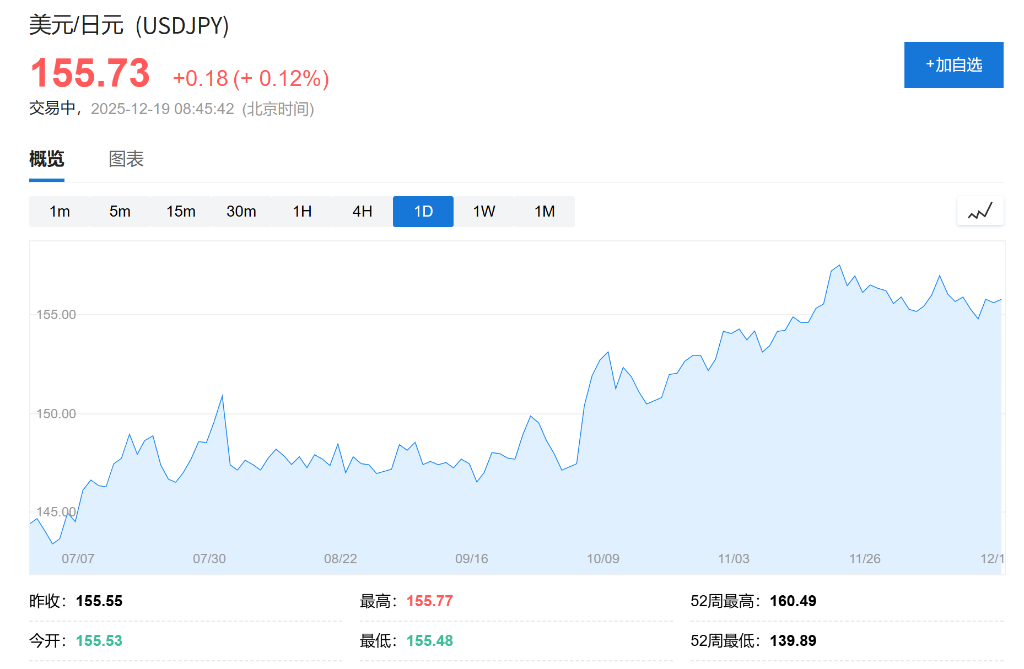
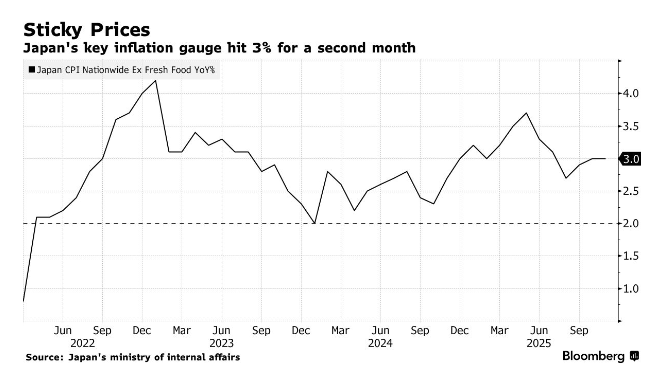
日本核心通胀率在11月维持稳定,连续第44个月高于日本央行设定的目标,这一数据进一步巩固了市场对于日本央行即将加息的预期。 12月19日周五,日本政府公布的数据显示,11月剔除生鲜食品的核心消费者价格指数(CPI)同比上涨3.0%,涨幅符合市场预期中值,且与10月 持平。与此同时,整体CPI同比涨幅则从上月的3.0%微降至2.9%。两项数据均持续位于日本央行2%的目标之上。 此次数据发布恰逢日本央行即将结束为期两天的政策会议。市场普遍预计,央行将把政策利率从当前的0.5%上调至0.75%,这将是该国自1995年 以来的最高利率水平。 市场对该数据反应总体积极。数据发布后,受加息预期强化提振,日元兑美元汇率小幅走强至155.73一线,日经225指数上涨0.8%。与此同时,10 年期日本国债收益率微跌至1.958%。 | | | 分时 多日 1分 5分 15分 30分 60分 日 7 | | | | | | | | F9 叠加 九转 画线 工具 岱 >> | | | | | | | 日经225 | | | --- | --- | --- | --- | --- | --- | --- | --- | --- | ...

稳在3%!日本通胀给足理由 30年来最高利率呼之欲出
Zhi Tong Cai Jing· 2025-12-19 01:33
Core Insights - Japan's core inflation rate remains stable at 3% for the second consecutive month, indicating persistent price pressures ahead of the Bank of Japan's monetary policy meeting [1][3] - The market anticipates the Bank of Japan will raise its benchmark interest rate to 0.75%, the highest level in 30 years, as inflation data aligns with analyst expectations [3][4] - The core consumer price index (CPI) rose by 3% year-on-year in November, matching the previous month and economists' median forecasts [1][3] Inflation Trends - The overall inflation rate recorded at 2.9%, consistent with analyst predictions, while the inflation rate excluding energy prices also stands at 3%, showing a slight decline from the previous month [1][3] - The core inflation indicator has remained above the Bank of Japan's 2% target for 44 consecutive months, driven by rising energy prices as government subsidies are reduced [3][4] Government Response - Prime Minister Fumio Kishida faces challenges due to rising living costs, with the ruling Liberal Democratic Party experiencing setbacks in two national elections [3] - To alleviate public pressure, the Kishida government has introduced measures such as winter electricity subsidies and one-time cash payments for children, included in the economic stimulus plan [3] Corporate Pricing Strategies - A report from Teikoku Databank indicates that the number of price hikes by major food companies in Japan is expected to reach 20,609 this year, a 64.6% increase from the previous year [3] - Companies in the food and beverage sector plan to raise prices on 1,050 products next year, a significant reduction from the 4,400 products planned for price increases in the same period last year [5]
美CPI降温别高兴太早:经济学家怀疑政府关门导致数据失真
Hua Er Jie Jian Wen· 2025-12-19 00:57
Core Insights - The November core inflation unexpectedly dropped to its lowest level in over four years, raising skepticism among economists due to data collection issues caused by a prolonged government shutdown [1][3] - The core Consumer Price Index (CPI) rose by 2.6% year-on-year, the lowest growth rate since March 2021, while the overall CPI increased by 2.7%, both below economists' expectations [1][3] Data Collection Issues - The Bureau of Labor Statistics (BLS) faced significant data collection challenges due to a 43-day government shutdown, which hindered the collection of October price data, leading to potential distortions in both year-on-year and month-on-month data [3][4] - Economists criticized the BLS for assuming zero growth in rental prices for October, which artificially lowered the November inflation figures [3][6] Market Reactions - Despite doubts about the reliability of the data, U.S. stock markets rebounded following the CPI release, with the three major indices opening higher [3][8] - The probability of a Federal Reserve rate cut in January increased slightly to about 22%, with expectations for two rate cuts in 2026 [3][8] Housing Costs Concerns - Housing costs emerged as a major point of contention, with a year-on-year increase of only 3%, the smallest in over four years, raising questions about the accuracy of the inflation data [9][10] - The report indicated that core goods prices rose by 1.4% year-on-year, while energy prices increased by 4.2%, highlighting the mixed signals in the inflation data [9][10] Economic Outlook - Economists expressed concerns that the data collection delays and the timing of data collection during discount periods could further distort the inflation figures [4][6] - The overall sentiment among market participants remains divided, with some viewing the data as a potential signal for the Federal Reserve to consider rate cuts, while others caution against overreacting to potentially flawed data [8][10]

2026年欧洲利率剧本初步揭幕:北欧稳字当头 欧洲央行下一步可能是加息
Zhi Tong Cai Jing· 2025-12-19 00:56
北京时间周四晚间,四家欧洲地区的中央银行密集公布利率决议,堪称一场"欧洲货币政策盛宴",结果 也如市场所预期那样:欧洲央行、挪威央行和瑞典央行维持基准利率不变,而英国央行如预期宣布降 息。 但其中透露出一些关于2026年欧洲货币政策前景的重要细节与线索。以下是四个关键要点。 英国央行投票决定降息,但只是勉强通过 市场原以为英国央行降息已成定局,利率期货市场显示出降息的概率几乎高达98%。但将利率下调25个 基点的投票结果,仅以最微弱优势通过:即5比4。多位英国央行货币政策制定者呼吁转向谨慎立场,称 通胀仍存在持续的扩张风险。 英国央行货币政策委员会成员梅根·格林(Meghan Greene)是四位反对降息者之一,她认为有迹象表明英 国服务业通胀存在显著飙升风险,而核心商品通胀仍处于新冠疫情前的水平。 来自巴克莱银行的英国市场首席经济学家杰克·米宁(Jack Meaning)在英国央行公布利率决议后表示,该 央行实施了一次"偏鹰派的降息举措",并补充称未来降息的门槛可能会比现在高得多。 欧洲央行的预测似乎为按兵不动提供了理由 欧洲央行最新预测似乎支持了欧洲央行官员们的普遍观点——他们表示利率处于"良好水平",与 ...