供需紧平衡

Search documents
【冠通期货研究报告】尿素周报:印标发布,盘面拉涨-20260209
Guan Tong Qi Huo· 2026-02-09 12:36
Report Summary 1. Industry Investment Rating The provided content does not mention the industry investment rating. 2. Core View - Before the Spring Festival holiday, the order - receiving situation is good but not fully filled, and the price remains stable. After the futures rose on Monday, the order - receiving progress is expected to accelerate. - The gas - fired plants have basically resumed production, and production is normal during the Chinese New Year. Agricultural demand for goods is good, and the peak season for wheat top - dressing after the Spring Festival is approaching. Industrial demand is gradually weakening. - The overall volatility of the macro - market and commodities increased last week, but urea remained relatively stable. After the Indian tender was issued on Saturday, the futures rose on Monday. The probability of spot price reduction before the festival is low, and the futures will fluctuate within a narrow range [2]. 3. Summary by Directory 3.1. Spot Market Dynamics - Before the Spring Festival holiday, the order - receiving situation is good but not fully filled, and the price remains stable. After the futures rose on Monday, the order - receiving progress is expected to accelerate. The ex - factory price range of small - particle urea in Shandong, Henan, and Hebei is mostly between 1700 - 1760 yuan/ton, with Henan's prices at the lower end [4]. 3.2. Futures Dynamics - Last week, the futures showed a downward - opening and mostly weak - oscillating trend. As of February 9, the main May contract of urea was reported at 1788 yuan/ton, a decrease of 1 yuan/ton from the settlement price on January 19. The weekly trading volume was 12.8833 million tons, a week - on - week decrease of 4.4244 million tons; the open interest was 7.5489 million tons, a week - on - week increase of 0.5991 million tons. - After the Indian tender was released on Saturday, the domestic market sentiment improved, and the futures rose. Last week, the increase in urea futures was less than that of the spot, and the basis strengthened. As of February 9, the 05 - contract basis was 2 yuan/ton, a weekly increase of 1 yuan/ton; the 5 - 9 spread was 40 yuan/ton, a weekly increase of 18 yuan/ton. - On February 9, 2026, the number of urea warehouse receipts was 10860, a week - on - week decrease of 396 [6][9]. 3.3. Urea Supply - From January 29 to February 4, the weekly urea output was 1.4692 million tons, an increase of 14310 tons from the previous period, a week - on - week increase of 0.98%, and the average daily output was 209900 tons. The coal - based weekly output was 1.2428 million tons, a week - on - week decrease of 0.15%; the gas - based weekly output was 226400 tons, a week - on - week increase of 7.71%. The small - particle weekly output was 117780 tons, a week - on - week increase of 1.32%; the large - particle weekly output was 291400 tons, a week - on - week decrease of 0.34%. - It is expected that 4 - 5 enterprises will resume production in the next cycle. As of February 9, 2026, the national daily urea output was 210000 tons, the same as the previous day, and the operating rate was 85.26%. - The prices of coking coal and anthracite coal are expected to remain stable, and the price of liquefied natural gas has increased. The price of synthetic ammonia has decreased, and the price of urea has increased. The methanol price has remained stable [12][14][15]. 3.4. Urea Demand - As of February 9, the quotation of 45% sulfur - based compound fertilizer was 3230 yuan/ton, a week - on - week increase of 30 yuan/ton. The operating rate of compound fertilizer factories was basically flat last week. Before the festival, they continued to stock up for production, and the inventory in the factory decreased slightly. The terminal sales were good. The last operating data before the holiday is expected to show a week - on - week decline. As of February 6, the operating rate of compound fertilizer factories was 41.79%, a week - on - week increase of 0.45%, and a year - on - year increase of 15.45%. - From January 30 to February 6, the average weekly capacity utilization rate of melamine in China was 57.95%, a decrease of 8.5 percentage points from the previous period and 7.73 percentage points lower than the same period last year. Before the holiday, downstream panel factories and melamine production entered the holiday mode and are currently at a low level compared to the same period in previous years [17]. 3.5. Inventory Data - As of February 6, 2025, the total inventory of Chinese urea enterprises was 918500 tons, a decrease of 26400 tons from the previous week, a week - on - week decrease of 2.79%, and 827400 tons lower than the same period last year. The downstream agricultural demand for goods is smooth, but the factory demand has entered the seasonal off - season, and the downstream inventory is still being smoothly reduced, which verifies the tight - balance supply - demand logic and supports the urea market. The port sample inventory was 165000 tons, an increase of 21000 tons from the previous week [20]. 3.6. International Market - India's RCF issued a new round of urea import tender, with a target purchase volume of 1.5 million tons. Under the influence of the new Indian tender, market confidence is boosted, and international urea prices are expected to continue to rise. - As of February 9, the FOB price of small - particle urea in China was 422.5 US dollars/ton, a week - on - week increase of 20 US dollars/ton; the FOB price of large - particle urea in China was 455 US dollars/ton, a week - on - week increase of 22.5 US dollars/ton. The prices in other regions also showed varying degrees of increase [22].
长江有色:供紧缺口及资金做多点燃涨势 9日锡价或上涨
Xin Lang Cai Jing· 2026-02-09 02:48
Core Viewpoint - The recent surge in tin prices is attributed to a combination of macroeconomic factors, supply-demand dynamics, and market sentiment, marking the end of a previous downward trend and indicating a potential for further growth in the sector [5]. Group 1: Supply Constraints - Global tin resource extraction is limited, with a supply ratio of only 14 years, indicating long-term supply constraints [2]. - The production recovery in Myanmar is lagging, with January output below 1,000 tons, and full-scale production expected only in the second half of the year [2]. - Indonesian tin exports are affected by policy approvals, and geopolitical risks in the Democratic Republic of Congo increase the likelihood of supply disruptions [2]. Group 2: Demand Dynamics - Despite the upcoming Chinese New Year holiday, there is a noticeable demand for stocking up on tin from downstream sectors such as solder and photovoltaic materials, driven by low prices [3]. - Emerging sectors like AI servers and electric vehicles are creating rigid demand, supporting the tin market [3]. - Global semiconductor sales are projected to reach a historical high in 2025, further solidifying the demand for tin [3]. Group 3: Inventory Levels - Global visible tin inventories are at historically low levels, with a consumption-to-inventory ratio below 10%, indicating a lack of significant accumulation in both domestic and overseas markets [4]. - This low inventory situation means that even minor fluctuations in demand can lead to substantial price volatility, reinforcing price support [4]. Group 4: Market Outlook - The strong rebound in tin prices signals the end of the previous adjustment phase, driven by macroeconomic conditions, industry dynamics, and market sentiment [5]. - The upcoming period may see a dual boost from domestic growth policies and the resumption of business activities post-holiday, with tin expected to lead the sector due to its scarcity and essential role in emerging fields [5]. - Investors are advised to adopt a balanced strategy for positioning before the holiday and focus on sectors with strong growth potential post-holiday [5]. Group 5: Short-term Forecast - On February 9, tin prices are expected to maintain a strong oscillating pattern, supported by increased risk appetite and last-minute pre-holiday demand [6]. - However, price increases may face limitations due to potential profit-taking by previous investors and limited acceptance of high prices in the spot market [6]. - The ability to break through resistance levels will depend on the sustainability of capital inflows and actual trading activity in the spot market [6].


有色巨震后,错杀机会凸显?
格隆汇APP· 2026-02-08 09:12
Core Viewpoint - The recent volatility in the A-share non-ferrous metal sector is primarily driven by macroeconomic sentiment disturbances, while the fundamental logic of "tight supply and steady demand" remains unchanged, indicating potential mispricing in certain sub-sectors [5][9]. Group 1: Market Volatility Factors - The sharp fluctuations in the non-ferrous sector are attributed to three external factors: adjustments in Federal Reserve policy expectations, the "negative gamma effect" amplifying volatility, and seasonal characteristics before the Spring Festival suppressing risk appetite [11][12]. - The nomination of Kevin Warsh as the new Federal Reserve Chairman triggered a reversal in policy expectations, leading to a decline in interest rate cut forecasts and impacting precious metals prices significantly [13][14][15]. - The "negative gamma effect" exacerbated the situation, where speculative funds, heavily leveraged in the futures and options markets, were forced to liquidate positions as prices fell below key support levels, creating a vicious cycle of selling [17][18]. Group 2: Seasonal and Sentiment Pressures - Seasonal factors related to the Spring Festival, characterized by a demand lull and conservative funding behavior, further intensified the downward pressure on prices, as many downstream industries typically halt operations before the holiday [19][20][21]. - The collective withdrawal of funds from the market, driven by risk aversion, left the non-ferrous sector without sufficient support, compounding the effects of policy and leverage adjustments [22]. Group 3: Supply and Demand Dynamics - Despite short-term emotional disturbances, the core supply-demand dynamics in the non-ferrous metal industry remain intact, with several sub-sectors showing signs of mispricing and potential for recovery [23]. - The long-term investment logic for precious metals remains solid, supported by ongoing central bank gold purchases and unresolved U.S. debt issues, with China's central bank increasing gold reserves for 14 consecutive months, reaching 74.15 million ounces by December 2025 [24]. - In industrial metals, the supply-demand balance for copper and zinc remains tight, with production in major countries like Chile and Peru falling short of expectations [25]. - Energy metals and minor metals continue to face supply constraints, with lithium prices affected by sentiment and uncertainties in production processes, while rare earth elements like praseodymium and neodymium are experiencing price increases due to tightening global supply [26][27][28]. Conclusion - The recent macroeconomic sentiment-induced turbulence has not altered the fundamental supply-demand balance in the non-ferrous metal industry, instead providing a rational entry point for medium to long-term investments [31]. - As global energy transitions and de-globalization trends continue, the supply-demand equilibrium in the non-ferrous metal sector is likely to persist, presenting structural investment opportunities [32].

长江有色:4日锡价大涨 期货持仓激增现货成交畏高
Xin Lang Cai Jing· 2026-02-04 08:11
Core Viewpoint - The significant rise in tin prices on February 4, 2026, is attributed to a combination of a supply shock from a natural disaster in Myanmar, favorable macroeconomic conditions, and increased demand expectations from key sectors [2] Supply Side - Global tin supply is facing rigid shortages due to multiple disruptions, including a recent earthquake in Myanmar, export restrictions in Indonesia, and production halts in the Democratic Republic of Congo [3] - Domestic supply is also constrained, with low raw material availability and high operating rates at smelters, but limited production increases [3] Demand Side - While traditional electronic sectors are experiencing seasonal weakness, emerging sectors such as AI servers, photovoltaics, and new energy vehicles are showing strong demand [4] - After a price correction, downstream inventory replenishment has contributed to the price increase [4] Inventory Situation - Both LME and domestic tin inventories are at low levels, with a significant portion of domestic stocks being held for delivery, leading to insufficient available inventory for downstream enterprises [5] Industry Status Near Chinese New Year - As the Chinese New Year approaches on February 16, the industry is experiencing a "supply and demand lull," with upstream smelters beginning to shut down for maintenance, further tightening supply [6] - Midstream traders and processors are operating at low inventory levels with minimal replenishment activity, while downstream purchasing is primarily driven by immediate needs [6] Short-term Price Trends and Future Outlook - Following the substantial price increase on February 4, the short-term outlook suggests a "high-level fluctuation" pattern, with potential for price stabilization after the market digests the supply disruption effects [7] - In the medium to long term, the fundamental balance of supply and demand remains supportive of price increases, particularly driven by ongoing demand growth in semiconductor and photovoltaic sectors [7] Investment Strategies - Short-term traders are advised to operate within the fluctuation range while managing positions and avoiding holiday risks [8] - Long-term investors may consider accumulating positions during price corrections, focusing on the fundamental supply-demand balance [8]
碳酸锂:区间震荡企稳,聚焦供需紧平衡,成材:重心下移偏弱运行
Hua Bao Qi Huo· 2026-02-02 03:38
Report Industry Investment Rating - Not provided Core Viewpoints - The lithium carbonate market is expected to stabilize in a range, with a focus on the tight supply - demand balance [1][3] Summary by Related Catalogs Market Performance - Last week, the main contract of lithium carbonate futures showed a volatile downward trend, closing at the daily limit of 148,200 yuan/ton. The net short position of the main funds continued, the持仓 structure was divided, market divergence increased, the advantage of long - positions concentrated towards the top, and overall gaming intensified. Registered warehouse receipts increased by 420 tons to 30,211 tons. The SMM average price of electric carbon was 160,500 yuan/ton. Upstream lithium salt producers' willingness to sell single orders continued to weaken, while some downstream material factories had a strong willingness to purchase at relatively low prices, and market inquiries and transactions were active [1] Fundamentals - **Supply**: Last week, the raw material market generally rose. The SMM total weekly operating rate of lithium carbonate was 49.5% (-1.49%), and the operating rates of all processes except for salt lakes decreased. The SMM total output was 21,569 tons (-648 tons), a month - on - month decrease of 2.92% [2] - **Demand**: There was a significant structural differentiation in demand. Last week, the SMM lithium iron phosphate output increased by 1.0% month - on - month with increased inventory accumulation; the ternary output decreased by 1.1% month - on - month with gradually decreasing inventory. The output of power cells decreased slightly last week. As of January 18, the penetration rate of new energy vehicle sales by SMM rose to 55.6%. Energy - storage cells performed strongly, with both production and sales booming and low inventory [2] - **Inventory**: Last week, the SMM four - location sample social inventory decreased by 5.6% (-2,450 tons) month - on - month, the sample weekly inventory decreased by 1.3% (-1,414 tons) month - on - month. The total inventory days increased to 28.5 days, the downstream inventory days increased to 10.8 days, and the inventory days of upstream and other links decreased, showing a significant inventory structure differentiation [2] Macro - policy - **Demand - side**: Multiple incentives such as automobile trade - in subsidies and battery export tax - rebate policies stimulate terminal consumption and improve macro - liquidity [3] - **Supply - side**: On January 15, the National Development and Reform Commission proposed to introduce management measures for the comprehensive utilization of new energy vehicle power batteries, which will improve the recycling threshold and eliminate backward production capacity, optimizing the domestic supply structure in the long - term and raising the cost support center [3] - **Industrial planning**: The Qinghai Salt Lake Industry Plan, the key points of the "15th Five - Year Plan" for energy storage, and a series of deployments in the Central Economic Work Conference form synergistic benefits to support long - term supply - demand balance [3] - **Macro - environment**: The central bank's structural interest rate cut indirectly strengthens the long - term macro - positive atmosphere [3]
提价预期传导-浆纸行业更新推荐
2026-02-02 02:22
Summary of Conference Call on the Pulp and Paper Industry Industry Overview - The pulp and paper industry is expected to see an improvement in market conditions after a year of declining fixed asset investment, with a potential recovery in 2026 [1][2] - The Producer Price Index (PPI) has shown a slight increase since September 2025, indicating stabilization in pricing, although demand has not fully recovered yet [1][2] Key Insights - The anticipated decline in interest rates and a stronger RMB are expected to drive up pulp prices, which will subsequently lead to an increase in paper prices [1][2] - The U.S. Federal Reserve's interest rate cuts may enhance liquidity and stimulate end-user demand, while a weaker dollar could reduce upstream pulp manufacturers' profitability, providing them with pricing power [2] - China remains the largest consumer market for commodity pulp, accounting for nearly 40% of global demand, with seasonal demand expected to support pulp prices in March and April 2026 [5] - Domestic leading paper companies are expected to increase their self-produced pulp capacity, which may create variability in demand linked to end-user consumption [5] Supply and Demand Dynamics - The supply pressure for commodity pulp is expected to ease significantly in 2026, with only the APP Indonesia OKI Phase II project having uncertain production plans [5] - Some overseas pulp manufacturers have announced production cuts or shifts in production plans, contributing to a likely balanced supply-demand scenario in 2026 [5] - The European and American markets are projected to recover in 2026, with European port inventories showing a downward trend since October 2025 [5] Segment Analysis - **Cultural Paper**: Prices are at historical lows (approximately 4,700 RMB/ton), with many companies facing losses due to excess capacity. However, seasonal demand may provide some price support [7] - **White Cardboard**: Currently priced around 4,200 RMB/ton, it has seen slight price increases but remains at historical lows due to supply pressures. Marginal improvements are expected in 2026 [7] - **Specialty Paper**: This segment has faced declining profitability due to weak demand and increased competition. Price recovery is unlikely in the short term [7] - **Recycled Paper**: Prices have fluctuated due to raw material costs, with boxboard prices around 3,500 RMB/ton and corrugated prices at 2,700 RMB/ton. A clear improvement in supply-demand dynamics is anticipated [7] Future Outlook - The overall economic environment, cost control, and seasonal demand are expected to support gradual recovery across all segments of the paper industry [8] - The boxboard sector is experiencing positive changes in supply-demand dynamics, with prices expected to recover moderately [9] - The industry is approaching a critical inflection point for supply contraction, with minimal new capacity expected from 2026 or 2027 onwards [10] Recommended Companies - Leading companies with integrated pulp and paper capabilities are recommended for investment, such as Sun Paper, Jiulong, and Xianhe, due to their cost advantages from self-produced pulp [11] - Companies like Huawang Technology, Bohui, Chenming Paper, and Wuzhou Specialty are also suggested for consideration based on their relatively low valuations and potential for profit recovery [11]
策略联合行业-周期在扩散
2026-01-30 03:12
Summary of Key Points from Conference Call Records Industry Overview - **Upstream Cycle Products**: Benefiting from loose monetary conditions and a bottoming capacity cycle, supply-demand tight balance is driving price increases in sectors like chemicals, black chain, and real estate chain, presenting investment opportunities. Short-term market remains strong with long-term logic supporting this trend, but structural rotation and cost-effectiveness need to be monitored [1][2] Chemical Industry - **Current Situation**: The chemical industry is experiencing a hot market, with public fund holdings in large chemical sectors still underweight. Policies limiting new capacity and negative growth in capital expenditure are restricting supply, leading to an upward trend in industry prosperity [4] - **Investment Recommendations**: 1. **Oil and Petrochemicals**: Focus on companies with good resource endowments benefiting from high oil prices and potential value assessments [4] 2. **Basic Chemicals**: After a long bottoming process, current price differentials and valuations have safety margins. Key assets benefiting from unexpected demand and marginal changes in dual carbon policies should be monitored [4] 3. **Cyclical Leaders**: Attention should be given to tire companies with overseas expansion potential [4] Coal Sector - **Current Situation**: The coal sector has seen supply contraction and increased overseas demand, with inventory levels decreasing, indicating potential price increases. Many companies are undervalued from a price-to-book (PB) perspective, especially those with high spot market ratios [5][7] - **Investment Logic**: Companies with high spot ratios are expected to benefit significantly from rising coal prices. Recommended companies include Lu'an Huanneng, Jinkong Coal, and Shanmei International [6] Precious Metals - **Market Dynamics**: In the context of global turmoil, physical assets like gold are rising, with ongoing central bank purchases. Recommended stocks include Zijin Mining International and Shandong Gold [10] - **Industrial Metals**: Favorable outlook for aluminum and copper, with specific recommendations for China Aluminum and Zijin Mining [10][11] Logistics and Delivery - **SF Holding**: The company shows potential for absolute returns and valuation recovery, with a projected absolute return rate of 3.8% for 2025 and 2026. The company is at a ten-year low in valuation, with significant room for EPS upgrades and PE recovery [12] - **Third-party Delivery**: SF's leading position in the third-party delivery sector is expected to enhance performance through partnerships with major internet companies [12] Insurance Sector - **2026 Outlook**: The insurance sector is expected to perform strongly due to resonance in both asset and liability sides. The demand for dividend insurance is increasing, and the long-term interest rates are stabilizing, enhancing profit elasticity for insurance companies [23][24] Construction Materials - **Investment Opportunities**: Traditional undervalued construction materials like renovation materials, glass, and cement still hold investment value. Recommended companies include Beixin Building Materials and China Liansu [25] Real Estate Sector - **Recent Trends**: The real estate sector has rebounded due to bullish market sentiment and policy expectations. Anticipated easing measures in core cities may lead to a short-term market recovery [26][27] Engineering Machinery - **2026 Prospects**: The engineering machinery sector is expected to see synchronized domestic and international demand growth. Key recommendations include SANY Heavy Industry, XCMG, and Zoomlion [29][30] This summary encapsulates the critical insights and recommendations from the conference call records, providing a comprehensive overview of the current market dynamics and investment opportunities across various sectors.
补库需求支撑,碳酸锂价格尾盘收涨
Hua Tai Qi Huo· 2026-01-28 05:22
1. Report Industry Investment Rating - Not provided in the given content 2. Core Viewpoints of the Report - The price of lithium carbonate showed resilience and closed higher in the late trading, indicating that the short - term supply - demand tight balance will continue. The low downstream inventory and pre - holiday restocking demand support the price. However, there is a game between the short - term "strong reality" and long - term "weak expectation", and the price may be prone to correction if supply recovers or demand is overdrawn [1][2][3] 3. Summary by Relevant Catalogs Market Analysis - On January 27, 2026, the lithium carbonate main contract 2605 opened at 166,700 yuan/ton and closed at 179,600 yuan/ton, with a 1.50% change in the closing price compared to the previous day's settlement price. The trading volume was 382,313 lots, and the open interest was 422,433 lots (416,719 lots the previous day). The current basis was 1,360 yuan/ton, and the lithium carbonate warehouse receipts were 29,166 lots, a change of 520 lots compared to the previous day [1] Spot Market - According to SMM data, the price of battery - grade lithium carbonate was 168,000 - 177,000 yuan/ton, a change of - 9,000 yuan/ton compared to the previous day; the price of industrial - grade lithium carbonate was 165,000 - 173,000 yuan/ton, also a change of - 9,000 yuan/ton. The price of 6% lithium concentrate was 2285 US dollars/ton, a change of - 10 US dollars/ton compared to the previous day. The total weekly output of lithium carbonate was 22,217 tons, a decrease of 388 tons compared to the previous week [2] Inventory - The spot inventory was 108,896 tons, a decrease of 783 tons compared to the previous period. Among them, the smelter inventory was 19,834 tons, an increase of 107 tons; the downstream inventory was 37,592 tons, an increase of 1,940 tons; other inventories were 51,470 tons, a decrease of 2,830 tons [2] Strategy - There is a game between short - term "strong reality" and long - term "weak expectation". The current price increase depends on supply disruptions and pre - demand. If supply recovers or demand is overdrawn, the price is likely to correct. It is recommended to mainly conduct range operations, pay attention to consumption and inventory turning points, and consider selling hedges at high prices when appropriate. For single - side trading, conduct short - term range operations [3]
纯苯、苯乙烯日报:原油走强叠加扰动,芳烃情绪回暖-20260127
Tong Hui Qi Huo· 2026-01-27 09:22
Industry Investment Rating - No relevant information provided Core Viewpoint - Pure benzene is expected to maintain a tight balance in the short term, with its cost supported by strong crude oil prices. The domestic petroleum benzene operating rate may rebound from a low level, and downstream demand is expected to improve slightly [2]. - Styrene is expected to remain in a tight supply - demand balance in the short term, with prices oscillating strongly. The supply increase is limited in the short term, and the market has low expectations for inventory accumulation in the off - season in February [3]. Summary by Directory 1. Daily Market Summary Fundamental Information - On January 26, the styrene main contract closed down 0.08% at 7,702 yuan/ton, and the pure benzene main contract closed up 0.36% at 6,078 yuan/ton. The closing price of Brent crude oil was 61.1 US dollars/barrel (+1.1 US dollars/barrel), and the WTI crude oil main contract closed at 65.1 US dollars/barrel (+1.1 US dollars/barrel). The spot price of East China pure benzene was 6,020 yuan/ton (+55 yuan/ton) [2]. - The inventory of pure benzene at East China ports was 29.7 tons (-2.7 tons), and the inventory of styrene at East China ports was 9.4 tons (-0.7 tons). The overall demand for pure benzene downstream changed little, with only the aniline operating rate rising significantly to 87.6%. The styrene downstream entered the off - season, with small fluctuations in the operating rates of PS and ABS, and a slight increase in the EPS operating rate. The production profit of hard rubber was further compressed [2]. Views - For pure benzene, the operating rates of domestic petroleum benzene and hydro - benzene plants declined last week, leading to a decrease in pure benzene production. The overall demand was stable with a slight increase. Affected by the cold wave, the inventory at East China ports decreased, but the absolute inventory was still at a high level. In the future, the operating rate of domestic petroleum benzene may rebound, and downstream demand is expected to improve slightly. The cost is supported by strong crude oil, and pure benzene will maintain a tight balance in the short term [2]. - For styrene, the supply - side disturbances increased last week, with production and capacity utilization decreasing. The demand was differentiated, and the total consumption of the three major downstream products increased. With the approaching of the Spring Festival, the inventory entered the seasonal accumulation stage, and the inventory pressure was controllable. The profitability of integrated and non - integrated plants was further repaired. The supply increase is limited in the short term, and styrene will maintain a tight supply - demand balance and strong price oscillation [3]. 2. Industrial Chain Data Monitoring Price Data - The styrene futures main contract decreased by 0.08% to 7,702 yuan/ton, and the spot price increased by 1.36% to 7,754 yuan/ton. The basis increased by 81.25% to 203 yuan/ton. The pure benzene futures main contract increased by 0.36% to 6,078 yuan/ton, and the East China spot price increased by 0.92% to 6,020 yuan/ton. The prices of pure benzene in South Korea FOB, the United States FOB, and China CFR remained unchanged [5]. - The spread between domestic pure benzene and CFR decreased by 14.1% to - 381.2 yuan/ton, and the spread between East China and Shandong pure benzene decreased by 22.89% to 320 yuan/ton. The price of Brent crude oil increased by 2.88% to 61.1 US dollars/barrel, and the price of WTI crude oil increased by 2.73% to 65.1 US dollars/barrel. The price of naphtha increased by 0.10% to 6,893.3 yuan/ton [5]. Production and Inventory Data - The production of styrene in China decreased by 1.73% to 34.9 tons, and the production of pure benzene decreased by 2.54% to 42.5 tons. The port inventory of styrene in Jiangsu decreased by 7.06% to 9.4 tons, and the port inventory of pure benzene nationwide decreased by 8.33% to 29.7 tons [6]. Capacity Utilization Data - Among the pure benzene downstream, the capacity utilization rate of styrene decreased by 1.23% to 69.6%, that of caprolactam decreased by 1.00% to 76.2%, that of phenol decreased by 0.31% to 88.4%, and that of aniline increased by 10.51% to 87.6%. Among the styrene downstream, the capacity utilization rate of EPS increased by 4.65% to 58.7%, that of VBS decreased by 3.00% to 66.8%, and that of PS decreased by 0.10% to 57.3% [7]. 3. Industry News - Trump proposed to increase tariffs on South Korea. - The Prime Minister of Hungary will object to the EU's ban on importing Russian natural gas. - Due to cold weather, oil production in North Dakota, the United States, decreased by 80,000 - 110,000 barrels per day. - A source said that the Russian Ministry of Energy proposed to lift the gasoline export ban in advance. - The US durable goods orders in November increased by 5.3% month - on - month, higher than the expected 3.7% and the previous value of - 2.2%. - OPEC+ representatives said that they currently expect to maintain the established plan and keep the crude oil production unchanged next month [8]. 4. Industrial Chain Data Charts - The report provides data charts on pure benzene price, styrene price, styrene - pure benzene spread, SM import pure benzene cost vs. domestic pure benzene cost, styrene port inventory, styrene factory inventory, pure benzene port inventory, ABS inventory, aniline weekly capacity utilization, caprolactam weekly capacity utilization, and phenol weekly capacity utilization [9][12][19][23][28][29]
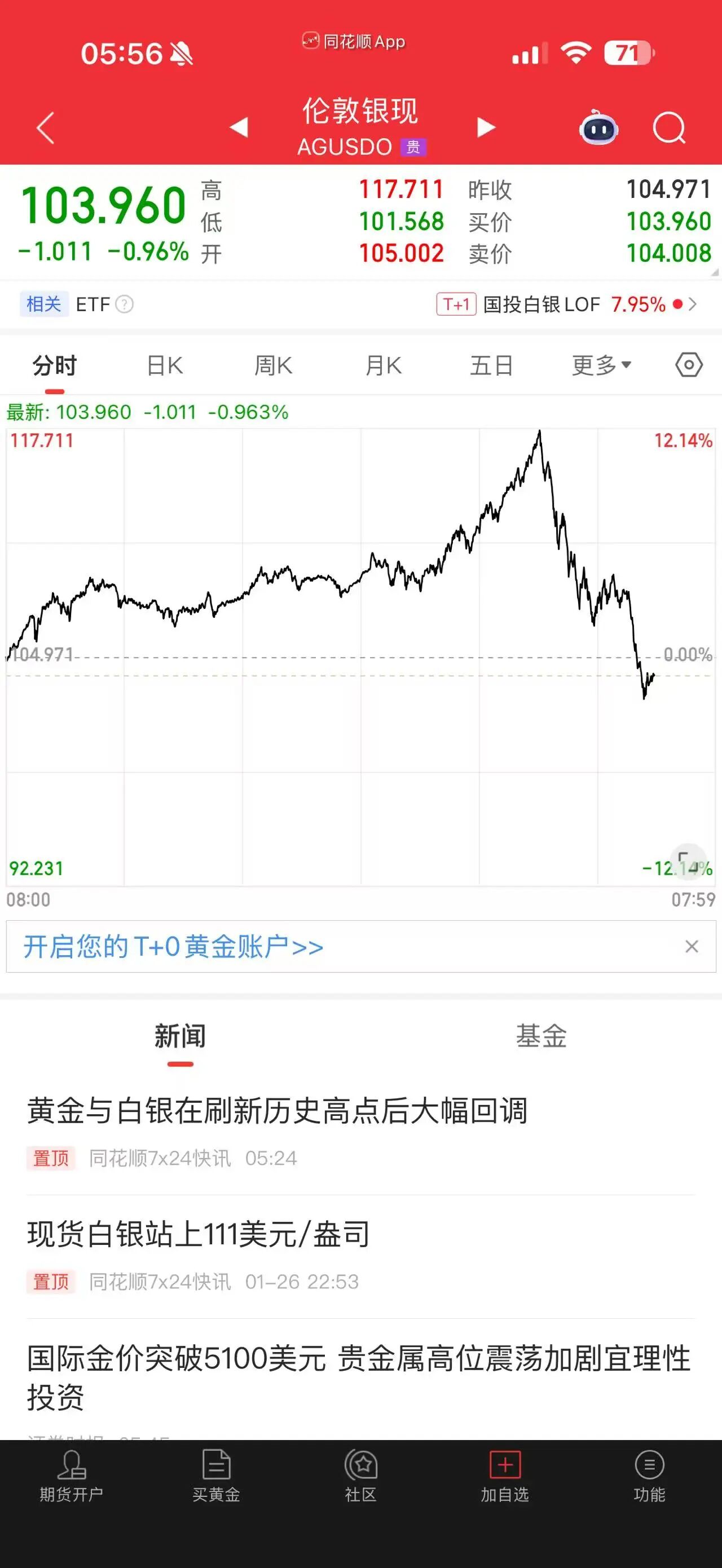
银价大跳水!盘中、盘后,交易所接连出手“降温”;特朗普称将提高对韩国关税,美军航母打击群正部署中东
Qi Huo Ri Bao· 2026-01-27 00:37
新闻 早上好,先来关注下黄金和白银。 26日晚, 白银价格加速上涨。伦敦银现货价格涨幅扩大至12%,纽约期银主力合约涨逾16%。 不过,今天凌晨,黄金与白银价格大幅回调,伦敦银现货价格转跌,报约103美元/盎司,此前最高触及117美元/盎司。伦敦金现货价格同样转跌,一度跌破 5000美元/盎司,此前在5100美元/盎司附近运行。 92.231 08:00 开启您的 T+0黄金账户>> 其全 黄金与白银在刷新历史高点后大幅回调 置顶 同花顺7x24快讯 05:24 现货白银站上11美元/盎司 置顶 同花顺7×24快讯 01-26 22:53 国际金价突破5100美元 贵金属高位震荡加剧馆 投资 期货开 加自元 网 同花顺 App 05:57 N 5110.320 昨收 5000.030 % 4983.940 买价 -38.810 -0.77% 开 5038.870 卖价 相关 ETF 2 T+0 金 ETF嘉实 2 同花顺黄金 2 银行金价 1141.75 日K 月K 王日 分时 周K 童零 最新: 5000.030 -38.810 -0.770% 5110.320 4967.360 08:00 开启您的 T+ ...