弱美元周期

Search documents
中金2026年展望:弱美元周期带动全球经济共振修复 叠加国内外长线资金支撑 将对A/港股带来提振
智通财经网· 2026-01-05 00:48
Group 1 - The weak US dollar is driving a global economic recovery, boosting domestic export growth and profit improvement in China [1] - Global monetary policy and liquidity are becoming more accommodative, raising valuations for A-shares and Hong Kong stocks [1] - Increased foreign capital inflow is expected to support A-shares, driven by a weak dollar and domestic policy catalysts [1] Group 2 - The Trump administration's policies since 2025 have hindered the nominal economic recovery in the US, but a shift in focus towards domestic issues may lead to fiscal and monetary easing in 2026 [2] - The easing environment is expected to alleviate three major constraints on the US economy, including weak consumer confidence and sluggish housing demand [2] - The technology, industrial, and resource sectors in the US are anticipated to continue leading the market in 2026, while consumer and financial sectors may catch up as the nominal cycle improves [2] Group 3 - A weaker dollar may provide room for the renminbi to appreciate, supported by expectations of US interest rate cuts and year-end foreign exchange settlement peaks [3] - The anticipated trend of abundant dollar liquidity suggests that the US dollar is likely in a depreciation phase, which may support the renminbi [3]
有色金属行业年度策略:烈火烹油,牛市仍在途
LIANCHU SECURITIES· 2025-12-29 10:02
Group 1: Overall Industry Insights - The non-ferrous metals industry is experiencing a significant transformation due to geopolitical shifts and economic changes, leading to a re-evaluation of resource values and pricing mechanisms [18][24][25] - The year 2025 marked a historic bull market for precious metals, particularly gold and silver, which redefined their financial and hedging attributes [18][27] - The non-ferrous metals sector has shown remarkable performance, with the Shenwan Non-ferrous Metals Index achieving an annual increase of 87.05%, outperforming major market indices [20] Group 2: Gold Market Analysis - The long-term bullish logic supporting gold remains intact, with expectations for a structured upward trend in gold prices through 2026, driven by a weakening US dollar and rising debt risks [3][34] - The anticipated transition in US Federal Reserve leadership is expected to create short-term trading opportunities around gold prices, influenced by market uncertainties [4][34] - The demand for gold from central banks is expected to slow down, impacting the overall market dynamics for gold in the near term [3][34] Group 3: Copper Market Dynamics - The copper supply is entering a long-term structural bottleneck, with a significant decrease in new mine production expected by 2026, enhancing the bargaining power of core mines [5][9] - The smelting sector is facing a "zero processing fee" era, leading to accelerated industry consolidation as high-cost smelting enterprises exit the market [9][10] - The fundamental support for copper prices is strong, with an expected widening supply-demand gap in 2026, indicating a trend of rising prices [9][10] Group 4: Aluminum Market Trends - The aluminum industry is witnessing a shift in value dynamics, with a focus on structural premiums due to increased reliance on imported resources [10][11] - The market for alumina is expected to face challenges due to oversupply and pressure on profitability, while the electrolytic aluminum sector is poised for growth driven by energy value [10][11] - The profitability within the aluminum industry is anticipated to concentrate further towards the downstream smelting segment, presenting investment opportunities [10][11] Group 5: Lithium Market Outlook - The lithium market is projected to experience a dual increase in supply and demand in 2026, although there are risks of mismatched release rhythms [11][12] - The recovery in lithium prices is expected to be supported by a rebound in demand from the energy storage sector, despite uncertainties in the electric vehicle market [11][13] - Investors are advised to monitor the construction and installation pace of domestic energy storage projects to better capture investment opportunities in the lithium sector [11][13]
有色“超级周期”再升温!有色龙头ETF(159876)午后强攻大涨3.5%
Sou Hu Cai Jing· 2025-12-17 06:09
Group 1 - The core viewpoint of the articles highlights the strong performance of the non-ferrous metal sector, particularly the non-ferrous metal leader ETF (159876), which has seen significant inflows and price increases, indicating positive market sentiment towards the sector [1][2] - The non-ferrous metal leader ETF (159876) attracted 10.13 million yuan in a single day and has accumulated 198 million yuan over the past 20 days, reflecting investor confidence in the future performance of the non-ferrous metal sector [1] - Citic Securities believes that as long as the Federal Reserve remains in a rate-cutting cycle, there will be upward momentum for non-ferrous metal prices, with a potential super cycle for industrial metals like copper and aluminum on the horizon [1] Group 2 - The non-ferrous metal leader ETF (159876) and its linked fund (017140) cover a wide range of metals including copper, aluminum, gold, rare earths, and lithium, providing a diversified investment option compared to single metal investments [2] - As of December 16, the non-ferrous metal leader ETF (159876) had a latest scale of 840 million yuan, making it the largest ETF tracking the same index among three similar products in the market [2]
2026年金属年度策略:百花盛开
2025-12-08 00:41
Summary of Key Points from Conference Call Records Industry Overview - The conference call discusses the outlook for the non-ferrous metals industry in 2026, predicting a vibrant year with strong performance expected, likely not inferior to 2025. The macroeconomic environment is favorable, with the US economy projected to experience GDP growth and continued liquidity easing, including potential interest rate cuts and expansive fiscal policies. The global manufacturing PMI has rebounded above 50, indicating a positive trend in manufacturing [2][4] Key Insights and Arguments - **Macroeconomic Conditions**: The US is expected to implement two to three interest rate cuts in 2026, with high deficits and loose fiscal policies likely to persist in the short term. This environment is beneficial for most commodities, especially those without severe supply-side excesses [4] - **China's Economic Outlook**: China's export pressures are expected to ease, with a gradual convergence in the real estate market's downward trend. Domestic liquidity is anticipated to align with global trends, creating a favorable environment for commodities, particularly those with supply-side constraints [5] - **Gold Market**: The marginal pricing of gold is changing, with central banks increasing their gold reserves, currently at about 20% of total reserves, which is below the historical median. Gold prices are expected to maintain a stable or upward trend, potentially exceeding $4,800 in 2026 [7] - **Aluminum Market**: Global electrolytic aluminum production is projected to increase by approximately 1.2 million tons in 2026, with demand growth outpacing supply growth. This is expected to lead to further price increases due to low inventory levels [8][9] - **Copper Market**: The global copper supply is expected to increase by about 600,000 tons in 2026, with demand growth projected at 2.7%. Copper prices are anticipated to exceed $12,000, with potential to reach $13,000, driven by low inventory and strong demand [10][11] Additional Important Content - **Steel Industry Dynamics**: The construction sector's demand for steel has decreased, but export demand remains strong. Overall steel demand is expected to be neutral, with a potential slight decline or increase depending on market conditions. The iron ore price is projected to average above $90 per ton, with a slow downward trend [12] - **Investment Strategies**: For the steel sector, it is recommended to focus on leading companies with low valuations and good profitability, while the aluminum sector is seen as undervalued but with high dividend yields. Both sectors are considered worthy of investment [14] - **Concerns about Substitute Materials**: The potential for substitutes like aluminum replacing copper is deemed overstated, as technological advancements and industry standards make such transitions difficult. The market is showing increased interest in non-ferrous metals, indicating a positive outlook for related stocks [13] This summary encapsulates the key points discussed in the conference call, providing insights into the non-ferrous metals industry and its future outlook.
时钟已进入弱美元周期
Sou Hu Cai Jing· 2025-11-06 14:12
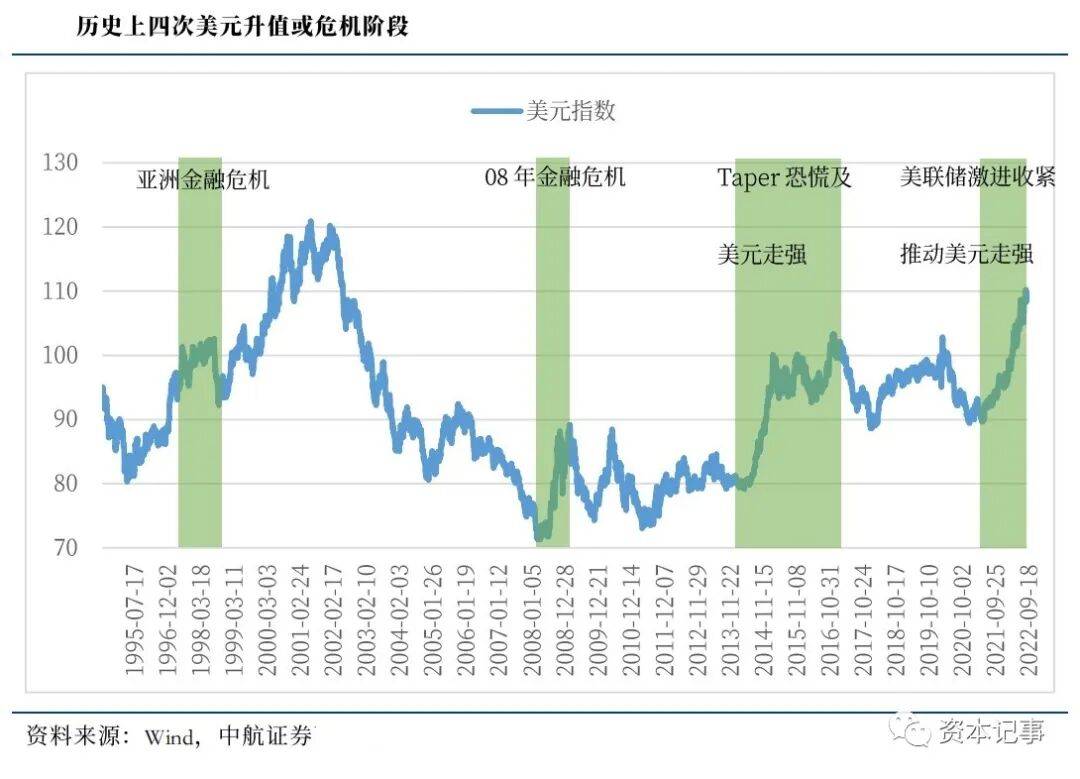
Core Viewpoint - The article discusses the transition from a strong dollar cycle to a weak dollar cycle, highlighting the expected decline of the US dollar and its implications for global assets and currencies [1][2][3]. Summary by Sections Dollar Cycle Phases - The dollar has experienced various cycles since 1971, with the current phase being a weak dollar cycle that has lasted over a year [1]. - Morgan Stanley predicts a significant decline in the DXY dollar index to 89 by the end of 2026, approximately 10% lower than the current level of 99.7 [2]. Currency Predictions - By the end of 2026, the euro is expected to rise from 1.1533 to 1.27 against the dollar, and the British pound from 1.3111 to 1.47 [2]. - The dollar is projected to fall against the Japanese yen from 154 to 124 [2]. - Deutsche Bank forecasts the dollar to yuan exchange rate to drop to 6.7 by the end of 2026 [2]. Monetary Policy and Interest Rates - The Federal Reserve recently lowered the federal funds rate by 25 basis points to a target range of 3.75%–4.00%, signaling a gradual easing approach [2]. - Market expectations for further rate cuts in 2026 have decreased, with a potential terminal rate approaching 3% [2]. Factors Influencing Dollar Weakness - Interest rate differentials are narrowing, with the Fed's rate cuts and the European Central Bank's slower rate cuts expected to reduce the dollar's carry trade advantage [3]. - Fiscal policies, including the anticipated tax cuts under Trump, are projected to increase federal deficits significantly, contributing to a weaker dollar [3]. - Global trust in the dollar as a safe asset is diminishing due to geopolitical tensions and economic policies, with the IMF reporting the lowest global dollar reserve share since 1995 [3]. Asset Rotation and Market Sentiment - A clear rotation in global assets is anticipated, with risk assets rebounding and commodity prices rising as the dollar weakens [7]. - Institutions like Allianz, UBS, and Bank of America recognize the consensus on a weaker dollar, shifting market logic towards buying non-dollar assets [7]. - UBS has upgraded emerging market stocks to overweight, particularly favoring Chinese stocks due to their relative valuation and low foreign investor holdings [7].


弱美元周期开启 亚洲新兴市场对冲窗口悄然打开
Zhi Tong Cai Jing· 2025-09-25 02:56
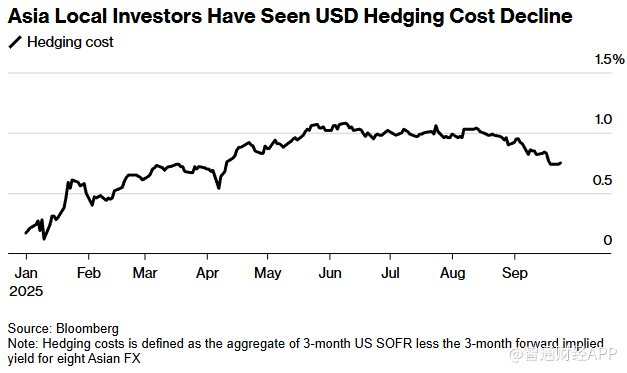
Group 1 - The cost of hedging dollar exposure for Asian investors has dropped to its lowest level since April, averaging 0.7%, indicating a potential opportunity for risk-averse investors [1][2] - The decline in hedging costs is attributed to expectations of continued interest rate cuts by the Federal Reserve, while the easing cycles of Asian central banks are nearing an end [1][4] - There is a growing demand for dollar hedging among Asian investors, particularly in capital-exporting economies in North Asia, due to concerns over a weakening dollar [1][4] Group 2 - The Federal Reserve has recently cut rates by 25 basis points and signaled further policy easing, while other Asian central banks are expected to conclude their easing cycles [4] - The Bloomberg Dollar Spot Index has fallen approximately 8% year-to-date, with institutions like Goldman Sachs predicting continued dollar depreciation [4] - A report from Deutsche Bank indicates that inflows into dollar-hedged ETFs have surpassed those into non-hedged ETFs for the first time in a decade, highlighting the increasing demand for hedging [4]

中金:特朗普“大重置”下,看汇探股
中金点睛· 2025-09-20 00:07
Core Viewpoint - Recent positive factors have collectively strengthened the RMB, with the exchange rate rising since mid-August and aligning closer to the central parity. Weak US labor market data and expectations of interest rate cuts have contributed to this trend. The RMB's appreciation is expected to continue in the context of a potential new round of US dollar depreciation driven by fiscal and monetary policies under the "Trump Reset" initiative [2][10]. Group 1: RMB Strengthening Factors - The RMB exchange rate has strengthened since mid-August, with the onshore rate approaching 7.10 and the offshore rate surpassing 7.10, marking new highs since November 2024 [4]. - Weak US labor market data, including significant downward revisions to non-farm employment and lower-than-expected job openings, have led to increased market expectations for interest rate cuts [4][5]. - China's exports have shown resilience, with a cumulative year-on-year growth of 5.9% from January to August 2025, exceeding market expectations [4]. Group 2: Impact of Weak Dollar on Emerging Markets - A weak dollar typically boosts global investment demand and economic growth in emerging markets, benefiting the profitability of export-oriented companies [3]. - The weak dollar enhances capital flows into emerging markets, improving their balance sheets and encouraging capital expenditures, which in turn supports economic recovery [12][21]. - Historical data indicates that a one standard deviation depreciation of the dollar index leads to a 0.16% increase in monthly capital inflows to emerging market equities [21]. Group 3: A/H Share Market Dynamics - The weak dollar and loose monetary conditions are expected to improve the profitability, valuation, and liquidity of A/H shares [26]. - A weak dollar typically leads to increased foreign capital inflows into the A/H market, with significant inflows observed in 2025, contrasting with net outflows in the previous year [35]. - The Hang Seng Index has shown greater elasticity to the dollar index compared to the CSI 300, with respective elasticities of -2.5 and -1.2, indicating a stronger response to dollar depreciation [40]. Group 4: Sector Performance under Currency Fluctuations - The appreciation of the RMB is expected to favor growth sectors in the A/H market, particularly in information technology and materials [50]. - Under a weak dollar scenario, A-share growth and value styles have shown average monthly returns of 3.6% and 2.6%, respectively, while the corresponding figures for Hong Kong stocks are 3.4% and 2.2% [51]. - Specific sectors such as consumer staples, materials, finance, and information technology are anticipated to perform well during periods of RMB appreciation [28][50].

【环球财经】美联储重磅决议公布在即 非美市场迎配置机遇
Xin Hua Cai Jing· 2025-09-16 14:15
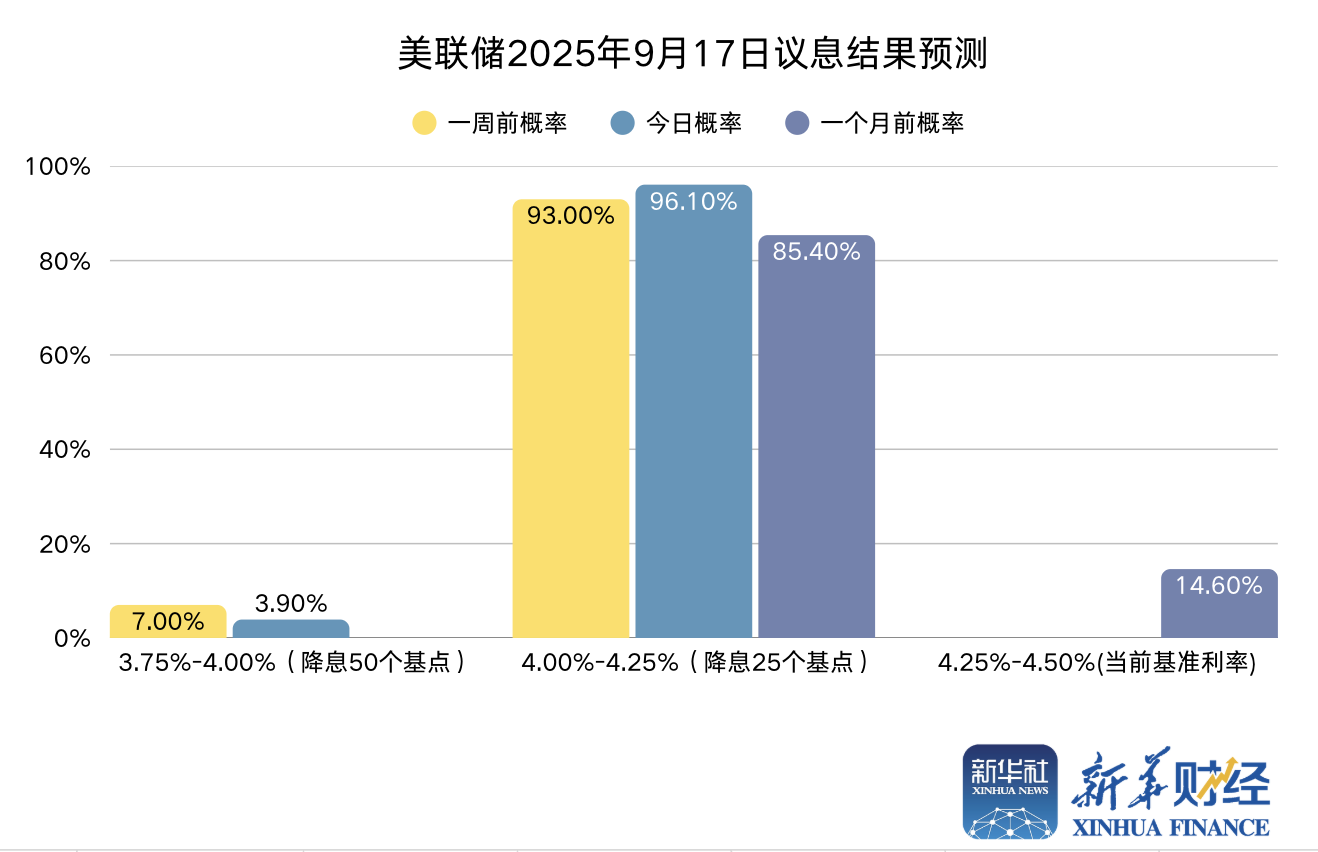
Group 1 - The U.S. job market is showing signs of weakness, with non-farm payrolls for July and August significantly below expectations, indicating a slowdown in economic momentum [5][6] - Inflation data remains moderate, with the U.S. CPI growth rate at 2.9% year-on-year and core CPI at 3.1%, suggesting that tariff impacts on inflation are manageable [5][6] - Market expectations are heavily leaning towards a 25 basis point rate cut by the Federal Reserve, with a 96.1% probability assigned to this outcome [2][6] Group 2 - Analysts predict that a weaker dollar is likely to continue, which may lead to a reallocation of global funds and support the performance of gold [8][10] - The current economic environment in the U.S. is characterized by "stagflation-like" tendencies, with declining consumer confidence and investment willingness [9] - The anticipated rate cuts by the Federal Reserve could lead to a favorable environment for gold, with prices already showing a significant increase of nearly 40% year-to-date [10][11] Group 3 - The impact of the Federal Reserve's rate cuts on the U.S. stock market is expected to vary, with potential short-term liquidity injections but possible long-term volatility [12][13] - Historical patterns suggest that U.S. stocks may not experience significant downward adjustments during preventive rate cuts, especially in the absence of other negative factors [13] - The Chinese stock market may benefit from the weaker dollar and a restructuring of global monetary order, with small-cap stocks in sectors like biotechnology and AI gaining attention [14][15]
世界格局一夜生变,中国亮剑,势不可挡!
Hu Xiu· 2025-09-12 23:01
Core Viewpoint - The article highlights the shift in global capital flows due to the weakening of the US dollar and emphasizes the historical opportunity for asset revaluation in the context of China's rising national strength following the recent military parade [1] Group 1 - The weakening US dollar is prompting a significant capital shift towards other markets, particularly in Asia [1] - The recent military parade showcased China's growing strength, which may influence global perceptions and investment strategies [1] - There is an ongoing historical opportunity for asset revaluation as China's national fortunes improve [1]
当牛市敲门,如何抢占市场C位?权益大厂策略会告诉你答案
券商中国· 2025-09-11 03:21
Core Viewpoint - The investment strategy conference held by Hua'an Fund emphasizes the identification of investment opportunities in A-shares, Hong Kong stocks, and global markets, focusing on sectors such as technology, AI, pharmaceuticals, consumption, high-end manufacturing, and military industry [1][3]. Group 1: Macro Insights - The global risk appetite has improved since the announcement of "equal tariffs" on April 8, which has implications for U.S. inflation and the dollar's strength [3]. - Despite a slowdown in investment and consumption growth in China, companies with global competitiveness are enhancing export resilience [3]. - Current low levels of Chinese government bond yields support equity assets, with risk premiums at historical 56th percentile, indicating equity still holds value [3]. Group 2: Sector Focus - Investment opportunities are highlighted in sectors such as AI, robotics, innovative pharmaceuticals, new consumption, and non-ferrous metals [3][11]. - The technology sector is seen as a key area for investment, with a focus on high-end manufacturing, smart vehicles, and innovative medical solutions [6][17]. - The conference discusses the balance of risk and return in the pharmaceutical sector and the potential of consumer recovery in specific sub-sectors [4]. Group 3: Investment Team Structure - Hua'an Fund boasts a robust investment management team of over 200 members, structured into a "three-generation talent ladder" to enhance investment strategies [7]. - The active equity investment team is organized into five groups: growth, value, balanced, industry selection, and multi-asset, facilitating efficient research-to-investment strategy conversion [7][5]. - The team includes specialists in various sectors, showcasing a blend of experience and innovation, which enhances the overall investment strategy [5][6]. Group 4: Future Trends - The shift from demographic dividends to engineer dividends in China is expected to sustain growth in high-skilled labor, with implications for sectors like technology and manufacturing [10][11]. - The current market is characterized by a "structural bull" driven by industrial confidence and risk appetite recovery, with a focus on identifying new demand and growth opportunities [12][15]. - Investment strategies will prioritize sectors with global competitiveness, including AI, biotechnology, innovative pharmaceuticals, and new energy [15][19].