
资产荒

Search documents
A股:新股海菲曼发行申购,发行价19.71元,但小散只能望而兴叹!
Sou Hu Cai Jing· 2026-02-24 04:52
Core Viewpoint - The new stock Hai Fei Man is being issued with a low price and valuation, attracting significant interest from investors despite the high capital requirements for participation in the North Exchange market [1][2][3]. Group 1: Stock Issuance Details - Hai Fei Man is issuing 9.47 million shares with a subscription limit of 473,700 shares [1]. - The issuance price is set at 19.71 yuan, with a price-to-earnings ratio of 14.99, significantly lower than the industry average of 65.52 [1][2]. Group 2: Market Participation and Conditions - The North Exchange requires cash subscriptions, meaning investors must have sufficient funds upfront to participate, which can be a barrier for many [2]. - Historically, investors need to freeze 700 to 800 billion yuan in capital for new stock issuances on the North Exchange, indicating strong market interest despite the high entry costs [3]. Group 3: Broader Market Context - The current investment environment is characterized by low returns on traditional financial products, pushing investors towards the stock market as a viable option [5]. - The stock market has seen a significant increase in daily trading volume, consistently exceeding 2 trillion yuan, indicating a strong influx of new capital [5]. - The market is exhibiting a "strong support" characteristic, where large amounts of capital quickly enter during downturns, suggesting a bullish trend [7].


宏观金融数据日报-20260224
Guo Mao Qi Huo· 2026-02-24 03:35
1. Report's Industry Investment Rating - Not mentioned in the provided content 2. Core View of the Report - After the Spring Festival, A-shares are likely to have a restorative rebound. In the long - term, with low interest rates, "asset shortage", and policy - guided long - term funds entering the market, the domestic market has sufficient funds, and the medium - and long - term upward trend of stock indices is expected to remain unchanged. It is recommended to hold long positions in stock indices for the long - term [7] 3. Summary by Relevant Catalogs Market Review and Forecast of Interest - rate Products - In the previous week, the central bank conducted 1652.4 billion yuan of reverse repurchase operations, with 405.5 billion yuan of reverse repurchase maturing, resulting in a net injection of 1246.9 billion yuan. It also carried out 150 billion yuan of treasury cash fixed - deposit tenders, 500 billion yuan of 182 - day outright reverse repurchase matured, and 1000 billion yuan of 182 - day outright reverse repurchase was conducted [4] - In the week of February 24 - 28 after the Spring Festival, 2252.4 billion yuan of reverse repurchase will mature in the central bank's open market, including 1452.4 billion yuan, 400 billion yuan, and 400 billion yuan maturing on February 24th, 25th, and 26th respectively. On February 25th, 300 billion yuan of MLF and 150 billion yuan of treasury cash fixed - deposit will also mature [5] Stock Index Market - During the Spring Festival, global major stock indices generally performed strongly. From February 14th to 22nd, 2026, the US Nasdaq Index rose 1.5%, the S&P 500 Index rose 1.1%, the Nikkei 225 Index fell 0.2%, and the South Korean Composite Index rose 5.5%. Chinese assets were generally stable, the Nasdaq Golden Dragon Index fell 0.6%, and the Hong Kong stock market showed a "first - down - then - up" trend [6] - Before the festival, the A - share market adjusted significantly due to rising risk - aversion sentiment. After the festival, it is likely to have a restorative rebound [6][7] Price and Volume Data of Stock Index Futures | Variety | Closing Price | Change from Previous Value | Variety | Closing Price | Change from Previous Value | | --- | --- | --- | --- | --- | --- | | | | (bp or %) | | | (bp or %) | | DRO01 | 1.31 | 4.76 (bp) | DR007 | 1.32 | - 10.48 (bp) | | GC001 | 1.47 | 19.50 (bp) | GC007 | 1.48 | 8.50 (bp) | | SHBOR 3M | 1.58 | 0.10 (bp) | LPR 5 - year | 3.50 | 0.00 (bp) | | 1 - year Treasury Bond | 1.31 | 0.05 (bp) | 5 - year Treasury Bond | 1.54 | 0.53 (bp) | | 10 - year Treasury Bond | 1.80 | 0.81 (bp) | 10 - year US Treasury Bond | 4.08 | 0.00 (bp) | | CSI 300 | 4660 | - 1.25% | IF Current Month | 4643 | - 1.6% | | SSE 50 | 3034 | - 1.47% | IH Current Month | 3025 | - 1.9% | | CSI 500 | 8300 | - 1.47% | IC Current Month | 8283 | - 2.0% | | CSI 1000 | 8205 | - 1.32% | IM Current Month | 8200 | - 1.7% | | IF Trading Volume | 120319 | 75.0 | IF Open Interest | 291728 | 3.8 | | IH Trading Volume | 61205 | 84.8 | IH Open Interest | 110461 | 9.2 | | IC Trading Volume | 141906 | 24.5 | IC Open Interest | 298512 | 0.2 | | IM Trading Volume | 186228 | 19.8 | IM Open Interest | 379866 | - 1.1% [4][6] Stock Index Futures Premium and Discount Situation | Project | Current Month Contract | Next Month Contract | Current Quarter Contract | Next Quarter Contract | | --- | --- | --- | --- | --- | | IF Premium/Discount | - 45.44% | 10.47% | 4.94% | 4.76% | | IH Premium/Discount | - 37.47% | 6.90% | 1.70% | 2.81% | | IC Premium/Discount | - 24.31% | 4.36% | 5.09% | 5.34% | | IM Premium/Discount | - 7.16% | 2.82% | 7.03% | 7.58% [8]
转债事件点评:把握春季行情下半场
GUOTAI HAITONG SECURITIES· 2026-02-23 13:08
Core Insights - The report suggests adopting a "steady first, with growth in mind" approach to maintain gains in the second half of the spring market and to reserve space for future positioning [2][15] - The spring market of 2026 began on December 17, 2025, driven by favorable policies and early capital allocation, leading to a strong performance in the A-share market, with the Shanghai Composite Index achieving 17 consecutive days of gains [9][13] - The convertible bond market experienced rapid growth followed by volatility, with median prices and conversion premiums reaching historical highs, indicating a significant reduction in the safety cushion of bonds [9][10] Market Trends - Historical data from 2017 to 2025 indicates that the market typically experiences a "rise then fall" pattern from the Spring Festival to the National People's Congress (NPC) [13][14] - The report highlights that during the period from the Spring Festival to the NPC, the market is likely to see a "spring surge," with small-cap growth stocks outperforming, particularly in TMT and high-end manufacturing sectors [13][14] - As the NPC approaches, the market may shift towards defensive sectors like pharmaceuticals and utilities, with high valuations in convertible bonds facing potential compression due to stock adjustments [13][14] Investment Strategy - The report recommends a balanced investment strategy, transitioning from aggressive profit-seeking to balancing returns and risks as the market moves into the NPC and Q1 earnings preview phase [15] - It emphasizes the importance of selecting convertible bonds with solid performance and reasonable pricing, while also considering high-quality, high-priced convertible bonds with clear growth prospects [15] - The report identifies sectors such as AI computing, semiconductors, non-ferrous metals, and post-cycle industries like consumption and real estate as favorable for convertible bonds due to improving supply-demand dynamics and favorable policy catalysts [15]
1月信贷社融点评:温和开门红
ZHESHANG SECURITIES· 2026-02-14 05:23
Investment Rating - The industry investment rating is "Positive" (maintained) [4] Core Insights - The report highlights a "strong deposit, weak loan" characteristic in the opening month of the year [4] - In January 2026, new social financing increased by 7.2 trillion yuan, a year-on-year increase of 166.2 billion yuan, with a balance growth of 8.2% [4][5] - New RMB loans in January 2026 amounted to 4.7 trillion yuan, a year-on-year decrease of 420 billion yuan, with a balance growth of 6.1% [4][5] - The report indicates that consumer demand has shown some recovery, particularly in short-term loans, but overall consumer credit demand may remain pessimistic throughout the year [1][2] Summary by Sections Credit Overview - Entity credit remained stable, with a significant reduction in bill financing [1] - Retail loans saw an increase of 456.5 billion yuan in January, with short-term loans contributing 109.7 billion yuan [1] - Corporate loans totaled 4.5 trillion yuan, a year-on-year decrease of 330 billion yuan, influenced by a substitution effect between short-term loans and bill financing [2] Social Financing - Government bonds contributed significantly to social financing, with new issuance of 976.4 billion yuan in January, a year-on-year increase of 283.1 billion yuan [5] - The report notes a trend of "deposit migration," with non-bank deposits reaching 36 trillion yuan, accounting for 10.7% of total deposits [5] Investment Recommendations - The report recommends a "New Momentum Portfolio" including banks like Nanjing Bank, Shanghai Bank, and others, highlighting their potential for value recovery [3][5] - It emphasizes the importance of high-dividend bank stocks in the current environment, suggesting that banks with new growth drivers may achieve greater value restoration [5]






破局:存款搬家和低利率“资产荒”的资管困局
Huachuang Securities· 2026-02-12 08:57
Group 1 - The core issue facing asset management institutions is the contradiction between the expansion of liabilities due to the "deposit migration" phenomenon and the "asset scarcity" caused by low interest rates in the post-real estate era [7][8]. - The potential scale of deposit migration is estimated to exceed 32 trillion yuan, with 1-year and above fixed deposits maturing in 2026 expected to be between 50-70 trillion yuan [2][13]. - As deposit willingness declines and investment willingness improves, residents are likely to diversify their asset allocation from housing and deposits to a broader range of financial assets, with insurance, bank wealth management, and public "fixed income+" products being key beneficiaries [2][20]. Group 2 - The low interest rate environment has led to a significant decline in the yields of traditional fixed-income assets, making equity assets more attractive; for instance, the 3-year fixed deposit rate of major banks has dropped from 4.25% in 2013 to 1.25% currently [3][37]. - The shift towards equity investments is expected to bring approximately 1.2 trillion yuan of incremental funds to the stock market by 2026, with insurance, bank wealth management, and public "fixed income+" products contributing around 0.8 trillion, 0.3 trillion, and 0.1 trillion yuan respectively [3][37]. - Insurance funds are increasingly allocating to equity assets to balance the rigid liability costs with declining yields on traditional assets, with the proportion of equity investments expected to rise significantly in the coming years [39][40]. Group 3 - Bank wealth management products are facing challenges due to structural issues post-net worth reform, which limits their ability to attract long-term funds; currently, equity assets account for only 2.1% of their total investment [30][43]. - Public "fixed income+" products have a systematic research advantage in equity investments, but their growth is constrained by market volatility, which may deter low-risk depositors [31][43]. - The overall asset allocation of insurance funds still has significant room for improvement, with current equity asset allocation at only 15.5%, compared to much higher levels in developed markets [25][41].
日度策略参考-20260212
Guo Mao Qi Huo· 2026-02-12 07:08
1. Report Industry Investment Ratings - Not provided in the given content 2. Core Views of the Report - Short - term pre - holiday stock index is expected to be in a strong sideways trend, accumulating strength for further upward movement. Long - term long positions in stock index futures should be held [1] - Asset shortage and weak economy are beneficial for bond futures, but the central bank has recently warned about interest rate risks. Attention should be paid to the Bank of Japan's interest rate decision [1] - Copper prices may be in a sideways and slightly upward trend; aluminum prices are likely to maintain a sideways movement; there are low - buying opportunities for alumina; zinc prices are expected to move sideways, and it is advisable to wait and see; nickel prices are in a strong sideways trend in the short - term, and long - term high global nickel inventory may still have a suppressing effect. Stainless steel futures are in a strong movement, and short - term low - buying is recommended [1] - Precious metal prices are expected to stabilize and move in a sideways range in the short - term. Platinum and palladium are expected to continue wide - range fluctuations [1] - For industrial silicon, the northwest is increasing production while the southwest is reducing it. For polysilicon, it is recommended to wait and see. For lithium carbonate, there is a need for a correction [1] - For steel products such as rebar and hot - rolled coil, it is not recommended to hold unilateral speculative positions during the holiday. For iron ore, it is not advisable to chase long at the current position. For black metals like manganese silicon and ferrosilicon, the situation is a combination of weak reality and strong expectations. For soda ash, the price is under pressure in the medium - term. For coking coal and coke, it is advisable to seize the opportunity of the price increase on the futures market to cash out the physical goods or establish a cash - and - carry arbitrage position [1] - For palm oil, it is recommended to wait and see before the holiday. For soybean oil, it is expected to move sideways in the short - term. For rapeseed oil, the subsequent supply contradiction is expected to ease. For cotton, the market is currently in a situation of "having support but no driving force". For sugar, the short - term fundamentals lack continuous driving force. For corn, it is recommended to wait and see in the short - term, and the market is expected to maintain a range - bound movement. For soybeans, it is recommended to pay attention to the low - buying opportunity of M2609 [1] - For pulp, it is advisable to wait and see. For logs, the futures price has an upward driving force [1] - For fuel oil and asphalt, the short - term supply - demand contradiction is not prominent and they follow crude oil. For rubber products such as natural rubber and BR rubber, the short - term is in a wide - range fluctuation, and BR rubber has an upward expectation in the long - term. For PTA and short - fiber, the downstream PTA industry is strong. For ethylene and glycol, the ethylene producers plan to maintain the operating rate of cracking units, and the glycol price is waiting at a low level. For pure benzene, the import demand is weak. For styrene, the spot price is supported. For water hyacinth, the upside space is limited. For methanol, it is a situation of long - short entanglement. For PP, the supply pressure is relatively large. For PVC, the future expectation is relatively optimistic. For LPG, the demand side is short - term bearish, suppressing the upward movement of the futures price [1] - For the container shipping European line, the pre - holiday freight rate has peaked and declined. The airlines are still cautious about trial resumption of flights and are expected to have a strong willingness to stop the price decline and raise prices after the off - season in March [1] 3. Summaries by Related Catalogs Macro - finance - Stock index futures: Short - term pre - holiday is expected to be in a strong sideways trend, and long - term long positions should be held [1] - Bond futures: Asset shortage and weak economy are beneficial, but the central bank has warned about interest rate risks, and attention should be paid to the Bank of Japan's interest rate decision [1] Non - ferrous metals - Copper: Pre - holiday downstream demand is weak, but copper prices may be in a sideways and slightly upward trend as market sentiment improves [1] - Aluminum: Industrial driving force is limited, and pre - holiday market risk - aversion sentiment has increased. Aluminum prices may maintain a sideways movement [1] - Alumina: Domestic operating capacity has decreased, and there are disruptions in the supply of a large - scale alumina enterprise in North China. Pay attention to low - buying opportunities [1] - Zinc: The cost center is stabilizing, and market sentiment has stabilized. Zinc prices are expected to move sideways, and it is advisable to wait and see [1] - Nickel: The US non - farm payrolls exceeded expectations, and market sentiment fluctuated. Indonesia's nickel ore quota policies have increased concerns about future supply. Short - term nickel prices are in a strong sideways trend, and there are high - inventory pressures in the long - term. It is recommended to pay attention to low - buying opportunities [1] - Stainless steel: Supply - side disturbances have emerged again, and macro sentiment is fluctuating. Stainless steel futures are in a strong movement. Short - term low - buying is recommended [1] - Tin: The short - term market sentiment has stabilized, but the price fluctuation is still large. In the short - term high - volatility situation, investors should pay attention to risk management and profit protection [1] Precious metals and new energy - Precious metals: The US non - farm payrolls in January were strong, and the interest - rate cut expectation was postponed. Due to high geopolitical uncertainties in the Middle East, precious metal prices are expected to stabilize and move in a sideways range in the short - term [1] - Platinum and palladium: The US non - farm payrolls in January were strong, and the US dollar index rebounded, suppressing the upward trend. However, fundamentals and key minerals support the prices, so they are expected to continue wide - range fluctuations in the short - term [1] - Industrial silicon: The northwest is increasing production, while the southwest is reducing it. The production schedules of polysilicon and organic silicon in December have decreased [1] - Polysilicon: It is recommended to wait and see [1] - Lithium carbonate: It is the off - season for new energy vehicles, but the energy - storage demand is strong. The price has increased significantly and needs a correction [1] Black metals - Rebar and hot - rolled coil: Spot trading is close to suspension, and futures prices are moving sideways. It is not recommended to hold unilateral speculative positions during the holiday. It is advisable to participate in the market by going long on the basis [1] - Iron ore: There is sector rotation, but there is obvious upward pressure. It is not advisable to chase long at the current position [1] - Manganese silicon and ferrosilicon: It is a combination of weak reality and strong expectations. Energy consumption dual - control and anti - involution may have an impact on supply [1] - Soda ash: It follows glass, and the medium - term supply - demand is more relaxed, so the price is under pressure [1] - Coking coal: It is the off - season for black metals, and the pre - holiday inventory replenishment is almost over. The futures market is more affected by capital sentiment. It is advisable to seize the opportunity of price increase on the futures market to cash out the physical goods or establish a cash - and - carry arbitrage position [1] - Coke: The logic is the same as that of coking coal [1] Agricultural products - Palm oil: The MPOB monthly report data has a bullish expectation difference, but the subsequent fundamentals still have pressure, which has little impact on the futures market. It is recommended to wait and see before the holiday [1] - Soybean oil: Supported by the strong movement of US soybeans, the South American weather is normal, and it is difficult to have weather - related speculation. More attention should be paid to the Sino - US soybean trade situation [1] - Rapeseed oil: The anti - dumping final ruling result of Canadian rapeseed has been released. After March, the tariff is expected to be adjusted to about 15%. Some oil mills have started purchasing, and the subsequent supply contradiction is expected to ease [1] - Cotton: The domestic new - crop harvest is expected to be good, and the purchase price of seed cotton supports the cost of lint cotton. The downstream operating rate is low, but the yarn mill inventory is not high, and there is a rigid demand for inventory replenishment. The cotton market is currently in a situation of "having support but no driving force" [1] - Sugar: There is a global surplus, and the domestic new - crop supply has increased. The short - term fundamentals lack continuous driving force, and attention should be paid to the change in the capital side [1] - Corn: Affected by the import restriction news, the futures market is strong. It is recommended to wait and see in the short - term. After the holiday, attention should be paid to the selling pressure of on - the - ground grain in the production area. The overall market is expected to maintain a range - bound movement [1] - Soybeans: The expected increase in US soybean exports has boosted the US futures market, but the decline in Brazilian basis has partially offset the impact. The domestic futures market is weaker than the overseas market. It is recommended to pay attention to the low - buying opportunity of M2609 [1] Others - Pulp: There are disturbances on the supply side, but the demand side has weakened after inventory replenishment. It is advisable to wait and see when the commodity market sentiment fluctuates greatly [1] - Logs: The spot price of logs has increased, the arrival volume in February has decreased, and the overseas quotation is expected to rise, so the futures price has an upward driving force [1] Energy and chemical industry - Fuel oil: OPEC+ has suspended production increase until the end of 2026, the Middle East geopolitical situation is uncertain, and the commodity market sentiment has cooled. The short - term supply - demand contradiction is not prominent, and it follows crude oil [1] - Asphalt: The short - term supply - demand contradiction is not prominent, following crude oil. The 14th Five - Year Plan rush - work demand is likely to be falsified, the supply of Ma瑞 crude oil is sufficient, and the asphalt profit is high [1] - Natural rubber: The raw material cost has strong support, the commodity market sentiment fluctuates, the pre - holiday downstream demand has weakened, and the futures - spot price difference has expanded to the same - period high [1] - BR rubber: The cost - end butadiene has strong bottom support, the profit of private butadiene rubber plants is still in a loss, the expectation of maintenance and production reduction has increased, the butadiene inventory is decreasing, and the high inventory of butadiene rubber is a potential negative factor. The short - term futures market is expected to fluctuate widely, and there is an upward expectation in the long - term [1] - PTA: The PX - mixed xylene price difference has narrowed to $150, PX maintains fundamental resilience during the high - level correction, and the downstream PTA industry is strong. The domestic PTA production in January is expected to reach a new high, and there is no production - reduction plan for the Spring Festival, and there is no new PTA production capacity throughout the year [1] - Ethylene and glycol: The production profit rate of naphtha cracking has declined, several Korean ethylene producers plan to maintain the operating rate of cracking units in February, and the glycol price is waiting at a low level [1] - Pure benzene: The inventory is high, and the import demand is weak. The US - Asia price difference is $88, which is not enough to open the arbitrage window [1] - Styrene: The Asian styrene price and economic situation are recovering, supported by supply tightening, unexpected Middle East shutdowns, surging export demand, and rising cost - end prices [1] - Water hyacinth: The export sentiment has eased slightly, the domestic demand is insufficient, and the upside space is limited. There is support from anti - involution and the cost end [1] - Methanol: Affected by the Iranian situation, the future import is expected to decrease, but the downstream negative feedback is obvious. It is a situation of long - short entanglement [1] - PP: The supply pressure is relatively large due to high operating load, the downstream improvement is less than expected, the price has returned to a reasonable range, and crude oil is in a slightly upward trend [1] - PVC: The global production capacity put into operation in 2026 is small, and the differential electricity price in the northwest region is expected to be implemented, forcing the elimination of PVC production capacity. The future expectation is relatively optimistic, but the current fundamentals are poor, and the export rush has slowed down stage by stage [1] - LPG: The February CP price has risen, and the March purchase is still relatively tight. The Middle East geopolitical conflict has cooled down, the short - term risk premium has declined, and the overseas cold - wave driving logic has gradually slowed down. The domestic PDH operating rate has declined, and the demand side is short - term bearish, suppressing the upward movement of the futures price [1] Shipping - Container shipping European line: The pre - holiday freight rate has peaked and declined. Airlines are still cautious about trial resumption of flights and are expected to have a strong willingness to stop the price decline and raise prices after the off - season in March [1]
如何理解央行买卖国债常态化?
Hua Er Jie Jian Wen· 2026-02-11 09:49
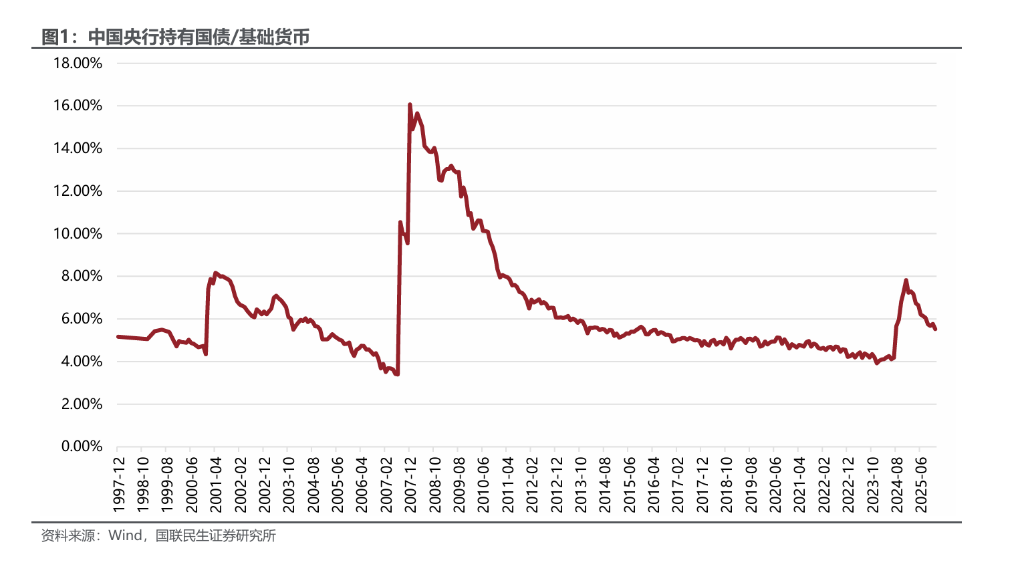
国联民生从三个维度解读这一转变:长期看,基础货币年均需投放3.2万亿元,但法定准备金已处低位、外汇占款增长有限,央行需寻找新的投放 渠道;横向对比看,美国、日本央行持有政府债占基础货币比重分别达79%、92%,而中国仅为5.5%,增持空间显著;短期看,央行已累计净买 入约7000亿元国债,按平均1年期限,月均到期500-600亿元,需持续滚动操作。 国联民生证券于2026年2月11日发布研究报告,由分析师王先爽、文雪阳解读央行最新发布的《2025年第四季度中国货币政策执行报告》。报告聚 焦央行国债买卖操作的常态化转向,这一政策信号对理解中国货币政策框架演变及债券市场走向具有关键意义。 常态化背后的三重逻辑 《报告》明确提出"未来中国人民银行将常态化开展国债买卖操作,关注长期收益率的变化,灵活把握操作规模。"这标志着央行货币投放渠道的 重大调整。 报告显示2025年末超储率回升至1.5%,同比提升0.4个百分点,解释了开年资金面偏宽松的现象。展望未来,考虑到资本市场活跃度较高,国联民 生预计一季度降准降息概率不高。中期看,"资产荒"现象可能回归,长债利率有下调空间;股市流动性方面,在M1增速企稳前维持中性偏保守 ...
日度策略参考-20260211
Guo Mao Qi Huo· 2026-02-11 03:30
1. Report Industry Investment Rating No relevant content provided. 2. Core Views of the Report - In the short - term, before the Spring Festival, stock index futures are expected to oscillate strongly to accumulate strength for further upward movement, and long - term long positions in stock index futures should be held [1]. - Asset shortage and weak economy are beneficial to bond futures, but the central bank has recently warned of interest rate risks, and attention should be paid to the Bank of Japan's interest rate decision [1]. - Before the Spring Festival, downstream demand is still weak, market participation has declined, and copper, aluminum, and alumina prices are expected to oscillate [1]. - The cost center of zinc fundamentals is stabilizing. Due to the increasing risk - aversion sentiment in the market, zinc prices are expected to decline and then stabilize, and it is recommended to wait and see [1]. - Market sentiment has improved. Indonesia's ESDM has issued a nickel ore RKAB quota of 2.6 - 2.7 billion tons in 2026, and the approval of nickel ore quotas has been slow recently, increasing concerns about future nickel ore supply. In the short - term, nickel prices are expected to be strong, but are still affected by the resonance of the non - ferrous metal sector. It is recommended to pay attention to Indonesian policies and macro - sentiment. In the medium - to long - term, the high global nickel inventory may still have a suppressing effect [1]. - The raw material end of stainless steel still has support, and with the improvement of macro - sentiment, stainless steel futures are expected to oscillate strongly. It is recommended to go long at low prices in the short - term and hold light positions during the holiday [1]. - In the short - term, macro - negative factors have been exhausted, but the volatility of tin prices is still large. In the short - term, investors are advised to focus on risk management and profit protection [1]. - The weak US dollar index, uncertain geopolitical situation in the Middle East, and China's continuous gold purchases for 15 months support precious metal prices. However, before the Spring Festival, market funds may be cautious, and precious metals are expected to stabilize and oscillate in the short - term [1]. - The weak US dollar index supports platinum and palladium prices, but the US Trade Representative's discussion of an agreement on critical minerals may cause fluctuations in platinum and palladium prices, so they are expected to fluctuate widely in the short - term [1]. - In the cement industry, production has increased in the Northwest and decreased in the Southwest. The production of polysilicon and organic silicon in December has declined [1]. - In the new energy vehicle industry, it is the off - season, but energy storage demand is strong, and there is a rush to export batteries. The price has risen significantly and there is a need for a correction [1]. - For rebar and hot - rolled coils, the expectation is strong, but the spot market is weak, and the upward momentum is insufficient. It is recommended to exit long positions and participate in cash - and - carry arbitrage [1]. - For iron ore, there is obvious upward pressure, and it is not recommended to chase the long position at this level [1]. - For silicon iron and glass, the reality is weak, but the expectation is strong. Energy consumption control and anti - involution may affect supply [1]. - Soda ash follows glass, and its medium - term supply and demand are more relaxed, so the price is under pressure [1]. - For coking coal and coke, during the off - season of the black industry, before the Spring Festival, the inventory replenishment is almost over. The market pays more attention to capital sentiment. It is recommended to cash in on the spot when the market rises and establish cash - and - carry arbitrage positions [1]. - For palm oil, the MPOB monthly report data has a positive expected difference, but the subsequent fundamentals still have pressure, and it is recommended to wait and see before the Spring Festival [1]. - For soybean oil, the cost is supported by the strong US soybean market. There is no abnormal weather in South America, and it is recommended to pay more attention to Sino - US soybean trade trends. It is expected to oscillate in the short - term [1]. - For rapeseed oil, after the anti - dumping final ruling on Canadian rapeseed, the tariff is expected to be adjusted to about 15% after March, and the supply contradiction is expected to ease [1]. - For cotton, there is support but no driving force in the short - term. Future attention should be paid to the central government's No. 1 document in the first quarter of next year, planting area intentions, weather during the planting period, and peak - season demand [1]. - For sugar, there is a global surplus and an increase in domestic new - crop supply. There is a strong consensus among short - sellers. If the price continues to fall, there is strong cost support, but there is a lack of continuous driving force in the short - term [1]. - For corn, before the Spring Festival, trading is coming to an end, and the price fluctuation is limited. After the festival, attention should be paid to the selling pressure of ground - stored grain, policy - grain release, import arrivals, and new - season wheat growth. It is expected to oscillate within a range [1]. - For soybeans, the increase in US soybean export expectations boosts the US market, but the decline in Brazilian discounts partially offsets the impact. The domestic market is weaker than the overseas market. It is recommended to pay attention to the subsequent selling pressure of Brazilian discounts and consider going long on M2609 at a low level [1]. - For pulp, there are disturbances on the supply side, but the demand side weakens after inventory replenishment. It is recommended to wait and see when the commodity sentiment fluctuates significantly [1]. - For logs, the spot price has risen, the arrival volume in February is expected to decline, and the external quotation is expected to rise, so the futures price has an upward driving force [1]. - For live pigs, the spot price is gradually stabilizing, demand is supported, but the production capacity has not been fully released [1]. - For fuel oil, OPEC+ has suspended production increases until the end of 2026, the geopolitical situation in the Middle East may cool down, and the commodity market sentiment has turned bearish. In the short - term, it follows crude oil [1]. - For asphalt, the supply of raw material Ma Rui crude oil is sufficient, the profit is high, and the demand for the 14th Five - Year Plan construction may be falsified [1]. - For natural rubber, the raw material cost has strong support, the market sentiment has turned bearish, the downstream demand before the Spring Festival has weakened, and the basis has widened to a high level [1]. - For BR rubber, the cost of butadiene has strong support, private cis - butadiene rubber plants may reduce production due to losses, but the high inventory of cis - butadiene rubber is a potential negative factor. In the short - term, the price is expected to fluctuate widely, and there is an upward expectation in the long - term [1]. - For PTA, the PX - mixed xylene spread has narrowed, PX maintains fundamental resilience, the downstream PTA industry is strong, and the domestic PTA production in January is expected to reach a new high with no planned production cuts during the Spring Festival and no new capacity throughout the year [1]. - For ethylene glycol, the production profit of naphtha cracking has declined, several Korean ethylene producers plan to maintain the operating rate of cracking units in February, and the price is waiting at a low level [1]. - For pure benzene, the inventory is high and the import demand is weak. The Asia - US spread is not enough to open the arbitrage window. The Asian styrene price and economic situation are recovering, supported by supply tightening, unexpected Middle East shutdowns, surging export demand, and rising costs [1]. - For urea, the export sentiment has eased, the domestic demand has limited upside, but there is anti - involution and cost support [1]. - For methanol, it is affected by the situation in Iran, with expected import reduction, but there is obvious downstream negative feedback. The downstream MTO leading device has stopped, and some enterprises have reduced production, but Fude restarted on January 25th. The situation in Iran has eased, but risks cannot be completely ruled out. Inland transportation costs have risen due to cold air, and northwest enterprises have large inventory - clearing pressure and are selling at reduced prices [2]. - For crude oil, it oscillates strongly, the price has returned to a reasonable range, and the pre - festival inventory replenishment has ended, with flat demand during the holiday [2]. - For PVC, there is less global production in 2026, the differential electricity price in the northwest region is expected to be implemented, forcing the elimination of PVC production capacity, and the future expectation is optimistic, but the current fundamentals are poor, and the rush to export has slowed down [2]. - For liquid chlorine, the macro - sentiment has temporarily subsided, the market is trading fundamentals again, the fundamentals are weak, the absolute price is at a low level, the price of liquid chlorine has weakened, and the spot price has risen slightly [2]. - For LPG, the CP price in February has risen, the purchase in March is still relatively tight, the short - term risk premium of the Middle East geopolitical conflict has declined, the driving logic of the overseas cold wave has gradually slowed down, the market expectation is weakening, the basis is expected to widen, the domestic PDH operating rate has declined, the profit is expected to recover seasonally, and the demand side is short - term bearish, suppressing the upward movement of the futures price. The ports are continuously reducing inventory, but the domestic civil gas is sufficient, showing a divergence between propane and PG [2]. - For container shipping, the pre - festival freight rate has peaked and declined, airlines are still cautious about trial resumption of flights, and airlines expect to stop the price decline and raise prices strongly after the off - season in March [2]. 3. Summary by Relevant Catalogs Macro - finance - Stock index futures: Short - term strong oscillation before the Spring Festival, long - term long positions held [1]. - Bond futures: Asset shortage and weak economy are beneficial, but central bank warns of interest rate risks, attention on Bank of Japan's interest rate decision [1]. Non - ferrous metals - Copper, aluminum, alumina: Oscillation due to weak downstream demand and increased risk - aversion sentiment [1]. - Zinc: Cost center stabilizes, price expected to decline and then stabilize, wait - and - see recommended [1]. - Nickel: Short - term strong due to supply concerns and improved macro - sentiment, long - term suppression from high inventory [1]. - Stainless steel: Raw material support and improved macro - sentiment, short - term long at low prices, light positions during holiday [1]. - Tin: High short - term volatility, focus on risk management and profit protection [1]. - Precious metals: Supported by various factors, but cautious market funds before Spring Festival, short - term stable oscillation [1]. - Platinum and palladium: Supported by weak US dollar, but agreement discussion may cause fluctuations, short - term wide - range fluctuation [1]. New energy and related industries - Polysilicon and organic silicon: December production decline [1]. - New energy vehicles: Off - season, but strong energy storage demand and battery export rush, price correction needed [1]. Building materials - Cement: Production increase in Northwest and decrease in Southwest [1]. - Rebar and hot - rolled coils: Strong expectation but weak spot, insufficient upward momentum, exit long positions and do cash - and - carry arbitrage [1]. - Iron ore: Upward pressure, not recommended to chase long [1]. - Silicon iron and glass: Weak reality, strong expectation, supply may be affected by energy consumption control and anti - involution [1]. - Soda ash: Follows glass, medium - term supply - demand relaxation, price under pressure [1]. - Coking coal and coke: Off - season, focus on capital sentiment, cash in on spot when rising and do cash - and - carry arbitrage [1]. Agricultural products - Palm oil: MPOB report has positive difference, but subsequent fundamentals have pressure, wait - and - see before Spring Festival [1]. - Soybean oil: Cost supported by US soybeans, no abnormal South American weather, short - term oscillation [1]. - Rapeseed oil: Anti - dumping ruling, supply contradiction expected to ease [1]. - Cotton: Short - term support but no driving force, attention on future policies and market conditions [1]. - Sugar: Global surplus, domestic new - crop supply increase, short - seller consensus, cost support if price falls, lack of short - term driving force [1]. - Corn: Pre - festival trading end, post - festival attention on selling pressure, policies, and wheat growth, range oscillation [1]. - Soybeans: US export boost, Brazilian discount impact, domestic market weaker, consider long on M2609 at low level [1]. Forest products - Pulp: Supply disturbances, demand weakens after inventory replenishment, wait - and - see during significant commodity sentiment fluctuations [1]. - Logs: Spot price rise, expected decline in February arrivals and rise in external quotation, upward driving force for futures [1]. Livestock - Live pigs: Spot price stabilizing, demand support, production capacity not fully released [1]. Energy and chemicals - Fuel oil: OPEC+ suspension, Middle East geopolitical cooling, short - term follows crude oil [1]. - Asphalt: Sufficient raw material supply, high profit, demand falsification possibility [1]. - Natural rubber: Cost support, bearish market sentiment, weak pre - festival downstream demand, widened basis [1]. - BR rubber: Butadiene cost support, plant production reduction expectation, high inventory risk, short - term wide - range fluctuation, long - term upward expectation [1]. - PTA: PX spread narrowing, PX resilience, strong downstream industry, high production and no new capacity [1]. - Ethylene glycol: Naphtha cracking profit decline, Korean producers maintain operating rate, low - price waiting [1]. - Pure benzene: High inventory, weak import demand, Asia - US spread not enough for arbitrage, styrene recovery [1]. - Urea: Export sentiment easing, limited domestic upside, anti - involution and cost support [1]. - Methanol: Affected by Iran, import reduction expected, downstream negative feedback, device changes, Iran situation and inland inventory - clearing [2]. - Crude oil: Strong oscillation, price in reasonable range, pre - festival inventory replenishment end, flat holiday demand [2]. - PVC: Future optimism with capacity elimination, current poor fundamentals, slowed export rush [2]. - Liquid chlorine: Macro - sentiment subsides, trading fundamentals, weak fundamentals, low price, liquid chlorine weakening, spot rise [2]. - LPG: Rising CP price, tight March purchase, declining risk premium, weakening expectation, basis widening, bearish demand, port inventory reduction and domestic gas sufficiency [2]. Shipping - Container shipping: Pre - festival freight rate decline, cautious airline resumption, expected post - off - season price increase [2].
A股午盘:节前大红包!国债收益率刺破关键位置,机构偷偷行动
Sou Hu Cai Jing· 2026-02-10 10:15
Core Viewpoint - The stock and bond markets are experiencing a rare simultaneous rise, indicating a shift in market dynamics and investor sentiment [1][3]. Group 1: Market Performance - The Shanghai Composite Index rose over 1%, with many individual stocks showing positive performance [1]. - The 10-year government bond yield briefly dipped below the critical 1.80% level, which is seen as a significant psychological and technical benchmark [3]. - The overall bond market is showing a divergence, with government bonds performing well while credit bonds and interbank certificates of deposit are underperforming [3]. Group 2: Market Dynamics - The bond market's positive sentiment is attributed to the actions of the central bank, which injected 38 billion yuan into the banking system through open market operations [5][7]. - The average weighted interest rate for short-term funds in the interbank market is reported at 1.26%, indicating a lower cost of funds, which encourages bond purchases [6]. - Fund companies are the primary buyers in the bond market, while insurance institutions are the main sellers, creating a balanced market dynamic [8][11]. Group 3: Investment Trends - The current market environment reflects a shift towards safer assets, as the appeal of stocks and commodities diminishes, leading to increased investment in government bonds [10][12]. - The cautious approach of public funds is evident, with a decrease in the duration of bond holdings, indicating a preference for stability over aggressive trading [11]. - The upcoming issuance of government bonds in February may create supply pressure, potentially limiting the downward movement of yields [14].

日度策略参考-20260210
Guo Mao Qi Huo· 2026-02-10 07:31
Report Industry Investment Ratings - Not provided in the given content Core Views of the Report - Short - term, pre - holiday stock index is expected to oscillate strongly to accumulate strength for further upward movement, and long - term long positions in stock index should be held [1] - Asset shortage and weak economy are beneficial to bond futures, but the central bank has recently reminded of interest rate risks, and attention should be paid to the Bank of Japan's interest rate decision [1] - Pre - holiday downstream demand is still weak, but market risk appetite has recovered, leading to a stable recovery in copper prices; the improvement of macro - sentiment has made aluminum prices oscillate strongly [1] - Due to the decline in domestic alumina operating capacity and supply - side disturbances, the short - term price is expected to run strongly; zinc prices are expected to correct under the rising market risk aversion sentiment [1] - Market sentiment has recovered. With the tightening supply of nickel ore in Indonesia, supply concerns may continue to disrupt the market, and short - term nickel prices have stabilized and recovered. Stainless steel futures oscillate, and attention should be paid to the actual production of steel mills [1] - Short - term macro - negative factors are exhausted, and tin price fluctuations are still large. Gold and silver are expected to stabilize and oscillate before the Spring Festival, and platinum and palladium are expected to fluctuate strongly in the short term [1] - Industrial silicon and polysilicon are in an oscillating state; the new energy vehicle market is in the off - season, but energy storage demand is strong. Carbonate lithium has a callback demand, and steel products such as rebar and hot - rolled coil are oscillating [1] - The iron ore market has obvious upward pressure, and it is not recommended to chase the rise; the black metal market is a combination of weak reality and strong expectations, and glass and soda ash are also oscillating [1] - Palm oil, soybean oil, and rapeseed oil are expected to turn to an oscillating state; the cotton market is currently supported but lacks a driving force; sugar has a strong short - selling consensus; corn is expected to oscillate narrowly in the short term [1] - The pulp market should be on the sidelines; the log market has upward driving forces; the livestock market's production capacity needs further release [1] - OPEC+ has suspended production increases until the end of 2026, and the geopolitical situation in the Middle East is cooling down. Fuel oil and asphalt markets are oscillating [1] - The raw material cost of rubber is strongly supported, but the downstream demand is weak; the BR rubber market is expected to oscillate widely in the short term and has an upward expectation in the long term [1] - PX maintains fundamental resilience, and the PTA industry is strong; the production profit of naphtha cracking has declined, and ethylene producers plan to maintain the operating rate [1] - Pure benzene has high inventory and weak import demand, while the Asian styrene market is recovering; urea and methanol markets are in a complex situation of multiple and short factors [1][2] - The PE market has flat demand during the holiday; the supply pressure of PP is large; the PVC market is expected to be optimistic in the future but has a poor current situation [2] - The LPG market is expected to weaken, and the basis is expected to expand; the shipping market's freight rate has peaked and declined, and airlines have a strong willingness to raise prices after the off - season [2] Summary by Related Catalogs Macro - finance - Stock index: Short - term pre - holiday strong oscillation, long - term long positions held [1] - Treasury bonds: Asset shortage and weak economy are beneficial, but central bank reminds of risks, pay attention to Bank of Japan's decision [1] Non - ferrous metals - Copper: Pre - holiday demand is weak, but prices have stabilized and recovered due to risk appetite recovery [1] - Aluminum: Macro - sentiment improvement leads to strong oscillation [1] - Alumina: Short - term strong operation due to capacity decline and supply disturbances [1] - Zinc: Price correction expected under risk - aversion sentiment [1] - Nickel: Supply concerns in Indonesia, short - term price recovery, pay attention to policies and macro - sentiment [1] - Stainless steel: Oscillation, pay attention to steel mill production [1] - Tin: High short - term volatility, pay attention to risk management [1] - Gold and silver: Stabilize and oscillate before the Spring Festival [1] - Platinum and palladium: Wide - range strong fluctuation in the short term [1] Industrial silicon and new energy - Industrial silicon: Northwest increases production, southwest reduces production, polysilicon and organic silicon production decreases in December [1] - Carbonate lithium: New energy vehicle off - season, but energy storage demand is strong, with a callback demand [1] Black metals - Rebar, hot - rolled coil: Oscillation, high production and inventory suppress price increase, unilateral long positions should be left on the sidelines, and positive arbitrage positions can be participated [1] - Iron ore: Oscillation, upward pressure is obvious, not recommended to chase the rise [1] - Coke, coking coal: Oscillation, pay attention to market sentiment and inventory [1] - Glass, soda ash: Oscillation, glass supply reduction expectation is rising, soda ash price is under pressure [1] Agricultural products - Palm oil, soybean oil, rapeseed oil: Turn to oscillation [1] - Cotton: Supported but lack of driving force, pay attention to policies and demand [1] - Sugar: Strong short - selling consensus, pay attention to cost support and capital changes [1] - Corn: Narrow - range oscillation in the short term, pay attention to post - holiday factors [1] - Soybean meal: Oscillation, pay attention to Brazilian discount and domestic supply - demand changes [1] Others - Pulp: On the sidelines due to supply - side disturbances and weak demand after restocking [1] - Log: Upward driving force due to price increase and expected decline in arrival volume [1] - Livestock: Production capacity needs further release [1] Energy and chemical industry - Crude oil: Oscillate strongly, price returns to a reasonable range [1][2] - Fuel oil: Follow crude oil in the short term [1] - Asphalt: Oscillation, profit is high [1] - Rubber: Raw material cost is strongly supported, but downstream demand is weak [1] - BR rubber: Wide - range oscillation in the short term, upward expectation in the long term [1] - PX, PTA: PX maintains resilience, PTA industry is strong [1] - Naphtha, ethylene: Naphtha cracking profit declines, ethylene producers plan to maintain the operating rate [1] - Pure benzene, styrene: Pure benzene has high inventory, styrene market recovers [1] - Urea, methanol: Complex multiple and short factors [1][2] - PE, PP, PVC: PE has flat demand, PP has large supply pressure, PVC is expected to be optimistic in the future [2] - LPG: Market expected to weaken, basis expected to expand [2] - Shipping: Freight rate peaks and declines, airlines plan to raise prices after the off - season [2]