
地缘风险

Search documents
石化行业周报:受地缘影响,原油周内计价风险溢价-20260119
China Post Securities· 2026-01-19 05:27
Investment Rating - Industry investment rating: Stronger than the market, maintained [1] Core Insights - Focus: Expectations for marginal improvement in PX and PTA supply and demand this year. The price spread between PX (China main port) and naphtha (Japan) has started to decline, recorded at 326.08 USD/ton on the 15th, with attention on the potential for the price spread to strengthen again. Geopolitical influences from Iran have led to a risk premium in oil pricing this week [2] - Review: The performance of the oil and petrochemical index was average this week, with a decrease of 0.27% compared to last week. Among the sub-indices, oilfield services performed the best within the oil and petrochemical sector, with an increase of 1.63% [5][3] - Oil: Crude oil prices increased; U.S. crude oil inventories rose while gasoline inventories fell [6][10] - Polyester: The price of polyester filament remained stable; inventory days for different varieties of polyester filament in Jiangsu and Zhejiang varied, with a decrease in weaving machine operating rates [13][20] - Olefins: Sample PE spot prices increased, while petrochemical inventories of polyolefins decreased [23][26] Summary by Sections Oil - Crude oil prices increased, with Brent crude futures and TTF natural gas futures closing at 64.47 USD/barrel and 37.66 EUR/MWh, respectively, marking increases of 1.6% and 32.1% compared to last week [7] - U.S. crude oil and petroleum product inventories (excluding strategic reserves) increased by 6,210 thousand barrels; gasoline, jet fuel, and distillate fuel oil inventories changed by -35, -892, and -29 thousand barrels, respectively [12] Polyester - The price of polyester filament remained stable, with POY, DTY, and FDY prices at 6,550, 7,750, and 6,800 CNY/ton, respectively, with price spreads increasing by 24 CNY/ton for each type compared to last week [15] - Inventory days for polyester filament in Jiangsu and Zhejiang were reported as 17.4, 23.2, and 12.8 days for FDY, DTY, and POY, respectively, with weaving machine operating rates decreasing by 0.6% [21][20] Olefins - Sample PE spot prices rose to 6,920 CNY/ton, reflecting a 0.29% increase from the previous week [26] - Petrochemical inventories of polyolefins decreased to 490,000 tons, down by 80,000 tons from last week [26]
北约盟约成新焦点金t+d破1040
Jin Tou Wang· 2026-01-19 04:11
Group 1 - The current trading price of gold T+D is around 1044 CNY per gram, with a reported increase of 1.15% [1][3] - The highest price reached was 1048.80 CNY per gram, while the lowest was 1017.86 CNY per gram [1] - Short-term outlook for gold T+D is bullish, with key resistance at 1050 CNY per gram and support at 1030 CNY per gram [3] Group 2 - Recent price movements indicate a strong upward momentum, with short-term moving averages in a bullish arrangement and MACD indicators showing a golden cross [3] - Caution is advised due to overbought conditions, as the RSI is approaching above 70, suggesting potential for a pullback [3] - External factors such as rising international gold prices and increased geopolitical risks are providing support for gold prices [3]
金饰克价一天上涨24元
2 1 Shi Ji Jing Ji Bao Dao· 2026-01-19 03:07
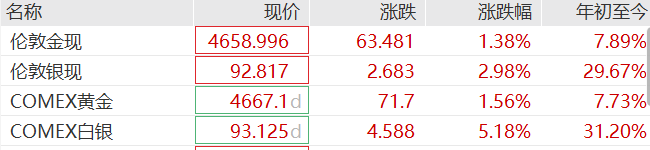
Core Viewpoint - The international gold market experienced a significant surge on January 19, with spot gold reaching a historical high of $4690 per ounce, marking a daily increase of over 2% [1]. Price Movements - As of January 19, 10:45 AM, spot gold was priced at $4659 per ounce, while COMEX gold futures were at $4667 per ounce, maintaining a position in the historical high range [1]. - The current prices and changes for gold and silver are as follows: - London Gold: $4658.996, up $63.481 (1.38%), year-to-date increase of 7.89% [2] - London Silver: $92.817, up $2.683 (2.98%), year-to-date increase of 29.67% [2] - COMEX Gold: $4667.1, up $71.7 (1.56%), year-to-date increase of 7.73% [2] - COMEX Silver: $93.125, up $4.588 (5.18%), year-to-date increase of 31.20% [2] Domestic Market Response - The surge in international gold prices has led to domestic gold jewelry brands adjusting their prices to historical highs. Notable price changes include: - Lao Miao Gold: 1459 CNY/gram, up 24 CNY/gram from the previous day - Lao Feng Xiang: 1456 CNY/gram, up 20 CNY/gram - Chow Tai Fook: 1455 CNY/gram, up 19 CNY/gram - Chow Sang Sang: 1451 CNY/gram, up 15 CNY/gram - Liufu Jewelry and King of Gold: 1453 CNY/gram, up 19 CNY/gram [3]. Market Drivers - The recent price increase is attributed to a combination of short-term geopolitical risks and long-term macroeconomic expectations. Reports indicate that former U.S. President Trump announced plans to impose tariffs on eight European countries starting February 1, which may heighten geopolitical tensions and influence precious metal price volatility [4]. - Analysis from CITIC Futures suggests that the geopolitical tensions and the potential for further tariffs could lead to continued fluctuations in gold prices. Additionally, the appointment of a new Federal Reserve chair and ongoing investigations into Powell may drive "devaluation trades," enhancing gold's monetary attributes [4]. - A deeper analysis from Anyang Futures indicates that the core driving logic in the gold market is the interplay between "delayed policy easing expectations" and "persistent inflation realities." Market expectations for interest rate cuts by major central banks, particularly the Federal Reserve, contrast with sticky inflation data that limits rapid shifts to easing [5]. - The ongoing gold purchasing behavior by central banks, including the People's Bank of China, provides long-term structural support for gold prices. In the short term, gold prices are expected to remain strong amid fluctuating monetary policy expectations and U.S. dollar exchange rate movements [5].





宝城期货甲醇早报-20260119
Bao Cheng Qi Huo· 2026-01-19 01:53
Group 1: Report's Investment Rating - There is no information about the industry investment rating in the provided content. Group 2: Core Viewpoints of the Report - The methanol 2605 contract is expected to show an overall trend of being strong in the short - term and mid - term, with a short - term (within a week) and mid - term (two weeks to a month) outlook of oscillation, and an intraday view of being strong, with a reference view of strong operation [1][5]. - The core logic is that pre - holiday overseas supply "hard contraction" is the key factor supporting the upward movement of methanol prices. Iran, a major import source, is facing serious supply disruptions. Meanwhile, the reduction of domestic port methanol inventory has led to the recovery of port spot prices and a stronger basis, which has boosted the confidence of long - positions in the futures market. As the geopolitical risk has weakened, the domestic methanol futures may maintain an oscillating and stable trend on Monday [5]. Group 3: Summary by Related Catalog Methanol Price and Market Outlook - For methanol 2605, the short - term view is oscillation, the mid - term view is oscillation, and the intraday view is strong, with an overall reference view of strong operation [1]. - The pre - holiday overseas supply "hard contraction" is the main support for the upward movement of methanol prices. The supply in Iran is disrupted, and the domestic port inventory is decreasing, leading to price recovery and a stronger basis, which affects the futures market [5]. - After the geopolitical risk weakens, the domestic methanol futures showed an oscillating trend on the night of last Friday with a slight decline, and are expected to maintain an oscillating and stable trend on Monday [5].
宝城期货原油早报-20260119
Bao Cheng Qi Huo· 2026-01-19 01:51
Report Industry Investment Rating - Not provided in the content Core View - The crude oil futures price is expected to run strongly, with short - term and medium - term trends being volatile and the intraday trend being strong. The core logic is that geopolitical risks still exist, and the geopolitical risks in the Middle East have intensified again due to the US's actions. Although the risks have weakened temporarily, the US - Iran conflict remains the main focus, and the domestic crude oil futures price is expected to maintain a strong pattern on Monday [1][5] Summary by Related Catalog Price and Trend - The short - term trend of crude oil 2603 is volatile, the medium - term trend is volatile, and the intraday trend is strong, with a reference view of strong operation [1] - The intraday view of crude oil (SC) is strong, and the medium - term view is volatile, with a reference view of strong operation [5] Driving Logic - Geopolitical risks still exist, which makes the crude oil market volatile and strong. Recently, US President Trump has frequently released geopolitical risk signals, and the geopolitical risks in the Middle East have intensified again. Although the risks have weakened temporarily, the US - Iran conflict remains the main focus. The domestic crude oil futures price maintained a volatile rebound trend on the night of last Friday and is expected to maintain a strong pattern on Monday [1][5]
伊朗内乱局势尚无缓和迹象 甲醇05合约低多或多配
Jin Tou Wang· 2026-01-19 01:25
Group 1 - Methanol futures main contract closed at 2239 CNY/ton as of January 16, 2026, with a weekly decline of 0.27% and an increase in open interest by 11,103 contracts compared to the previous week [1] - The average processing range for PTA in China was 336.2 CNY/ton as of January 7, 2026, reflecting a year-on-year increase of 17.23% [2] - The weekly average capacity utilization rate for PTA was 74.2%, up by 0.35% from the previous week, with domestic PTA production reaching 1.4312 million tons, an increase of 10,700 tons from the previous week [3] Group 2 - Dongwu Futures indicated that ongoing unrest in Iran and escalating external conflicts will continue to add risk premiums to methanol, with market participants debating geopolitical risks and reduced imports [4] - Ningzheng Futures reported that domestic methanol production is rising while downstream demand is declining, leading to a significant reduction in methanol port inventories, primarily due to low unloading volumes [4] - The methanol market is expected to experience short-term fluctuations, with port inventories decreasing but overall market performance remaining weak [4]
淡季影响需求提振 预计沥青盘面短期内窄幅震荡
Jin Tou Wang· 2026-01-19 01:19
Core Viewpoint - The asphalt futures market is experiencing a slight decline in prices, with a weekly drop of 1.11% and a significant reduction in open interest, indicating a potential shift in market dynamics [1]. Market Overview - As of January 15, the spot price of asphalt was reported at 3140 yuan/ton, reflecting a daily increase of 6.67 yuan/ton, or 0.21%. Over the past week, asphalt prices have risen by 40 yuan/ton, a 1.29% increase, and over the past month, prices have increased by 193.33 yuan/ton, or 6.56% [2]. - During the week of January 7 to January 13, the total shipment volume from 54 domestic asphalt manufacturers was 317,000 tons, representing a 1.0% increase compared to the previous week. The capacity utilization rate for 69 sample modified asphalt enterprises was 6.8%, up 0.1% week-on-week and 2.6% year-on-year [2]. Institutional Insights - Dayue Futures notes that recent production cuts by refineries have reduced supply pressure, but overall demand remains weak and below expectations. Inventory levels are stable, and weakening crude oil prices are diminishing cost support in the short term. The market is expected to experience narrow fluctuations, with asphalt prices projected to oscillate between 3138 and 3196 yuan/ton [3]. - Haitong Futures emphasizes that the absolute price trends of asphalt will continue to be influenced by geopolitical developments, particularly regarding the U.S. and Iran. The uncertain situation in Iran is likely to cause volatility in oil prices, which will subsequently affect asphalt prices. The short-term outlook suggests a focus on geopolitical risks, with strategies indicating a preference for buying low in the near term [3].
地缘风险加剧,贵金属现货续创新高:申万期货早间评论-20260119
申银万国期货研究· 2026-01-19 01:12
Core Viewpoint - Geopolitical risks are increasing, leading to new highs in precious metals spot prices, with gold surpassing $4650 per ounce and silver rising above $92 per ounce [1] Group 1: Precious Metals - Precious metals are experiencing increased volatility, supported by a macroeconomic environment of easing inflation pressures and a weak job market in the U.S. The expectation of interest rate cuts by the Federal Reserve strengthens the case for precious metals [4][20] - Gold's long-term upward trend is expected to continue due to factors such as weakened dollar credibility and central bank purchases [4][20] - Silver and platinum are also supported by supply-demand gaps, with silver facing tight supply and robust industrial demand, while platinum's demand is driven by hybrid vehicle catalysts and hydrogen energy [4][20] Group 2: Oil and Energy - Oil prices increased by 1.48% in the night session, with geopolitical risk premiums decreasing as Trump adopts a wait-and-see approach regarding Iran [2][14] - OPEC reports indicate that global demand for oil from member countries will remain stable at 43 million barrels per day in 2026, with an increase of 600,000 barrels per day expected by 2027 [2][15] Group 3: Agricultural Products - The Malaysian palm oil production for December was reported at 1,829,761 tons, a decrease of 5.46% month-on-month, while exports increased by 8.52% [3][29] - The U.S. government plans to finalize the 2026 biofuel blending quotas by early March, which is expected to support oilseed prices [3][29] Group 4: Economic Indicators - The U.S. Treasury Secretary stated that Trump's policies are attracting trillions of dollars in investments into the U.S. [7] - The People's Bank of China announced a reduction in the re-lending and rediscount rates by 0.25 percentage points, effective January 19 [8]

国投期货化工日报-20260116
Guo Tou Qi Huo· 2026-01-16 13:08
Report Industry Investment Ratings - Propylene: ★★★ (indicating a more distinct upward trend with relatively appropriate investment opportunities currently) [1] - Polypropylene: ★★★ [1] - Plastic: ★★★ [1] - Pure Benzene: ★★★ [1] - Styrene: ★★★ [1] - PTA: ★★★ [1] - Ethylene Glycol: ★★★ [1] - Short Fiber: ★★★ [1] - Bottle Chip: ★★★ [1] - Methanol: ★★★ [1] - Urea: ★★★ [1] - PVC: ★★★ [1] - Caustic Soda: ★★★ [1] - Soda Ash: ★☆☆ (indicating a bullish/bearish bias with a driving force for price increase/decrease, but poor operability on the market) [1] - Glass: ★★★ [1] Core Viewpoints - The chemical market shows a mixed trend with different products having their own supply - demand and price characteristics. Some products are affected by supply shortages, while others are influenced by demand changes, geopolitical factors, and production schedules [2][3][5]. Summaries by Relevant Catalogs Olefins - Polyolefins - Propylene futures fluctuated within the day. Supply was tight, inventory was controllable, and some offers continued to rise. Downstream factories followed well, driving up the trading center [2]. - Plastic and polypropylene futures also fluctuated. For polyethylene, pre - sales during the Spring Festival continued, the overall transaction center of spot goods moved up, and production confidence was enhanced. For polypropylene, although the futures maintained a high level, the market was cautious due to concerns about demand [2]. Pure Benzene - Styrene - Pure benzene futures fluctuated, and spot prices in East China continued to decline slightly. Supply was abundant, and the port was accumulating inventory. In the short - term, it would fluctuate due to geopolitical risks, and in the long - term, de - stocking was difficult [3]. - Styrene futures had a narrow - range consolidation. The supply - demand was in a tight balance, the port inventory was decreasing, the export market was good, and the downstream was bullish [3]. Polyester - As oil prices fell, the cost support for PX and PTA weakened. In the short - term, the upward drive for PX was weak, but the medium - term outlook was positive. PTA's main driver was from raw materials, and the processing margin would moderately recover [5]. - For ethylene glycol, new domestic plants were put into operation, while overseas plants stopped production. The industry was mixed. In the short - term, falling oil prices were a major negative, but in the second quarter, there were expectations of improvement [5]. - Short - fiber enterprises had low inventory, but downstream orders were weak. Demand would continue to decline, and the price would fluctuate with raw materials [5]. - Bottle - chip production decreased, downstream demand was for rigid needs, and the processing margin recovered, but long - term capacity pressure remained [5]. Coal Chemical Industry - Due to the cooling of the geopolitical situation in Iran, the methanol market declined. Overseas plant operation rates were low, and the port was de - stocking. However, with demand weakening, the de - stocking speed was expected to slow down, and the market was in a multi - empty game [6]. - Urea futures declined slightly, while spot prices were stable with a slight increase. With the approaching of spring demand and positive macro factors, the market was expected to be strong [6]. Chlor - Alkali Industry - PVC weakened within the day. Although production increased slightly and exports of some enterprises increased, downstream demand was weak, and inventory increased. In 2026, it was expected to reduce capacity, and the futures price center would rise [7]. - Caustic soda was in a weak position, and the industry was accumulating inventory. Although the profit of integrated enterprises was okay, the industry was generally in a loss, and it was necessary to track whether there would be production cuts [7]. Soda Ash - Glass - Soda ash fluctuated within the day. Production continued to rise, supply pressure was high, downstream procurement was weak, and the industry was accumulating inventory. It was recommended to short on rebounds [8]. - Glass was strong within the day and continued to de - stock. However, production lines were in a loss, capacity was compressed, and demand was insufficient. It might accumulate inventory seasonally, but in the long - term, supply reduction would relieve pressure, and it was recommended to buy on dips [8].
黄金时间·每日论金:金价在4600美元/盎司附近高位整固 将有望继续保持强势
Sou Hu Cai Jing· 2026-01-16 12:42
转自:新华财经 在供需缺口持续增加以及国内出口配额限制等基本环境下,白银价格整体维持强势。从整体波动幅度来 看,目前银价,守稳85美元/盎司一线,如期进入85-103美元/盎司的运行区间,依据技术形态分析, 银价中期95-103美元/盎司技术目标区正在逐渐实现,100美元/盎司的整数关口需要高度警惕,谨防 再次剧烈波动。 【黄金时间】是由新华财经与中国黄金报社共同打造的一档聚焦黄金珠宝市场的专题栏目,内容全面覆 盖黄金珠宝行业的政策动态、投资资讯、风险分析等,提供权威、专业、全面的黄金珠宝领域金融信息 服务。新华财经是新华社承建的国家金融信息平台。 编辑:郭洲洋 地缘局势方面,伊朗局势暂受控制,哈马斯指责以色列违反停火协议,种种因素表明冲突格局暂缓但仍 然没有停止的迹象。 综合金融市场表现来看,地缘风险仍存,美联储货币政策依然存在宽松预期,在此市场环境下,黄金价 格在今后的较长时期内将有望保持强势,短期的调整,或将都是潜在的市场机会。 从技术面来看,黄金价格的中期涨势没有改变,连续三个交易日,金价保持在4566美元上方运行,显示 金价前高的阻力转化为重要支撑后,力度依然强劲。中期上涨技术目标指向4825美元/ ...