
关税冲击

Search documents
早盘直击 | 今日行情关注
申万宏源证券上海北京西路营业部· 2025-04-16 02:13
盘面回顾:指数窄幅震荡,个股和板块表现分化。周二全天指数窄幅震荡,临近尾盘沪指收红,但 大部分中小市值宽基指数仍以绿盘报收。交易金额为1.07 万亿,较周一萎缩。周二 31 个一级行业表现 分化,领涨板块是美容护理、银行、家用电器、纺织服饰、传媒等。领跌板块是国防军工、商贸零售、 电子、钢铁、社会服务等。 风险提示:关税冲击的后续影响,美联储降息延后,海外经济衰退超预期,国内经济复苏不及预 期,政策执行不及预期等。 周二指数窄幅波动,市场观望情绪加大。周二 A 股全天窄幅波动,波幅仅 22 个指数点,显示在经 历了连续 5 个交易日的上涨后,市场观望情绪开始加大,追涨意愿下降。从中期角度来看,在中央汇金 等三家国资开始增持,叠加多家上市公司宣布回购增持后,市场已经迎来拐点。尽管"对等关税"的后续 影响还存在一定不确定性,但市场交易开始克服恐慌心理,指数在波折中继续修复行情。 后市展望:关税事件的冲击最高峰已经过去,A 股将在波折中继续修复。4 月 7 日的极端下跌是对 近期所谓"对等关税"事件的一次性反映,随着市场情绪逐渐平稳和以中央汇金为代表的国资以及多家上 市公司宣布回购增持后,目前 A 股已经进入修复性 ...
关税背景下如何看家电
2025-04-15 14:30
本次会议为中国国际金融股份有限公司中金公司闭门会议仅限受邀嘉宾参会未经中金公司和演讲嘉宾书面许可任何机构和个人不得以任何形式将会议内容和相关信息独来公布转发转载传播复制编辑修改等如有上述违法行为中金公司保留追究相关方法律责任的权利 这次会议是中国国际资产合作组织CICC的闭门会议只有邀请客人可以参加不需要CICC和评论员签署的允许任何组织或人员不得处罚、推进、重新印刷、分拆、複製、删除或更改会议内容和相关资讯 各位投资者大家早上好也欢迎大家早上8点来收听我们这个电话会那么今天这个电话会我们的主题就是在关税冲击的背景下如何看关税对于家电公司的一个影响和这样一个背景下如何去配置家电板块 首先我们第一部分来猜一下不同公司的收入场口的情况以及对美供应链的场口的情况应该说大家对于家电的行业还是有着刻板印象因为这两天很多公司作为出口链所以板块接的很多甚至很多大家觉得它就是出口链其实很多市场的投资者还是把 呃这个所谓的出口链啊等同于对美出口呃但这个可能也是一个刻板印象我们应该说实际上如果你对于很多家电厂商来说啊 对美供应链敞口其实是小于等于美国收入敞口小于外销收入的一个敞口的这个我们具体来分析吧首先从白店来说美帝这边我们看 ...
摩根士丹利:中国思考-中国如何对冲关税冲击
摩根· 2025-04-15 14:26
Investment Rating - The report does not explicitly provide an investment rating for the industry [2]. Core Insights - High tariffs are expected to remain elevated in the short term, posing substantial downward pressure on the economy, leading to heightened market focus on China's policy responses and the direction of the RMB exchange rate [3][11]. - The policy framework is likely to remain reactive, with incremental stimulus measures dependent on economic performance and existing policy effectiveness, suggesting that significant new stimulus may not be introduced until next year [4][12]. - The central bank may allow for a moderate depreciation of the RMB to align with monetary easing, but the potential for disorderly depreciation is considered low due to concerns over capital outflows [13]. Summary by Sections Tariff Impact and Policy Response - The escalating tariffs between the US and China increase the risk of long-term trade decoupling, with the US administration indicating a reluctance to further raise tariffs, complicating China's ability to increase imports from the US [3][4]. - The focus is shifting towards China's policy responses, with expectations that the government will expedite the implementation of existing policies rather than introduce new stimulus measures in the immediate term [11]. Economic Outlook - The GDP growth forecast for this year is set at 4.5%, but it faces downward risks due to the sustained high levels of tariffs, which may lead to a rapid decline in economic growth starting in the second quarter [12][13]. - Incremental stimulus measures are anticipated to be in the range of 1-1.5 trillion RMB, potentially boosting economic growth by 0.5-0.8 percentage points [12]. Currency Management - The central bank has already guided the RMB to depreciate by 0.4% against the USD since April 2, 2025, as part of a strategy to enhance currency flexibility in response to high tariffs [13]. - The forecast for the USD/RMB exchange rate by the end of the year is 7.50, but this target faces upward risks due to unexpected tariff impacts [13].
【招银研究|宏观点评】“抢出口”尾声——进出口数据点评(2025年3月)
招商银行研究· 2025-04-15 11:57
2025年一季度,我国进出口规模平稳增长,按美元计价,进出口总金额1.43万亿美元,同比小幅增长0.2%。其 中,出口8,536.7亿美元,同比增长5.8%。在贸易摩擦加剧、美国对华加征关税的压力下,我国出口表现出较 强的韧性,海外制造业经济景气度提升、中国高端智能绿色产品竞争力增强、以及"抢出口"效应是主要支撑。 进口5,807亿美元,同比下降7.0%。进口表现较弱,主要受铁矿砂、煤炭、原油、大豆等国际大宗商品价格下 跌、国内有效需求不足制约。贸易顺差2,729.7亿美元,同比扩张897.9亿美元(+49.0%)。 2025年3月,我国进出口金额同比增速表现分化,出口大幅提升,进口降幅收窄,贸易顺差大幅扩张。按美元 计价,进出口总金额5,251.8亿美元,同比增长5.0%。其中,出口3,139.1亿美元,同比12.4%;进口2,112.7亿美 元,同比-4.3%;贸易顺差1,026.4亿美元,同比扩张440.5亿美元(+75.2%)。 资料来源:Macrobond、招商银行研究院 图1:3月出口同比高增,进口同比降幅收窄 图4:我国对美出口依赖度持续下降 一、出口:增速提升,冲击初显 3月出口金额同比增速较 ...
渤海证券研究所晨会纪要(2025.04.15)-20250415
BOHAI SECURITIES· 2025-04-15 01:59
Macro and Strategy Research - The scale of corporate bond financing has decreased, with March social financing increasing by over 1 trillion yuan year-on-year for the fourth consecutive month, primarily supported by government bond financing and on-balance sheet credit financing [2] - Corporate short-term loans have significantly increased year-on-year, with a net increase of 460 billion yuan in March, while medium and long-term loans showed a slight decrease, indicating a preference for short-term loans due to high bond financing costs [2][3] - M1 year-on-year growth has rebounded, likely due to accelerated fiscal fund disbursement, enhancing the liquidity of private sector demand [3] - Overall, March financial data shows improvements in both total and structural aspects, with notable increases in social financing and M1 growth, although medium and long-term loans still require further stimulation [3] Fund Research - The market saw significant net inflows into broad-based indices led by the CSI 300, with a net inflow of over 98 billion yuan, while the CSI A500 index experienced a net outflow of approximately 3.97 billion yuan [5][7] - The average net value of bond funds increased by 0.16%, while FOF and equity funds performed poorly, with the average net value of quantitative funds dropping by 3.99% [6][7] - The active equity fund position increased to 80.96%, up by 2.8 percentage points from the previous period, indicating a rising confidence in equity markets [6]
经观季度调查 |2025年一季度经济学人问卷调查:“稳增长”与“防风险” 再平衡 保持关税冲击下的增长韧性
Jing Ji Guan Cha Bao· 2025-04-14 15:01
Group 1 - The core challenges facing the economy include the restructuring of global trade, deep adjustments in the real estate market, and long-term pressure from insufficient domestic demand [1] - 68% of economists predict that the GDP growth rate in Q1 2025 will be between 5.0% and 5.2%, while 24% expect it to be between 4.7% and 4.9% [3][4] - The stability of wage and property income is crucial for residents' spending willingness, with income being the primary influencing factor for consumption at 81% [1][6] Group 2 - Economists emphasize the need for macroeconomic policies to balance "stabilizing growth" and "preventing risks," with a stronger focus on growth while also addressing risk prevention [1][14] - The impact of U.S. tariffs is expected to create significant challenges for labor-intensive industries and consumer electronics, necessitating policy adjustments [12][13] - The survey indicates that 72% of economists believe China may initiate cuts in reserve requirements and interest rates in April to counteract the effects of U.S. tariffs [13] Group 3 - The current economic environment necessitates a focus on stabilizing employment, with 48% of economists identifying stimulating market vitality as a key strategy [10] - The need for increased fiscal support in areas such as consumption, livelihood, and broad infrastructure is highlighted as essential for achieving the 5% growth target [14] - The anticipated expansionary fiscal policy for 2025 is projected to reach 8 trillion yuan, reflecting the need to address external influences and employment pressures [13]
【招银研究】关税冲击暂缓,市场波动延续——宏观与策略周度前瞻(2025.04.14-04.18)
招商银行研究· 2025-04-14 11:20
Core Viewpoint - The article discusses the increasing "stagflation" pressure in the US economy, highlighting the divergence between consumer and corporate sectors, and the implications of tariff policies on economic performance and market dynamics [2][3]. Economic Conditions - The US economy is experiencing heightened "stagflation" pressures, with consumer confidence low and inflation expectations high, as indicated by the University of Michigan's consumer survey [2]. - The Atlanta Fed's GDPNOW model predicts a Q1 consumption growth rate of only 0.7%, while corporate investment growth is forecasted at 8.9%, driven by strong equipment investment [2]. - The service sector's PMI fell to 50.8, nearing the contraction threshold, while the manufacturing PMI dropped to 49, indicating a contraction [2]. Tariff Impact - Recent fluctuations in US tariff policies have led to significant market volatility, with a shift in trading logic from recession fears to capital flight from dollar assets [3]. - The US government announced a temporary exemption on tariffs for certain technology products, which could alleviate effective tariffs on about 25% of China's exports to the US [8]. - The article notes that the "export rush" effect has diminished, with a decline in container throughput at major ports [8]. Monetary Policy - The Federal Reserve's dual mandate suggests a reluctance to quickly lower interest rates, with officials expressing concerns over inflation driven by tariffs [2]. - The article anticipates that the Fed's intervention to address liquidity issues may be less likely than in the past, leading to a potential upward trend in interest rates [3]. Domestic Economic Response - China's economy is facing challenges from both internal and external factors, with a weak real estate market and declining retail sales due to tariff impacts [7]. - The government is expected to accelerate the issuance of special bonds to support economic growth and mitigate the effects of external shocks [9]. Market Outlook - The bond market is expected to present more opportunities than risks, with a potential decline in interest rates, while the A-share market is likely to remain volatile [12]. - The article suggests a balanced allocation in A-shares, focusing on technology, consumption, and dividend stocks, while also noting the potential for defensive positioning in the Hong Kong market [14].

3月金融数据点评:政策工具充足,泰然应对“关税”
Changjiang Securities· 2025-04-14 10:43
Economic Indicators - In March, the total social financing (TSF) stock growth rate rebounded to 8.4% year-on-year, while the credit growth rate under TSF increased to 7.2%[2] - The new TSF in March was 5.89 trillion RMB, with new RMB loans increasing by 3.64 trillion RMB[6] - M2 growth remained stable at 7.0% year-on-year[6] Policy Response - There are sufficient monetary and fiscal policy tools available to address the impact of tariffs, including interest rate cuts and accelerated government bond issuance[2][6] - The government plans to issue approximately 13.86 trillion RMB in new debt for 2025, with 4 trillion RMB issued in the first quarter[6] Credit Dynamics - The increase in credit was primarily supported by government bonds and short-term loans, with corporate medium- and long-term loans showing a slight decrease[6] - In March, corporate short-term loans increased by 460 billion RMB, while medium- and long-term loans decreased by 200 billion RMB[6] Risks and Uncertainties - Economic recovery may be weaker than expected, leading to lower credit growth and social financing stock growth[32] - The final implementation of tariff policies remains uncertain, which could affect domestic economic conditions[32]
公募REITs二级市场上周波动下行,保障房REITs表现仍持续优异
Mei Ri Jing Ji Xin Wen· 2025-04-14 08:26
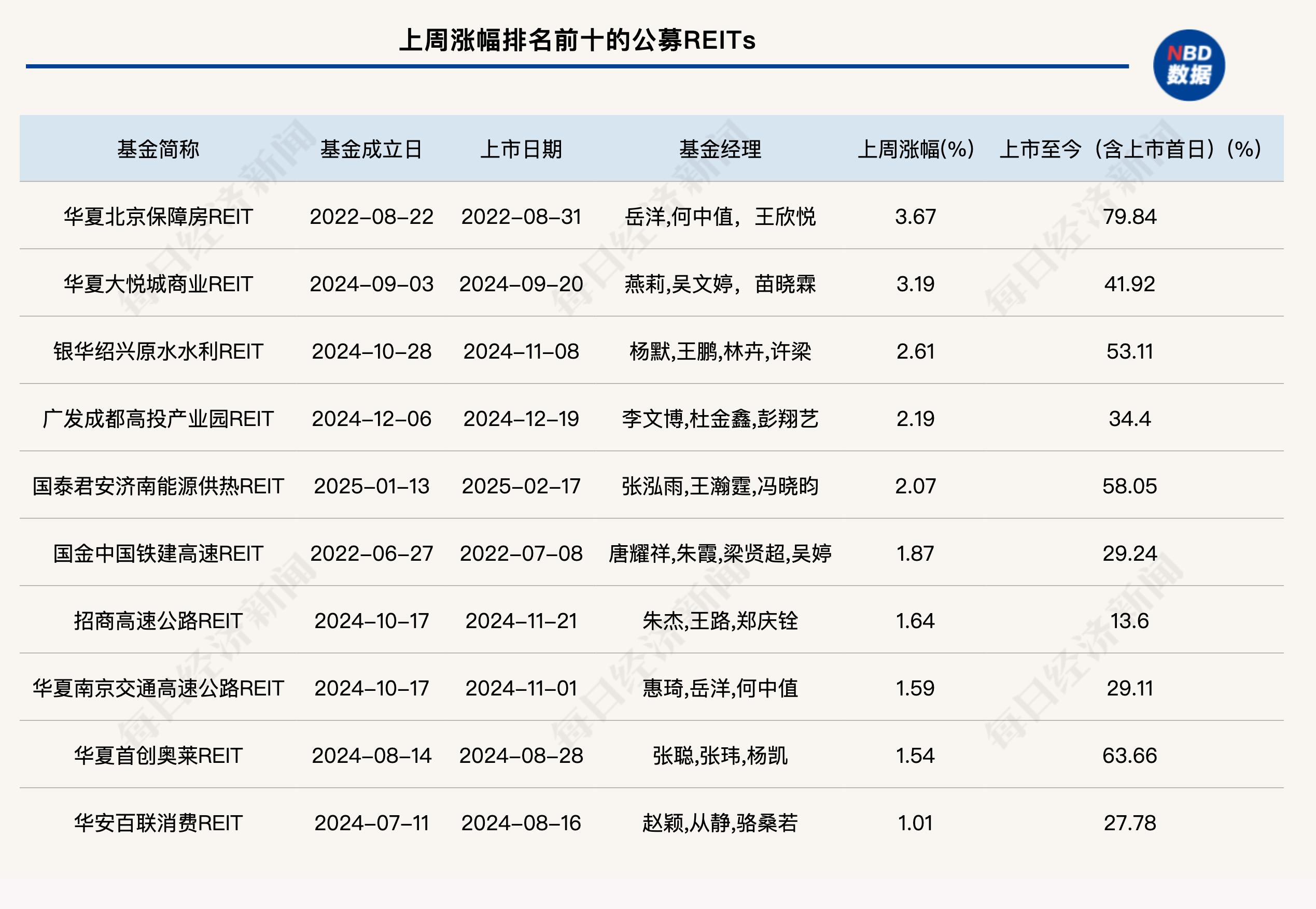
Core Viewpoint - The public REITs market experienced a downward trend last week, with overall trading activity declining, while the affordable housing REITs continued to perform well [1][2]. Market Performance - The CSI REITs index fell by 1.36% to 856.7 points, and the CSI REITs total return index decreased by 1.18% to 1065.4 points [2]. - Among the 64 publicly listed REITs, only 24 saw an increase in value, a decrease from the previous week [2]. - The top-performing REITs included Huaxia Beijing Affordable Housing REIT, Huaxia Joy City Commercial REIT, and Yinhua Shaoxing Raw Water REIT, with weekly gains of 3.67%, 3.19%, and 2.61% respectively [2][4]. Sector Analysis - The affordable housing sector showed resilience, with a weekly increase of 0.27%, while other sectors like industrial parks and logistics saw declines of 2.14% and 2.96% respectively [2][8]. - The trading volume for REITs decreased to 590 million yuan, down 11% from the previous week, with specific declines in property and operating rights trading [7][8]. New Issuances - The first rental housing public REIT in Jiangsu, Huatai Suzhou Hengtai Rental Housing REIT, announced its pricing range between 2.270 yuan and 2.774 yuan per share [1][9]. - As of April 11, a total of 65 public REITs have been issued, with a combined issuance scale of 173.1 billion yuan [1]. Future Outlook - Analysts predict that the REITs market may maintain narrow fluctuations in the coming weeks due to limited new information, with a focus on stable sectors like affordable housing and water resources [10].
申万宏源证券晨会报告-20250414
Shenwan Hongyuan Securities· 2025-04-14 00:43
Group 1: Market Overview - The Shanghai Composite Index closed at 3238 points, with a daily increase of 0.45% but a decline of 4.19% over the past five days and 3.11% over the past month [1] - The Shenzhen Composite Index closed at 1882 points, with a daily increase of 0.72% but a decline of 9.86% over the past five days and 5.55% over the past month [1] - Large-cap indices showed a daily increase of 0.38%, while mid-cap and small-cap indices increased by 0.84% and 1.15%, respectively, indicating a mixed performance across market segments [1] Group 2: Industry Performance - Non-metallic materials sector saw a daily increase of 6.86%, with a 1-month increase of 5.53% and a 6-month increase of 18.56% [1] - The semiconductor sector increased by 5.03% daily but decreased by 7.88% over the past month, while other electronic sectors saw a daily increase of 4.59% but a 1-month decline of 15% [1] - The agriculture sector, particularly planting, experienced a significant decline of 7.37% daily, with a 1-month increase of 8.93% and a 6-month increase of 18.16% [1] Group 3: Trade and Tariff Analysis - The report discusses misconceptions regarding the impact of tariffs on exports, suggesting that the elasticity of tariff impacts is non-linear and may decrease at higher rates [9][12] - It highlights that trade partners like Canada and Mexico remain crucial trade channels, mitigating the impact of tariffs on U.S. exports [9] - The analysis indicates that the U.S. GDP could suffer a loss of up to 3% due to tariffs, with significant implications for consumer prices and inflation [12] Group 4: Company-Specific Insights - Jinbo Biological's new collagen filling product has received approval, potentially reshaping the industry landscape [17] - The company is expected to leverage its existing distribution channels to promote the new product, which is anticipated to significantly enhance its revenue [21] - The report emphasizes the growth potential in the aesthetic medicine market, with the domestic market size projected at approximately 150 billion yuan [21]