稳增长政策

Search documents
多空交织 国债高位徘徊
Qi Huo Ri Bao· 2025-07-22 23:49
Group 1 - The bond market has been operating in a bearish trend since July, with the 10-year government bond yield rising from a low of 1.64% to 1.67% due to strong macroeconomic data and robust stock market performance [1] - Economic resilience is evident, with GDP growth rates of 5.4% in Q1 and 5.2% in Q2, leading to a cumulative growth rate of 5.3% for the first half of the year, indicating that a 4.7% growth rate in the second half is sufficient to meet the annual target of 5% [2] - Consumption policies have shown significant effects, with retail sales in key categories such as home appliances and communication equipment growing over 10% year-on-year, while investment in high-tech manufacturing continues to outpace overall growth [2][3] Group 2 - The overall economic structure is shifting towards high-quality development, with manufacturing increasingly focusing on technology-intensive sectors, while real estate investment remains weak, with a cumulative decline of 11.2% in real estate development investment [2] - The macroeconomic policy will maintain a steady growth tone, with a focus on promoting consumption and addressing "involution" in the market, which is expected to lead to a moderate rise in consumer prices [3] - The liquidity in the market is reasonably ample, which is favorable for the bond market, but the strong economic resilience and low probability of interest rate cuts in the short term suggest a continued oscillation in the bond market, with the 10-year government bond yield expected to remain in the range of 1.6% to 1.7% [3]
能源化策略:原油和化?的分化,期货与现货的分化,能化难有趋势?情
Zhong Xin Qi Huo· 2025-07-22 12:02
1. Report Industry Investment Rating Not provided in the content. 2. Core Views of the Report - The energy and chemical market is expected to experience volatile trends, with attention on policy variables and cost - side fluctuations. There is a divergence between crude oil and chemicals, as well as between futures and spot markets, making it difficult for the energy and chemical sector to have a clear - cut trend. [1][4] - Crude oil supply pressure persists, and geopolitical disturbances should be monitored. The strong reality of high refinery operations and the weak expectation of supply pressure are in a state of balance, leading to an oscillating oil price. [8] - Domestic chemical products have shown strong performance, especially coal and coal - chemical products with high self - sufficiency rates. However, the increase in chemical futures prices has not been followed by spot prices, and the basis of chemical products has weakened. [2] 3. Summary by Related Catalogs 3.1 Market Outlook - **Crude Oil**: Supply pressure remains, and geopolitical disturbances should be noted. The high refinery operations in domestic and foreign markets and the supply pressure are in a state of balance, resulting in an oscillating oil price. [8] - **LPG**: The support from the cost side is weakening, and the fundamental situation of ample supply remains unchanged. The PG futures may experience weak oscillations. [3] - **Asphalt**: The valuation of asphalt futures prices is gradually entering a severely over - valued stage. [3] - **High - sulfur Fuel Oil**: There is significant downward pressure on high - sulfur fuel oil futures prices. [3] - **Low - sulfur Fuel Oil**: Low - sulfur fuel oil follows the oscillating and weakening trend of crude oil. [3] - **Methanol**: The operating load in the inland region remains low, and methanol prices will oscillate. [3] - **Urea**: Supply is strong while demand is weak. Although sentiment is temporarily boosted and exports support the market, urea prices will oscillate in the short term. [3] - **Ethylene Glycol**: Port inventories have decreased, and the expectation of inventory accumulation has been postponed. [3] - **PX**: The downward space is limited, and it will seek a direction during oscillations. [3] - **PTA**: The driving force is limited, and it is affected by cost and macro - sentiment disturbances. [3] - **Short - fiber**: There are limited industrial contradictions. [3] - **Bottle Chip**: The increase in polymerization cost supports the valuation. [3] - **PP**: The expectation of stable growth boosts the market, and PP prices will oscillate. [3] - **Plastic**: The expectation of stable growth in the petrochemical industry provides a slight boost, and plastic prices will oscillate. [3] - **Pure Benzene**: The improvement of the balance sheet and positive commodity sentiment are expected to lead to a weak rebound. [3] - **Styrene**: The stable - growth plan boosts the market, and styrene prices will rise. [3] - **PVC**: Market sentiment has warmed up again, and a cautious and optimistic attitude is recommended. [3] - **Caustic Soda**: There is a strong expectation but weak reality, and caustic soda prices will experience a weak rebound. [3] 3.2 Variety Data Monitoring 3.2.1 Energy and Chemical Daily Indicator Monitoring - **Inter - period Spreads**: Different varieties have different inter - period spread values and changes, such as Brent's M1 - M2 spread being 0.78 with a change of - 0.1, and PX's 1 - 5 month spread being 60 with a change of 8. [36] - **Basis and Warehouse Receipts**: Each variety has corresponding basis values, changes, and warehouse receipt quantities. For example, the basis of asphalt is 198 with a change of 33, and the number of warehouse receipts is 82300. [37] - **Inter - variety Spreads**: The inter - variety spreads also show different values and changes, like the 1 - month PP - 3MA spread being - 354 with a change of - 62. [39] 3.2.2 Chemical Basis and Spread Monitoring The content mainly lists various chemical products such as methanol, urea, styrene, etc., but specific data and analysis are not fully presented in a summarized way in the provided text. [40][52][63]
ETF市场日报 | 煤炭、基建板块强势!科创债相关ETF热度延续
Sou Hu Cai Jing· 2025-07-22 07:22
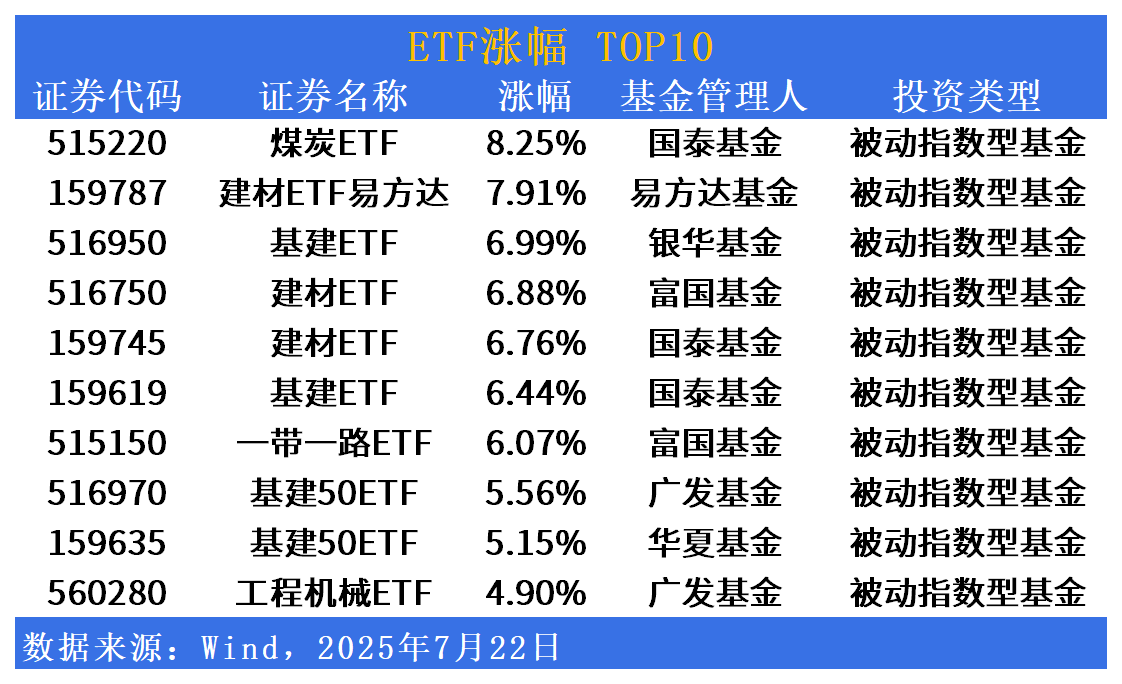
Market Overview - A-shares continued to rise, with the Shanghai Composite Index and ChiNext Index reaching new highs for the year, closing up 0.62% and 0.61% respectively, while the Shenzhen Component Index rose 0.84% [1] - The trading volume in the Shanghai and Shenzhen markets approached 1.9 trillion, an increase of nearly 200 billion compared to the previous day [1] Sector Performance - The infrastructure and building materials sectors led the gains, with significant increases in various ETFs, including Coal ETF (8.25%), Building Materials ETF (7.91%), and Infrastructure ETF (6.99%) [2][3] - The Coal industry is highlighted as a high-dividend sector, with leading companies expected to attract continued investment due to stable cash flows and dividend capabilities [3] Policy Impact - The Ministry of Finance's recent notification is expected to enhance market preference for high-dividend assets, benefiting sectors like coal and infrastructure [3] - Financial institutions anticipate improvements in infrastructure projects in the second half of the year, supported by the launch of major projects and the issuance of special bonds [4] Gaming Sector - The gaming sector experienced a decline, with the National Press and Publication Administration issuing fewer import game licenses compared to the previous year, although domestic game approvals increased by 20.54% [5] ETF Activity - The short-term bond ETF recorded the highest trading volume at 21.2 billion, while the building materials ETF had the highest turnover rate at 253% [6] - A new Hong Kong Stock Connect Internet ETF is set to begin fundraising, focusing on major internet companies in Hong Kong [7]

华宝期货黑色产业链周报-20250721
Hua Bao Qi Huo· 2025-07-21 14:09
【华宝期货】黑色产业链周报 华宝期货 2025.7.21 目录 01 周度行情回顾 02 本周黑色行情预判 03 品种数据(成材、铁矿石、煤焦) 01 周度行情回顾 | 品种 | | | 期货主力合约收盘价格 | | | 现货价格 | | | | | | --- | --- | --- | --- | --- | --- | --- | --- | --- | --- | --- | | | | 2025.7.18 | 2025.7.11 | 价格变动 | 涨跌幅 | | 2025.7.18 | 2025.7.11 | | 涨跌幅 | | 螺纹钢 | RB2510 | 3147 | 3133 | 14 | 0.45% | HRB400E: Φ20:汇总价格:上海 | 3250 | 3220 | 30 | 0.93% | | 热轧卷板 | HC2510 | 3321 | 3273 | 48 | 1.47% | Q235B: 5.75*1500*C: 市场价: 上海 | 3340 | 3300 | 40 | 1.21% | | 铁矿石 | 60521 | 785 | 764 | 21 | 2.75% | 日照港P ...
中信期货晨报:国内商品期货多数上涨,碳酸锂、原油表现偏强-20250721
Zhong Xin Qi Huo· 2025-07-21 06:06
1. Report Industry Investment Rating - Not mentioned in the provided content 2. Core Views of the Report - Overseas fundamentals are relatively stable, with the new Fed Chair nominee affecting interest - rate cut expectations. Attention should be paid to the progress of tariff implementation in early August. The long - term weak - dollar pattern continues, and non - dollar assets are worth focusing on [6]. - China's Q2 economic data shows resilience, with export performance better than market expectations. The current pro - growth policies mainly focus on using existing resources, and the probability of incremental policies is higher in Q4. Domestic assets present mainly structural opportunities [6]. - The logic of policy - driven investment is strengthened in the second half of the year, and the probability of incremental policies in Q4 is higher. Strategic allocation of resources such as gold and copper should be maintained [6]. 3. Summary by Relevant Catalogs 3.1 Macro Highlights - **Overseas Macro**: US consumer confidence recovered in June, driving a slight rebound in CPI and retail sales. The potential Fed Chair nominees generally advocate interest - rate cuts, and the nomination is expected between October and December 2025. US tariff policies on other countries and China may be implemented before August 1st and 12th [6]. - **Domestic Macro**: China's Q2 GDP grew by 5.2% year - on - year, and June's export value increased by 5.8% year - on - year, better than expected. High - frequency data shows an increase in infrastructure work, and investment fundamentals have improved. As the Politburo meeting approaches, the market anticipates domestic - demand boosting policies. Currently, pro - growth policies focus on using existing resources, and incremental policies are more likely in Q4 [6]. - **Asset Views**: Domestic assets offer mainly structural opportunities. Attention should be paid to the details of "anti - involution" policies. Overseas, factors such as tariff frictions, Fed policies, and geopolitical risks should be monitored. A long - term weak - dollar pattern is expected, and strategic allocation of resources like gold and copper is recommended [6]. 3.2 View Highlights Financial - **Stock Index Futures**: Positive expectations for "anti - involution" policies are hard to disprove, but there is a lack of incremental funds [7]. - **Stock Index Options**: Market sentiment fluctuates, and selling options dominate, with deteriorating option liquidity [7]. - **Treasury Bond Futures**: The bond yield curve continues to steepen, and attention should be paid to unexpected tariff changes, supply, and monetary easing [7]. Precious Metals - Gold and silver continue to adjust, and attention should be paid to Trump's tariff policies and Fed's monetary policies [7]. Shipping - For container shipping to Europe, attention should be paid to the game between peak - season expectations and price - increase implementation, as well as tariff policies and shipping companies' pricing strategies [7]. Black Building Materials - **Steel**: The market is affected by macro factors and fluctuates at high levels. Attention should be paid to the progress of special bond issuance, steel exports, and hot - metal production [7]. - **Iron Ore**: Hot - metal production slightly rebounds, and the market fluctuates strongly. Attention should be paid to overseas mine production and shipment, domestic hot - metal production, weather, port ore inventory, and policy dynamics [7]. - **Coke**: The first round of price increases is about to be implemented, and there are strong expectations for a second - round increase. Attention should be paid to steel production, coking costs, and macro sentiment [7]. - **Coking Coal**: Mongolian coal resumes customs clearance, and the market fluctuates. Attention should be paid to steel production, coal - mine safety inspections, and macro sentiment [7]. - **Silicon Ferroalloy**: Market sentiment cools, and prices decline weakly. Attention should be paid to raw material costs and steel procurement [7]. - **Manganese Ferroalloy**: Policy falls short of expectations, and the market fluctuates weakly. Attention should be paid to cost prices and overseas quotes [7]. - **Glass**: Market sentiment declines, and short - term fundamental contradictions are limited. Attention should be paid to spot sales [7]. - **Soda Ash**: Inventory continues to accumulate, and spot prices keep falling. Attention should be paid to soda - ash inventory [7]. Non - ferrous Metals and New Materials - **Copper**: The possible early implementation of US tariffs on copper pressures copper prices. Attention should be paid to supply disruptions, domestic policy surprises, Fed's hawkish stance, and domestic demand recovery [7]. - **Alumina**: The scale of warehouse - receipt registration needs to be observed, and the market declines. Attention should be paid to unexpected ore production resumption, excessive electrolytic - aluminum production resumption, and extreme market trends [7]. - **Aluminum**: The inventory - accumulation rhythm fluctuates, and prices fluctuate. Attention should be paid to macro risks, supply disruptions, and insufficient demand [7]. - **Zinc**: The rebound of the black - metal sector boosts zinc prices, and short - selling opportunities should be watched. Attention should be paid to macro - turning risks and unexpected increases in zinc - ore supply [7]. - **Lead**: Cost support is stable, and inventory accumulates. Prices fluctuate. Attention should be paid to supply - side disruptions and slow battery exports [7]. - **Nickel**: With the opening of the LME's Hong Kong delivery warehouse, nickel prices are expected to decline in the long term. Attention should be paid to unexpected macro and geopolitical changes, Indonesian policies, and insufficient supply [7]. - **Stainless Steel**: Nickel - iron prices are weak, and the market fluctuates. Attention should be paid to Indonesian policies and unexpected demand growth [7]. - **Tin**: The supply - demand fundamentals are resilient, and prices are strongly supported at the bottom. Attention should be paid to the resumption of production in Wa State and demand improvement expectations [7]. - **Industrial Silicon**: Silicon prices rise under the "anti - involution" sentiment, and attention should be paid to warehouse - receipt changes. Attention should be paid to unexpected supply - side production cuts and excessive photovoltaic installations [7]. - **Lithium Carbonate**: Supply disruptions are hyped, and prices fluctuate strongly. Attention should be paid to insufficient demand, supply disruptions, and new technological breakthroughs [7]. Energy and Chemicals - **Crude Oil**: Supply pressure persists, and attention should be paid to geopolitical disturbances. The market is expected to decline [9]. - **LPG**: The market returns to trading a loose fundamental situation and may decline [9]. - **Asphalt**: "Anti - involution" trading keeps the asphalt - fuel oil price spread high, and the market is expected to decline [9]. - **High - Sulfur Fuel Oil**: High supply and "anti - involution" factors lead to a weakening market, which is expected to decline [9]. - **Low - Sulfur Fuel Oil**: Rotterdam's low - sulfur marine fuel is largely replaced by high - sulfur fuel, and the market is expected to decline [9]. - **Methanol**: Low domestic production counters increasing imports, and the market fluctuates [9]. - **Urea**: The domestic supply - demand imbalance persists, and exports are needed. The market may fluctuate [9]. - **Ethylene Glycol**: The basis is stable, and plants are restarting. The market is expected to rise [9]. - **PX**: Crude - oil prices are stable, and PX fluctuates strongly [9]. - **PTA**: Supply - demand weakens, but the cost of PX is strong. The market fluctuates [9]. - **Short - Fiber**: The basis declines, and processing fees increase. The market is expected to rise [9]. - **Bottle Chips**: Maintenance begins, and processing fees reach the bottom. The market fluctuates [9]. - **PP**: News of petrochemical growth boosts the market, which fluctuates [9]. - **Plastic**: Production is expected to increase next week, and the market fluctuates [9]. - **Styrene**: There is no clear market driver, and the market is expected to decline [9]. - **PVC**: Market sentiment warms up again, and the market fluctuates [9]. - **Caustic Soda**: Expectations for growth are strong, and the market is cautiously optimistic [9]. - **Oils and Fats**: Palm oil leads the rise in oils and fats, but attention should be paid to inventory - accumulation pressure in producing areas. The market is expected to rise [9]. - **Protein Meal**: Concerns about China's counter - measures against Canada drive up rapeseed meal prices. The market is expected to rise [9]. - **Corn/Starch**: Spot supply is locally tight, and prices fluctuate weakly. The market is expected to decline [9]. - **Hogs**: Supply is abundant, and prices are under pressure. The market fluctuates [9]. Agriculture - **Rubber**: Positive sentiment drives up prices, and the market fluctuates [9]. - **Synthetic Rubber**: The market rebounds after a decline and fluctuates [9]. - **Pulp**: The market is dominated by macro factors and fluctuates. Attention should be paid to macro - economic changes and US dollar - based price quotes [9]. - **Cotton**: Cotton prices rise with increasing positions and reach new highs. Attention should be paid to demand and production [9]. - **Sugar**: Sugar prices rise slightly and fluctuate [9]. - **Logs**: Delivery continues, and prices rise with increasing positions. Attention should be paid to shipment and delivery volumes. The market is expected to decline [9].
沪指站稳3500点,500质量成长ETF(560500)红盘蓄势,机构:市场多头思维进一步巩固
Sou Hu Cai Jing· 2025-07-21 06:02
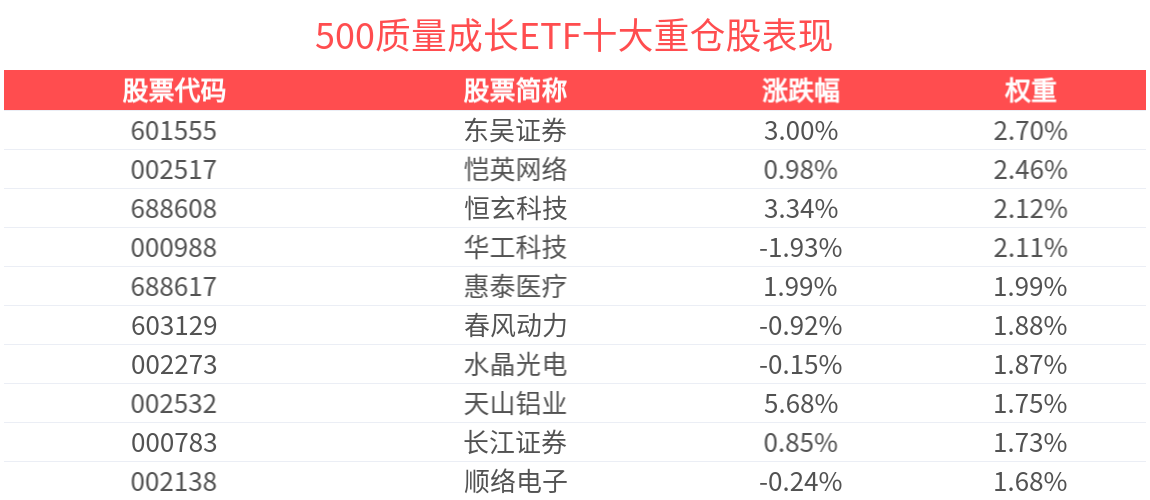
500质量成长ETF紧密跟踪中证500质量成长指数,中证500质量成长指数从中证500指数样本中选取100只盈利能力较高、盈利可持续、现金流量较为充沛且 具备成长性的上市公司证券作为指数样本,为投资者提供多样化的投资标的。 数据显示,截至2025年6月30日,中证500质量成长指数(930939)前十大权重股分别为东吴证券(601555)、恺英网络(002517)、华工科技(000988)、恒玄科技 (688608)、惠泰医疗(688617)、春风动力(603129)、水晶光电(002273)、天山铝业(002532)、长江证券(000783)、顺络电子(002138),前十大权重股合计占比 20.42%。 | 股票代码 | 股票简称 | 涨跌幅 | 权重 | | --- | --- | --- | --- | | 601222 | 东吴证券 | 3.00% | 2.70% | | 002517 | 恺英网络 | 0.98% | 2.46% | | 688608 | 恒玄科技 | 3.34% | 2.12% | | 000988 | 华工科技 | -1.93% | 2.11% | | 688617 | 惠泰医 ...





锌周报:稳增长情绪发酵,锌价震荡偏强-20250721
Tong Guan Jin Yuan Qi Huo· 2025-07-21 03:12
1. Report Industry Investment Rating - Not mentioned in the report 2. Core Views of the Report - Last week, the main contract price of SHFE zinc first declined and then rebounded. Macroscopically, the moderate rebound of inflation and the better - than - expected retail data in the US highlighted economic resilience. Domestically, the good performance of H1 GDP was offset by concerns about insufficient policy stimulus in H2. The statement of optimizing supply by the Ministry of Industry and Information Technology on July 18th ignited market enthusiasm [3][4][11]. - Fundamentally, domestic refinery production increased, with stable operation of new projects, slowdown in processing fee growth, good refinery profits, and sufficient raw materials. The supply was on the rise. The zinc market remained stronger overseas than in China, and imports were difficult to increase. In the demand side, it was the off - season for consumption, and the actual demand was weak. The galvanized plate consumption confidence was boosted, but the actual order increment was limited. The operating rates of die - casting zinc alloy and zinc oxide were weak. The downstream procurement was mainly for rigid demand, and the spot premium further declined, while the inventory accumulation slowed down [4]. - Overall, the domestic and foreign macro - environment was moderately positive, and the fundamentals were weak. The market hoped that the supply optimization could improve the surplus situation of the zinc market. In the short term, the zinc price was mainly influenced by macro and policy expectations, and the futures price was expected to continue to fluctuate strongly. However, it was still unclear how the supply optimization policy would affect the zinc industry chain, so caution was needed when chasing up the price [4]. 3. Summary According to the Directory 3.1 Transaction Data - SHFE zinc decreased from 22380 yuan/ton on July 11th to 22295 yuan/ton on July 18th, a decline of 85 yuan/ton. LME zinc increased from 2738 dollars/ton to 2824 dollars/ton, an increase of 86 dollars/ton. The SHFE - LME ratio decreased from 8.17 to 7.89, a decline of 0.28. The SHFE inventory increased by 4649 tons to 54630 tons, the LME inventory increased by 13850 tons to 119100 tons, and the social inventory increased by 0.33 million tons to 9.35 million tons. The spot premium decreased from 60 yuan/ton to 10 yuan/ton, a decline of 50 yuan/ton [5]. 3.2 Market Review - The main contract price of SHFE zinc ZN2509 first declined and then rebounded. Supported by the domestic anti - involution sentiment, the black - series prices rose, which was beneficial to the zinc price. It found support around 22000 yuan/ton and then rebounded slightly, closing at 22295 yuan/ton, with a weekly decline of 0.38%. The LME zinc price stabilized and rebounded, closing at 2824 dollars/ton, with a weekly increase of 3.14% [6]. - In the spot market, as the zinc price rebounded, the downstream procurement motivation weakened, and the spot premium continued to decline. The zinc prices and premiums varied in different regions such as Shanghai, Ningbo, Guangdong, and Tianjin [7]. - In terms of inventory, as of July 18th, the LME zinc inventory was 119100 tons, an increase of 13850 tons from last week. The SHFE inventory was 54630 tons, an increase of 4649 tons. As of July 17th, the social inventory was 9.35 million tons, an increase of 0.33 million tons from July 10th. The inventory in Guangdong and Tianjin increased significantly, while that in Shanghai decreased slightly [8]. - In the macro - aspect, in the US, the CPI in June increased moderately, the core CPI was lower than expected, the PPI reached a new low, and the retail sales exceeded expectations. There were also various international trade and policy news, such as Trump's tariff - related statements and trade negotiations among countries. In China, the H1 GDP was 66.05 trillion yuan, with a year - on - year growth of 5.3%. The Ministry of Industry and Information Technology stated that the steady - growth work plans for ten key industries were about to be introduced [8][9][10]. 3.3 Industry News - As of July 18th, the average weekly TC of domestic Zn50 remained flat at 3800 yuan/metal ton, and the SMM imported zinc concentrate index increased by 7.27 dollars/dry ton to 73.75 dollars/dry ton. Excellon Resources was preparing to restart the production of the Mallay silver - lead - zinc mine in Peru next year, which had produced 6 million ounces of silver, 45 million pounds of zinc, and 35 million pounds of lead from 2012 to 2018 [12]. 3.4 Related Charts - The report provides multiple charts, including the price trends of SHFE zinc and LME zinc, the internal - external price ratio, the spot premium, the LME premium, the inventory data of SHFE, LME, social and bonded areas, the processing fees of domestic and foreign zinc mines, the import profit and loss of zinc mines, the domestic refined zinc production, the smelter profit, the net import of refined zinc, and the operating rates of downstream primary enterprises [14][16][17].
基建ETF(159619)涨超4.6%,城镇化转型与稳增长政策或提振行业预期
Mei Ri Jing Ji Xin Wen· 2025-07-21 02:17
Core Viewpoint - The infrastructure ETF (159619) has risen over 4.6%, driven by urbanization transformation and stable growth policies that may boost industry expectations [1] Group 1: Urbanization and Infrastructure Development - China's urbanization phase is transitioning from rapid growth to stable development, focusing on enhancing existing urban areas for high-quality development [1] - Key tasks include establishing a new model for real estate development, advancing the renovation of urban villages and dilapidated housing, and emphasizing urban renewal [1] - There is a push to upgrade urban infrastructure, including old pipeline renovations and the networking of urban clusters and metropolitan areas [1] - The focus on green and low-carbon development aims to enhance the safety of urban infrastructure and improve ecological environment management [1] - Future urbanization will emphasize the construction of medium and large cities and metropolitan areas, prioritizing structural optimization, quality enhancement, and governance efficiency [1] Group 2: Infrastructure ETF Overview - The infrastructure ETF (159619) tracks the CSI Infrastructure Index (930608), which selects listed companies in construction, engineering machinery, and other related fields from the A-share market [1] - The index covers multiple infrastructure sectors, including railways, highways, water conservancy, and electricity, reflecting the overall performance of listed companies in infrastructure construction [1] - Investors without stock accounts can consider the Guotai CSI Infrastructure ETF Initiated Link C (016837) and Guotai CSI Infrastructure ETF Initiated Link A (016836) [1]
周期中报预告有何亮点?
2025-07-21 00:32
Summary of Key Points from Conference Call Records Industry or Company Involved - **Airline Industry**: White Cloud Airport, Hainan Airlines, China National Aviation, Eastern Airlines, Southern Airlines, Huaxia Airlines - **Shipping Industry**: Jinjiang Shipping, Antong Holdings - **Express Logistics Industry**: Jitu Express, SF Express, Shentong, Yunda, YTO Express - **Chemical Industry**: TDI market, high-speed resin market, various sub-industries - **Steel Industry**: General steel market performance and outlook - **Coal Industry**: Current market conditions and challenges Core Points and Arguments Airline Industry Performance - White Cloud Airport reported a Q2 profit of 450 million yuan, with net profit excluding non-recurring items at 290 million yuan, stable compared to Q1 [3] - Hainan Airlines expects a mid-term profit of 45 to 65 million yuan, despite a slight loss in Q2 [3] - China National Aviation anticipates a mid-term net profit increase of 78% to 90%, driven by fleet expansion and lower fuel prices [3] - Huaxia Airlines showed strong performance with a Q2 profit of approximately 160 million yuan, exceeding expectations [3] Shipping Industry Growth - Jinjiang Shipping's net profit for H1 is expected to be between 780 million to 810 million yuan, a significant increase of 146% to 155% due to rising demand in Southeast Asia [4] - Antong Holdings reported a net profit of 490 million to 540 million yuan, with a growth of 218% to 250% attributed to adjustments in shipping capacity [4] Express Logistics Sector Highlights - Jitu Express saw a 66% increase in package volume in Southeast Asia and a 14.7% increase in China, benefiting from strong TikTok e-commerce growth [5] - SF Express reported a 32% growth in business volume in June, with Shentong surpassing Yunda in revenue for the first time since 2020 [5] Chemical Industry Insights - The chemical industry’s operating rate fell to 71.9%, the lowest in history, with significant implications for older production facilities [8] - TDI market supply has contracted significantly, leading to rapid price increases, though sustainability of these price hikes is uncertain [12] - High-speed resin market demand remains strong, with companies like Shengjun Group expected to see a 50% increase in sales [13] Steel Industry Outlook - The steel industry is experiencing the lowest production and inventory levels historically, with a potential recovery driven by government policies [15] - Major steel companies have seen a 20% increase in stock prices, with expectations of further profit growth in the coming months [15] Coal Industry Challenges and Opportunities - Coal companies reported mixed results, with some facing significant declines while others, like Baotai Long, turned losses into profits [18] - The coal market is currently in a destocking phase, with rising demand from electricity and chemical sectors [19] Other Important but Possibly Overlooked Content - The launch of the official direct sales platform by Hanglv Zongheng APP aims to enhance ticket sales efficiency for airlines, potentially reducing reliance on OTA platforms [6] - The government’s redefinition of old equipment standards in the petrochemical industry may significantly impact sectors with high old capacity ratios [9] - The chemical sector is expected to face downward pressure in Q3, but certain products like refrigerants and high-speed resins are projected to perform well [14] - The Ministry of Industry and Information Technology's supply-side reforms are expected to benefit major oil companies and private refining enterprises [20][21]
信达策略:周期股异动是牛市主升浪的信号
Ge Long Hui· 2025-07-20 15:19
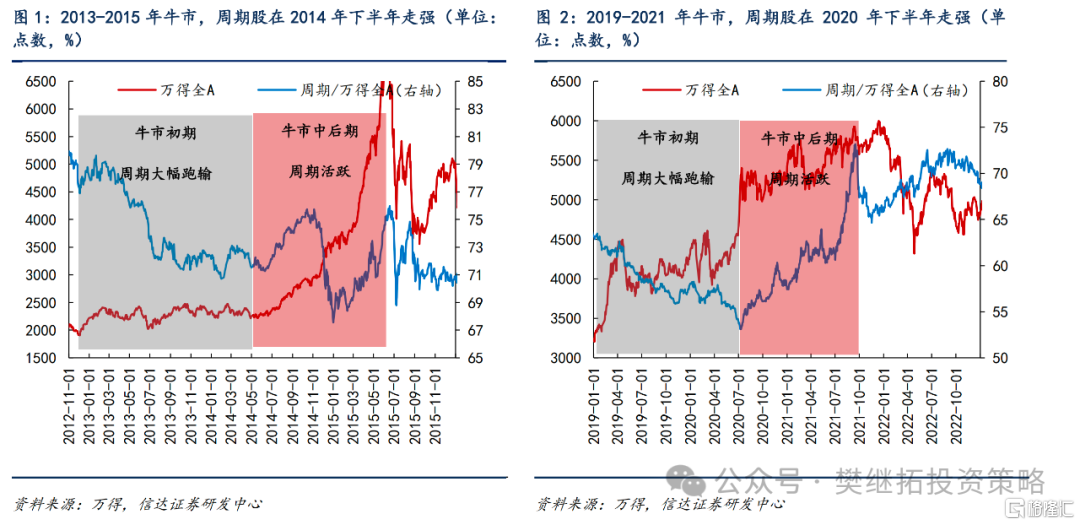
Core Viewpoint - The recent performance of cyclical stocks, such as photovoltaic, steel, and chemicals, indicates a potential signal for the mid-stage main upward wave of the bull market [1][12] Group 1: Historical Context - In previous major bull markets (2013-2015 and 2019-2021), cyclical stocks underperformed in the early stages but became active in the later stages [2][5] - During the mid-stage of the 2014-2015 bull market, cyclical stocks outperformed despite weak economic conditions and declining commodity prices, driven by themes like mergers and acquisitions and state-owned enterprise reforms [2][5] - In the 2020-2021 bull market, cyclical stocks significantly outperformed as the economy stabilized and commodity prices rose [2][5] Group 2: Reasons Behind Performance - The underperformance of cyclical stocks in the early bull market stages is attributed to limited incremental capital, leading to slow price increases, while only a few sectors with strong fundamentals saw gains [9][12] - As the bull market progresses, increased resident capital leads to valuation uplifts across most sectors, with cyclical stocks benefiting from their low valuations in the early stages [9][12] Group 3: Future Outlook - There are two potential scenarios for the future: 1. If economic recovery is weak and supply-side policies take time to impact, cyclical stocks may see 1-2 quarters of excess returns but face volatility afterward [12] 2. If supply-side policies improve quickly and demand-side growth policies show results, cyclical stocks could experience a year-long rally starting from the mid-stage of the bull market [12] - Regardless of the scenario, cyclical stocks are expected to generate excess returns within the next 1-2 quarters [12] Group 4: Current Market Judgments - The current market is characterized by low valuations, weak corporate earnings, and positive policy signals, resembling the early stages of previous bull markets [16] - The market is entering a phase driven by policy improvements and capital inflows, suggesting a broader bull market is likely [16] Group 5: Investment Strategy - The recommendation is to adopt a flexible allocation strategy, increasing exposure to non-bank financials, AI applications, and cyclical stocks, which are expected to show elastic performance in the next six months [18][19] - The focus should shift from a "barbell strategy" to an "elastic strategy," with strong performance anticipated in sectors like new consumption and AI, which are less correlated with the economy [18][19]