
信用债市场

Search documents
周度债市讨论会
2026-03-03 02:52
Summary of Key Points from Conference Call Industry Overview - The conference call primarily discusses the bond market and its current dynamics, including investor sentiment, monetary policy, and fiscal measures in response to trade tensions and economic pressures [1][2][3][4]. Core Insights and Arguments - **Investor Sentiment**: Investors generally hold a bullish outlook on the bond market but are hesitant to make significant investments due to uncertainties surrounding tariff negotiations, economic downturn pressures, and the potential for monetary policy easing [1][2]. - **Policy Expectations**: There is low expectation for significant policy changes from the upcoming Politburo meeting at the end of April, with most investors anticipating a focus on maintaining economic stability and flexibility in policy implementation [1][3][5]. - **Tariff Impact**: Approximately 46% of investors believe that tariff impacts will ease in the third quarter, but overall sentiment regarding the annual outlook for tariff relief remains pessimistic [6][7]. - **Monetary Policy Outlook**: A majority of investors expect a reserve requirement ratio (RRR) cut in the next three months, with a smaller percentage anticipating interest rate cuts. The rationale for RRR cuts includes addressing liquidity gaps and supporting government bond issuance [9][10]. - **Bond Market Predictions**: Investors predict that the 10-year government bond yield will fluctuate between 1.5% and 1.8%, indicating a slight downward adjustment in market expectations [11]. Additional Important Content - **Trade Policy Response**: The policy response to trade tensions includes stabilizing the market, maintaining exchange rate stability, and expanding domestic demand, with a focus on service consumption as a key driver [12][13]. - **Service Consumption Policies**: Recent policies in the service consumption sector include direct subsidies for hospitality, dining, and transportation, with expectations for further financial support to stimulate consumption [14]. - **Real Estate Sector Focus**: Key points of interest in the real estate sector include government attitudes towards market stabilization and the potential for policy shifts regarding property development and financing [15][16]. - **Credit Bond Market Regulation**: Recent regulatory changes in the credit bond market have tightened oversight on local state-owned enterprises, impacting their financing capabilities [24]. - **Local Government Financing**: Local governments, particularly in Guangdong, are actively issuing special bonds to support land reserve projects, with a focus on expediting the issuance process compared to previous years [25][37]. This summary encapsulates the essential insights and data points discussed during the conference call, providing a comprehensive overview of the current state of the bond market and related economic policies.
信用债市场周观察:保持短久期、高流动性策略
Orient Securities· 2025-10-13 03:16
固定收益 | 动态跟踪 保持短久期、高流动性策略 信用债市场周观察 研究结论 风险提示 政策变化超预期;货币政策变化超预期;经济基本面变化超预期;信用风险暴露超预 期;数据统计可能存在遗误 报告发布日期 2025 年 10 月 13 日 | 齐晟 | 执业证书编号:S0860521120001 | | --- | --- | | | qisheng@orientsec.com.cn | | | 010-66210535 | | 杜林 | 执业证书编号:S0860522080004 | | | dulin@orientsec.com.cn | | | 010-66210535 | | 王静颖 | 执业证书编号:S0860523080003 | | | wangjingying@orientsec.com.cn | | | 021-63326320 | | 徐沛翔 | 执业证书编号:S0860525070003 | | | xupeixiang@orientsec.com.cn | | | 021-63326320 | | 估值小幅修复,底仓品种价值显现:可转 | 2025-09-29 | | --- | --- ...
信用利差周报2025年第36期:央行支持金融机构发债加大消费信贷投放,美联储降息开启宽松窗口-20250926
Zhong Cheng Xin Guo Ji· 2025-09-26 07:11
1. Report Industry Investment Rating - Not provided in the given content 2. Core Viewpoints of the Report - The central bank's support for financial institutions to issue bonds to enhance consumer credit supply is expected to enrich the credit - bond market product structure, but the credit risk and pricing of underlying assets need attention [3][11]. - The Fed's interest - rate cut eases the inversion pressure of the Sino - US interest - rate spread, providing external space for China's monetary policy. However, its impact on China's credit - bond market is mainly on the emotional and capital levels, and the real effect needs to be transmitted through domestic policies. Investors are advised to be cautious [4][14][16]. - The current credit - bond investment has entered a "cooling - off period", and the investment strategy should focus on coupon defense of short - and medium - term varieties, with more attention paid to industry fundamentals and individual credit - risk identification [16]. 3. Summary by Directory Market Hotspots - **Central bank supports financial institutions to issue bonds**: On September 17, the central bank stated that it would support financial institutions to issue financial bonds and ABS to enhance consumer credit supply. As of August 2025, the bond - issuance scale of financial institutions reached 3.53 trillion yuan, a year - on - year increase of 18.06%. This move is expected to increase the supply of ABS products and enrich the credit - bond market variety structure, but the credit risk of underlying assets should be noted [3][10][11]. - **Fed's interest - rate cut**: On September 17, the Fed cut the federal funds rate target range by 25 basis points to 4.00% - 4.25%. It eases the Sino - US interest - rate spread inversion pressure, but the impact on China's credit - bond market is limited. The domestic bond - market logic is still dominated by internal factors. Investors are advised to be cautious [4][13][14]. Macroeconomic Data - At the end of August, the stock of social financing scale was 424 trillion yuan, a year - on - year increase of 8.8%, with the growth rate decreasing by 0.2 percentage points compared with July. The new social financing scale in August was 2.57 trillion yuan, a year - on - year decrease of 463 billion yuan, mainly due to the weakened support of government bond financing for social financing. In terms of money supply, M1 in August was 6.0%, up 0.4 percentage points from the previous month, and the M1 - M2 "scissors gap" narrowed to 2.8% [5][17]. Money Market - Last week, the central bank net - injected 1162.3 billion yuan through open - market operations. Affected by factors such as the approaching quarter - end, increased cash demand for the National Day holiday, and monthly time points, the capital price increased. The repurchase rates for terms within a month increased by 5 - 12 basis points, while the 3 - month and 1 - year Shibor changed little [6][20]. Credit - Bond Primary Market - Last week, the credit - bond issuance scale increased significantly to 326.103 billion yuan, with the daily average issuance scale increasing to 65.221 billion yuan. The cancellation of bond issuance decreased to 460.5 million yuan. All bond types and industries saw an increase in issuance scale. The infrastructure investment and financing industry had a net inflow of 38.49 billion yuan, and most industries in industrial bonds had a net inflow. The average issuance cost of credit bonds fluctuated, with a change range of 4 - 44 basis points [23][24][31]. Credit - Bond Secondary Market - Last week, the secondary - market spot - bond trading volume was 9261.011 billion yuan, with the daily average trading volume increasing to 1852.202 billion yuan, indicating increased trading activity. Affected by the "stock - bond seesaw" effect, most bond yields increased. The interest - rate bond yields increased by up to 5 basis points, and the credit - bond yields increased by 2 - 5 basis points. The credit spreads fluctuated within a narrow range, and the rating spreads changed little, with a change range within 3 basis points [35][38][42].
关注科创债ETF未“超涨”成分券
Orient Securities· 2025-09-22 03:11
1. Report Industry Investment Rating No relevant content provided. 2. Core Viewpoints of the Report - After the issuance of the second batch of Sci - tech Bond ETFs, the "over - rising" spread of component bonds remained stable at around 7 - 8bp, with no "front - running" phenomenon. If the scale of the second - batch ETFs expands rapidly, component bonds with a smaller "over - rising" margin may experience an excessive decline in valuation. Bonds with a maturity of more than 5 years or perpetual bonds have a smaller "over - rising" margin [5][8]. - Although the bond market fluctuated last week, credit bonds performed relatively stably. Credit bonds are still a choice for pursuing certainty, and medium - term bonds of 2 - 3 years can be quickly deployed. It is recommended to use the idea of mining based on the issuer's yield curve [5][12]. - Credit bonds are still the choice for pursuing certainty, and the 2 - 3Y medium - term can be quickly deployed. The idea of mining based on the issuer's yield curve is continued to be recommended, and riding opportunities or "convex points" of individual bonds can be found during the exploration towards the medium - and long - term [5][12]. 3. Summary According to the Directory 3.1 Credit Bond Weekly Viewpoint - The second batch of Sci - tech Bond ETFs completed fundraising on September 12, with a total issuance of approximately 40.8 billion yuan and are scheduled to be listed on September 24. The "over - rising" spread of component bonds is stable, and the probability of large - scale redemptions and negative feedback is low. Component bonds with a smaller "over - rising" margin may see an excessive decline in valuation if the ETF scale expands [5][8]. - Last week, the bond market fluctuated, but credit bonds were stable. Credit bonds are a good choice for certainty, and 2 - 3Y medium - term bonds can be deployed. The idea of mining based on the issuer's yield curve is recommended [5][12]. 3.2 Credit Bond Weekly Review 3.2.1 Negative Information Monitoring - From September 15 to September 21, 2025, Wuhan Contemporary Technology Investment Co., Ltd. failed to pay the principal and interest of bond H20 Technology 4 on time. Shanghai Shimao Construction Co., Ltd., Sichuan Bluetown Development Co., Ltd., and Shanghai Shimao Co., Ltd. had major negative events such as overdue debts, being included in the list of dishonest被执行人, and large - scale litigation [16][17]. 3.2.2 Primary Issuance - From September 15 to September 21, the primary issuance of credit bonds was 326.1 billion yuan, a 25% increase from the previous period. The total repayment amount increased to 236.5 billion yuan, and the net inflow was 89.6 billion yuan, remaining the same as the previous period. The cost of new bonds for high - grade issuers increased, and 3 bonds were cancelled or postponed for issuance, with a total scale of 1.55 billion yuan [17][18][20]. 3.2.3 Secondary Trading - The valuation of credit bonds was generally stable, fluctuating within ±2bp, and credit spreads were passively narrowed by about 4bp. The 5Y - 1Y term spreads of all grades widened, while the 3Y - 1Y spreads were flat or slightly narrowed. The AA - AAA grade spreads were stable or declined. The credit spreads of urban investment bonds in each province narrowed by about 1bp on average, and only Ningxia widened. The spreads of industrial bonds in each industry also narrowed by about 1bp, with the media industry having the largest narrowing of 2bp. The liquidity of credit bonds improved, with the turnover rate increasing by 0.24pct to 1.77%. The top five real - estate companies with widening spreads were Times Holdings, Country Garden, Rongqiao, Logan Group, and Pearl River Investment [22][26][29].
信用债ETF系列报告:信用债ETF近期表现如何?
Hua Yuan Zheng Quan· 2025-09-05 05:56
Report Summary 1. Report Industry Investment Rating The document does not provide the industry investment rating. 2. Core Viewpoints - In August 2025, although the net value of credit - bond ETFs declined, the total market value and circulating shares remained stable, with the market value and shares of science - innovation bond ETFs increasing significantly [2]. - The decline in the net value of credit - bond ETFs did not trigger a negative feedback loop of fund share redemptions, and the secondary discount of credit - bond ETFs did not show signs of spreading to the primary market [2]. - As of the end of August 2025, 8 benchmark - making credit - bond ETFs and 10 science - innovation bond ETFs have been included in the exchange repurchase pledge pool, which can help holders improve leverage efficiency and relieve liquidity pressure [2]. - The secondary discount rate of credit - bond ETFs will fluctuate and return to the center. The bond market is expected to recover in the future, which may drive up the net value of credit - bond ETFs [2][3]. - In August 2025, the yields of the constituent bonds of listed credit - bond ETFs did not show obvious over - adjustment. Attention should be paid to the marginal impact that the listing of the second batch of science - innovation bond ETFs may bring [3]. 3. Summary by Relevant Content 3.1 Performance in August 2025 - **Market Environment**: In August 2025, the equity market continued its strong performance, and the Shanghai Composite Index rose from 3,573 at the end of July to 3,858 on August 29. Affected by the stock - bond seesaw effect, the bond market declined, and the yield of the active 10 - year Treasury bond rose from around 1.71% at the end of July to 1.78% on August 29 [2]. - **Net Value Performance**: The average unit net value of science - innovation bond ETFs decreased by 0.26% compared with the end of last month, and all adjusted to below 100 yuan by the end of August. The average unit net value of benchmark - making credit - bond ETFs decreased by 0.23% compared with the end of last month [2]. - **Market Value and Circulating Shares**: The total market value and circulating shares of credit - bond ETFs were generally stable in August, and there was no large - scale primary redemption of ETF shares. By the end of August, the total market value of benchmark - making credit - bond ETFs was 126.2 billion yuan, and the circulating shares were 1.254 billion, both slightly decreasing from the end of last month. The total market value of science - innovation bonds was 120.2 billion yuan, and the circulating shares were 1.207 billion, showing a significant increase from the end of last month [2]. - **Discount Rate**: On August 18, affected by the strong performance of the equity market, the discount rate of benchmark - making credit - bond ETFs deepened to over 0.5%, and the discount rate of science - innovation bond ETFs exceeded 0.3%. By the end of August, the discount rate of benchmark - making credit - bond ETFs was 0.2%, and that of science - innovation bond ETFs was 0.06%, showing a large - scale repair compared with the deep discount on August 18 [2]. 3.2 Inclusion in the Repurchase Pledge Pool - As of the end of August 2025, 8 benchmark - making credit - bond ETFs and 10 science - innovation bond ETFs have been included in the exchange repurchase pledge pool. Holders can choose to finance through repurchase to obtain liquidity instead of directly redeeming ETF shares at the primary level, which can relieve the pressure of ETF share redemptions to some extent [2][3]. 3.3 Future Outlook - **Market Factors**: As of the end of August 2025, the total number of fixed - income wealth management products in the market was 40,605, with a total scale of 28.68 trillion yuan, an increase of 120 billion yuan from the end of July. In August, wealth management products net - bought 59.9 billion yuan of credit bonds in the inter - bank market, showing no signs of negative feedback from wealth management redemptions [2]. - **Yield Forecast**: Considering factors such as continuous central bank easing and the decline in bank liability costs, the report expects the yield of the 10 - year Treasury bond to be between 1.6% - 1.8% in the second half of the year, and the bond market is expected to recover, which may drive up the net value of credit - bond ETFs [2][3]. 3.4 Component Bond Yields and Market Impact - In August 2025, the yields of the constituent bonds of the CSI AAA science - innovation bond index and the Shanghai Stock Exchange benchmark - making corporate bond index mostly showed significant corrections, but compared with the maturity yields of medium - and short - term notes of ChinaBond (AA+), the yields of the index constituent bonds did not show obvious over - adjustment [3]. - On August 20, 14 fund companies collectively submitted applications for the second batch of science - innovation bond ETFs. Based on the impact of the first batch of science - innovation bond ETFs on the yields of constituent bonds after listing, the second batch may bring a downward trend in the spreads of constituent bonds at the initial stage of listing. It is recommended to pay attention to the allocation opportunities of medium - and short - duration science - innovation bond ETF constituent bonds [3].
一文全览“美国债券市场”
Tianfeng Securities· 2025-09-02 12:11
1. Report Industry Investment Rating - No information provided regarding the industry investment rating. 2. Core Viewpoints of the Report - The US bond market is the world's largest, influencing global capital flows and investor decisions. The report comprehensively analyzes its current situation, focusing on the classification, structure, and scale of credit bonds [10][11]. 3. Summary According to Relevant Catalogs 3.1 US Bond Market Overview 3.1.1 Global Fixed - Income Market - In 2024, the total global fixed - income market size was $145.06 trillion, with a year - on - year growth of 2.43%. The US fixed - income market accounted for 40.10% of the global total, reaching $58.2 trillion (BIS口径), 2.22 times that of the EU market and 2.32 times that of the Chinese mainland market [11]. - China's mainland fixed - income market had the fastest growth rate in 2024 at 9.31%, followed by Singapore (7.02%), Hong Kong (5.94%), and the US (5.23%) [15]. 3.1.2 US Fixed - Income Market - **Stock Scale**: As of Q1 2025, the US fixed - income market stock was $47.44 trillion (SIFMA口径), a 1.35% increase from the end of 2024. Treasury bonds had the highest balance at $28.58 trillion, accounting for 60.25%, followed by corporate bonds ($11.36 trillion, 23.94%), municipal bonds ($4.23 trillion, 8.92%), federal agency bonds ($1.98 trillion, 4.18%), and money market instruments ($1.28 trillion, 2.70%) [17]. - **Issuance Scale**: In H1 2025, the US fixed - income market issuance was $5.70 trillion, a 14.21% increase compared to the same period in 2024. Treasury bond issuance was the largest at $2.43 trillion, accounting for 42.69%, followed by corporate bonds ($1.17 trillion, 20.58%) and MBS ($0.87 trillion, 15.19%) [25]. - **Daily Average Trading Volume**: In H1 2025, the daily average trading volume was $1.54 trillion, a 19.34% increase compared to the full - year 2024 average. Treasury bonds had the largest trading volume at $1.11 trillion, accounting for 71.97%, followed by MBS ($3497.06 billion, 22.77%) and corporate bonds ($575.01 billion, 3.74%) [32][34]. - **Daily Average Turnover Rate**: The US Treasury market had the highest liquidity, with a daily average turnover rate of 3.32% in 2024. MBS was second, with a peak turnover rate of 2.73% in 2020. Corporate bonds, municipal bonds, federal agency bonds, and ABS had long - term turnover rates below 1% [38]. 3.2 US Credit Bond Market Overview 3.2.1 US Municipal Bond Market - **Stock and Primary Issuance**: From 2014 - Q1 2025, the US municipal bond stock showed a fluctuating upward trend, reaching $4.23 trillion in Q1 2025. From 2011 - 2024, public - issued revenue bonds were the main issuance type, with the issuance of public - issued general obligation bonds increasing first and then decreasing, and private - placement bonds having a relatively small scale [47]. - **Secondary Trading**: In H1 2025, the total trading volume reached $1.92 trillion, with 8.7038 million transactions, increasing by 18.99% and 26.04% respectively compared to the same period. The turnover rate recovered to 0.32% in 2024 after reaching a low in 2021 [60]. - **Holder Structure**: Individual investors were the largest holders, accounting for 45.24% in Q1 2025, followed by mutual funds, which accounted for 28.28% [65]. - **Rating and Default Situation**: As of the end of 2024, about 92% of municipal bonds had an A - grade or higher. The median rating was Aa3. The default rate was low, with the five - year and ten - year average cumulative default rates for all municipal bonds being 0.08% and 0.15% respectively [67][79]. 3.2.2 US Corporate Bond Market - **Stock and Primary Issuance**: The corporate bond stock continued to expand, reaching $11.36 trillion in Q1 2025, a year - on - year increase of 3.67%. In H1 2025, the total issuance was $1.17 trillion, a 5.14% year - on - year increase. Investment - grade bonds accounted for 86.34% of the issuance in H1 2025 [84][88][90]. - **Secondary Trading**: The daily average trading volume increased year by year, reaching $759.83 million in H1 2025, a 19.20% increase compared to 2024. The turnover rate was relatively stable from 2015 - 2024, slightly increasing to 0.45% in 2024 [96]. - **Holder Structure**: Foreign investors were the largest holders in Q1 2025, accounting for 28.55%, followed by life insurance companies (22.81%) and mutual funds (15.06%) [102]. - **Rating and Default Situation**: Corporate bond ratings were generally lower than municipal bonds. In 2024, the number of Baa - rated corporate bonds was the largest. The global corporate debt default amount increased in 2024, with the US having the largest number of default companies. Distressed debt exchanges were the main cause of default [107][113]. 3.3 US Other Bond Market Overview 3.3.1 US Treasury Market - **Stock Scale**: As of H1 2025, the US Treasury stock was $28.65 trillion, with medium - term Treasury bonds having the largest share at $15.07 trillion [125]. - **Issuance Scale**: In H1 2025, the issuance was $14.42 trillion, a 3.02% year - on - year increase, and the net increase was $0.34 trillion, a $0.30 trillion year - on - year decrease. Short - term Treasury bonds accounted for 83.14% of the issuance in H1 2025 [129]. - **Trading Volume**: The daily average trading volume increased year by year, reaching $1.11 trillion in H1 2025, a 21.74% year - on - year increase [131]. 3.3.2 US Federal Agency Bond Market - **Stock Scale**: From 2014 - 2021, the scale decreased, and then began to recover after 2022, reaching $1.98 trillion in Q1 2025 [136]. - **Issuance**: The issuance was affected by multiple factors and fluctuated significantly year - by - year. The Federal Home Loan Banks had the largest issuance share [142]. - **Trading Volume**: The daily average trading volume showed a fluctuating downward trend, decreasing from $6.05 billion in 2014 to the range of $3 - 4 billion in recent years [142]. 3.3.3 US MBS and ABS Markets - **Stock Scale**: MBS achieved fluctuating growth with government guarantees, while ABS shifted to mortgage - type underlying assets due to the contraction of unsecured assets [147]. - **Issuance**: In H1 2025, MBS issuance was $86.5381 billion, and ABS issuance was $21.4659 billion. Automobile loan - backed securities became the highest - issuance variety in ABS in H1 2025 [153]. - **Trading Volume and Turnover Rate**: MBS had a larger trading scale, and its daily average turnover rate was higher than that of ABS, reaching 2.40% and 0.09% respectively in 2021 [155][159].
如何看待当前美国经济数据?
2025-07-21 00:32
Summary of Key Points from Conference Call Records Industry Overview - The current economic situation in the United States is characterized by a gradual decline, with inflation and retail data showing signs of weakness. The CPI is expected to rise to around 3% in September-October and potentially reach 3.3%-3.5% by year-end, influenced by geopolitical factors and tariffs [1][2][3]. Core Insights and Arguments - **Inflation and Retail Sales**: In June, retail sales increased by 0.6%, but the actual growth rate was only 0.3%, indicating insufficient consumer market resilience. The impact of tariffs is causing a dampening effect on consumer expectations, which may lead to further pressure on consumer sentiment [1][2]. - **Economic Stagnation**: The U.S. economy is showing signs of stagflation, with slight inflation increases and poor retail performance. Despite decent non-farm payroll data in June, the structure of employment remains weak, suggesting significant room for interest rate cuts by the Federal Reserve in the second half of the year [2][3]. - **Market Optimism**: There is a prevailing optimism in the market, with expectations of breaking through a peak in the second half of 2024. Investors believe the most challenging phase has passed, and domestic policies will remain supportive to counter external uncertainties [4][5]. - **Consumer Subsidy Policies**: The effectiveness of domestic subsidy policies, particularly in the home appliance and automotive sectors, has led to a notable recovery in retail growth, indicating that demand has not been exhausted. These policies are expected to continue, with a gradual tapering process [6][10]. - **Emerging Industries**: Emerging sectors such as artificial intelligence and robotics are receiving significant policy support and technological advancements, positioning them as potential new growth points for the economy [8][10]. Additional Important Content - **Investment Recommendations**: Three key sectors are recommended for investment: 1. **Consumer Sector**: Focus on domestic subsidy-related areas, offline service consumption, and new consumption trends. 2. **Technology Sector**: Emphasis on AI, robotics, and the semiconductor supply chain. 3. **Dividend Sector**: High dividend, stable cash flow, and low valuation stocks are suggested for long-term positioning [10][11]. - **Market Liquidity**: The market has seen a good effect from liquidity and inflow of incremental funds, with a solid foundation for individual investors to enter the market [7]. - **Future Market Trends**: The market is expected to transition from policy-driven to fundamentals and liquidity-driven growth, with potential for a new upward trend in the second half of the year [9][11]. This summary encapsulates the key points from the conference call records, highlighting the current economic landscape, core insights, and investment opportunities within the U.S. market.
渤海证券研究所晨会纪要(2025.07.16)-20250716
BOHAI SECURITIES· 2025-07-16 01:20
Macroeconomic and Strategic Research - In June 2025, China's exports in USD terms increased by 5.8% year-on-year, up from 4.8% in May, while imports rose by 1.1%, recovering from a 3.4% decline in the previous month [2] - The trade surplus reached USD 114.77 billion, compared to USD 103.22 billion in May [2] - The rebound in export growth is attributed to the delayed effects of the US-China tariff suspension and ongoing demand from ASEAN countries, although future costs may rise due to new US-Vietnam tariff agreements [2] - The global manufacturing PMI returned above the neutral line, providing support for Chinese exports, with significant improvements noted in South Korea's export growth [2] - Import growth was driven by strong demand for high-end manufacturing products, particularly semiconductors, contributing approximately 1.8 percentage points to the overall import growth [3] - Export pressures are expected to emerge by the end of Q3 2025, influenced by US tariff policies and potential demand shifts [4] Fixed Income Research - The issuance guidance rates for credit bonds mostly declined, with an overall change of -9 basis points to 0 basis points [4] - The net financing amount for credit bonds increased, with corporate bonds seeing zero issuance while other types experienced growth [5] - The secondary market saw a decrease in transaction volume, with corporate bonds and company bonds increasing while medium-term notes and short-term financing bonds decreased [5] - Credit spreads for short-term and corporate bonds narrowed, indicating a generally low historical spread level, particularly for AAA-rated five-year bonds [5] - The report suggests a cautious approach to investing in credit bonds, emphasizing the importance of monitoring interest rate trends and individual bond coupon values [5] Industry Research - The metal industry faces increased uncertainty due to tariffs, with notable developments including Trump's proposed 30% tariffs on Mexico and the EU, and a 17% year-on-year increase in copper production from Codelco [7] - The steel sector shows manageable inventory levels and limited supply-demand conflicts, with raw material prices rebounding, supporting price stability [8] - Copper prices are under pressure due to tight supply and low inventory, compounded by US tariff policies creating trade uncertainties [8] - Aluminum prices are expected to fluctuate due to macroeconomic uncertainties and subdued downstream demand during the off-season [8] - Gold prices are supported by tariff and trade uncertainties, with future movements dependent on economic data and geopolitical developments [8] - The lithium market is experiencing downward pressure from oversupply, despite some support from "anti-involution" sentiments [8] - The report maintains a "neutral" rating for the steel industry and a "positive" rating for non-ferrous metals, recommending increased holdings in specific companies [9]
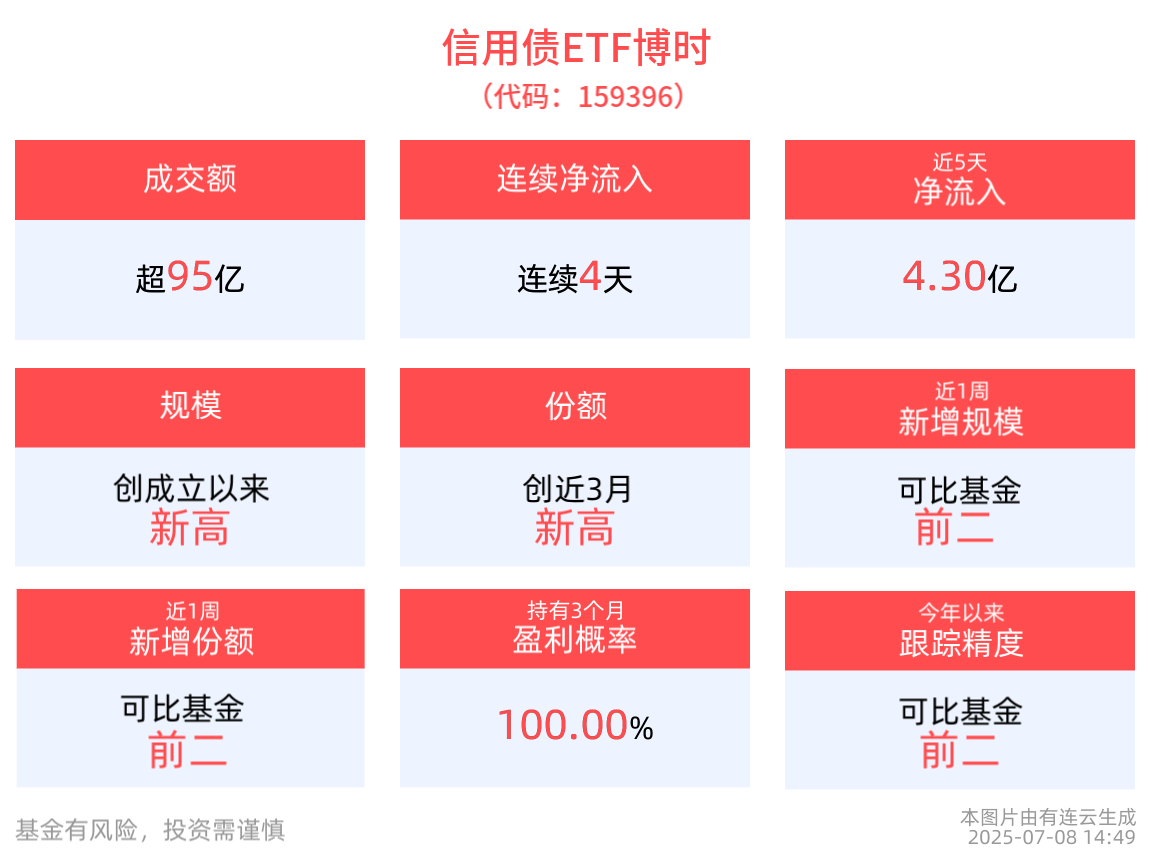
最新规模创成立以来新高!信用债ETF博时(159396)连续4天净流入,内地债市未来数年有巨大增长机会
Sou Hu Cai Jing· 2025-07-08 07:13
Core Viewpoint - The credit bond ETF from Bosera has shown strong performance and liquidity, with significant inflows and a positive outlook for the credit bond market in China [3][4]. Group 1: Performance Metrics - As of July 7, 2025, the Bosera credit bond ETF has accumulated a weekly increase of 0.26%, ranking in the top 25% among comparable funds [3]. - The ETF's latest scale reached 12.742 billion yuan, marking a new high since its inception and ranking second among comparable funds [3]. - The ETF has achieved a monthly profitability percentage of 80.00% since its inception, with a historical holding period of 3 months showing a 100.00% profitability probability [4]. Group 2: Liquidity and Trading Activity - The ETF recorded a turnover rate of 74.67% during trading, with a total transaction volume of 9.562 billion yuan, indicating active market participation [3]. - Over the past week, the ETF averaged daily transactions of 5.386 billion yuan, ranking first among comparable funds [3]. - The ETF has seen continuous net inflows over the past four days, totaling 430 million yuan, with a peak single-day inflow of 185 million yuan [4]. Group 3: Risk and Return Analysis - The ETF's maximum drawdown since inception is 0.89%, with a relative benchmark drawdown of 0.10%, indicating a relatively stable performance [4]. - The Sharpe ratio for the past month is 1.63, placing it in the top 50% among comparable funds, suggesting higher returns for the same level of risk [4]. - The ETF has a management fee of 0.15% and a custody fee of 0.05%, which are the lowest among comparable funds [4]. Group 4: Market Context - The CEO of the Hong Kong Stock Exchange highlighted the growing demand for connectivity between global and domestic markets, with the Bond Connect program being a preferred channel for international investors in China's interbank bond market [3]. - Guohai Securities maintains an optimistic outlook for the credit bond market, suggesting strategies to explore short-term yields and focus on high-valuation, liquid targets in the 3-5 year range [3].

2025年7月信用债市场展望:信用债ETF扩容,有何机会与风险?
Shenwan Hongyuan Securities· 2025-07-03 15:14
Group 1 - The macro environment for credit bonds remains favorable in July 2025, with a focus on new supply and demand changes, particularly the expansion of credit bond ETFs [3] - Credit bond supply is not expected to improve significantly, but structural changes are emerging, with a notable increase in the issuance of technology innovation bonds [3] - The overall yield of various credit bonds is at a relatively low level since 2024, with credit spreads showing differentiation, particularly in the short and medium to long-term segments [3][26] Group 2 - The credit bond market is expected to experience a strong but volatile performance in July, supported by the recovery of wealth management scale and the expansion of ETFs, which may further improve demand for credit bonds [3] - A stable coupon strategy is recommended, with a focus on opportunities and risks arising from the expansion of credit bond ETFs [3] - The report suggests a 2-3 year short to medium-term strategy while actively exploring the value of medium to high-grade credit bonds in the 3-5 year range, particularly 4-5 year bonds [3] Group 3 - The characteristics of credit bond ETF constituent bonds include a predominance of high ratings (AA+ and above), with a higher proportion of central and state-owned enterprises [7] - Recent performance of constituent bonds has been strong, with increased liquidity and a relative decline in yields and credit spreads compared to non-constituent bonds [7] - Strategies for credit bond ETF expansion include early positioning in constituent bonds before listing and focusing on related non-constituent bond opportunities [7][5] Group 4 - In June 2025, the issuance and net financing of traditional credit bonds increased, with a total issuance of 1.304 trillion yuan and net financing of 252.7 billion yuan [13] - The net financing of urban investment bonds expanded further, while the issuance and net financing of industrial bonds also saw a significant increase [13] - The report highlights that the credit bond yield overall declined in June, with long-term bonds outperforming short-term ones [19][27]