
宏观政策

Search documents
中央财办分管日常工作的副主任、中央农办主任韩文秀,发表署名文章
Zhong Guo Ji Jin Bao· 2026-02-16 05:31
Core Viewpoint - The article emphasizes the importance of maintaining stability while seeking progress and improving quality in economic work, aiming for a good start to the "15th Five-Year Plan" [3][4]. Group 1: International and Domestic Situations - In 2025, the economic work will be reviewed, highlighting achievements during the "14th Five-Year Plan" and analyzing both international and domestic challenges [3][4]. - Internationally, geopolitical tensions and economic instability are increasing, with predictions of a decline in global trade growth from 2.4% in 2025 to 0.5% in 2026 [5]. - Domestically, there are significant challenges such as weak consumer demand and investment growth, with per capita consumer spending growth lagging behind disposable income growth [6]. Group 2: Economic Support and Reform - The article outlines five essential principles for economic work, including fully tapping economic potential and combining policy support with reform innovation [8][9]. - It stresses the need for a balanced approach between market freedom and government regulation to foster a healthy economic environment [10]. Group 3: Investment and Human Capital - There is a call for a dual focus on investing in physical assets and human capital, emphasizing the importance of improving living standards and developing human resources [11][12]. - The need for investment in education, healthcare, and skills training is highlighted to enhance overall productivity and economic resilience [12]. Group 4: Key Economic Tasks for 2026 - The article outlines key tasks for 2026, including expanding domestic demand, promoting technological and industrial innovation, and deepening reforms to stimulate high-quality development [13][14][15]. - It emphasizes the importance of improving the business environment and enhancing cooperation in international trade [16]. Group 5: Social Welfare and Risk Management - There is a strong focus on improving people's livelihoods, with policies aimed at stabilizing employment and enhancing social services [17]. - The article also addresses the need for effective risk management in key sectors, particularly in real estate and local government debt [18].
华宝期货晨报铝锭-20260213
Hua Bao Qi Huo· 2026-02-13 03:22
成材:重心下移 偏弱运行 铝锭:春节下游走弱 市场偏谨慎 投资咨询业务资格: 负责人:赵 毅 从业资格号:F3059924 投资咨询号:Z0002978 电话:010-62688526 从业资格号:F3078638 投资咨询号:Z0018248 电话:010-62688555 晨报 铝锭 以伊冲突 于 1 月 5 日开始停产;其余大部分钢厂均表示将于 1 月中旬左右停产放假, 个别钢厂预计 1 月 20 日后停产放假,停产期间日度影响产量 1.62 万吨左 右。2024 年 12 月 30 日-2025 年 1 月 5 日,10 个重点城市新建商品房成 交(签约)面积总计 223.4 万平方米,环比下降 40.3%,同比增长 43.2%。 成材昨日继续震荡下行,价格再创近期新低。在供需双弱的格局下, 市场情绪同样偏悲观,导致价格重心持续下移。无论从宏观上还是产业上, 市场近期均无太多亮点。且今年冬储偏低迷,对价格支撑不强。 观点:震荡整理运行。 后期关注/风险因素:宏观政策;下游需求情况。 成 材:武秋婷 原材料:程 鹏 原材料: 冯艳成 有色金属:于梦雪 基本面来看,当前国产铝土矿货源较为充足,短期价格持稳 ...
碳酸锂:区间震荡整理,聚焦供需边际,成材:重心下移偏弱运行
Hua Bao Qi Huo· 2026-02-13 03:22
Report Summary 1. Report Industry Investment Rating - Not provided in the content 2. Core View of the Report - Supply and demand have returned to a tight balance. Due to the uncertainty during the Spring Festival, it is recommended to hold a light position and wait and see before the festival [5] 3. Summary According to Relevant Contents Market Performance - Yesterday, the price of the main contract of lithium carbonate futures rose significantly to 149,420 yuan/ton, with a slight decrease in trading volume and open interest; the daily inventory of lithium carbonate on the GZFE increased to 37,282 lots. The SMM average price of electric carbon in the spot market was 142,500 yuan/ton, with an electrician price difference of 3,500 yuan/ton. The spot market sentiment was cautious despite the strong futures market [3] Fundamental Analysis - **Supply**: Last week, raw material prices in the market generally declined. This week, the SMM total weekly operating rate was 46.02% (-1.27%), and the operating rates of all processes except lithium mica decreased. The SMM weekly total output was 20,184 tons (-560 tons). There were also information disturbances on the supply side, and the sentiment of ethnic resource nationalism increased, providing some resonance support to the overall market sentiment [3][4] - **Demand**: Last week's data showed that the production of lithium iron phosphate and ternary materials decreased slightly month - on - month, and inventory was destocked. As of January 18, the penetration rate of new energy vehicle sales in the SMM data rose to 55.6%, remaining at a relatively high level. In January, the total production of power and energy storage batteries in China was 168.0 GWh, a month - on - month decrease of 16.7% and a year - on - year increase of 55.9%; sales were 148.8 GWh, a month - on - month decrease of 25.4% and a year - on - year increase of 85.1%. Energy storage cells performed strongly, with both production and sales booming and low inventory [4] - **Inventory**: According to SMM data, last week, the social inventory of the four - location sample increased by 3.73% week - on - week to 43,050 tons. This week, the total sample weekly inventory decreased to 102,932 tons, and the total inventory days decreased to 29.6 days, returning to a tight - balance pattern [4] Macro - policy and Environment - **Demand - side**: Multiple incentives such as subsidies for car trade - ins and export tax rebates for batteries stimulate terminal consumption and improve macro - liquidity [5] - **Supply - side**: On January 15, the National Development and Reform Commission proposed to introduce management measures for the comprehensive utilization of new energy vehicle power batteries, which will improve the recycling threshold and eliminate backward production capacity, optimizing the domestic supply structure and raising the cost support center in the long term [5] - **Industrial Planning**: The industrial planning of Qinghai Salt Lake, the key points of the "15th Five - Year Plan" for energy storage, and a series of deployments at the Central Economic Work Conference form synergistic benefits, supporting long - term supply - demand balance [5] - **Macro Environment**: The central bank's structural interest rate cut indirectly strengthens the long - term macro - positive atmosphere [5]
一季度《中国经济观察》发布:经济韧性与分化并存,政策蓄力构建再平衡
Sou Hu Cai Jing· 2026-02-12 09:18
Group 1 - The core viewpoint of the articles indicates that China's economy is projected to reach 140 trillion yuan in 2025, with a real GDP growth of 5.0%, meeting the initial target growth rate [2] - In 2025, the industrial production showed steady improvement, with the manufacturing value-added growing by 6.1% year-on-year, supported by strong export demand and domestic equipment renewal policies [5] - The retail sales of consumer goods in 2025 increased by 3.7% year-on-year, although the fourth quarter saw a decline of 1.8%, marking the first quarterly negative growth since 2023 [9] - Fixed asset investment in 2025 experienced a decline of 3.8%, marking the first annual negative growth since records began, with significant contractions in real estate and infrastructure investments [12] - Exports in 2025 grew by 5.5%, with a trade surplus reaching nearly 1.2 trillion USD, the highest on record, driven by high-end manufacturing categories like integrated circuits and new energy products [15] Group 2 - Looking ahead to 2026, the central economic work conference emphasizes higher quality requirements for economic growth, with macro policies expected to maintain a steady expansion [3] - The government plans to support domestic demand and optimize supply, with a focus on increasing investment in human capital and lowering financing barriers for private enterprises [3] - The manufacturing PMI for January 2026 was reported at 49.8%, indicating a contraction in manufacturing activity, primarily due to insufficient domestic demand recovery [18] - The non-manufacturing business activity index for January 2026 was at 49.4%, with the construction sector returning to contraction territory, influenced by adverse weather and the upcoming holiday [19] - Public fiscal revenue in 2025 saw a year-on-year decline of 1.7%, with expenditures also falling short of budgeted growth, reflecting a cautious fiscal environment [22]


第一财经研究院《2025年人民币汇率年报》发布!
Sou Hu Cai Jing· 2026-02-12 07:16
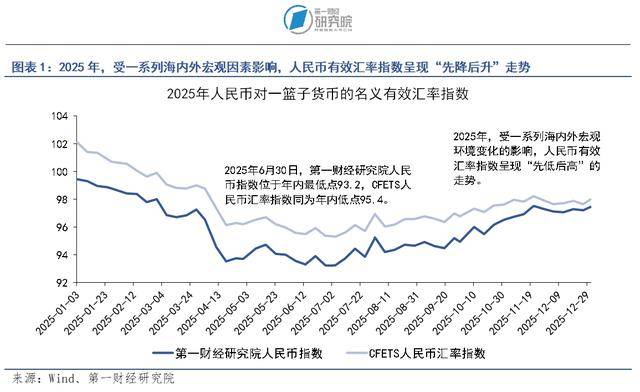
摘要 2025年,人民币表现出较强的韧性,人民币有效汇率指数呈现出"先降后升"的走势。 人民币对美元出现明显的"补涨"行情。与美元指数的快速回落相比,人民币对美元汇率在2025年前四个 月表现得相对"克制"。自5月起,人民币对美元汇率呈现单边上涨趋势。 我们认为,在这一轮人民币升值的背后存在两条结构性主线。第一条是中国宏观政策持续落地后,经济 预期和资本市场风险偏好改善,带动人民币资产价格修复。第二条线索是中国出口在全球贸易战背景下 保持强大的韧性,贸易顺差规模达到历史高位,为人民币汇率提供坚实支撑。 人民币对美元汇率突破7这一关键心理关口后,市场关于"人民币是否会持续升值""是否应该大幅升 值"等讨论迅速升温。我们认为,随着中国经济基本面的持续改善,人民币汇率有望继续温和升值,同 时中国宏观环境的改善需要财政与货币政策保持相应的政策力度、维持合适的节奏,并形成良好的政策 协同。 正文 一、2025年人民币有效汇率指数呈现"先降后升"走势 2025年,从内部来看,中国经济存在"供强需弱"的结构性矛盾,坚持内需主导和创新驱动是2026年中国 经济工作重点任务之首。从外部来看,国际经贸斗争与科技博弈变得更为长期化 ...
华宝期货晨报铝锭-20260212
Hua Bao Qi Huo· 2026-02-12 02:51
晨报 铝锭 成材:重心下移 偏弱运行 铝锭:长假前市场谨慎 关注宏观波动 投资咨询业务资格: 负责人:赵 毅 从业资格号:F3059924 投资咨询号:Z0002978 电话:010-62688526 从业资格号:F3078638 投资咨询号:Z0018248 电话:010-62688555 从业资格号:F3038114 投资咨询号:Z0014834 电话:010-62688541 从业资格号:F03127144 投资咨询号:Z0020161 电话:021-20857653 成文时间: 2026 年 2 月 12 日 逻辑:云贵区域短流程建筑钢材生产企业春节期间停产检修时间大多 在 1 月中下旬,复产时间预计在正月初十一至正月十六左右,停产期间预 计影响建筑钢材总产量 74.1 万吨。安徽省 6 家短流程钢厂,1 家钢厂已 证监许可【2011】1452 号 逻辑:昨日沪铝区间震荡。宏观上非农就业者上个月增加了 13 万人, 失业率下降至 4.3%,就业数据表现强于预期,促使交易员下调对美联储今 年降息幅度的预期。 以伊冲突 于 1 月 5 日开始停产;其余大部分钢厂均表示将于 1 月中旬左右停产放假, 个别钢 ...
瑞达期货铁矿石产业链日报-20260211
Rui Da Qi Huo· 2026-02-11 09:12
1. Report Industry Investment Rating - Not provided in the content 2. Core Viewpoint of the Report - On Wednesday, the I2605 contract reduced positions and consolidated. Macroeconomically, US President Trump is considering sending another US aircraft carrier strike group to the Middle East for possible military action if negotiations with Iran fail. In terms of supply and demand, the shipping and arrival volumes of Australian and Brazilian iron ore decreased this period, the blast furnace operating rate of steel mills was stable, and molten iron production remained below 2.3 million tons. Iron ore port inventory reached a new high. Overall, as the Spring Festival holiday approaches, steel mills have less restocking demand. Recently, Australia was affected by a hurricane, and the shipping volume decreased significantly. At the same time, the central bank's report reiterated moderate easing, and the market may fluctuate. Technically, the 1 - hour MACD indicator of the I2605 contract shows that DIFF and DEA rebounded from low levels. It is recommended for short - term trading and attention should be paid to risk control [2] 3. Summary by Relevant Catalogs Futures Market - The closing price of the I main contract is 762.50 yuan/ton, up 1.00 yuan; the position volume of the I main contract is 506,957 hands, down 6,983 hands; the I 5 - 9 contract spread is 17.5 yuan/ton, unchanged; the net position of the top 20 in the I contract is - 22,383 hands, down 5,244 hands; the Dalian Commodity Exchange warehouse receipt of I is 2,900 hands, unchanged; the Singapore iron ore main contract's 15:00 quote is 99.9 US dollars/ton, down 0.28 US dollars [2] Spot Market - The price of 61.5% PB powder ore at Qingdao Port is 823 yuan/dry ton, up 2 yuan; the price of 60.5% Mac fine ore at Qingdao Port is 812 yuan/dry ton, up 3 yuan; the price of 56.5% Super Special fine ore at Jingtang Port is 723 yuan/dry ton, up 2 yuan; the basis of the I main contract (Mac fine dry ton - main contract) is 49 yuan, up 2 yuan; the 62% Platts iron ore index (previous day) is 100.20 US dollars/ton, unchanged; the ratio of Jiangsu scrap steel to 60.5% Mac fine ore at Qingdao Port is 3.23, down 0.03; the estimated import cost is 801 yuan/ton, unchanged [2] Industry Situation - The global iron ore shipping volume (weekly) is 2,535.30 million tons, down 559.30 million tons; the arrival volume at 47 ports in China (weekly) is 2,455.60 million tons, down 213.60 million tons; the iron ore inventory at 47 ports (weekly) is 17,914.68 million tons, up 156.42 million tons; the iron ore inventory of sample steel mills (weekly) is 10,316.64 million tons, up 348.05 million tons; the iron ore import volume (monthly) is 11,965.00 million tons, up 911.00 million tons; the available days of iron ore (weekly) is 32 days, up 3 days; the daily output of 266 mines (weekly) is 38.51 million tons, down 1.05 million tons; the operating rate of 266 mines (weekly) is 61.27%, down 1.67%; the iron concentrate inventory of 266 mines (weekly) is 39.07 million tons, down 2.71 million tons; the BDI index is 1,882.00, down 13.00; the iron ore freight rate from Tubarao, Brazil to Qingdao is 22.35 US dollars/ton, down 0.64 US dollars; the iron ore freight rate from Western Australia to Qingdao is 7.944 US dollars/ton, down 0.12 US dollars [2] Downstream Situation - The blast furnace operating rate of 247 steel mills (weekly) is 79.55%, up 0.53%; the blast furnace capacity utilization rate of 247 steel mills (weekly) is 85.71%, up 0.26%; the domestic crude steel output (monthly) is 6,818 million tons, down 169 million tons [2] Option Market - The 20 - day historical volatility of the underlying (daily) is 15.22%, down 0.03%; the 40 - day historical volatility of the underlying (daily) is 16.80%, down 0.18%; the implied volatility of at - the - money call options (daily) is 19.68%, up 0.18%; the implied volatility of at - the - money put options (daily) is 18.12%, down 0.47% [2] Industry News - From February 2nd to February 8th, 2026, Mysteel's global iron ore shipping volume was 2,535.3 million tons, a week - on - week decrease of 559.3 million tons. The shipping volume of iron ore from Australia and Brazil was 1,948.9 million tons. The arrival volume at 47 ports in China was 2,455.6 million tons, a week - on - week decrease of 213.6 million tons; the arrival volume at 45 ports in China was 2,361.3 million tons, a week - on - week decrease of 123.4 million tons; the arrival volume at six northern ports was 1,264.0 million tons, a week - on - week decrease of 24.7 million tons. Australia's shipping volume was 1,279.8 million tons, a week - on - week decrease of 540.6 million tons, and the volume shipped from Australia to China was 1,097.5 million tons, a week - on - week decrease of 521.6 million tons. Brazil's shipping volume was 669.0 million tons, a week - on - week decrease of 31.5 million tons [2]
接力!开年7家银行获股东、高管大力增持
2 1 Shi Ji Jing Ji Bao Dao· 2026-02-11 06:33
Core Viewpoint - The banking sector continues to attract significant investment, with major banks' stock prices reaching new highs, driven by shareholder and executive buybacks [1][5]. Group 1: Shareholder Buybacks - Seven banks have seen their shareholders and executives increase their stakes in their own companies this year [1]. - Shanghai International Group's subsidiary increased its stake in Shanghai Pudong Development Bank by 93,999,979 shares, representing 0.32% of the total share capital [2]. - Ping An Life increased its holdings in China Merchants Bank by 12.48 million H-shares, investing approximately HKD 572 million, raising its total holdings to 368 million H-shares, which is over 8% of the total [2]. - Lanzhou Bank's major shareholder increased its stake by 419,120 shares, amounting to approximately RMB 1 million [3]. - Everbright Bank and other banks have also seen significant shareholder buybacks, with Everbright Group planning to increase its stake by up to RMB 800 million [4]. Group 2: Bank Performance and Growth - In 2024, 30 listed banks received shareholder buybacks, indicating strong investor confidence [5]. - Major state-owned banks, including ICBC and ABC, received substantial increases in their shareholdings, totaling over 1 billion shares [5]. - Eight banks reported a net profit growth exceeding 10%, reflecting positive financial performance [7]. Group 3: Regulatory and Economic Factors - Regulatory requirements for managing the market value of banks with low price-to-book ratios have prompted shareholder buybacks [7]. - The upcoming maturity of convertible bonds and low conversion rates have made shareholder buybacks a strategic move to enhance core tier one capital [7]. - The recent National People's Congress meeting highlighted economic growth targets and supportive fiscal policies, which are expected to improve the banking environment [8].
碳酸锂:市场预期回温,盘面震荡企稳,成材:重心下移偏弱运行
Hua Bao Qi Huo· 2026-02-11 03:09
Report Summary 1. Report Industry Investment Rating No information provided. 2. Core Viewpoint of the Report The market expectation of lithium carbonate has warmed up, and the disk has stabilized in shock. It is recommended to hold a light position and wait and see before the Spring Festival, as there are still many uncertainties [2][5]. 3. Summary by Relevant Catalogs Market Performance - The main contract of lithium carbonate futures closed at 137,340 yuan/ton, with the trading volume dropping to 295,200 lots and the open interest increasing to 345,900 lots. The net short position of the main funds continued, and the long - short ratio of the net position increased month - on - month. The daily inventory of lithium carbonate on the GZFE increased by 940 lots to 35,537 lots. The average price of SMM electric carbon was 136,000 yuan/ton, and the price difference between electric and industrial carbon was 3,500 yuan/ton. The Spring Festival stockpiling is almost over, with most enterprises having a low psychological purchase price, being cautious and waiting and seeing, and the market inquiry and trading being relatively light [3]. Fundamental Analysis - **Supply**: Last week, the raw material market generally declined. The SMM total weekly operating rate was 47.29% (-2.21%), and the operating rates of all processes except lithium mica decreased. The SMM weekly total output was 20,744 tons (-825 tons) [4]. - **Demand**: Last week, the production of lithium iron phosphate and ternary materials decreased slightly month - on - month, and the inventory was destocked. As of January 18, the penetration rate of new energy vehicle sales increased to 55.6%, remaining at a relatively high level. The energy - storage battery cells performed strongly, with both production and sales booming and low inventory [4]. - **Inventory**: According to SMM data, last week, the social inventory of the four - place samples increased by 3.73% month - on - month to 43,050 tons, the weekly inventory of the samples decreased by 2,019 tons to 105,463 tons, the total inventory days increased to 30 days, and the downstream inventory days increased to 11.8 days (+9.26% month - on - month), showing passive inventory accumulation, structural differentiation, and poor transmission [4]. Macro - policy Analysis - **Demand - side**: Multiple incentives such as subsidies for trading in old cars for new ones and tax rebates for battery exports stimulate terminal consumption and improve macro - liquidity [5]. - **Supply - side**: On January 15, the National Development and Reform Commission proposed to introduce management measures for the comprehensive utilization of new energy vehicle power batteries, which will improve the recycling threshold and eliminate backward production capacity, optimize the domestic supply structure in the long term, and raise the cost support center [5]. - **Industrial Planning**: The industrial planning of Qinghai Salt Lake, the key points of energy - storage during the 15th Five - Year Plan period, and a series of deployments of the Central Economic Work Conference form synergistic benefits to support the long - term supply - demand balance [5]. - **Macro - environment**: The central bank's structural interest rate cut indirectly strengthens the long - term macro - positive atmosphere [5].
更加积极有为的宏观政策推动经济向新向优
Xin Lang Cai Jing· 2026-02-10 21:07
(来源:经济参考报) 2025年,面对外部环境急剧变化、国内困难挑战增多的复杂严峻形势,我国实施更加积极有为的宏观政 策,不仅有效化解外部环境变化的不利影响,更在风浪中稳住了发展的底盘、巩固了发展的根基,国内 生产总值首次跃上140万亿元新台阶,经济结构持续优化,新动能不断培育壮大,向新向优特征鲜明。 但也要看到,外部环境变化影响加深,国内供强需弱矛盾突出。下阶段,要实施更加积极有为的宏观政 策,持续扩大内需、优化供给,做优增量、盘活存量,推动经济实现质的有效提升和量的合理增长,确 保"十五五"开好局、起好步。 中国经济总量平稳增长 财政政策更加积极 高质量发展取得新成效 2025年全年国内生产总值1401879亿元,按不变价格计算,比上年增长5.0%,符合年初设定的发展目 标。中国经济"稳"的格局得到巩固,"进"的步伐更加有力,"新"的动能培育壮大,"韧"的特性愈发凸 显。 第一,2025年中国经济增速保持平稳。分产业看,第一产业增加值93347亿元,比上年增长3.9%;第二 产业增加值499653亿元,增长4.5%;第三产业增加值808879亿元,增长5.4%,第三产业对经济增长形 成明显上拉。从"三驾马 ...