
库存消化

Search documents
首席点评:公募基金规模首破36万亿
Shen Yin Wan Guo Qi Huo· 2025-09-26 02:08
1. Report Industry Investment Ratings - **Bullish Outlook**: Crude oil, methanol, gold, silver, copper, iron ore, corn, lithium carbonate [6] - **Bearish Outlook**: Zinc, cotton, apple, soybean meal, rapeseed meal, stock index (IH, IF, IC, IM) [6] 2. Core Views of the Report - The scale of China's public - offering funds has exceeded 36 trillion yuan, with bond funds slightly decreasing due to the stock - bond seesaw effect. The US GDP growth rate in Q2 was revised up, and the PCE price index indicated persistent inflation. The market's expectation of a rate cut in October has cooled [1]. - For the stock index, September was more volatile, in a high - level consolidation phase after continuous growth. The long - term strategic allocation period of the Chinese capital market has just begun. The CSI 500 and CSI 1000 are more offensive, while the SSE 50 and SSE 300 are more defensive [2][12]. - The SC crude oil rose slightly at night. Russia will ban diesel exports and extend the gasoline export ban. The global decline rate of oil and gas field production has accelerated. Future OPEC production increase should be monitored [3][14]. - The glass futures continued to rebound, and the supply - demand situation was slowly improving. The inventory of glass and soda ash was being digested. Attention should be paid to autumn consumption and policy changes [4][18]. 3. Summary by Directory 3.1 Main News of the Day 3.1.1 International News - The US GDP in Q2 was revised up to an annualized quarter - on - quarter growth of 3.8%, and the core PCE price index was revised up to 2.6% [7]. 3.1.2 Domestic News - The Ministry of Commerce included three US entities in the export control list and three Taiwan - related US entities in the unreliable entity list [8]. 3.1.3 Industry News - The China Non - Ferrous Metals Industry Association proposed measures to control the expansion of copper smelting capacity, and relevant departments are studying regulatory measures [9]. 3.2 Daily Returns of External Markets - The FTSE China A50 futures, ICE Brent crude oil, London gold, London silver, ICE No. 11 sugar, CBOT soybeans, CBOT wheat, CBOT corn, and CBOT soybean oil all rose, while LME copper and CBOT soybean meal fell [11]. 3.3 Morning Comments on Major Varieties 3.3.1 Financial Products - **Stock Index**: After the decline of US indices, the previous trading day's stock index rebounded. The financing balance increased. In the long - term, the strategic allocation period of the Chinese capital market has started [2][12]. - **Treasury Bonds**: Treasury bonds rebounded after hitting the bottom. The central bank continued to inject medium - term liquidity. The domestic economic situation was still in adjustment. With the Fed's rate cut, the central bank's policy space has increased, but policy adjustment needs central government deployment. It is recommended to be bearish on long - term bonds and neutral on short - term bonds [13]. 3.3.2 Energy and Chemical Products - **Crude Oil**: SC crude oil rose slightly at night. Russia restricted fuel exports, and the global decline rate of oil and gas field production accelerated. Future OPEC production increase should be monitored [3][14]. - **Methanol**: Methanol fell at night. The average operating load of coal - to - olefin plants increased, and the coastal inventory decreased. It is short - term bearish [15]. - **Rubber**: Rubber prices fell slightly. Supply may increase, the bonded area inventory decreased, and tire production increased. It is expected to fluctuate within a range [16]. - **Polyolefins**: Polyolefins rebounded slightly. Prices follow the cost, and future demand and supply policies should be monitored. It may fluctuate within a low - level range [17]. - **Glass and Soda Ash**: Glass futures continued to rebound, and the supply - demand situation was slowly improving. The inventory of glass and soda ash decreased. Attention should be paid to autumn consumption and policy changes [4][18]. 3.3.3 Metals - **Precious Metals**: Gold's upward trend paused. The Fed's rate - cut stance was cautious, but the rate - cut prospect was clear. The long - term driver for gold was still there, but there was short - term adjustment [20]. - **Copper**: Copper prices fell at night. The Indonesian mine accident may lead to a supply - demand gap, which will support copper prices in the long - term. Attention should be paid to the US dollar, smelting output, and downstream demand [21]. - **Zinc**: Zinc prices rose slightly at night. The smelting output may increase, and the short - term supply may be in surplus. It may fluctuate weakly within a range [22]. - **Lithium Carbonate**: Weekly production increased. Inventory was being digested rapidly. It may fluctuate in the short - term, and the actual situation of projects in Jiangxi should be monitored [23]. 3.3.4 Black Metals - **Coking Coal and Coke**: The night - session prices were weak. The fundamentals of finished steel products improved, and the prices are expected to fluctuate at a high level [25]. - **Iron Ore**: Steel mills resumed production, and iron ore demand was supported. Global iron ore shipments decreased, and port inventory decreased rapidly. It is expected to fluctuate strongly [26]. - **Steel**: The profitability of steel mills remained stable, and supply pressure increased. The supply - demand contradiction was not significant, and the market is expected to be bullish, with hot - rolled coils stronger than rebar [27]. 3.3.5 Agricultural Products - **Protein Meal**: Soybean meal fell at night, and rapeseed meal was strong. Argentina temporarily cancelled export taxes, but the exemption period ended early. Domestic soybean meal may fluctuate at a low level [28]. - **Edible Oils**: Edible oils were strong at night. The impact of floods in Malaysia on palm oil production was limited. After digesting the negative news of Argentina's tax cancellation, oil prices rebounded [29]. - **Sugar**: International sugar prices are expected to be weak, while domestic sugar prices are supported by low inventory but pressured by imports. Zhengzhou sugar may fluctuate after a rebound [30]. - **Cotton**: ICE cotton prices rose slightly. International supply pressure still exists, and domestic new - cotton purchase is in focus. Cotton prices are expected to fluctuate weakly [31]. 3.3.6 Shipping Index - **Container Shipping to Europe**: The EC rebounded. Shipping companies signaled post - holiday price support, but success depends on cargo volume and capacity control. It is expected to fluctuate in the short - term [32].
《能源化工》日报-20250903
Guang Fa Qi Huo· 2025-09-03 05:32
1. Report Industry Investment Rating No information provided in the text. 2. Report's Core View Polyolefin - In September, the polyolefin market shows a phased characteristic of "decreased supply and increased demand", with inventory being reduced and overall market pressure under control. It is recommended to continue holding the expanding position of the LP01 contract [2]. Caustic Soda - The caustic soda market is strong in the short - term. After the parade, there may be an increase in orders from other provinces, and some caustic soda plants may raise prices. It is necessary to pay attention to the downstream purchasing rhythm and device fluctuations [4]. PVC - The PVC market continues to be in a situation of oversupply. Although it is the traditional demand peak season in September, demand remains sluggish. It is expected to continue weak and volatile [4]. Crude Oil - Overnight oil prices rose. The supply side supports buying, while the demand side is under pressure. It is recommended to pay attention to the subsequent OPEC+ meetings. In the short - term, wait and see, use a positive arbitrage strategy, and look for opportunities to expand options after the volatility increases [7]. Methanol - The methanol supply is expected to increase, while the traditional downstream demand is weak. It is necessary to focus on the restart of MTO devices at ports and the inventory digestion rhythm. The 01 contract can consider the possibility of a decline in imports due to gas restrictions in Iran [17]. Urea - The urea futures price rebounded slightly, driven by supply - side maintenance and Indian tender news. However, weak demand limits the upside space [21]. PX - PX supply is expected to increase, and the supply - demand is in a tight balance in September. PX11 can focus on the area around 6800 [25]. PTA - PTA supply - demand is expected to improve, and the absolute price is supported in the short - term. [26] Ethylene Glycol - In September, domestic ethylene glycol supply is high, imports are revised down, and port inventories are low. Consider going long EG2601 or selling put options EG2601 - P - 4300 [26]. Short - fiber - In September, short - fiber supply - demand is expected to improve, but the inventory reduction is limited. The price fluctuates mainly with raw materials [26]. Bottle Chip - In September, bottle chip manufacturers maintain a 20% production cut. Demand declines slightly, and the upside space is limited [26]. Pure Benzene - Pure benzene supply is expected to remain high, demand support is weak, and the absolute price is under short - term pressure. However, the strong oil price restricts the downward space. For BZ2603, focus on the area around 5800 - 6000 [34]. Styrene - Short - term styrene supply is high, and the driver is weak. However, there is an expectation of supply - demand improvement in the future, and the downward space is limited. Consider going long lightly below 7000 and focus on the support around 6900, and then mainly short on rebounds [34]. 3. Summary According to Relevant Catalogs Polyolefin - **Price and Spread**: L2601, L2509, PP2601, PP2509 closing prices all decreased slightly. The basis of North China LL and the spreads of L2509 - 2601 and PP2509 - 2601 changed [2]. - **Inventory**: PE enterprise inventory decreased by 14.92%, and social inventory increased by 0.99%. PP enterprise inventory decreased by 5.91%, and trader inventory decreased by 1.81% [2]. - **Operating Rate**: PE device operating rate decreased slightly, and downstream weighted operating rate increased by 0.72%. PP device operating rate increased by 2.6%, and powder operating rate increased by 4.1% [2]. Caustic Soda and PVC - **Price and Export Profit**: FOB price of caustic soda in East China remained unchanged, and export profit decreased. PVC's CFR Southeast Asia price decreased, and export profit increased [4]. - **Operating Rate and Profit**: The caustic soda industry operating rate and PVC total operating rate decreased. The profit of externally - purchased calcium carbide PVC and Northwest integrated PVC decreased [4]. - **Demand**: The operating rate of some downstream industries of caustic soda and PVC changed, and PVC's pre - sales volume decreased [4]. - **Inventory**: The inventory of liquid caustic soda in East China decreased, while that in Shandong increased. PVC upstream factory inventory and total social inventory increased [4]. Crude Oil - **Price and Spread**: Brent, WTI, and SC prices all rose. The spreads of Brent M1 - M3, WTI M1 - M3, etc. changed significantly [7]. - **Refined Oil**: The prices of some refined oil products and their spreads changed, and the cracking spreads of some refined oil products also changed [7]. Methanol - **Price and Spread**: MA2601 and MA2509 closing prices decreased. The basis of Taicang and regional spreads changed [17]. - **Inventory**: Methanol enterprise inventory, port inventory, and social inventory all increased [17]. - **Operating Rate**: The operating rate of domestic upstream enterprises decreased, while that of overseas enterprises increased. The operating rate of downstream MTO devices increased [17]. Urea - **Price and Spread**: The prices of some urea products and their spreads changed [21]. - **Supply and Demand**: Domestic urea daily and weekly production decreased, and factory and port inventories increased [21]. PX, PTA, and Ethylene Glycol - **PX**: PX futures prices decreased, and spreads such as PX - crude oil and PX - naphtha decreased [24][25]. - **PTA**: PTA spot and futures prices changed slightly, and the processing fee increased [25]. - **Ethylene Glycol**: The price of ethylene glycol decreased, and the basis increased [25]. Pure Benzene and Styrene - **Upstream Price and Spread**: The prices of crude oil, naphtha, etc. changed, and the spreads of pure benzene - naphtha and ethylene - naphtha decreased [32]. - **Benzene and Styrene Price and Spread**: The prices of pure benzene and styrene decreased, and the basis and import profit changed [32]. - **Downstream Cash Flow**: The cash flows of some downstream products of pure benzene and styrene changed [33]. - **Inventory and Operating Rate**: The inventories of pure benzene and styrene in Jiangsu ports increased. The operating rates of some industries in the industrial chain changed [34].
澜沧古茶上半年收入降近4成,面临经营重压与战略调整挑战
Sou Hu Cai Jing· 2025-09-02 20:36
Group 1 - The core viewpoint of the article highlights the significant decline in the financial performance of Lancang Ancient Tea, with a reported revenue of approximately 120 million yuan and a net loss of 28.946 million yuan in the first half of 2025, representing year-on-year declines of 38.75% and 668.80% respectively [1] - The primary reason for the performance drop is attributed to the slower-than-expected recovery of the terminal consumer market and poor sales in offline physical stores, compounded by management adjustments during the period [1] - The traditional sales channel of distributors saw a drastic revenue drop of 71.5%, amounting to only 35.1 million yuan, which intensified the overall performance pressure on the company [1] Group 2 - The company adopted a cautious approach towards online business, reducing online marketing expenses by 63.7%, yet online sales still fell by 15.9% to 28.8 million yuan [1] - The three core product lines, 1966, Tea Mama, and Yan Leng, all experienced revenue declines, with the 1966 series seeing a year-on-year drop of approximately 41.54% and a significant decrease in gross margin by 12.3 percentage points [1] - High inventory levels pose another major challenge for the company, with inventory reaching approximately 900 million yuan, accounting for 71.93% of total assets, and a low inventory turnover rate of 0.06 times [2] Group 3 - The company has reduced production of finished products and procurement of raw materials in response to the inventory issue, but the slow sales recovery has led to a significant decrease in cash flow, with cash and cash equivalents dropping to 22.6 million yuan from 65.4 million yuan at the end of the previous year [2] - The changing market environment has also impacted the company, with the Pu'er tea market growth slowing down and inventory digestion cycles extending, prompting leading companies in the industry to adjust their strategies towards the mass consumer market [2] - Compared to its competitors, the company's strategic adjustments appear to be lagging, highlighted by the resignation of the general manager due to a mismatch between operational philosophy and market demand, adding further uncertainty to the company's future [2][4]


水井坊(600779):Q2释放压力 期待动销恢复
Xin Lang Cai Jing· 2025-08-31 10:28
Core Viewpoint - The company reported a significant decline in revenue and net profit for the first half of 2025, indicating ongoing challenges in the market and operational pressures [1][2]. Revenue Performance - In the first half of 2025, total revenue was 1.498 billion yuan, down 12.84% year-on-year, with Q2 revenue at 539 million yuan, a 31.37% decline [1][2]. - The decline in Q2 revenue was attributed to continued pressure on traditional consumption scenarios such as business banquets, a slow market recovery, and higher-than-expected channel inventory levels [2]. - Sales volume of liquor products increased by 8.6% in Q2, while average price decreased by 39.0% [2]. - Revenue from high-end products in Q2 was 454 million yuan, down 36.96%, while mid-range products saw revenue of 38 million yuan, up 67.68% [2]. Profitability and Costs - The gross profit margin in Q2 was 74.42%, a decrease of 7.13 percentage points year-on-year, primarily due to a decline in product mix and increased promotional costs [3]. - The sales net profit margin for Q2 was -15.75%, down 22.9 percentage points year-on-year [3]. - The company experienced a significant increase in sales expenses and management costs, leading to a rise in the overall expense ratio despite a decrease in sales scale [3]. Cash Flow and Liabilities - Cash receipts from sales in Q2 amounted to 991 million yuan, an increase of 29.54% year-on-year, with a positive operating cash flow of 70 million yuan [3]. - As of the end of Q2, contract liabilities were 983 million yuan, showing a slight increase compared to the end of Q1 [3]. Future Outlook and Valuation - The company has adjusted its net profit forecasts for 2025-2026 down by 27% to 1.071 billion yuan and 1.164 billion yuan, respectively, with a new forecast for 2027 at 1.248 billion yuan [4]. - The expected earnings per share (EPS) for 2025-2027 are projected at 2.20, 2.39, and 2.56 yuan, respectively, with current price-to-earnings (P/E) ratios of 21, 20, and 18 times [4]. - The company is implementing strategies such as "dual brands" and "one city, one policy" to stimulate sales recovery and return to a growth trajectory [4].

国金证券给予太极集团增持评级,库存消化业绩承压,回购彰显发展信心
Mei Ri Jing Ji Xin Wen· 2025-08-22 04:01
Group 1 - The core viewpoint of the report is that Taiji Group (600129.SH) is rated as "Buy" due to several positive factors [2] - The company is experiencing continuous inventory digestion, which is putting pressure on its industrial sector performance [2] - There is a notable decrease in the sales expense ratio as the company accelerates its marketing model transformation, indicating potential for future profit recovery [2] - The company plans to repurchase shares, demonstrating confidence in its development [2]


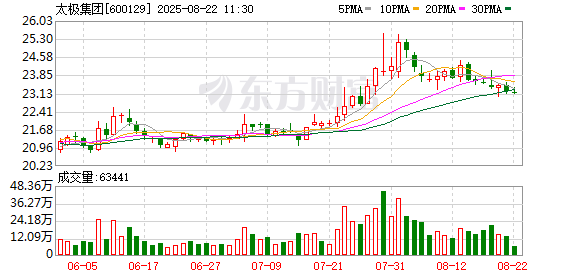
太极集团(600129):库存消化业绩承压,回购彰显发展信心
SINOLINK SECURITIES· 2025-08-22 02:59
Investment Rating - The report maintains a "Buy" rating for the company, indicating an expected price increase of over 15% in the next 6-12 months [5][13]. Core Insights - The company reported a significant decline in revenue and net profit for the first half of 2025, with revenue at 5.66 billion RMB, down 27.6% year-on-year, and net profit at 139 million RMB, down 71.9% year-on-year [2]. - The pharmaceutical industrial segment faced pressure, with a 44% decline in revenue, while the pharmaceutical commercial segment saw a 9.9% decrease [3]. - The company is undergoing a transformation in its marketing model, leading to a notable decrease in sales expense ratio, which is expected to improve future profitability [3]. - A share buyback plan has been announced, with an amount ranging from 80 to 120 million RMB, aimed at enhancing shareholder value [4]. Summary by Sections Performance Review - In 1H25, the company achieved revenue of 5.66 billion RMB, a decrease of 27.6% year-on-year, and a net profit of 139 million RMB, down 71.9% year-on-year. The second quarter alone saw revenue of 2.83 billion RMB, down 21.6% year-on-year, and a net profit of 64 million RMB, down 74.1% year-on-year [2]. Operational Analysis - The pharmaceutical industrial revenue was approximately 2.84 billion RMB, down 44% year-on-year, while the pharmaceutical commercial revenue was about 3.37 billion RMB, down 9.9% year-on-year. The decline in sales of key products, such as the Tai Chi Huoxiang Zhengqi Oral Liquid, significantly impacted revenue [3]. - The company is optimizing its marketing structure and enhancing internal collaboration, resulting in a sales expense ratio of 13.99%, a decrease of 17.67 percentage points year-on-year. The gross margin for the pharmaceutical industrial segment was 42.44%, down 20.46 percentage points year-on-year, indicating potential for recovery as inventory levels improve [3]. Profit Forecast and Valuation - Revenue forecasts for 2025 and 2026 have been adjusted to 10.52 billion RMB and 11.65 billion RMB, respectively, with a projected revenue of 12.72 billion RMB for 2027. Net profit forecasts for the same years have been revised to 452 million RMB and 582 million RMB, with an expected net profit of 725 million RMB in 2027 [5]. - The earnings per share (EPS) for 2025, 2026, and 2027 are projected to be 0.81 RMB, 1.04 RMB, and 1.30 RMB, respectively, with corresponding price-to-earnings (P/E) ratios of 29, 22, and 18 times [5].
申万期货品种策略日报:聚烯烃(LL、PP)-20250820
Shen Yin Wan Guo Qi Huo· 2025-08-20 02:34
Report Summary 1. Report Industry Investment Rating No investment rating information is provided in the report. 2. Core View of the Report - Polyolefin futures are running weakly. The spot market of polyolefins is mainly driven by supply - demand factors. The market heat has cooled down, and the inventory is slowly being digested after the previous rebound. The short - term petrochemical inventory may fluctuate, and the destocking process in summer is tortuous. However, domestic demand is the main driver at the macro level, and the terminal备货 demand may gradually pick up in the middle and late August. The focus should be on the autumn stocking market rhythm after supply - demand digestion and the potential changes in the cost side [2]. 3. Summary by Related Catalogs Futures Market - **LL and PP Futures Prices**: For LL, the previous day's closing prices for January, May, and September contracts were 7307, 7291, and 7268 respectively, with changes of - 27, - 21, and - 24 compared to the day before, and percentage changes of - 0.37%, - 0.29%, and - 0.33% respectively. For PP, the previous day's closing prices for January, May, and September contracts were 7016, 7032, and 6987 respectively, with changes of - 32, - 16, and - 39 compared to the day before, and percentage changes of - 0.45%, - 0.23%, and - 0.56% respectively [2]. - **Trading Volume and Open Interest**: The trading volumes of LL for January, May, and September contracts were 195031, 3873, and 54494 respectively, and the open interests were 360140, 18851, and 125736 respectively, with changes of 18234, 761, and - 22109 respectively. For PP, the trading volumes for January, May, and September contracts were 198360, 7393, and 50844 respectively, and the open interests were 416594, 28997, and 81393 respectively, with changes of 24874, 1950, and - 18050 respectively [2]. - **Price Spreads**: The current price spreads of LL for January - May, May - September, and September - January are 16, 23, and - 39 respectively, compared to previous values of 22, 20, and - 42. For PP, the current price spreads for January - May, May - September, and September - January are - 16, 45, and - 29 respectively, compared to previous values of 0, 22, and - 22 [2]. Spot Market - **Raw Materials**: The current prices of methanol futures, Shandong propylene, South China propane, PP recycled materials, North China powder, and mulch film are 2395 yuan/ton, 6410 yuan/ton, 560 dollars/ton, 5600 yuan/ton, 6800 yuan/ton, and 8800 yuan/ton respectively. The previous values were 2400 yuan/ton, 6425 yuan/ton, 564 dollars/ton, 5600 yuan/ton, 6800 yuan/ton, and 8800 yuan/ton respectively [2]. - **Intermediate and Final Products**: The current price ranges of LL in the East China, North China, and South China markets are 7250 - 7700 yuan/ton, 7200 - 7450 yuan/ton, and 7400 - 7750 yuan/ton respectively. The previous price ranges were 6950 - 7100 yuan/ton, 7250 - 7700 yuan/ton, and 7200 - 7450 yuan/ton. For PP, the current price ranges in the East China, North China, and South China markets are 6950 - 7050 yuan/ton, 6900 - 7000 yuan/ton, and 6850 - 7100 yuan/ton respectively, and the previous price ranges were 7400 - 7750 yuan/ton, 6900 - 7000 yuan/ton, and 6900 - 7100 yuan/ton [2]. News - On Tuesday (August 19), the settlement price of West Texas Intermediate crude oil futures for September 2025 on the New York Mercantile Exchange was $62.35 per barrel, down $1.07 or 1.69% from the previous trading day, with a trading range of $62.25 - $63.39. The settlement price of Brent crude oil futures for October 2025 on the London Intercontinental Exchange was $65.79 per barrel, down $0.81 or 1.22% from the previous trading day, with a trading range of $65.61 - $66.58 [2].
国投期货软商品日报-20250815
Guo Tou Qi Huo· 2025-08-15 13:59
Report Industry Investment Ratings - Cotton: ★☆☆ (One star, indicating a bullish bias but limited operability on the market) [1] - Pulp: ★☆★ (Not clearly defined in the given content, but seems to imply a certain bullish tendency) [1] - Sugar: ★★★ (Three stars, representing a clearer bullish trend with appropriate investment opportunities) [1] - Apple: ☆☆☆ (White stars, suggesting a relatively balanced short - term trend and poor operability, for observation only) [1] - Timber: ☆☆☆ (White stars, suggesting a relatively balanced short - term trend and poor operability, for observation only) [1] - Natural Rubber: ★★★ (Three stars, representing a clearer bullish trend with appropriate investment opportunities) [1] - 20 - rubber: ★☆☆ (One star, indicating a bullish bias but limited operability on the market) [1] - Butadiene Rubber: ★☆☆ (One star, indicating a bullish bias but limited operability on the market) [1] Core Viewpoints - The report analyzes the market conditions of various soft commodities including cotton, pulp, sugar, apple, natural rubber, 20 - rubber, butadiene rubber, timber, and logs. It provides investment suggestions based on supply - demand, inventory, and price trends of each commodity [2][3][4] Summary by Commodity Cotton & Cotton Yarn - Zhengzhou cotton slightly declined, and the mainstream sales basis of cotton spot was stable with average spot trading. Pure - cotton yarn trading improved this week with a slightly stronger price. As of the end of July, the commercial inventory was 218.98 million tons, a decrease of 64 million tons month - on - month and 58.8 million tons year - on - year. The inventory digestion in July was good, and it is expected to improve further in August. The market is cautiously optimistic about future Sino - US trade negotiations. There is a strong expectation of increased production in Xinjiang in the new season. The USDA August report was bullish, with US cotton production significantly reduced by 30.2 million tons to 287.7 million tons, and the global ending inventory also decreased. The recommended operation is to buy on dips [2] Sugar - Overnight, US sugar fluctuated. The production data of the central - southern region of Brazil in the first half of July was neutral to bearish. Due to less rainfall in July, the production progress accelerated, with the cane crushing volume and sugar production increasing year - on - year. However, due to more rainfall in the early stage, the overall production progress was still slow, and some international institutions lowered the production forecast for this year. Domestically, Zhengzhou sugar fluctuated. In terms of production and sales, the sales rhythm this year was fast, the inventory decreased year - on - year, and the spot pressure was relatively light. In June, the sugar import volume increased year - on - year, but the cumulative import volume this year was still low. The market's trading focus has shifted to imports and the production forecast for the next season. The import volume of sugar and syrup decreased significantly this year, reducing the sales pressure on domestic sugar. However, the production forecast for the 25/26 season is uncertain. Attention should be paid to subsequent weather conditions and cane growth [3] Apple - The futures price fluctuated upward. Currently, the market demand for apples is poor, the cold - storage shipment speed is slow, and the spot price is weak. On the other hand, the remaining cold - storage inventory is not large, and storage merchants are actively shipping. The price of early - maturing apples was high after their listing, but the overall quality was average. As of August 14, the national cold - storage apple inventory was 46.13 million tons, a year - on - year decrease of 49.4%. Last week, the national cold - storage apple destocking volume was 5.07 million tons, a year - on - year decrease of 32.31%. The market's trading focus has shifted to the production forecast for the new season. The western producing areas were affected by cold snaps and strong winds during the flowering period this year, but the impact of low temperatures on production was small, mainly increasing the risk of fruit rust. On the other hand, the flower volume in the producing areas was sufficient this year, and there are still differences in the production forecast. The recommended operation is to wait and see [4] 20 - rubber, Natural Rubber & Synthetic Rubber - Today, the futures prices of RU, NR, and BR all increased. The domestic spot price of natural rubber increased, the synthetic rubber spot price was stable, the FOB price of butadiene at foreign ports was stable, and the raw material market price in Thailand was stable with a slight decline. In terms of supply, the global natural rubber supply is gradually entering the high - yield period, and there is more rainfall in most Southeast Asian producing areas. This week, the operating rate of domestic butadiene rubber plants continued to decline, with Qixiang Tengda and Maoming Petrochemical under maintenance, Xinjiang Landi planning for maintenance, Yihua Nuclear Plastics restarted, and Dushanzi Petrochemical operating at a low load. The operating rate of upstream butadiene plants continued to rise significantly. Jilun's new 200,000 - ton butadiene plant was successfully put into production. In terms of demand, the operating rate of domestic all - steel tires rebounded this week, while the operating rate of semi - steel tires continued to decline, and the finished - product inventory of tire enterprises increased. In terms of inventory, this week, the total natural rubber inventory in Qingdao reported by Longzhong continued to decline to 62 million tons, and both the bonded and general trade inventories in Qingdao continued to decline. The social inventory of Chinese cis - butadiene rubber reported by Fuchuang continued to decline to 1.15 million tons. As imported goods arrived at ports one after another, the inventory of Chinese butadiene at ports continued to rise significantly to 2.04 million tons. Overall, the demand performance is average, the supply of natural rubber increases, the synthetic rubber supply decreases, the rubber inventory declines, the market sentiment improves, and there is an expectation of interest - rate cuts in the US. The strategy is to wait and see for RU, and be bullish for NR and BR [5] Pulp - Today, the pulp futures declined with a large intraday decline. The spot price of Shandong Yinxing was stable at 5850 yuan/ton, the price of Russian needles in the Yangtze River Delta was 5300 yuan/ton, and the price of broad - leaf pulp Jinyu was stable at 4200 yuan/ton. As of August 14, 2025, the inventory of mainstream pulp ports in China was 209.9 million tons, an increase of 5.1 million tons from the previous period, a month - on - month increase of 2.5%. Currently, the domestic port inventory is relatively high year - on - year. The pulp supply is relatively loose, and the demand is still weak. After entering August, the downstream may gradually transition to the peak season, which may boost the demand. The recommended operation is to buy on dips [6] Logs - The futures price fluctuated. The mainstream spot price was stable. In terms of supply, the arrival volume increased last week. However, the foreign offer has rebounded for two consecutive months, while the increase in the domestic spot price was small, increasing the pressure on traders. It is expected that imports will not increase significantly in the short term, and the domestic supply may remain at a low level. In terms of demand, after entering the off - season, the daily average shipment volume at ports fluctuated around 60,000 cubic meters. The overall shipment situation was good. As of August 8, the total log inventory at national ports was 3.08 million cubic meters, a month - on - month decrease of 2.84%. The total log inventory was low, and the inventory pressure was relatively small. Overall, the supply - demand situation has improved, but the peak - season demand has not started yet. The recommended operation is to wait and see [7]
夜盘价格有所回落,焦煤大幅上涨还能支撑玻璃走多远?
Jin Shi Shu Ju· 2025-08-06 16:52
Core Viewpoint - The domestic glass market continues to show weakness, with price adjustments observed in various regions due to supply and demand dynamics, particularly influenced by the real estate sector's ongoing downturn [1] Supply and Demand Dynamics - In the Hebei region, some manufacturers have lowered prices by 1-1.5 yuan per weight box, while in South China, prices decreased by 1 yuan per weight box due to slow sales caused by heavy rain [1] - The current market is transitioning from expectation-driven to a focus on actual supply and demand fundamentals, with supply pressures increasing despite seasonal maintenance leading to some supply contraction [1] - As of July 31, 2025, the national float glass daily production reached 159,600 tons, a slight increase of 180 tons year-on-year, with total production in July at 4.91 million tons, reflecting a month-on-month growth of 4.72% and a capacity utilization rate of 79.20% [1] Impact of Real Estate Sector - The persistent downturn in the real estate sector is a key factor suppressing glass demand, with the area of completed constructions declining by 5.0% year-on-year, leading to weak growth in rigid demand for glass [1] - The current real estate situation remains bleak, with downstream processing orders showing only a slight increase, primarily driven by essential needs [1] - The average order days for float glass processing enterprises is only 9.55 days, indicating a continued low operating status [1] Inventory and Supply Chain Issues - Although glass production enterprise inventory decreased by 1.56 million weight boxes to 51.78 million weight boxes last week, significant inventory pressure remains [1] - The completion of a round of stocking in mid to late July is expected to slow down purchasing in August, with processing enterprises showing reduced willingness to accept orders due to compressed profits [1] - The market is constrained by weak spot demand and ineffective inventory transfer to downstream sectors, making it difficult for apparent inventory reductions to translate into substantial price support [1] Cost Support Factors - Rising coal and raw material prices are currently the main supportive factors for market costs, providing a bottom support for prices [1] - While the price of soda ash is steadily rising, its impact on glass production costs is limited [1] - There is a notable profit disparity among glass enterprises based on fuel types, with those using natural gas facing significant losses, while coal gas enterprises enjoy relatively better profits, complicating unified production reduction efforts [1] Market Outlook - Most institutions maintain a cautious outlook for the short-term market, with recommendations to consider low-positioned long positions while being mindful of operational risks [1] - The forecast indicates that the supply increase and weak demand in the float glass market will persist in August, with prominent inventory pressures and limited price upward movement, necessitating vigilance regarding potential price-cutting strategies for inventory clearance [1] - The focus should remain on the speed of inventory digestion and potential policy stimulus until there is a substantial improvement in demand [1]
玻璃纯碱:上周库存双降,后市关注消化速度
Sou Hu Cai Jing· 2025-08-05 13:11
Group 1 - The core viewpoint of the article highlights the focus on supply and demand dynamics in the glass and soda ash markets, with an emphasis on the speed of inventory digestion upstream [1] Group 2 - Glass futures continue to show weakness, with a gradual deepening of summer maintenance affecting supply [1] - The inventory of glass production enterprises decreased to 51.78 million heavy boxes, a reduction of 1.56 million heavy boxes week-on-week [1] - Soda ash futures experienced a tentative rebound, with production enterprise inventory at 1.684 million tons, down 104,000 tons week-on-week [1] - Overall, both glass and soda ash in China are in a phase of inventory digestion, with current prices rapidly declining [1] - The market is now focusing on the effectiveness of supply-side contraction [1]