
资金流动

Search documents
TMGM:印度卢比近期为何走弱?进口商购汇需求成关键因素
Sou Hu Cai Jing· 2025-12-23 08:50
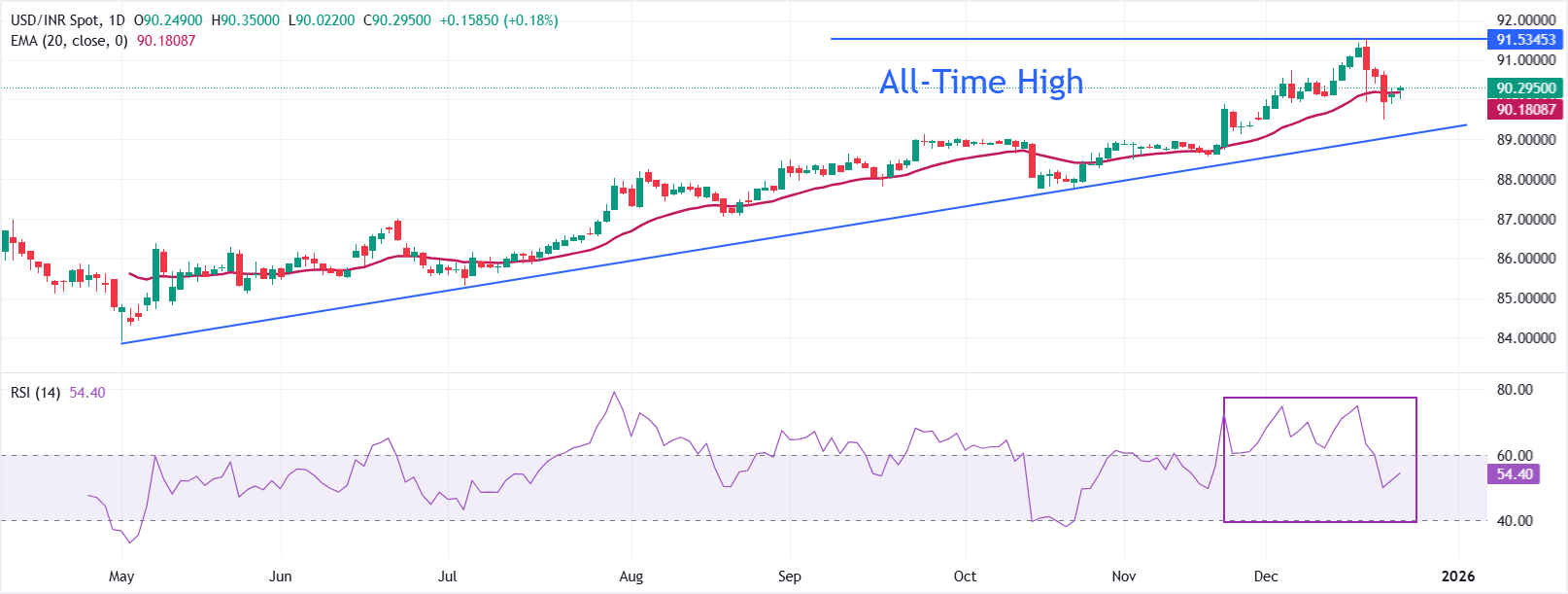
Core Viewpoint - The Indian Rupee has experienced fluctuations against the US Dollar, influenced by both domestic and external factors, including interventions by the Reserve Bank of India and foreign institutional investor activities [1][2]. Group 1: Currency Fluctuations - The USD/INR exchange rate rebounded after hitting a three-week low of 89.25, driven by Indian importers buying dollars at specific price levels [1]. - The Rupee had previously appreciated significantly, reaching a historical low near 91.55, supported by the Reserve Bank of India's interventions in the spot and non-deliverable forward markets [1]. Group 2: Foreign Investment Activity - From December 17 to 19, foreign institutional investors turned net buyers, increasing their holdings in the Indian stock market by 35.9838 billion Rupees, providing short-term support for the Rupee [1]. - This trend was not sustained, as foreign investors became net sellers on the following Monday, offloading 4.5734 billion Rupees worth of shares, indicating volatility in capital flows [1]. Group 3: External Economic Environment - The US Dollar index fell approximately 0.2%, trading around 98.00, with market attention on the upcoming preliminary GDP data for Q3, which is expected to slow from 3.8% to 3.2% annualized growth [2]. - There is a weak expectation for a rate cut by the Federal Reserve, with only a 20% probability of a 25 basis point cut in January, as indicated by the CME FedWatch tool [2]. - Despite multiple rounds of negotiations, India and the US have yet to reach a trade agreement, maintaining stable demand for dollars from Indian importers, which continues to pressure the Rupee [2]. Group 4: Domestic Economic Indicators - The Reserve Bank of India's monthly report highlighted robust economic growth in November, with strong urban and rural demand, emphasizing the collaborative effect of fiscal, monetary, and regulatory policies in maintaining economic resilience throughout the year [2]. Group 5: Technical Analysis - The USD/INR exchange rate is currently trading around 90.2950, with the 20-day moving average at 90.1809, indicating a positive short-term trend as prices remain above this average [4]. - The 14-day Relative Strength Index has retreated from the overbought zone to a neutral level of 54, suggesting a moderation in upward momentum [4]. - Key support is identified at approximately 89.1409, corresponding to an upward trend line formed from 83.8509; maintaining above the 20-day moving average limits potential pullback [4].

国泰海通|海外策略:恒指波幅创2022年以来新低
国泰海通证券研究· 2025-12-18 14:09
Market Performance - Global indices experienced a slight increase last week, with the MSCI Global down by 0.3%, MSCI Developed Markets down by 0.3%, and MSCI Emerging Markets up by 0.3% [1] - The Hang Seng Index's volatility reached its lowest level since 2022, while the Chinese technology sector saw gains, contrasting with significant pullbacks in developed market technology stocks [1] Earnings Expectations - Hong Kong's earnings expectations were marginally revised downwards, with the Hang Seng Index's 2025 EPS forecast adjusted from 2079 to 2060 [2] - In contrast, the S&P 500's 2025 EPS forecast remained stable at 273, and the Eurozone STOXX 50's forecast was maintained at 330 [2] Economic Outlook - Economic indicators showed a rebound in major markets, with the Citigroup Economic Surprise Index for the US, Europe, and China all rising, supported by factors such as anticipated Fed rate cuts and improved service sector performance in Europe [2] Capital Flows - The Federal Reserve is expected to cut rates by 25 basis points in December and restart bond purchases at a rate of $40 billion per month [3] - Market liquidity tightened, with the SOFR-OIS spread widening, while capital flows were primarily directed towards China, the US, Japan, India, and South Korea [3]


人民币兑美元为何走强?用轻松方式讲透十二月六日汇率逻辑
Sou Hu Cai Jing· 2025-12-06 21:20
Core Viewpoint - The article explains the fluctuations in the RMB to USD exchange rate, emphasizing that these changes are influenced by various economic factors rather than random occurrences. Group 1: Factors Influencing RMB Strength - The stability of the domestic economy is a key factor, with signs of recovery in manufacturing and consumption contributing to a stronger RMB [4]. - The easing environment in the U.S. also plays a role, as expectations of interest rate cuts can enhance the comparative strength of the RMB [4]. - The direction of capital flows is crucial; an influx of foreign investment into the domestic market can bolster the RMB's value [4]. Group 2: Observations on Exchange Rate Trends - The RMB's performance over the past year has shown variability, with periods of gradual increase and sudden spikes, resembling a runner's pace [6]. - The outlook suggests a "steady but not frantic" approach, with the RMB likely to fluctuate around the 7.0 mark in the short term, influenced by domestic stability and external uncertainties [6]. - Long-term trends are expected to be non-linear, with gradual progress rather than sharp movements, indicating a cautious but optimistic outlook for the RMB [6]. Group 3: Public Perception and Practical Advice - For the general public, the exchange rate should be viewed as an economic signal rather than a daily concern, especially for those not involved in foreign trade or cross-border investments [8]. - Individuals are advised to consider exchange rate ranges for currency conversion rather than reacting to daily fluctuations, focusing on overall trends instead [8].

高盛: 富时罗素多个指数成份股调整将引发8.5亿美元资金流动
Jin Rong Jie· 2025-12-05 04:15
Group 1 - FTSE Russell announced changes to the FTSE China 50 Index, FTSE China A50 Index, FTSE China A150 Index, FTSE China A200 Index, and FTSE China A400 Index, effective after the market close on December 19, 2025 [1] - Goldman Sachs indicated that the changes to the FTSE China 50 Index and FTSE China A50 Index could trigger over $850 million in capital flows, with significant passive investment expected in sectors such as metal producers and healthcare [1]

全球股市立体投资策略周报 11 月第 2 期:北美经理人持仓自10月高点回落-20251118
Haitong Securities International· 2025-11-18 06:45
Market Performance - Global markets experienced a slight increase, with MSCI Global up by 0.4%, MSCI Developed Markets up by 0.4%, and MSCI Emerging Markets up by 0.2. [7][36] - Among developed markets, France's CAC40 index showed the strongest performance with a gain of 2.8%, while Australia's S&P 200 had the weakest performance, declining by 1.5%. [7][36] - In emerging markets, India's Sensex30 performed best with a rise of 1.6%, while the ChiNext index saw the largest decline at 3.0%. [7][36] Trading Sentiment - North American manager holdings index saw a significant decline, while European and Hong Kong markets experienced increased trading volume. [20][23] - The trading volume for the Hang Seng Index increased to 151 billion shares, while the S&P 500 saw a decrease to 42 billion shares. [20][23] - Investor sentiment in Hong Kong improved, while sentiment in the US declined, with the NAAIM manager holdings index dropping to 87.9%. [23][30] Earnings Expectations - Earnings expectations for technology and innovative pharmaceutical sectors in Hong Kong and the US were revised upward. [69] - The 2025 EPS forecast for the Hang Seng Index was adjusted from 2072 to 2077, with the technology sector seeing the largest upward revision of +7.5. [69][70] - In the US, the S&P 500's 2025 EPS forecast was raised from 271 to 272, with healthcare leading the revisions. [69][70] Economic Expectations - Economic sentiment across major global markets declined, influenced by factors such as the cooling of Fed rate cut expectations and geopolitical risks in Europe. [7][56] - The Citigroup Economic Surprise Index for the US decreased, reflecting the impact of Fed rate cut expectations and tech stock corrections. [7][56] Fund Flows - The Fed's hawkish stance has led to a decrease in rate cut expectations, with the market now pricing in less than a 50% chance of a cut in December. [56][62] - In terms of micro liquidity, significant capital inflows were observed in the US, China, India, Japan, and South Korea, with Hong Kong seeing a net inflow of 164 billion HKD. [62][66] Sector Performance - The healthcare sector led performance across various markets, with notable gains in Hong Kong (7.2%), the US (3.9%), and Europe (4.9%). [16][19] - Conversely, the non-essential consumer sector lagged in performance across multiple markets, including a decline of 2.7% in the US. [16][19]
合规与增长两难:出海企业如何突围?业内人士谈破局关键
Xin Lang Cai Jing· 2025-11-13 12:44
Core Insights - Chinese companies are facing multiple challenges in their overseas expansion, including heightened compliance thresholds, restricted capital flows, and obstacles in localized operations [1] - The transition from "scale expansion" to "quality enhancement" is critical, with compliance and funding pressures being key bottlenecks for growth [1][2] - The future of overseas expansion for Chinese enterprises will focus on compliance, collaboration, and deep localization as core strategies [5] Compliance and Funding Challenges - The efficiency and security of cross-border capital flows are significant issues, with examples such as the unstable funding environment in Mexico leading to operational funding gaps for Chinese companies [1][2] - Companies are encouraged to diversify their transaction designs, such as utilizing local leasing and financing arrangements to activate assets and establish flexible capital reserve mechanisms [1] Financial Services and Compliance - Financial institutions like CITIC Bank are focusing on two main drivers to help companies balance compliance and growth: standardizing complex processes and enhancing financial services to activate development momentum [2] - Upgrading treasury management systems and offering innovative financial tools are essential for addressing financing difficulties faced by newly established overseas companies [2] Geopolitical and Regulatory Dynamics - The dynamic changes in geopolitical and regulatory policies are increasing the complexity of overseas operations, with specific examples highlighting the need for companies to adapt to local supply chain requirements [3] - The shift from document integrity checks to substantive reviews in ODI (Outbound Direct Investment) registration has led to failures for some companies due to undisclosed investment purposes [3][4] Hidden Risks in Overseas Expansion - Various overlooked aspects in the overseas expansion cycle can become significant obstacles, such as differences in financial regulations across countries that may hinder capital flow if not planned in advance [3][4] - Tax compliance discrepancies, such as Malaysia's SST tax not allowing deductions, can lead to unexpected tax burdens for companies [3] Future Trends in Overseas Expansion - The next decade will see a shift towards more precise investment strategies, with companies leveraging local industry advantages for specialized investments [5] - Localization and precise site selection will become core competitive advantages for companies expanding overseas, moving from simple branch establishment to deep localization [5]
国泰海通|策略:内资资金波动,外资流入加速
国泰海通证券研究· 2025-11-11 11:33
Core Viewpoint - The article discusses the current state of the Chinese stock market, highlighting a decrease in trading activity and concentration, while noting an increase in foreign capital inflow into A-shares and Hong Kong stocks [3][4]. Market Pricing Status - Market sentiment has declined, with average daily trading volume dropping to 2 trillion yuan and the average number of daily limit-up stocks decreasing to 68.4 [3] - The proportion of stocks that increased in value has risen to 54.77%, with the median weekly return for all A-shares increasing to 0.6% [3] - Industry trading concentration has decreased, with only one industry (electric power equipment and new energy) having a turnover rate above 95% [3] A-Share Fund Flow - The issuance of new equity funds has decreased to 21.84 billion yuan, with overall stock positions slightly reduced [4] - The private equity confidence index has slightly declined, but positions are nearing the highest levels of the year [4] - Foreign capital inflow reached 800 million USD, with northbound trading accounting for 27.4% of total trading volume [4] - The IPO fundraising for the period was 3.59 billion yuan, with a future lock-up release scale of 24.73 billion yuan [4] - Net buying in margin trading has decreased to 11.63 billion yuan, accounting for 10.8% of total trading volume [4] A-Share Industry Allocation - Foreign capital primarily flowed into the electronics sector, with a net inflow of 6.32 million USD, while the power equipment sector saw a net inflow of 6.83 billion yuan [5] - The non-bank financial sector and pharmaceutical sector saw significant net inflows in ETFs, while the electronics and power equipment sectors experienced net outflows [5] Hong Kong and Global Fund Flow - Southbound capital inflow increased to 38.68 billion yuan, reaching the 89th percentile since 2022 [6] - Global capital flows showed a net outflow from developed markets and a net inflow into emerging markets, with significant inflows into Asian stock markets, particularly in Japan and China [6]

融资资金重回流入,公募基金发行提速
GUOTAI HAITONG SECURITIES· 2025-10-28 07:14
1. Report Industry Investment Rating No relevant content provided. 2. Core Viewpoints of the Report - The trading enthusiasm in the market declined this period. In terms of funds, the issuance of equity - oriented funds increased marginally, the inflow of margin trading funds accelerated, while foreign funds had a slight outflow from A - shares and Hong Kong stocks [1][5]. 3. Summary by Related Catalogs 3.1 Market Pricing Status: The trading enthusiasm declined marginally - **Market sentiment**: The trading turnover rate decreased, the average daily trading volume of the entire A - shares dropped to 1.8 trillion, the average daily number of limit - up stocks rose to 73.2, the maximum consecutive limit - up number was 7, the limit - up board rate rose to 78.6%, and the number of stocks on the Dragon and Tiger List decreased to 59 [5]. - **Profit - making effect**: The proportion of rising stocks increased to 81.2%, and the median weekly return of all A - share stocks rose to 3.1% [5]. - **Trading concentration**: The trading concentration of industries declined. There were 4 industries with the historical percentile of industry turnover rate above 90%, among which the turnover rates of the coal and petroleum and petrochemical industries were above 95% [5]. 3.2 A - share Capital Flow - **Public funds**: The newly - issued scale of equity - oriented funds rose to 12.15 billion, and various public funds reduced their stock positions compared with the previous period [5]. - **Private funds**: In October, the confidence index of private funds decreased slightly, and the positions continued to approach the highest level of the year (as of October 17) [5]. - **Foreign capital**: There was a slight outflow of 120 million US dollars, among which active foreign capital inflowed 16 million US dollars (as of October 22), and the historical percentile of the trading proportion of north - bound funds rose to 38.7% [5]. - **Industrial capital**: The initial public offering (IPO) raised 2.54 billion yuan this period, the private placement scale was 21.151 billion yuan, and the restricted - share lifting scale was 48.76 billion yuan [5]. - **ETF**: Passive funds suddenly turned to net outflow, with a net outflow of 14.7 billion yuan. The passive trading proportion decreased to 6.9% month - on - month, and the premium/discount rate of stock ETFs decreased [5]. - **Margin trading**: The net purchase this period was 21.09 billion yuan, and the trading volume proportion decreased to 11% [5]. - **Retail investors**: Alternative indicators showed that the activity of retail investors increased marginally [5]. 3.3 A - share Industry Allocation - **Foreign capital**: (As of October 22) Non - ferrous metals (+47.3 million US dollars) and electronics (+29.0 million US dollars) had the highest net inflows, while food and beverages (-15.3 million US dollars) and transportation (-13.2 million US dollars) had net outflows [5]. - **Margin trading**: (As of October 23) Electronics (+8.23 billion yuan) and communication (+3.42 billion yuan) had the highest net inflows, while non - ferrous metals (-1.43 billion yuan) had a net outflow [5]. - **ETF**: The passive capital flow behavior of primary industries was concentrated. The non - banking sector (+770 million yuan) had the highest net inflow; among secondary industries, securities and traditional Chinese medicine had net inflows. Power equipment (-4.52 billion yuan) and electronics (-3.24 billion yuan) had the highest net outflows, and among secondary industries, batteries and semiconductors had net outflows. The ETFs with the highest increase this period included securities ETFs and STAR Market 50 ETFs, etc. The 7 - 10 - year China Bond ETF and 0 - 3 - year China Bond ETF had the highest margin trading net purchases; the ChiNext ETF and CSI 300 ETF had the highest net redemptions, and the CSI Overseas Internet ETF and Hang Seng Technology ETF had margin trading net sales [5]. - **Dragon and Tiger List funds**: Machinery, electronics, and power equipment were the top three industries on the Dragon and Tiger List [5]. 3.4 Hong Kong Stocks and Global Capital Flow - **South - bound capital**: The net purchase of south - bound capital per week rose to 17.28 billion yuan, at the 59th percentile since 2022 (MA5) [5]. - **Global capital flow**: This period (as of October 22), the net flow of active/passive funds in developed markets was -6.53 billion/21.88 billion US dollars, and the net flow of active/passive funds in emerging markets was -610 million/-660 million US dollars. From the perspective of foreign capital only, global foreign capital marginally flowed into non - US developed markets this period, with the UK (+1.01 billion US dollars) and France (+550 million US dollars) having the highest inflows, while the US (-132 million US dollars) continued to have an outflow. From the perspective of the overall global flow including domestic capital of each country, the US had the highest inflow, while China and the UK had outflows. North American funds had a large net subscription, and US technology/industrial funds had the highest net subscriptions [5].
ETF基金周度跟踪:商品ETF表现强劲,资金大幅流入商品与港股TMT板块-20251018
CMS· 2025-10-18 11:38
1. Report Industry Investment Rating - No industry investment rating information is provided in the report. 2. Core Viewpoints of the Report - The report focuses on the performance of the ETF fund market from October 13th to October 17th, summarizing the performance and fund flows of the overall ETF market, different popular segmented ETF funds, and innovative theme and segmented industry ETF funds for investors' reference [1]. - During this period, most stock ETFs declined. Commodity ETFs had the largest increase, with an average gain of 9.05% for funds above a certain scale. Conversely, Hong Kong TMT ETFs, A-share TMT ETFs, and Hong Kong mid - stream manufacturing ETFs had significant drops, with average declines of 7.71%, 6.93%, and 6.93% respectively for funds above a certain scale [2][5]. - Funds flowed significantly into commodity ETFs and Hong Kong TMT ETFs, with net inflows of 20.745 billion yuan and 16.662 billion yuan respectively for the whole week. In contrast, bond ETFs and A-share large - cap ETFs had significant outflows, with net outflows of 13.897 billion yuan and 10.668 billion yuan respectively for the whole week [3][7]. 3. Summaries According to Relevant Catalogs 3.1 ETF Market Overall Performance - **Market Performance**: Most stock ETFs declined. Commodity ETFs led the increase, while Hong Kong TMT ETFs, A-share TMT ETFs, and Hong Kong mid - stream manufacturing ETFs had large drops [2][5]. - **Fund Flows**: Commodity ETFs and Hong Kong TMT ETFs saw large inflows, while bond ETFs and A-share large - cap ETFs had large outflows [3][7]. 3.2 Different Popular Segmented Type ETF Fund Market Performance - **A - share ETFs**: Include various types such as broad - based index (full - market, large - cap/super large - cap, small - and medium - cap, science and technology/growth enterprise board), industry (TMT, new energy, consumption, medicine, cycle, finance and real estate), SmartBeta (value, growth, dividend, free cash flow), and theme ETFs. Each type has different performance in terms of fund scale, weekly fund flow, weekly return, recent one - month return, and year - to - date return [15][16][17]. - **Hong Kong ETFs**: Comprise broad - based index, industry (TMT, mid - stream manufacturing, consumption, medicine, finance and real estate), SmartBeta (dividend), and theme ETFs, with different performance indicators [30][31][32]. - **Shanghai - Hong Kong - Shenzhen ETFs**: Include industry and theme ETFs, showing different performance [38][39]. - **US Stock ETFs**: Divided into broad - based index and industry ETFs, with corresponding performance [40][41]. - **Other QDII - ETFs (excluding Hong Kong/US stocks)**: Have different performance in terms of fund scale, weekly fund flow, etc. [42]. - **Bond ETFs**: Show different performance in terms of fund scale, weekly fund flow, and return [43]. - **Commodity ETFs**: Generally performed well, with significant inflows and high returns [44]. 3.3 Innovative Theme and Segmented Industry ETF Fund Market Performance - **TMT Innovative Themes**: Include themes such as animation and games, film and television, fintech, etc., with different weekly and year - to - date returns [46]. - **Consumption Segmented Industries**: Such as liquor, food and beverage, household appliances, etc., have different performance [47]. - **Medicine Segmented Industries**: Include vaccine biotechnology, traditional Chinese medicine, innovative drugs, etc., with different returns [48]. - **New Energy Themes**: Such as power utilities, green power, photovoltaic industry, etc., have different performance [49]. - **Central and State - owned Enterprise Themes**: Include various central and state - owned enterprise - related themes, with different weekly and year - to - date returns [50][51]. - **Stable Growth Themes**: Such as coal, real estate, non - ferrous metals, etc., have different performance [52]. - **Shanghai - Hong Kong - Shenzhen/Hong Kong Stock Connect Segmented Industries**: Include internet, securities, medicine, etc., with different returns [53]. - **Dividend/Dividend Low - Volatility Index Families**: Different dividend - related indexes have different performance [54]. - **Growth Enterprise Board Index Families**: Different growth enterprise board - related indexes have different performance [55].

近期的痛苦——交易量从现在开始保持高位;高盛的资金流动专家_ZeroHedge
Goldman Sachs· 2025-09-26 02:28
Investment Rating - The report indicates a positive outlook for the market, suggesting that trading will continue to rise from now on, despite some potential short-term challenges [1]. Core Insights - The report highlights that despite technical setups not showing an "unrestricted" green light, there are supportive factors for continued upward movement in the market [1]. - Historical data shows that after the Federal Reserve maintains interest rates for six months or longer, stock fund inflows typically increase by 6% over the following 12 months, supporting a moderate market rise expectation [2]. - Investor sentiment has rebounded, with the latest AAII bull-bear reading at 0.98, indicating a stronger bullish sentiment compared to earlier in the year [4]. - The report notes that despite high stock prices, investor positioning sentiment indicators remain low, suggesting room for growth [7]. - There is a significant net inflow into global equities, particularly from domestic investors into U.S. stocks, indicating strong demand [15]. Summary by Sections 1. Fund Flows - The report states that stock fund inflows have been robust, with a notable increase of $68 billion in the past week, contrasting with a $10 billion outflow the previous week [15]. 2. Sentiment - The sentiment indicators show a rebound, with institutional investors finding reasons to increase their positions in the U.S. stock market [4][7]. 3. Asset Management Positioning - CFTC data indicates that asset managers' net positions are significantly below levels seen a year ago, suggesting potential for growth in this area [12]. 4. Hedge Fund Positioning - Hedge funds have seen an increase in overall leverage, reaching 287.5%, indicating a bullish stance in the market [14]. 5. Retail Activity - Retail purchases have shown impressive growth, with no signs of slowing down, contributing positively to the S&P 500 performance [22]. 6. Liquidity - The report notes that liquidity levels are currently high, with the S&P liquidity at $20.42 million, significantly above the two-year average [27]. 7. Market Challenges - The report mentions upcoming challenges, such as the anticipated $22 billion in stock sales by U.S. pension funds at the end of the month, which could pose a technical obstacle [29].