反内卷

Search documents
建筑材料行业周报:地产政策预期再起,关注后续落地情况
GOLDEN SUN SECURITIES· 2026-02-09 01:24
Investment Rating - The report maintains a "Buy" rating for several key stocks in the construction materials sector, including Yao Pi Glass, Yinlong Co., Puyang Co., San Ke Tree, and Bei Xin Materials [7]. Core Insights - The construction materials sector saw a 4.91% increase from February 2 to February 6, 2026, outperforming the Shanghai and Shenzhen 300 index by 4.10% [12]. - The report highlights the positive impact of government policies aimed at stabilizing prices and boosting macroeconomic governance, which may lead to improved demand in municipal engineering projects [1][12]. - The cement industry is experiencing a demand bottoming out, with a focus on supply-side improvements and regional demand increases driven by large infrastructure projects [1][17]. - The glass fiber market shows structural opportunities, particularly in high-end demand segments, while the overall glass market is under pressure from inventory levels [1][34]. Summary by Sections Cement Industry Tracking - As of February 6, 2026, the national cement price index was 340.08 CNY/ton, down 0.83% week-on-week, with a significant drop in cement output and utilization rates [17]. - The report anticipates a continued decline in cement demand leading up to the Lunar New Year, with a strategy of "stabilizing prices and reducing volume" being adopted by many companies [17][30]. Glass Industry Tracking - The average price of float glass as of February 5, 2026, was 1154.49 CNY/ton, reflecting a 0.85% increase week-on-week, but overall inventory levels remain high [34]. - The report notes that downstream demand is cooling due to the upcoming holiday, although some support from export orders is noted [34]. Glass Fiber Industry Tracking - The report indicates a slight increase in the price of non-alkali glass fiber, driven by rising costs, while high-end electronic yarn prices have seen significant increases [5][34]. - The overall production capacity in the glass fiber sector remains stable, with a slight increase in inventory levels noted [5][34]. Consumer Building Materials - The consumer building materials segment is experiencing a weak recovery, with fluctuations in raw material prices impacting overall demand [6]. - The report emphasizes the potential for long-term market share growth in this segment, particularly in response to policies stimulating consumption [1][6].
多晶硅:反内卷预期再起,节前观望,节后关注现货价格;工业硅:临近春节,重视风险管理,等待盘面企稳
Yin He Qi Huo· 2026-02-09 01:11
Report Industry Investment Rating There is no information provided in the report regarding the industry investment rating. Core Viewpoints of the Report - In the polysilicon market, Tongwei Co., Ltd. has fully shut down its polysilicon production capacity, and GCL Technology has cut production, leading to a reduction in February's polysilicon output to around 80,000 tons. The boost from export rush to downstream operating rates fell short of expectations, but at the current silicon wafer operating rate, a monthly output of around 46GW can theoretically lead to polysilicon inventory reduction. From late December to January, there were basically no bulk transactions in the polysilicon spot market, and manufacturers' inventories have significantly accumulated to 340,000 tons. Anti - involution policies are expected to continue, with a greater emphasis on market - oriented principles in the future. Currently, the polysilicon spot market is under great pressure, and if some manufacturers significantly cut prices, the spot price may drop to near the cost line of each company. It is recommended to wait and see before the Spring Festival and pay attention to the spot price after the festival [4]. - In the industrial silicon market, this week, the weekly output of DMC decreased by 1.90% to 41,300 tons, the weekly output of polysilicon decreased by 0.05% to 19,200 tons, the operating rate of primary aluminum alloy decreased by 0.9 percentage points to 57.9%, and the operating rate of recycled aluminum alloy decreased by 1 percentage point to 58.3%. The weekly output of industrial silicon decreased by 14.05% to 63,200 tons, and the total number of open furnaces decreased by 34 to 184. The social inventory of industrial silicon increased by 0.8 tons to 562,000 tons, the inventory of sample enterprises in Xinjiang, Yunnan, and Sichuan decreased by 0.3 tons to 208,700 tons, and the downstream raw material inventory increased by 0.02 tons to 238,400 tons. Due to major manufacturers' planned production cuts and the increased production - cut expectations of silicone enterprises after a meeting last week, combined with a bearish commodity market atmosphere, the industrial silicon futures prices dropped significantly. Currently, the basis is at a relatively high level, and manufacturers are not willing to cut prices. The futures price is undervalued, but considering the approaching Spring Festival, it is possible for the futures price to further decline and then undergo re - valuation. It is recommended to reduce long positions and wait for the market to stabilize [6]. Summary According to the Table of Contents Chapter 1: Comprehensive Analysis and Trading Strategies Polysilicon - **Supply and Demand**: Tongwei's full - scale shutdown and GCL's production cut led to a reduction in February's output to around 80,000 tons. There was basically no bulk trading in the spot market from late December to January, and inventories reached 340,000 tons. At the current silicon wafer operating rate, a monthly output of 46GW can lead to theoretical inventory reduction [4]. - **Market Policy**: Anti - involution policies will continue, with more emphasis on market - oriented principles in the future. Measures such as state reserves and selling at no less than cost may continue, while manufacturers' joint price - holding actions have been cancelled [4]. - **Trading Strategy**: It is recommended to wait and see before the Spring Festival. After the festival, if the spot price drops to near the previous low, consider lightly increasing long positions or buying call options. The bottom of the spot price can be referred to the range of (45,000, 46,000) [4][5]. Industrial Silicon - **Supply and Demand**: This week, the output of downstream products decreased, and the output and the number of open furnaces of industrial silicon also decreased. The social inventory increased, the inventory of sample enterprises decreased slightly, and the downstream raw material inventory increased slightly [6][15][19][25]. - **Trading Logic**: Due to production cuts and a bearish market atmosphere, the futures price dropped significantly. The basis is high, and manufacturers are reluctant to cut prices. The futures price is undervalued, but there is a possibility of further decline and re - valuation before the Spring Festival [6]. - **Trading Strategy**: Reduce long positions and wait for the market to stabilize. The operating range of the futures price can be referred to (8,200, 9,100) [6][7]. Chapter 2: Industrial Silicon Fundamental Data Tracking - **Market Performance**: This week, industrial silicon futures prices broke through support levels and declined, while spot prices remained stable. The basis strengthened [12]. - **Downstream Demand**: The weekly output of DMC decreased by 1.90%, the weekly output of polysilicon decreased by 0.05%, the operating rate of primary aluminum alloy decreased by 0.9 percentage points, and the operating rate of recycled aluminum alloy decreased by 1 percentage point [15]. - **Industrial Silicon Production**: The weekly output decreased by 14.05% to 63,200 tons, and the total number of open furnaces decreased by 34 to 184. Major manufacturers cut production as planned, and the operating rates of other manufacturers remained stable for the time being [19]. - **Inventory**: The social inventory increased by 0.8 tons to 562,000 tons, the inventory of sample enterprises in Xinjiang, Yunnan, and Sichuan decreased by 0.3 tons to 208,700 tons, and the downstream raw material inventory increased by 0.02 tons to 238,400 tons [25]. - **Product Prices**: This week, industrial silicon spot prices remained stable, as did DMC and terminal product prices [30][35]. - **Intermediate and Downstream Industry Data**: The operating rate of silicone intermediates decreased slightly, the price of aluminum alloy increased, and the operating rate increased slightly. The price of industrial silicon raw materials remained stable [41][45][48]. Chapter 3: Polysilicon Fundamental Data Tracking - **Price Trends**: This week, the prices of silicon wafers and distributed components decreased, while the prices of batteries, polysilicon, and centralized components increased [52]. - **Component Data**: Due to the previous sharp increase in silver prices, the cost of photovoltaic components increased significantly, and the economic viability of export rush was hindered. Although the silver price has recently declined, the component production schedule is still at a low level due to the short export - rush window period around the Spring Festival. It is expected that the photovoltaic component production schedule in February will be 30GW. The European photovoltaic component inventory is 34.2GW, and the domestic manufacturers' component inventory is 26.1GW, both at a relatively low - to - neutral level [61]. - **Battery Data**: The export tax refund for photovoltaic batteries will be reduced and cancelled in 2027. The incremental demand for battery export rush may be less than that of components. It is expected that the photovoltaic battery production schedule in February will be adjusted down to around 35GW [62]. - **Silicon Wafer Data**: The silicon wafer inventory has increased to 28.32GW. The export tax refund for silicon wafers will be cancelled simultaneously with that of components, and there is still demand for silicon wafer export rush. The silicon wafer production schedule in February will remain flat at 46GW compared to the previous month [68]. - **Polysilicon Data**: This week, the polysilicon output decreased slightly, and the factory inventory increased to 340,000 tons. GCL Technology reduced its operating rate, and Tongwei Co., Ltd. shut down all production. The polysilicon operating rate in February will not change much compared to January, and the output may be reduced to around 80,000 tons due to Tongwei's shutdown and the number of days in the month [73].


“反内卷” 政策引导,石油板块供需向好,石油ETF(561360)收涨超1.3%
Sou Hu Cai Jing· 2026-02-09 01:07
Core Viewpoint - The oil ETF (561360) rose over 1.3% on February 6, driven by the "anti-involution" policy, which is guiding the oil sector towards improved supply and demand dynamics [1] Group 1: Industry Trends - The "anti-involution" policy is leading to a profound supply-side reform in the industry, which includes the elimination of outdated production capacity, restrictions on inefficient expansion, and encouragement for leading enterprises to pursue high-end and integrated layouts [1] - Despite an overall slowdown in industry growth, the market share and profitability stability of leading companies are expected to strengthen [1] Group 2: Competitive Advantages - The advantages of integrated refining are becoming more pronounced, as leading companies are constructing a full industry chain from "crude oil to chemical products," significantly enhancing their cost control capabilities and resilience against price fluctuations of single products [1] - The global refining focus continues to shift towards China, with domestic leading companies enhancing their competitiveness through scale, technology, and industry chain support [1] Group 3: ETF and Index Information - The oil ETF (561360) tracks the oil and gas industry index (H30198), which focuses on the entire oil and gas sector, covering upstream exploration, midstream transportation, and downstream sales [1] - The constituent stocks primarily consist of representative company securities in oil and gas extraction, refining, and energy services, reflecting the overall performance of publicly listed companies in the oil and gas industry [1]
7628电子布再提价推升业绩弹性,消费建材小阳春可期
东方财富· 2026-02-09 00:25
Investment Rating - The report maintains an investment rating of "Outperform" for the construction materials sector, indicating a positive outlook compared to the broader market [2]. Core Views - The report highlights a favorable supply-demand dynamic in the electronic fabric market, with price increases expected to continue in 2026, driven by structural adjustments and strong demand for mid-to-high-end products [5][9]. - The real estate market is showing signs of recovery, particularly in major cities, which is anticipated to boost the performance of consumer building materials [5][9]. - The cement industry is entering a seasonal downturn, with a slight decrease in prices and demand, but is expected to stabilize post-Chinese New Year [22][29]. Summary by Sections Cement - The cement market is experiencing a seasonal decline, with average shipment rates around 25%, down approximately 8 percentage points week-on-week [22][24]. - The average price of cement is approximately 347 RMB/ton, reflecting a decrease of 3.2 RMB/ton [22][24]. - Recommendations include companies like Huaxin Cement and Conch Cement, with a focus on potential recovery post-holiday [29]. Glass - The glass market is entering a demand lull, with production capacity decreasing to about 14.89 million tons per day, and inventory levels rising [31][41]. - The average price of float glass has increased to 1,154 RMB/ton, with a week-on-week rise of 10 RMB/ton [31][41]. - Companies to watch include Qibin Group and Xinyi Glass, as they may benefit from the anticipated stabilization in the market [41]. Fiberglass - The electronic fabric prices have increased, with 7628 electronic fabric now priced at 5.1-5.3 RMB/m, indicating a strong market outlook for 2026 [5][9]. - The report recommends China Jushi as a key player in the fiberglass sector, with additional attention on International Composite Materials and Changhai Co., Ltd. [5][9]. Carbon Fiber - Carbon fiber prices are stable, with potential demand growth driven by advancements in commercial aerospace [5][9]. - Companies like Zhongfu Shenying and Guangwei Composites are highlighted for their growth potential in this sector [5][9].



财信证券晨会纪要-20260209
Caixin Securities· 2026-02-08 23:23
Group 1: Market Overview - The A-share market showed a mixed performance with the Shanghai Composite Index down by 0.25% closing at 4065.58 points, while the North Star 50 Index increased by 0.90% to 1520.89 points [9][10] - The overall market saw a total trading volume of 21,634.75 billion, a decrease of 308.05 billion from the previous trading day [10] Group 2: Industry Dynamics - In January 2026, the number of new margin trading accounts reached 190,500, a year-on-year increase of 157% [30][31] - The micro-short drama market in China is projected to exceed 100 billion yuan in 2025, doubling from 2024 [34] - The average working hours for major engineering machinery products in January 2026 increased by 23.9% year-on-year [41] Group 3: Company Updates - China Merchants Securities (600999.SH) outlined its business development strategy focusing on resource integration and enhancing competitiveness [46][47] - KAIT (920978.BJ) entered a strategic partnership with a humanoid robot team to develop advanced control systems [49] - Muyuan Foods (002714.SZ) reported a January sales volume of 7.009 million pigs, a year-on-year increase of 2.73% [51][52] - Wens Foodstuff Group (300498.SZ) saw an 18% year-on-year increase in chicken sales for January [53]
机构乐观预测2026年市场表现
Zhong Guo Zheng Quan Bao· 2026-02-08 20:22
Core Viewpoint - Multiple asset management institutions have provided outlooks for the equity market in 2026, highlighting potential corporate earnings recovery as a key focus despite rising global macro volatility [1][2] Group 1: Corporate Earnings Recovery - Corporate earnings recovery is expected to be more resilient in 2026, with the macro environment transitioning to a positive phase, as indicated by improving CPI and PPI data [1][2] - The internal economic environment shows a gradual reduction in tail risks, while global macro volatility is increasing due to geopolitical tensions and fiscal pressures in major economies [2] Group 2: Relative Valuation of Equity Assets - The financing balance relative to the total A-share market value has reached its second-highest level since 2015, indicating a historical high in margin financing scale [2] - The current equity-to-bond valuation ratio is in a historically reasonable range, suggesting that equity assets still hold relative valuation advantages [3] Group 3: Investment Strategies - A shift in investment strategy from focusing on high-dividend and technology sectors to a "spindle-type" allocation is noted, with mid-cycle manufacturing becoming a focal point [1][3] - The "anti-involution" policy is expected to lead to a supply-demand balance in certain industries, creating a more favorable environment for related companies [2] - The market is anticipated to revolve around themes of "anti-involution" and "technology narrative," with a potential return to high-dividend defensive logic [3] Group 4: Artificial Intelligence Investment - Investment in the AI sector should focus on resilient companies with competitive advantages in business models, pricing power, and technology, as well as those capable of supporting growth with sufficient capital [4]
出口高频数据大幅回升——每周经济观察第58期
一瑜中的· 2026-02-08 15:02
Economic Outlook - The Huachuang Macro WEI index remains high at 9.38% as of February 1, 2026, down from 10.77% on January 25, indicating a general recovery since November [8] - The increase in the WEI index is primarily driven by domestic demand, particularly in movie box office and residential property transaction areas [8] Asset Performance - The stock-bond Sharpe ratio difference is at 3.69, indicating a high relative value for stocks compared to bonds, while the bond-stock yield difference is at a historical low of 0.06% [12] Demand Analysis - Residential property sales remain weak, with a 27% year-on-year decline in transaction area for 67 cities as of February 6, 2026, worsening from a 17% decline in January [3][16] - Passenger car retail sales saw a slight year-on-year increase of 0.3% in January, despite a month-on-month decline of 20.4% [2][16] Production Insights - Cement shipment rates are low at 26.3% as of February 6, 2026, stable compared to the previous week but better than 22.8% year-on-year [3][21] - The operating rate for asphalt plants has decreased to 24.5%, down 1 percentage point from the previous week and 4.8 percentage points year-on-year [3][21] Trade Developments - The global manufacturing PMI rose to 50.9 in January, up from 50.4, indicating a recovery in global trade demand [25] - China's port container throughput increased by 12.4% week-on-week as of February 2, 2026, with a significant year-on-year increase of 15% [25] Price Trends - Major commodity prices have declined, with the South China comprehensive index down 4.5% and the RJ/CRB commodity price index down 3.3% [44] - Oil prices fell, with Brent crude at $68.1 per barrel, down 3.7%, and WTI crude at $63.6 per barrel, down 2.5% [44][45] Interest Rates and Debt - As of February 6, 2026, the yields on 1-year, 5-year, and 10-year government bonds are 1.3207%, 1.5552%, and 1.8102%, respectively, with slight fluctuations compared to January 30 [4][59] - A total of 256.6 billion yuan in new local government bonds is planned for issuance in the week of February 9, 2026 [49]

上海启动二手房收购试点,期待政策力度进一步加大
Huafu Securities· 2026-02-08 14:51
Investment Rating - The industry rating is "Outperform the Market" [8] Core Insights - The report highlights that the Shanghai government has initiated a pilot program for purchasing second-hand housing, with expectations for further policy support [3] - The report indicates that the effective investment policies discussed in the State Council meeting will focus on infrastructure, urban renewal, public services, and emerging industries, aiming to promote significant projects [3] - The report notes that the real estate market is showing signs of stabilization, with various supportive measures being implemented, including tax reductions and subsidies for home purchases [3] - The construction materials sector is expected to benefit from supply-side reforms and a potential recovery in housing demand due to declining interest rates and improved purchasing power [6] Summary by Sections Recent High-Frequency Data - As of February 6, 2026, the average price of bulk P.O 42.5 cement in China is 329.1 CNY/ton, down 0.2% week-on-week and down 15.3% year-on-year [4][14] - The average price of glass (5.00mm) is 1105.7 CNY/ton, down 0.1% week-on-week but up 2.8% year-on-year [20][24] Sector Review - The Shanghai Composite Index and Shenzhen Composite Index both fell by 1.27%, while the construction materials index rose by 0.7% [5][55] - Sub-sectors such as glass manufacturing (+5.32%) and cement products (+4.74%) performed well, while fiberglass manufacturing (-1.81%) and refractory materials (-3.24%) saw declines [5][55] Investment Recommendations - The report suggests focusing on three main investment lines: 1. High-quality companies benefiting from stock renovation, such as Weixing New Materials and Beixin Building Materials [6] 2. Undervalued stocks with long-term alpha attributes, such as Sankeshu and Dongfang Yuhong [6] 3. Leading cyclical construction material companies showing signs of bottoming out, such as Huaxin Cement and Conch Cement [6]
A股分析师前瞻:兼具胜率与赔率,策略分析师普遍看好持股过节
Xuan Gu Bao· 2026-02-08 13:49
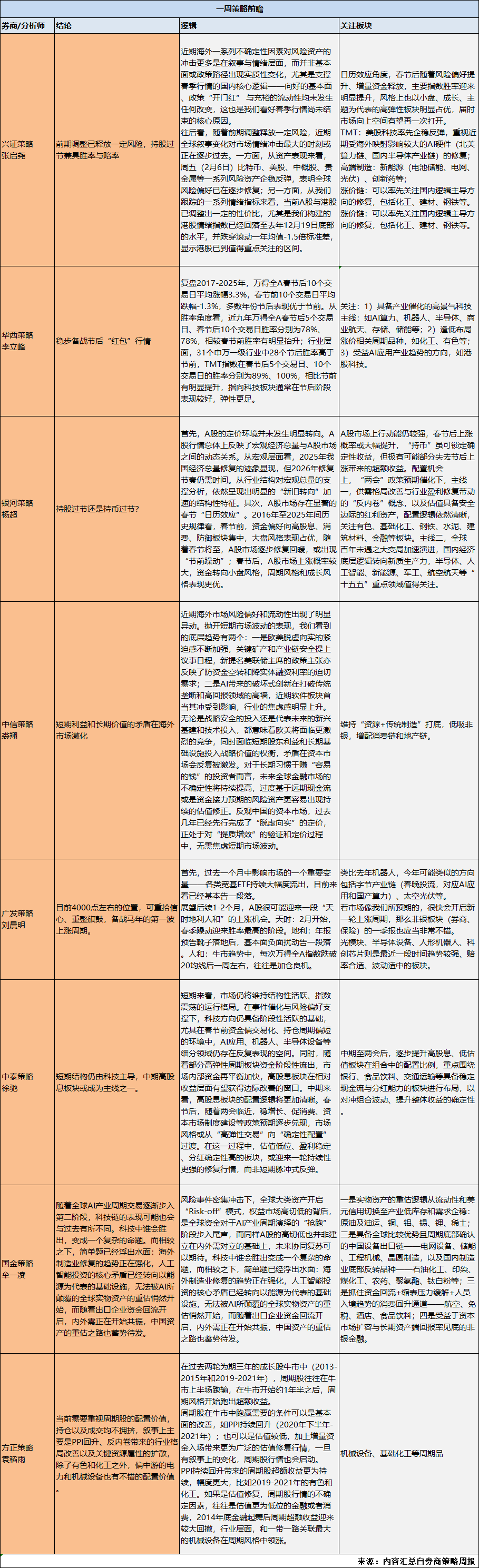
本周各家券商策略分析师讨论的焦点在于是否持股过节,整体偏向乐观。 华西策略李立峰团队也指出,可稳步备战节后"红包"行情。 其复盘2017-2025年,万得全A春节后10个交易日平均涨幅3.3%,春节前10个交易日平均跌幅-1.3%,多数年份节后表现优于节 前。从胜率角度看,近九年万得全A春节后5个交易日、春节后10个交易日胜率分别为78%、78%,相较春节前胜率有明显抬升; 行业层面,31个申万一级行业中28个节后胜率高于节前,TMT指数在春节后5个交易日、10个交易日的胜率分别为89%、100%, 相比节前有明显提升,指向科技板块通常在节后阶段表现较好,弹性更足。 银河策略杨超团队称,A股市场上行动能仍较强,春节后上涨概率或大幅提升,"持币"虽可锁定确定性收益,但极有可能部分失 去节后上涨带来的超额收益。以2016年至2025年间历 史规律看,春节前,资金偏好向高股息、消费、防御板块集中,大盘风格表现占优,随着春节将至,A股市场逐步修复回暖,或 出现"节前躁动";春节后,A股市场上涨概率较大,资金转向小盘风格,周期风格和成长风格表现更优。 广发策略刘晨明团队指出,目前4000点左右的位置,占据天时地利人和。 ...
化工板块单日吸金近200亿元!锂电、磷化工强势领涨,化工ETF(516020)逆市上探3.45%!景气周期启动?
Xin Lang Cai Jing· 2026-02-08 12:15
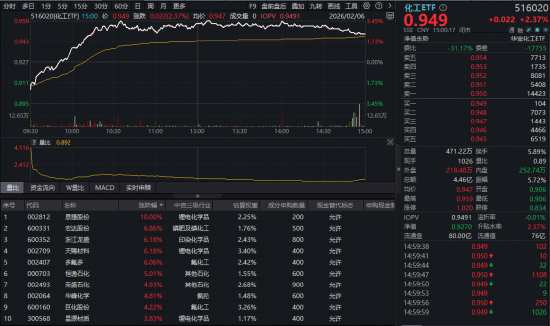
Core Viewpoint - The chemical sector experienced a significant rally on February 6, with the chemical ETF (516020) showing a maximum intraday increase of 3.45% before closing up 2.37% despite market conditions [1][7]. Market Performance - The chemical ETF opened lower but quickly rebounded, maintaining high levels before a slight pullback at the close [1][7]. - Key stocks in the lithium battery, phosphate chemical, and petrochemical sectors saw substantial gains, with Enjie Technology hitting the daily limit, and other stocks like Hongda shares, Zhejiang Longsheng, and Tianci Materials rising over 6% [1][7]. Capital Inflow - The basic chemical sector attracted significant capital, with a net inflow of 19.918 billion yuan, the highest among 30 sectors tracked by Citic [3][9]. - This capital influx indicates strong investor interest and confidence in the sector's growth potential [3][9]. Industry Trends - The lithium battery sector is entering a growth phase characterized by rising prices and demand for key chemical materials such as lithium iron phosphate and hexafluorophosphate [3][9]. - Analysts suggest that policy directions are optimizing supply-side dynamics, enhancing the competitive advantages of leading companies in the chemical industry [3][9]. Future Outlook - Zhongyuan Securities anticipates that ongoing regulatory measures will strengthen supply-side constraints, benefiting certain sub-industries like chlorine-alkali, pesticides, and polyester filament in February [3][9]. - Guojin Securities remains optimistic about investment opportunities in the chemical sector, recommending a focus on leading companies and products experiencing price increases [3][9]. Investment Strategy - Investors are encouraged to consider the chemical ETF (516020) for efficient exposure to the sector, as it tracks the CSI sub-industry index covering various themes including AI computing and new energy [3][9].