
债市行情

Search documents
流动性周报:央行购债规模怎么看?-20251110
China Post Securities· 2025-11-10 08:26
Group 1: Industry Investment Rating - There is no information about the industry investment rating in the report. Group 2: Core Viewpoints - The bond market in the fourth quarter may move in a volatile manner. Short - term bonds have high allocation and trading value, and there is a possibility of an unexpected decline in inter - bank certificate of deposit rates at the end of the year. Long - term bonds have some room for repair due to the expansion of the term spread. Although there are many bullish factors in the bond market in the fourth quarter, redemption pressure persists, and trading should be based on an interval - oscillation strategy. With the increasing expectation of monetary easing, a more optimistic view of the subsequent bond - market situation can be taken [3][10]. - The restart of the central bank's bond purchases in October had a net purchase amount of only 20 billion yuan, lower than market expectations. The restart should be understood more as a signal, and high expectations for the purchase volume should not be held [3][10]. - The key impact on the market lies in whether the central bank will adjust the bond - purchase term to hedge against the potentially concentrated issuance of long - term and ultra - long - term local bonds in November, which may bring significant pressure to the allocation portfolio [4][19]. Group 3: Summary by Directory 1. How to View the Central Bank's Bond - Purchase Scale - **Viewpoint Review**: The bond market in the fourth quarter may move in a volatile way. Short - term bonds have high value, and long - term bonds have repair space. Bullish factors are numerous, but redemption pressure exists. With rising easing expectations, the subsequent bond - market situation can be viewed more optimistically [3][10]. - **Analysis of the Central Bank's Bond - Purchase Scale**: - **From the perspective of liquidity**: The central bank's bond - purchase space comes from the switch between tools. Since the beginning of this year, repurchase and MLF have been the main channels for the central bank to inject medium - and long - term liquidity. The medium - and long - term liquidity injection has been sufficient, especially after the second quarter, so there is no need to rely on the central bank's bond - purchase channel. At the end of the year, the central bank can increase bond purchases to make up for the concentrated maturity of MLF, but the operation space may be within one trillion yuan if mainly relying on bond purchases [10][11][13]. - **From the perspective of the central bank's bond maturity**: The cumulative scale of the central bank's bond purchases in this round should be limited to around one trillion yuan. The restart of bond purchases is a form of "roll - over," and the continuous purchase scale after the restart needs to reach around one trillion yuan to match the maturity volume. Otherwise, it may be a de - facto non - roll - over [15]. - **From the perspective of monthly purchase scale**: To have a relatively neutral impact on the market, the single - period injection scale may be small. If calculated based on a net weekly purchase of 20 billion yuan, the monthly net purchase scale can reach around 100 billion yuan. Concentrated incremental purchases may cause an abnormal decline in short - term Treasury bond yields, which is not what the central bank wants to see [16].
流动性预期改善,机构看好债市年末行情
Mei Ri Jing Ji Xin Wen· 2025-11-06 02:02
Group 1 - The central bank resumed government bond trading operations in October, with a net injection of 20 billion yuan, indicating a shift towards a more accommodative monetary policy [1] - Analysts from CITIC Securities believe that the central bank's unexpected resumption of bond trading signals an improvement in market liquidity expectations [1] - Zhongyou Securities expresses a more optimistic outlook for the year-end bond market, noting that interbank certificate of deposit rates are currently in a high allocation value range, suggesting potential downward pressure on short-term yields [1] Group 2 - Related products include the benchmark government bond ETF (511100), which focuses on medium to long-term bonds with low fees [2] - The credit bond ETF fund (511200) targets medium to short-term credit bonds, also with low fees and high credit quality [2] - The Sci-Tech Innovation Bond ETF (551550) offers medium to short-term bonds with low fees and high credit quality [2]
机构称债市已重回基本面资金面定价,国债ETF5至10年(511020)备受关注
Sou Hu Cai Jing· 2025-11-04 01:15
Group 1 - The bond market is expected to have a smooth bullish phase in Q4 due to limited supply and increased allocation by banks and insurance funds [1] - Since October 13, various institutions have increased their positions in long-term bonds, while rural commercial banks have significantly reduced their holdings [1] - The central bank's resumption of government bond purchases has established a yield ceiling for bonds, leading to a growing trend of non-bank entities investing in the bond market [1] Group 2 - The scale of actively managed pure bond funds decreased by 743.3 billion, with potential adjustments to punitive redemption fees expected to be a net positive for the market [2] - MLF rates have dropped to 1.60%, indicating a potential future decrease in policy rates, with expectations for 30Y government bonds to decline by nearly 15 basis points [2] - As of November 3, 2025, the 5-10 year government bond ETF has seen a recent increase in trading activity, with a turnover of 153.59% and a total transaction volume of 2.469 billion [2] Group 3 - The 5-10 year government bond ETF reached a new high in scale at 1.608 billion, with recent inflows balancing out [3] - The ETF has shown a net value increase of 21.59% over the past five years, ranking in the top 18.78% among index bond funds [3] - Historical performance indicates a 100% probability of profit over three years, with a monthly profit probability of 70.91% [3] Group 4 - The 5-10 year government bond ETF has a Sharpe ratio of 1.05 over the past year, indicating favorable risk-adjusted returns [4] - The maximum drawdown over the past six months was 1.09%, with a relative benchmark drawdown of 0.46% [5] - The management fee for the ETF is 0.15%, and the custody fee is 0.05% [6] Group 5 - The tracking error for the 5-10 year government bond ETF was 0.027% over the past month, demonstrating its close alignment with the underlying index [7] - The index reflects the performance of actively traded government bonds with maturities of 5, 7, and 10 years [7]
固收-债市行情升温能否持续?
2025-11-03 15:48
Summary of Key Points from the Conference Call Industry Overview - The conference call primarily discusses the bond market, focusing on the impact of central bank policies and market dynamics on fixed income securities, particularly government and credit bonds [1][2][4]. Core Insights and Arguments - **Central Bank Actions**: The central bank's resumption of bond purchases is viewed as a signal of renewed expectations for monetary easing, significantly boosting market sentiment despite limited liquidity increase [1][2][4]. - **Market Sentiment**: Short-term trading sentiment has exceeded expectations, with a notable recovery in market activity following the central bank's actions [2][3]. - **Institutional Buyers**: The primary buyers of long-term government bonds are brokerages and insurance companies, while public funds show limited expectations for future yield declines [3][4]. - **Credit Bond Performance**: The credit bond market has shown strong performance, with demand driven by insurance funds, wealth management products, and asset management products. Public funds have increased their allocation to credit bonds, particularly in the 3 to 5-year maturity range [8][9][11]. - **Yield Movements**: Recent yield declines for government bonds ranged from 8.9 to 11.5 basis points for 1 to 5-year maturities, while credit bonds showed more significant declines for maturities beyond two years [10][12]. Additional Important Insights - **Market Dynamics**: The bond market is expected to face challenges in forming a smooth bull market due to year-end redemption pressures and new public fund fee regulations [6][7]. - **Investment Strategies**: Recommendations include extending duration and focusing on 3 to 5-year AA/AA2 rated municipal bonds, which offer high coupon rates as a core allocation. Super long-term bonds should be approached cautiously, with a focus on liquidity [16][18]. - **Future Market Outlook**: The market's recovery is ongoing, but caution is advised as the absolute yield levels are currently in the historical top 25%, indicating potential risks of rapid increases [14][15]. - **ETF and Insurance Trends**: The growth of new ETF products is limited, and insurance premium growth is not expected to be significant in the fourth quarter, suggesting weaker demand for long-term bonds [17][18]. This summary encapsulates the key points discussed in the conference call, providing insights into the current state and future outlook of the bond market.
11月债市有哪些机会?:债券研究周报-20251102
Guohai Securities· 2025-11-02 13:34
Report Summary 1. Report Industry Investment Rating No industry investment rating is provided in the report. 2. Core Viewpoints of the Report - The bond market showed an overall volatile performance in the latest week. On October 31, the yield to maturity of the active 10Y Treasury bond dropped to 1.79%, and the 30Y - 10Y term spread narrowed. Medium - and short - term bonds remained strong [4][10]. - There were three characteristics of institutional behavior this week: large banks increased their purchases of short - term bonds, securities firms increased their allocation of medium - and long - term bonds, and funds allocated more to credit bonds than to interest - rate bonds [4][10]. - In November, the money market rate and short - term bonds are expected to be stable, but the certificate of deposit (CD) rate may not decline significantly. The money market is likely to be stable, and the short - end interest rate is expected to range between 1.35% - 1.40%. Although the 1Y AAA - rated CD rate has dropped to 1.63%, it is less likely to decline further [4][11]. - Interest rates are in a high - probability winning state this year, but the probability of a trending market is not high, yet there are structural opportunities. The October PMI was lower than market expectations, and the fundamentals are generally not negative for the bond market. The 30Y - 10Y Treasury spread, 10Y CDB - 10Y Treasury spread, and 5Y CDB - Treasury spread are at relatively high odds [4][11]. - The short - term performance of Bond 25 Special 06 is strong, but there is a certain risk of interest rate increase. The balance of Bond 25 Special 06 was 247 billion yuan on October 31. The probability of its refinancing next year is small, and there is a "herding" phenomenon among funds holding this bond. If it is not refinanced, it may experience excessive decline [4][12]. 3. Summary by Relevant Catalog 3.1 This Week's Bond Market Review - The bond market was volatile. The 10Y Treasury yield dropped to 1.79% on October 31, and the 30Y - 10Y term spread narrowed. Medium - and short - term bonds were strong [10]. - Large banks mainly bought Treasury bonds with maturities of less than 1Y and 1 - 3Y. Securities firms increased their purchases of 7Y, 10Y, and 30Y Treasury bonds, with low net purchases of policy - financial bonds. Funds continued to allocate more to credit bonds than to interest - rate bonds since October [4][10]. 3.2 Bond Yield Curve Tracking 3.2.1 Key Maturity Interest Rates and Spread Changes - As of October 31, compared with October 27, the 1Y Treasury yield dropped 7.95bp to 1.38%, the 10Y Treasury yield dropped 4.69bp to 1.80%, and the 30Y Treasury yield dropped 6.00bp to 2.14% [13]. - The 30Y Treasury - 10Y Treasury spread dropped 1.31bp to 34.77bp, and the 10Y CDB - 10Y Treasury spread dropped 2.41bp to 13.00bp [14]. 3.2.2 Treasury Term Spread Changes - As of October 31, compared with October 27, the 3Y - 1Y Treasury spread dropped 2.28bp to 3.20bp, the 5Y - 3Y Treasury spread rose 6.31bp to 15.16bp, the 7Y - 5Y Treasury spread dropped 4.14bp to 11.06bp, the 10Y - 7Y Treasury spread rose 3.37bp to 11.86bp, the 20Y - 10Y Treasury spread dropped 1.63bp to 32.88bp, and the 30Y - 20Y Treasury spread rose 0.32bp to 1.89bp [16]. 3.3 Bond Market Leverage and Funding Situation 3.3.1 Balance of Inter - bank Pledged Repurchase - As of October 31, 2025, compared with October 27, the balance of inter - bank pledged repurchase increased by 0.40 trillion yuan to 11.41 trillion yuan [19]. 3.3.2 Changes in Inter - bank Bond Market Leverage Ratio - As of October 31, 2025, compared with October 27, the inter - bank bond market leverage ratio increased by 0.24 pct to 106.85% [20]. 3.3.3 Pledged Repurchase Turnover - From October 27 to October 31, the average daily turnover of pledged repurchase was 6.70 trillion yuan. The average overnight turnover was about 5.75 trillion yuan, and the average overnight turnover ratio was 85.95% [24][27]. 3.3.4 Operation of Inter - bank Funding - Bank funds for lending first increased and then decreased. As of October 31, the net lending of large banks and policy banks was 4.16 trillion yuan, and the net borrowing of joint - stock banks, city commercial banks, and rural commercial banks was 0.36 trillion yuan. The net lending of the banking system was 3.80 trillion yuan [28]. - The daily lending amount of banks first increased and then decreased. As of October 31, the daily lending amount of large banks and policy banks was 3.17 trillion yuan, and that of small and medium - sized banks was - 0.45 trillion yuan [30]. - As of October 31, DR001 was 1.3184%, DR007 was 1.4551%, R001 was 1.4069%, and R007 was 1.4923% [30]. 3.4 Duration of Medium - and Long - Term Bond Funds 3.4.1 Median Duration of Bond Funds - As of October 31, the median duration of medium - and long - term bond funds was 2.65 years (de - leveraged), up 0.05 years from October 27; the median duration (including leverage) was 2.71 years, up 0.07 years from October 27 [40]. 3.4.2 Median Duration of Interest - Rate Bond Funds - As of October 31, the median duration of interest - rate bond funds (including leverage) was 3.73 years, up 0.11 years from October 27; the median duration of credit bond funds (including leverage) was 2.49 years, up 0.14 years from October 27. The median duration of interest - rate bond funds (de - leveraged) was 3.30 years, up 0.01 years from October 27, and the median duration of credit bond funds (including leverage) was 2.45 years, up 0.06 years from October 27 [43]. 3.5 Changes in Bond Lending Balance - As of October 31, compared with October 27, the borrowing volume of 10Y CDB bonds showed volatility [48].
债基今年以来分红逼近1200亿元,占比超7成,30年国债ETF(511090)早盘窄幅震荡
Sou Hu Cai Jing· 2025-10-30 02:36
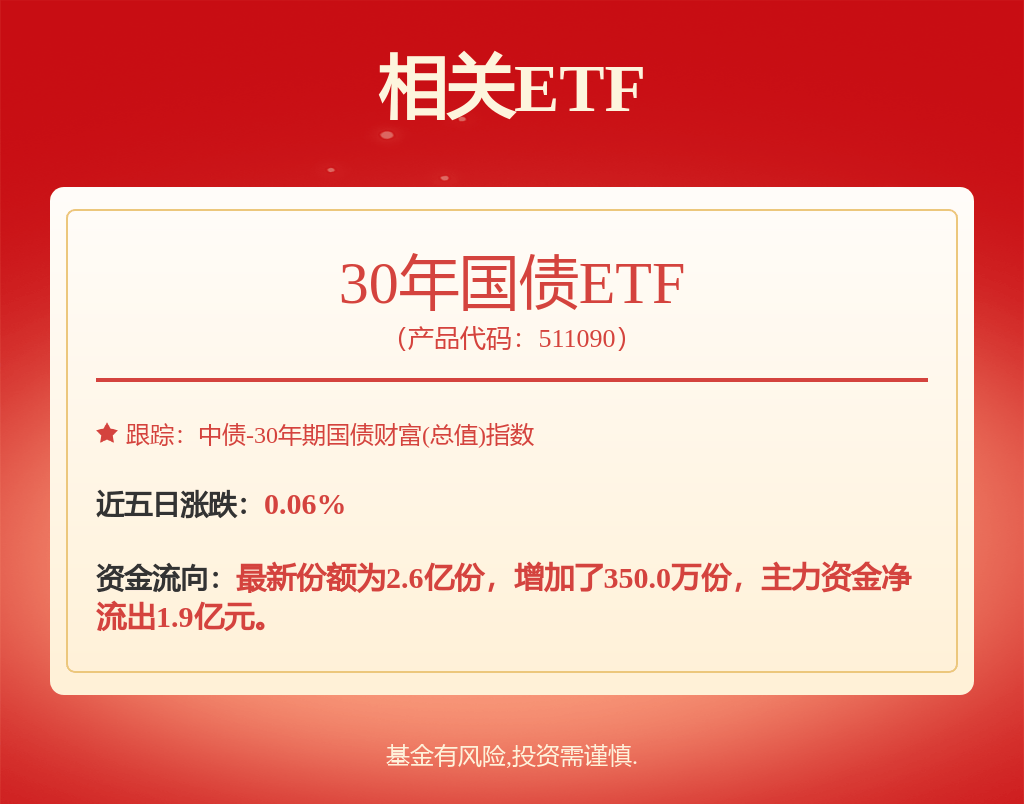
Group 1 - The bond market is experiencing slight fluctuations, with the 30-year government bond ETF down by 0.06% and the 30-year futures contract down by 0.14% as of 10:00 AM [1] - The central bank conducted a 7-day reverse repurchase operation of 342.6 billion yuan at a stable interest rate of 1.40%, while yields on major government bonds have seen a slight increase [1] - Public funds have distributed dividends 3,359 times this year, totaling 168.9 billion yuan, which is a 21.94% increase compared to the same period last year [1] Group 2 - Bond funds continue to provide stable returns and are a significant contributor to the overall dividend distribution, while equity and mixed funds are also showing increased payouts [2] - The Pengyang 30-year government bond ETF is the first ETF tracking the 30-year government bond index, offering T+0 trading attributes, making it suitable for investors looking to manage cash and adjust portfolio duration [2] - The bond market is currently influenced by mixed factors, including potential negative impacts from new fund redemption regulations and the central bank's resumption of bond purchases, which could affect interest rates [2]

机构看好四季度债市行情,国债ETF5至10年(511020)备受关注
Sou Hu Cai Jing· 2025-10-29 02:03
Group 1 - The core viewpoint indicates significant growth in secondary bond funds in Q3, while active pure bond fund scales decreased by 743.3 billion, reflecting the impact of punitive redemption fees [1] - By the end of Q3, the balance of secondary bond funds reached 1.35 trillion, increasing by 503.7 billion in a single quarter, while the balance of primary bond funds decreased to 994.2 billion, down by 40.5 billion [1] - The total scale of medium to long-term pure bond funds was 5.83 trillion, decreasing by 546.5 billion in the quarter, and short-term pure bond funds dropped to 860 billion, down by 196.8 billion [1] Group 2 - The index bond fund reached 1.56 trillion, increasing by 71.2 billion, likely due to the growth of bond ETFs [1] - The punitive redemption fee's formal document has not yet been released, indicating regulatory considerations to prevent significant industry impact, with potential adjustments to the final rules [1] - The active pure bond fund scale may decline further, as institutions shift towards secondary bond funds and bond indices, with expectations of a favorable market in Q4 [1] Group 3 - As of October 28, 2025, the 5-10 year government bond ETF index rose by 0.18%, with a recent price of 117.21 yuan, and a one-year cumulative increase of 3.76% [2] - The trading volume for the 5-10 year government bond ETF was active, with a turnover rate of 90.2% and a transaction value of 1.415 billion yuan [2][3] - The latest scale of the 5-10 year government bond ETF reached 1.57 billion, marking a six-month high, with net value growth of 21.54% over five years [3] Group 4 - The maximum drawdown for the 5-10 year government bond ETF in the last six months was 1.09%, with a relative benchmark drawdown of 0.40% [4] - The management fee for the 5-10 year government bond ETF is 0.15%, and the custody fee is 0.05% [5] - The tracking error for the 5-10 year government bond ETF over the last month was 0.025%, closely tracking the index of active government bonds [6]
美债收益率下行空间仍在,关注美国9月CPI数据
Sou Hu Cai Jing· 2025-10-21 12:28
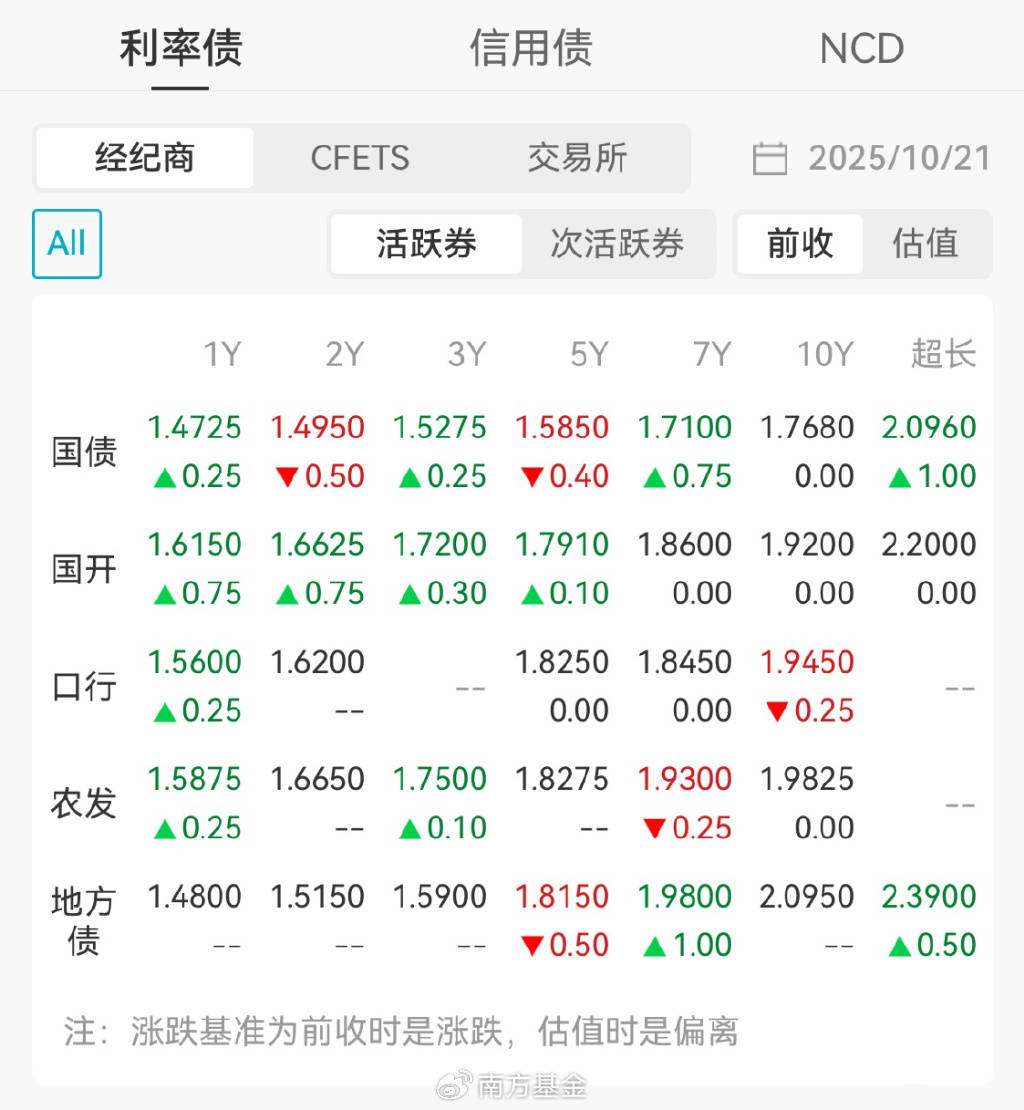
Market Overview - The bond market is experiencing slight fluctuations with mixed performance, as the 10-year and 30-year government bonds yield 1.77% and 2.1% respectively [1] - Government bond futures are down across the board, with the 30-year main contract falling by 0.33% and the 10-year main contract decreasing by 0.17% [1] Liquidity Situation - The central bank has conducted a reverse repurchase operation of 100 billion, resulting in a net liquidity recovery of 68.5 billion after accounting for 91 billion in maturing amounts [2] - The liquidity remains stable and accommodative, with overnight and 7-day funding rates at 1.3% and 1.44% respectively [2] Reverse Repo Details - Recent reverse repo operations include: - 7-day reverse repo on October 20 with an issuance of 189 billion and maturity of 116 billion [4] - 7-day reverse repo on October 21 with an issuance of 159.5 billion and maturity of 91 billion [4] Bond Market Outlook - In the short term, the bond market pricing is not primarily driven by fundamentals, as new fund sales regulations have yet to be implemented and expectations for loose monetary policy remain insufficient [3] - The 10-year government bond yield is likely to fluctuate within the range of 1.7% to 1.8% [3] U.S. Treasury Focus - The key focus for U.S. Treasuries this week is the September CPI data; if inflation remains moderate, it could strengthen the expectation for a rate cut by the Federal Reserve in October, potentially leading to further declines in Treasury yields [5] - However, there are two risk factors to consider: a marginal easing in U.S.-China trade tensions may reduce market risk aversion, and regional bank credit issues in the U.S. could impact the market in the short term [5] - A balanced allocation between domestic stocks and bonds is recommended, along with diversification across countries for stable asset management [5]
固收 债市周周谈:债市继续进攻
2025-10-19 15:58
Summary of Key Points from Conference Call Industry Overview - The conference call primarily discusses the **Chinese bond market** and its dynamics in the context of macroeconomic factors and market sentiment [1][2][3]. Core Insights and Arguments 1. **Impact of US-China Trade Relations**: The trade tensions between the US and China have a limited negative impact on the bond market, with the best-case scenario being the maintenance of the current status or a formal agreement [1][2]. 2. **Stock Market Influence**: A significant decline in stock market trading volume and the Hang Seng Technology Index indicates a decrease in risk appetite, leading institutional funds to potentially flow back into the bond market [1][3]. 3. **Banking Sector's Role**: Banks have played a crucial role in stabilizing the bond market by increasing their investments in government bonds, with the ten-year government bond yield stabilizing around 1.75% [1][4][5]. 4. **Economic Contribution**: In the first three quarters, the banking system increased bond investments by 11.4 trillion RMB, accounting for over 80% of new loan growth, significantly contributing to the economy [1][6]. 5. **Future Market Expectations**: The stock market is expected to decline slowly, with a further decrease in risk appetite, leading to a potential shift towards safer bond assets [1][7]. 6. **Fourth Quarter Bond Market Outlook**: A positive outlook for the 30-year government bond is anticipated, with expectations of a yield increase of over 20 basis points due to reduced primary issuance and increased demand from insurance companies [1][9][10]. 7. **Yield Projections**: The central yield for the 30-year government bond is projected at 2%, with an expected range of 1.7% to 2.3% over the next year [1][11]. 8. **Investment Strategies in Low-Rate Environment**: In a low-interest-rate environment, it is suggested to focus on long-duration bonds to capture capital gains, as short-term bonds offer limited opportunities [1][12]. 9. **Economic Growth Challenges**: The GDP growth rate for the fourth quarter is expected to be challenging, with estimates around 4.7%-4.8%, influenced by weak consumption and investment [1][14]. 10. **Real Estate Market Risks**: Significant risks in the real estate market could negatively impact the banking sector, with property prices having dropped substantially in many areas [1][15]. 11. **Potential for Interest Rate Cuts**: The likelihood of further interest rate cuts by the People's Bank of China is high, with expectations of a 10 to 20 basis point reduction due to easing domestic economic pressures [1][16][17]. 12. **Investment Opportunities**: The bond market is viewed as having potential investment opportunities, particularly in the 30-year government bonds and long-term capital bonds from state-owned enterprises [1][18]. 13. **Sales Fee Regulations**: New sales fee regulations are expected to have a limited impact on the bond market, as the market has already priced in these changes [1][19]. Other Important but Overlooked Content - The call emphasizes the importance of monitoring the bond market closely in the fourth quarter, as it presents a critical opportunity for investors to capitalize on potential market movements [1][19].
存款搬家结束了吗?
Western Securities· 2025-10-19 05:31
1. Report Industry Investment Rating There is no information provided in the report regarding the industry investment rating. 2. Core Viewpoints of the Report - The slowdown of deposit relocation does not mean it has ended. Further data observation is needed as the YoY growth rate of non - bank deposits remains at a relatively high level, and there are seasonal disturbances. Asset relocation may continue due to factors such as the high economic base and trade frictions in Q4 [2][14] - The bond market is likely to remain weakly volatile. A defensive approach is recommended, with control over the duration level, and seizing allocation and trading opportunities after adjustments [3][15] 3. Summary by Relevant Catalogs 3.1 Review Summary and Bond Market Outlook - This week, the bond market showed a "first decline then rise" trend. The 10Y and 30Y Treasury bond rates changed by +0.4bp and -3bp respectively. Market sentiment was affected by factors such as US - China negotiation signals, stock market trends, and economic data [10] - Deposit relocation accelerated in July and August but slowed down in September. It is still too early to conclude that it has ended [11][14] - The bond market is expected to be weakly volatile. It is recommended to focus on defense, control the duration, and choose to allocate certificates of deposit and short - term interest - rate bonds [15] 3.2 Bond Market Review 3.2.1 Fundamentals - The central bank had a net withdrawal this week, and the capital interest rate increased. Next week, the maturity volume of reverse repurchases is less than that of the previous week [16] - The R001 and DR001 increased by 5bp and 1bp respectively compared to October 11th. The 3M certificate of deposit issuance rate first rose, then fell, and then rose again [18] 3.2.2 Secondary Market Trends - Bond yields first rose and then fell. Except for the 7Y, 20Y, and 30Y Treasury bonds, the yields of other key - term Treasury bonds increased. Most of the term spreads of Treasury bonds narrowed [26] - The spread between new and old 10Y Treasury bonds first widened and then narrowed, the spread of 10Y China Development Bank bonds widened negatively, and the spread of 30Y Treasury bonds narrowed [29][30] 3.2.3 Bond Market Sentiment - The median duration of the full - sample bond funds slightly increased. The turnover rate of ultra - long bonds increased, and the 30Y - 10Y Treasury bond spread narrowed rapidly. The inter - bank leverage ratio rose to 107.6%, and the exchange leverage ratio decreased to 122.4%. The implied tax rate of 10 - year China Development Bank bonds slightly narrowed [33] 3.2.4 Bond Supply - This week, the net financing of interest - rate bonds decreased. Next week, the issuance scale of Treasury bonds will increase, and the 10Y Treasury bond 250016.IB will be re - issued. The issuance scale of local government bonds will also increase [48][51] - The net financing of certificates of deposit increased this week, and the average issuance rate rose to 1.63% [53] 3.3 Economic Data - In September, the import and export growth rates significantly rebounded, and prices generally recovered. The YoY decline of the freight rate index slowed down in October, and industrial production improved marginally [59][60] - The YoY growth rate of non - bank deposits declined in September, and the M1 growth rate increased [60] 3.4 Overseas Bond Market - The release of key US inflation data was postponed due to the government "shutdown." The expectation of a Fed rate cut in October has increased again, mainly due to the weak employment market [69] - US bonds rose, and most emerging markets had more gains than losses [70] 3.5 Major Asset Performance - The Shanghai Gold Index performed the best, followed by Chinese - funded US dollar bonds, Chinese bonds, the US dollar, convertible bonds, Shanghai Copper, rebar, the CSI 300 Index, live pigs, the CSI 1000 Index, and crude oil [74] 3.6 Policy Review - On October 17th, multiple policies were introduced, including promoting logistics cost reduction, expanding green trade, adjusting the Hainan duty - free shopping policy, and more. These policies aim to support economic development and stabilize market expectations [77][82]