
资产荒

Search documents
上半年理财收益率降至2.12% 单季新增千万投资者
Di Yi Cai Jing· 2025-07-30 00:29
Core Insights - The report indicates that the number of investors holding wealth management products increased by 8.37% year-on-year, reaching 136 million by the end of June [1][4] - The average annualized yield of wealth management products fell to 2.12%, down 68 basis points from 2.8% in the same period last year [1][4] - The total scale of the wealth management market reached 30.67 trillion yuan, with a year-to-date increase of 720 billion yuan [2][3] Investor Trends - The number of personal investors increased by 10.29 million in the first half of the year, indicating a strong influx of new investors [1][4] - The risk appetite of individual investors has shifted, with an increase in the proportion of those with higher risk preferences [4][6] Market Dynamics - The gap between the scale of wealth management products and public funds has widened, with public fund assets totaling 34.39 trillion yuan, a year-to-date increase of 1.56 trillion yuan [2][3] - The growth in wealth management products was primarily driven by the second quarter, contributing approximately 1.53 trillion yuan to the total scale [3] Product Composition - Cash management products have seen a significant decline, with a reduction of nearly 1 trillion yuan in the first half of the year, now accounting for 25.79% of open-ended wealth management products [7][8] - The proportion of risk-rated products has shifted, with a notable increase in the share of higher-risk products [6][9] Asset Allocation - Wealth management products have increased their allocation to public funds, cash, and deposits, while reducing exposure to credit bonds [10][11] - By the end of June, the total investment assets of wealth management products reached 32.97 trillion yuan, with a significant portion allocated to bonds [10][11]
方正富邦自购权益类基金超2500万元
Zheng Quan Shi Bao Wang· 2025-07-29 12:33
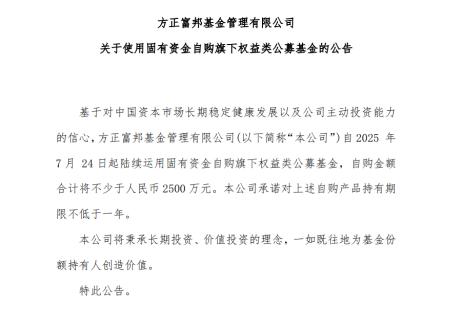
Core Viewpoint - The surge in public fund self-purchases reflects confidence in the long-term market outlook, with Fangzheng Fubang Fund recently investing over 25 million yuan in its equity funds, committing to hold for at least one year [1][2]. Group 1: Fund Self-Purchase Actions - Fangzheng Fubang Fund announced the use of its own funds to purchase equity fund products, demonstrating confidence in the long-term stability and healthy development of the Chinese capital market [2][5]. - The total self-purchase amount is no less than 25 million yuan, with a commitment to hold the purchased products for no less than one year [2][5]. - This follows a previous self-purchase of 5 million yuan in April for the Fangzheng Fubang CSI All Share Free Cash Flow ETF, which is one of the first approved ETFs in its category [5]. Group 2: Market Sentiment and Strategic Outlook - The self-purchase trend is seen as a positive signal to investors, indicating that the company is optimistic about the market and trusts its fund managers [5]. - The company maintains an optimistic outlook for the second half of the year and into 2025, expecting macro policies to remain accommodative, which may alleviate profit pressures in related industries [5]. - Key drivers for A-shares in the latter half of 2025 are anticipated to be a combination of policy easing, asset scarcity, and industrial upgrades [5]. Group 3: Investment Management and Product Strategy - Fangzheng Fubang Fund emphasizes long-term and value investment principles, aiming to create value for fund shareholders [5][6]. - The company is enhancing its core research and investment capabilities, focusing on a multi-strategy research and investment system to strengthen its investment management [6][7]. - The fund has a diverse product lineup, including innovative thematic products and passive index funds, with a focus on sectors like humanoid robots and military technology [7][8]. Group 4: Performance Metrics - Fangzheng Fubang Fund's equity research team has achieved a return of 31.49% for the Fangzheng Fubang Xinhong A fund over the past year, ranking in the top 12% of its peers [7]. - In fixed income, the fund's products have shown strong performance, with an absolute return of 11.6% over the past three years, placing it in the top 9% among 150 fund companies [8]. - The fund's assets under management reached 80.861 billion yuan in 2024, reflecting a year-on-year growth of 32.20% [8].

施罗德基金:下半年市场“股债双牛”,有色、新消费、AI硬件机会活跃
Hua Er Jie Jian Wen· 2025-07-29 08:08
Group 1 - The core viewpoint is that the domestic market in China is expected to show a "dual bull" pattern in both equity and bond markets in the second half of the year, driven by structural investment opportunities in new economy sectors and a low-growth, low-inflation environment in the bond market [1] - The A-share market, despite uncertainties, is likely to benefit from a loose liquidity environment and recognition from decision-makers of the stock market's impact on public confidence and consumption [1] - In the cyclical sector, there are structural opportunities in non-ferrous metals, but a comprehensive rebound in the sector requires significant improvement in macro demand [1] Group 2 - The technology sector is expected to experience a clear domestic and international divergence, with overseas demand for computing power exceeding expectations, particularly in hardware segments benefiting from global AI infrastructure, such as GPU supply chains and optical modules [2] - The bond market is influenced by China's rapid demographic changes and complex geopolitical situation, with a focus on consumption and technology as new growth points for the economy [2] - The investment strategy for the second half of the year should consider allocations to fixed income plus, equity assets, overseas short-term bonds, and gold to capitalize on potential benefits from China's economic transformation [2]
谁在主导港股行情? 本轮周期行情的持续性?
2025-07-29 02:10
Summary of Conference Call Records Industry Overview - The Hong Kong stock market is primarily driven by southbound funds and passive investments, with significant increases in trading volume but no notable changes in active allocation ratios, indicating that long-term foreign capital has not significantly entered the market [1][4] - The market is experiencing a structural rally with rapid sector rotation, necessitating investor attention to specific sectors and industry dynamics [1][5] - The phenomenon of AH premium narrowing has been observed, with some companies trading at higher prices in Hong Kong than in A-shares, attributed to alignment with industrial development trends and foreign capital preferences [1][8] Key Points and Arguments - **Liquidity as a Dominant Factor**: The primary driver of the recent market activity has been liquidity rather than fundamentals, with a significant influx of southbound funds [2][10] - **Structural Market Characteristics**: The market has shown a high level of structural activity, with different sectors taking turns as hotspots, leading to a disparity between index returns and actual investment returns [5][6] - **Investment Opportunities**: The ongoing influx of southbound funds, which accounted for 8.2 trillion RMB this year, has positioned them as a dominant force in the market, particularly in ETFs and trading funds [10][11] - **Future Market Outlook**: The Chinese market is expected to continue facing a "money surplus but lack of quality assets" situation, which will sustain structural market trends [11][12] - **IPO and Placement Dynamics**: The balance of supply and demand in the market is expected to remain stable, with estimated IPO and placement absorption power around 3 trillion RMB, matching the supply from southbound funds and foreign capital [13][14] Important but Overlooked Content - **Sector-Specific Insights**: The electric equipment industry is expected to benefit significantly from the Yaxia Hydropower Station project, which has a total investment of approximately 1.2 trillion RMB, catalyzing long-term growth in related sectors [3][40] - **Impact of Policies on Industries**: The "anti-involution" policy is influencing the basic materials sector by reducing production capacity, which may benefit long-term industry development despite short-term profitability pressures [25][26] - **Investment Strategy Recommendations**: Investors are advised to position themselves during market lows rather than chasing highs, focusing on structural opportunities rather than overall index performance [18][19] Conclusion - The Hong Kong stock market is characterized by a liquidity-driven structural rally, with significant implications for various sectors, particularly in the context of ongoing policy changes and macroeconomic conditions. Investors are encouraged to adopt a strategic approach that emphasizes sector rotation and specific investment opportunities while being mindful of the broader market dynamics.

利率 - 需要担心赎回压力吗?
2025-07-29 02:10
Summary of Conference Call Notes Industry Overview - The notes primarily discuss the bond market and macroeconomic conditions in China, focusing on interest rates, government financing, and corporate profitability [1][3][5]. Key Points and Arguments 1. **Economic Conditions**: June economic data shows significant divergence in supply and demand, with household income growth lagging behind GDP growth. External demand for exports to the U.S. has sharply declined, indicating persistent insufficient total demand [1][3]. 2. **Government Financing**: It is projected that government financing will decrease by over 2 trillion yuan in the second half of 2025, following a peak in social financing growth in July. This decline in financing is expected to contribute to lower interest rates [1][4]. 3. **Corporate Profitability**: Corporate profit margins are under pressure due to declining total demand and trade tensions, resulting in low investment returns. The central bank maintains a moderately loose monetary policy, alleviating concerns about policy tightening [1][5]. 4. **Interest Rate Projections**: The current central level for the 10-year government bond yield is 1.5%, with the current yield at 1.7%. Short-term projections suggest that rates may decline further, potentially falling below 1.5% [1][7]. 5. **Liquidity Management**: The central bank's operations indicate a stable interest rate level around 1.8% during tight liquidity periods. The reasonable range for current operations is estimated between 1.4% and 1.7% [1][8]. 6. **Asset-Liability Matching**: Banks are achieving a yield of approximately 1.5% on mortgages, while the yields on 10-year and ultra-long government bonds are 1.7% and 1.9%, respectively. Insurance companies are also adjusting their guaranteed rates below 2%, making long-term bonds attractive [1][9]. 7. **Redemption Pressure**: Current redemption pressure is primarily preventive and not indicative of a trend, similar to the situation in August 2024. The market is not expected to experience significant volatility due to this preventive redemption [2][10]. 8. **Market Outlook**: The third quarter is expected to see increased volatility in funding rates, but the overall range will remain between OMO reductions of 20 basis points and increases of 20 basis points, indicating a more accommodative environment compared to the second quarter [2][11]. Additional Important Content - The notes emphasize the lack of significant counter-cyclical demand policies to address the ongoing economic challenges, which could further impact total demand and interest rates [1][3]. - The analysis suggests that the bond market is not at risk of a trend reversal to bearish conditions, as the fundamental factors driving interest rates downward remain unchanged [3].
8月金股报告:资金面有望驱动市场继续上涨
ZHONGTAI SECURITIES· 2025-07-28 15:41
Market Overview - The market is expected to continue rising in August, driven by liquidity conditions[5] - As of July 28, the Wind All A Index surpassed its peak from October 8 of the previous year, indicating a bullish market sentiment[5] Market Drivers - The upward market movement is attributed to ample incremental capital and improved supply-demand dynamics, particularly in cyclical stocks[7] - Recent trends show a significant increase in public and retail investor participation, with new fund issuance in June reaching nearly 30 billion, the highest monthly level since 2022[8] Investment Strategy - The report recommends focusing on large financial and technology assets, highlighting the potential for banks and insurance companies to benefit from reduced economic risks and lower liability costs[9] - Technology assets are suggested for contrarian trading due to their low trading congestion, with historical performance showing a strong correlation with trading dynamics[9] Key Stock Recommendations - The August stock selection includes: Hong Kong Tech 50 ETF, Fuda Co., Su Neng Co. (automotive), Zhujiang Co., Core International (trading), Wanhua Chemical, Dongcai Technology (chemicals), and others[17] - The report emphasizes the importance of sectors like steel and pharmaceuticals, which are expected to perform well due to demand recovery and policy support[9] Risks - Potential risks include unexpected economic downturns and insufficient policy support, which could impact market performance[18]






2025年二季度基金持债分析:加杠杆、拉久期,增配国债和金融债
CAITONG SECURITIES· 2025-07-28 15:40
Report Industry Investment Rating The document does not mention the industry investment rating. Core Viewpoints of the Report - In the second quarter, the stock and bond markets both performed well, boosting the expansion of the fund industry. Although bond funds face certain redemption pressure in the short term, the current internal economic momentum is weak, the logic of asset shortage continues, and the monetary policy guides sufficient liquidity. There is no pressure for a trend adjustment in the bond market. It is expected that the scale of bond funds will continue to increase steadily in the third quarter, and the scale increase of equity - containing products may exceed that of the second quarter [6]. - The share and net asset value of the entire market's funds increased in the second quarter. The scale of bond funds increased significantly. In terms of positions, the overall allocation ratio of the entire market's funds to bonds and stocks decreased, while the allocation ratio of cash increased significantly. Among them, the bond allocation mainly showed an increase in the allocation of treasury bonds, financial bonds, and credit bonds, and a decrease in the allocation of policy - financial bonds and inter - bank certificates of deposit [6]. - The performance of equity - containing products rebounded more. Among them, the performance of long - term bonds was better than that of short - term bonds, and the performance of hybrid second - tier bond funds was better than that of hybrid first - tier bond funds. Although the performance of hybrid funds was good, the scale declined. The main reasons are that the return gap between hybrid funds and second - tier bond funds is not obvious, and the risk level is higher; and the return of hybrid funds is lower than that of stock - type funds, and the recovery of risk appetite drives the scale of stock - type funds to rise, thus suppressing the hybrid funds [7]. Summary According to the Directory 1. Fund Total Scale Rises, Bond Allocation Scale Increases - **1.1 Fund Market Scale: Fund Shares and Net Asset Value Both Increase** - As of the end of the second quarter of 2025, there were approximately 1.29 trillion funds in total, with a market share of about 30.90 trillion shares and a net asset value of about 33.72 trillion yuan. Compared with the end of the first quarter of 2025, the number of various funds increased by 2.44%, the market share increased by 5.14%, and the net asset value increased by 6.68% [21]. - The net asset value of hybrid funds slightly decreased, while that of other types of funds increased. The net asset value of bond - type funds increased significantly. The total share of bond funds in the second quarter of 2025 was 9.60 trillion shares, a 6.27% increase from the end of the first quarter of 2025; the net asset value of bond - type funds was about 10.91 trillion yuan, an 8.54% increase from the end of the first quarter of 2025 [25][32]. - The outstanding shares of pure - bond funds and hybrid bond funds increased. The new - issue shares of actively managed and passively managed bond funds both increased slightly quarter - on - quarter but decreased significantly year - on - year [36][45]. - **1.2 Fund Asset Allocation: Bond Allocation Ratio Decreases Slightly, Cash Allocation Ratio Increases** - As of the end of the second quarter of 2025, the total asset value of funds increased by 8.42% compared with the end of the first quarter of 2025. The market value of stocks held increased by 4.09% quarter - on - quarter, the market value of bonds held increased by 7.69% quarter - on - quarter, and the market value of cash held increased significantly by 32.30% quarter - on - quarter. The reason for the increase in cash allocation by funds is mainly due to the increase in the cash allocation ratio of money market funds [53]. - The proportion of funds held in stocks, bonds, and other assets decreased, while the proportion of cash held increased. At the end of the second quarter of 2025, the proportions of stocks, bonds, cash, and other assets were 19.64%, 57.80%, 12.88%, and 9.15% respectively, among which the proportion of bond - holding assets decreased by 0.39 pct quarter - on - quarter [53]. - **1.3 Fund Bond - Holding Analysis: The Allocation of Financial Bonds Increased the Most Quarter - on - Quarter** - As of the end of the second quarter of 2025, the total value of bonds held by all funds was about 21.21 trillion yuan, a 7.69% increase from the end of the first quarter of 2025. Among them, interest - rate bonds, financial bonds, credit bonds, inter - bank certificates of deposit, and other bonds increased by 7.71%, 12.82%, 8.96%, 5.33%, and 5.78% respectively quarter - on - quarter [55][56]. - The proportion of inter - bank certificates of deposit held by funds decreased the most. In the bond positions of funds at the end of the second quarter of 2025, the allocation ratios of interest - rate bonds, financial bonds, and credit bonds increased by 0.01 pct, 0.59 pct, and 0.23 pct respectively quarter - on - quarter, while the allocation ratios of inter - bank certificates of deposit and other bonds decreased by 0.78 pct and 0.05 pct respectively quarter - on - quarter [56]. 2. Bond Fund Bond - Holding Analysis - **2.1 All Bond Funds: The Total Bond - Holding Scale Increases, the Allocation Proportion of Treasury Bonds Increases, and the Allocation Proportion of Policy - Financial Bonds Decreases** - As of the end of the second quarter of 2025, the total value of bonds held by bond - type funds was about 12.5207 trillion yuan, a 10.01% increase from the end of the first quarter of 2025. Among them, the market value of interest - rate bonds, financial bonds, credit bonds, inter - bank certificates of deposit, and other bonds increased by 405.9 billion yuan, 292.5 billion yuan, 380.6 billion yuan, 28.2 billion yuan, and 32.4 billion yuan respectively, with quarter - on - quarter growth rates of 7.96%, 13.05%, 11.87%, 8.85%, and 6.29% respectively [61][65]. - The allocation ratios of interest - rate bonds, inter - bank certificates of deposit, and other bonds decreased. The market value of treasury bonds and policy - bank bonds held by all bond funds accounted for 6.46% and 37.52% of the bond investment market value respectively, with quarter - on - quarter changes of 1.29 pct and - 2.13 pct respectively. The allocation ratios of enterprise bonds and short - term financing bills increased, while the allocation ratio of medium - term notes decreased [65][67]. - **2.2 Medium - and Long - Term Pure - Bond Funds: In Terms of Allocation Proportion, Reduce the Allocation of Policy - Financial Bonds and Increase the Allocation of Treasury Bonds** - As of the end of the second quarter of 2025, the total value of bonds held by medium - and long - term pure - bond funds was about 7.7616 trillion yuan, a 5.38% increase from the end of the first quarter of 2025. Among them, interest - rate bonds, financial bonds, credit bonds, inter - bank certificates of deposit, and other bonds changed by 4.47%, 6.50%, 5.86%, 0.45%, and 11.96% respectively quarter - on - quarter [71]. - In the second quarter, the allocation ratios of financial bonds and local government bonds in medium - and long - term bond funds increased the most, while the allocation ratio of interest - rate bonds decreased significantly. The market value of treasury bonds and policy - bank bonds held by medium - and long - term pure - bond funds accounted for 6.74% and 42.63% of the bond investment market value respectively, with quarter - on - quarter changes of 1.33 pct and - 1.76 pct respectively. The allocation ratios of enterprise bonds and short - term financing bills decreased, while the allocation ratio of medium - term notes increased [71][74]. - **2.3 Short - Term Pure - Bond Funds: In Terms of Allocation Proportion, Reduce the Allocation of Non - Financial Credit Bonds and Increase the Allocation of Financial Bonds** - As of the end of the second quarter of 2025, the total value of bonds held by short - term pure - bond funds was about 128.05 billion yuan, a 21.29% increase from the end of the first quarter of 2025. Among them, interest - rate bonds, financial bonds, credit bonds, inter - bank certificates of deposit, and other bonds increased by 28.73%, 52.18%, 13.26%, 13.10%, and 27.17% respectively quarter - on - quarter [79]. - Compared with the first quarter of 2025, short - term pure - bond funds reduced the allocation ratios of credit bonds and inter - bank certificates of deposit and increased the allocation ratios of interest - rate bonds, financial bonds, and other bonds. The market value of treasury bonds and policy - bank bonds held by short - term pure - bond funds accounted for 2.02% and 11.70% of the bond investment market value respectively, with quarter - on - quarter changes of 0.62 pct and 0.17 pct respectively. The allocation ratios of enterprise bonds, short - term financing bills, and medium - term notes decreased [79][81][82]. - **2.4 Hybrid First - Tier Bond Funds: Increase the Allocation of Cash and Bonds, Mainly Increase the Allocation of Interest - Rate Bonds and Financial Bonds** - At the end of the second quarter of 2025, the total asset value of hybrid first - tier bond funds was about 99.45 billion yuan, a 14.55% increase from the end of the first quarter of 2025. Among them, the market values of stocks, bonds, cash, and other assets changed by 1.85%, 15.00%, 17.19%, and - 3.39% respectively quarter - on - quarter [85]. - As of the end of the second quarter of 2025, the total value of bonds held by hybrid first - tier bond funds was about 96.11 billion yuan, a 15.00% increase from the end of the first quarter of 2025. Among them, interest - rate bonds, financial bonds, credit bonds, inter - bank certificates of deposit, and other bonds changed by 25.48%, 30.68%, 4.17%, 23.63%, and 10.04% respectively quarter - on - quarter. The allocation ratios of interest - rate bonds and financial bonds increased, while the allocation ratio of credit bonds decreased significantly [85]. - In terms of proportion, hybrid first - tier bond funds significantly increased the allocation of treasury bonds and reduced the allocation of various non - financial credit bonds in the second quarter [88]. - **2.5 Hybrid Second - Tier Bond Funds: Increase the Allocation of Cash and Bonds, Mainly Increase the Allocation of Interest - Rate Bonds** - At the end of the second quarter of 2025, the total asset value of hybrid second - tier bond funds was about 94.03 billion yuan, a 6.94% increase from the end of the first quarter of 2025. Among them, the market values of stocks, bonds, cash, and other assets changed by 2.66%, 7.34%, 30.18%, and - 6.07% respectively quarter - on - quarter [90]. - As of the end of the second quarter of 2025, the total value of bonds held by hybrid second - tier bond funds was about 79.61 billion yuan, a 7.34% increase from the end of the first quarter of 2025. Among them, interest - rate bonds, financial bonds, credit bonds, inter - bank certificates of deposit, and other bonds changed by 18.51%, 6.18%, 7.63%, - 16.54%, and - 3.92% respectively quarter - on - quarter. The allocation ratio of interest - rate bonds increased, while the allocation ratios of other types of bonds decreased [91]. - In the second quarter, the allocation ratio of treasury bonds in hybrid second - tier bond funds increased, while the allocation ratio of policy - bank bonds decreased. The allocation ratio of medium - term notes increased, while the allocation ratios of enterprise bonds and short - term financing bills decreased [95]. 3. Analysis of the Structure of Fund Heavy - Positioned Bonds: The Proportion of Treasury Bond Positions Continues to Rise - In the second quarter, bond funds mainly increased the allocation of treasury bonds and reduced the allocation of policy - financial bonds. In the heavy - positioned interest - rate bonds of bond - type funds in the second quarter of 2025, the proportions of treasury bonds, local government bonds, and policy - bank bonds were 11.62%, 1.34%, and 87.04% respectively. Compared with the first quarter of 2025, the allocation ratio of treasury bonds increased by 2.70 pct, the allocation ratio of local government bonds decreased by 0.12 pct, and the allocation ratio of policy - bank bonds decreased by 2.58 pct [97]. - Bond funds increased the allocation ratio of AAA - rated industrial bonds and reduced the allocation ratios of AA +, AA, and below - AA - rated industrial bonds. In the heavy - positioned industrial bonds of bond - type funds in the second quarter of 2025, the proportions of AAA, AA +, AA, and below - AA industrial bonds were 94.81%, 4.59%, 0.60%, and 0.00% respectively [101]. - Bond funds increased the allocation ratios of AAA - and AA - rated urban investment bonds and reduced the allocation ratio of AA + - rated urban investment bonds. In the heavy - positioned urban investment bonds of bond - type funds in the second quarter of 2025, the proportions of AAA, AA +, AA, and below - AA urban investment bonds were 61.30%, 29.45%, 8.91%, and 0.34% respectively [102]. - In terms of regions, at the end of the second quarter of 2025, the heavy - positioned urban investment bonds of bond - type funds were still mainly from Zhejiang, Shandong, and Jiangsu. Notably, in the second quarter, the position - holding ratios of bond funds in regions such as Guangdong and Guangxi Zhuang Autonomous Region increased quarter - on - quarter, while the position - holding ratios in regions such as Hunan and Henan decreased quarter - on - quarter [105][106]. 4. Analysis of Fund Leverage and Duration: Both Leverage Ratio and Duration Increase - In the second quarter, the leverage ratios of medium - and long - term pure - bond funds, first - tier bond funds, and second - tier bond funds increased. The leverage ratios of medium - and long - term pure - bond funds, first - tier bond funds, and second - tier bond funds were 120.20%, 116.61%, and 113.83% respectively, increasing by 2.58 pct, 3.29 pct, and 1.73 pct respectively compared with the first quarter of 2025 [110]. - In the second quarter, the durations of medium - and long - term pure - bond funds, first - tier bond funds, and second - tier bond funds increased. The durations of medium - and long - term pure - bond funds, first - tier bond funds, and second - tier bond funds were 3.76 years, 4.07 years, and 3.83 years respectively, increasing by 0.79 years, 1.19 years, and 0.93 years respectively compared with the first quarter of 2025 [110]. 5. Fund Performance Analysis: The Performance of Equity - Containing Products Rebounded More - In the second quarter of 2025, the median quarterly returns of various funds were ranked as follows: stock - type funds (1.59%) > hybrid funds (1.18%) > second - tier bond funds (1.15%) > ChinaBond Treasury Bond Total Full - Price Index (1.11%) > first - tier bond funds (1.08%) > medium - and long - term pure - bond funds (0.99%) > short - term pure - bond funds (0.67%) > ChinaBond CDB Bond Total Full - Price Index (0.41%) > money - market funds (0.33%) [113]. - Although the performance of hybrid funds was good, the scale declined. The main reasons are that the return gap between hybrid funds and second - tier bond funds is not obvious, and the risk level is higher; and the return of hybrid funds is lower than that of stock - type funds, and the recovery of risk appetite drives the scale of stock - type funds to rise, thus suppressing the hybrid funds [113].
A股突破3600点唤醒牛市记忆,平安成金融保险股领涨先锋
Ge Long Hui· 2025-07-28 11:44
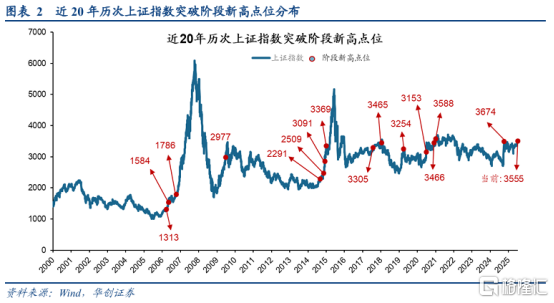
Group 1 - The Shanghai Composite Index has surpassed the 3600-point mark for the first time since October 8 of the previous year, indicating a potential bullish market trend [1][8] - Historical data suggests that once the index stabilizes above 3600 points, targets of 3700 and even 4000 points become achievable [1][8] - The market has shown strong bullish sentiment, with trading volumes exceeding 1 trillion yuan for 43 consecutive days, recently hovering around 1.8 trillion yuan [1][8] Group 2 - Multiple institutions are optimistic about the current bull market, with reports indicating that the index has confirmed a comprehensive market rally [2][8] - The index has broken through previous high points, signaling a significant shift in market sentiment and the establishment of a bull market [2][8] Group 3 - The insurance sector is gaining attention due to its deep connection with the capital markets, with leading companies like Ping An showing strong performance [4][21] - As of July 28, the insurance index has seen a cumulative increase of 28% since April 8, while the Hong Kong insurance sector has risen nearly 48% in the same period [22][23] Group 4 - The current bull market is characterized by a "slow bull" trend, driven by policy guidance and a reassessment of confidence in Chinese assets [9][10] - The influx of foreign capital into A-shares and Hong Kong stocks has increased investor confidence, with a net increase of 10.1 billion USD in domestic stocks and funds in the first half of the year [9][10] Group 5 - The insurance sector is expected to benefit from a combination of policy support, market conditions, and improvements in the fundamentals of insurance companies [24][29] - The recent adjustments in preset interest rates and the easing of capital constraints are likely to enhance the valuation recovery of insurance companies [24][30] Group 6 - Ping An is positioned as a key beneficiary of the current market dynamics, with significant growth in its new business value and improvements in its operational efficiency [38][40] - The company's integrated financial and healthcare ecosystem is expected to provide additional valuation premiums, distinguishing it from traditional insurance firms [40][41]
存款利率下行,长城基金旗下纯债基金助力闲钱管理升级
Xin Lang Ji Jin· 2025-07-28 09:36
Core Viewpoint - The continuous decline in deposit interest rates in China, with a three-year fixed deposit rate falling below 2%, contrasts with a high household savings rate of approximately 43% in 2024, indicating a strong inclination towards risk-averse investment strategies among residents [1][2]. Group 1: Deposit Rates and Savings - The current household savings in China has risen to 162.02 trillion yuan, reflecting a significant increase in savings despite lower interest rates [1]. - The deposit interest rates have decreased significantly over the past decade, with one-year and three-year fixed deposit rates dropping to 0.95% and 1.25%, respectively, leading to reduced interest income compared to 2014 [2]. Group 2: Investment Strategies - In the current low-interest-rate environment, managing idle funds requires a shift from merely saving to seeking more competitive investment returns, particularly in the bond market [2][3]. - Pure bond funds are highlighted as a suitable investment option for idle cash, offering better returns compared to fixed deposits, with a one-year, two-year, and three-year growth of 2.69%, 6.56%, and 9.53% respectively [3]. Group 3: Risk and Volatility - While pure bond funds present higher potential returns, they also carry slightly higher volatility compared to fixed deposits, yet they remain a relatively low-risk investment option [3][5]. - Historical data shows that the annualized volatility of pure bond funds is significantly lower than that of mixed bond and equity funds, aligning well with the risk preferences of conservative investors [5]. Group 4: Liquidity and Accessibility - Liquidity is a crucial factor for managing idle funds, with fixed deposits imposing penalties for early withdrawals, while pure bond funds offer higher transaction efficiency and quicker access to funds [6]. - The trading efficiency of pure bond funds allows for same-day transactions, enhancing the ability for investors to manage their cash effectively [6]. Group 5: Fund Performance - Changcheng Fund's short-term bond fund has demonstrated strong performance, achieving positive returns for five consecutive years, with notable annual returns of 5.51% and 4.14% in 2023 and 2024, respectively [7]. - The Changcheng Xinli 30-day fund, designed for investors with short-term cash management needs, has also shown competitive returns, ranking 9th among 165 similar funds [8]. Group 6: Index Bond Funds - The rise of index bond funds is noted, offering low fees, high efficiency, and good liquidity, catering to investors looking to quickly adapt to bond market trends [9]. - The performance of index bond funds has been strong, with the Changcheng Zhongdai 1-3 year government bond fund achieving a one-year return of 2.40%, significantly outperforming its benchmark [9].

信用赎回可控,把握波段机会
CAITONG SECURITIES· 2025-07-28 09:10
Group 1: Report Industry Investment Rating - No relevant content mentioned Group 2: Core Viewpoints of the Report - Anti - involution policies affect commodity prices and inflation expectations, leading to significant adjustments in the bond market. Credit bond yields rise with interest rates, and most credit spreads widen, especially for secondary perpetual bonds [3]. - It's too early to talk about negative feedback, with a very low probability. The market's ability to respond has improved, and there has been no change in macro - expectations. Moreover, bank wealth management's focus on liquidity can prevent negative feedback [4][6]. - The asset shortage pattern remains unchanged and is intensifying. Interest rates may have short - term adjustments but not continuous and significant ones. Credit spreads are likely to be volatile, and investors should seize phased trading opportunities [7]. Group 3: Summary by Related Catalogs 1 Market Review: Sharp Correction, Widening Spreads of Secondary Perpetual Bonds 1.1 Market Performance - The credit bond market had a sharp correction this week, with credit spreads widening. The stock market strengthened, and the bond market adjusted significantly. Yields of medium - and long - term secondary perpetual bonds rose more than 10bp, with a 14.5bp decline in 10Y secondary perpetual bonds. Credit spreads of secondary perpetual bonds widened more, while those of some medium - and long - term notes, corporate bonds, and urban investment bonds slightly narrowed [25]. 1.2 Insurance Continues to Allocate, Funds Sell Massively - Insurance companies continued to strongly allocate credit bonds, with a net purchase of 125.63 billion yuan this week, a 38.7% increase from the previous week. The net purchase of ultra - long - term credit bonds over 5 years was 6.75 billion yuan, with a similar increase compared to the previous week [40]. - Funds sold a large amount of credit bonds, reaching 22.578 billion yuan. The net sales of bonds within 5Y were 12.738 billion yuan, and those over 5Y were 7.474 billion yuan [40]. 1.3 Low - Rating Transaction Proportion Declines - The proportion of transactions with a remaining maturity of over 3 years for urban investment bonds, industrial bonds, and secondary perpetual bonds was 30%, 29%, and 72% respectively, remaining at a high level. The proportion of low - rating transactions decreased, with a 1 - percentage - point decline in urban investment bonds with AA(2) and below, a 1 - percentage - point decline in industrial bonds with AA and below, and a 3 - percentage - point decline in secondary perpetual bonds with AA and below [49][53]. 2 Market Outlook: Redemption is Controllable, Seize Trading Opportunities 2.1 Redemption is Controllable, Seize Trading Opportunities - The market adjusted due to the impact of anti - involution policies on commodity prices and inflation expectations. Indicators such as the term structure of interest rate swaps showed a change in inflation expectations [57][61]. - There is no need to worry about negative feedback because the market's response ability has improved, and bank wealth management's focus on liquidity can prevent it. The asset shortage pattern persists, and interest rates are unlikely to have continuous and significant adjustments. Credit spreads are likely to be volatile, and investors should seize phased trading opportunities [4][7]. 2.2 Science and Technology Innovation Bonds Continue to Contribute Net Financing - In July, non - financial credit bond financing was good, with a net financing of 347.9 billion yuan, exceeding the levels of July in the previous two years [93]. 3 What to Buy in Credit? 3.1 Focus on High - Grade Secondary Perpetual Bonds for Trading, Weak - Quality Urban Investment Bonds for Coupon - For short - term secondary perpetual bonds, the price - to - value ratio is positive, while for medium - and long - term ones, it is negative. It is recommended that high - grade trading strategies focus on secondary perpetual bonds, and low - grade coupon strategies focus on urban investment bonds. The price - to - value ratio of short - term AAA secondary capital bonds to medium - term notes remains positive, and that of long - term ones fluctuates around 0 [100]. - The price - to - value ratio of short - term urban investment bonds to medium - term notes is positive, and that of long - term low - grade ones has rebounded rapidly, reaching the historical central level. Urban investment bonds still have an advantage in terms of bond selection scope [102]. 3.2 General Credit Coupon is More Advantageous - Currently, the proportion of urban investment bonds with a valuation above 2.3% is 19.8%, that of non - financial industrial bonds is 10.8%, and that of secondary perpetual bonds is 6.8%. From the perspective of coupon bond selection, general credit has a wider bond selection space [106]. 3.3 First - Level Issuance Statistics - No specific content provided in the output for further summary 3.4 Second - Level Valuation Change Details - No specific content provided in the output for further summary