
地缘风险

Search documents
美联储降息预期摇摆,黄金价值持续
Guo Xin Qi Huo· 2025-11-25 03:57
Report Industry Investment Rating - Not mentioned in the provided content Core Viewpoints of the Report - Gold will continue to demonstrate its unique allocation value in the medium to long term, supported by factors such as continuous gold purchases by global central banks, monetary policy shifts, ongoing trade uncertainties, and recurring geopolitical risks. Short - term fluctuations in the Fed's interest - rate cut expectations only limit gold's upward movement but do not reverse the bullish trend [3][12] - The Fed's interest - rate cut path may be "stop - and - go" due to inflation stickiness and economic data fluctuations. Policy expectation revisions will be a key factor affecting the volatility rhythm of precious metals [3][12] - Global trade tensions and geopolitical conflicts in the Middle East and between Russia and Ukraine provide support and increase the volatility of precious metals [3][12] Summary by Related Content Fed Policy and Personnel Changes - In 2026, the Fed's Monetary Policy Committee will undergo a major personnel reshuffle. Fed Chair Powell's term ends on May 15, 2026, and Trump's administration is accelerating the selection of a new chair. Five final candidates have been short - listed, with a possible pre - Christmas 2025 announcement. This may lead to a "dual leadership" situation in the first half of 2026 [6] - Atlanta Fed President Bostic will retire in February 2026. His retirement and the selection of his successor will be an important window to observe the White House's influence on the Fed. The Fed's internal policy differences will become more complex, with the dovish camp strengthening and the hawkish camp remaining a counterbalance [7] - Any news of personnel changes may cause the market to re - evaluate the direction of monetary policy, directly affecting precious - metal prices. Investors should closely monitor these changes to predict the 2026 precious - metal market volatility [8] Gold Market Performance in 2025 Q3 - The global gold market showed strong performance in Q3 2025, with both supply and demand booming. Total demand (including over - the - counter transactions) reached 1,313 tons, a record quarterly high, a 3% year - on - year increase. The demand value soared 44% year - on - year to $146 billion. Supply also increased by 3% to 1,313 tons, with mine production rising seasonally to 977 tons and recycled gold supply remaining at a high of 344 tons [8] - The LBMA gold price hit 13 record highs in Q3, with a quarterly average price of $3,456.54 per ounce, a 40% year - on - year increase [8] Gold Market Demand Structure - Investment demand continued to dominate the market in Q3 2025. Global gold ETF holdings increased by 222 tons, and demand for gold bars and coins exceeded 300 tons for the fourth consecutive quarter, reaching 316 tons. Gold jewelry consumption decreased to 371 tons but the consumption value increased to $4.1 billion due to rising gold prices [9] - Global gold ETFs' significant increase in positions drove up the total holdings, with North American and Asian markets being the main sources of capital inflows. As of November 20, 2025, the holdings of the world's largest gold ETF, SPDR Gold Shares, increased by 19.13% compared to the end of 2024, indicating strong institutional demand for gold [9] Price Trends and Investment Suggestions - The COMEX gold futures contract may form strong support in the range of $3,900 - $4,000 per ounce. If it can effectively break through the $4,200 mark, the next target may be around $4,400 per ounce. The Shanghai gold futures contract may fluctuate in the range of 900 - 950 yuan per gram [4][13] - Silver is more elastic due to the resonance of supply - demand tightness and financial attributes. Investors are advised to maintain a long - position strategy when gold prices pull back, and focus on the Fed's interest - rate decision path, inflation data inflection points, and geopolitical situations [4][13]
综合晨报-20251125
Guo Tou Qi Huo· 2025-11-25 03:37
Group 1: Energy and Metals - International oil prices rebounded overnight, with the Brent 01 contract up 1.41%. The Russia-Ukraine geopolitical risk is entangled between sanctions and peace talks. There is a greater expectation of inventory accumulation in Q4 and Q1 next year, and the downward drive for oil prices remains [1]. - Precious metals rose overnight. With multiple Fed officials advocating a December rate cut, the implied probability of a rate cut in the interest rate market rose to 80%. The market is uncertain, and precious metals are oscillating at high levels [2]. - Copper prices oscillated overnight. The domestic spot market shows a certain bullish sentiment, and the SMM social inventory decreased by 1.39 million tons to 18.06 million tons [3]. - Shanghai aluminum fluctuated narrowly overnight. The inventory decreased, and the demand has resilience but lacks highlights. The price adjustment may continue, with support at around 21,100 yuan [4]. - Alumina supply is in an oversupply pattern, and it will mainly operate weakly before large-scale production cuts [5]. - Cast aluminum alloy continues to follow the aluminum price, and the spread with AL may narrow [6]. - Zinc prices found support at the 60 - day moving average. The LME zinc 0 - 3 month spot premium remains high. The rebound height of Shanghai zinc is limited, and it is expected to oscillate in the range of 22,200 - 23,000 yuan/ton [7]. - Lead prices are looking for support at the annual line. The export of lead - acid batteries is expected to remain under pressure. Shanghai lead is expected to oscillate in the range of 17,000 - 17,500 yuan/ton [8]. - Shanghai nickel rebounded, and the stainless - steel cost support continues to move down [9]. - Tin prices are mainly considered for short - selling, and call options can be used to hedge risks [10]. - Lithium carbonate futures prices oscillated sharply at high levels, and risk control should be prioritized [11]. - Polysilicon futures prices maintain an oscillating pattern due to weak supply and demand [12]. - Industrial silicon futures maintain an oscillating operation, and attention should be paid to the dynamics of silicone prices [13]. - Steel prices oscillated narrowly at night. Supply pressure is gradually easing, and demand is still weak. Steel prices are expected to oscillate in a range [14]. - Iron ore fundamentals are becoming more relaxed, and the price is expected to oscillate [15]. - Coke prices may oscillate weakly [16]. - Coking coal prices may oscillate weakly [17]. - Silicomanganese prices oscillated. The bottom support expectation has moved down [18]. - Ferrosilicon prices oscillated. The bottom support will be tested [19]. - The SCFIS European route index rose significantly. The 02 contract may maintain a discount, and the price of the 12 contract has limited up - and - down space [20]. - Both high - and low - sulfur fuel oils face pressure from abundant supply and weak demand [21]. - Asphalt prices are expected to oscillate weakly under pressure [22]. Group 2: Chemicals - Urea supply is sufficient, and the market may return to a stalemate [23]. - Methanol futures rose sharply. You can try to go long on the 5 - 9 spread at low prices, but beware of weak reality [24]. - Pure benzene continues the idea of short - selling on rebounds, and options can be considered for allocation [25]. - Styrene supply and demand are in a tight balance, but the sustainability of support is questionable, and the rebound height is limited [26]. - Polypropylene, polyethylene, and propylene prices have certain low - level support, but the supply pressure of polyethylene increases, and the demand of polypropylene and polyethylene is weak [27]. - PVC may follow the cost, and caustic soda runs weakly [28]. - PX is still strong before new capacity is put into production, and PTA is mainly driven by cost [29]. - Ethylene glycol prices have a short - term rebound expectation, but the rebound space is limited [30]. - Short - fiber prices fluctuate with raw materials, and bottle - chip prices are mainly driven by cost [31]. Group 3: Agricultural Products - Soybean meal futures rebounded. Pay attention to the impact of La Nina on South American soybean production and wait for the Sino - US trade agreement [35]. - Soybean oil and palm oil prices are expected to oscillate in a range. Palm oil supply is increasing while demand is weak [36]. - Rapeseed meal and rapeseed oil prices are supported by supply shortages. It is recommended to wait and see in the short term [37]. - Domestic soybeans rebounded strongly. Pay attention to the spot market and policy guidance [38]. - Corn futures oscillated at a high level. There are still differences in the new - season corn output. Pay attention to the sales progress of new corn in the Northeast [39]. - Live hog futures had a large increase in the far - month contract. The price may have a second bottoming next year [40]. - Egg prices: Pay attention to the spot price performance and the convergence of the basis [41]. - Cotton prices are expected to oscillate in a range. It is recommended to wait and see [42]. - Sugar prices: International supply is sufficient, and domestic production expectations are good. Pay attention to production progress [43]. - Apple prices oscillated at a high level. Pay attention to the inventory reduction situation [44]. - Wood prices oscillated. Low inventory supports prices, and it is recommended to wait and see [45]. - Pulp prices fell slightly. Supply is loose, demand is weak, and it is recommended to wait and see [46]. Group 4: Financial Instruments - A - shares rose in a narrow range with shrinking volume. The short - term macro - liquidity uncertainty restricts the market. It is recommended to wait and see [47]. - Treasury bond futures oscillated upward. The yield curve may flatten slightly, but there may be phased adjustments [48].
黄金今日行情走势要点分析(2025.11.25)
Sou Hu Cai Jing· 2025-11-25 02:50
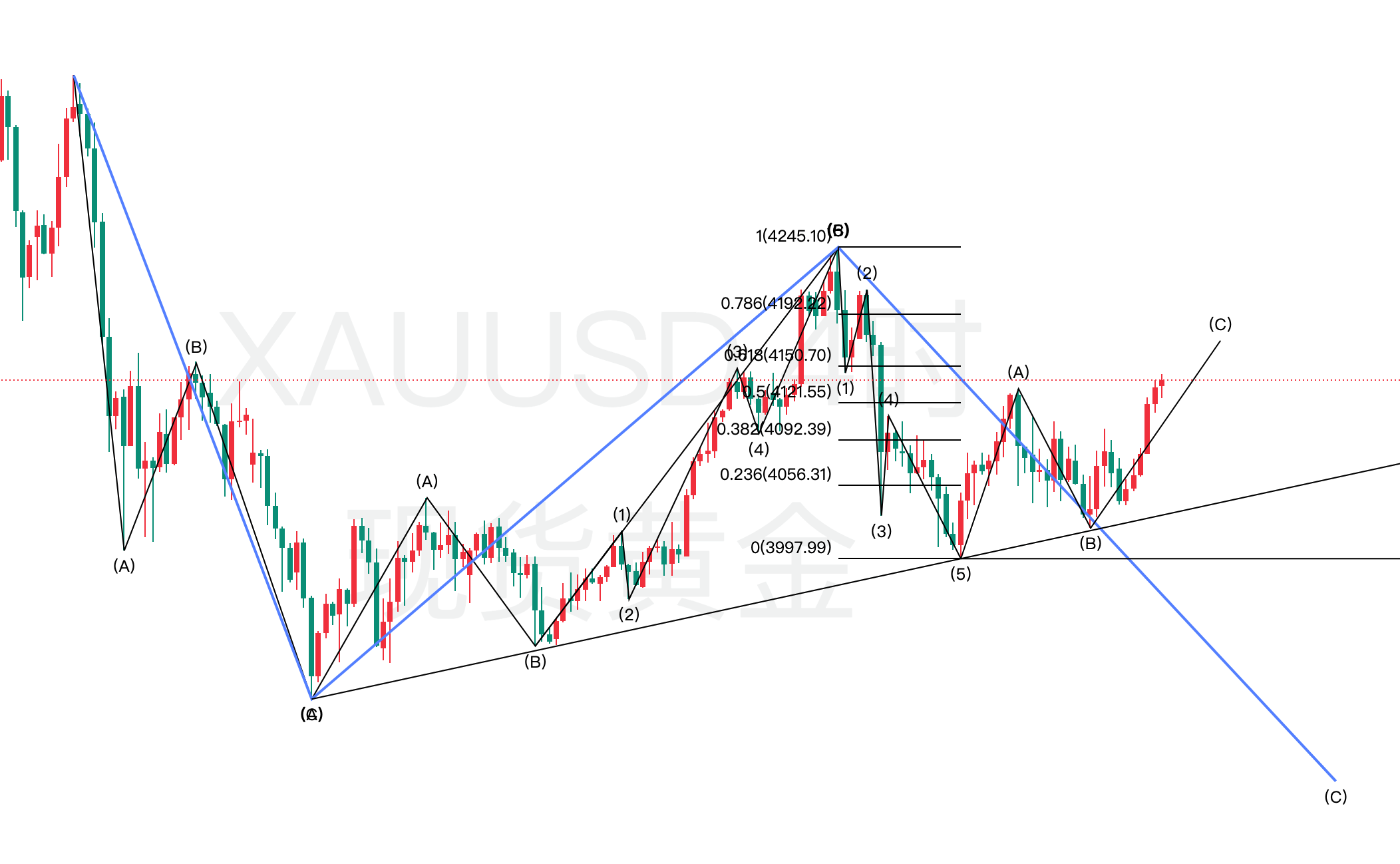
Group 1: Fundamental Analysis - The market is driven by interest rate cut expectations, with the probability of a 25 basis point cut in December rising from 40% to 81% following dovish signals from key Federal Reserve officials [2] - Geopolitical risks are increasing demand for safe-haven assets, as tensions escalate in Ukraine with missile launches and stalled peace negotiations [2] - Key economic data to watch includes U.S. retail sales and PPI, which are expected to support the case for interest rate cuts, enhancing gold's appeal as a non-yielding asset [2] Group 2: Technical Analysis - The daily chart indicates a strong bullish trend, breaking out of previous consolidation and forming a "breakout after consolidation" pattern, suggesting accumulating bullish momentum [3] - The 5-day moving average is a critical support level at approximately 4095, indicating that if prices stabilize above this level, the bullish trend is likely to continue [3] - In the four-hour chart, gold prices are in a bullish phase, with the current upward movement confirming a rebound structure, and key resistance levels to monitor include 4151, 4160, and 4245 [5]

大越期货燃料油早报-20251125
Da Yue Qi Huo· 2025-11-25 02:24
Report Summary Investment Rating The report does not provide an overall investment rating for the fuel oil industry. Core Viewpoints The report analyzes the fuel oil market from multiple aspects, including fundamentals, basis, inventory, market trends, and positions. It concludes that the market is influenced by various factors such as geopolitical risks, supply - demand dynamics, and interest rate policies. The fuel oil prices are expected to move in the ranges of 2490 - 2540 for FU2601 and 3020 - 3070 for LU2601. The market is affected by both bullish and bearish factors, with supply being influenced by geopolitical risks and demand remaining neutral [3]. Summary by Directory 1. Daily Prompt - The report presents comprehensive analysis of the fuel oil market, including fundamentals, basis, inventory, market trends, and positions. It also provides expected price ranges for FU2601 and LU2601 [3]. 2. Multi - Air Concerns - Bullish factors: Russian fuel export restrictions and the cancellation of US - Russia talks along with sanctions on Russian oil - related enterprises [4]. - Bearish factors: Uncertainty in demand optimism and pressure on upstream crude oil [4]. 3. Fundamental Data - Fundamentals: High - sulfur fuel oil spot demand is mostly weak, with sufficient supply in Singapore in November, potentially pressuring prices in late November and December. The basis shows that the spot is nearly at par with the futures. The inventory in Singapore increased by 257 barrels to 2344.9 barrels in the week of November 19. The price is below the 20 - day line which is trending down. High - sulfur main positions are short and decreasing, while low - sulfur main positions are long and increasing [3]. 4. Spread Data - The report provides data on the basis of high - sulfur and low - sulfur fuel oils in Singapore. The basis of high - sulfur fuel oil is 10 yuan/ton, and that of low - sulfur fuel oil is 47 yuan/ton [3]. 5. Inventory Data - The inventory data shows the changes in Singapore's fuel oil inventory from September 10 to November 19. The inventory in the week of November 19 was 2344.9 barrels, an increase of 257 barrels [8]. Market Data - Futures market: The current prices of FU and LU main contracts are 2500 and 3055 respectively, down 29 and 62 from the previous values, with declines of 1.15% and 1.99%. The basis of FU remained unchanged, while that of LU decreased by 20, a decline of 29.52% [5]. - Spot market: The prices of high - sulfur and low - sulfur fuel oils in Zhoushan and Singapore have changed. For example, the price of high - sulfur fuel oil in Zhoushan decreased by 11 to 445, a decline of 2.41% [6].
能源日报-20251124
Guo Tou Qi Huo· 2025-11-24 11:58
Report Industry Investment Ratings - Crude oil: ★☆☆ (One star, indicating a bias towards a bearish trend, with a driving force for price decline but limited operability on the trading floor) [1] - Fuel oil: ★★★ (Three stars, representing a clearer bearish trend and a relatively appropriate investment opportunity currently) [1] - Low - sulfur fuel oil: ★★★ (Three stars, representing a clearer bearish trend and a relatively appropriate investment opportunity currently) [1] - Asphalt: ★★★ (Three stars, representing a clearer bearish trend and a relatively appropriate investment opportunity currently) [1] Core Viewpoints - The progress of the Russia - Ukraine peace plan negotiation and the Venezuela geopolitical risk are the key factors affecting the energy market this week. The energy market is generally under pressure due to factors such as geopolitical situation, supply - demand imbalance, and the Fed's attitude towards interest rate cuts [2][3][4] Summary by Categories Crude Oil - The Russia - Ukraine peace negotiation has made progress, and the Fed's wavering attitude towards a December interest rate cut has pressured crude oil and other risk assets. There is a greater expectation of inventory accumulation in the fourth quarter and the first quarter of next year, so the previous bearish strategy should be continued [2] Fuel Oil & Low - sulfur Fuel Oil - The absolute price of fuel oil is dragged down by the cost side. High - sulfur fuel oil has a pattern of strong supply and weak demand, with limited impact of geopolitical factors on Russian exports and high - level exports from the Middle East to Asia during the off - peak power generation season. The demand for feedstock in China is expected to gradually decline. Although the US sanctions on Russia on November 21 may cause short - term fluctuations, the medium - term supply surplus will suppress the market. Low - sulfur fuel oil was previously supported by unstable overseas refineries, but the partial restart of the Azur refinery on November 29 and the possible increase in supply from the Dangote RFGC device maintenance at the end of December will increase the subsequent pressure [3] Asphalt - The price in the northern market remains stable supported by some refineries switching to produce residual oil and the terminal project rush - demand, while the price in the southern market has been declining due to abundant resource supply and refinery shipment pressure, narrowing the north - south price difference. The weekly shipment volume has been below 400,000 tons since the middle of the month, at a low level in the same period in the past four years. In the short term, the main contract on the trading floor is supported at 3,000 yuan/ton, but the weak crude oil trend still suppresses the asphalt market sentiment, and with the expectation of supply increase, the asphalt is expected to be under pressure and fluctuate weakly [4]
建信期货能源化工周报-20251121
Jian Xin Qi Huo· 2025-11-21 11:15
行业 能源化工周报 日期 2025 年 11 月 21 日 021-60635738 lijie@ccb.ccbfutures.com 期货从业资格号:F3031215 021-60635737 renjunchi@ccb.ccbfutures.com 期货从业资格号:F3037892 028-8663 0631 penghaozhou@ccb.ccbfutures.com 期货从业资格号:F3065843 021-60635740 pengjinglin@ccb.ccbfutures.com 期货从业资格号:F3075681 021-60635570 liuyouran@ccb.ccbfutures.com 期货从业资格号:F03094925 021-60635727 fengzeren@ccb.ccbfutures.com 能源化工研究团队 研究员:李捷,CFA(原油、沥青) 研究员:任俊弛(PTA、MEG) 研究员:彭浩洲(工业硅多晶硅) 研究员:彭婧霖(聚烯烃) 研究员:刘悠然(纸浆) 研究员:冯泽仁(玻璃纯碱) 期货从业资格号:F03134307 请阅读正文后的声明 | ⇒ 原油 . | | --- ...
国投期货能源日报-20251121
Guo Tou Qi Huo· 2025-11-21 10:58
1. Report Industry Investment Ratings - Crude oil: ★☆☆, indicating a slightly bullish or bearish trend with limited operability on the trading floor [1] - Fuel oil: ★☆☆, with the same implications as crude oil [1] - Low - sulfur fuel oil: ★☆☆, similar to the above [1] - Asphalt: ★☆☆, also suggesting a slightly bullish or bearish trend with poor operability [1] - Liquefied petroleum gas: ☆☆☆, meaning the short - term multi/empty trend is in a relatively balanced state, and it's better to wait and see [1] 2. Core Viewpoints - The cyclical inflection point of oil prices caused by supply contraction has not been seen, and the rebound space of oil prices due to geopolitical factors is limited, with the market trending weakly in a volatile manner [2] - High - sulfur fuel oil is under multiple pressures, and its weak trend is expected to continue, while the low - sulfur fuel oil market fundamentals are strengthening, but the supply rebound risk from the RFCC unit maintenance of the Dangote refinery in Nigeria at the end of December needs attention [2] - The cost support for asphalt is continuously weakening, and the medium - to - long - term fundamentals are bearish [3] - The supply of liquefied petroleum gas has an incremental bearish suppression, and the supply - demand relationship has weakened marginally, causing the LPG trading floor to turn weak [4] 3. Summary by Related Catalogs Crude Oil - Overnight international oil prices fell further, with the SC01 contract dropping 1.67% during the day [2] - The geopolitical risk premium between Russia and Ukraine was suppressed, and the rebound space of oil prices due to geopolitical factors is limited, with the market trending weakly in a volatile manner [2] Fuel Oil & Low - sulfur Fuel Oil - Overnight crude oil price drop dragged down the fuel oil market [2] - High - sulfur fuel oil faces multiple pressures, including the possible decline of geopolitical factors, the steady increase in production in the Middle East, the end of the power generation peak season, and the possible weakening of refinery feed demand. Its weak trend is expected to continue [2] - Low - sulfur fuel oil market fundamentals are strengthening due to supply - side disturbances, strong diesel cracking, and increased demand. However, the supply rebound risk from the RFCC unit maintenance of the Dangote refinery in Nigeria at the end of December needs attention [2] Asphalt - In November, the discount of diluted asphalt dropped to - 11 US dollars per barrel, and the cost support continued to weaken [3] - Since November, the weekly shipment volume has decreased month - on - month and is at a low level in the same period of the past four years. The commercial inventory depletion has slowed down, and the year - on - year increase of social inventory has expanded. The medium - to - long - term fundamentals are bearish [3] Liquefied Petroleum Gas - This week, the commodity volume decreased but the arrival volume increased, with supply having an incremental bearish suppression [4] - The profitability improvement of butane dehydrogenation units boosted the downstream chemical enterprises' enthusiasm for starting work, and the demand on the combustion side improved due to the significant cooling in many places [4] - The supply - demand relationship weakened marginally, causing the LPG trading floor to turn weak [4]
【黄金期货收评】贵金属长期驱动仍稳固 沪金微涨0.22%
Jin Tou Wang· 2025-11-20 09:52
Group 1: Gold Market Overview - On November 20, the closing price of Shanghai gold futures was 932.56 CNY per gram, with a daily increase of 0.22% and a trading volume of 223,736 lots [1] - The spot price of gold in Shanghai was quoted at 932.00 CNY per gram, indicating a discount of 0.56 CNY per gram compared to the futures price [1] Group 2: Economic Indicators - From mid-September to mid-October, the number of people continuing to claim unemployment benefits in the U.S. rose by nearly 40,000, suggesting weakened hiring intentions among businesses amid economic uncertainty [2] - The NAHB/Wells Fargo Housing Market Index for November showed that builder confidence remained low for the 19th consecutive month, with a slight increase of 1 point to 38 [2] Group 3: Institutional Insights - Gold and silver prices experienced a general increase, with COMEX gold futures rising by 0.29% to 4,078.30 USD per ounce and COMEX silver futures increasing by 1.08% to 51.07 USD per ounce [3] - The market faced selling pressure due to a general deleveraging, primarily caused by government shutdown concerns affecting the timely release of non-farm and inflation data, leading to a cautious stance from the Federal Reserve regarding interest rate cuts [3] - Long-term factors such as sovereign debt issues, geopolitical risks, and central bank gold purchases driven by de-dollarization remain unchanged, supporting the core drivers of gold and silver prices [3] - The expected trading range for COMEX gold is between 4,000 and 4,200 USD per ounce, while the Shanghai gold range is between 910 and 960 CNY per gram [3]
南华原油风险管理日报-20251119
Nan Hua Qi Huo· 2025-11-19 10:28
Report Investment Rating - No investment rating for the industry is provided in the report. Core Views - Recently, crude oil has been fluctuating within a narrow range, with frequent switches between bullish and bearish sentiments and no clear trend. On Wednesday, crude oil rebounded slightly, mainly driven by the refined product side. The trends of gasoline and diesel in Europe and the US have diverged, with diesel surging to a new stage high, possibly related to the approaching Russian sanctions date, but more of an emotional premium. Subsequently, the seasonal increase in the operating load in Europe and the US will ease the supply pressure. Market concerns cannot be ignored: macroeconomic negatives have been temporarily ignored, the overnight panic index has risen, and European and American stock markets have fallen, while crude oil has not priced in this risk. After the subsequent positive factors fade, a corrective market may occur. Geopolitical risks in regions such as Russia-Ukraine, South America, and Africa provide potential bullish support, but the market has shown fatigue in reacting to these risks, and actual events are needed to have a pulling effect. Going forward, attention should be focused on the sustainability of the gasoline-diesel divergence and the impact of macro funds' risk aversion sentiment on crude oil [1]. Summary of Related Catalogs Trading Strategies - Unilateral: Trade within a range. The resistance level for Brent above is $65, and the support level below is $60. - Arbitrage: Hold off for now. - Options: Hold off for now [5]. Logic Analysis - The rally was driven by sentiment in the refined product side, with divergence and weak follow-up as key features. The core driving force behind the overnight rally in crude oil came from the refined product side, with a significant divergence in the trends of gasoline and diesel in Europe and the US. Diesel soared to a new stage high due to the approaching Russian sanctions date (Russia mainly exports diesel and Europe mainly consumes diesel), providing emotional support for crude oil. However, this driving force is more of a short-term emotional premium - the seasonal increase in the operating load in Europe and the US will ease the supply pressure of gasoline and diesel. At the same time, the follow-up increase in the crude oil market has significantly weakened, failing to form a strong follow-up pattern [8]. - Deteriorating macro sentiment hides potential risks, which may trigger a corrective market later. At the macro level, negative factors have been temporarily ignored by the market but have planted the seeds of risk. The overnight panic index rose significantly and lifted from a low level, European and American stock markets fell across the board, and the US stock market hit a new stage low. The risk aversion sentiment in the financial market is gradually fermenting. Currently, the crude oil market has not priced in this macro risk. If the positive support from geopolitical and refined product sides fades later, the market may reprice the fundamentals and macro logic, leading to a significant corrective market [9]. - Geopolitical risks provide emotional support, but it's difficult to have a substantial pulling effect without real events. There are numerous geopolitical risk points, including the high-intensity conflict between Russia and Ukraine, US pressure on Venezuela and Mexico, and the turmoil in Sudan (interruption of oil exports) and Libya in Africa, which constitute long-term potential bullish factors for the crude oil market. However, the crude oil market has shown fatigue in reacting to geopolitical news. These risks can only provide short-term emotional support and are difficult to have a substantial pulling effect. Only when geopolitical events actually occur and materialize will they have a corresponding impact on oil prices according to the degree of risk [10]. Related News - For the week ending November 14 in the US, API crude oil inventories increased by 4.448 million barrels, compared with a previous increase of 1.3 million barrels. Cushing crude oil inventories decreased by 790,000 barrels, compared with a previous decrease of 43,000 barrels. Gasoline inventories increased by 1.546 million barrels, compared with a previous decrease of 1.385 million barrels. Refined oil inventories increased by 577,000 barrels, compared with a previous increase of 944,000 barrels [11]. - Sources said that due to a drone attack by Ukraine on Friday, the crude oil shipments at Russia's Novorossiysk port were delayed by 2 to 3 days compared with the original plan [11]. - According to foreign media reports, the US Treasury Department claimed in an unusual statement that its recent efforts to weaken Russia have been successful. The statement showed the market impact of measures targeting Russian oil giants Rosneft and Lukoil. The office responsible for overseeing US sanctions at the Treasury Department said that "driven by the effectiveness of US sanctions, the demand for Russian oil is plummeting." The press release stated that various grades of Russian oil "are trading far below all other international prices," with some at multi-year lows. The statement - a November 17 memo from the economic analysis department of the Treasury's Office of Foreign Assets Control (OFAC) sanctions - said that nearly a dozen major Indian buyers indicated that they plan to suspend purchases of Russian oil for December delivery. A Treasury spokesperson said in an email that the Treasury is prepared to take further action to end the conflict if necessary [11][12].
操作评级:能源日报-20251118
Guo Tou Qi Huo· 2025-11-18 14:01
Report Industry Investment Ratings - Crude oil: One red star, indicating a bullish bias but limited trading opportunities on the market [5][6] - Fuel oil: Three red stars, suggesting a clearer upward trend and relatively appropriate investment opportunities [5][6] - Low-sulfur fuel oil: Three red stars, indicating a clearer upward trend and relatively appropriate investment opportunities [5][6] - Asphalt: Three green stars, suggesting a clearer downward trend and relatively appropriate investment opportunities [5][6] - Liquefied petroleum gas: Three red stars, indicating a clearer upward trend and relatively appropriate investment opportunities [5][6] Core Viewpoints - The oil price has continued to show a weak and volatile performance since the end of October. The supply-side contraction-induced cyclical inflection point of oil prices has not been seen yet, and a weak and volatile judgment on crude oil is maintained [2] - High-sulfur fuel oil is still supported by geopolitical factors in the short term, but the medium-term supply pattern tends to be loose. Low-sulfur fuel oil has been strong recently due to supply-side fluctuations, but medium-term supply pressure still exists [2] - The cost support for asphalt has been continuously weakening, the demand is expected to follow the seasonal weakening pattern, and the medium- and long-term fundamentals have a bearish impact on BU [3] - The supply and demand of liquefied petroleum gas have tightened marginally, and it is expected to fluctuate strongly [4] Summary by Related Catalogs Crude Oil - Since the end of October, the oil price has continued to show a weak and volatile performance. Geopolitical risks have boosted the oil price, but the rebound height has always been limited [2] - According to the monthly reports of the three major institutions, considering the suspension of production increases by OPEC+ in the first quarter of next year and the strict implementation of production cut compensation, the global oil market will have a supply surplus of 1.84 million barrels per day and 3.31 million barrels per day this year and next year respectively [2] - The supply-side contraction-induced cyclical inflection point of oil prices has not been seen yet, and a weak and volatile judgment on crude oil is maintained [2] Fuel Oil & Low-Sulfur Fuel Oil - High-sulfur fuel oil is still supported by geopolitical factors in the short term. The subsequent actual exports of Russia still have uncertainties, but the medium-term supply pattern tends to be loose [2] - Low-sulfur fuel oil has been strong recently due to supply-side fluctuations, but the possible increase in low-sulfur shipping volume caused by the planned maintenance of the RFCC unit of the Kaigute refinery at the end of December needs attention, and medium-term supply pressure still exists [2] Asphalt - In November, the discount of diluted asphalt dropped to -$11 per barrel, and the cost support has been continuously weakening [3] - Since November, the weekly shipment volume has decreased month-on-month and is also at a low level in the same period of the past four years [3] - The "14th Five-Year Plan" end-year rush demand expectation has been falsified, and the subsequent demand will follow the seasonal weakening pattern. The medium- and long-term fundamentals have a bearish impact on BU [3] Liquefied Petroleum Gas - The increase in propane discount supports the import landed cost [4] - The improvement in the profitability of butane dehydrogenation units has boosted the enthusiasm of downstream chemical enterprises to start operations, and the demand on the combustion side has improved [4] - The supply and demand of liquefied petroleum gas have tightened marginally, and it is expected to fluctuate strongly [4]