
股债跷跷板

Search documents
股市不改中期乐观逻辑,债市延续回暖
Zhong Xin Qi Huo· 2026-01-14 01:17
Group 1: Report Industry Investment Rating - The investment rating for stock index futures is "oscillating with a bullish bias" [7]. - The investment rating for stock index options is "oscillating with a bullish bias" [7]. - The investment rating for treasury bond futures is "oscillating" [8]. Group 2: Core Views of the Report - Stock index futures: The end of the 17 - day consecutive rise is due to capital release, but the mid - term optimistic logic remains unchanged. Short - term profit - taking pressure increases, but such corrections are normal capital release during the upward trend. The logic of betting on policy expectations and industrial prosperity before the Two Sessions continues, with a focus on IC long positions and双创ETF [1][7]. - Stock index options: Market sentiment cools slightly under market rotation. The trading volume of the options market decreases slightly, and the implied volatility of most varieties drops slightly. The strategy of buying call options on previously high - heat varieties during corrections can be changed to a bull spread combination [2][7]. - Treasury bond futures: The bond market continues to recover, but attention should be paid to changes in the capital side. The capital side shows a slight convergence, and the short - end may be affected by the capital side. The adjustment of the stock market may drive the long - end bond market, and institutional allocation motivation may support the bond market [3][8][10]. Group 3: Summary by Relevant Catalogs Stock Index Futures - Market performance: On Tuesday, the Shanghai Composite Index ended its 17 - day consecutive rise with a decline, and trading volume reached a new high. The basis, inter - period spread, and positions of IF, IH, IC, and IM changed [1][7]. - Logic: Short - term profit - taking pressure comes from historical patterns, abnormal trading inquiries, and contract premiums. However, the mid - term trading logic remains intact, with sector rotation [1][7]. - Operation suggestions: Allocate IC long positions and双创ETF [7]. Stock Index Options - Market performance: The underlying market took a high - level rest on Tuesday. The overall trading volume of the options market decreased slightly, and trading heat shifted to 50 and 300. The implied volatility of most varieties declined slightly [2][7]. - Logic: Market sentiment cooled under capital rotation, and relevant indicator changes were opposite to those on Monday [2][7]. - Operation suggestions: Hold bull spread positions [7]. Treasury Bond Futures - Market performance: Treasury bond futures rose across the board. T, TF, TS, and TL had different changes in trading volume, positions, inter - period spreads, cross - variety spreads, and basis. The central bank conducted reverse repurchase operations and had a net capital withdrawal [8][9]. - Logic: The short - end TS was relatively weak. The approaching tax period may cause capital side fluctuations, and the stock market adjustment may drive the bond market, especially the long - end. Institutional allocation motivation may support the bond market [3][8][10]. - Operation suggestions: Trend strategy is to oscillate. Hedging strategy is to pay attention to short - hedging at low basis levels. Basis strategy is basis oscillation. Curve strategy is to consider taking profits on short - term curve steepening [10].
中长期纯债基金业绩回调,上周业绩均值转负,固收类资产短期如何布局?
Mei Ri Jing Ji Xin Wen· 2026-01-13 07:44
Group 1 - The bond market showed a trend of initial decline followed by recovery, but the overall space for recovery remains limited, with some pure bond funds performing poorly [1][2] - The average weekly performance of medium to long-term pure bond funds recorded -0.006%, marking a notable change after several weeks of positive performance [2][5] - The yield on 1 to 5-year agricultural development bonds increased by 2 basis points, while the 10-year and 30-year government bond yields rose by 3 and 4 basis points respectively [2][3] Group 2 - The bond ETF experienced significant capital outflows, indicating a shift in investor risk appetite from low-risk assets to equity assets [4][5] - The pharmaceutical and biotechnology sector in the Hong Kong stock market saw strong performance, attracting substantial capital inflows, contrasting sharply with the bond ETF's situation [4][5] - Analysts suggest that the bond market may face increased volatility in 2026, with a cautious outlook prevailing among institutions regarding the bond market compared to the bullish environment of 2023 to 2024 [5]
固收周观:股债跷跷板效应凸显,宽松基调下曲线陡峭(2026年第2期)
Soochow Securities· 2026-01-12 10:42
Report Industry Investment Rating - Not provided in the content Core Viewpoints of the Report - In the first week of 2026, the bond market experienced significant adjustments. The main reasons were that the central bank's open - market bond purchases in December 2025 were only 50 billion yuan, not increasing as expected, and the stock market had a strong start, causing funds to flow from the bond market to the stock market. The "stock - bond seesaw" effect was the more important factor suppressing the bond market. It is expected that the allocation funds in the bond market will be diverted by the stock market. In the next week, the release of December's financial data is expected to have limited impact on the bond market. Short - term interest rates will remain stable, while long - term interest rates are more affected by the stock market, and the yield curve is expected to steepen. When the 10 - year Treasury yield approaches the 1.9% stage high, investors can enter the market at an appropriate time [1][16][17] - Last week, gold in the cross - year market quickly rebounded to the previous high of $4,500 per ounce after a short - term plunge and is about to break through the previous high. The RMB exchange rate also had a short - term correction, but based on the expectation of loose fiscal and monetary policies in major global economies and their higher tendency of fiscal deficit monetization than China, the previous bullish view is continued. Crude oil is marginally bullish in terms of total demand and short - term bullish but long - term bearish in terms of total supply, and is expected to maintain a low - level volatile pattern [2] - In the medium - term thinking framework, the two - sector model of "an overheated technology sector + a cold traditional sector" should be continued. The growth engine shows structural characteristics, with monetary policy supporting the traditional sector and fiscal policy guiding the technology sector. The driving force of investment is greater than that of consumption, and domestic demand is more important than external demand, which is not limited to specific transitional economies [2][20] - The US unemployment rate in December 2026 slightly decreased, but new employment was lower than expected. The number of non - farm payrolls also decreased, and the labor market is gradually entering a low - speed equilibrium stage, which makes the Fed more inclined to maintain the current interest rate level. The probability of the Fed cutting interest rates in January is 24.4%, which is relatively low [4][21][26] Summary According to the Directory 1. One - Week Viewpoints - **Analysis of bond market adjustment in the first week of 2026**: From December 31, 2025, to January 9, 2026, the yield of the 10 - year Treasury active bond rose 1.8bp. Through daily analysis, factors such as the relaxation of bond fund redemption fee regulations, the "stock - bond seesaw" effect, the central bank's bond - buying volume, and market expectations all affected the bond market. The main reasons for the bond market adjustment were the central bank's bond - buying volume in December 2025 not meeting expectations and the strong start of the stock market [1][11][16] - **Analysis of future trends**: The release of December's financial data is expected to have limited impact on the bond market. Short - term interest rates will remain stable, long - term interest rates are more affected by the stock market, and the yield curve is expected to steepen. When the 10 - year Treasury yield approaches 1.9%, investors can enter the market [1][16][17] 2. Summary of Domestic and Foreign Data 2.1 Liquidity Tracking - **Open - market operations**: From January 5 to 9, 2026, the net investment in open - market operations showed a large - scale net withdrawal in the early stage and a net investment in the later stage. The total amount of net investment was - 122.14 billion yuan [36] - **Interest rate data**: The money market interest rate decreased last week compared with the previous week. The issuance volume of interest - rate bonds last week was 918.813 billion yuan, and the total repayment amount was 697.556 billion yuan, with a net financing amount of 221.257 billion yuan [37][38][41] 2.2 Domestic and Foreign Macroeconomic Data Tracking - **Commodity price data**: Steel prices generally rose, and the official prices of LME non - ferrous metal futures all increased. The price of rebar rose by 17 yuan/ton, and the price of hot - rolled coils rose by 20 yuan/ton. The prices of zinc, lead, copper, and aluminum futures all increased to varying degrees [55] 3. One - Week Review of Local Government Bonds 3.1 Primary Market Issuance Overview - **Issuance scale and type**: Last week, 26 local government bonds were issued in the primary market, with a total issuance amount of 117.664 billion yuan, including 29.23 billion yuan of refinancing bonds, 87.434 billion yuan of new special bonds, and 1 billion yuan of new general bonds. The net financing amount was 117.664 billion yuan, mainly invested in comprehensive projects [65] - **Issuing regions**: Three provinces and cities issued local government bonds, and two provinces and cities issued local special refinancing special bonds for replacing hidden debts, with a total issuance amount of 29.23 billion yuan. From January 1 to last week, the total amount of local special refinancing special bonds issued nationwide was 2,202.521 billion yuan [69] - **Early redemption of urban investment bonds**: The total early redemption scale of urban investment bonds last week was 1.33 billion yuan, from Zhejiang and Gansu provinces. From November 15, 2024, to last week, the total early redemption scale of urban investment bonds nationwide was 118.207 billion yuan, with Chongqing having the highest redemption scale [75][79] 3.2 Secondary Market Overview - **Transaction volume and turnover rate**: The stock of local government bonds last week was 54.73 trillion yuan, the trading volume was 310.211 billion yuan, and the turnover rate was 0.57%. The top three provinces in terms of trading activity were Shandong, Guangdong, and Jiangsu, and the top three trading - active maturities were 30Y, 10Y, and 7Y [82] - **Yield to maturity**: The yield to maturity of local government bonds decreased across the board last week [87] 3.3 Local Government Bond Issuance Plan for this Month - Not elaborated in detail, only a chart of the issuance plan is provided [88] 4. One - Week Review of the Credit Bond Market 4.1 Primary Market Issuance Overview - **Total issuance and net financing amount**: Last week, 336 credit bonds were issued in the primary market, with a total issuance amount of 269.892 billion yuan, a total repayment amount of 138.743 billion yuan, and a net financing amount of 131.149 billion yuan, an increase of 192.849 billion yuan compared with the previous week [88] - **Issuance by type**: The net financing amount of urban investment bonds was 28.226 billion yuan, and that of industrial bonds was 102.923 billion yuan. By bond type, the net financing amount of short - term financing bills was 38.817 billion yuan, that of medium - term notes was 47.129 billion yuan, that of enterprise bonds was - 2.881 billion yuan, that of corporate bonds was 45.019 billion yuan, and that of private placement notes was 3.065 billion yuan [90][93] 4.2 Issuance Interest Rates - The actual issuance interest rates of short - term financing bills decreased by 4.43bp, those of medium - term notes increased by 11.93bp, and those of corporate bonds decreased by 58.69bp [103] 4.3 Secondary Market Transaction Overview - The total trading volume of credit bonds last week was 558.53 billion yuan, with short - term financing bills having a trading volume of 159.816 billion yuan, medium - term notes having a trading volume of 294.315 billion yuan, enterprise bonds having a trading volume of 11.128 billion yuan, corporate bonds having a trading volume of 38.844 billion yuan, and private placement notes having a trading volume of 54.428 billion yuan [103] 4.4 Yield to Maturity - The yield to maturity of state - owned development bonds increased across the board. The yields of short - term financing bills and medium - term notes showed a differentiated trend, the yields of enterprise bonds generally increased, and the yields of urban investment bonds showed a differentiated trend [104][105][106] 4.5 Credit Spreads - The credit spreads of short - term financing bills and medium - term notes narrowed across the board, the credit spreads of enterprise bonds generally showed a differentiated trend, and the credit spreads of urban investment bonds narrowed across the board [108][109][113] 4.6 Grade Spreads - The grade spreads of short - term financing bills and medium - term notes showed a differentiated trend, the grade spreads of enterprise bonds showed a differentiated trend, and the grade spreads of urban investment bonds narrowed across the board [115][119][123] 4.7 Trading Activity - The most actively traded credit bonds last week were mainly from large - scale enterprises such as Yili and Huijin. The industrial sector had the largest weekly trading volume of bonds, followed by public utilities, finance, daily consumption, and materials [127] 4.8 Issuer's Rating Changes - Not elaborated in detail, only a table of issuer's rating or outlook improvement is provided [128]
【笔记20260112— 巴菲特连夜来开户】
债券笔记· 2026-01-12 10:25
Group 1 - The market is experiencing a 17-day consecutive rise, with trading volume reaching a historical high, indicating strong bullish sentiment [6] - The interbank funding environment is balanced and slightly loose, with DR001 rising to approximately 1.33% and DR007 around 1.49% [4][3] - The bond market shows stability, with the 10-year government bond yield slightly declining to around 1.888% after opening higher [6] Group 2 - The "stock-bond seesaw" effect is not significant, as stock prices surge while bond yields fluctuate downwards [6] - Recent geopolitical risks have led to a rise in gold prices, reflecting market uncertainty [6] - The central bank conducted a reverse repurchase operation of 861 billion yuan, with a net injection of 361 billion yuan after 500 billion yuan matured [3]

国债周报:债期弱势震荡整理-20260112
Guo Mao Qi Huo· 2026-01-12 06:56
【国债周报(TL&T&TF&TS)】 投资咨询业务资格:证监许可【2012】31号 本报告非期货交易咨询业务项下服务,其中的观点和信息仅供参考,不构成任何投资建议,期市有风险,投资需谨慎 债期弱势震荡整理 樊梦真 从业资格证号:F3035483 投资咨询证号 :Z0014706 报告日期:2026-1-12 本报告非期货交易咨询业务项下服务,其中的观点和信息仅供参考,不构成任何投资建议;期市有风险,投资需谨慎 01 PART ONE 主要观点 周度行情一览 • 上周国债期货市场整体呈现先抑后扬的弱势整理震荡格局,其中超长端期限表现最弱。政策面有一些积极信号,一是证监会发布的基金销售费用新规比预期温和, 延长了债基赎回费的缓冲期,这有助于稳定债基负债端,二是银行eve指标比例放松,或释放万亿长债承接空间。但市场对于这些政策利好定价较为有限,仅推 动利率小幅下行1bp。央行方面,周内央行进行买断式逆回购操作11000亿元,期限为3个月,等量对冲到期量。这表明央行意在维持市场中长期流动性的稳定, 避免因大规模到期而产生波动。 1月4日至9日,7天期逆回购累计投放1225亿元,到期量为20113亿元,净回笼18888 ...
【债市观察】年初“股债跷跷板”凸显 10债能否在1.90%企稳?
Zhong Guo Jin Rong Xin Xi Wang· 2026-01-12 03:53
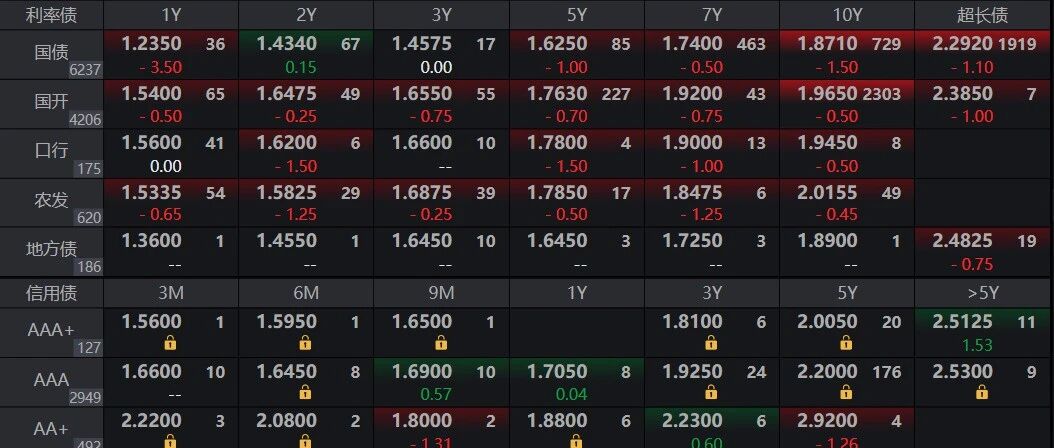
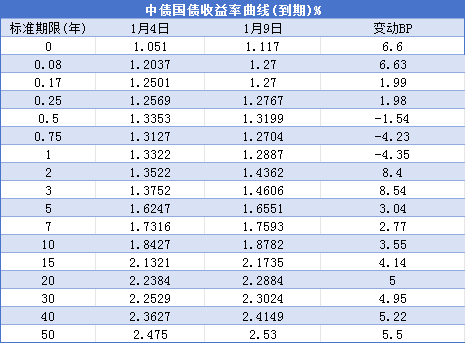
Core Viewpoint - The bond market experienced significant adjustments under multiple negative pressures, while equity and commodity markets rose, with the Shanghai Composite Index surpassing 4100 points. Concerns regarding government bond issuance scale and duration were validated at the beginning of the year, and the central bank's bond purchase announcement fell short of expectations, exacerbating short-term selling pressure [1]. Market Review - From January 5 to January 9, 2026, the bond market saw fluctuations in yields across various maturities, with the 10-year government bond yield approaching 1.90% before stabilizing. The yield curve flattened overall, indicating a shift in market sentiment [2][3]. - On January 9, the yields for different maturities changed as follows: 1-year (-4.35 BP), 2-year (8.4 BP), 3-year (8.54 BP), 5-year (3.04 BP), 7-year (2.77 BP), 10-year (3.55 BP), 30-year (4.95 BP), and 50-year (5.5 BP) [2]. - The bond market faced supply concerns, with the 10-year government bond yield rising to 1.8615% on January 5 and reaching 1.8985% on January 7 before slightly declining [5]. Primary Market - A total of 58 bonds were issued last week, amounting to 763.234 billion yuan, including 6 government bonds (49.5 billion yuan), 26 policy bank bonds (150.57 billion yuan), and 26 local government bonds (117.664 billion yuan) [5]. - The upcoming week (January 12 to January 16, 2026) plans to issue 21 bonds totaling 270.201 billion yuan, including 2 government bonds (167 billion yuan) and 14 local government bonds (70.201 billion yuan) [5]. Economic Indicators - The consumer price index (CPI) for December 2025 rose by 0.2% month-on-month and 0.8% year-on-year, while the core CPI increased by 1.2% year-on-year. The producer price index (PPI) rose by 0.2% month-on-month but fell by 1.9% year-on-year [13]. - As of December 2025, China's foreign exchange reserves stood at 33,579 billion USD, an increase of 115 billion USD from the previous month, reflecting a 0.34% rise [14]. Institutional Perspectives - Financial institutions suggest that the probability of a unilateral rise in interest rates is low, with expectations for the bond market to stabilize after mid-January. Concerns remain regarding long-term bond supply and monetary easing [16]. - Analysts indicate that while there may be short-term adjustments in the market, the overall supply and funding variables remain unclear, necessitating cautious evaluation of downward interest rate potential [17].
央行大额净回笼,股债延续跷跷板行情
Hua Lian Qi Huo· 2026-01-11 13:38
1. Report Industry Investment Rating - No relevant content provided. 2. Core Views of the Report - This week, the total issuance scale of China's bond market was 1294.537 billion yuan, with the supply rhythm significantly advanced at the beginning of the year. Government bonds and credit bonds jointly pushed up the weekly issuance volume. The combined issuance scale of national bonds and local bonds exceeded 400 billion yuan, and the combined issuance of medium - term notes, short - term financing bills, and financial bonds exceeded 80 billion yuan, indicating active financing demand from enterprises and financial institutions. The supply pressure at the beginning of the year was released in advance, with the planned issuance of local bonds in the first quarter exceeding 2 trillion yuan [7]. - This week, the central bank's open - market operations saw a large - scale net withdrawal. Due to the concentrated maturity of 7 - day and 14 - day reverse repurchases around the New Year, the net withdrawal of funds in a single week reached 1.655 trillion yuan, a two - year high. This reflects the central bank's "precise regulation" thinking. The long - term yield rose rapidly. However, on January 9th, the central bank conducted 3.4 billion yuan of reverse repurchase operations, achieving a net injection, and the bond market sentiment recovered [7]. - The short - term funds remained stable. DR007 fluctuated narrowly around the 7 - day reverse repurchase policy rate of 1.40%, and the overnight Shibor remained stable in the 1.2% - 1.3% range, indicating sufficient market funds [7]. - The yield of interest - rate bonds completed a "rise and fall" cycle this week. Attention should be paid to the issuance progress of government bonds, credit delivery data, and the central bank's reverse repurchase renewal rhythm. The long - term yield may still fluctuate, while the short - term liquidity is expected to remain loose. If the equity market continues to strengthen, the bond market may face greater capital diversion pressure, and the long - term yield may rise again. If the central bank increases the net injection, the short - term stability will be enhanced, and institutional allocation demand may shift to short - term varieties [7]. - The bank system's excess reserve ratio is at a reasonable level, and the central bank's timely small - scale reverse repurchase operations have effectively smoothed out the capital fluctuations caused by the concentrated maturity of New Year's reverse repurchases. The bank system's liquidity remains relatively loose, laying a foundation for the decline in short - term interest - rate bond yields [9]. - This week, the yield of credit bonds generally declined, the market's demand for high - quality entities continued to be released, the credit spread narrowed passively, and the overall valuation center moved down. The urban investment bonds are mainly short - term (within 1 year), with intensified regional differentiation. The yields of high - quality regions such as Shanghai, Jiangsu, and Zhejiang declined significantly, while provinces like Liaoning and Yunnan are still under pressure. In the industrial bond market, stable industries such as public utilities, transportation, and power performed steadily, while industries such as light manufacturing and real estate had large valuation deviations, and credit risk re - pricing should be noted. The credit bond market showed a "simultaneous rise of stocks and bonds" pattern, with fund companies as the main buyers, insurance institutions showing a net selling trend, banks' allocation and trading desks being divided, and wealth management funds continuously increasing their positions in 1 - 3 - year credit bonds [9]. - With the release of consumer loan and equipment renewal loan demand driven by the new round of trade - in programs and the return of enterprise and household deposits promoted by fiscal spending, the stability of the bank's liability side has been improved, and the expectations of credit expansion and economic recovery have been strengthened. With the support of the central bank's reverse repurchase and MLF tools, the short - term yield may remain in a low - level shock, while the long - term yield may be suppressed by economic recovery expectations, and the interest - rate curve may continue to show a "bullish steepening" pattern [9]. - In November 2025, 500 billion yuan of local special bond balance limits were issued, driving government - funded expenditures from negative to positive. The market expects that fiscal stimulus in 2026 will be significantly advanced, especially in the first half of the year. The expected issuance scale of local government special bonds in 2026 is about 4.4 trillion yuan, and the expected issuance scale of special national bonds is about 1.3 trillion yuan [9]. 3. Summaries According to Relevant Catalogs 3.1 Bond Market Issuance - This week, the total issuance scale of China's bond market was 1294.537 billion yuan, with government bonds and credit bonds jointly driving the increase. The combined issuance of national bonds and local bonds exceeded 400 billion yuan, and the combined issuance of medium - term notes, short - term financing bills, and financial bonds exceeded 80 billion yuan. The planned issuance of local bonds in the first quarter exceeds 2 trillion yuan [7]. 3.2 Central Bank Operations - This week, the central bank's open - market operations had a net withdrawal of 1.655 trillion yuan due to the concentrated maturity of reverse repurchases. On January 9th, it conducted 3.4 billion yuan of reverse repurchase operations, achieving a net injection [7]. 3.3 Yield Trends - The yield of interest - rate bonds completed a "rise and fall" cycle this week. The long - term yield may still fluctuate, while the short - term liquidity is expected to remain loose [7]. - The yield of credit bonds generally declined this week, and the credit spread narrowed passively. Urban investment bonds showed regional differentiation, and industrial bonds in different industries had different performances [9]. 3.4 Market Participants' Behavior - Bank system liquidity is relatively loose, providing a stable capital environment for bond issuance and institutional allocation [9]. - In the credit bond market, fund companies are the main buyers, insurance institutions are net sellers, banks' allocation and trading desks are divided, and wealth management funds are increasing their positions in 1 - 3 - year credit bonds [9]. 3.5 Fiscal Policy Expectations - In 2026, fiscal stimulus is expected to be significantly advanced, especially in the first half of the year. The expected issuance scale of local government special bonds is about 4.4 trillion yuan, and the expected issuance scale of special national bonds is about 1.3 trillion yuan [9]. 3.6 Other Market Indicators - Multiple charts show data on bond market prices, yields, interest rates, and liquidity, including the prices of national bond futures, the basis of national bond futures, the implied interest rate of national bond futures, various bond yields, inter - bank repurchase rates, inter - bank lending rates, loan rates, and market liquidity indicators [10][14][16]
国债期货日报:股债跷跷板延续,国债期货全线收跌-20260108
Hua Tai Qi Huo· 2026-01-08 03:26
Report Industry Investment Rating No relevant information provided. Core View The bond market is oscillating between the expectations of stabilizing growth and policy easing. The stock market rally, the broad - money signal released by the Politburo meeting, the stable LPR, the continued expectation of Fed rate cuts, and increased global trade uncertainty have all influenced the bond market. In the short term, attention should be paid to the policy signals at the end of the month [1][2][3]. Summary by Directory I. Interest Rate Pricing Tracking Indicators - China's CPI (monthly) had a -0.10% month - on - month change and a 0.70% year - on - year increase; PPI (monthly) had a 0.10% month - on - month change and a -2.20% year - on - year decrease [9]. - Social financing scale was 440.07 trillion yuan, with a month - on - month increase of 2.35 trillion yuan (+0.54%); M2 year - on - year was 8.00%, down 0.20% (-2.44%); Manufacturing PMI was 50.10%, up 0.90% (+1.83%) [10]. - The US dollar index was 98.74, up 0.14 (+0.14%); USD/CNY (off - shore) was 6.9844, up 0.008 (+0.12%); SHIBOR 7 - day was 1.45, up 0.03 (+1.97%); DR007 was 1.46, up 0.03 (+2.09%); R007 was 1.51, with no change (-0.31%); AAA - rated 3 - month inter - bank certificates of deposit were 1.60, up 0.01 (+0.34%); 1 - year AA - AAA credit spread was 0.09, up 0.00 (+0.34%) [10]. II. Overview of the Treasury and Treasury Futures Market No specific text - based summary information provided, only references to figures such as the closing price trend of Treasury futures' main continuous contracts, the price change rates of various Treasury futures varieties, etc. [12][19][23]. III. Overview of the Money Market Liquidity No specific text - based summary information provided, only references to figures like the trading statistics of inter - bank pledged repurchase and local government bond issuance [26][31]. IV. Spread Overview No specific text - based summary information provided, only references to figures such as the term spread of spot bonds and the cross - variety spread of futures [35][42]. V. Two - Year Treasury Futures No specific text - based summary information provided, only references to figures like the implied interest rate of the two - year Treasury futures' main contract and the Treasury bond's maturity yield [39][44]. VI. Five - Year Treasury Futures No specific text - based summary information provided, only references to figures like the implied interest rate of the five - year Treasury futures' main contract and the Treasury bond's maturity yield [48][52]. VII. Ten - Year Treasury Futures No specific text - based summary information provided, only references to figures like the implied yield of the ten - year Treasury futures' main contract and the Treasury bond's maturity yield [53][58]. VIII. Thirty - Year Treasury Futures No specific text - based summary information provided, only references to figures like the implied yield of the thirty - year Treasury futures' main contract and the Treasury bond's maturity yield [59][65]. Strategy - **Unilateral**: With the decline of repurchase rates, the prices of Treasury futures are oscillating [4]. - **Arbitrage**: Pay attention to the decline of the 2603 basis [4]. - **Hedging**: There is medium - term adjustment pressure, and short positions can use far - month contracts for appropriate hedging [4].
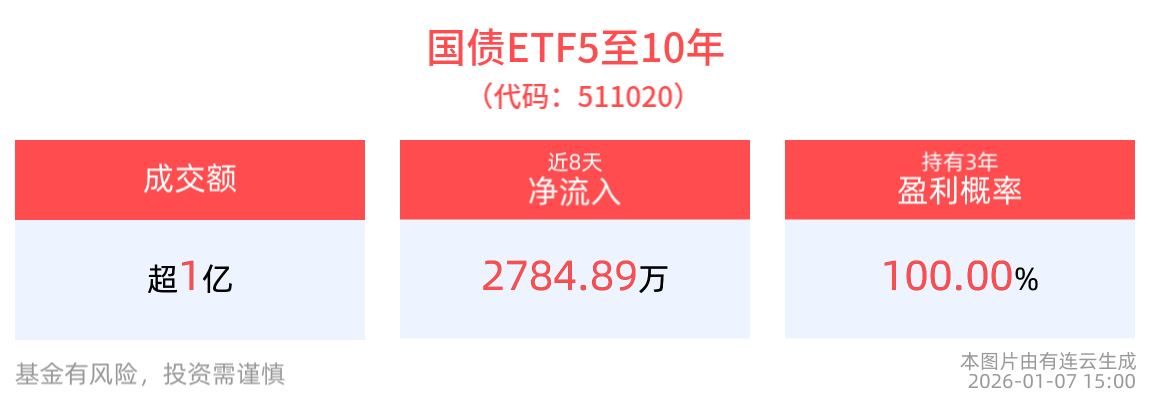
成交额超1亿元,国债ETF5至10年(511020)近8个交易日净流入2784.89万元
Sou Hu Cai Jing· 2026-01-08 01:47
Group 1 - The bond market continues to show weakness, with the 30-year government bond yield surpassing 2.33% [1] - The sentiment in the bond market remains unstable, with yields fluctuating throughout the day, and the 10-year government bond approaching 1.90% [1] - The market experienced a brief recovery, but the strengthening equity market exerted pressure on bond yields, leading to a rise in the 30-year bond yield again [1] Group 2 - The 2-year government bond saw active trading with over 200 transactions and a yield increase of nearly 4 basis points [1] - The liquidity in the market remains balanced, with minor fluctuations in the certificate of deposit market [1] - The 30-year government bond futures fell by 0.44%, while the 10-year and 5-year bonds also experienced slight declines [1] Group 3 - The China Bond ETF for 5-10 year government bonds saw a slight increase of 0.06%, with a latest price of 115.13 yuan [4] - The trading volume for the 5-10 year government bond ETF was 1.86 billion yuan, with a turnover rate of 9.91% [4] - The fund has a management fee of 0.15% and a custody fee of 0.05% [5]
格林期货早盘提示:国债-20260108
Ge Lin Qi Huo· 2026-01-08 01:43
研究员: 刘洋 从业资格: F3063825 交易咨询资格:Z0016580 联系方式:liuyang18036@greendh.com | 板块 | 品种 | 多(空) | 推荐理由 【行情复盘】 | | --- | --- | --- | --- | | | | | 周三国债期货主力合约开盘集体低开,早盘上涨收复失地,午后震荡回落,特别在 股指收涨后,较大幅度回落,截至收盘 30年期国债期货主力合约 TL2603下跌 0.44%, | | | | | 10 年期 T2603 下跌 0.08%,5 年期 TF2603 下跌 0.06%,2 年期 TS2603 下跌 0.03%。 | | | | | 【重要资讯】 | | | | | 1、公开市场:周三央行开展了 286 亿元 7 天期逆回购操作,当天有 5288 亿元逆回 | | | | | 购到期,当日合计净回笼 5002 亿元。 | | | | | 2、资金市场:周三银行间资金市场隔夜利率保持低位,DR001 全天加权平均为 | | | | | 1.27%,上一交易日加权平均 1.26%;DR007 全天加权平均为 1.46%,上一交易日加 | | | ...