
宏观政策

Search documents
华宝期货晨报铝锭-20251016
Hua Bao Qi Huo· 2025-10-16 02:52
Report Industry Investment Rating - Not provided Core Viewpoints - For成材, the market is expected to move in a sideways consolidation pattern, with a focus on macro - policies and downstream demand [3] - For铝锭, the price is expected to trade in a short - term range, and attention should be paid to macro sentiment and mining - end news [4] Summary by Relevant Catalogs 成材 - During the Spring Festival, short - process construction steel enterprises in Yunnan and Guizhou regions will stop production and carry out maintenance from mid - to late January, and resume production around the 11th to 16th day of the first lunar month, affecting a total construction steel output of 741,000 tons. Six short - process steel mills in Anhui, one stopped production on January 5th, and most others will stop around mid - January, with a daily output reduction of about 16,200 tons for some [2][3] - From December 30, 2024, to January 5, 2025, the transaction (signing) area of newly built commercial housing in 10 key cities was 2.234 million square meters, a 40.3% decrease from the previous period and a 43.2% increase year - on - year [3] - Yesterday,成材 prices continued to decline in a volatile manner, reaching a new low recently. In the context of weak supply and demand, market sentiment is pessimistic, and the price center of gravity continues to shift downward. This year's winter storage is sluggish, providing little support for prices [3] 铝锭 - Macroscopically, traders analyze Fed Chairman Powell's speech to find clues about possible future interest rate cuts during the US government shutdown. The Fed's Beige Book shows that US economic activity has changed little recently, employment is basically stable, but there are signs of weakness such as more layoffs and reduced spending by low - and middle - income families [2] - Fundamentally, the profit of alumina plants is further compressed, high - cost production capacity turns to losses and stops production. After the rainy season ends, bauxite shipments from Guinea resume, weakening the support for ore prices [3] - From October, some northern electrolytic aluminum enterprises expect an increase in the direct supply ratio of molten aluminum due to the peak season of downstream processed materials demand, which will keep the aluminum ingot output low and reduce the market supply of spot aluminum ingots, supporting aluminum prices from the supply side [3] - In the first week of October, the overall operating rate of aluminum processing sectors adjusted slightly due to the National Day holiday, in line with seasonal characteristics but with obvious internal differentiation. The operating rate of aluminum cables declined, and the operating rate of aluminum profiles decreased slightly, the operating rate of aluminum sheets and strips dropped by 1 percentage point to 68.0%, and the operating rate of aluminum foils decreased slightly [3] - As of October 16, the inventory of electrolytic aluminum ingots in major domestic consumption areas was 627,000 tons, a decrease of 23,000 tons from Monday and 22,000 tons from last Thursday [3]
当前经济基本面的点状改善有望逐渐扩散到更多行业,A50ETF(159601)一键布局核心资产
Sou Hu Cai Jing· 2025-10-16 02:52
Core Insights - The A-share market showed mixed performance on October 16, with the MSCI China A50 Connect Index demonstrating resilience, rising approximately 0.4% during the session [1] - Key financial indicators such as social financing scale, M2 (broad money), and RMB loan balance grew year-on-year by 8.7%, 8.4%, and 6.6% respectively, indicating solid financial support for the real economy [1] - Guosen Securities suggests that the gradual improvement in the economic fundamentals, influenced by macro policies like "anti-involution," is expected to spread across more industries, with market sentiment remaining relatively mild, indicating potential for future market gains [1] Company and Industry Analysis - The A50 ETF (159601) closely tracks the MSCI China A50 Connect Index, providing a packaged investment in 50 leading interconnected assets, making it a preferred choice for domestic and foreign capital [1] - The constituent stocks of the A50 ETF are distributed across various sectors, including electronics, banking, food and beverage, and power equipment [1] - The top ten holdings in the A50 ETF include Zijin Mining, CATL, Industrial Fulian, Kweichow Moutai, Haiguang Information, BYD, Cambricon Technologies, Heng Rui Medicine, China Merchants Bank, and Luxshare Precision [1]
9月核心CPI,19个月来涨幅首次回到1%
2 1 Shi Ji Jing Ji Bao Dao· 2025-10-15 23:41
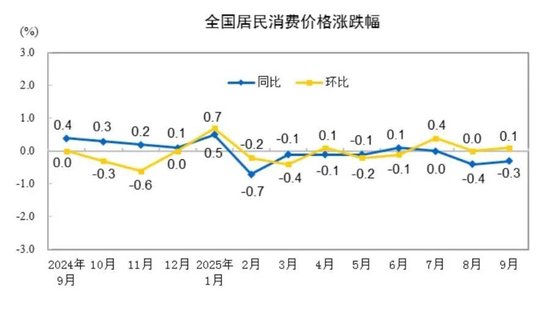
Group 1: CPI Analysis - In September, the national Consumer Price Index (CPI) decreased by 0.3% year-on-year, while it increased by 0.1% month-on-month [1][3][8] - The core CPI, excluding food and energy, rose by 1.0%, marking the first return to a 1% increase in nearly 19 months [6][8] - Food prices fell by 4.4%, contributing significantly to the CPI decline, while non-food prices increased by 0.7% [3][5][7] Group 2: PPI Analysis - The Producer Price Index (PPI) decreased by 2.3% year-on-year in September, with a month-on-month stability [1][8][11] - The decline in PPI was less severe than in previous months, narrowing by 0.6 percentage points compared to the previous month [1][8][11] - The industrial producer purchase prices also saw a year-on-year decrease of 3.1%, with a month-on-month increase of 0.1% [8][11] Group 3: Economic Insights - Economic policies have shown positive effects, leading to a narrowing of price declines in several industries [11][12] - The construction of a unified national market and the optimization of market competition have contributed to the recovery of prices in certain sectors [11][12] - The demand for high-quality and upgraded consumption has led to price increases in specific manufacturing sectors, such as a 14.7% rise in the price of arts and crafts products [12]

中国宏观经济研究院毕吉耀:做强国内大循环 对冲不确定性
Zhong Guo Zheng Quan Bao· 2025-10-15 22:29
Core Insights - China's economy has shown strong vitality and resilience in 2023, with a growth rate of 5.3% in the first half, surpassing last year's 5.0% and approaching the average growth rate of 5.5% during the previous four years of the 14th Five-Year Plan [2][4] - The government is focusing on enhancing domestic circulation to counter external uncertainties, emphasizing the importance of a robust domestic market for long-term growth [5] Economic Performance - Major economic indicators have performed well, with retail sales from January to August reaching 32.4 trillion yuan, a year-on-year increase of 4.6%, and fixed asset investment totaling 32.6 trillion yuan, growing by 0.5% [2] - Foreign trade has also shown resilience, with total goods import and export amounting to 33.61 trillion yuan from January to September, reflecting a year-on-year growth of 4% [2] Technological Innovation - Continuous technological innovation is empowering high-quality development, with significant breakthroughs in fields such as integrated circuits, artificial intelligence, and quantum communication [3] - By 2025, China aims to rank 10th in the global innovation index, with accelerated conversion of patent achievements into productive forces [3] Policy Framework - The government is committed to enhancing the policy toolbox to stabilize employment and the economy, ensuring timely implementation of policies based on changing circumstances [5] - The economic foundation remains stable, with a large market capacity, strong industrial support, and a diverse range of business entities contributing to resilience against external shocks [4]
国债期货日报:权益回调,国债期货全线收涨-20251015
Hua Tai Qi Huo· 2025-10-15 05:23
宏观面:(1)宏观政策:2025年8月1日,财政部与税务总局发布公告称,自2025年8月8日起,对在该日及以后新 发行的国债、地方政府债券和金融债券的利息收入将恢复征收增值税。此前已发行的上述债券(包括8月8日后续 发行的部分)仍享受免征增值税政策,直至到期;关税方面,中美发布斯德哥尔摩经贸会谈联合声明,自2025年8 月12日起再次暂停实施24%的关税90天;国务院第九次全体会议强调,采取有力措施巩固房地产市场止跌回稳态势, 培育壮大服务消费,加力扩大有效投资;9月10日,财政部长明确表示,"持续发力、适时加力实施更加积极有为 的宏观政策";发改委也表示"不断释放内需潜力" 和 "推进重点行业产能治理";10月8 日,美方将多家中国实体 列入出口管制清单并征收特别港务费,10月10 日,交通运输部发布关于对美船舶收取船舶特别港务费的公告。(2) 通胀:8月CPI同比下降0.4%。 资金面:(3)财政:8月末,M2同比增长8.8%,M1同比回升至6%,剪刀差连续收窄,显示资金活性增强,企业经 营活力改善。前八个月人民币贷款增加13.46万亿元,社融增量累计26.56万亿元,政府债券融资占比高企,反映企 业中长 ...
宏观政策效果持续显现,9月PPI同比降幅收窄至2.3%
Xin Lang Cai Jing· 2025-10-15 02:53
Core Insights - The Producer Price Index (PPI) in September decreased by 2.3% year-on-year, with a narrowing decline of 0.6 percentage points compared to the previous month, and remained stable month-on-month for two consecutive months [1] Group 1: PPI Trends - The narrowing year-on-year decline in PPI is attributed to lower comparison bases from the previous year and the ongoing effectiveness of macroeconomic policies [1] - The construction of a unified national market has led to a reduction in the year-on-year price decline in related industries, with significant improvements in market competition and capacity management [1] - Specific industries such as coal processing, black metal smelting, and photovoltaic equipment manufacturing saw their price decline rates narrow by 8.3, 3.4, and 2.4 percentage points respectively, contributing to a reduced downward impact on PPI by approximately 0.34 percentage points [1] Group 2: Industry Performance - Upgrades in industrial structure and the release of consumer potential have resulted in year-on-year price increases in certain sectors, including a 1.4% increase in aircraft manufacturing and a 1.2% increase in electronic materials manufacturing [1] - The overall industrial product market is characterized by a "strong supply and weak demand" situation, with no fundamental changes expected in this trend [2] - Future PPI trends may face downward pressure due to fluctuations in the external economic environment and a steady increase in the PPI comparison base from October onwards, making it challenging for PPI to turn positive by year-end [4][5]
产业层?缺乏利好,铁矿难以?枝独秀
Zhong Xin Qi Huo· 2025-10-15 02:41
1. Report Industry Investment Rating - The mid - term outlook for the industry is "oscillation" [5]. 2. Core View of the Report - As the traditional peak season nears its end, the industry's terminal demand support is expected to weaken further. Future market price increases will rely more on policies and the macro - level. It is necessary to continue to monitor the possibility of positive signals from the macro and policy fronts [5]. 3. Summary by Related Catalogs 3.1 Iron and Steel and Related Products 3.1.1 Steel - Core logic: Uncertainty in Sino - US trade relations persists, cost - side support is loosening, and the futures market is weak. Spot market transactions are generally weak, with low speculative interest. Iron - water production is decreasing from a high level, electric - furnace profits are poor, and steel mills are conducting some maintenance and production conversions. After the National Day holiday, demand recovery is limited. With high supply, the inventory of five major steel products has increased significantly, and the fundamentals are weak [6]. - Outlook: Steel inventory is at a moderately high level, and the fundamentals are lackluster. Considering increased overseas risks, short - term futures prices are expected to face pressure. However, due to potential positive signals from the end - of - October meeting and the difficulty of a trend - like decline in costs under high iron - water production, the downside space is limited [6]. 3.1.2 Iron Ore - Core logic: Spot market prices have fallen significantly. Overseas mine shipments have decreased slightly, and the arrival volume at 45 ports has increased significantly. The demand - side iron - water production is still at a high level, and some steel mills plan to replenish inventory after the holiday. Port inventory has increased, and overall inventory pressure is not prominent [6]. - Outlook: There is still support for the rigid demand for iron ore, short - term supply is generally stable, and fundamental pressure is not significant. However, macro - level disturbances and uncertainties in Sino - US trade relations limit the upside space, and short - term prices are expected to oscillate [7]. 3.1.3 Scrap Steel - Core logic: The supply of scrap steel has recovered this week, approaching the same - period level in previous years. Demand has decreased as finished - product prices are under pressure and electric - furnace profits are poor. Inventory has decreased slightly during the holiday [8]. - Outlook: With insufficient fundamental drivers, scrap - steel prices are expected to follow finished - product prices in the short term [8]. 3.2 Carbon - Related Products 3.2.1 Coke - Core logic: The futures market is under pressure and oscillating. On the spot side, supply is temporarily stable, demand is supported by iron - water production, and overall inventory is at a low level. The price of coke is in a stalemate between rising and falling due to the game between coking plants and steel mills [9]. - Outlook: With rigid demand support, limited supply growth, and a healthy short - term fundamental situation, coke prices are expected to remain stable in the future [9]. 3.2.2 Coking Coal - Core logic: The futures market is under pressure and oscillating. Supply is generally stable, but imports are affected by some factors. Demand is supported by coke production, and inventory is at a low level. Spot prices are oscillating steadily [10]. - Outlook: After coal mines return to pre - holiday production levels, there is limited room for output growth. Import recovery will take time, and with high short - term coke production, the fundamental contradictions are not prominent. Considering the warm macro - environment, prices are expected to oscillate [10]. 3.3 Other Products 3.3.1 Glass - Core logic: With the approaching of important domestic meetings, the supply side has limited changes. Demand is in the peak season, but due to large intermediate - level inventory and limited restocking ability, the supply - demand fundamentals are weak. The upstream is facing pressure to increase inventory and reduce prices [11]. - Outlook: After the National Day holiday, production and sales are poor, and short - term prices are expected to oscillate weakly. In the long term, market - based capacity reduction is needed, and prices are expected to decline [11]. 3.3.2 Soda Ash - Core logic: Supply is still high, and demand is stable with some differences between heavy and light soda ash. The industry is in a bottom - clearing stage, and upstream inventory is expected to increase. Prices are expected to oscillate weakly [13]. - Outlook: The oversupply situation remains unchanged. Prices are expected to oscillate widely following macro - changes, and the price center will decline in the long term to promote capacity reduction [13]. 3.3.3 Manganese Silicon - Core logic: The terminal steel - using demand peak season is lackluster, and the manganese - silicon futures market has followed the black - goods sector. The first - round inquiry price has decreased, and the market is waiting and watching. Cost - side prices have slightly declined, demand is resilient, but supply is at a high level, and inventory - reduction difficulty is increasing [14]. - Outlook: In the short term, high costs, peak - season demand, and policy expectations support prices, but due to pessimistic supply - demand expectations, the price center may decline after the peak season [14]. 3.3.4 Ferrosilicon - Core logic: The terminal steel - using demand in the peak season is weak, and the ferrosilicon futures market has followed the black - goods sector. The first - round inquiry price has decreased, and market confidence is low. Supply is at a high level, and inventory - reduction difficulty is increasing. Demand from steel mills is resilient, but the metal - magnesium market is oversupplied [15]. - Outlook: In the short term, high costs, peak - season demand, and policy expectations support prices, but as the supply - demand relationship becomes looser, prices may decline after the peak season [15].
总理座谈会上,发言的8位专家和企业家是谁→
Di Yi Cai Jing Zi Xun· 2025-10-15 02:18
Core Viewpoint - The Chinese government is focusing on implementing counter-cyclical adjustments and enhancing macroeconomic policies to stabilize and stimulate economic growth in response to current challenges [2][4]. Group 1: Economic Policy and Measures - The government emphasizes the need for continuous macroeconomic policy support, particularly in the fourth quarter, which is seen as a critical period for economic performance [2][4]. - New incremental measures are expected, including increased fiscal spending, potential interest rate cuts by the central bank, and stronger support for the real estate market [2][4]. - The issuance of long-term special bonds totaling 1.3 trillion yuan is aimed at supporting key projects and expanding effective investment [5]. Group 2: Domestic Demand and Investment - Expanding domestic demand is identified as a key strategy for stabilizing growth, with a focus on enhancing consumer spending and effective investment [5]. - Recent data shows a decline in domestic demand indicators, with retail sales growth slowing to 3.4% year-on-year in August, the lowest for the year [5]. - The government is implementing new policy tools, including a 500 billion yuan financial instrument aimed at bolstering project capital [6]. Group 3: Foreign Trade and Investment - The government is committed to stabilizing foreign trade and investment, with efforts to diversify markets and enhance overseas service systems [6]. - In the first three quarters, China's total goods trade reached 33.61 trillion yuan, reflecting a year-on-year growth of 4% [6]. - The trade value in September was 4.04 trillion yuan, marking an 8% increase year-on-year, the highest monthly growth rate this year [6]. Group 4: Industry Competition and Governance - The government is taking steps to address irrational competition in various industries, promoting cooperation among businesses and enhancing the innovation ecosystem [7][8]. - Recent measures include the release of industry-specific growth plans and regulations to maintain fair market competition [7]. - Data indicates improvements in industry profitability, with raw material manufacturing profits rising by 22.1% year-on-year from January to August [8].

有色商品日报-20251014
Guang Da Qi Huo· 2025-10-14 06:39
Group 1: Investment Ratings - No investment ratings for the industry are provided in the report. Group 2: Core Views - The overnight LME copper price rose significantly, with the domestic market following suit. However, the spot import window remained closed, indicating cautious sentiment in the domestic market. The Fed official's support for two interest rate cuts this year and the US government's conciliatory remarks on Sino - US trade talks boosted market risk appetite and drove up non - ferrous metal prices. Copper prices may maintain a relatively strong trend due to the ongoing impact of the Indonesian mine accident, but the probability of exceeding the previous domestic historical high is low [1]. - Alumina showed a weak and volatile trend, while aluminum and aluminum alloy showed a strong and volatile trend. Alumina is generally bearish but may be bottoming out. The aluminum price is expected to maintain a relatively strong pattern, and whether it can rise further depends on the improvement of demand [1][2]. - Nickel prices are expected to fluctuate widely. The nickel ore market is relatively stable, but policy risks in Indonesia need to be watched out for. The nickel - iron and stainless - steel industries and the new energy industry also have different trends [2]. Group 3: Summary by Directory 1. Research Views - **Copper**: Overnight LME copper rose, and the domestic market followed. LME copper inventory decreased by 50 tons to 139,395 tons, Comex copper inventory increased by 1,224 tons to 309,239 tons, SHFE copper warehouse receipts increased by 2,926 tons to 32,890 tons, and BC copper decreased by 75 tons to 7,018 tons. High copper prices led to a decline in downstream orders and a slowdown in spot procurement, and social inventory increased. Copper prices may be strong but have a low probability of exceeding previous domestic highs [1]. - **Aluminum**: Overnight, alumina was weakly volatile (AO2601 closed at 2,897 yuan/ton, down 0.64%), aluminum was strongly volatile (AL2510 closed at 20,975 yuan/ton, up 0.55%), and aluminum alloy was strongly volatile (AD2511 closed at 20,490 yuan/ton, up 0.52%). Alumina prices fell, and the profit of alumina plants was further compressed. The aluminum price is expected to be strong, and the follow - up trend depends on demand improvement [1][2]. - **Nickel**: Overnight, LME nickel fell 0.23% to 15,180 US dollars/ton, and Shanghai nickel fell 0.34% to 121,240 yuan/ton. LME inventory increased by 4,716 tons to 242,094 tons, and domestic SHFE warehouse receipts increased by 44 tons to 25,272 tons. The nickel ore market is relatively stable, but policy risks in Indonesia need attention. Nickel prices are expected to fluctuate widely [2]. 2. Daily Data Monitoring - **Copper**: On October 13, 2025, the price of flat - water copper was 85,010 yuan/ton, down 1,645 yuan from October 10. LME inventory decreased by 50 tons, SHFE warehouse receipts increased by 2,926 tons, and social inventory increased by 36,000 tons [3]. - **Lead**: The average price of 1 lead was 17,030 yuan/ton on October 13, up 50 yuan from October 10. LME inventory remained unchanged, and SHFE inventory decreased by 1,978 tons [3]. - **Aluminum**: On October 13, the Wuxi quotation was 20,800 yuan/ton, down 180 yuan from October 10. LME inventory decreased by 2,825 tons, SHFE warehouse receipts increased by 4,032 tons, and social inventory increased slightly [4]. - **Nickel**: On October 13, the price of Jinchuan nickel plate was 123,675 yuan/ton, down 1,350 yuan from October 10. LME inventory increased by 4,716 tons, SHFE nickel warehouse receipts increased by 44 tons, and social inventory increased by 2,866 tons [4]. - **Zinc**: The main settlement price on October 13 was 22,285 yuan/ton, down 0.4% from October 10. LME inventory decreased by 475 tons, and social inventory increased by 17,300 tons [6]. - **Tin**: The main settlement price on October 13 was 283,550 yuan/ton, down 1.7% from October 10. LME inventory decreased by 25 tons, and SHFE inventory decreased by 550 tons [6]. 3. Chart Analysis - **Spot Premium**: Charts show the spot premium trends of copper, aluminum, nickel, zinc, lead, and tin from 2019 - 2025 [8][10][11]. - **SHFE Near - Far Month Spread**: Charts show the near - far month spread trends of copper, aluminum, nickel, zinc, lead, and tin from 2020 - 2025 [15][18][21]. - **LME Inventory**: Charts show the LME inventory trends of copper, aluminum, nickel, zinc, lead, and tin from 2019 - 2025 [23][25][27]. - **SHFE Inventory**: Charts show the SHFE inventory trends of copper, aluminum, nickel, zinc, lead, and tin from 2019 - 2025 [29][31][33]. - **Social Inventory**: Charts show the social inventory trends of copper, aluminum, nickel, zinc, stainless steel, and 300 - series stainless steel from 2019 - 2025 [35][37][39]. - **Smelting Profit**: Charts show the smelting profit - related trends of copper, aluminum, nickel, zinc, and stainless steel from 2019 - 2025, including copper concentrate index, rough copper processing fee, etc. [42][44][48]. 4. Non - Ferrous Metals Team Introduction - Zhan Dapeng, a master of science, is the director of non - ferrous research at Everbright Futures Research Institute, a senior researcher of precious metals, etc. He has more than ten years of commodity research experience [51]. - Wang Heng, a master of finance from the University of Adelaide, Australia, is a non - ferrous researcher at Everbright Futures Research Institute, mainly researching aluminum and silicon [51]. - Zhu Xi, a master of science from the University of Warwick, UK, is a non - ferrous researcher at Everbright Futures Research Institute, mainly researching lithium and nickel [52].
国债期货日报:关税升级,国债期货全线收涨-20251014
Hua Tai Qi Huo· 2025-10-14 05:39
1. Report Industry Investment Rating No relevant content provided. 2. Core Viewpoints of the Report - Affected by the tariff black - swan market, the risk appetite declined, impacting the bond market. The continuous expectation of the Fed's interest rate cut and the increasing global trade uncertainty added to the uncertainty of foreign capital inflows. Overall, the bond market oscillated between the expectations of stable growth and monetary easing, and short - term attention should be paid to the policy signals at the end of the month [3]. 3. Summary by Catalog I. Interest Rate Pricing Tracking Indicators - Price indicators: China's CPI (monthly) had a 0.00% month - on - month change and - 0.40% year - on - year change; China's PPI (monthly) had a 0.00% month - on - month change and - 2.90% year - on - year change [9]. - Monthly economic indicators: Social financing scale was 433.66 trillion yuan, with an increase of 2.40 trillion yuan (0.56%); M2 year - on - year was 8.80%, with no change; Manufacturing PMI was 49.80%, with a 0.40% (0.81%) increase [9]. - Daily economic indicators: The US Dollar Index was 99.24, up 0.40 (0.40%); USD/CNH (off - shore) was 7.1370, down 0.005 (- 0.07%); SHIBOR 7 - day was 1.45, up 0.04 (3.14%); DR007 was 1.45, up 0.06 (3.94%); R007 was 1.53, up 0.02 (1.49%); AAA - rated 3 - month inter - bank certificates of deposit was 1.59, up 0.01 (0.82%); AA - AAA credit spread (1Y) was 0.09, up 0.00 (0.82%) [9]. II. Overview of the Treasury Bond and Treasury Bond Futures Market No specific content other than referring to relevant figures (such as the closing price trend of the main continuous contract of treasury bond futures, the price change rates of various treasury bond futures varieties, etc.) is provided. The data sources for these figures are Flush and Huatai Futures Research Institute [11][13][15]. III. Overview of the Money Market Liquidity The section mainly shows relevant figures including Shibor rate trend, the maturity yield trend of AAA - rated inter - bank certificates of deposit, the trading statistics of inter - bank pledged repurchase, and local government bond issuance. The data sources are Flush and Huatai Futures Research Institute [24]. IV. Spread Overview The section presents figures about the inter - period spread trend of various treasury bond futures varieties and the term spread of spot bonds and cross - variety spreads of futures. The data sources are Flush and Huatai Futures Research Institute [27][28][29]. V. Two - Year Treasury Bond Futures The section includes figures such as the implied interest rate of the main contract of two - year treasury bond futures and the maturity yield of treasury bonds, the IRR of the TS main contract and the funding rate, the three - year basis trend of the TS main contract, and the three - year net basis trend of the TS main contract. The data sources are Flush and Huatai Futures Research Institute [33][38][44]. VI. Five - Year Treasury Bond Futures The section contains figures like the implied interest rate of the main contract of five - year treasury bond futures and the maturity yield of treasury bonds, the IRR of the TF main contract and the funding rate, the three - year basis trend of the TF main contract, and the three - year net basis trend of the TF main contract. The data sources are Flush and Huatai Futures Research Institute [46][50][52]. VII. Ten - Year Treasury Bond Futures The section shows figures including the implied yield of the main contract of ten - year treasury bond futures and the maturity yield of treasury bonds, the IRR of the T main contract and the funding rate, the three - year basis trend of the T main contract, and the three - year net basis trend of the T main contract. The data sources are Flush and Huatai Futures Research Institute [53][55][56]. VIII. Thirty - Year Treasury Bond Futures The section presents figures such as the implied yield of the main contract of thirty - year treasury bond futures and the maturity yield of treasury bonds, the IRR of the TL main contract and the funding rate, the three - year basis trend of the TL main contract, and the three - year net basis trend of the TL main contract. The data sources are Flush and Huatai Futures Research Institute [60][62][66]. Strategies - Unilateral strategy: With the decline of repurchase rates and the oscillation of treasury bond futures prices, a cautious and bullish stance is recommended for the 2512 contract [4]. - Arbitrage strategy: Pay attention to the decline of the basis of TF2509 [5]. - Hedging strategy: There is medium - term adjustment pressure, and short - position holders can use far - month contracts for appropriate hedging [5].