
流动性

Search documents
如何定价流动性驱动的市场?
2025-08-11 14:06
Summary of Key Points from Conference Call Records Industry or Company Involved - The discussion primarily revolves around the U.S. stock market, particularly the performance of major technology companies, as well as the A-share and Hong Kong stock markets. Core Insights and Arguments U.S. Stock Market Performance - The U.S. stock market has shown strong performance this year, with the Nasdaq index rebounding over 30% and leading technology stocks performing exceptionally well, benefiting from strong earnings and capital expenditures [1][3] - The current risk premium in the U.S. stock market is extremely low, with the S&P 500 close to 0 and the Nasdaq even negative, raising questions about the traditional methods of calculating risk premiums [1][4] A-Share Market Dynamics - The A-share market has seen its margin trading balance exceed 2 trillion, indicating increased market confidence but also potential volatility risks due to high leverage [1][6][31] - The influx of southbound funds into the Hong Kong market is providing support, while small-cap and thematic stocks in the A-share market are performing actively [2] Valuation Discrepancies Between China and the U.S. - There is a significant valuation gap between the U.S. and China, with the U.S. having a higher risk-free rate but still maintaining high valuations, contrary to traditional logic [1][8] - The calculation methods for risk-free rates may be flawed, leading to misleading conclusions about risk premiums [1][9] Capital Expenditure Trends - Major U.S. technology companies like Microsoft, Amazon, and Google have reported strong second-quarter earnings, with significant increases in capital expenditures driven by demand for AI and cloud computing [38][39][41] - The demand for new-generation data centers is growing, necessitating upgrades to existing infrastructure to meet low-latency and high-bandwidth requirements [40] Market Sentiment and Future Outlook - The current market sentiment is optimistic, supported by the increase in margin trading and the performance of major tech stocks, but caution is advised regarding potential corrections [6][31][37] - The outlook for the A-share market is positive, with expectations of a structural market in the first half of the year and a potential index market in the second half, driven by improved earnings and liquidity conditions [37] Global Asset Scarcity - The global asset scarcity is influencing expectations for U.S. stock valuations, as there are limited alternatives to major U.S. companies, which are expected to maintain low risk premiums as long as their performance remains strong [14] Other Important but Possibly Overlooked Content - The importance of relative interest rates is highlighted, as they provide a more accurate reflection of the relationship between costs and returns, particularly in the context of the U.S. and Chinese real estate markets [11] - The structural differentiation within the U.S. stock market, where leading companies enjoy global premiums, is stabilizing overall market valuations despite weaker performances in smaller stocks [13] - The discussion on the H-share premium and its implications for the Hong Kong market indicates that differences in investor risk compensation requirements can lead to price discrepancies, which are influenced by market mechanisms and regulations [17][18] This summary encapsulates the key insights and arguments presented in the conference call records, providing a comprehensive overview of the current market dynamics and future outlooks for both the U.S. and A-share markets.
金属周期品高频数据周报:7月电解铝产能利用率达98.4%,续创2012年有统计数据以来新高水平-20250811
EBSCN· 2025-08-11 11:50
Investment Rating - The industry is rated as "Overweight (Maintain)" [6] Core Views - The aluminum production capacity utilization rate reached a new high of 98.4% in July, the highest level since 2012 [3] - The steel sector's profitability is expected to recover to historical average levels due to government policies aimed at phasing out outdated capacity [5] - The construction and real estate sectors are experiencing a decline in key metrics, with significant drops in new construction and sales areas [23][76] Summary by Sections Liquidity - The M1 and M2 growth rate difference was -3.7 percentage points in June 2025, indicating a contraction in liquidity [11][20] - The BCI small and medium enterprise financing environment index was 46.09 in July, down 6.16% month-on-month [11][20] Infrastructure and Real Estate Chain - Key enterprises' average daily crude steel output hit a yearly low in late July [2] - The national average capacity utilization rate for blast furnaces was 90.09%, down 0.15 percentage points [42] - The cumulative year-on-year decline in new construction area for real estate was -20% for the first half of 2025 [23] Industrial Products Chain - The average operating rate for semi-steel tires was 74.35%, down 0.10 percentage points [2] - Major commodity prices showed mixed performance, with cold-rolled steel, copper, and aluminum prices increasing by 1.26%, 0.33%, and 0.68% respectively [2] Exports Chain - The new export orders PMI for China was 47.10% in July, down 0.6 percentage points [4] - The CCFI composite index for container shipping rates was 1200.73, down 2.56% [4] Valuation Metrics - The Shanghai Composite Index increased by 1.23%, with the engineering machinery sector performing best at +6.21% [4] - The PB ratio for the steel sector relative to the broader market was 0.57, with historical highs reaching 0.82 [4] Investment Recommendations - The steel sector is expected to see a recovery in profitability, supported by government policies [5] - Caution is advised regarding potential volatility in futures prices, particularly in coking coal [5]
【申万固收|利率】恢复买债或渐行渐近——暨6-7月流动性深度复盘与8月流动性展望
Xin Lang Cai Jing· 2025-08-11 01:39
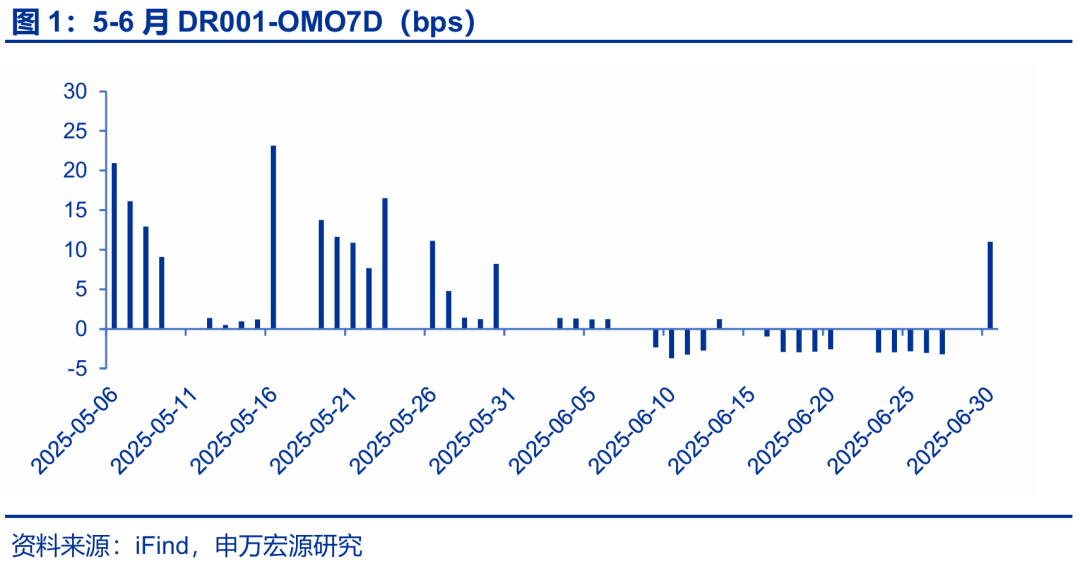
Group 1 - June liquidity was unexpectedly stable and loose, with the average DR001 at 1.39%, down 11bps from May, and 14 out of 20 working days below the policy rate [2][4] - The People's Bank of China (PBOC) conducted two unexpected reverse repos in June, totaling 10,000 billion yuan, to stabilize the market ahead of significant bond issuances [2][3] - The liquidity situation in June was supported by the arrival of 520 billion yuan in capital injections from four major banks, and the exchange rate of the US dollar against the yuan faced appreciation pressure [3][10] Group 2 - July maintained a loose liquidity stance, with the average DR001 remaining at 1.39%, but experienced significant volatility, with a range of 34bps [16][17] - The liquidity tightening in mid-July was attributed to tax payment periods and market concerns about the PBOC's stance, which were alleviated by a neutral to friendly tone from the PBOC [16][18] - The bond market's performance influenced liquidity, with a notable adjustment in the bond market during the week of July 21-25, leading to a temporary tightening of liquidity [18][21] Group 3 - August is expected to see a return to stable and loose liquidity, supported by significant government bond net supply, with estimated net financing of 1.47 trillion yuan [24][25] - The PBOC's decision to reinstate value-added tax on new bond interest income is seen as a potential negative for new bond pricing, emphasizing the importance of managing issuance costs [25][26] - The potential for the PBOC to resume bond purchases in August is being closely monitored, with several conditions indicating a possibility for such actions [32][33]

这波牛市的核心驱动力是什么?——极简投研
Mei Ri Jing Ji Xin Wen· 2025-08-09 09:16
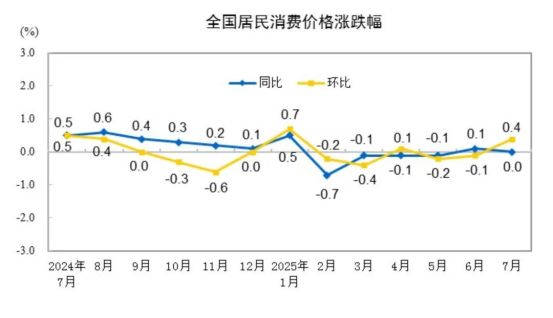
Group 1 - The core driving force of the current bull market is being questioned, whether it is based on fundamentals or valuations [5][20] - The Consumer Price Index (CPI) remained flat year-on-year in July 2025, with a month-on-month increase of 0.4%, indicating a stable inflation environment [3][12] - The Producer Price Index (PPI) showed a month-on-month decline of 0.2%, but the rate of decline has narrowed, suggesting a positive feedback effect from consumption policies [3][4] Group 2 - Historical analysis of companies like Kweichow Moutai and Yangtze Power indicates that valuation-driven performance often outweighs fundamental performance over the years [6][8] - The stock price performance of Kweichow Moutai shows that valuation contributed in 13 out of 23 years, while performance only contributed in 5 years [6][7] - For Yangtze Power, valuation also played a significant role, with valuation-driven years outnumbering performance-driven years [8][10] Group 3 - The A-share market's core driving force is predominantly valuation, with significant liquidity expected to continue supporting the market [11][15] - The monthly trading volume in the A-share market has shown substantial differences, with recent averages exceeding 1.68 trillion yuan, indicating strong market activity [17][18] - The current total market value to GDP ratio stands at 80.92%, suggesting room for growth in the market [22]

8月人民币实体信贷和社融新增均超预期
Qi Huo Ri Bao· 2025-08-08 06:59
Group 1 - The core viewpoint indicates that the new RMB loans and social financing in August exceeded market expectations, suggesting a neutral to tight liquidity state [1][2] - The economic data for August shows a recovery in consumption, investment, and exports, with retail sales increasing by 0.5% year-on-year, marking the first positive growth this year [1] - The monetary multiplier reached a historical high of 7.17 in August, reflecting strong credit expansion, while the excess reserve ratio continued to decline, leading to tighter interbank liquidity [2] Group 2 - The central bank's operations included a total of 620 billion yuan in reverse repos maturing this week, with a net injection of 90 billion yuan over the first four days [2] - Despite the central bank's excess MLF operations, the issuance rates for interbank certificates of deposit remained firm, indicating ongoing pressure on banks' medium to long-term liabilities [3] - The VIX index has decreased from a high of 38.28 to around 25, reflecting a decline in market risk appetite due to simultaneous declines in US crude oil and stock markets [3] Group 3 - FTSE Russell announced it will conduct a final assessment regarding the inclusion of RMB bonds in its indices, with a high likelihood of Chinese government bonds being included, which could attract significant allocation funds to the bond market [4] - The interbank lending center extended trading hours for overseas institutions investing in the Chinese bond market, demonstrating a positive regulatory attitude towards foreign capital [4]
7000亿来了!
Wind万得· 2025-08-07 09:42
民生固收报告称, 央行呵护资金面的态度没发生转变 ,综合看 8 月资金面不具备收紧的基础。预计 8 月政府债净融资 1.17-1.39 万亿元,与 7 月接近。 央行近期 部署下半年重点工作提到, " 落实落细适度宽松的货币政策,加力支持科技创新、提振消费、小微企业、稳定外贸等 " 的表述,与 7 月 30 日召 开的中央政治局会议定调保持一致。 央行网站 8 月 7 日显示,为保持银行体系流动性充裕, 8 月 8 日, 中国人民银行将以固定数量、利率招标、多重价位中标方式开展 7000 亿元买断式逆回 购操作,期限为 3 个月( 91 天)。 Wind 数据显示,本周央行公开市场将有 16632 亿元逆回购到期,其中周一至周五分别到期 4958 亿元、 4492 亿元、 3090 亿元、 2832 亿元、 1260 亿元。 中信证券近期报告称,经测算,完全排除 MLF 以及逆回购到期的因素, 8 月流动性缺口的绝对规模压力不大。 财政和货币政策对流动性格局的风险可 控,更多需要关注机构行为对资金面的扰动 。预计流动性不会进一步大幅收紧,但在一些跨月或税期走款等特殊时点, 仍建议谨慎布局,不要过度博 弈。 长 ...

债市收盘| 隔夜资金利率不足1.3%,主要利率债收益率全线下行
Xin Lang Cai Jing· 2025-08-07 09:32
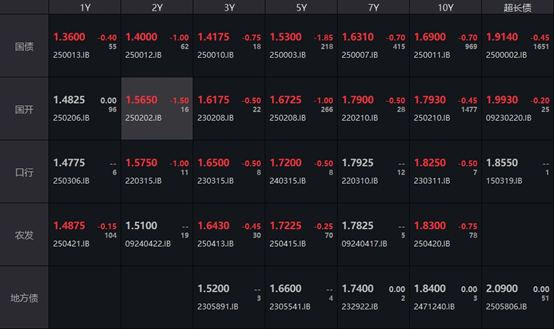
Group 1 - The core viewpoint of the articles indicates a downward trend in the yields of major term government bonds, with the 10-year government bond yield returning to 1.69% and a generally loose funding environment as the overnight rate is below 1.3% [1][5] - The closing prices of government bond futures mostly increased, with the 30-year main contract rising by 0.03% to 119.380 yuan, the 10-year main contract up by 0.05% to 108.615 yuan, and the 5-year main contract also up by 0.05% to 105.830 yuan [1][3] - The interbank major interest rate bond yields decreased across the board, with the 10-year government bond active coupon yield down by 0.7 basis points to 1.69% and the 30-year government bond yield down by 0.45 basis points to 1.914% [1][2] Group 2 - The auction results for government bonds showed a weighted interest rate of 1.585% for a 3-year bond and 1.715% for a 7-year bond, with full bid-to-cover ratios of 3.27 and 5.36 respectively [3] - The trading market for non-financial credit bonds saw significant movements, with the top five gainers including bonds from companies like 德达 and 文蓝, while the top five losers included bonds from 万科 and 梁山 [4] - The central bank conducted a reverse repurchase operation of 160.7 billion yuan at a rate of 1.40%, with a net withdrawal of 122.5 billion yuan for the day [5][6]
申万宏源:8至10月或是债市颠簸期 中短端仍料表现稳健
Xin Lang Cai Jing· 2025-08-07 01:12
Core Viewpoint - The report from Shenwan Hongyuan indicates that the 10-year government bond yield in China is expected to fluctuate between 1.65% and 1.80% from August to October, with stringent conditions required for a downward breakthrough [1] Group 1: Market Conditions - The bond market is anticipated to experience volatility during August to October, with mid to short-term bonds expected to perform steadily, leading to a steeper yield curve compared to the current state [1] - In August, the pressure on the bond market may not be significant due to a peak in government bond supply, and monetary policy will need to support liquidity alongside fiscal needs [1] Group 2: Central Bank Actions - If the bond market experiences intensified adjustments, the central bank may consider restarting open market operations for government bonds [1] - The focus on preventing capital turnover and managing risks suggests that liquidity is more likely to remain loose rather than further easing [1] Group 3: Future Risks and Economic Indicators - The transition between the third and fourth quarters is identified as a potential risk window, as government bond supply is expected to decrease, leading to a lower probability of liquidity hedging [1] - There may be a risk of rising consumer price index and producer price index as the economy enters a verification period for anti-involution effects [1] Group 4: Investment Opportunities - The second half of the year may present lower odds for the bond market and higher odds for the stock market, driven by the migration of household deposits and insurance funds into equities [1] - The stock market is showing signs of bottoming out, with a gradual emergence of wealth effects, while the bond market's pricing is becoming less sensitive to fundamentals and liquidity, making it more reactive to changes in price expectations [1]

8月流动性月报:超储结构偏短,不排除资金波动-20250806
Huachuang Securities· 2025-08-06 05:15
1. Report Industry Investment Rating No relevant content provided. 2. Core Viewpoints of the Report - In July 2025, the capital market experienced increased volatility but maintained a stable central level. The central bank actively adjusted its open - market operations to maintain market stability. The implementation effect of monetary policy will continue to emerge, and the central bank may maintain a coordinated policy stance during the peak issuance of government bonds. - In August, the overall capital gap pressure is expected to be seasonally large, around 1.8 trillion yuan. However, the capital central level is likely to remain around 1.5%, with a limited risk of significant tightening. The central bank may maintain a coordinated policy stance and there is a relatively higher probability of restarting bond - buying from August to September [4][5][69]. 3. Summary According to the Directory 3.1 7 - Month Capital and Liquidity Review 3.1.1 Capital Review - In July 2025, the overnight capital fluctuation range increased compared to the end of the previous quarter. The overnight capital fluctuated between 1.3 - 1.4% at the beginning of the month and rose to around 1.5% in the middle. The 7D capital price was basically around 1.5% from the beginning to the middle of the month and rose to around 1.6% at the end. The spread between 7D and overnight capital inverted for one day at the end of the month [10]. - The capital operation was affected by fiscal expenditures, reverse - repurchase operations, and MLF. The capital center decreased overall, with DR001 centered around 1.4% and DR007 fluctuating around 1.5% [11]. - The capital stratification pressure increased briefly in July, with spreads at a seasonal low. The capital volatility of overnight increased, and the 7D capital volatility changed seasonally. The average daily trading volume of inter - bank pledged repurchase decreased slightly compared to June [16][22][23]. 3.1.2 Liquidity Review - In terms of liquidity volume, the base currency in July may have decreased by 6019 billion yuan. The end - of - month excess reserves may have decreased by 5161 billion yuan, with an excess reserve ratio of about 1.55%. The narrow - sense excess reserve level after deducting reverse - repurchase is about 0.7%, still at a low level [31]. - In open - market operations, the central bank actively increased reverse - repurchase investments in July, with a net investment of 1880 billion yuan. MLF invested 4000 billion yuan and matured 3000 billion yuan. The net investment of outright reverse - repurchase was 2000 billion yuan, and a 1000 - billion - yuan treasury deposit operation was carried out [33][37][40]. 3.2 7 - Month Monetary Policy Tracking - In the middle of July, the central bank leader stated that the effect of the implemented monetary policy would continue to emerge, and it was reasonable for small and medium - sized banks to increase bond holdings. The regulatory attitude was more moderate than expected. - In the middle and late July, the central bank solicited opinions on "canceling the freezing of collateral for bond repurchase", which may improve collateral utilization efficiency in the long run. - At the end of July, the Political Bureau meeting emphasized implementing a more proactive fiscal policy and a moderately loose monetary policy, and fully releasing policy effects. The probability of a short - term interest rate cut is low, and the central bank may maintain a coordinated policy stance during the peak issuance of government bonds [3][48][52]. 3.3 8 - Month Gap Prediction 3.3.1 Rigid Gap - In August, the growth of general deposits may freeze about 902 billion yuan in reserves. The MLF maturity is 3000 billion yuan, and the outright reverse - repurchase maturity is 0.9 trillion yuan (4000 billion yuan for 3M and 5000 billion yuan for 6M) [4][57]. 3.3.2 Exogenous Shocks - Cash withdrawals and non - financial institution deposits may slightly freeze excess reserves. Cash withdrawals may consume about 577 billion yuan in excess reserves, and non - financial institution deposits may consume about 723 billion yuan [61]. 3.3.3 Fiscal Factors - The government bond issuance in August is expected to be around 1.5 trillion yuan. Considering factors such as payment reflux, taxation, and fiscal expenditures, government deposits may freeze about 2000 billion yuan in liquidity [64]. 3.3.4 Comprehensive Judgment - The overall capital gap in August is estimated to be around 1.8 trillion yuan, with a seasonally large pressure. However, the capital central level is likely to remain around 1.5%, with a limited risk of significant tightening. The central bank may continue the idea of over - repurchase and pay attention to the bank's liability situation and the possibility of the central bank restarting bond - buying from August to September [4][5][69].
2025年8月流动性展望:央行放松管控放大波动,维持框架内的相对宽松
Xinda Securities· 2025-08-04 14:11
1. Report Industry Investment Rating The provided content does not mention the industry investment rating. 2. Core Viewpoints of the Report - In June, the excess reserve ratio rose to 1.3%, still at a low level for the end - of - quarter month and lower than expected. The central bank maintained the normalization of capital prices by supporting bank lending. In July, the central bank aimed to keep liquidity relatively loose within the existing framework, with the excess reserve ratio expected to be around 1.2%. In August, the excess reserve ratio is projected to be about 1.1%, remaining at a neutral level in recent years. The probability of reserve requirement ratio cuts and interest rate cuts in August is low, but the central bank may still maintain relatively loose liquidity [2][3]. - The fluctuation of the capital market in July was related to the improvement of the equity market sentiment, especially the freezing of funds due to new stock listings on the Beijing Stock Exchange. The capital market in August may continue the tone of July, and attention should be paid to whether DR001 can break through the lower limit of 1.3% at the beginning of the month [2][33][61]. 3. Summary by Relevant Catalogs 3.1. Quarter - end Central Bank Claims Did Not Rise Unexpectedly, and the Increase in the Excess Reserve Ratio in June Was Weaker than Seasonal - In June, the excess reserve ratio rose by about 0.3pct to 1.3%, lower than the expected 1.5%, due to the central bank's claims on other depository corporations not rising additionally as expected to offset the previous decline. After the central bank announced the liquidity injection of various tools in May, the difference between the central bank's claims on other depository corporations and high - frequency data decreased, and its follow - up normalization needs attention [6]. - In June, the fiscal deposit decreased by 5722 billion yuan, less than the expected 7400 billion yuan. The expenditure progress of special refinancing bonds was slow, and the repurchase of treasury cash time deposits might have led to an additional increase in government deposits. Other factors such as currency issuance, central bank legal deposit reserves, and foreign exchange funds were close to expectations [8]. - Despite the relatively low excess reserve ratio, the net lending scale of banks continued to rise in June, and the central DR001 rate dropped below 1.4%, indicating that the central bank was normalizing capital prices by supporting bank lending [15]. 3.2. In July, the Central DR001 Rate Was Stable but with Increased Fluctuations, and the Central Bank Maintained Relative Looseness within the Existing Framework - In July, although the supply pressure of government bonds remained high, the general fiscal revenue and expenditure might show an anti - seasonal deficit, and the expenditure of replacement bonds was expected to bring additional government deposit injections. It was estimated that government deposits would increase by about 450 billion yuan, and the consumption of excess reserves would weaken marginally. Credit lending decline might lead to a decrease in bank reserve payments by about 90 billion yuan. Currency issuance might increase by about 30 billion yuan, and foreign exchange funds might continue to withdraw about 50 billion yuan. In the open market, the central bank's claims on other depository corporations might rise by about 260 billion yuan, and the excess reserve ratio was expected to be about 1.2% [15]. - In July, DR001 once exceeded 1.35%, and 1.3% seemed to become the new lower limit. The average DR001 for the whole month did not decline significantly but fluctuated more. The decline in non - bank capital demand led to a decline in DR007 despite the decrease in bank net lending. This might indicate that the central bank had achieved policy normalization and hoped to maintain relatively loose liquidity within the existing framework, resulting in stable but more volatile capital interest rates [27]. - The increased fluctuation of the capital market in late July might be related to the improvement of the equity market sentiment, especially the freezing of funds due to new stock listings on the Beijing Stock Exchange. The freezing and unfreezing of funds on the Beijing Stock Exchange might only impact the inter - bank liquidity under special circumstances [33]. - The cross - month progress of institutions in July was generally slow, but the abundant capital supply ensured the looseness of the capital market at the end of the month [37]. 3.3. In August, Relative Looseness May Still Be Maintained within the Existing Framework, and Attention Should Be Paid to Whether the Central Bank Continues to Relax Controls and Amplify Fluctuations - In August, although the general fiscal deficit might be higher than the same period in previous years, and the expenditure of replacement bonds might still cause additional leakage of government deposits, the net supply of government bonds was also at a high level. It was estimated that government deposits would decrease by about 50 billion yuan. Reserve payments might increase seasonally, currency issuance might increase by about 50 billion yuan, and foreign exchange funds might continue to withdraw about 50 billion yuan. In the open market, the central bank's claims on other depository corporations might decline by about 430 billion yuan, and the excess reserve ratio was expected to be about 1.1% [3][43]. - Since July, the central bank has emphasized the implementation of existing policies. The threshold for reserve requirement ratio cuts and interest rate cuts has increased, and it is not the baseline expectation for August. However, the central bank's concern about bond investment risks has decreased, and it may still tend to maintain relatively loose liquidity within the existing framework in August [3][56]. - In August, the capital market may continue the tone of July. Attention should be paid to whether DR001 can break through the lower limit of 1.3% at the beginning of the month. If so, the central bank may further relax controls on bank lending, increasing the fluctuation of the capital market. Although the exogenous disturbances such as the tax period in August may decrease, the decline in the central DR001 and DR007 rates may be limited [61].