地缘溢价

Search documents
液化石油气日报:地缘风险攀升,盘面强势反弹-20260127
Hua Tai Qi Huo· 2026-01-27 05:13
1、\t1月26日地区价格:山东市场,4440-4440;东北市场,3940-4100;华北市场,4250-4430;华东市场,4170-4340; 沿江市场,4680-4980;西北市场,4300-4360;华南市场,4740-4820。(数据来源:卓创资讯) 液化石油气日报 | 2026-01-27 地缘风险攀升,盘面强势反弹 市场分析 2、\t2026年2月下半月中国华东冷冻货到岸价格丙烷639美元/吨,涨19美元/吨,丁烷629美元/吨,涨19美元/吨,折 合人民币价格丙烷4913元/吨,涨140元/吨,丁烷4836元/吨,涨140元/吨。(数据来源:卓创资讯) 3、\t2026年2月下半月中国华南冷冻货到岸价格丙烷631美元/吨,涨19美元/吨,丁烷621美元/吨,涨19美元/吨,折 合人民币价格丙烷4852元/吨,涨141元/吨,丁烷4775元/吨,涨141元/吨。(数据来源:卓创资讯) 近期中东局势显著升温,美国上周五加大了对伊朗的施压,对运输伊朗石油的船只实施更多制裁,并宣布一支舰 队正驶向这个中东国家。伊朗不同于委内瑞拉,由于其地缘位置的重要性,可能波及周边重要产油国以及霍尔木 兹海峡,因此 ...
华泰证券:地缘溢价或提前带动油价筑底反弹
Xin Hua Cai Jing· 2026-01-27 01:34
(文章来源:新华财经) 新华财经北京1月27日电华泰证券最新研报指出,2026年1月以来,委内瑞拉、伊朗等地缘紧张局势再次 引发市场供应风险担忧,1月23日WTI/Brent期货价格收于61.07/65.88美元/桶,较12月末上涨 6.4%/8.3%。地缘溢价已导致淡季油价筑底反弹,随着需求回升及全球性储备性累库,2026年第二至第 三季度油价有望见底上探,叠加美联储降息对需求拉动,亚非拉地区成品油需求或景气上行,上调2026 年布伦特原油均价为65美元/桶(前值62美元/桶)。长期而言,考虑主要产油国边际成本及"利重于 量"诉求,油价中枢存60美元/桶底部支撑。具备增产降本能力及天然气业务增量的能源龙头企业或将 显现配置机遇;油价筑底后库存损失减少,炼化有望迎来盈利低迷下的景气反转。 ...

商品日报(1月26日):贵金属继续飙升油气强势走高 碳酸锂日内剧烈波动
Xin Hua Cai Jing· 2026-01-26 10:45
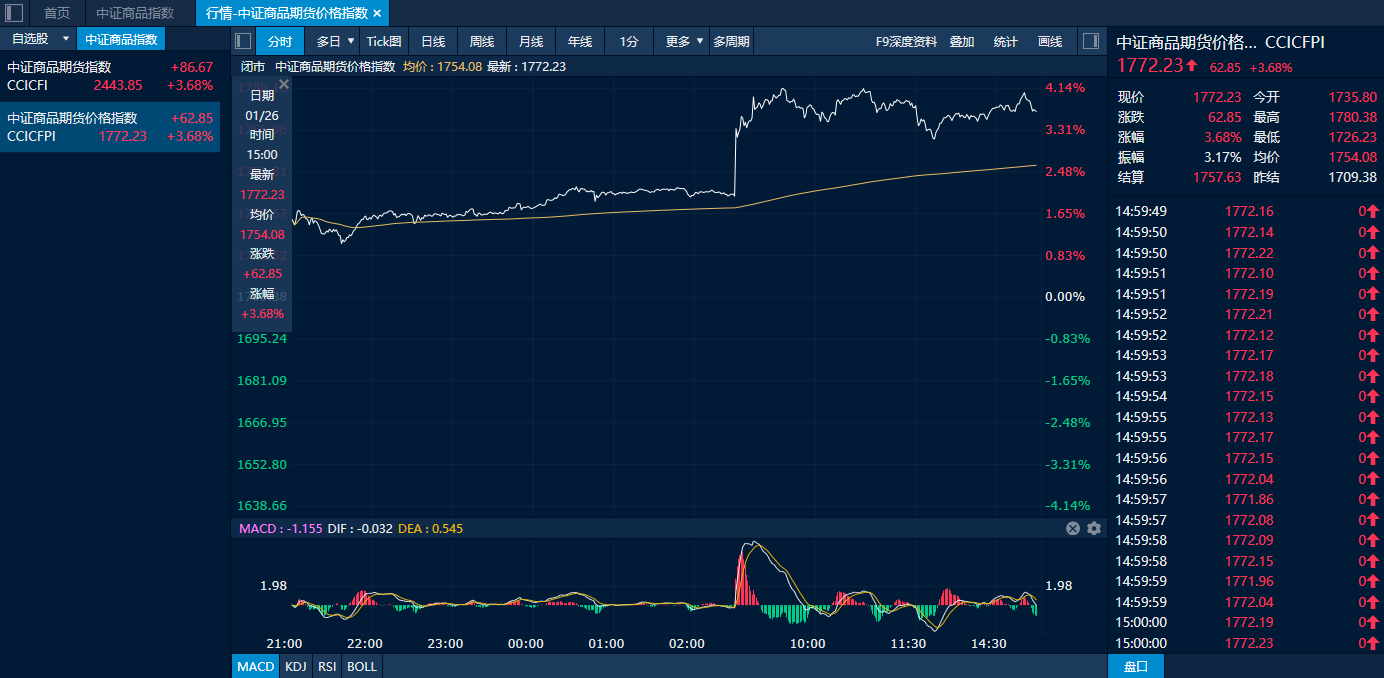
截至26日下午收盘,中证商品期货价格指数收报1772.23点,较前一交易日上涨62.85点,涨幅3.68%;中证商品期货指数收报2443.85点,较前一交易日上涨 86.67点,涨幅3.68%。 贵金属继续飙升双轮驱动油气强势走高 1月26日商品市场的热点仍在持续火热的贵金属市场以及近期快速反弹的能化板块。截至收盘,除沪银飙升近13%领涨商品市场以外,铂、钯分别跟涨超 9%、8%,金价涨幅虽不足4%,但仍历史性首次触及1150元/克上方。近期除了地缘局势继续给贵金属带来避险买盘以外,美国总统特朗普周末对加拿大的 关税威胁,进一步强化了市场"卖出美国"的交易倾向,加上美日联手干预日元贬值令美元兑日元汇率单日大跌,也加剧了美元的跌势。此外,市场对美联储 潜在新任主席人选的鸽派政策倾向或加速美联储宽松的押注,亦构成了强化贵金属看涨热情的重要利多。因此,环顾整个市场,对于贵金属而言,除了过于 一致的看涨预期可能成为潜在风险以外,市场暂时没有看到真正构成遏制贵金属多头热情的实际因素。在此背景下,即便机构多将短线获利回吐视为贵金属 价格波动的诱因,但仍维持对贵金属多头配置的策略建议。 贵金属市场火热也带动资金开始向估值洼 ...

惊爆!1月23日油价调整,全国92、95汽油新售价超乎想象!
Sou Hu Cai Jing· 2026-01-24 16:43
Core Viewpoint - Oil prices are no longer just economic indicators but a battleground for global political and economic forces, with ongoing volatility in the market [1] Group 1: Market Dynamics - Recent fluctuations in oil prices include a drop in WTI crude by $1.26 (2.08%) to $59.36 per barrel and Brent crude by $1.30 to $63.96 per barrel, indicating a continued tug-of-war in the oil market [1] - The market is currently experiencing a fierce battle between bullish and bearish factors, with U.S. easing tensions with Iran providing some support for prices, while trade concerns and a strong dollar continue to suppress risk assets [3] - The balance in the oil market is fragile, with any minor changes potentially leading to significant price volatility [3] Group 2: Supply and Demand Factors - A report from OPEC highlighted a supply surplus, with global oil production exceeding demand by 500,000 barrels per day, a stark reversal from a previous estimate of a 400,000 barrel shortage [3] - The surge in U.S. shale oil production is a key contributor to the supply surplus, with October data showing combined U.S. crude oil and LNG output reaching a record 15.9 million barrels per day, up 2 million barrels per day year-on-year [4] - Global economic growth is sluggish, particularly in the U.S. and Europe, leading to lowered expectations for oil demand [7] Group 3: Monetary Policy Impact - The strong dollar, driven by persistent expectations of no rate cuts from the Federal Reserve, has made oil more expensive for non-dollar buyers, thereby suppressing actual purchasing power in the international market [3] - The recent interest rate cuts by the Federal Reserve did not yield positive reactions in the commodity markets, with prices for key industrial raw materials like oil and copper declining [7] - The anticipated impact of monetary policy changes on the oil market has been disrupted, challenging the traditional view that rate cuts benefit commodity prices [7] Group 4: Geopolitical Risks - Geopolitical risks remain significant, with the current stability in the Middle East reducing risk premiums on oil, but potential escalations could reignite market fears [9] - The focus is shifting to OPEC's upcoming meetings to determine if production cuts will be adjusted in response to falling prices [9] - The presence of U.S. military forces in the Caribbean and Venezuela's military readiness could also influence market sentiment [9] Group 5: Consumer Impact - Fluctuations in oil prices directly affect consumer fuel costs, with projections indicating a potential increase of 0.09 yuan per liter due to recent price adjustments [7] - While lower oil prices may benefit consumers by reducing transportation and logistics costs, prolonged low prices could signal economic recession risks [8]

能源化工日报-20260123
Wu Kuang Qi Huo· 2026-01-23 01:02
1. Industry Investment Rating No information about the industry investment rating is provided in the report. 2. Core Viewpoints - For crude oil, although the geopolitical premium has disappeared and OPEC's production increase is minimal with supply not yet surging, short - term oil prices should not be overly bearish. Maintain a range strategy of buying low and selling high, but currently, wait and see as the price needs to test OPEC's export price - support willingness. [2] - For methanol, with low valuation and an improving outlook next year, the downside is limited. Despite short - term negative pressure, geopolitical instability in Iran brings expectations, and there is feasibility to buy on dips. [3] - For urea, the current situation of internal - external price differences has opened the import window, and with the expected increase in production at the end of January, negative fundamental expectations are coming, so take profits on rallies. [6] - For rubber, with a weak seasonal pattern, it is expected to continue to decline after consolidation. Adopt a bearish approach, short on rebounds if RU2605 breaks below 16000, and partially build positions for the strategy of buying NR main contract and shorting RU2609. [11] - For PVC, the fundamentals are poor with strong supply and weak demand in China. Short - term electricity price expectations and pre - April 1 export rush support the price, but mid - term, short on rallies before significant industry production cuts. [14] - For pure benzene and styrene, the non - integrated profit of styrene is moderately high with limited room for upward valuation repair. As the non - integrated profit has significantly recovered, gradually take profits. [17] - For polyethylene, OPEC+ plans to suspend production growth in Q1 2026, and crude oil prices may have bottomed. Although the spot price has risen, the valuation has room to decline further. With no new capacity planned in H1 2026 and reduced coal - based inventory, the price has support, but demand is in a seasonal downturn. [20] - For polypropylene, the EIA report forecasts a slight reduction in global oil inventory, and the supply surplus may ease. With no new capacity in H1 2026, the supply pressure is relieved. In a context of weak supply and demand, the inventory pressure is high. Wait for the supply - surplus situation to change in Q1 next year for the price to bottom. Long the PP5 - 9 spread on dips. [23] - For PX, it is expected to continue to accumulate inventory before the maintenance season. After the Spring Festival, both PX and its downstream PTA will have strong supply - demand, and there are mid - term opportunities to buy on dips following crude oil. [26] - For PTA, it is expected to enter the Spring Festival inventory - accumulation stage with high short - term maintenance on the supply side and weakening demand due to seasonality. There is room for valuation to rise after the Spring Festival, and look for mid - term buying opportunities. [28] - For ethylene glycol, the overall load is still high, and the inventory - accumulation cycle at ports will continue. There is an expectation of further profit compression and load reduction under new - plant commissioning pressure. Be cautious of rebound risks in the short term due to the tense situation in Iran and cold wave expectations. [30] 3. Summary of Each Product Crude Oil - **Market Information**: INE main crude oil futures rose 5.30 yuan/barrel, or 1.20%, to 446.40 yuan/barrel. Related refined product futures, high - sulfur fuel oil rose 48.00 yuan/ton, or 1.89%, to 2592.00 yuan/ton; low - sulfur fuel oil rose 51.00 yuan/ton, or 1.65%, to 3135.00 yuan/ton. [1] - **Strategy**: Maintain a range strategy of buying low and selling high, but wait and see currently. [2] Methanol - **Market Information**: Regional spot prices in Jiangsu changed by 5 yuan/ton, Lunan by - 5 yuan/ton, Henan by 0 yuan/ton, Hebei by 0 yuan/ton, and Inner Mongolia by - 2.5 yuan/ton. The main futures contract changed by 45.00 yuan/ton to 2260 yuan/ton, and MTO profit changed by 1 yuan. [3] - **Strategy**: Buy on dips as the valuation is low and the outlook is improving. [3] Urea - **Market Information**: Regional spot prices in Shandong changed by 0 yuan/ton, Henan by - 10 yuan/ton, Hebei by 0 yuan/ton, Hubei by 0 yuan/ton, Jiangsu by - 10 yuan/ton, Shanxi by - 20 yuan/ton, and Northeast by 0 yuan/ton. The overall basis was - 36 yuan/ton. The main futures contract changed by - 3 yuan/ton to 1776 yuan/ton. [5] - **Strategy**: Take profits on rallies due to expected negative fundamentals. [6] Rubber - **Market Information**: Rubber prices rebounded with a volatile pattern. The long - side reasons include limited production growth in Southeast Asian rubber forests, a seasonal upward trend in the second half of the year, and improved demand expectations in China. The short - side reasons are uncertain macro expectations, increased supply, and a seasonal demand slump. As of January 15, 2026, the operating rate of Shandong tire enterprises' all - steel tires was 62.84%, up 2.30 percentage points from last week and 2.78 percentage points from the same period last year; the semi - steel tire operating rate was 74.35%, up 6.35 percentage points from last week but down 4.09 percentage points from the same period last year. As of January 11, 2026, China's total natural rubber social inventory was 125.6 million tons, a 1.9% increase. Spot prices: Thai standard mixed rubber was 14700 (+100) yuan, STR20 was 1885 (+15) dollars, etc. [8][9][10] - **Strategy**: Adopt a bearish approach, short on rebounds if RU2605 breaks below 16000, and partially build positions for the strategy of buying NR main contract and shorting RU2609. [11] PVC - **Market Information**: The PVC05 contract rose 106 yuan to 4849 yuan. The spot price of Changzhou SG - 5 was 4570 (+70) yuan/ton, the basis was - 279 (- 36) yuan/ton, and the 5 - 9 spread was - 114 (+4) yuan/ton. The overall PVC operating rate was 79.6%, unchanged from the previous period. The demand - side downstream operating rate was 43.9%, down 0.1%. Factory inventory was 31.1 million tons (- 1.7), and social inventory was 114.4 million tons (+3). [13] - **Strategy**: Short on rallies mid - term before significant industry production cuts. [14] Pure Benzene and Styrene - **Market Information**: The spot price of pure benzene in East China was 5760 yuan/ton, unchanged; the active contract closing price was 6000 yuan/ton, unchanged; the basis was - 240 yuan/ton, narrowing by 195 yuan/ton. The spot price of styrene was 7600 yuan/ton, up 250 yuan/ton; the active contract closing price was 7694 yuan/ton, up 386 yuan/ton; the basis was - 94 yuan/ton, weakening by 136 yuan/ton. The upstream operating rate was 70.86%, down 0.06%; the Jiangsu port inventory was 9.35 million tons, a reduction of 0.71 million tons. The demand - side three - S weighted operating rate was 41.91%, up 1.02%. [16] - **Strategy**: Gradually take profits as the non - integrated profit of styrene has significantly recovered. [17] Polyethylene - **Market Information**: The main contract closing price was 6814 yuan/ton, up 148 yuan/ton; the spot price was 6640 yuan/ton, up 65 yuan/ton; the basis was - 174 yuan/ton, weakening by 83 yuan/ton. The upstream operating rate was 81.56%, up 1.23%. The production enterprise inventory was 35.03 million tons, a reduction of 4.51 million tons; the trader inventory was 2.92 million tons, unchanged. The downstream average operating rate was 41.1%, down 0.11%. The LL5 - 9 spread was - 31 yuan/ton, narrowing by 3 yuan/ton. [19] - **Strategy**: The price has support from reduced coal - based inventory and OPEC+ production suspension, but demand is in a seasonal downturn. [20] Polypropylene - **Market Information**: The main contract closing price was 6624 yuan/ton, up 139 yuan/ton; the spot price was 6660 yuan/ton, up 100 yuan/ton; the basis was 36 yuan/ton, weakening by 39 yuan/ton. The upstream operating rate was 76.61%, down 0.01%. The production enterprise inventory was 43.1 million tons, a reduction of 3.67 million tons; the trader inventory was 19.39 million tons, a reduction of 1.08 million tons; the port inventory was 7.06 million tons, a reduction of 0.05 million tons. The downstream average operating rate was 52.58%, down 0.02%. The LL - PP spread was 190 yuan/ton, widening by 9 yuan/ton; the PP5 - 9 spread was - 25 yuan/ton, widening by 9 yuan/ton. [21][22] - **Strategy**: Wait for the supply - surplus situation to change in Q1 next year for the price to bottom. Long the PP5 - 9 spread on dips. [23] PX - **Market Information**: The PX03 contract rose 184 yuan to 7390 yuan; PX CFR rose 19 dollars to 907 dollars. The basis was - 70 yuan (- 30), and the 3 - 5 spread was - 78 yuan (- 4). The Chinese PX load was 88.9%, down 0.5%; the Asian load was 81%, up 0.4%. In January, South Korea's PX exports to China decreased by 6.8 million tons year - on - year. The inventory at the end of November was 446 million tons, a monthly increase of 6 million tons. [25] - **Strategy**: Look for mid - term buying opportunities following crude oil after the Spring Festival. [26] PTA - **Market Information**: The PTA05 contract rose 144 yuan to 5298 yuan; the East China spot price rose 70 yuan to 5155 yuan. The basis was - 71 yuan (- 1), and the 5 - 9 spread was 34 yuan (- 10). The PTA load was 76.6%, up 0.3%. The downstream load was 86.7%, down 1.6%. The social inventory (excluding credit warehouse receipts) on January 16 was 204.5 million tons, an increase of 4 million tons. The spot processing fee was 353 yuan, down 31 yuan; the futures processing fee was 450 yuan, up 23 yuan. [27] - **Strategy**: Expect inventory accumulation during the Spring Festival. Look for mid - term buying opportunities. [28] Ethylene Glycol - **Market Information**: The EG05 contract rose 158 yuan to 3847 yuan; the East China spot price rose 90 yuan to 3660 yuan. The basis was - 109 yuan (+1), and the 5 - 9 spread was - 103 yuan (+14). The ethylene glycol load was 73%, down 1.4%. The downstream load was 86.7%, down 1.6%. The import arrival forecast was 20.5 million tons, and the East China port departure on January 21 was 0.76 million tons. The port inventory was 79.5 million tons, a reduction of 0.7 million tons. The naphtha - based profit was - 1059 yuan, the domestic ethylene - based profit was - 862 yuan, and the coal - based profit was - 5 yuan. [29] - **Strategy**: Be cautious of rebound risks in the short term and expect further valuation compression mid - term without significant production cuts. [30]
原油日报:地缘溢价持续扰动油市-20260121
Hua Tai Qi Huo· 2026-01-21 05:08
Report Summary 1. Report Industry Investment Rating - Short - term: Oil prices will fluctuate within a range; Medium - term: Bearish allocation [3] 2. Core View - Geopolitical premiums continue to disrupt the oil market. Although Trump cancelled the plan to strike Iran, the tense situation in Iran has not been completely alleviated, and it will still have an emotional impact on oil prices in the short term, but the fundamentals have not been affected by geopolitics [1][2] 3. Summary by Related Content Market News and Important Data - The price of light crude oil futures for February delivery on the New York Mercantile Exchange rose 90 cents to close at $60.34 a barrel, a gain of 1.51%. The price of Brent crude oil futures for March delivery rose 98 cents to close at $64.92 a barrel, a gain of 1.53%. The main SC crude oil contract closed up 0.91% at 443 yuan per barrel [1] - On January 21 local time, the US military boarded and seized the seventh sanctioned oil tanker related to Venezuela. The US Southern Command said the tanker violated the isolation regulations imposed on sanctioned vessels by President Trump [1] - On January 16 local time, the US is accelerating the expansion of Chevron's oil production license in Venezuela. Under the new license arrangement, Chevron will be allowed to pay the Venezuelan government in cash instead of crude oil in kind, which will significantly enhance its business flexibility [1] Investment Logic - Oil prices rebounded again yesterday. The situation in Iran remains the focus. Although Trump cancelled the plan to strike Iran, the short - term impact on oil prices still exists, but it is only an emotional impact and has not affected the fundamentals [2] Strategy - Short - term: Oil prices will fluctuate within a range; Medium - term: Bearish allocation [3] Risks - Downward risks: A peace agreement is reached between Russia and Ukraine, and macro black - swan events occur - Upward risks: Supply of sanctioned oil (from Russia, Iran, and Venezuela) tightens, and large - scale supply disruptions are caused by conflicts in the Middle East [3]
天?寒冷美国天然??幅拉升,芳烃给出检修计划价格
Zhong Xin Qi Huo· 2026-01-21 01:38
Group 1: Report Industry Investment Rating - Not provided in the content Group 2: Core Views of the Report - The prices of oil and gas are rising, and due to the cold snap, coal prices are also strong, providing cost support for chemicals. Chemicals also have some industry benefits. Before the Spring Festival, there is an expectation of spring maintenance, and the market anticipates the possible "Golden March and Silver April" consumption peak after the Spring Festival. The futures prices have limited adjustment space and will generally fluctuate [2]. - Crude oil still has the possibility of geopolitical risks, and chemicals should be treated with a fluctuating mindset [3]. Group 3: Summary by Variety Crude Oil - **View**: Geopolitical premium fluctuates, and oil prices continue to oscillate. Supply pressure persists, but geopolitical premium may fluctuate. It should be viewed as oscillating in the short - term [3][6]. - **Main Logic**: Global on - land crude oil inventories have been accumulating, overseas refined oil inventories are under pressure, and the supply surplus pattern remains. The shutdown of Kazakhstan's Tengiz oilfield supports the Western market. Geopolitics is the short - term focus, and previous military actions between Iran and Israel had little impact on oil supply. If relevant tail risks materialize, oil prices are likely to rise and then fall. If the Iranian situation eases, oil prices may approach the lower limit of the oscillation range [6]. Asphalt - **View**: The high valuation of asphalt is gradually being revised downward, and it is expected to oscillate weakly in the medium - term [3][6][7]. - **Main Logic**: OPEC+ will suspend production increases in Q1, and the partial lifting of sanctions on Venezuela will increase its oil production and exports. The current asphalt market is still trading the reduction of discounts due to the US selling Venezuelan oil at the current price, which supports asphalt costs. However, it will lead to abundant long - term supply, which is a major negative for asphalt. The US - Iran situation has not further escalated, and the decline in crude oil has led to the downward revision of asphalt's high valuation. The supply and demand of asphalt are both weak, and inventory accumulation pressure is high [6]. High - Sulfur Fuel Oil - **View**: The geopolitical premium of fuel oil has declined, and it is expected to oscillate. Venezuelan oil production growth expectations will long - term pressure high - sulfur fuel oil, and short - term attention should be paid to the geopolitical situation in the Middle East [3][7]. - **Main Logic**: OPEC+ will suspend production increases, and the US is helping Venezuela increase oil production, leading to a strong expectation of a surge in heavy - oil supply, which pressures high - sulfur fuel oil in the long - term. The US - Iran situation has temporarily cooled, and the geopolitical premium of fuel oil has significantly declined. Although Iraq may resume fuel - oil power generation in the short - term, high floating storage in the Asia - Pacific region and the replacement of fuel - oil power generation by natural gas and photovoltaics in the Middle East are long - term negatives for high - sulfur fuel oil. The three driving forces supporting high - sulfur fuel oil are showing a cooling trend, but the expansion of the asphalt - fuel oil spread may increase the processing demand for fuel oil [7]. Low - Sulfur Fuel Oil - **View**: The futures price of low - sulfur fuel oil fluctuates widely and is expected to oscillate. It is affected by the substitution of green fuels and high - sulfur fuels, with limited demand space, but its current valuation is low and it follows crude - oil fluctuations [3][9]. - **Main Logic**: The futures price of low - sulfur fuel oil follows crude - oil fluctuations. The expected release of Venezuelan oil has led to an increase in the Brent - Dubai crude oil spread and a rebound in the low - high sulfur spread. Low - sulfur fuel oil has strong product attributes and is supported. However, it faces negative factors such as a decline in shipping demand, green - energy substitution, and high - sulfur substitution. The export tax - refund rate of low - sulfur fuel oil has an advantage over refined oil, and the pressure of reducing oil and increasing chemicals is likely to be transmitted to low - sulfur fuel oil, resulting in a trend of increasing supply and decreasing demand [9]. PX - **View**: The bottom of polyester load is relatively confirmed, and PX's profitability has stabilized. In the short - term, PX prices will seek upward drivers without new negatives, and PXN is expected to remain in the range of [300, 350] dollars/ton [10][11]. - **Main Logic**: Crude - oil prices oscillate in a range, naphtha remains stagnant, and PX strengthened significantly in the afternoon. Macroeconomic利好 policies were successively introduced, boosting market sentiment. There were rumors of individual factories' far - month maintenance plans, which stimulated the market. The bottom of polyester's new - year start - up is confirmed, and PTA's good profitability supports the upstream, so PX's profitability has stabilized after half a month of correction [11]. PTA - **View**: Funds have flowed in again, and TA's profit has expanded. It is expected to oscillate strongly in the short - term, and the TA05 - 09 maintains a positive - spread logic [11][12]. - **Main Logic**: International oil prices are tepid, the commodity - market sentiment is positive, and TA rose rapidly in the afternoon with a large increase in positions and inflow of funds. Fundamentally, the low point of downstream polyester load is confirmed, and demand has bottomed out. Without new negatives, prices are expected to be warm in the short - term. With the rapid rise of futures prices, the basis is expected to be weak overall [12]. Pure Benzene - **View**: Port de - stocking is obvious, and pure benzene oscillates strongly. Short - term high inventory may limit the increase, but there will be a quarterly improvement [13][15]. - **Main Logic**: The East - China pure - benzene port has de - stocked for the first time in two months. Low - price pure benzene and strong downstream styrene have created a market waiting for a rise. Downstream profit - locking has pushed up the price of pure benzene. There is a possibility of the US canceling the 15% tariff on South Korean pure benzene. In the chemical industry, pure benzene, with a relatively low valuation, has become a long - position choice for funds [15]. Styrene - **View**: Supply and demand are tight, and styrene has been oscillating strongly recently. If there is no unexpected significant increase in supply or major negative news from crude oil, it will continue to oscillate strongly in the short - term under the repeated stimulation of exports [16]. - **Main Logic**: The strength of styrene comes from export disturbances, geopolitical disturbances leading to rising crude - oil prices, and a positive overall commodity atmosphere. The expected inventory accumulation in January has been reversed, and the non - integrated device profit is relatively high. Before the restart of Sinochem Quanzhou in late January, the supply - demand pattern is favorable [16]. Ethylene Glycol - **View**: The main - port inventory continues to accumulate, and ethylene glycol is in a difficult situation. In the short - term, prices will remain in a range, and the long - term inventory - accumulation pressure is still large, so the rebound height is limited [17][18]. - **Main Logic**: Overseas imports are still large, and there is obvious seasonal inventory - accumulation pressure. Domestic supply is shrinking slowly, some port inventories are tight, and polyester factories are gradually reducing production, making it difficult to reverse the weak pattern [18]. Short - Fiber - **View**: Short - fiber moderately follows the rise, and profits are compressed. Prices will follow the upstream for adjustment, and processing fees are under some pressure [19][20]. - **Main Logic**: Upstream polyester raw materials have risen sharply, and short - fiber sales have improved slightly. However, due to the strong short - term cost, short - fiber profits are under pressure, and the absolute price is expected to moderately follow the rise [20]. Polyester Bottle - Chip - **View**: Supply continues to compress, and processing fees have a repair expectation. The absolute value will follow the raw materials, and the support for processing fees at the bottom has increased [21]. - **Main Logic**: Upstream polyester raw materials rose in the afternoon, and polyester bottle - chips followed the cost increase. The trading atmosphere was good, and the price of polyester bottle - chips will mainly follow the upstream in the short - term, with support for processing fees at the bottom [21]. Methanol - **View**: The inland area remains weak, and there is a long - short game in the coastal area. Methanol will oscillate in a range in the short - term [24]. - **Main Logic**: The inland market has a pattern of strong supply and weak demand, and producers are actively reducing prices to clear inventory. Coastal port high - inventory pressure is significant, and the shutdown of the Zhejiang Xingxing device has further weakened the MTO external - procurement demand. Short - term negatives are stronger than the positives of overseas macro uncertainties [24]. Urea - **View**: New orders at low prices have improved, and urea has stabilized and oscillated. The market has no substantial guiding information, and the trading rhythm is adjusted according to prices. In the short - term, the fundamentals have little change, and it will oscillate [25]. - **Main Logic**: The daily production of urea remains at a high level, and the supply of goods is sufficient. The demand for compound fertilizers and other industries is relatively rigid, and the agricultural demand in the Jiangsu and Anhui regions is also advancing. After several days of price decline, new orders at low prices have improved, and the market has temporarily stabilized [25]. LLDPE (Plastic) - **View**: Maintenance has slightly decreased, and plastic will oscillate. In the short - term, it will oscillate [29]. - **Main Logic**: Oil prices oscillate, and the supply - surplus pattern remains. The low production in Kazakhstan supports the Western market, and geopolitics is the short - term focus. Fundamentally, the pressure has been released, and after the rebound, the profits of various production methods have been repaired. Maintenance has decreased recently, and demand is in the off - season. However, considering the expected macro - consumption policy support and the improvement in inventory and downstream confidence, the downside space is limited [29]. PP - **View**: Maintenance and macro - expectations still provide support, and PP should be viewed as oscillating. It will oscillate in the short - term [30]. - **Main Logic**: Oil prices oscillate, and the supply - surplus pattern remains. The low production in Kazakhstan supports the Western market, and geopolitics is the short - term focus. The profits of various PP production methods have been repaired, and the upside space is limited. The downstream is in the off - season, and trading volume has decreased recently. However, considering the expected macro - consumption policy support and short - term maintenance support, the downside space is limited [30]. PL - **View**: Supply has tightened, and PL will oscillate. It will oscillate in the short - term [31]. - **Main Logic**: The PDH maintenance expectation still provides support. Individual domestic devices have stopped, and the market supply has tightened again. However, downstream follow - up is weak, suppressing the overall buying rhythm. Enterprises mainly maintain stable prices for sales, and the actual - order price range has little change. Short - term powder profits fluctuate slightly, and downstream demand support in the off - season is limited [31]. PVC - **View**: "Rushing for exports" provides support, and the downside space should be carefully considered. It is expected to oscillate. The cancellation of export tax - refunds and the expected increase in the external - market price may promote short - term export - rushing, but in the long - term, the fundamentals are still under pressure, and the market will be oscillating [34]. - **Main Logic**: At the macro - level, the export tax - refund for PVC will be cancelled on April 1st. At the micro - level, short - term "rushing for exports" may promote de - stocking, but long - term supply - demand expectations are still under pressure. Profits have improved, boosting the production willingness of marginal enterprises. Downstream start - up is seasonally weak, and restocking willingness is poor. Upstream price increases are not conducive to export orders, and the sustainability of this week's export orders needs to be observed. The supply of calcium carbide has decreased while demand has increased, and its price may be boosted. The supply - demand of caustic soda is weak, and its profit is squeezed, and the price is under pressure [34]. Caustic Soda - **View**: It has a low valuation and weak expectations, and it is running weakly. Inventory pressure is large, and with stable costs, profits may still be squeezed, and the market will run weakly [35]. - **Main Logic**: The weak reality of caustic soda continues, and inventory is still accumulating. Alumina marginal - device profits are poor, and production cuts may be slow. Weiqiao's caustic - soda inventory is high, and the purchase price has been lowered again. The commissioning of 4.8 million tons of alumina in Guangxi in Q1 2026 will marginally boost caustic - soda demand. Non - aluminum start - up is weakening, and the restocking willingness of the middle and lower reaches is not high. Upstream start - up has changed little, and caustic - soda production remains at a historical high. The "rushing for exports" of epichlorohydrin supports the price of liquid chlorine, and the short - term cost of caustic soda may be stable [35]. Group 4: Variety Data Monitoring Energy and Chemical Daily Indicator Monitoring - **Inter - period Spreads**: Data on the inter - period spreads of various varieties such as Brent, Dubai, PX, PTA, MEG, etc. are provided, including the latest values and changes [36]. - **Basis and Warehouse Receipts**: Data on the basis and warehouse receipts of varieties like asphalt, high - sulfur fuel oil, low - sulfur fuel oil, etc. are given, including the latest values and changes [37]. - **Inter - variety Spreads**: Data on the inter - variety spreads of different combinations such as PP - 3MA, TA - EG, L - P, etc. are provided, including the latest values and changes [38]. Chemical Basis and Spread Monitoring - Not detailed in the content, only the variety names are listed. Commodity Index - **Comprehensive Index**: The comprehensive index is 2414.16, down 0.15%. The commodity 20 index is 2773.48, down 0.23%. The industrial - products index is 2308.47, down 0.34% [281]. - **Energy Index**: On January 20, 2026, the energy index was 1099.40, with a daily decline of 0.37%, a 5 - day decline of 2.59%, a 1 - month increase of 2.61%, and a year - to - date increase of 1.18% [283].
能源化策略报:原油延续震荡整理,纯苯去库引发期价?幅反弹
Zhong Xin Qi Huo· 2026-01-20 03:13
1. Report Industry Investment Rating The report does not explicitly mention an overall industry investment rating. 2. Core Viewpoints of the Report - The crude oil price continues to fluctuate and consolidate. The geopolitical situation in Iran has significantly eased, and geopolitical factors have temporarily receded. The supply - demand pattern of the chemical industry is complex, and it is recommended to adopt a volatile mindset for investment [2][3][4]. 3. Summary by Relevant Catalogs 3.1 Market Conditions and Outlook of Each Variety - **Crude Oil**: Geopolitical premiums fluctuate, and oil prices continue to oscillate. The supply - surplus pattern persists, but geopolitical factors remain the short - term focus. The outlook is for a volatile trend [8]. - **Asphalt**: High valuations are gradually being revised downwards. The market is affected by factors such as OPEC+ production policies and Venezuelan oil supply, with a long - term bearish outlook and a short - term trend of volatile decline [9]. - **High - Sulfur Fuel Oil**: Geopolitical premiums have declined. The expected increase in heavy - oil supply exerts long - term pressure, but short - term attention should be paid to the geopolitical situation in the Middle East. The outlook is for a volatile trend [9]. - **Low - Sulfur Fuel Oil**: The futures price fluctuates widely. It is affected by factors such as the expected release of Venezuelan oil and the substitution of green energy. The current valuation is low, and it follows the movement of crude oil. The outlook is for a volatile trend [12]. - **PX**: The fundamentals are under continuous pressure, lacking upward drivers. The price is expected to be range - bound in the short term, with PXN expected to be sorted within the range of [300, 350] [13][14]. - **PTA**: Cost support is insufficient, and downstream negative feedback is strong. It is expected to fluctuate within a range in the short term, with attention paid to the support level around 5000 yuan/ton [14][15]. - **Pure Benzene**: The port has significantly reduced inventory, and the price has risen strongly. Although high inventory may limit the increase in the short term, there is a quarterly improvement. The outlook is for a volatile trend [16][18]. - **Styrene**: Supply and demand are tight, and the commodity atmosphere is favorable. It is expected to be strongly volatile in the short term. If there is no significant increase in supply or major negative news from crude oil, the upward trend may continue [19][20]. - **Ethylene Glycol**: The main port inventory continues to accumulate, and the situation is difficult to reverse. The price is expected to be range - bound in the short term, with limited rebound height [20][22]. - **Short - Fiber**: Demand sustainability is insufficient, and it fluctuates within a range. The price follows the movement of upstream raw materials, and processing fees are under some pressure [23][24]. - **Bottle Chips**: Supply is being compressed, and there is an expectation of processing fee repair. The absolute value follows the movement of raw materials, and the long - short position of "long PR03 and short TA03" can be continued [25][26]. - **Methanol**: The inland market is weak, and there is a long - short game in the coastal area. It is expected to fluctuate within a range in the short term [27]. - **Urea**: Agricultural demand slows down, and industrial demand is rigid. It is expected to be weakly volatile in the short term, with attention paid to downstream purchasing behavior and production enterprise order digestion [28]. - **LLDPE**: Maintenance has decreased, and the price has declined. It is expected to be volatile in the short term, with limited downward space [32]. - **PP**: There is still macro - expectation support. It is expected to be volatile in the short term, with attention paid to the impact of profit changes on maintenance willingness [33]. - **PL**: Supply has tightened. It is expected to be volatile in the short term, with weak downstream demand support [34]. - **PVC**: "Export rush" provides support, and the downward space is limited. In the long term, the fundamentals are under pressure, and the market is expected to be volatile [36]. - **Caustic Soda**: It has a low valuation and weak expectations, and is expected to run weakly. Inventory pressure is high, and profits may be squeezed [36][37]. 3.2 Variety Data Monitoring - **Inter - period Spreads**: The report provides inter - period spread data for multiple varieties such as Brent, Dubai, PX, PTA, etc., showing the changes in spreads [38]. - **Basis and Warehouse Receipts**: It includes basis and warehouse receipt data for varieties like asphalt, high - sulfur fuel oil, low - sulfur fuel oil, etc., reflecting the relationship between spot and futures prices [39]. - **Inter - variety Spreads**: Data on inter - variety spreads such as PP - 3MA, TA - EG, etc., are presented, showing the relative price relationships between different varieties [41].
燃料油日报:多空因素交织,市场驱动暂不明朗-20260120
Hua Tai Qi Huo· 2026-01-20 03:05
1. Report Industry Investment Rating - High - sulfur fuel oil: Short - term neutral, pay attention to the development of the Iranian situation; medium - term bearish [2] - Low - sulfur fuel oil: Short - term neutral, pay attention to the development of the Iranian situation; medium - term bearish [2] - Cross - variety: No rating [2] - Cross - period: No rating [2] - Spot - futures: No rating [2] - Options: No rating [2] 2. Core Viewpoints of the Report - The market drivers are currently unclear with a mix of bullish and bearish factors. The geopolitical premium has declined, and the cost - side drive for FU and LU prices has weakened again. The overall contradiction in the fuel oil market is limited. There are resistances above and supports below the market. The Iranian situation is uncertain and may repeatedly disturb the market [1]. - For low - sulfur fuel oil, the overall contradiction and drive are limited. The increase in shipments from Kuwait and Nigeria will bring local pressure, while the high premium of gasoline and diesel will support the market [1]. 3. Summary by Related Catalogs Market Analysis - The main contract of SHFE fuel oil futures closed up 0.12% at 2,538 yuan/ton, and the main contract of INE low - sulfur fuel oil futures closed up 0.07% at 3,060 yuan/ton [1]. - The Iranian situation is currently under control, not affecting oil supply, and the geopolitical premium has declined, weakening the cost - side drive for FU and LU prices [1]. - The fuel oil market has a mix of bullish and bearish factors with limited overall contradictions. Short - term attention should be paid to the drag of the decline in the cracking spread in the US Gulf on the Asia - Pacific and domestic markets and the potential increase in downstream refinery demand [1]. - For low - sulfur fuel oil, the increase in shipments from Kuwait and Nigeria, especially Kuwait's high shipments in January, will bring local pressure. The high premium of gasoline and diesel will support the market [1]. Strategy - High - sulfur fuel oil: Short - term neutral, pay attention to the development of the Iranian situation; medium - term bearish [2] - Low - sulfur fuel oil: Short - term neutral, pay attention to the development of the Iranian situation; medium - term bearish [2] - Cross - variety: No strategy [2] - Cross - period: No strategy [2] - Spot - futures: No strategy [2] - Options: No strategy [2]
邓正红能源软实力:供应端未有实质性缺失 油价涨幅有限 短期延续震荡运行节奏
Sou Hu Cai Jing· 2026-01-19 13:32
Core Viewpoint - The ongoing easing of tensions in the Middle East has alleviated concerns about potential supply disruptions, leading to limited price increases in oil, while geopolitical risks remain present [1][2][3] Group 1: Oil Market Dynamics - The value of oil soft power is influenced by both implicit rules (geopolitical expectations, market psychology) and explicit material factors (supply and demand fundamentals) [2] - Current geopolitical risks, particularly the threat of Iran blocking the Strait of Hormuz, could significantly impact oil prices, potentially pushing them above $70 per barrel if tensions escalate [3][5] - The market is currently experiencing a tug-of-war between rising geopolitical risks and increasing production and inventory levels, resulting in limited price movements [5] Group 2: Geopolitical Influences - Trump's recent actions regarding Greenland, including threats of tariffs on European countries, have negatively impacted market sentiment and increased geopolitical uncertainty [4] - The reduction of the "safety premium" in oil prices, which typically ranges from $5 to $8 per barrel, reflects a shift in investor expectations towards supply stability as geopolitical risks decrease [2][4] Group 3: Supply and Demand Interplay - The oil price fluctuations are characterized by a dual-variable model of "soft power premium" and "hard power surplus," where geopolitical conflicts elevate risk perceptions while global supply surpluses exert downward pressure on prices [5] - The current market sentiment has shifted focus from Iran to Greenland, creating downward pressure on oil prices and highlighting the dominant role of "rule power" in shaping market psychology [4][5]