
美元信用危机

Search documents
金价暴跌2636元,击鼓传花游戏结束?大跌原因曝光,再涨美元完蛋
Sou Hu Cai Jing· 2025-10-24 09:20
Core Viewpoint - The recent significant drop in international gold prices, attributed to potential peace talks in the Russia-Ukraine conflict, has led to a shift in market sentiment and reduced demand for gold as a safe-haven asset [1][3][7]. Group 1: Market Reactions - On October 21, international gold prices fell sharply from a high of $4,398 to a low of $4,021, a drop of $377, equivalent to 2,636 RMB [1]. - The announcement of a potential ceasefire in the Russia-Ukraine conflict has prompted investors to sell off gold, leading to a significant decrease in its price [3][7]. - The Chicago Mercantile Exchange raised margin requirements for gold and silver futures by 5.5% and 8.5%, respectively, which has further reduced leverage in the gold market and increased the cost for investors [3]. Group 2: Historical Context and Future Outlook - Historically, gold prices tend to drop when the Federal Reserve lowers interest rates, but the current dynamics suggest a shift in the underlying factors influencing gold prices, moving away from traditional dollar-based frameworks [4]. - The ongoing global financial market's skepticism towards the dollar's credibility is driving central banks to increase their gold reserves, with China being a notable example of consistent accumulation [4][6]. - Forecasts indicate that gold prices could rise significantly in the coming years, with Goldman Sachs projecting a price increase to $4,900 by December 2026, driven by strong demand from central banks and private sectors [6]. Group 3: Geopolitical Implications - The potential for a ceasefire in the Russia-Ukraine conflict is seen as a factor that could diminish the demand for gold, as geopolitical tensions often drive investors to seek safe-haven assets [5][7]. - The U.S. government's inability to maintain its dollar dominance through military means, coupled with the ongoing conflict dynamics, suggests that the future of gold prices will be influenced more by shifts in global monetary policy and central bank strategies rather than direct conflict outcomes [5][6].

依然对黄金新高充满信心
Sou Hu Cai Jing· 2025-10-22 16:30
Core Viewpoint - The recent fluctuations in gold prices mask a fundamental restructuring of long-term pricing logic in the market [1] Group 1: Recent Market Trends - Gold prices experienced a significant rise in Q1 due to strong expectations of interest rate cuts by the Federal Reserve, reaching a historical high of $3,390 per ounce in late April [2] - Following this peak, gold prices entered a period of volatility, with a dramatic drop occurring on October 21, where prices fell over 5% in a single day, dropping below $4,100 [5] - The market's reaction shifted from euphoria to panic, attributed to profit-taking by speculative investors and easing tensions in the Middle East [5][6] Group 2: Underlying Drivers of Gold Prices - The current bull market in gold is driven by a fundamental shift in the perception of sovereign credit, particularly regarding the U.S. dollar as a global reserve currency [6] - Central banks globally have been purchasing gold at unprecedented levels since 2024, with the proportion of gold in global foreign exchange reserves rising from under 25% at the end of 2024 to over 30% by Q3 2025 [7] - Countries like China, Poland, Turkey, and Singapore are leading a strategic move away from dollar-denominated assets towards gold [7][8] Group 3: Implications of Geopolitical Events - The freezing of Russia's overseas assets post-Ukraine conflict has highlighted the risks of relying solely on U.S. debt and the dollar system for national reserves [8] - This has initiated a global shift from U.S. Treasury bonds to gold, reinforcing the underlying logic of the current bull market [8] Group 4: Future Outlook for Gold - The recent price drop is viewed as a healthy technical correction, allowing long-term value investors to enter the market at more favorable positions [9] - Despite concerns about the strength of the U.S. economy and the dollar, the long-term outlook for gold remains positive, with expectations of new highs driven by ongoing geopolitical and monetary shifts [10][16]
金价高位回调,黄金ETF基金(159937)回调超2%,是为逢低加仓好时机?
Sou Hu Cai Jing· 2025-10-20 03:13
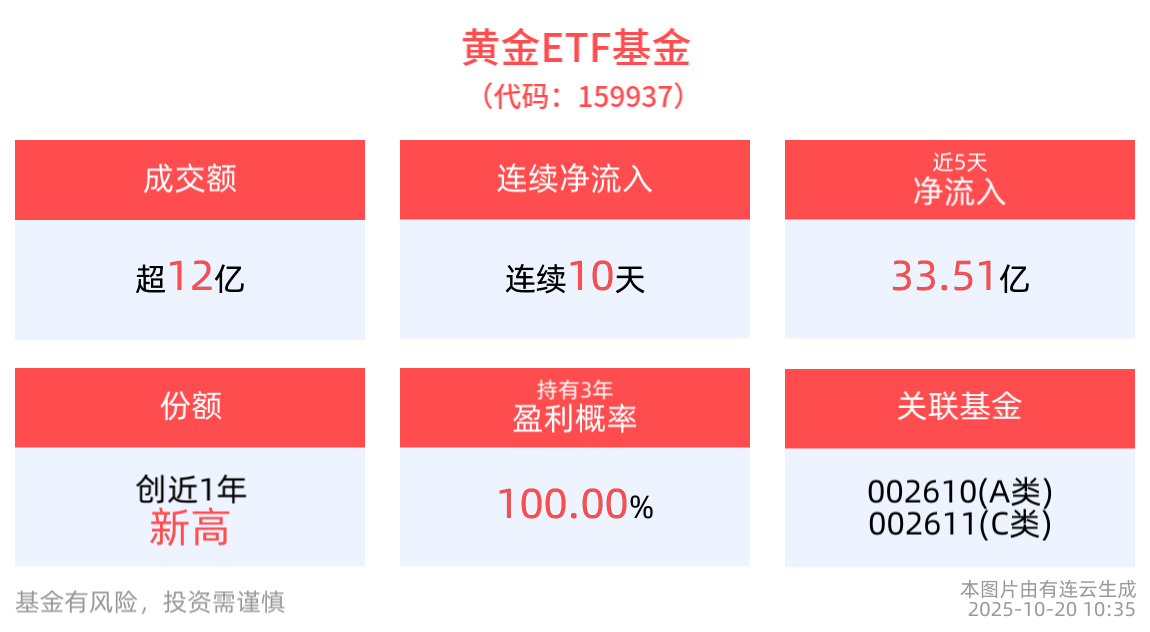
Core Viewpoint - The recent performance of gold ETFs reflects a significant increase in gold prices driven by geopolitical risks and changes in global liquidity expectations, with a notable rise in trading volume and net inflows into gold ETFs [4][5]. Group 1: Gold ETF Performance - As of October 20, 2025, the gold ETF (159937) has decreased by 2.36%, with a latest price of 9.33 yuan, while showing an 11.33% increase over the past week as of October 17 [3]. - The trading volume for the gold ETF reached 12.23 billion yuan, with a turnover rate of 3.14%, and an average daily trading volume of 31.28 billion yuan over the past week, ranking it among the top three comparable funds [4]. Group 2: Market Drivers - The recent surge in international gold prices is attributed to a combination of geopolitical risk, a weakening global credit system, and changing liquidity expectations, with multiple factors contributing to the current market dynamics [4][5]. - Key pressures on the gold market include a high concentration of long positions and the potential for speculative funds to take profits, which could lead to increased volatility and a possible price correction [4]. Group 3: Institutional Trends - There has been a consistent net inflow into the largest gold ETF, SPDR, and the People's Bank of China has increased its gold holdings for 11 consecutive months, although its reserves remain lower than the global average of 15%-20% [5]. - The trend of reducing U.S. Treasury holdings while increasing gold investments is observed across both institutional and individual investors [5]. Group 4: Future Outlook - The long-term outlook for gold remains positive due to factors such as a weakening U.S. dollar and ongoing geopolitical instability, which are expected to support continued central bank purchases of gold [5]. - The latest share count for the gold ETF reached 4.166 billion, marking a one-year high [5].
多因素推动资金持续涌入黄金类ETF“吸金”又“吸睛”
Zheng Quan Shi Bao· 2025-10-19 18:06
Core Viewpoint - The recent surge in international gold prices is driven by geopolitical risks, global credit system instability, and liquidity factors, leading to increased investment in gold-related ETFs [1][4]. Group 1: Gold Price Performance - On October 17, the London spot gold price reached a record high of $4,380.79 per ounce before slightly retreating to $4,251.45 per ounce [2]. - The gold price has shown strong performance, with significant increases in gold-related ETF management scales, indicating heightened investor interest [3]. Group 2: ETF Growth - Several gold ETFs have seen substantial growth in management scale over the past week, including: - Huaan Gold ETF: increased to 85.235 billion yuan, up 14.418 billion yuan - Bosera Gold ETF: expanded to 39.667 billion yuan, up 7.061 billion yuan - E Fund Gold ETF: rose to 33.906 billion yuan, up 6.588 billion yuan - Guotai Gold ETF: increased to 26.849 billion yuan, up 5.723 billion yuan - The performance of gold ETFs has been impressive, with some achieving over 60% year-to-date returns [3]. Group 3: Investment Drivers - The current gold price rally is attributed to multiple factors, including geopolitical risk, a weakening global credit system, and changing liquidity expectations [4]. - Recent global events, such as U.S. government shutdown concerns and European fiscal worries, have further fueled gold price increases [4]. Group 4: Long-term Outlook - Over the past three years, gold has demonstrated strong performance relative to other asset classes, highlighting its increasing allocation value [5]. - Despite potential short-term fluctuations, the long-term investment value of gold remains solid, driven by its safe-haven attributes amid geopolitical tensions [6][7]. Group 5: Gold Stocks - Gold stocks are expected to see significant revenue and profit growth due to high gold prices, although they have not fully reflected the gains seen in gold prices recently [8].
黄金史无前例地上涨,预示着美元霸权走下坡路
Sou Hu Cai Jing· 2025-10-17 10:40
Core Insights - The unprecedented surge in gold's market value, which increased by $10 trillion and rose by 55% over the past 12 months, reflects a profound restructuring of the global monetary order, highlighting the diminishing dominance of the US dollar [2] - The current gold bull market is unique as it defies traditional financial market logic, occurring amidst a stable dollar index and high US stock market levels, driven by a crisis of confidence in the dollar's reliability [2] - Central banks globally are accumulating gold at record speeds, with countries like China, Poland, Turkey, and India increasing their reserves, indicating a strategic shift towards diversifying international reserves away from the dollar [3] Group 1 - The collective action of emerging market countries to increase gold reserves while reducing US Treasury holdings signifies a transition from a unipolar to a multipolar reserve system, marking the end of the dollar's status as the sole core reserve currency [3] - Geopolitical risks, such as the ongoing Russia-Ukraine conflict and instability in the Middle East, are driving nations to seek alternative wealth storage methods beyond sovereign currencies, further supporting gold's price increase [3] - The traditional asset allocation models are failing as government debt in major economies exceeds 300% of GDP, prompting institutional investors to significantly increase their gold allocations as a hedge against extreme risks [4] Group 2 - The current rise in gold prices signifies the most profound transformation of the monetary order since the establishment of the Bretton Woods system, with gold playing a crucial role as a value anchor in the emerging multipolar system [5] - The surge in gold's market value is a correction to the excessive expansion of dollar hegemony and a precursor to the future international monetary system, as central banks adjust their reserve structures and investors rediscover gold's financial attributes [5] - The unprecedented rise in gold is a collective response to the dominance of a single currency, indicating that the hegemony of the dollar is nearing its end, with gold illuminating the new economic landscape in a post-dollar era [5]
黄金价格突破4000美元,未来走势备受关注
Xin Lang Cai Jing· 2025-10-15 09:23
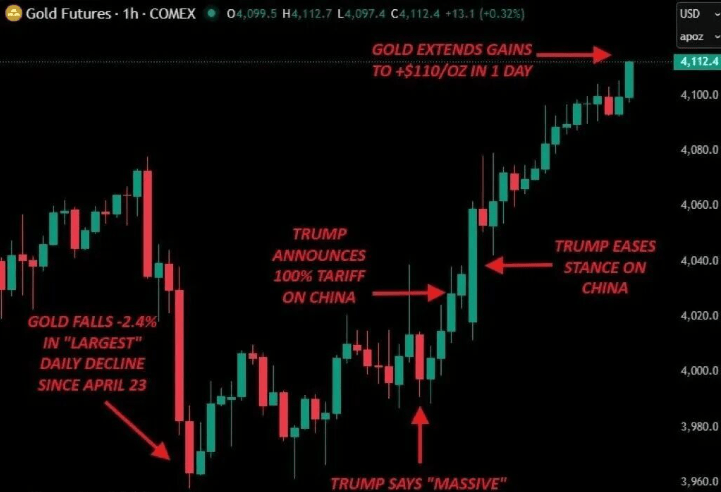
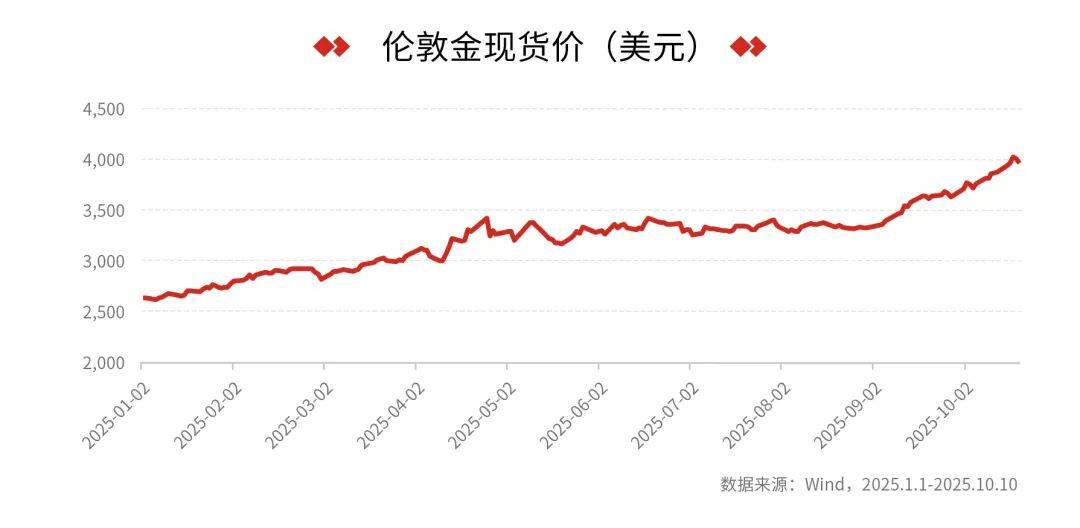
(来源:ETF炼金师) 2025年10月8日,伦敦现货黄金价格攀升至4040.05美元/盎司,创下历史新高。这一突破距离3月首次突 破3000美元关口仅过去7个月,年内涨幅已超过50%,创下自1980年以来最快的年度涨幅。 黄金价格从3000美元飞跃至4000美元的过程展现了多个因素的共同作用。自3月中旬首次突破3000美元 后,黄金在4月份迅速攀升至3500美元,随后在3300-3600美元区间震荡调整。9月美联储宣布降息,开 启宽松政策,成为金价快速上升的重要催化剂。10月国庆假期前,黄金价格在短时间内突破4000美元, 再次引发市场关注。 推动黄金价格上涨的底层逻辑主要包括美元信用危机、美联储的降息政策以及地缘政治冲突的升级。美 国庞大的联邦政府债务已经对其财政可持续性构成压力,债务危机的风险正在加大,市场对美元资产的 信心受到打击,黄金作为避险资产的优势愈发明显。同时,全球范围内去美元化的趋势加速,越来越多 的国家推进储备资产多元化,导致多国央行持续增持黄金。 此外,9月美联储宣布降息25个基点,由于美国劳动力市场表现疲软,市场普遍认为2025年下半年可能 会有更多降息举措,这种宽松的货币政策为金价提 ...
黄金ETF、金ETF、上海金ETF年内涨55%,现货黄金突破4200美元/盎司
Ge Long Hui A P P· 2025-10-15 09:01
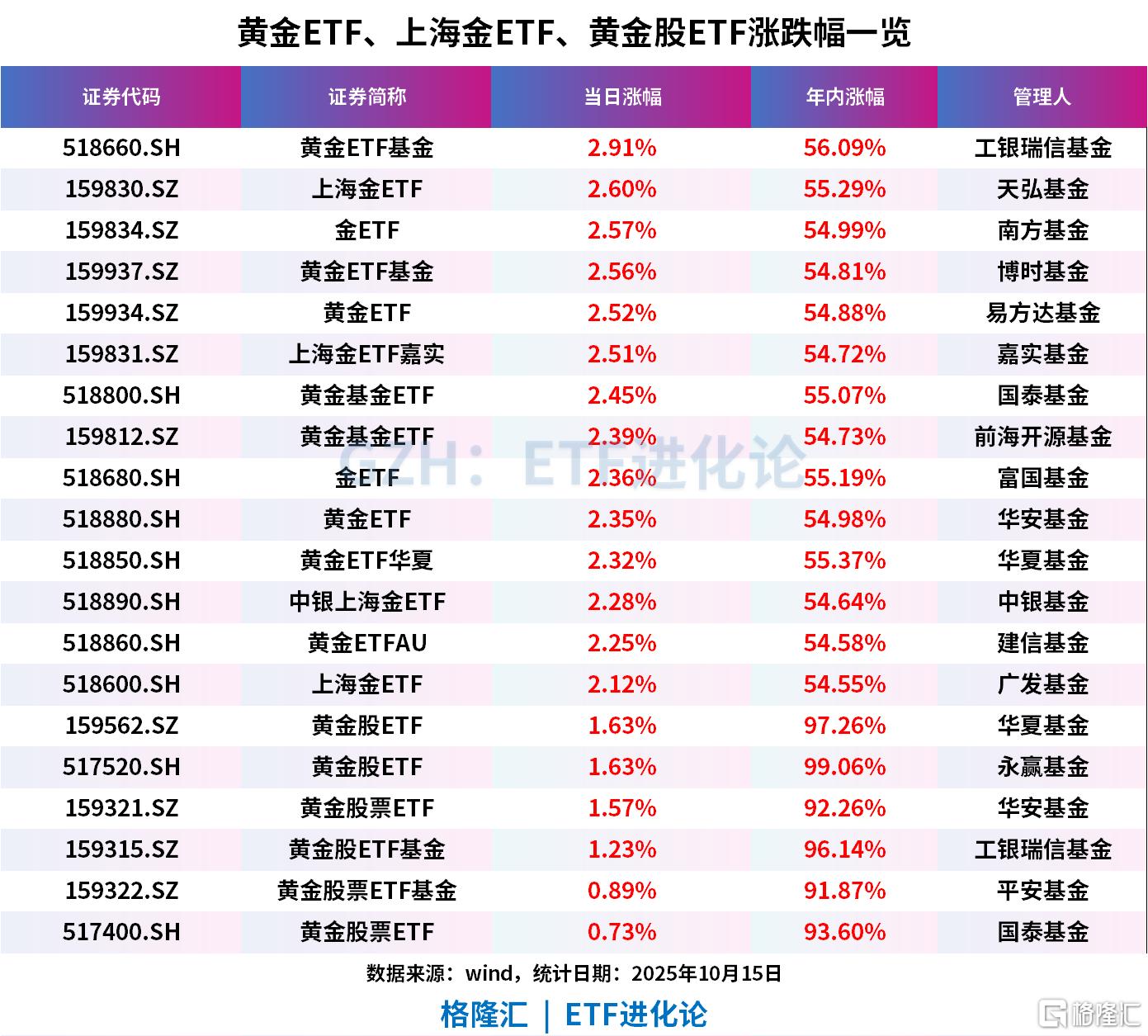
现货黄金突破4200美元/盎司。 黄金ETF基金、上海金ETF、金ETF、黄金ETF基金、黄金ETF、上海金ETF嘉实、黄金基金ETF、黄金基金ETF、金ETF、黄金ETF、黄金ETF华夏、中银上 海金ETF、黄金ETFAU、上海金ETF今日涨超2%,年内涨55%;黄金股ETF、黄金股ETF、黄金股票ETF、黄金股ETF基金今日涨超1%,年内涨超90%。 | 证券代码 | 证券简称 | 当日涨幅 | 年内涨幅 | | --- | --- | --- | --- | | 518660.SH | 黄金ETF基金 | 2.91% | 56.09% | | 159830.SZ | 上海金ETF | 2.60% | 55.29% | | 159834.SZ | #ETF | 2.57% | 54.99% | | 159937.SZ | 黄金ETF基金 | 2.56% | 54.81% | | 159934.SZ | 黄金ETF | 2.52% | 54.88% | | 159831.SZ | 上海金ETF嘉实 | 2.51% | 54.72% | | 518800.SH | 黄金基金ETF | 2.45% | 55.0 ...
黄金一路狂飙至4000?后市如何看?
Sou Hu Cai Jing· 2025-10-15 08:58
Core Viewpoint - The price of gold has surged to a historical peak of $4040.05 per ounce, marking a more than 50% increase in 2025, driven by macroeconomic policies, geopolitical tensions, and increased demand from central banks and ETFs [1][3][4]. Group 1: Price Surge Dynamics - Gold's leap from $3000 to $4000 occurred in just over six months, with key catalysts including the Federal Reserve's interest rate cuts and geopolitical tensions [1][3]. - The Federal Reserve's initiation of a rate-cutting cycle in September has been a significant driver for gold prices, with expectations of further cuts in the future [4][10]. Group 2: Demand Factors - Central banks globally are increasing their gold reserves, with nearly half planning to buy more gold in the next 12 months, which reduces the available supply for trading [3][6]. - Gold ETFs have seen substantial inflows, with total assets under management reaching $472 billion by the end of Q3 2025, a 23% increase [8]. Group 3: Economic and Geopolitical Context - The U.S. government shutdown and rising geopolitical tensions, particularly between the U.S. and China, have heightened the demand for gold as a safe-haven asset [3][4]. - The ongoing debt crisis in the U.S. and the trend towards de-dollarization are contributing to a loss of confidence in dollar assets, further enhancing gold's appeal [4][10]. Group 4: Future Outlook - Analysts are optimistic about gold's future, with expectations of continued central bank purchases and potential price support from ongoing geopolitical tensions [10]. - However, there are concerns about short-term volatility and potential selling pressure if profit-taking occurs after recent price increases [10].
金价这么高 到底谁在买?年内已经涨了50%,中国大妈继续购买吗?还是年轻人在购买?
Sou Hu Cai Jing· 2025-10-15 01:02
Group 1: Market Overview - The gold market in 2025 is experiencing a historic rally, with London spot gold surpassing $4,160 per ounce, marking a 51% increase year-to-date, the best annual performance since 1979 [1] - Domestic gold jewelry prices have also surged, with brands like Chow Tai Fook seeing prices rise to 1,168 RMB per gram, an increase of 45 RMB since the end of September, reflecting a nearly 50% cumulative increase post-National Day holiday [1] Group 2: Consumer Demographics - Young consumers aged 18-24 have become the main drivers of gold consumption, with ownership rates rising from 37% five years ago to 62% today, indicating a significant shift in purchasing behavior [3] - The purchasing logic of this demographic includes lightweight consumption, aesthetic appeal, and a dual mindset of consumption as savings, with young consumers viewing gold as both a personal investment and a gift [4][10] Group 3: Investment Behavior - The behavior of older consumers, often referred to as "Chinese aunties," has shifted from impulsive buying to more rational investment strategies, with a 40% increase in investment gold bar sales while traditional jewelry sales have weakened [6] - The underlying logic for the current gold price increase is attributed to a crisis of trust in the U.S. dollar, with central banks in Asia accelerating gold purchases to reduce reliance on the dollar [6][7] Group 4: Economic Drivers - The expectation of interest rate cuts by the Federal Reserve is a significant catalyst for gold's appeal, as it offers protection against inflation and a weakening dollar, prompting both institutions and individuals to adjust their asset allocations [7] - In the domestic market, gold priced in RMB has seen a 46% increase this year, serving as a hedge against currency fluctuations and an alternative to declining bank investment yields [7] Group 5: Market Dynamics - The current market shows signs of irrational behavior, with institutions adjusting their price targets dramatically, indicating potential misjudgments about the market's direction [11] - The demand shift is driving industry upgrades, with brands like Chow Tai Fook leveraging IP collaborations and advanced technologies to enhance product value, resulting in a 6.3 percentage point increase in gross margins for companies like Luk Fook [12] Group 6: Future Outlook - The gold price surpassing $4,000 reflects a generational and global asset reallocation, with young consumers redefining gold's consumption attributes while older consumers focus on investment gold bars [14] - The market's transition from a safe-haven asset to a speculative target raises concerns about volatility, emphasizing the importance of understanding the motivations behind gold purchases in an era of fluctuating credit systems [14]

黄金突破4000美元后急转直下!三大信号说明危险来了,普通人的黄金该怎么办?
Sou Hu Cai Jing· 2025-10-14 20:17
Core Insights - Gold prices have shown volatility in 2025, initially breaking the $3500 mark before dropping to around $3120, reflecting a decline of over 10% within a week, followed by a rebound to $3365 [1] - Central banks globally have been accumulating gold at an unprecedented rate, with Q1 2025 seeing purchases of 244 tons, marking the 14th consecutive quarter of over 100 tons [3] - The traditional safe-haven status of gold appears to be weakening, as recent U.S. economic data and U.S.-China trade negotiations have not revealed significant risk factors [3] Central Bank Activity - Poland's central bank increased its gold reserves by 29 tons in a single month, while countries like Kazakhstan opted to sell, indicating a divergence in national strategies regarding the dollar credit system [3] - The World Gold Council reported that global investment demand for gold surged by 170% year-on-year in Q1 2025, while gold jewelry consumption fell by 32%, indicating a shift from commodity to financial attributes [7] Market Dynamics - Goldman Sachs noted that approximately 35% of current gold prices reflect non-traditional factors, a 12 percentage point increase from 2024, influenced by macroeconomic variables like dollar credit crises and global debt expansion [5] - The volatility in gold prices is exacerbated by external factors such as trade tensions and geopolitical events, with significant price fluctuations observed in response to U.S. Treasury Secretary's comments on tariff negotiations [5][7] Investment Strategies - Experts recommend that investors consider multiple factors such as changes in safe-haven demand, dollar exchange rates, and global economic data when making investment decisions [7] - Suggested strategies include avoiding herd mentality, diversifying investment channels, and setting clear stop-loss levels to manage risk effectively [7] Future Outlook - The trend of increasing central bank gold purchases is expected to continue, primarily driven by the need to diversify away from dollar-denominated assets amid rising U.S. policy uncertainties and concerns over the sustainability of U.S. debt [9] - As gold becomes more driven by investment demand, its prices are likely to be more sensitive to capital flows, reflecting broader shifts in the global monetary system [11]
