
金三银四

Search documents
聚酯数据日报-20260212
Guo Mao Qi Huo· 2026-02-12 07:01
Group 1: Report Industry Investment Rating - No relevant content Group 2: Core Views of the Report - The crude oil market has a slight increase due to uncertain geopolitical situations, and the PTA market is trading on the strong expectation of "Golden March and Silver April", but the weak reality of PTA inventory accumulation is negative for the spot basis, causing the basis to decline [3]. - The overseas ethylene glycol market has been in a long - term slump, but the reduction of ethylene glycol exports in the Middle East has boosted market confidence. The supply contraction has opened up room for price increases [3]. Group 3: Summary by Related Catalogs Market Quotes - INE crude oil increased from 476.1 yuan/barrel on February 10, 2026, to 476.8 yuan/barrel on February 11, 2026, with a change of 0.70 yuan/barrel [3]. - PTA - SC increased from 1770.1 yuan/ton to 1795.0 yuan/ton, with a change of 24.91 yuan/ton; PTA/SC ratio increased from 1.5116 to 1.5181, with a change of 0.0064 [3]. - CFR China PX increased from 909 to 917, with a change of 8; PX - naphtha spread decreased from 311 to 305, with a change of - 7 [3]. - PTA main contract futures price increased from 5230 yuan/ton to 5260 yuan/ton, with a change of 30.0 yuan/ton; PTA spot price increased from 5140 yuan/ton to 5180 yuan/ton, with a change of 40.0 yuan/ton [3]. - PTA spot processing fee decreased from 403.4 yuan/ton to 392.9 yuan/ton, with a change of - 10.6 yuan/ton; PTA futures processing fee decreased from 463.4 yuan/ton to 452.9 yuan/ton, with a change of - 10.6 yuan/ton [3]. - PTA main contract basis increased from (75) to (73), with a change of 2.0; PTA warehouse receipt quantity increased from 106172 to 107036, with a change of 864 [3]. - MEG main contract futures price increased from 3733 yuan/ton to 3764 yuan/ton, with a change of 31.0 yuan/ton; MEG - naphtha spread increased from (202.03) to (200.03), with a change of 2.0 [3]. - MEG domestic price increased from 3623 yuan/ton to 3652 yuan/ton, with a change of 29.0 yuan/ton; MEG main contract basis decreased from - 102 to - 105, with a change of - 3.0 [3]. Industry Chain Start - up Situation - PX start - up rate remained at 85.92%, with a change of 0.00% [3]. - PTA start - up rate decreased from 76.73% to 74.58%, with a change of - 2.15% [3]. - MEG start - up rate decreased from 62.36% to 59.80%, with a change of - 2.56% [3]. - Polyester load decreased from 77.26% to 76.26%, with a change of - 1.00% [3]. Polyester Product Data - POY150D/48F remained at 6980, with a change of 0.0; POY cash flow decreased from 122 to 78, with a change of - 44.0 [3]. - FDY150D/96F decreased from 7230 to 7225, with a change of - 5.0; FDY cash flow decreased from (128) to (177), with a change of - 49.0 [3]. - DTY150D/48F remained at 8140, with a change of 0.0; DTY cash flow decreased from 82 to 38, with a change of - 44.0 [3]. - Long - filament sales rate increased from 13% to 91%, with a change of 78% [3]. - 1.4D direct - spun polyester staple fiber price was 6590; polyester staple fiber cash flow decreased from 77 to 38, with a change of - 39.0 [3]. - Polyester staple fiber sales rate decreased from 39% to 28%, with a change of - 11% [3]. - Semi - bright chip price increased from 5890 to 5920, with a change of 30.0; chip cash flow decreased from (68) to (82), with a change of - 14.0 [3]. - Chip sales rate decreased from 23% to 14%, with a change of - 9% [3]. Device Maintenance - A 2.5 - million - ton PTA device in East China is expected to stop on February 10, 2026, and the specific restart time is undetermined [3].
1月行业信息思考:春节错期对1月数据及3月开工旺季影响
SINOLINK SECURITIES· 2026-02-10 06:38
Group 1 - The core disturbance in January industry data is attributed to the timing of the Spring Festival, which significantly affects production, consumption, and export data compared to the previous lunar year [1][5][12] - The production sector shows an overall weakness compared to the same lunar period last year, with notable contraction in construction-related segments, while manufacturing exhibits divergence in performance [1][12] - Consumption patterns reveal significant declines in real estate transaction areas, while overall commodity consumption remains relatively stable, with variations in service consumption [1][13] Group 2 - The impact of the Spring Festival timing extends beyond January, potentially suppressing March production and investment data during the peak season [2][20] - The construction sector's new project initiation is expected to continue its downward trend due to ongoing inventory reduction policies, which will affect the overall recovery pace post-holiday [3][20] - Despite a more proactive fiscal policy and faster issuance of special bonds, the recovery in production and investment post-holiday is anticipated to be limited compared to previous years [3][20] Group 3 - In the energy and resources sector, coal supply constraints due to production cuts and holiday shutdowns have led to price fluctuations, while metal demand shows improvement [4][25] - The real estate sector remains under pressure with low transaction volumes and investment levels, impacting demand for construction materials [4][34] - The financial sector shows high activity in the A-share market, with insurance premium income experiencing a year-on-year decline, while new credit issuance exceeds expectations [4][34] Group 4 - The manufacturing sector continues to show strong growth in machinery and heavy truck sales, benefiting from domestic equipment renewal policies and demand from emerging markets [4][34] - Consumer spending remains stable overall, but demand for durable goods is under pressure due to high base effects and policy rollbacks [4][34] - The TMT sector is experiencing multiple catalysts from both industry and policy perspectives, while the new energy sector sees a decline in domestic sales but strong export growth [4][34]
焦煤焦炭周度报告-20260206
Zhong Hang Qi Huo· 2026-02-06 10:04
1. Report Industry Investment Rating - Not provided in the report 2. Core Viewpoints - The double - coking futures market maintained a volatile trend this week. Before the Spring Festival, the coking coal futures market is expected to fluctuate mainly. After the festival, attention should be paid to the "Two Sessions expectations" and the demand strength during the "Golden March and Silver April". The price has support at the bottom, but the upward momentum needs to be accumulated. The coke market is affected by the cost side of coking coal, with stable capacity utilization of independent coking enterprises and slightly higher capacity utilization of steel mills. The iron - water output is stable, supporting the coke consumption. The new round of coke price increase has been postponed and implemented, improving the profit per ton of independent coking enterprises [5][35][38] 3. Summary by Directory 3.1 Report Summary - Most Tangshan steel mills have basically completed winter storage replenishment, with a small increase in winter storage. The average available days of coke in Tangshan steel mills is about 11 days, 2 days more than the average in early December last year [5] - On February 3, it was reported that some mines in Indonesia suspended spot trading, which attracted high attention. On February 5, the director of the Indonesian Mineral and Coal Department stated that the approval document for the 2026 coal mining work plan had not been officially issued, and the rumored reduction information was invalid [5] - The government work reports of 13 provinces in 2026 mentioned infrastructure - related content. Henan will implement more than 1,000 provincial key projects with an annual investment of 1 trillion yuan; Shaanxi will implement 640 provincial key projects with an investment of over 350 billion yuan [5] - As the Spring Festival approaches, the domestic coking coal supply side has a slight contraction. The inventory reduction of coking coal is not smooth. Independent coking enterprises continue to replenish coking coal inventory, and steel mills slightly replenish raw material inventory. The capacity utilization of independent coking enterprises remains stable, and that of steel mills rises slightly. The iron - water output is stable, supporting the coke consumption. The new round of coke price increase has been postponed [5] 3.2 Multi - empty Focus - Bullish factors: The inventory structure of coking coal has improved, domestic macro - policies are positive, and the iron - water output is stable, supporting the demand for furnace materials [9] - Bearish factors: The winter storage expectation of steel is not strong, restricting the raw material replenishment space of steel mills. As the Spring Festival approaches, the downstream replenishment rhythm slows down, and the financial market fluctuates sharply with repeated sentiment [9] 3.3 Data Analysis - **Supply contraction**: As of the week of February 6, the operating rate of 523 sample mines was 86.67%, a week - on - week decrease of 2.46%, and the daily average output decreased by 16,200 tons. The operating rate of 314 sample coal washing plants was 35.54%, a week - on - week decrease of 1.26%, and the daily average output decreased by 4,600 tons. As of January 31, the customs clearance volume of Mongolian coal at the Ganqimaodu Port was 1.07676 million tons, remaining at a high level [11] - **Inventory reduction not smooth**: As of the week of February 6, the clean coal inventory of 523 sample mines was 2.6465 million tons, a decrease of 25,300 tons; the clean coal inventory of 314 sample coal washing plants was 3.3446 million tons, an increase of 228,900 tons. The coking coal inventory at ports was 2.7276 million tons, a decrease of 136,200 tons [17] - **Independent coking enterprises replenish inventory**: As of February 6, the coking coal inventory of all - sample independent coking enterprises was 13.0239 million tons, an increase of 676,000 tons. The available days of inventory were 15.51 days, an increase of 0.74 days. The coke inventory of independent coking enterprises was 827,400 tons, a decrease of 16,500 tons [20] - **Steel mills slightly replenish inventory**: As of February 6, the coking coal inventory of 247 steel enterprises was 8.242 million tons, an increase of 98,400 tons. The available days of inventory were 13.12 days, an increase of 0.09 days. The coke inventory was 6.9238 million tons, an increase of 141,900 tons, and the available days were 12.76 days, an increase of 0.22 days [24] - **Capacity utilization**: As of February 6, the capacity utilization of all - sample independent coking enterprises was 72.2%, a week - on - week increase of 0.34%, and the daily average output of metallurgical coke was 631,400 tons, an increase of 3,000 tons. The capacity utilization of 247 steel enterprises was 86.33%, a week - on - week increase of 0.42%, and the daily average output of coke was 472,400 tons, an increase of 2,300 tons [26] - **Coke consumption**: As of the week of February 6, China's coke consumption was 1.0286 million tons, an increase of 2,700 tons. The daily average iron - water output of 247 steel enterprises was 2.2858 million tons, an increase of 6,000 tons [28] - **Coke price increase**: As of February 6, the average loss per ton of coke for independent coking enterprises was 10 yuan/ton, a decrease of 45 yuan/ton compared with the previous period. The profitability rate of 247 steel enterprises was 39.39%, the same as the previous period. Since mid - January, multiple coking enterprises issued price increase letters, originally planned to be implemented on January 19 and postponed to January 30 [30] - **Double - coking basis structure**: The double - coking futures market fluctuated [32] 3.4后市研判 - **Coking coal**: As the Spring Festival approaches, the domestic coking coal supply side has a slight contraction, the downstream inventory rhythm slows down, and the inventory reduction is not smooth. Independent coking enterprises have been replenishing coking coal inventory for many weeks, but the replenishment intensity weakens as the Spring Festival approaches. The raw material replenishment intensity of steel mills is less than that of independent coking enterprises. Before the festival, the coking coal futures market is expected to fluctuate mainly. After the festival, attention should be paid to the "Two Sessions expectations" and the demand strength during the "Golden March and Silver April". The price has support at the bottom, but the upward momentum needs to be accumulated [35] - **Coke**: Recently, the capacity utilization of independent coking enterprises remains stable, and that of steel mills rises slightly. On the demand side, the iron - water output is stable, supporting the coke consumption. Since mid - January, multiple coking enterprises issued price increase letters, originally planned to be implemented on January 19 and postponed to January 30. After the new round of coke price increase, the profit per ton of independent coking enterprises has improved. The coke inventory pressure of independent coking enterprises is not large, and the futures market fluctuates with the cost side of coking coal [38]
地产专题分析报告:等待“金三银四”的检验
SINOLINK SECURITIES· 2026-02-01 12:17
New Housing Market - New housing transaction volume in 47 cities increased by 16.6% week-on-week from January 24 to January 30, but decreased by 17.1% compared to the same period last year[2] - The decline in new housing transactions has narrowed compared to the previous week, indicating a potential stabilization in market sentiment[4] Second-hand Housing Market - Second-hand housing transaction volume in 22 cities saw a seasonal decline with a week-on-week growth rate of -5.5% during the same period, down 16.2% year-on-year[7] - The second-hand housing market is stabilizing at a low point, influenced by seasonal factors as the Spring Festival approaches[9] Market Outlook - The upcoming "Golden March and Silver April" period will be crucial for assessing whether the real estate market can stabilize and recover[9] - New housing stability depends on the release pace of quality supply, while second-hand housing stability is influenced by price stabilization in core cities[11] Risk Factors - Risks include unexpected declines in housing prices, exceeding expectations in real estate company debt risks, and macroeconomic downturns[3][12]
钢材铁矿月度报告-20260130
Zhong Hang Qi Huo· 2026-01-30 12:04
Report Industry Investment Rating - No relevant information provided Core Viewpoints of the Report - In February, the steel market trading is expected to weaken. The demand for rebar will decline due to the Spring Festival and weather, and the post - holiday resumption expectation is crucial. Hot - rolled coil demand will also weaken, but it has some resilience. The high post - holiday inventory and supply will suppress prices, and the inventory depletion intensity is the focus of market game. The "two new" policies may bring phased opportunities for the manufacturing industry. The short - term steel fundamentals have no prominent contradictions and will mainly fluctuate sideways [5]. - The core contradiction of iron ore in February is the game between short - term restocking demand and long - term supply - demand relaxation. Pre - holiday restocking by steel mills will support prices, but during the Spring Festival, the port inventory may increase passively. After the holiday, high inventory will suppress prices, but the post - holiday "golden March and silver April" expectation and macro - policies may provide some support [8]. Summary by Directory 1.后市预判 (Outlook) - Steel: In February, market trading before the Spring Festival will weaken. Rebar demand will be affected by the holiday and weather, and the post - holiday resumption is key. Hot - rolled coil demand will also decline, but has some resilience. High post - holiday inventory and supply will pressure prices, and inventory depletion is the focus. The "two new" policies may bring opportunities. Short - term steel fundamentals are stable with sideways fluctuations [5]. - Iron ore: The core is the game between short - term restocking and long - term supply - demand. Pre - holiday restocking supports prices, during the holiday port inventory may rise. After the holiday, high inventory suppresses prices, but post - holiday expectations and policies may support [8]. 2.产业动态 (Industry Dynamics) - Steel winter storage expectations are low, and electric arc furnace steel mills will stop production during the Spring Festival. Only 40% of northwest construction steel traders plan to winter - store, with an expected selling price of 3100 - 3200 yuan/ton. Shandong steel traders' winter - storage volume is expected to be 24.35 tons, a 38.35% year - on - year decrease, with a psychological price of 3050 - 3080 yuan/ton. In the northeast, hot - rolled coil forms an independent market due to logistics. Only 10.6% of merchants plan to winter - store, 14.5% are on the sidelines, and 74.9% have no plan. Anhui steel traders' winter - storage enthusiasm has declined significantly, with "passive winter - storage" and "low - volume trial" as the main modes. Four out of ten sample steel mills in Henan will stop production or conduct maintenance during the holiday, and the rest will maintain normal production and have winter - storage plans. About 20% of short - flow steel enterprises in Guangdong will stop production in mid - to late January, and over 60% will stop in early February, with most resuming production in early March. In Guangxi, 1 steel mill plans to stop production at the end of January, and 4 plan to stop in mid - to early February, resuming production after the Lantern Festival [11][12]. 3.数据分析 (Data Analysis) - **Steel Supply**: Since January, rebar production has changed little from last year and remained low, while hot - rolled coil production has declined. As of January 30, the weekly actual rebar production was 199.83 tons, an increase of 22.16 tons from last year, and hot - rolled coil was 309 tons, a decrease of 14.22 tons. In February, production is expected to remain low, especially for independent electric arc furnace steel mills, whose production suspension scope will expand, and blast furnace large - scale resumption is unlikely [14]. - **Inventory**: As of January 30, rebar inventory in steel mills was 149.13 tons, a decrease of 53.72 tons from last year, and social inventory in 35 cities was 326.4 tons, a decrease of 123.88 tons. Hot - rolled coil mill inventory was 77.25 tons, a decrease of 17.55 tons, and social inventory in 33 cities was 278.33 tons, a decrease of 15.49 tons. Hot - rolled coil inventory depletion is better than rebar. Rebar demand is weak due to construction site shutdowns, while hot - rolled coil demand in manufacturing has more resilience [15]. - **Exports**: In 2025, China's steel exports reached a record high, with 119 million tons exported, a 7.5% year - on - year increase, and an average export price of 694 US dollars/ton, an 8.1% decrease. "Steel + billet" equivalent crude steel exports were 138 million tons, a 14.3% increase. Hot - rolled coil exports declined due to overseas anti - dumping duties, while rebar exports increased due to high demand in "Belt and Road" countries. The 2026 steel export license policy may affect short - term exports but optimize the long - term structure [18]. - **Consumption**: Rebar consumption decreased seasonally before the Spring Festival. As of January 30, the apparent consumption was 176.4 tons, a decrease of 24.04 tons from the beginning of the month. Cement weekly shipments also declined. As of January 27, the capital availability rate of sample construction sites was 59.68%, with non - housing projects at 60.64% and housing projects at 54.99%. Hot - rolled coil consumption showed "seasonal pressure but resilience". As of January 30, the weekly consumption was 311.41 tons. In December 2025, the official manufacturing PMI was 50.1%. In January, there was some year - end rush demand in manufacturing, but demand is expected to decline in February, and attention should be paid to post - holiday resumption and "two new" policy funds [20][21]. - **Iron Ore Import**: As of the week of January 23, the global iron ore shipment was 2978.3 tons, and the arrival at 45 Chinese ports was 2530 tons. In January, shipments were significantly higher than last year, and arrivals also increased. In 2025, China's iron ore imports reached a new high, with a cumulative import of 1260.22 million tons, a 1.78% increase. In December, the import was 119.647 million tons, a 6.36% increase [27]. - **Supply Structure**: In January, the shipment of non - mainstream iron ore remained stable. On January 17, 2026, the first shipment of nearly 200,000 tons of Simandou iron ore arrived at Ma'jishan Port in Zhejiang. The second shipment was on the way. The Simandou iron ore project in Guinea can supply 120 million tons of high - quality iron ore annually after reaching full production, which helps diversify import sources [29]. - **Inventory and Shipment**: Recently, the port iron ore shipment has increased, and steel mill inventory has also risen. Due to concentrated arrivals, port inventory increased instead of decreasing. As of January 30, the inventory at 45 ports was 1702.226 million tons, an increase of 10.5137 million tons from the beginning of the month, and the inventory of 247 steel enterprises was 996.8 million tons, an increase of 10.2205 million tons. The daily port shipment was 332.31 tons, an increase of 7.1 tons from the beginning of the month [32]. - **Trading Volume**: As of the week of January 23, the daily average spot trading volume of iron ore at major Chinese ports was 97.5 tons, and the forward spot was 103.3 tons. Spot trading was stable due to sufficient supply and limited demand. Forward trading was relatively active as steel mills aimed to avoid post - holiday risks and take advantage of price differences [33]. - **Iron Ore Consumption**: As of January 30, the daily average pig iron output of 247 steel enterprises was 227.98 tons, and the daily average iron ore consumption was 280.96 tons. Pig iron output has fluctuated around 228 tons for weeks. Due to weak demand and safety inspections, iron ore consumption decreased steadily, and without significant profit improvement and demand recovery, iron ore prices will be suppressed [35]. - **Price Difference**: As of January 29, the price difference between rebar and hot - rolled coil futures contracts was 151 yuan/ton, and it has fluctuated within a range since January. The basis between steel and iron ore futures and spot prices was stable, with similar trends and amplitudes. Weak winter demand in the spot market and lack of significant improvement in market expectations in the futures market make it difficult for the basis to expand [37][40].
国金证券:二手房成交趋于稳定
Mei Ri Jing Ji Xin Wen· 2026-01-27 00:28
Group 1 - The core cities' new and second-hand residential sales area is expected to stabilize by 2025, with the improvement in second-hand transactions primarily driven by the "seesaw" effect with new housing demand [1] - Looking ahead, with the arrival of the "golden three silver four" period, both new and second-hand housing transactions may reverse again, as the entry of quality supply will boost new housing sales volume while second-hand transactions are expected to stabilize [1]

地产专题分析报告:二手房销售延续改善
SINOLINK SECURITIES· 2026-01-25 12:52
Report Summary 1) Report Industry Investment Rating No information provided. 2) Core View of the Report - The real - estate market has shown different trends in new and second - hand housing this week. In the future, with the arrival of the "Golden March and Silver April", the transaction volume of new and second - hand housing may reverse. [2][4][7][11] 3) Summary by Related Content New Housing Market - This week (1.17 - 1.23), the new housing market's downward trend in prosperity slowed down. The transaction volume of new houses in 47 cities decreased by 0.5% week - on - week and 32.0% year - on - year, with the decline slightly widening compared to last week. [2][4] - It is expected that the new housing market will continue the off - season mode in January, with relatively stable transaction volume. Affected by the Spring Festival misalignment effect, the year - on - year growth rate of the new housing transaction area may turn positive in the next two weeks. [2][4] Second - hand Housing Market - This week (1.17 - 1.23), the second - hand housing market bottomed out and stabilized. The transaction volume of second - hand houses in 22 cities continued to rise, with a week - on - week increase of 1.0% and a year - on - year growth rate turning positive at 10.0%. [2][7] - Since the beginning of the year, the supply of high - quality new houses has been relatively limited, and the "seesaw" effect between second - hand and new housing demand has been continuously evident. Meanwhile, the continuous return of housing prices to the valuation bottom has accelerated the release of demand. [7] Future Outlook - With the arrival of the "Golden March and Silver April", the transactions of new and second - hand housing may reverse again. The entry of high - quality supply will drive the increase in new housing transactions, while second - hand housing transactions will tend to be stable. [2][11]
建信期货能源化工周报-20260123
Jian Xin Qi Huo· 2026-01-23 10:59
1. Report Industry Investment Rating No relevant content provided. 2. Core Views of the Report - The crude oil market is in a weak supply - demand situation with continuous inventory accumulation expected in 2026. Attention should be paid to selling points from geopolitical situations [7][8]. - For asphalt, demand lacks highlights, and attention should be paid to the dynamics of Venezuelan raw materials which may be the main support [31]. - PTA is expected to rise first and then fall with a downward - shifted price center, while ethylene glycol is expected to be under pressure for shock consolidation [56]. - The polyolefin market follows the cost - driven logic, but the upside space is limited. Attention should be paid to structural short - selling opportunities [74]. - Pulp maintains a wide - range shock trend with pressure on the upside and support on the downside [110]. - The soda ash market is under pressure from increasing supply and shrinking demand, and is likely to continue a weak operation in the long - term, with short - term shock operation expected [153]. 3. Summary by Directory Crude Oil - **Market Review and Operation Suggestions**: Weather speculation has ended, and the market is in shock. Supply - demand is weak, and attention should be paid to selling points from geopolitical situations [7]. - **Fundamental Changes**: Three major institutions' January reports show a pessimistic outlook for 2026, with continuous inventory accumulation. US refinery data is also bearish [8]. Asphalt - **Market Review and Operation Suggestions**: Crude oil supply - demand is weak, and Venezuelan situation drives the price up. Supply may decline slightly, and demand is weak [30]. - **Fundamental Changes**: Crude oil supply - demand is weak. Spot prices in some areas change slightly, and the average domestic price drops slightly. Supply and profit change, and demand is weak with inventory changes [32][33][34]. Polyester - **Market Review and Operation Suggestions**: PTA first falls and then rises, and is expected to rise first and then fall. Ethylene glycol first suppresses and then rises, and is expected to be under pressure [55][56]. - **Main Driving Forces**: Downstream consumption demand weakens. PTA supply is stable, and the price may rise first and then fall. Ethylene glycol has a trend of inventory accumulation and is expected to be under pressure [57][58][60]. Polyolefins - **Market Review and Operation Suggestions**: Futures prices first fall and then rise. The market follows the cost - driven logic, but the upside is limited. Attention should be paid to short - selling opportunities [73][74]. - **Fundamental Changes**: Polypropylene and polyethylene production increase. Production profits vary. Inventory shows a differentiated structure, and downstream start - up levels have different performances [75][79][84]. Pulp - **Market Review and Outlook**: The pulp contract price rises slightly, and the spot price is weak. It maintains a wide - range shock [109][110]. - **Fundamental Changes**: Pulp shipping volume, import volume, inventory, and downstream market have different changes [111][117][131]. Soda Ash - **Market Review and Operation Suggestions**: The futures price first falls and then rebounds, with a stable price center. Supply pressure is high, demand shrinks, and inventory decreases. It is expected to be in shock in the short - term and weak in the long - term [146][153]. - **Soda Ash Market Situation**: Supply is at a high level, inventory decreases but the core contradiction remains, spot prices are stable, and downstream demand has different impacts [154][164][173].
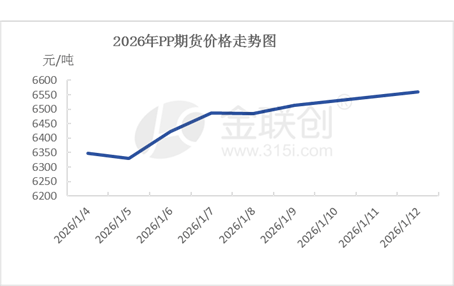
“黄金一月”背后的暗流:解读2026开年PP期货异动密码
Sou Hu Cai Jing· 2026-01-16 04:40
Core Viewpoint - The polypropylene (PP) futures market experienced a strong surge at the beginning of 2026, driven by tightening fundamentals, robust cost support, and improved macro expectations, although the sustainability of this trend is under scrutiny. Group 1: Supply and Demand Dynamics - Supply has contracted due to a peak in domestic PP plant maintenance, with several facilities undergoing planned and unplanned shutdowns, leading to a temporary tightening of supply [3] - Demand remains resilient, particularly in traditional sectors such as home appliances, automotive, and consumer goods, correcting previous overly pessimistic expectations, while social inventory has continued to deplete to low levels [3] Group 2: Cost Factors - Cost support is solid, with international oil prices remaining high due to geopolitical factors, and the cost of naphtha routes being robust. Domestic coal prices are also supported, reducing the cost advantage of coal-based routes, which together elevate the marginal cost of PP production, creating a strong price floor [4] Group 3: Macro Sentiment and Financial Dynamics - Improved macro sentiment and expectations for stable growth policies have enhanced market perceptions of manufacturing and consumption prospects. With low inventory levels and bullish logic, capital has actively entered the market, amplifying and accelerating the upward trend in the spot market due to the financial attributes of futures [5] - Despite the current market exuberance, there are potential risks and long-term challenges, including the unchanged trend of capacity expansion, which may lead to a loosening of the supply-demand balance, and the need for validation of downstream acceptance of high raw material prices and the sustainability of demand recovery [5] - The future direction of the market will depend on key verification points such as the actual progress of new capacity releases, the ability to maintain high cost levels, and the performance of the upcoming traditional peak demand season [5]

基础化工行业专题:涤纶长丝减产推进,“金三银四”值得期待
Guotou Securities· 2026-01-14 03:05
Investment Rating - The industry investment rating is maintained at "Outperform the Market-A" [5] Core Viewpoints - The report highlights that major polyester filament manufacturers have initiated a new round of production cuts since late December, with plans to further expand reductions as the Spring Festival approaches, effectively responding to market changes and improving profitability [1][2] - The report anticipates a favorable "golden March and silver April" period, with a projected industry load of around 71%-72% during the Spring Festival, marking a three-year low, and a significant reduction in inventory levels [2] - The overall fundamentals of the filament industry are improving, with supply growth expected to be moderate and demand gradually recovering due to consumption stimulus policies and external factors [3] Summary by Sections 1. Polyester Filament: A Key Link in the Polyester Industry Chain - Polyester filament is a widely used synthetic fiber with characteristics such as durability, elasticity, and resistance to corrosion, widely applied in textiles and various industrial products [14] 2. Industry Self-Regulation and Supply-Demand Dynamics - The polyester filament industry has established a mature self-regulation mechanism, with two rounds of collaborative pricing strategies implemented to stabilize prices and manage production effectively [20][21] - The supply peak has passed, with future capacity additions concentrated in major companies, and the industry is expected to maintain a balanced supply-demand situation through 2026-2027 [27] 3. Sufficient Profit Elasticity and Expectations for "Golden March and Silver April" - The report indicates that polyester filament has strong profit elasticity, with significant profit increases observed during previous upturns, leading to improved profitability for key companies [30]


