
消费升级

Search documents
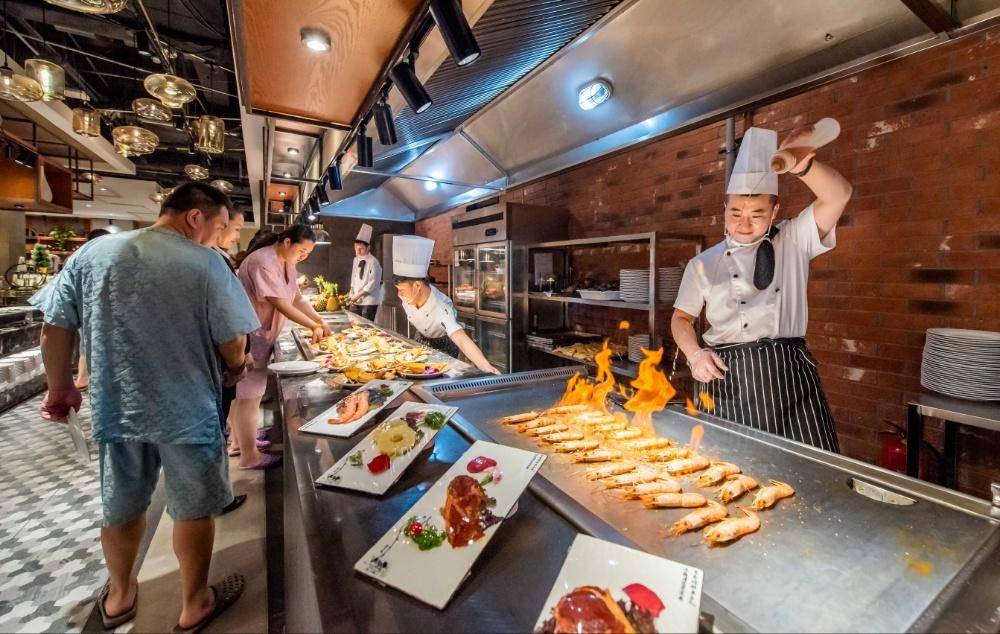
美团平台洗浴中心搜索量同比增长超6倍
Sou Hu Cai Jing· 2025-12-31 12:00
Core Insights - The consumption trend for leisure and entertainment during the New Year period is significantly boosted by the festive atmosphere and winter weather conditions, leading to a notable increase in various service sectors [1][6] Group 1: Beauty and Personal Care - The search volume for beauty services such as haircuts, manicures, and eyelash extensions has doubled in the week leading up to New Year's Day, indicating a strong demand for beauty-related experiences [1] - The discussion volume around beauty services has increased by nearly 40% year-on-year, particularly among the 20-35 age group in major cities like Shanghai, Beijing, and Shenzhen [3] - Nearly 20,000 beauty service professionals on the platform saw their income grow by almost 100% during the weekend before New Year's, reflecting the high demand for beauty services [3] Group 2: KTV and Entertainment - The KTV industry has transformed into a dynamic entertainment space, integrating new technologies like AI for singing and scoring, as well as incorporating food and social activities, making it a popular choice for New Year celebrations [4] - KTV transaction volume has increased by nearly 30% year-on-year in the two weeks leading up to New Year's, with cities like Taiyuan and Changsha showing over 70% growth [6] - The post-00 generation is the fastest-growing demographic in KTV transactions, with a year-on-year increase of over 57%, highlighting a shift in consumer preferences towards entertainment experiences [6] Group 3: Bathing and Wellness - The search volume for keywords related to 24-hour bathing centers has surged by over 600%, indicating a growing trend for wellness and relaxation experiences during the winter season [1] - Over 1,000 quality bathing centers across the country saw a nearly 60% increase in transaction volume on the winter solstice, with cities like Harbin experiencing a staggering growth rate of over 211% [1]


2026年换新指南:补贴加码,这些实惠与你有关
Sou Hu Cai Jing· 2025-12-31 11:03
新年伊始,一项关乎你我钱包和消费升级的重磅政策正式落地。近日,国家多部门密集发布2026年"大规模设备更新和消费品以旧换新"(简 称"两新")政策的实施细则。与往年相比,新一轮政策不仅资金加码、范围拓宽,更在补贴方式上做出了多项精准优化,力求让政策红利更直 接、更公平地惠及广大消费者和企业。无论是打算置换爱车、升级家电,还是关注智能生活,这份"换新指南"都值得你仔细了解。 首先,支持范围优化,新增领域直击民生痛点。除延续对汽车、家电等传统大宗消费的支持外,政策首次将智能手表、智能眼镜、智能家居 (含适老化产品) 纳入"数码和智能产品"补贴范畴,顺应了消费升级趋势。同时,在设备更新端,老旧小区加装电梯、养老机构设备、商业 综合体改造等也被纳入,体现了政策对民生改善与实体商业的扶持。 核心亮点:更精准的补贴,更广泛的受益 2026年"两新"政策的核心变化可概括为"两优化一扩大"。 这些真金白银的补贴,无疑将显著降低消费者的升级成本,加速老旧耐用消费品出清。 深远意义:促消费、稳增长与产业升级的"多赢"之举 此番"两新"政策的加码升级,其意义远不止于短期刺激消费。从宏观层面看,它通过中央财政(超长期特别国债)与地方 ...
消费板块2026年展望:政策密集出台推动行业高质量发展 消费板块有望接力科技轮动
Zhong Guo Jin Rong Xin Xi Wang· 2025-12-31 10:49
Core Insights - In 2025, the A-share consumer sector is undergoing unprecedented changes, shifting from "scale expansion" to "quality improvement and efficiency enhancement" amid external uncertainties like global economic fluctuations and geopolitical tensions [1][2] - The focus of competition is moving from price wars to service quality and operational efficiency, prompting companies to adopt refined operational strategies [2][4] Policy Initiatives - Multiple policies have been introduced to regulate market order, boost consumer confidence, and promote high-quality development in the consumer sector [2][3] - The National Development and Reform Commission and the Ministry of Finance announced a plan for a large-scale equipment update and a consumption upgrade policy for 2026, with an initial allocation of 62.5 billion yuan for consumer goods [2][3] - A joint notification from the Ministry of Commerce, the People's Bank of China, and financial regulators aims to enhance collaboration between commerce and finance to stimulate consumption [2][3] Industry Challenges - Many companies are facing the challenge of "increasing revenue without increasing profit," as consumer demands for product quality, service experience, and transparency rise [2][3] - The government is addressing industry pain points through regulatory measures and encouraging innovation to ensure food safety, fair pricing, and consumer rights protection [3] Future Outlook - Analysts from various brokerages express optimism about investment opportunities in the consumer sector for 2026, with a focus on different sub-sectors [5][6] - The domestic demand policy is expected to strengthen, making the consumer sector a key area for investment alongside technology themes [6][7] - Specific recommendations include focusing on high-dividend companies and sectors benefiting from wealth effects and supply-side optimization [8][9]
科技焕新,超越增长丨21世纪经济报道2025年终特刊
21世纪经济报道· 2025-12-31 10:32
Core Viewpoint - The article emphasizes the structural transformation of the Chinese economy, focusing on the transition from production-oriented to wealth-oriented growth, and the importance of leveraging technological innovation to drive future growth opportunities leading up to 2026 [1][4]. Group 1: Economic Transformation and Opportunities - The year 2025 is identified as a pivotal point for global restructuring, where China's strength will be reassessed across multiple dimensions including technology, trade, governance, and security [4]. - China has three major advantages for economic growth: the potential for GDP per capita to reach levels of developed countries, the new technology revolution focusing on digital and green technologies, and the benefits of a super-large market economy [6]. - The focus for 2026 will be on short-term demand expansion and risk control, while also promoting an innovation-driven growth model that emphasizes modern industrial systems and technological self-reliance [7]. Group 2: Industry Insights and Innovations - The automotive industry is at a crossroads, with a shift from a "favorable wind" era to a new phase characterized by technological competition and globalization [19]. - The Chinese manufacturing sector is expanding globally, with companies adapting to new trade rules and focusing on localizing supply chains [10]. - The rise of new industries such as robotics, artificial intelligence, and innovative pharmaceuticals is seen as a foundation for future economic growth, reflecting a systematic reassessment of growth paradigms [13]. Group 3: Financial and Market Dynamics - The capital market in China requires a significant ideological shift to better support long-term technological innovations and address mismatches in investment strategies [13]. - The banking sector is diversifying its global presence, moving from traditional markets to emerging markets along the Belt and Road Initiative, focusing on infrastructure and resource development [11]. - The trend of "investing in people" is highlighted as essential for stimulating consumer markets, moving away from a focus solely on physical investments [7].

帮主郑重:告别2025,中长线投资者的3个实在启示
Sou Hu Cai Jing· 2025-12-31 09:53
Group 1 - The core message emphasizes that the investment landscape in 2025 was volatile, with many investors losing money by chasing trends rather than holding onto solid investments [1][3] - A specific example illustrates that an investor who sold consumer stocks to invest in AI concepts ended up losing money, while the consumer stocks doubled in value by year-end [3][4] - The article outlines three key lessons from the 2025 market: the importance of long-term investment strategies, focusing on company growth rather than market speculation, and maintaining emotional resilience to avoid being swayed by short-term market fluctuations [4] Group 2 - Looking ahead to 2026, the recommended investment strategy includes focusing on high-dividend blue-chip stocks, leading companies with core technologies, and high-quality firms that align with consumer upgrades [4] - The approach suggests a buy-and-hold strategy, avoiding frequent trading and short-term market concerns, with the belief that time will reward long-term investors [4]
2026年汽车“两新”政策落地:按车价比例补贴,新能源车最高补2万元
Hua Xia Shi Bao· 2025-12-31 09:40
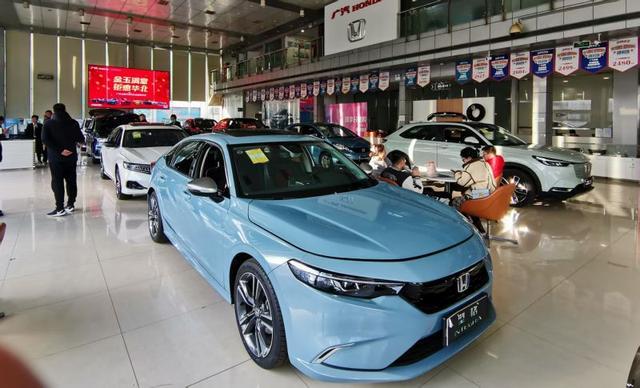
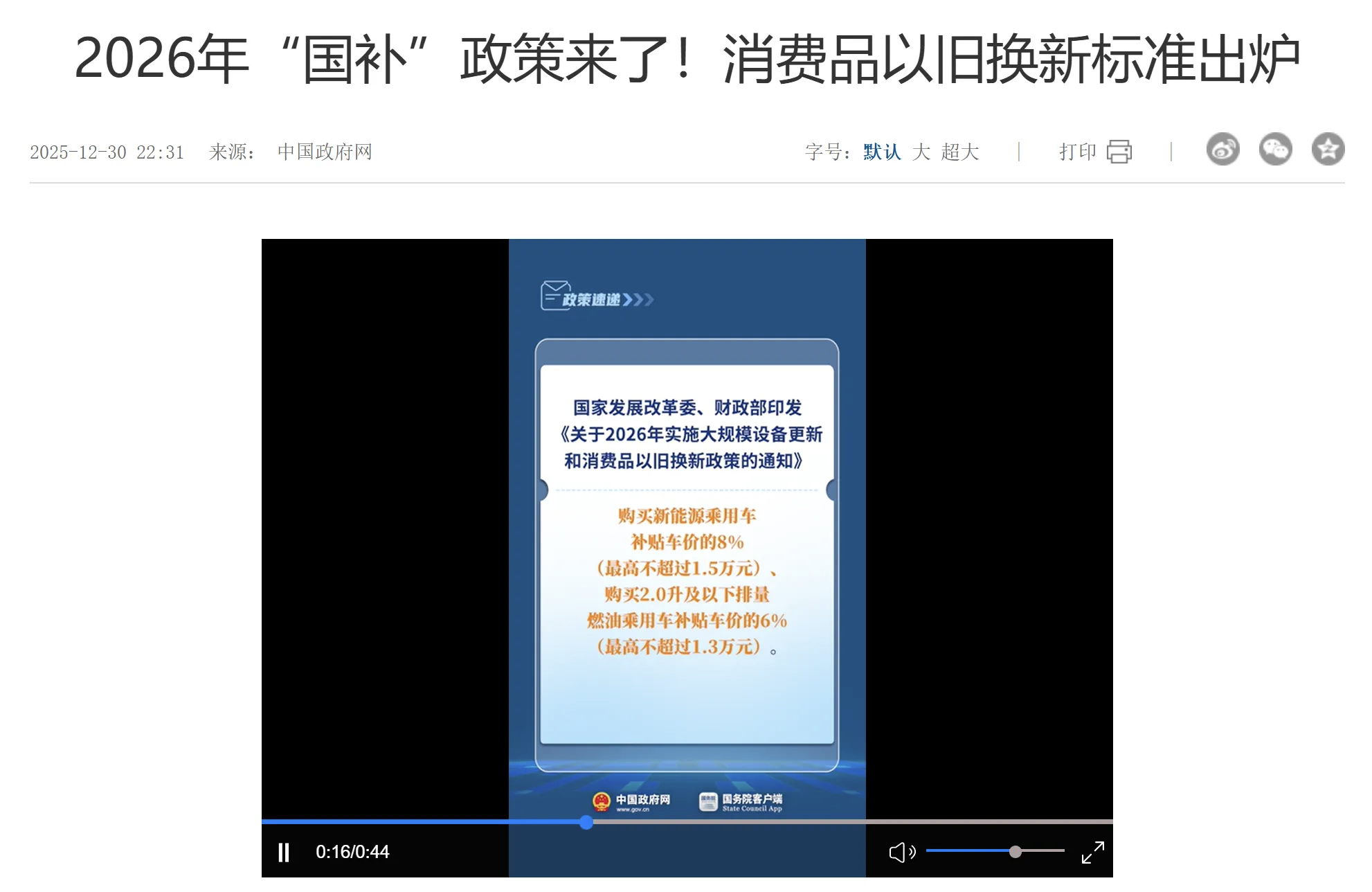
Core Viewpoint - The announcement of the 2026 "Two New" policy for automobiles is expected to significantly boost the automotive consumption market in China, providing a strong stimulus for consumer spending during the upcoming holiday season [2][8]. Group 1: Policy Changes - The 2026 policy introduces a major adjustment in the old-for-new vehicle subsidy standard, shifting from a fixed subsidy to a percentage-based calculation based on the price of the new vehicle [2][3]. - The government has allocated 62.5 billion yuan in special long-term bonds to ensure the timely implementation of the policy during peak consumption periods [2][8]. Group 2: Subsidy Details - The new subsidy structure encourages higher-end consumption, with personal consumers receiving a 12% subsidy (capped at 20,000 yuan) for purchasing new energy vehicles after scrapping their old cars, and a 10% subsidy (capped at 15,000 yuan) for fuel vehicles [3][4]. - In the vehicle replacement scenario, the subsidy for new energy vehicles is set at 8% (capped at 15,000 yuan), while for fuel vehicles, it is 6% (capped at 13,000 yuan) [3][4]. Group 3: Market Impact - The policy aims to address structural issues in the automotive market, promoting a shift from volume expansion to quality improvement, particularly benefiting brands with high-value, technology-rich models [5][6]. - The 2025 old-for-new policy had already shown significant results in boosting automotive consumption and facilitating the upgrade of the automotive industry, with over 60% of the market now driven by replacement demand [7][8]. Group 4: Implementation and Monitoring - The new policy emphasizes optimizing fund allocation and implementing strict measures against illegal practices, such as price gouging and fraudulent claims for subsidies [5][6]. - A pre-allocation system for subsidy funds has been established to alleviate financial pressure on enterprises, ensuring smooth policy execution [7].
2026年汽车“国补”哪些车能申请?补贴金额是多少?一文说清楚
Jin Rong Jie· 2025-12-31 08:59
Core Viewpoint - The 2026 automobile trade-in policy has been clarified by the National Development and Reform Commission and the Ministry of Finance, with changes in the form and method of subsidies compared to 2025, while the maximum amount of "national subsidies" remains unchanged [1] Subsidy Amounts - A one-time subsidy is available for those who scrap their old vehicles and purchase eligible new energy passenger cars or fuel passenger cars with an engine displacement of 2.0 liters or less. The subsidy for new energy vehicles is 12% of the vehicle price, capped at 20,000 yuan, while for fuel vehicles, it is 10% of the vehicle price, capped at 15,000 yuan [3] - If the old vehicle is sold instead of scrapped, the subsidy for new energy vehicles is 8% of the vehicle price, capped at 15,000 yuan, and for fuel vehicles, it is 6% of the vehicle price, capped at 13,000 yuan [3] Subsidy Conditions - For scrapping, the gasoline passenger vehicle must be registered before June 30, 2013, while diesel and other fuel vehicles must be registered before June 30, 2015. New energy vehicles must be registered before December 31, 2019. For vehicle transfer, there are no specific registration date requirements, but the old vehicle must be registered in the applicant's name before January 8, 2025 [4] Overall Impact - The 2026 trade-in policy is more detailed, and the subsidy method based on vehicle price is expected to promote the sales of higher-end models. It is estimated that over 12 million passenger vehicles will benefit from the subsidies in 2026, driving new car consumption by nearly 1.5 million units [6] - The new subsidy policy is seen as a way to utilize the same amount of funding to support more vehicles, facilitating a smooth transition of policies and promoting consumption upgrades. The market is expected to show a "low first, high later" trend in 2026, with a strong start in January [6]
世界并非注定如此|我们的四分之一世纪
经济观察报· 2025-12-31 08:27
Core Viewpoint - The article reflects on significant events and transformations over the past 25 years, emphasizing that the world is shaped by unique actions taken by individuals and society, rather than being predetermined [5][13]. Group 1: Historical Context - The turn of the millennium in 1999 was marked by global optimism, with people celebrating the arrival of the new century amidst rapid economic growth and technological advancements [11]. - In 2001, significant figures like Xu Zhiyuan joined the newly founded Economic Observer, reflecting a period of change and the willingness of society to engage with challenging issues [12]. - The early 2000s saw a shift in the perception of migrant workers, with the "Sun Zhigang incident" in 2003 marking a turning point in the acceptance of urban labor [12]. Group 2: Economic Developments - The 2008 financial crisis, triggered by the U.S. subprime mortgage crisis, had profound effects on China, leading to a massive stimulus policy and rapid urbanization that transformed the real estate market [16]. - The Beijing Olympics in 2008 symbolized national pride, while the subsequent rise in housing prices led to government interventions, including purchase restrictions in 2016 [16]. Group 3: Social Changes - The year 2016 was pivotal, with a notable shift towards "consumption downgrade" among households, indicating changing consumer behaviors and market dynamics [20]. - The emergence of new internet giants like Pinduoduo and Kuaishou highlighted the potential of the underserved lower-tier markets [20]. - The COVID-19 pandemic brought about a collective reflection on life and societal pressures, particularly affecting young people's views on family and career [22]. Group 4: Cultural Reflections - A nostalgic trend emerged in 2020, with younger generations romanticizing the early 2000s, despite the ongoing technological revolutions that posed new challenges [23]. - The article concludes with a dialogue between a young journalist and a seasoned observer, emphasizing the role of the younger generation in shaping the future [24].

博时市场点评12月31日:2025交易收官,沪指收涨0.09%
Xin Lang Cai Jing· 2025-12-31 08:01
Economic Indicators - The official manufacturing PMI for December is reported at 50.1, an increase of 0.9 percentage points from the previous month, indicating a return to the expansion zone [2][8] - The non-manufacturing business activity index stands at 50.2%, up 0.7 percentage points from last month, also returning to the expansion zone [2][8] - The comprehensive PMI output index is at 50.7%, reflecting a 1.0 percentage point increase from the previous month, signaling overall economic recovery [2][8] Policy Developments - The National Development and Reform Commission and the Ministry of Finance announced a large-scale equipment update and consumption upgrade policy for 2026, with an initial funding of 62.5 billion yuan to support the replacement of old consumer goods [2][3] - The subsidy for purchasing new cars is set at 12% or 10% of the car price, with a maximum subsidy of 20,000 yuan or 15,000 yuan, maintaining the 2025 standards [2][3] - The scope of household appliance subsidies has been narrowed to six categories, with the subsidy rate for first-level energy-efficient appliances reduced from 20% to 15%, and the maximum subsidy per appliance decreased from 2,000 yuan to 1,500 yuan [2][3] Market Performance - On the last trading day of 2025, the Shanghai Composite Index rose by 0.09% to 3,968.84 points, while the Shenzhen Component Index fell by 0.58% to 13,525.02 points, and the ChiNext Index decreased by 1.23% to 3,203.17 points [5][11] - The market turnover was reported at 20,659.23 billion yuan, a decrease from the previous trading day [6][12] - The two-margin balance was recorded at 25,552.84 billion yuan, showing an increase from the previous day [6][12] Sector Analysis - The defense, media, and real estate sectors showed strong performance, with increases of 2.13%, 1.54%, and 1.13% respectively [5][11] - Conversely, the telecommunications, agriculture, forestry, animal husbandry, and electronics sectors experienced declines of 1.35%, 1.10%, and 1.02% respectively [5][11]
2026年两新政策总量微调,结构聚焦
China Post Securities· 2025-12-31 06:54
Policy Overview - The 2026 policy aims to promote high-quality economic development and consumption upgrades through systematic adjustments in funding, support scope, and subsidy models, characterized by "total adjustment, structural focus, and efficiency improvement" compared to 2025[2][9]. Support Scope - The support scope for equipment updates has expanded to include new projects such as installing elevators in old residential areas and upgrading facilities in elderly care institutions[3][10]. - The scope for consumer goods replacement has contracted from 12 categories to 6 for home appliances, while the number of digital smart products has increased from 3 to 4, adding smart glasses[3][11]. Funding Scale - The first batch of funding for the 2026 replacement policy is set at 625 billion yuan, with an expected total funding of 2,500 billion yuan for the year, a 16.7% decrease from 3,000 billion yuan in 2025[3][13]. - If the funding follows a high-low distribution pattern, the total for 2026 could be around 2,000 billion yuan, reflecting a 33.33% year-on-year decline[3][13]. Subsidy Standards - The subsidy standards have been adjusted to focus on high-efficiency products, with a reduction in support for lower-efficiency appliances and a shift in automotive subsidies towards new energy vehicles[3][14]. - Specific adjustments include a decrease in the subsidy for high-efficiency appliances from 20% to 15% and a tightening of purchase limits to one unit per category[3][14]. Execution Efficiency - The policy will start on January 1, 2026, immediately following the notification on December 30, 2025, improving execution efficiency by eliminating the previous staggered rollout[3][15]. - Emphasis is placed on creating a fair business environment and preventing fraudulent claims, thereby enhancing the effective use of funds[3][16]. Risk Factors - Potential risks include escalating geopolitical tensions, adjustments to the replacement policy rules, and the possibility that the policy effects may fall short of expectations[3][4][17].