贸易战

Search documents
拉斯维加斯外国游客锐减
Xin Lang Cai Jing· 2025-09-24 14:02
拉斯维加斯被称为美国的"娱乐之都",但数据显示,当地接待的游客数量已连续7个月同比下跌,旅游 业面临不景气的局面。外国游客人数也明显减少。拉斯维加斯会议与游客管理局表示,受关税等政策影 响,来自加拿大的游客数8月份同比减少了20%。美国媒体指出,除了拉斯维加斯,美国其他一些旅游 热点地区也面临类似困境。这背后涉及多重原因,当地旅游业界对美国政府发动贸易战、收紧移民政策 影响国际游客赴美的担忧日益加剧。美国政府征收更高的签证费、更严格的入境规定叠加地缘政治因 素,正吓退"数以百万计"的国际游客。与此同时,物价飙升也在改变美国民众的消费方式。(央视财 经) ...
中国订单至今为零,巴西收获240万吨订单,美国豆农痛苦喊话特朗普
Sou Hu Cai Jing· 2025-09-24 09:10
Core Insights - The article highlights the significant shift in China's soybean procurement strategy, moving from the U.S. to Brazil due to trade tensions and tariffs imposed by the U.S. government [5][21]. Group 1: Current Market Dynamics - U.S. soybean farmers are facing challenges as China, the largest buyer, has not purchased any soybeans from the U.S. this year, instead placing a large order of 2.4 million tons with Brazil [1][5]. - The U.S. soybean industry is experiencing urgent warnings from farmers about the severe consequences of not being able to export their crops [5][21]. Group 2: Historical Context - The article recounts a historical incident from 2003 when China was manipulated into signing high-priced soybean contracts with U.S. suppliers, only to face a price collapse shortly after due to a sudden change in U.S. agricultural forecasts [9][11]. - This incident led to significant financial losses for Chinese companies, prompting a long-term strategy for improving domestic soybean production and reducing reliance on foreign imports [13][25]. Group 3: Strategic Shifts - China has implemented a three-step strategy to revitalize its domestic soybean industry, which includes preserving soybean farmland, enhancing storage, and promoting domestic soybean production [16][25]. - The country has increasingly turned to South America, particularly Brazil and Argentina, for soybean imports, with Brazil becoming the primary source, accounting for over 70% of imports by 2024 [19][21]. - Additionally, China is developing soybean farms in Russia's Far East to further secure its supply chain and reduce dependency on maritime transport [22][25].


【环球财经】旅游业持续下滑 美国“娱乐之都”乐不起来了
Xin Hua She· 2025-09-24 08:46
Core Insights - Las Vegas is experiencing a significant decline in tourism, with visitor numbers dropping for seven consecutive months, indicating a broader economic downturn [1][3][4] - The decrease in international tourists, particularly from Canada and Mexico, is attributed to various factors including trade policies and rising costs [3][4] Visitor Trends - Visitor numbers in Las Vegas fell by 11.3% in June and 12% in July compared to the previous year, with hotel occupancy rates declining by 6.5% and 7.6% respectively [1] - International tourist numbers decreased by 13% in June, with shorter stays reported by visitors [2] Economic Impact - Local businesses reliant on tourism are facing severe challenges, with one transportation service reporting a 60% drop in business [2] - The Las Vegas tourism downturn is seen as a signal of potential national economic trends, reflecting broader issues affecting the U.S. economy [3] Government and Policy Factors - Concerns are rising regarding the impact of U.S. government policies, including trade wars and immigration restrictions, on international tourism [3] - Increased visa fees and stricter entry regulations are contributing to the decline in international visitors [3] Local Responses - In response to the decline in visitors, hotels are offering promotions such as free parking and room upgrades to attract guests [2] - The mayor of Las Vegas has publicly called for the return of Canadian tourists, acknowledging the economic pressure from the drop in international visitors [4]
彻底丢掉最大出口市场,美国豆农被关税推向绝境
Sou Hu Cai Jing· 2025-09-24 08:41
Core Insights - The U.S. soybean industry is facing severe challenges due to the Trump administration's tariff policies, which have resulted in the loss of the Chinese market, a critical buyer for U.S. soybeans [2] - The American Soybean Association has reported that since the fall harvest began, China, the largest buyer, has not placed any orders, highlighting the urgency of the situation for U.S. farmers [2] - The agricultural sector is experiencing financial strain due to rising production costs and declining soybean prices, which have dropped approximately 40% from the historical highs of 2022 [3] Group 1: Market Dynamics - The U.S. Department of Agriculture forecasts a record soybean production of 4.3 billion bushels this year, but prices are significantly lower compared to previous years [3] - The soybean supply chain, which includes fertilizers, machinery, storage, transportation, finance, and ports, is at risk, threatening related employment [3] - Agricultural loan rates in the U.S. are at a ten-year high, with agricultural debt expected to rise to nearly $562 billion by 2025, increasing the risk of defaults in the Midwest [3] Group 2: Trade Relations - China accounts for approximately 60% of global soybean imports, and prior to 2018, the U.S. exported an average of 28% of its soybeans to China [4] - In the 2023-2024 fiscal year, U.S. soybean exports to China are projected to be nearly 25 million tons, significantly higher than the 4.9 million tons exported to the European Union [4] - Brazil has overtaken the U.S. as China's largest soybean supplier, with Brazilian exports to China increasing by over 280% since 2010 [4] Group 3: Political Implications - Farmers in agricultural states that previously supported Trump are now expressing dissatisfaction due to the financial impact of tariffs, which could influence the upcoming 2026 midterm elections [3] - The American Soybean Association has consistently urged the government to prioritize soybean issues in trade negotiations with China to prevent further market share loss to countries like Brazil [2]

中美经贸关系的“温度计”
Sou Hu Cai Jing· 2025-09-24 04:15
Core Viewpoint - TikTok is emerging as a "thermometer" for Sino-U.S. economic relations, highlighting the need for an open, fair, and non-discriminatory business environment to stabilize relations between the two countries [2] Group 1: Trade Relations - Over the past 40 years, Sino-U.S. trade has surged by more than 270 times, with projections for 2024 nearing $688.3 billion [2] - U.S. exports to China support millions of jobs, indicating the vitality of the Chinese market [2] Group 2: Political Challenges - The U.S. has increasingly politicized trade, using "security" as a justification for restrictions on various sectors, including semiconductors and social media platforms [2] - Actions taken by the U.S. not only hinder Chinese companies but also adversely affect American firms, disrupting global supply chains [2] Group 3: Future Cooperation - China maintains a clear stance that differences can be resolved through dialogue and expresses a reluctance to engage in trade wars, while firmly upholding its bottom line [2] - Historical evidence suggests that Sino-U.S. cooperation is mutually beneficial, presenting opportunities rather than burdens [2]

商品期货早班车-20250924
Zhao Shang Qi Huo· 2025-09-24 01:18
1. Report Industry Investment Ratings No industry investment ratings are provided in the report. 2. Core Views - The precious metals market continues to rise, but there is a risk of a peak in the short - term. Basic metals are expected to be volatile, and different metals have different trends and trading strategies. In the black industry, steel and iron ore markets have certain supply - demand characteristics, and it is recommended to take a wait - and - see approach. The agricultural products market shows different supply - demand situations for each variety, with corresponding trading strategies. The energy and chemical market has complex supply - demand relationships, and most products are recommended to be short - term cautious or long - term bearish [1][2][6][7][10]. 3. Summary by Category 3.1 Precious Metals - **Market Performance**: Precious metal prices continue to rise, with New York gold breaking through $3,800 per ounce, and market funds continue to go long [1]. - **Fundamentals**: The Fed's stance on interest rate cuts is divided, and economic data in the US and the eurozone shows mixed trends. Domestic gold ETF funds continue to flow in, and inventories of gold and silver in different regions have changed [1]. - **Trading Strategy**: Due to the unchanged de - dollarization logic, but with contradictory outlooks and high prices, it is recommended to partially close long positions or buy out - of - the - money put options before the holiday for gold, and also partially take profits for silver [1]. 3.2 Basic Metals Copper - **Market Performance**: Copper prices oscillated weakly yesterday [2]. - **Fundamentals**: The path of the US dollar interest rate cut is clear, but there are uncertainties. Domestic policy expectations have fallen short in the short - term, and Powell's speech has affected risk preferences [2]. - **Trading Strategy**: Adopt an oscillatory thinking in the short - term and wait for good buying points [2]. Aluminum - **Market Performance**: The closing price of the electrolytic aluminum main contract decreased by 0.29% compared with the previous trading day, closing at 20,685 yuan per ton [2]. - **Fundamentals**: Aluminum smelters maintain high - load production, and downstream consumption continues to pick up [2][4]. - **Trading Strategy**: The inventory accumulation of aluminum ingots slows down, and it is recommended to go long on dips due to the expected post - holiday destocking [4]. Alumina - **Market Performance**: The closing price of the alumina main contract decreased by 1.94% compared with the previous trading day, closing at 2,877 yuan per ton [4]. - **Fundamentals**: The operating capacity of alumina plants continues to increase, and electrolytic aluminum plants maintain high - load production [4]. - **Trading Strategy**: The supply - demand surplus pattern of alumina remains unchanged, and it is expected that the price will oscillate weakly. It is recommended to wait and see [4]. Industrial Silicon - **Market Performance**: The main contract opened low and oscillated narrowly on Tuesday [4]. - **Fundamentals**: The supply side has new furnaces opened, and social inventory slightly accumulates. The demand side has high polysilicon operating rates, but the "anti - involution" policy has a multi - empty game [4]. - **Trading Strategy**: The disk is expected to oscillate between 8,700 - 9,800 yuan, and it is recommended to wait and see [4]. Lithium Carbonate - **Market Performance**: The main contract closed at 73,660 yuan per ton, up 0.3% [4]. - **Fundamentals**: Supply is increasing, with lithium ore imports and production changing. Demand is strong due to the peak season of energy storage and new energy vehicles. It is expected to continue destocking in September [4]. - **Trading Strategy**: The price is expected to oscillate between 68,000 - 75,000 yuan, and the core driver lies in supply - side changes. It is recommended to wait and see [4]. Polysilicon - **Market Performance**: The main contract opened low and oscillated narrowly on Tuesday, with a decrease of 1.43% [4]. - **Fundamentals**: The supply - demand pattern is supply - strong and demand - weak. Supply is stable with high operating rates, and demand has limited price fluctuations in downstream products. The photovoltaic installation demand in the third quarter is pessimistic [4]. - **Trading Strategy**: The disk is expected to oscillate downward. Pay attention to the support level at 48,000 yuan and the 11 - 12 reverse spread opportunity [4]. 3.3 Black Industry Steel - **Market Performance**: The main contract of rebar closed at 3,145 yuan per ton, down 25 yuan from the previous night's closing price [6]. - **Fundamentals**: The demand for building materials is in the peak season, but the previous high supply has led to slow destocking. The demand for plates is stable, and the inventory accumulation margin slows down. The overall supply - demand contradiction of steel is limited, but the structural differentiation is obvious [6]. - **Trading Strategy**: Mainly adopt a wait - and - see approach for single - side trading. Try the 10/5 reverse spread for rebar. The reference range for RB01 is 3,100 - 3,170 yuan [6]. Iron Ore - **Market Performance**: The main contract of iron ore closed at 803 yuan per ton, down 4.5 yuan from the previous night's closing price [6]. - **Fundamentals**: The shipments from Australia and Brazil decreased, and the inventory increased. The second round of coke price cuts has been implemented, and the steel mill's profit margin has slightly recovered. The supply - demand of iron ore is marginally neutral to strong, and the inventory accumulation may be slower than the seasonal pattern [6]. - **Trading Strategy**: Adopt a wait - and - see approach. The reference range for I01 is 790 - 810 yuan [6]. Coking Coal - **Market Performance**: The main contract of coking coal closed at 1,224 yuan per ton, up 13 yuan from the previous night's closing price [6]. - **Fundamentals**: The second round of coke price cuts has been implemented, but some non - mainstream coking plants have proposed price increases. The inventory at each link of the supply side is differentiated, and the futures valuation is high [6]. - **Trading Strategy**: Adopt a wait - and - see approach. The reference range for JM01 is 1,180 - 1,250 yuan [6]. 3.4 Agricultural Products Soybean Meal - **Market Performance**: Overnight, CBOT soybeans rose slightly [7]. - **Fundamentals**: The US soybeans have a slight reduction in production and are entering the harvest season. South America is expected to increase production in the long - term. The demand is structurally differentiated, with an increase in US soybean crushing but a weak export demand for new crops. The global inventory is expected to be high [7]. - **Trading Strategy**: In the short - term, US soybeans are weak due to weak export expectations, and the domestic market is also weak due to a narrowing gap expectation. Pay attention to Sino - US tariff policies in the medium - term [7]. Corn - **Market Performance**: The corn 2511 contract is running weakly, and most of the spot prices of corn have fallen [7]. - **Fundamentals**: The auction of imported grains has increased the market supply, and the low transaction rate reflects weak market sentiment. The new crop is expected to increase production, and the cost has decreased significantly, suppressing the long - term price expectation. Trade negotiations bring uncertainties to imports [7]. - **Trading Strategy**: Due to the pressure of new crop listing, the futures price is expected to oscillate and decline [7]. Sugar - **Market Performance**: The Zhengzhou sugar 01 contract closed at 5,487 yuan per ton, up 0.86% [8]. - **Fundamentals**: Internationally, Brazil's sugar production has reached a new high, and the raw sugar price has been affected. Domestically, the import volume in August reached a new high, and the market expects high imports in the future. The sugar production in Inner Mongolia for the 25/26 season has officially started [8]. - **Trading Strategy**: Go short in the futures market and sell call options [8]. Cotton - **Market Performance**: Overnight, the US cotton futures price stopped falling and rebounded, and the international crude oil price rose significantly. The Zhengzhou cotton futures price also stopped falling and rebounded [8]. - **Fundamentals**: Internationally, the cotton boll opening rate in the US is slightly different from previous years, and the local cotton price in Pakistan is under pressure. Domestically, the opening rate of spinning mills is basically stable [8]. - **Trading Strategy**: Adopt a wait - and - see approach and mainly use a range strategy of 13,600 - 14,000 yuan per ton [8]. Logs - **Market Performance**: The log 09 contract closed at 805 yuan per cubic meter, down 0.31%. The spot prices of logs in different regions are stable [8]. - **Fundamentals**: The total inventory of major ports across the country has slightly decreased, and the current spot price is stable, with no obvious improvement in downstream demand [8]. - **Trading Strategy**: Adopt a wait - and - see approach [8]. Palm Oil - **Market Performance**: In the short - term, Malaysian palm oil continues to fall, digesting the negative impact of Argentina's suspension of export tariffs [8]. - **Fundamentals**: The supply side is in the seasonal production - increasing cycle, and the demand side has an estimated 8.7% month - on - month increase in exports from September 1 - 20 according to ITS [8]. - **Trading Strategy**: In the short - term, palm oil is weak due to the suppression of international oils. Pay attention to the production in the producing areas and biodiesel policies in the later stage [8]. Eggs - **Market Performance**: The egg 2511 contract is running weakly, and the spot price is stable [8]. - **Fundamentals**: The double - festival stocking is coming to an end, the downstream acceptance of high egg prices is low, the supply is sufficient, and the inventory has increased. The feed price is low, and the vegetable price has dragged down the egg price [8]. - **Trading Strategy**: The egg price is expected to oscillate weakly, and the futures price is also expected to be weak [8]. Pigs - **Market Performance**: The pig 2511 contract continues to decline, and the spot price of pigs has slightly decreased [8][9]. - **Fundamentals**: The supply is abundant, the slaughter of farmers and second - fattening pigs is increasing, and the slaughter volume in September is expected to increase by 3.9%. The weather is getting cooler, and the pig growth is accelerating. Fearing the seasonal weakening of demand after the double festivals, the pre - festival slaughter enthusiasm has increased, and the pre - festival pig price is expected to be weak. The pig - to - grain ratio has fallen below 6, and policy support may boost market sentiment [8][9]. - **Trading Strategy**: Due to the loose supply, the futures price is expected to be weak [9]. 3.5 Energy and Chemicals LLDPE - **Market Performance**: The main contract of LLDPE continued to decline slightly yesterday. The low - price spot quotation in North China is 7,050 yuan per ton, the basis of the 01 contract is the disk price minus 50, and the basis is strengthening. The market trading performance is average. The US dollar price in the overseas market has a slight decline, and the import window is closed [10]. - **Fundamentals**: On the supply side, new devices are put into operation, and the domestic supply continues to increase. The import volume is expected to decrease slightly. On the demand side, it is currently the peak season for downstream agricultural films, and the demand has improved month - on - month, but other areas' demand remains stable [10]. - **Trading Strategy**: In the short - term, the industrial chain inventory is slightly destocked, the basis is weak, the supply is increasing, and the peak - season demand is less than expected. It will mainly oscillate, and the upside space is significantly restricted by the import window. In the long - term, the supply - demand pattern will gradually become loose in the fourth quarter, and it is recommended to short at high prices or do the month - spread reverse spread [10]. PVC - **Market Performance**: The V01 contract closed at 4,884, down 0.3% [10]. - **Fundamentals**: PVC is oscillating at the bottom, and the spot trading is light. The supply - demand is in a weak balance. New devices have been put into operation, the production in August increased by 6% year - on - year, the upstream operating rate is 78%, the downstream factory operating rate is about 37% and has declined by 2% month - on - month. The real estate new construction and completion are down 15% year - on - year, and the social inventory has reached a new high [10]. - **Trading Strategy**: Due to the weak supply - demand, it is recommended to short [10]. Glass - **Market Performance**: The fg01 contract closed at 1,188, down 2.3% [10]. - **Fundamentals**: The glass trading is stable, and the center of gravity has slightly moved up. The supply - demand is weak. The daily melting volume of the supply side is 160,000 tons, with a year - on - year growth rate of - 7.0%. One production line is expected to resume production in October. The inventory has decreased, the downstream deep - processing enterprise order days are 10.4 days, and the operating rate is about 49% and has increased by 1% month - on - month. The real estate new construction and completion are down 15% year - on - year, and the spot price has slightly increased [10]. - **Trading Strategy**: Due to the seasonal recovery of demand, it is recommended to go long [10]. PP - **Market Performance**: The main contract of PP continued to decline slightly yesterday. The spot price of PP in East China is 6,730 yuan per ton, the basis of the 01 contract is the disk price minus 100, and the basis is strengthening. The market trading performance is average. The US dollar quotation in the overseas market has a slight decline, the import window is closed, and the export window is open [10]. - **Fundamentals**: On the supply side, the overall maintenance scale is still relatively high in the short - term, new devices are gradually starting up, the domestic supply is increasing, and the supply pressure has increased. The export window has reopened. On the demand side, the peak season of "Golden Nine and Silver Ten" is coming, and the downstream operating rate has increased month - on - month [10]. - **Trading Strategy**: In the short - term, the industrial chain inventory is slightly destocked, the basis is weak, the supply and demand are both increasing. It is expected that the disk will oscillate weakly, and the upside space is limited by the import window. In the long - term, the supply - demand pattern will become loose in the fourth quarter, and it is recommended to short at high prices or do the month - spread reverse spread [10]. Crude Oil - **Market Performance**: Yesterday, the oil price stabilized. The agreement for Iraq to resume the Kurdish crude oil export pipeline was blocked, and Trump's statement about anti - Russian oil has affected the market [10]. - **Fundamentals**: On the supply side, pay attention to the decline in Russian crude oil exports, with a small expected reduction. OPEC+ plans to increase production, but the actual increase is relatively small. The supply pressure from other countries is gradually increasing. On the demand side, the gasoline consumption peak season is over, and the refineries in Europe and the US are entering the autumn maintenance period. The demand is weakening month - on - month, and there is a risk of global economic slowdown in Q4 [10]. - **Trading Strategy**: Due to strong supply and weak demand, it is recommended to short crude oil at high prices and pay attention to the short - selling opportunity for the SC main contract around 500 yuan per barrel [10]. Styrene - **Market Performance**: The main contract of EB continued to decline slightly yesterday. The spot market quotation in East China is 6,900 yuan per ton, and the market trading atmosphere is average. The US dollar price in the overseas market has a slight decline, and the import window is still closed [10]. - **Fundamentals**: On the supply side, the pure benzene inventory is at a normal to high level, and the supply - demand expectation has marginally improved, but the overall contradiction is still large. The styrene inventory is also at a normal to high level, and the downstream has destocked before the holiday. On the demand side, the downstream enterprises are still suffering large losses, the finished product inventory has slightly decreased but is still at a high level. The downstream operating rate has increased month - on - month with the arrival of the "Golden Nine and Silver Ten" peak season [10]. - **Trading Strategy**: In the short - term, the pure benzene inventory has slightly decreased, and the supply - demand has marginally improved, but the overall contradiction is still large. The styrene inventory is at a normal to high level, the downstream has restocked before the holiday, the basis is weakening, and the supply - demand is weak. It is expected that the disk will oscillate weakly, and the upside space is limited by the import window. In the long - term, as the supply gradually recovers, the market supply - demand pattern will become loose. It is recommended to short at high prices or do the month - spread reverse spread when the price rebounds [10].
中国是否打算从美国增购大豆?外交部回应
券商中国· 2025-09-23 10:57
Group 1 - The Chinese government emphasizes that trade wars and tariff disputes do not benefit either party and should be resolved through equal, respectful, and mutually beneficial negotiations [1] - A question was raised regarding whether China plans to increase soybean purchases from the U.S. as part of tariff negotiations, to which the spokesperson suggested consulting relevant Chinese authorities for specifics [1] Group 2 - The article includes various unrelated headlines and alerts, such as significant movements in the stock market and warnings about a typhoon, but these do not pertain to specific companies or industries [2] - There are mentions of the media's authority and copyright regarding the content published, indicating a focus on financial news dissemination [3] - The article also includes a notice about unauthorized reproduction of content, which is a standard legal disclaimer in media publications [4]
关税战后,全球富豪押注哪些资产?
Hu Xiu· 2025-09-23 10:06
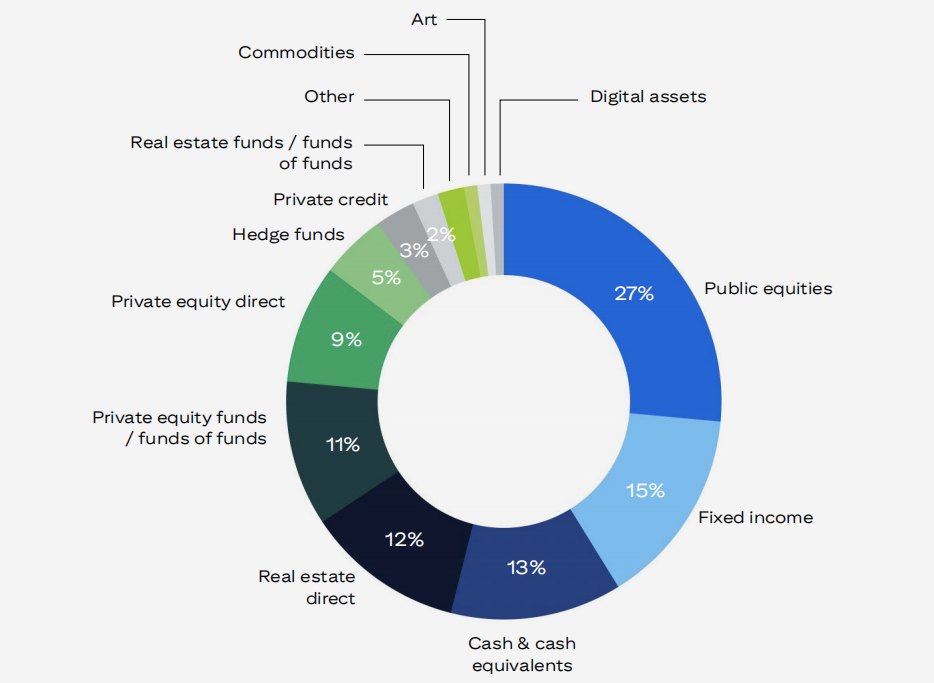
Core Insights - The report reveals the investment sentiment and strategies of family offices in the context of trade policy uncertainty, geopolitical tensions, and technological changes [1][2]. Group 1: Key Findings - Asset allocation among family offices remains stable, with half of the respondents maintaining fixed income holdings and two-thirds keeping real estate allocations unchanged. Private equity shows the most optimistic trend, with a net increase of 26% in allocations [5][6]. - Despite uncertainties surrounding tariffs, family offices express a positive outlook for portfolio returns over the next twelve months, with 30% expecting returns between 10%-15% and 8% anticipating returns exceeding 15% [8][9]. - Nearly two-thirds of family offices took action to enhance portfolio resilience following the U.S. tariff announcement, with 39% opting for active management [10][11]. Group 2: Investment Strategies and Sentiment - 70% of respondents are engaged in direct investments, with 40% increasing their activities in the past year, reflecting confidence in selecting profitable transactions [13][14]. - Trade tensions have become the primary concern for family offices this year, with 60% citing it as their top worry, while interest rates have dropped to fourth place [15][16]. - Family offices report effective management of investment risks, with 83% believing their investment risks are well managed, although confidence in managing cybersecurity and geopolitical risks is lacking [18][19]. Group 3: Asset Allocation and Market Outlook - Family offices' asset allocation for 2025 remains consistent with 2024, with public equities averaging 27%, fixed income at 15%, and alternative assets at 40% [30][31]. - The sentiment towards asset classes is predominantly neutral, with developed market equities showing the highest net positive sentiment at +17% [44][45]. - Regional sentiment varies, with the Americas showing net bullish sentiment for private equity direct investments at +21%, while the Asia-Pacific region shows a much lower sentiment at +1% [48][49].
美国农民明知贸易战会砸饭碗,仍死挺特朗普,真相其实很简单!
Sou Hu Cai Jing· 2025-09-23 04:22
Core Insights - The article highlights the paradox of American farmers supporting Trump despite the negative impact of the trade war on agricultural exports, which saw a 37% drop in U.S. agricultural product exports [3] - It discusses the illusion of government subsidies as a safety net for farmers, which has led them to view their votes as insurance against losses [4][6] - The article emphasizes the financial benefits farmers have gained from tax reforms and relaxed labor policies, which have allowed them to reduce costs significantly [8][10] Group 1: Government Subsidies - During the 2018 trade war, the U.S. Department of Agriculture provided $52 billion in subsidies, which allowed many farmers to cover up to 80% of their losses [4] - Farmers are currently facing uncertainty as promised subsidies for 2024 have not materialized, leading to skepticism about government support [6] Group 2: Labor Policies - The relaxation of H-2A visa policies has enabled farmers to save 30% on labor costs, as workers are paid less than the legal minimum wage and are discouraged from complaining due to visa risks [8] Group 3: Tax Reforms - The reduction of corporate tax rates from 35% to 21% has resulted in significant savings for large agricultural businesses, with some farmers reporting annual tax savings of hundreds of thousands of dollars [10] - The article notes that the shift in Chinese import patterns towards Brazil and Argentina has led to a 28% drop in U.S. soybean export prices, highlighting the risks associated with these financial strategies [10]

美国出现内讧,特朗普遭“自己人”背刺,央媒6个字揭开美国现状
Sou Hu Cai Jing· 2025-09-23 04:12
Core Insights - The unexpected decline in the Producer Price Index (PPI) for August, which fell by 0.1% month-on-month and saw a year-on-year drop from 3.1% to 2.6%, indicates potential underlying economic issues amidst ongoing trade tensions [5][10] - The primary driver of the PPI decrease was a 1.7% drop in trade services prices, suggesting that retailers and wholesalers are compressing their profit margins [6][9] - Despite the overall PPI decline, core PPI, which excludes volatile food, energy, and trade services, rose by 0.3% month-on-month and 2.8% year-on-year, indicating persistent inflationary pressures [8][10] Economic Indicators - The Federal Reserve's recent decision to cut interest rates by 25 basis points reflects a slowdown in U.S. economic growth, with only one dissenting vote advocating for a larger cut [6][9] - The significant 1.7% drop in trade services prices is the largest decline in the past 12 months, highlighting the pressures faced by businesses [9] Market Reactions - Financial markets displayed cautious optimism, with the Dow Jones slightly down by 0.14%, while the S&P 500 and Nasdaq rose by 0.4%, indicating a temporary alleviation of inflation concerns [10] - Consumer prices are expected to rise, with predictions of a 0.3% month-on-month increase in the Consumer Price Index (CPI) for August, potentially reaching a year-on-year rate of 2.9%, the highest since January [10] Broader Implications - The ongoing trade war and its economic ramifications may have far-reaching effects on global markets, as U.S. price fluctuations could influence trade and capital flows worldwide [13] - The socio-political climate in the U.S. poses additional risks, with increasing political violence and societal division potentially impacting economic stability [11][13]