
化债

Search documents
中国建筑20251126
2025-11-26 14:15
Summary of China State Construction Engineering Corporation Conference Call Industry Overview - The construction industry in China is facing significant challenges due to macroeconomic conditions and a downturn in fixed asset investment, which decreased by 0.5% year-on-year, marking the first negative growth in five years [8][5] - The construction business activity index is below the critical threshold of 50%, indicating a contraction in the industry [8] Company Performance - In the first ten months, China State Construction signed new contracts totaling 3.6 trillion yuan, a year-on-year increase of 1% [4] - The building business contracts amounted to 3.3 trillion yuan, up 2% year-on-year, while the real estate business saw a decline of approximately 9.5%, with contract sales of 280 billion yuan [4] - The company’s new signed contracts in the housing construction sector reached 2.2 trillion yuan, a 1.5% increase, and infrastructure contracts grew by 3.1% to 1.1 trillion yuan [2][4] - The overseas new contracts also increased by about 3% [4] Financial Health - The company reported a stable impairment provision level compared to the previous year, with expectations that the overall impairment level will remain relatively stable despite potential increases in real estate inventory impairments [7] - Accounts receivable have increased due to the industry’s business model, primarily concentrated in local government platforms and state-owned enterprises, which has significant implications for cash flow [10] Stock Performance and Market Strategy - The company’s stock price has been under pressure due to macroeconomic conditions, capital market trends, and performance pressures [6] - To support its market value, the company is implementing a stable dividend policy and share buybacks, as the current stock price is considered to deviate from its normal value range [6][11] - The company plans to maintain the dividend per share at the same level for 2025, ensuring a stable dividend policy while utilizing various market management tools to restore reasonable valuation [11] Debt Recovery and Urban Renewal - The company has actively pursued debt recovery, with over 100 billion yuan in overdue government debt recovered from January to September, with 30%-40% of this included in the accounts [3][12] - In the urban renewal sector, new contracts signed reached nearly 300 billion yuan, reflecting a growth of over two digits year-on-year, indicating a significant market potential [12] Real Estate Business Outlook - The real estate sector remains a core business, with contract sales growing by 17% year-on-year in Q3, reaching 80 billion yuan, outperforming the national average decline of 13.6% [15] - The company aims to stabilize its turnover and gross margin, anticipating a recovery in the macro real estate market [15] Future Projects and Investments - The company currently has over 420 PPP projects, with nearly 350 in operation, focusing on establishing a comprehensive investment management system for project lifecycle management [13][14] - Future investment strategies will combine infrastructure and real estate, with a cautious approach to market conditions while actively seeking quality land resources, particularly in top-tier cities [14]

工程出海逻辑逐步兑现,高景气度领域成长占优
Guotou Securities· 2025-11-26 12:04
Investment Rating - The report maintains an investment rating of "Outperform the Market - A" for the construction industry [4]. Core Views - The report highlights that the logic of overseas engineering expansion is gradually being realized, with high growth areas showing superior growth. Infrastructure and real estate demand continue to face pressure, while railway and water conservancy investments perform well, with the effects of debt reduction expected to gradually manifest [1][8]. - Central state-owned enterprises (SOEs) are experiencing a significant decline in revenue and performance, but there is a long-term trend of improving operational quality. Many SOEs have shown improvements in profitability, cash flow, and expense ratios, indicating a gradual enhancement in operational quality [2][8]. - The overseas new contract signing is rapidly increasing, demonstrating the effectiveness of the overseas expansion strategy. The contract value and revenue from foreign engineering projects have shown significant year-on-year growth, providing support for domestic construction enterprises [3][8]. Summary by Sections 1. Industry Overview - Infrastructure investment growth has been declining, with broad infrastructure investment growth dropping from 11.50% in early 2023 to 1.51% by October 2025. Narrow infrastructure investment growth turned negative, indicating a significant slowdown in traditional infrastructure demand [16][17]. - The investment growth in the railway sector remains positive, while road transport investment has been declining due to funding pressures from local governments and construction enterprises [18][20]. 2. Central SOEs Performance - Central SOEs in the infrastructure sector are facing revenue and performance growth challenges, but operational quality is improving. The implementation of debt reduction measures is expected to show fiscal effects by 2026 [2][8]. 3. Overseas Expansion - The overseas contract signing for Chinese construction enterprises has increased significantly, with major state-owned enterprises showing higher growth rates in new contracts compared to the overall market. This trend is expected to support revenue growth in the coming years [3][8]. 4. Regional Investment Trends - In the western region, particularly Xinjiang, fixed asset investment growth is significantly higher than the national average, with major infrastructure projects expected to drive demand growth [6][8]. - The coal chemical industry in Xinjiang is projected to see substantial investment, with over 400 key projects planned, totaling an investment of 3.47 trillion yuan [6][8]. 5. Cleanroom Engineering Demand - The demand for cleanroom construction is expected to rise due to increased capital expenditure in the AI and semiconductor industries. The cleanroom engineering sector is experiencing rapid growth in orders, particularly from overseas markets [7][8]. 6. Investment Recommendations - The report suggests that low-valuation central SOEs like China State Construction and China Communications Construction Company are well-positioned for stable returns, with improving operational metrics and increasing dividends [9][8]. - Leading companies in overseas expansion, such as China National Materials and China Steel International, are expected to outperform traditional construction enterprises due to their strong growth in overseas orders [9][8].




认知:是投资升阶的充要条件
雪球· 2025-11-26 08:24
Group 1 - The core viewpoint is that the current bull market in A-shares is still ongoing, despite market fluctuations, as it is determined by national policies and the realization of capital market value [4][6]. - The process of debt reduction is still in its early stages, indicating that the market's recovery is complex and slow [4]. - Economic indicators such as consumer spending, housing prices, and private enterprise investment remain weak, suggesting that deflationary pressures have not changed [5][6]. Group 2 - Technical indicators like K-line combinations, moving averages, and trading volume are essential for stock trading, serving as the foundation of technical analysis [11]. - Fundamental analysis focusing on performance and valuation is crucial for value investors, but it may not significantly improve the success rate for most retail investors due to information lag [13][14]. - National policies and geopolitical factors are vital for identifying market trends and investment opportunities, acting as catalysts for bull markets [15]. Group 3 - Understanding broader trends and logical analysis is key to identifying potential high-performing stocks and serves as a basis for long-term investment decisions [17]. - Maintaining the right rhythm and mindset is critical for successful trading, emphasizing the importance of patience and clarity in decision-making [18][19]. - A comprehensive understanding of all the aforementioned factors contributes to an investor's cognitive development, which is essential for achieving higher investment success [20][21][22].


华泰证券:预计明年会尽量靠前形成实物工作量
Sou Hu Cai Jing· 2025-11-26 00:32
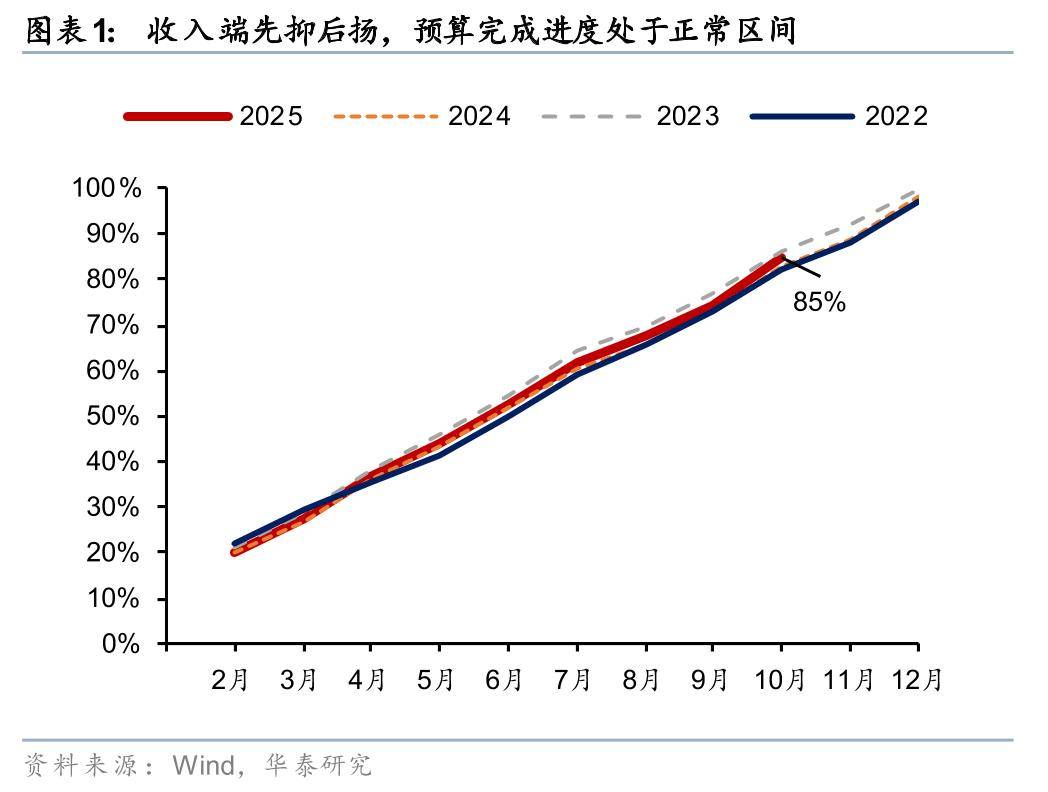
Core Viewpoint - The fiscal policy review for 2025 highlights a balance between stabilizing growth and preventing risks, with significant fiscal expansion not leading to improved fixed asset investment growth [2][3][32]. Group 1: Fiscal Policy Review for 2025 - The budget revenue showed a weak recovery, with a cumulative year-on-year growth turning positive in the first ten months, reaching 85% of the budget execution [5][9]. - Government fund revenue was negatively impacted by declining land transfer income, with a progress rate of 55% in the first ten months [9][12]. - The expenditure side saw a strong increase, with government fund expenditure growth reaching 220% for central government funds, while local expenditure grew by only 7.3% [9][12]. Group 2: Debt Management and Special Bonds - The "6+4+2" debt management plan for 2024 accelerated the debt resolution process, with a total of 3.88 trillion yuan allocated for debt resolution and clearing corporate arrears, exceeding initial expectations [16][20]. - The issuance of special bonds reached 4.4 trillion yuan by mid-November, with a significant portion allocated for debt resolution and land reserve projects, leading to a partial crowding-out effect on infrastructure projects [12][22]. Group 3: Outlook for 2026 - The fiscal policy for 2026 is expected to be more proactive, with a projected deficit rate maintained at around 4%, signaling the necessity of fiscal expansion [3][35]. - New special bond quotas may be increased to approximately 5 trillion yuan to support infrastructure projects, particularly in the context of the "15th Five-Year Plan" [3][35]. - The fiscal revenue is anticipated to remain under pressure due to declining land transfer income, which has historically accounted for 70%-80% of government fund revenue [38][39]. Group 4: Expenditure and Economic Growth - The relationship between GDP growth and fiscal expenditure is expected to persist, with government leveraging fiscal expansion to support economic growth amid weak expectations from residents and enterprises [40][45]. - Central government spending is likely to focus on major projects, with local governments continuing to rely heavily on central transfers due to limited self-financing capabilities [45][46].

国泰海通:预计2026年狭义财政赤字率仍需突破4%,新增地方专项债或在4.6万亿左右
Sou Hu Cai Jing· 2025-11-23 06:25
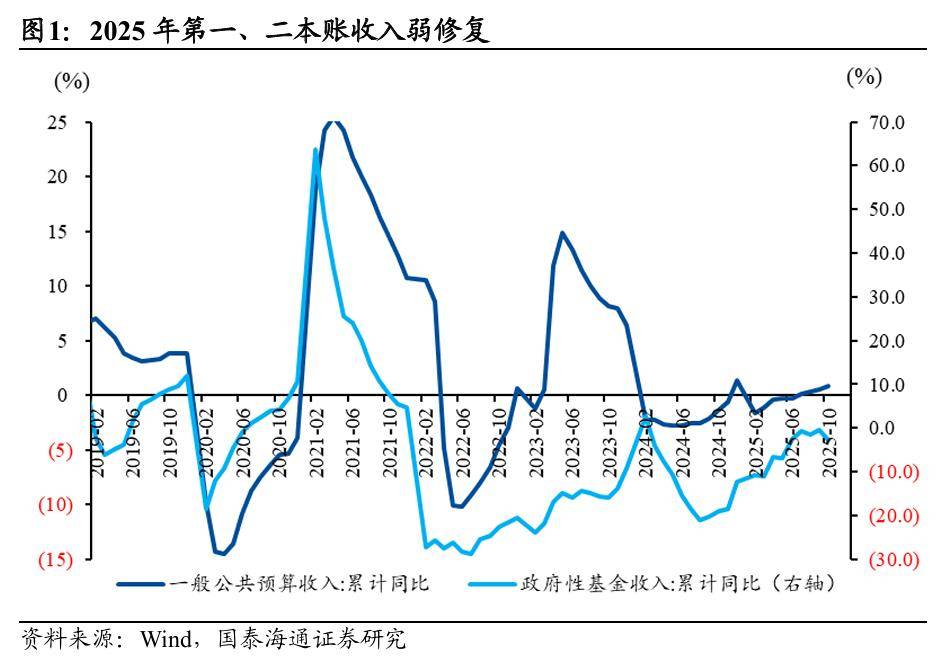
Core Viewpoint - The fiscal policy for 2026 will focus on promoting stable growth, improving people's livelihoods, and managing risks under the "15th Five-Year Plan," with a projected narrow fiscal deficit rate exceeding 4% and new local special bonds around 4.6 trillion yuan [1][5][43]. Group 1: Fiscal Policy Characteristics - The core feature of China's fiscal policy in 2025 is a shift towards a "people-oriented" expenditure structure, which is reflected in the resilience of consumption and the decline in infrastructure investment since July [1][5]. - On the revenue side, there is a weak recovery in the two accounts, with tight constraints still present. The income from individual income tax and securities transactions has improved, while land transfer income has seen a narrowing decline [5][11]. - On the expenditure side, there is a moderate expansion in total fiscal spending, with a structural shift towards social welfare. The central government's financial support is increasing, but the alignment of financial resources and responsibilities still needs optimization [1][11][15]. Group 2: Key Tasks for 2026 - The fiscal policy for 2026 will focus on three key tasks: promoting the synergy between social welfare and consumption incentives, addressing the slowdown in external demand, and resolving funding constraints for infrastructure investment [1][21][22]. - Policies such as trade-in programs and childbirth subsidies are expected to continue and be enhanced, with a focus on service consumption, projecting a retail sales growth rate of around 4.5% [2][25]. Group 3: Infrastructure Investment and Debt Management - For infrastructure investment and debt management, it is essential to clarify the scale and path of debt management funding, with an estimated need for around 3 trillion yuan in special bonds for debt management and clearing overdue accounts in 2026 [3][29]. - The pressure of interest payments after debt replacement is expected to be manageable due to a low-interest environment, which will help offset the visible interest payment pressure [3][37]. - The growth rate of infrastructure investment is projected to be around 3.5% in 2026, influenced by the constraints of debt management and the pursuit of effective investment [3][41]. Group 4: Fiscal Data Projections for 2026 - The growth rate of broad fiscal spending is expected to be around 4.6%, with a narrow fiscal deficit rate still needing to exceed 4%, and new local special bonds projected at approximately 4.6 trillion yuan [5][43][49]. - The general public budget revenue growth rate is estimated at about 1%, while government fund revenue is expected to decline by around 5% [43][46].

国泰海通|宏观:财政将如何发力——2026年财政政策展望
国泰海通证券研究· 2025-11-20 12:46
Core Insights - The article emphasizes that the fiscal policy in the first year of the "14th Five-Year Plan" will focus on balancing active and sustainable requirements to promote stable growth, improve people's livelihoods, and mitigate risks [1][2] Fiscal Policy Overview - In 2026, the narrow fiscal deficit rate is expected to exceed 4%, with new local special bonds around 4.6 trillion and long-term special government bonds issued at approximately 1.5 trillion [1][3] - The core feature of China's fiscal policy in 2025 is a shift in expenditure structure towards "people's livelihood," which is linked to the resilience of consumption and the decline in infrastructure investment since the third quarter [2] Revenue and Expenditure Dynamics - On the revenue side, there is a weak recovery in the two accounts, with continued tight constraints [2] - On the expenditure side, broad fiscal spending is expected to moderately expand, with a structural shift towards social welfare and a decline in infrastructure investment contributing to a drag of at least 2 percentage points [2][3] Key Tasks for 2026 - The fiscal policy will focus on three key tasks: 1. Promoting the synergy between social welfare and consumption incentives 2. Addressing the growth continuity issues due to external demand slowdown 3. Resolving funding constraints for infrastructure investment [2] Infrastructure Investment and Debt Management - For infrastructure investment and debt management, three key questions need to be clarified: 1. The scale and path of debt management funding, with around 3 trillion in special bonds needed for debt management and clearing [3] 2. The potential increase in interest payment pressure post-debt replacement, which may rise but remain manageable due to a low interest rate environment [3] 3. The funding sources and performance of infrastructure investment, with an expected growth rate of around 3.5% in 2026 [3] Overall Fiscal Growth Projections - The overall growth rate of broad fiscal spending is projected to be around 4.6% in 2026, with the narrow fiscal deficit rate needing to exceed 4% [3]

2026年财政政策展望:财政将如何发力
Haitong Securities International· 2025-11-20 05:02
Fiscal Policy Overview - The fiscal policy for 2026 aims to balance growth, social welfare, and risk prevention, with a narrow fiscal deficit rate expected to exceed 4%[1] - New local special bonds are projected to be around CNY 4.6 trillion, while ultra-long-term special government bonds may be issued at approximately CNY 1.5 trillion[1] Revenue and Expenditure Trends - In 2025, the fiscal structure shifted towards "people's livelihood," with a mild recovery in revenue but continued constraints[2] - Total broad fiscal expenditure is expected to grow by about 4.6% in 2026, with a focus on social welfare and consumption incentives[5] Infrastructure Investment Insights - Infrastructure investment growth is anticipated to be around 3.5% in 2026, influenced by debt resolution and effective investment strategies[3] - Approximately CNY 3 trillion in special bonds will be needed for debt resolution and clearing overdue payments in 2026[3] Consumer Spending and Social Welfare - Consumer spending is projected to grow at around 4.5%, supported by policies like trade-in programs and birth subsidies[4] - The expected increase in social welfare spending includes a CNY 1,080 billion rise in pensions and CNY 1,000 billion for birth subsidies, which will stimulate consumption[4] Risks and Challenges - Potential risks include slower-than-expected policy implementation, sluggish recovery in consumer spending, and rising local debt pressures[5] - The fiscal space may be constrained, impacting the effectiveness of the proposed measures[5]
信用分析周报(2025/11/10-2025/11/14):平台市场化转型,成效几何?-20251116
Hua Yuan Zheng Quan· 2025-11-16 12:17
Report Summary 1. Report Industry Investment Rating The report does not provide an industry investment rating. 2. Core Viewpoints - The transformation effect of market - oriented business entities remains to be seen, and it is difficult to expect significant incremental bond supply. The supply - demand relationship of traditional credit bonds remains tight, and the pricing of outstanding bonds among market - oriented entities may become more differentiated in the future [3][35] - The concentrated opening of amortized open - end bond funds may directly benefit general credit bonds (such as urban investment bonds and industrial bonds), especially 3 - 5Y medium - and long - term credit bonds. High - rated (AAA - and above) medium - term notes are recommended as key trading targets in the future [7][75][76] 3. Summary by Directory 3.1 Platform Market - Oriented Transformation - **Local Bond Issuance for Debt Resolution** - Special Refinancing Bonds: As of 2025/11/9, 19,934 billion yuan of the 2 - trillion - yuan debt quota allocated in 2025 has been issued, almost fully utilized. Except for Henan, all other regions have completed the issuance of special refinancing special bonds within the annual quota [14] - Special New Special Bonds: As of 2025/11/9, 12,818 billion yuan of special new special bonds have been issued in 2025, exceeding the annual limit of 80 billion yuan. The excess may be used to repay non - implicit debt corporate arrears [20] - **Progress of Bond - Issuing Urban Investment Entities Exiting the Platform** - From 2025/1/1 - 11/9, 179 bond - issuing urban investment entities announced exiting the platform. Most provinces have a progress of over 50%, while Liaoning and Guizhou are relatively lagging, and future debt - resolution resources may be tilted towards them [24][27] - **Effect of Platform Market - Oriented Transformation** - The number of market - oriented business entities is increasing, but it has not led to a significant increase in bond financing scale. The reasons may be weak asset quality, cautious regulatory review, and limited investor recognition. The transformation effect remains to be observed [3][34] 3.2 Primary Market - **Net Financing Scale** - This week, the net financing of credit bonds (excluding asset - backed securities) was 154.9 billion yuan, a decrease of 30.5 billion yuan from last week. The net financing of asset - backed securities was 35.9 billion yuan, an increase of 18.5 billion yuan from last week [36] - **Issuance Cost** - The issuance rate of AA industrial bonds increased by 30BP to over 3%. The issuance rates of other different - rated and different - type bonds fluctuated within 15BP compared to last week [45] 3.3 Secondary Market - **Trading Volume** - This week, the trading volume of credit bonds (excluding asset - backed securities) decreased by 51.8 billion yuan compared to last week. The trading volume of asset - backed securities increased by 1.4 billion yuan [46] - **Yield** - The yields of different - rated and different - term credit bonds fluctuated within 3BP compared to last week [49] - **Credit Spreads** - Except for the slight compression of credit spreads in AA+ electrical equipment, light manufacturing, and automobile industries, the credit spreads of other industries and ratings slightly widened. The credit spreads of urban investment bonds, industrial bonds, and bank capital bonds also had small - scale fluctuations [54] 3.4 This Week's Bond Market News - The implied ratings of 20 bond issues of Lionbridge Financial Leasing (China) Co., Ltd. were downgraded; the implied rating of "Yuanhe 4B" issued by China Power Construction Group Hubei Engineering Co., Ltd. was downgraded; the entity rating of Beijing Aerospace宏图 Information Technology Co., Ltd. was downgraded, and the bond rating of "Hongtu Convertible Bond" was also downgraded [72] 3.5 Investment Recommendations - The central bank achieved a net injection of 626.2 billion yuan this week. Except for a few industries, the credit spreads of most industries and ratings slightly widened. The credit spreads of urban investment bonds, industrial bonds, and bank secondary and perpetual bonds had small - scale fluctuations [74] - The concentrated opening of amortized open - end bond funds may benefit general credit bonds and 3 - 5Y medium - and long - term credit bonds. High - rated medium - term notes are recommended as key trading targets [75][76]
各地2025年前三季度经济财政债务盘点:各地的先后节奏
GOLDEN SUN SECURITIES· 2025-11-12 00:07
Group 1: Economic and Fiscal Overview - The report analyzes the economic and fiscal data from various regions for the first three quarters of 2025, highlighting different developmental characteristics across regions [2] - Heavy debt regions show weaker economic growth, industrial value-added, and fixed asset investment compared to non-heavy debt regions, indicating a significant disparity in performance [2] - Despite the challenges, heavy debt regions have managed to achieve a higher year-on-year growth rate in general budget revenue compared to non-key regions, while their budget expenditure growth rate is lower [2] Group 2: Company Performance - Jinpan Technology - Jinpan Technology (688676.SH) reported a revenue of 5.194 billion yuan for the first three quarters of 2025, reflecting a year-on-year increase of 8.25% [3] - The company achieved a net profit attributable to shareholders of 486 million yuan, up 20.27% year-on-year, and a net profit excluding non-recurring items of 456 million yuan, increasing by 19.05% [3] - For Q3 2025, Jinpan Technology's revenue reached 2.04 billion yuan, representing an 8.38% year-on-year growth and a 12.61% quarter-on-quarter increase [3]

环保投资的下一站:三大关键词剧透未来丨每日研选
Sou Hu Cai Jing· 2025-11-05 00:30
Core Insights - The environmental industry is being reshaped by three driving forces: "debt resolution," "marketization," and "green dual carbon" initiatives [1] Group 1: Investment Opportunities - Environmental investment is focusing on three main lines: systematic green transformation driven by dual carbon goals, marketization reforms in resource pricing, and debt resolution policies improving financial health of environmental companies [1] - The non-electric utilization of renewable energy, particularly hydrogen and ammonia, is becoming a significant avenue for green electricity consumption, with European regulations boosting demand for sustainable aviation fuel [2] - The dual drivers of "soil remediation" and "capacity replacement" are creating new opportunities in environmental monitoring and soil restoration sectors [3] Group 2: Asset Valuation and Market Trends - Water and waste incineration operational assets are expected to experience a "Davis double hit" due to increasing environmental quality demands and improved cash flows from debt resolution policies [4] - The market for solid waste management and wastewater treatment is anticipated to grow, with a focus on companies that can provide comprehensive solutions and have stable cash flows [5]