实际利率

Search documents
在贵金属板块方面
Sou Hu Cai Jing· 2025-11-12 07:59
Group 1 - The cautious sentiment in the precious metals sector is driven by changes in real interest rates, which are inversely related to the prices of precious metals [1] - Previous expectations of interest rate cuts by the Federal Reserve led to a decline in real interest rates, supporting the prices of gold and silver [1] - As expectations for rate cuts diminish, the upward pressure on real interest rates increases, reducing the attractiveness of precious metals and causing price fluctuations [1] Group 2 - Precious metals possess safe-haven attributes, which may attract investment if high interest rates from the Federal Reserve increase global economic growth risks or geopolitical tensions escalate [1] - There exists a conflict between short-term cautious expectations and long-term support for precious metals, creating a dynamic market environment [1]
全球风险资产
Sou Hu Cai Jing· 2025-11-12 07:59
Core Viewpoint - The expectation of a Federal Reserve interest rate cut has diminished, leading to pressure on global risk assets through two main channels [1] Group 1: Impact on Currency and Commodities - A decline in interest rate cut expectations supports the US dollar index in the short term, which, as a core global pricing currency, makes dollar-denominated commodities and emerging market assets less attractive, potentially causing capital to flow back to dollar assets [1] - The continued restrictive monetary policy will elevate real interest rates, negatively impacting the valuation logic of risk assets, particularly high-valuation growth assets, as rising discount rates compress their valuation space [1] Group 2: Market Performance - Recent market performance indicates a pullback in the US Nasdaq index, emerging market equities, and cyclical commodities like oil, reflecting the pressure on risk assets [1]
美联储威廉姆斯:模型显示生产率提升加快会推高实际利率。
Sou Hu Cai Jing· 2025-11-06 17:00
Group 1 - The core viewpoint is that an acceleration in productivity improvements is projected to lead to higher real interest rates according to models presented by the Federal Reserve's Williams [1]
瑞银:金价年底或达4200美元,黄金股ETF(159562)盘中持续溢价,资金连续3日净流入
2 1 Shi Ji Jing Ji Bao Dao· 2025-11-04 06:39
Core Viewpoint - The recent decline in gold prices and the continuous drop in A-shares have led to a significant decrease in gold and precious metal-related ETFs, although there has been a net inflow of funds into gold stock ETFs despite the downturn [1] Group 1: ETF Performance - As of 14:10 on November 4, the performance of various ETFs was as follows: Gold ETF Huaxia (518850) fell by 0.89%, Non-ferrous Metals ETF (516650) dropped by 3.65%, and Gold Stock ETF (159562) decreased by 3.88% [1] - The holdings of the Gold Stock ETF, including companies like WanGuo Gold Group, saw declines exceeding 6%, while Zijin Mining, Chifeng Jilong Gold Mining, and Jiangxi Copper also experienced significant losses [1] Group 2: Fund Inflows - Despite the three-day decline in the Gold Stock ETF (159562), it recorded a net inflow of funds totaling 57.12 million yuan over the same period [1] Group 3: Market Outlook - Major Wall Street banks remain optimistic about the future of gold prices, with UBS stating that the current price drop is temporary and maintaining a year-end target of $4,200 per ounce [1] - UBS also indicated that if geopolitical or market risks escalate, gold prices could potentially rise to $4,700 per ounce within the year [1] - GF Securities noted that the decline in real interest rates continues to provide marginal support for gold prices, with expectations of a new round of interest rate cuts by the Federal Reserve and a halt to balance sheet reduction in December [1] - The continuation of monetary easing and rising inflation are expected to support gold prices, with ETF investments and central bank purchases being key drivers for sustained upward movement [1]





贵金属期货:黄金税收新政落地,意味着什么?
Sou Hu Cai Jing· 2025-11-03 01:53
Group 1: Monetary Policy and Economic Indicators - The Federal Reserve has lowered interest rates by 25 basis points to a range of 3.75%–4.00%, marking the second rate cut of the year, and plans to end balance sheet reduction by December 1, 2025, with all maturing U.S. Treasury securities being reinvested [1] - The breakeven inflation rate increased by 0.04% to 2.40%, while the U.S. September CPI rose by 3.02% year-on-year, up from 2.94%, indicating a rebound for five consecutive months [2] - The dollar index increased by 2.1% in October, influenced by hawkish statements from Fed Chairman Powell regarding future rate cuts [3] Group 2: Market Risks and Global Trends - The VIX index peaked in mid-October but significantly declined due to the easing of U.S.-China tariff risks, while geopolitical uncertainties remain high following the cancellation of a summit between Trump and Putin [3] - In 2024, global central banks have cumulatively purchased 1,044.63 tons of gold, marking the 17th consecutive quarter of net purchases, with a notable increase in global gold ETF holdings as of 2025 [3] Group 3: Gold and Silver Market Outlook - A new tax policy regarding gold transactions will take effect on November 1, 2025, which may initially pressure physical demand but could enhance the financial attributes of gold in the long term [4] - The short-term outlook for gold is cautiously bullish, with expectations of upward movement due to anticipated declines in real interest rates [5][6] - Silver prices are also expected to trend cautiously upward, sharing macroeconomic logic with gold amid expectations of lower future interest rates [7]
广发证券:预计伦敦金年底前将盘整震荡 明年一季度后再创新高
Zhi Tong Cai Jing· 2025-11-02 23:53
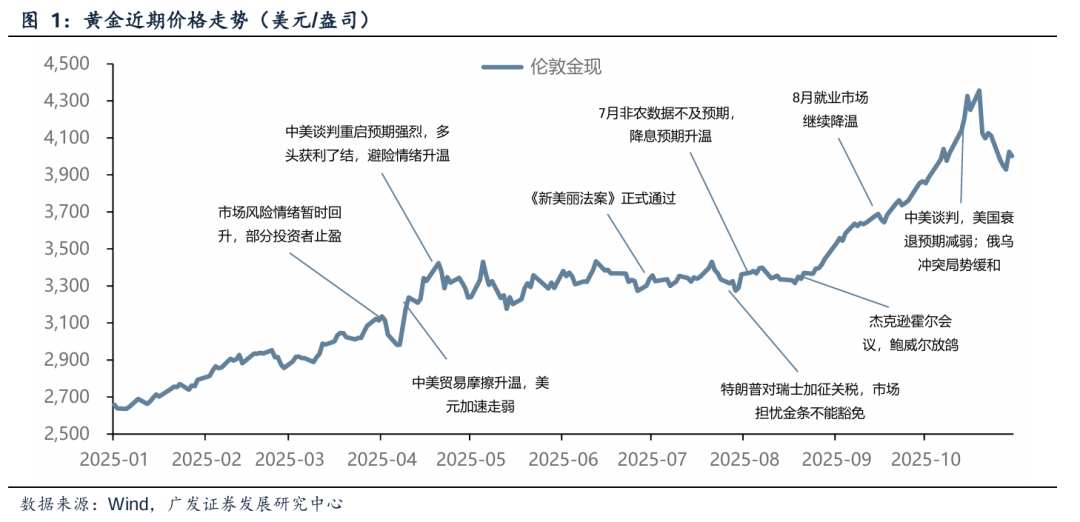
Core Viewpoint - The short-term outlook for gold remains uncertain with high volatility, and geopolitical risks are easing. Without unexpected positive factors, London gold is expected to consolidate before reaching new highs in the first quarter of next year [1][13]. Group 1: Recent Market Movements - The recent significant drop in gold prices is primarily due to high implied volatility and profit-taking after substantial gains, alongside a market that has over-priced geopolitical instability, particularly in U.S.-China relations and the Russia-Ukraine conflict, which have shown signs of easing [2][5]. Group 2: Long-term Bullish Logic for Gold - Macroeconomic Narrative: Since the pandemic, U.S. debt and fiscal deficits have expanded, with federal debt reaching historical highs. Concerns over the sustainability of U.S. Treasuries are impacting the international capital flow system. The expansion of the U.S. twin deficits is forcing a crisis transfer abroad, amidst rising global economic policy uncertainty and geopolitical risks. There are three potential solutions to the global debt issue: (1) unexpected high inflation that erodes debt, benefiting gold and commodities; (2) technological advancements leading to economic growth that mitigates debt, favoring AI technology; (3) proactive fiscal tightening, which may exacerbate domestic and international conflicts and reverse globalization [5][6]. Group 3: Supporting Factors for Gold Prices - Fundamental Factors: A decline in real interest rates continues to provide marginal support for gold prices. Following the October meeting, the Federal Reserve has initiated a new round of rate cuts and plans to halt balance sheet reduction in December, with ongoing monetary easing and rising inflation expected to support gold prices [9]. - Financial Factors: ETF investments and central bank purchases of gold remain key drivers for sustained price increases. Since late August, European investors have been notably absent. If the U.S. economy weakens further, European investors are likely to divest from dollar assets and reinvest in gold, potentially driving prices to new highs. Additionally, the ongoing global debt crisis is leading to a restructuring of the monetary credit system, de-dollarization, and a trend of central banks continuing to purchase gold, all of which will support gold price increases [10].

金价8天狂泄409美元!抄底者哭了,高位接盘者遭血洗,场面惨烈!
Sou Hu Cai Jing· 2025-11-01 04:03
Core Insights - Gold prices experienced a dramatic decline of $409 in just eight days, marking a 9.3% drop from a peak of $4,382 per ounce to $3,973 per ounce, the most significant drop since 2013 [3][4][6] - The decline has severely impacted retail investors and futures traders, with many facing substantial losses due to high leverage and market volatility [6][7] Group 1: Market Data - The London Bullion Market Association (LBMA) reported that gold prices fell from $4,382 per ounce on October 20 to $3,973 per ounce by October 28, a loss of $409 [3] - In the domestic market, the Shanghai gold spot price dropped by 35 yuan per gram over two days, with major retailers seeing weekly declines exceeding 2% [3] - On October 21, global gold ETFs saw a net outflow of $5 billion, and non-commercial net long positions in gold futures on the New York Mercantile Exchange decreased by 12% [3][6] Group 2: Causes of the Decline - The Federal Reserve's shift in policy, with a reduction in the expected rate of interest rate cuts, led to an increase in real interest rates, making gold a less attractive investment [4][5] - A decrease in geopolitical risks, particularly regarding Ukraine and the Middle East, resulted in the withdrawal of safe-haven investments from gold [5] - Technical indicators showed that gold was overbought prior to the decline, with the Relative Strength Index (RSI) remaining above 70, triggering automated sell-offs when prices fell below key support levels [5] Group 3: Impact on Stakeholders - Retail investors who purchased gold at high prices faced significant losses, with some losing amounts equivalent to a month's salary within a week [6] - Physical gold retailers experienced a sharp decline in sales, with some reporting a drop of over 40% in sales revenue in major cities [6] - Futures traders faced severe losses, with many accounts losing over 100,000 yuan in a single day due to the rapid market downturn [6] Group 4: Future Outlook - Short-term price corrections are expected, but long-term support remains, with industry representatives predicting gold prices could reach approximately $4,980 per ounce by next October [7] - Key indicators to watch include the Federal Reserve's interest rate decisions and any resurgence of geopolitical risks, which could drive demand for gold as a safe-haven asset [7] - Historical data suggests that after significant declines, gold prices often recover, emphasizing the importance of understanding market signals and managing risk [8]

凌晨美联储利率决议,谨防黄金冲高跳水,专家释放三大信号
Sou Hu Cai Jing· 2025-10-30 17:02
Core Viewpoint - The Federal Reserve announced a 25 basis point interest rate cut, bringing the federal funds rate down to 3.75%-4.00%, marking the fifth cut since September 2024. This led to significant market volatility, particularly in gold prices, which initially surged but then fell sharply due to market reactions to the Fed's statements [1][3]. Market Reaction - Following the announcement, spot gold prices briefly rose to $4020 per ounce before dropping below $3980, illustrating the classic market behavior of "buy the rumor, sell the news" [3]. - Prior to the rate cut, market expectations for a reduction were extremely high, with a 98% probability, leading to a significant increase in gold prices from $3726 to a peak of $4400, an over 18% rise in just over a month [3]. Economic Context - The market environment was particularly sensitive, with gold prices having recently experienced a decline from $4400 to below $3900, a drop of $500, influenced by easing geopolitical tensions and progress in U.S.-China trade talks [5]. - The volatility in gold prices was also attributed to technical indicators, with the RSI remaining above 70, indicating overbought conditions [7]. Investor Behavior - The Fed's hawkish signals regarding future rate cuts led to profit-taking among investors, resulting in a rapid decline in gold prices shortly after the announcement [3][7]. - There is a notable divergence in investor sentiment, with some viewing the rate cut as a signal that bullish momentum has peaked, while others maintain a long-term bullish outlook based on expectations of continued monetary easing [9]. Interest Rates and Gold Prices - Despite the rate cut, the yield on 10-year U.S. Treasury bonds remains high, increasing the opportunity cost of holding gold, which is a critical factor affecting gold prices [11]. - The Fed's cautious stance on inflation may slow the pace of real interest rate declines, further complicating the outlook for gold [11]. Central Bank Actions - Central banks have been net buyers of gold, with global official gold reserves increasing by 10 tons in July 2025, and the People's Bank of China having increased its gold holdings for ten consecutive months [7][15]. - This structural buying by central banks is expected to provide long-term support for gold prices, although it may not fully offset short-term speculative selling [9][15]. Future Outlook - HSBC forecasts that gold prices will fluctuate between $3700 and $4050 by the end of 2025, with potential upward pressure from a weak dollar, despite possible limitations on price increases if the Fed's rate cuts are less aggressive than expected [13]. - Historical patterns indicate that gold typically experiences significant volatility following initial rate cuts, with an average volatility of 12% in the month following such events [13].

买金门槛变了!
Sou Hu Cai Jing· 2025-10-27 02:13
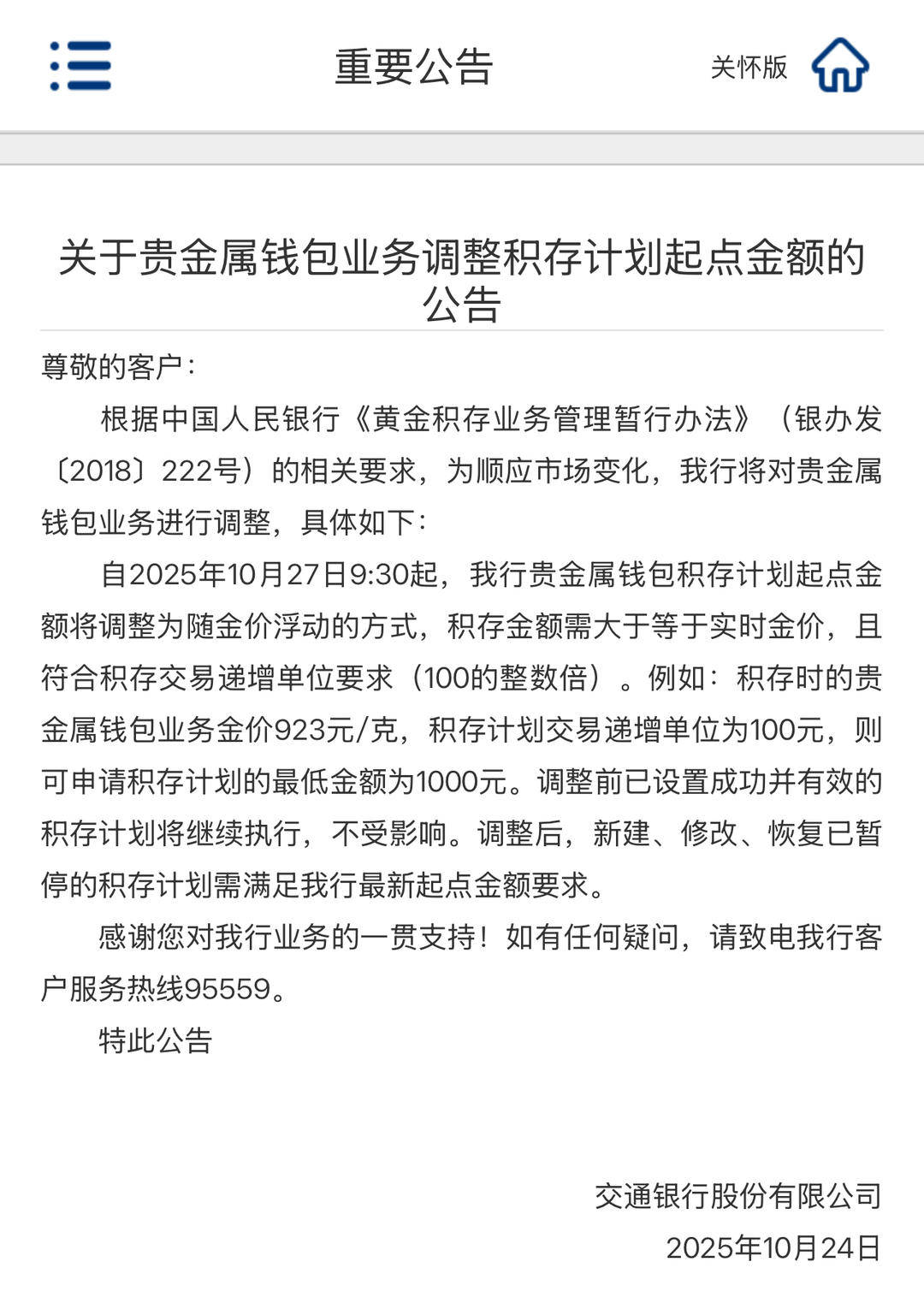
Core Viewpoint - The Bank of Communications has announced a change in its precious metals wallet accumulation plan, linking the minimum accumulation amount to real-time gold prices, effective from October 27, 2023, in response to market fluctuations [1][5]. Group 1: Changes in Accumulation Plans - The minimum accumulation amount will now be at least equal to the real-time gold price, with increments required in multiples of 100 [1][3]. - Other banks, including Industrial and Commercial Bank of China, Bank of China, Ping An Bank, and Industrial Bank, have also raised their minimum investment thresholds for gold accumulation plans in October [4][6]. Group 2: Recent Gold Price Trends - As of October 24, the London gold price was reported at $4,111.555 per ounce, having increased by 24% since late August [3][9]. - The recent surge in gold prices is attributed to three main factors: declining real interest rates, rising geopolitical tensions, and increased gold reserves by central banks in emerging markets [9].



买金门槛变了!多家银行出手
新浪财经· 2025-10-26 08:04
Core Viewpoint - The article discusses the adjustment of the gold accumulation plan by Bank of Communications, which will now be linked to real-time gold prices, reflecting the recent volatility in gold prices and potentially influencing other banks to follow suit [2][4]. Group 1: Bank Adjustments - Starting from October 27, Bank of Communications will adjust its gold accumulation plan's minimum investment amount to be at least equal to the real-time gold price, with increments in multiples of 100 [2]. - Other banks, including Industrial and Commercial Bank of China, Bank of China, Ping An Bank, and Industrial Bank, have also raised their minimum investment thresholds for gold accumulation products in October [6][7]. - For instance, ICBC raised its minimum investment for its gold accumulation product from 850 to 1000 yuan, while Bank of China increased its minimum from 850 to 950 yuan [7]. Group 2: Market Dynamics - Gold prices have seen significant fluctuations, with a 24% increase since late August, reaching historical highs [4]. - The recent rise in gold prices is attributed to three main factors: declining real interest rates, increasing geopolitical tensions, and central banks in emerging markets boosting their gold reserves [9]. - Market volatility is expected, with recent price corrections linked to changes in geopolitical situations and positive signals regarding the U.S. government shutdown [9].