
供给侧改革

Search documents
有色和贵金属每日早盘观察-20250722
Yin He Qi Huo· 2025-07-22 14:08
Group 1: Report Overview - The report is a daily morning observation of non - ferrous and precious metals on July 22, 2025, covering multiple metals including precious metals, copper, alumina, etc. [1][2] Group 2: Precious Metals Market Review - London gold reached a five - week high, closing up 1.4% at $3396.67 per ounce; London silver hit a one - week high, closing up 1.97% at $38.897 per ounce. Affected by the overseas market, Shanghai gold futures rose 0.76% to 785.76 yuan per gram, and Shanghai silver futures rose 1.85% to 9420 yuan per kilogram. The US dollar index fell 0.64% to 97.853, the 10 - year US Treasury yield dropped to 4.3802%, and the RMB exchange rate against the US dollar strengthened, rising 0.07% to 7.1707. [2] Important Information - EU diplomats are exploring broader counter - measures against US tariffs but prefer negotiation; the US Treasury Secretary is more concerned about high - quality deals; Indonesia's 19% US tariff may take effect by August 1. A US Republican congressman accused Powell of perjury, and the Fed added a video tour of its headquarters renovation on its website. The probability of the Fed keeping rates unchanged in July is 97.4% and in September is 41.4%. [2] Logic Analysis - With the approaching of reciprocal tariffs, market concerns resurfaced. Trump's pressure on Powell also increased market unease and loosened the expectation of the Fed maintaining high rates. [2] Trading Strategy - For the precious metals market, consider holding long positions for the unilateral strategy, and stay on the sidelines for arbitrage and options. [4] Group 3: Copper Market Review - The night - session of SHFE copper 2508 contract closed at 79770 yuan per ton, up 0.64%, and the SHFE copper index added 689 lots to 514,000 lots. LME copper closed at $9867 per ton, up 0.74%. LME inventory increased by 100 tons to 122,000 tons, and COMEX inventory rose by 1023 tons to 248,000 tons. [6] Important Information - The Ministry of Industry and Information Technology will introduce a growth - stabilizing plan for ten key industries. In June 2025, China's refined copper imports were 337,000 tons, up 15.15% month - on - month and 9.23% year - on - year; scrap copper imports were 183,244.238 tons, down 1.06% month - on - month but up 8.49% year - on - year. [6] Logic Analysis - The expected supply - side reform boosts market sentiment, but the current consumption is in the off - season, and the upside of copper prices is limited. [8][9] Trading Strategy - For copper, the short - term price is expected to be strong, and it is recommended to hold long positions for the unilateral strategy, and stay on the sidelines for arbitrage and options. [12] Group 4: Alumina Market Review - The night - session of alumina 2509 contract rose 118 yuan to 3430 yuan per ton, up 3.56%. Spot prices in different regions also increased. The price of thermal coal at Jinzheng Northern Port also went up. [11] Important Information - The government will promote the construction of a unified national market and eliminate backward production capacity. The Ministry of Industry and Information Technology will implement a growth - stabilizing plan for key industries. An electrolytic aluminum plant in Xinjiang tendered for 10,000 tons of alumina, and the winning bid price was 3430 yuan per ton, down 50 yuan from last week. The alumina warehouse receipts on the SHFE were 6922 tons, unchanged from the previous day. A large - scale alumina enterprise in Shandong resumed production after maintenance, and a company in Guizhou will have a 10 - day maintenance. As of Friday, the national alumina production capacity was 112.92 million tons, with 93.85 million tons in operation, up 300,000 tons from last week, and the operating rate was 83.1%. [11][14][15] Logic Analysis - The expected policy of eliminating backward production capacity and low warehouse receipts drive up the futures price. The supply - demand of alumina remains in a tight balance, and attention should be paid to the import market after the futures price rises. [16] Trading Strategy - For alumina, the short - term price is expected to be strong but volatile. It is recommended to be cautious when chasing high for the unilateral strategy, and stay on the sidelines for arbitrage and options. [17] Group 5: Electrolytic Aluminum Market Review - The night - session of SHFE aluminum 2508 contract rose 100 yuan per ton to 20880 yuan per ton. On July 21, the spot prices in East, South, and Central China all increased. [19] Important Information - The national aluminum ingot inventory increased by 9000 tons from last Thursday. The SHFE aluminum warehouse receipts decreased by 2804 tons to 63744 tons on July 21. From January to June, the completed floor area of housing decreased by 14.8%, and in June, it decreased by 2.15% year - on - year. New US tariffs may take effect in early August, and the EU is considering counter - measures. The Ministry of Industry and Information Technology will implement a growth - stabilizing plan for key industries. In June, the export of aluminum products decreased, and the import of aluminum ingots decreased month - on - month but increased year - on - year. On July 20, a 50,000 - ton capacity of an electrolytic aluminum project in Baise entered the restart stage. [20][21][22] Logic Analysis - The new US tariffs in early August bring uncertainty, and domestic policy expectations are also a factor. The negative feedback in the fundamentals continues, but the demand in the off - season may not be too weak, and the market's optimistic sentiment about the domestic policy of eliminating backward production capacity supports the aluminum price. [22] Trading Strategy - For electrolytic aluminum, the short - term price is expected to be strong and volatile, and it is recommended to go long on dips for the unilateral strategy, and stay on the sidelines for arbitrage and options. [23] Group 6: Cast Aluminum Alloy Market Review - The night - session of cast aluminum alloy 2511 contract rose 120 yuan to 20220 yuan per ton. The spot prices in different regions all increased. [25] Important Information - In June 2025, the weighted average full cost of the Chinese cast aluminum alloy (ADC12) industry was 19551 yuan per ton, up 14 yuan from May. The industry had a theoretical loss of 41 yuan per ton. As of July 17, the weekly output of cast aluminum alloy increased by 2300 tons to 142,500 tons, and the weekly output of ADC12 increased by 4000 tons to 79,400 tons. [26] Logic Analysis - The supply of alloy ingot enterprises is restricted by the shortage of scrap aluminum, and the demand is supported by motorcycle parts orders but weak in automobile parts orders. The futures price is mainly affected by the cost and aluminum price, and attention should be paid to the arbitrage opportunity between the spot and futures. [26] Trading Strategy - For cast aluminum alloy, the price is expected to be in a high - level shock. It is recommended to consider spot - futures arbitrage when the price difference is above 300 - 400 yuan for the arbitrage strategy, and stay on the sidelines for options. [27] Group 7: Zinc Market Review - The LME zinc market rose 0.73% to $2844.5 per ton, and the SHFE zinc 2509 contract rose 0.39% to 22875 yuan per ton. The SHFE zinc index position decreased by 1896 lots to 236,500 lots. The spot market was weak, with low trading volume. [29] Important Information - As of July 21, the SMM seven - region zinc ingot inventory was 92,700 tons, down 40 tons from July 14 and 80 tons from July 17. In June 2025, the import of zinc concentrates was 330,000 tons, down 32.87% month - on - month but up 22.42% year - on - year; the import of refined zinc was 36,100 tons, up 34.98% month - on - month and 3.24% year - on - year; the export of refined zinc was 1900 tons, with a net import of 34,100 tons. The export of galvanized sheets and die - cast zinc alloys increased, while the export of zinc oxide increased month - on - month but decreased year - on - year. [30][32][33] Logic Analysis - The zinc price may rebound in the short - term due to macro and capital factors, but in the long - term, the supply of zinc ore is sufficient, the supply of refined zinc is expected to increase, and the consumption is in the off - season, so the domestic social inventory may continue to accumulate. [33] Trading Strategy - For zinc, the short - term price may be strong, and it is recommended to go long in the short - term. After the macro sentiment fades, consider shorting at high prices according to the inventory accumulation. Stay on the sidelines for arbitrage and options. [34] Group 8: Lead Market Review - The LME lead market rose 0.17% to $2015 per ton, and the SHFE lead 2509 contract rose 0.18% to 16995 yuan per ton. The SHFE lead index position decreased by 351 lots to 98,500 lots. The spot price of SMM1 lead increased by 100 yuan per ton, and the transaction improved. [37] Important Information - As of July 21, the SMM five - region lead ingot inventory was 71,300 tons, up 7900 tons from July 14 and 2300 tons from July 17. A large - scale secondary lead smelter in North China will resume production in early August, affecting the July output by about 2000 tons. In June 2025, the import of lead - acid batteries was 486,100 units, up 14.73% month - on - month and 8.51% year - on - year; the export was 18.7446 million units, down 6.69% month - on - month and 20.53% year - on - year. [38] Logic Analysis - In the short - term, the supply of lead ingots may improve, and the demand from downstream battery enterprises may increase in the traditional peak season. The lead price is supported by the cost and consumption expectations, and may be strong under the improving macro environment. [38] Trading Strategy - For lead, it is recommended to hold long positions for the unilateral strategy, sell put options for the arbitrage strategy, and stay on the sidelines for options. [39] Group 9: Nickel Market Review - The LME nickel price rose 265 to $15510 per ton, and the LME nickel inventory increased by 300 to 207,976 tons. The SHFE nickel main contract NI2509 rose 1830 to 123,700 yuan per ton, and the index position increased by 6896 lots. The premiums of Jinchuan, Russian nickel, and electrowon nickel changed differently. [41] Important Information - Nornickel lowered its 2025 nickel production forecast to 196,000 - 204,000 tons. Lifezone Metals released a feasibility study report on its Kabanga nickel project, which is expected to produce 902,000 tons of nickel per year. In June 2025, China's unforged nickel imports were 17,200 tons, down 2.67% month - on - month but up 130.76% year - on - year; the refined nickel exports were 10,100 tons, down 27.41% month - on - month and 2.01% year - on - year. The net import of unforged nickel in June was 7072 tons. [42][43] Logic Analysis - The market is optimistic about the stimulus policy in the second half of the year. Nornickel's production cut helps relieve the oversupply. The fundamentals of nickel are not prominent, and the price may rebound in the short - term but the increase may be limited. [46] Trading Strategy - For nickel, the price may rise in the short - term following the macro environment. It is recommended to stay on the sidelines for arbitrage and sell deep - out - of - the - money put options for options. [47] Group 10: Stainless Steel Market Review - The main SS2509 contract rose 35 to 12905 yuan per ton, and the index position increased by 5967 lots. The spot prices of cold - rolled and hot - rolled stainless steel were in a certain range. [49] Important Information - In June 2025, Indonesia's exports of 300 - series stainless steel products to Taiwan region of China decreased sharply. The environmental assessment of an 80,000 - ton stainless steel cold - rolling project in Guangxi was approved. A project of Guangdong Guangqing Metal Technology Co., Ltd. to improve the quality of stainless steel and build a continuous casting machine will start construction in September 2025 and is expected to be put into operation in March 2026, with an annual output of 400,000 tons of 400 - series stainless steel billets. [49] Logic Analysis - The market is optimistic about the stimulus policy, and the stainless steel price is expected to be strong in the short - term. However, the actual demand is not optimistic, and the market is trading on the macro logic. [50] Trading Strategy - For stainless steel, the price is expected to rise in a volatile manner for the unilateral strategy, and it is recommended to stay on the sidelines for arbitrage. [52] Group 11: Industrial Silicon Market Review - The main contract of industrial silicon futures closed at 9260 yuan per ton, up 4.99%. Spot prices also increased significantly. [54] Important Information - A fire broke out at Shandong Zibo Dongyue Organic Silicon Material Co., Ltd., which has a methyl chlorosilane monomer production capacity of 600,000 tons per year. [54] Logic Analysis - Leading enterprises are reducing production, and the复产 capacity in the southwest is small - scale. There is a supply - demand gap in industrial silicon before the leading enterprises resume production. The inventory is mainly in the trading sector, and the futures price increase forms a positive feedback with the spot price. In the long - term, the market reversal depends on the leading enterprises'复产 rhythm. [54] Trading Strategy - For industrial silicon, it is recommended to take a long - biased approach for the unilateral strategy, buy protective put options for options, and conduct reverse arbitrage for the 11th and 12th contracts and positive arbitrage for the 11th and 10th contracts for arbitrage. [55] Group 12: Polysilicon Market Review - No specific market review information is provided. Important Information - The Ministry of Industry and Information Technology will introduce a growth - stabilizing plan for key industries. The US solar manufacturing and trade alliance has filed an anti - dumping/anti - subsidy investigation against India, Indonesia, and Laos. [59] Logic Analysis - The polysilicon market is full of rumors, and the price increase can be transmitted to the downstream. The futures price is expected to fluctuate between 40,000 and 47,000 yuan per ton. The increase in industrial silicon price drives up the cost of polysilicon, and the price is expected to be strong in the short - term until the number of warehouse receipts increases. [59][60] Trading Strategy - For polysilicon, it is recommended to pay attention to the number of warehouse receipts for the unilateral strategy, stay on the sidelines for options, and conduct reverse arbitrage for the far - month contracts for arbitrage. [60] Group 13: Lithium Carbonate Market Review - The main 2509 contract of lithium carbonate rose 1760 to 71,280 yuan per ton, and the index position increased by 17,000 lots. The Guangzhou Futures Exchange warehouse receipts decreased by 210 to 9969 tons. The spot prices of electric and industrial lithium carbonate also increased. [62] Important Information
A股投资策略周报告:关注政策和业绩催化方向-20250722
CHINA DRAGON SECURITIES· 2025-07-22 12:52
Group 1 - The "anti-involution" trend is expected to continue, with positive performance in related sectors following the July 1 policy announcement. This trend is based on the expectation of improved industry performance and sustained demand, which may enhance the space for the "anti-involution" market [4][24]. - The U.S. tariff policy impact has dulled, with the recent extension of tariff exemptions and adjustments indicating a less aggressive stance, which may limit its overall market impact [4][30]. - As of July 20, 2025, 43.7% of the 1,547 listed companies that disclosed earnings forecasts reported positive expectations, particularly in sectors like non-bank financials, metals, and construction materials [4][31]. Group 2 - The GDP growth rate for the first half of 2025 was 5.3%, exceeding the annual target, with the second quarter showing a slight decline to 5.2% due to external factors. The first and third industries saw growth, while the second industry experienced a decline [34][35]. - The "anti-involution" policies have led to active responses from various industries, including steel, photovoltaic, and automotive sectors, which are expected to benefit from these measures [12][40]. - The focus on technology and advanced manufacturing sectors is highlighted, with significant opportunities in military, low-altitude economy, AI, and robotics, driven by favorable policies and high industry sentiment [40].
日度策略参考-20250722
Guo Mao Qi Huo· 2025-07-22 10:04
Market Trends and Investment Analysis Report on Industry Investment Ratings - **Bullish**: Copper, Aluminum, Nickel, Stainless Steel, Tin, Polysilicon, Rebar, Hot Rolled Coil, Iron Ore, Anchor, Ferrosilicon, Glass, Palm Oil, Pulp, Crude Oil, Fuel Oil, Synthetic Rubber, PTA, Ethylene Glycol, Short Fiber, Styrene, Propylene, Synthetic Rubber, PVC, LPG [1] - **Bearish**: Corn (C01), Cotton, Urea, PE, PP [1] - **Neutral**: Treasury Bonds, Gold, Silver, Zinc, Alumina, Coke, Methanol, Rapeseed Oil, Bitumen, Natural Rubber, BR Rubber, PTA, Coal, Ethylene Glycol, Short Fiber, Styrene, Propylene, Urea, PE, PP, PVC, LPG, Freight Rates on the China - Europe Route [1] Core Views - The stock index is expected to be strong in the short - term due to "asset shortage", "national team" support, "anti - involution" policies, and real estate policy expectations [1] - Asset shortage and weak economy are favorable for bond futures, but short - term central bank warnings on interest rate risks limit the upside [1] - Market uncertainties support a strong short - term shock in gold prices [1] - The decline of the US dollar index and the fermentation of the "anti - involution" theme in China are driving up the prices of non - ferrous metals [1] - Market sentiment and supply - demand factors are influencing the prices of various commodities in different directions [1] Summary by Industry Macro - finance - **Stock Index**: Expected to be strong in the short - term as the market's response to bad news is dull, and the willingness to allocate equity assets has increased [1] - **Treasury Bonds**: In a shock state, with asset shortage and weak economy being favorable, but central bank warnings limiting the upside [1] - **Gold**: Expected to have a strong short - term shock due to market uncertainties [1] - **Silver**: Bullish in the short - term, but caution is needed in the medium - term [1] Non - ferrous Metals - **Copper, Aluminum**: Prices are rising due to the decline of the US dollar index and the fermentation of the "anti - involution" theme in China [1] - **Alumina**: Prices have increased significantly due to the fermentation of the "anti - involution" theme and high electrolytic aluminum profits [1] - **Zinc**: Prices have rebounded strongly due to improved macro - sentiment and increased risk of LME zinc squeezing [1] - **Nickel**: Prices are oscillating strongly in the short - term, mainly influenced by the macro - situation, and attention should be paid to supply and macro - changes [1] - **Stainless Steel**: Prices are boosted by the "anti - involution" policy and improved macro - sentiment [1] - **Tin**: Prices are expected to rise with improved macro - sentiment and continuous reduction of LME tin inventories [1] Ferrous Metals - **Rebar, Hot Rolled Coil**: Prices are in a shock state, with strong furnace materials providing valuation support [1] - **Iron Ore**: Prices are in a shock state, with good commodity sentiment but a marginal weakening of fundamentals [1] Agricultural Products - **Palm Oil**: Bullish, with expected growth in international demand and an increase in the reference price in Malaysia, but there are risks of increased production in the origin and weak exports [1] - **Cotton**: Expected to be in a weak shock state, with short - term trade negotiation and weather premiums, and strong medium - term macro - uncertainties [1] - **Sugar**: Brazilian sugar production is expected to reach a record high, but the price may be affected by the price of crude oil [1] - **Corn**: The C09 contract's rebound space is limited, and the C01 contract is recommended to be shorted at high prices [1] - **Soybean Meal**: The MO1 contract is expected to be in a strong shock state, affected by Sino - US relations and import costs [1] - **Pulp**: Bullish in the short - term due to strong commodity sentiment and low valuation [1] - **Log**: After a significant increase, it is not recommended to chase the rise [1] - **Live Pigs**: Futures prices are stable, with sufficient inventory expectations and limited decline in spot prices [1] Energy and Chemicals - **Crude Oil, Fuel Oil**: Prices are in a shock state, with the market returning to supply - demand logic, expected OPEC+ production increase, and strong short - term consumption in Europe and the US [1] - **Bitumen**: Prices are in a shock state, with short - term cost drag and a balance between cost disturbances and demand recovery [1] - **Natural Rubber**: Prices are under pressure due to weakening downstream demand, expected increase in supply, and a slight increase in inventory [1] - **Synthetic Rubber**: Prices are supported by macro - policies, cost increases, and inventory reduction [1] - **PTA**: Supply has shrunk, but crude oil prices are strong, and the polyester downstream load remains high [1] - **Ethylene Glycol**: Supply is expected to shrink, and the market expects a decrease in future arrivals [1] - **Short Fiber**: Prices are affected by low registration of warehouse receipts, increased factory maintenance, and cost changes [1] - **Styrene**: Prices are affected by the decline in pure benzene prices, increased device load, and weakening basis [1] - **Urea**: Prices are in a weak shock state, with supply contraction expectations and a domestic demand off - season [1] - **PE, PP**: Prices are in a shock state, affected by maintenance, orders, and market sentiment [1] - **PVC**: Prices are in a strong shock state, affected by the increase in coking coal prices and market sentiment [1] - **LPG**: Prices are in a shock state, affected by cost, demand seasonality, and market sentiment [1] Shipping - **China - Europe Freight Rates**: Expected to form an arc - top trend, with the peak time advancing, and subsequent shipping capacity deployment being sufficient [1]
1.2万亿超级工程开工!重庆钢铁:离西藏最近的上市钢企
市值风云· 2025-07-22 10:02
Core Viewpoint - The steel industry is poised for recovery due to significant infrastructure projects, particularly the Yarlung Tsangpo River downstream hydropower project, which has a total investment exceeding 1.2 trillion yuan and is expected to consume over 200,000 tons of steel during its construction [4][7][9]. Group 1: Project Impact on Steel Demand - The Yarlung Tsangpo River hydropower project will require substantial steel, with an estimated total steel consumption of over 200,000 tons, which is manageable within the context of China's projected steel production of 1.005 billion tons in 2024 [7][9]. - The project is expected to have a long construction period of 10 years, meaning the steel demand will be spread out, minimizing its impact on the overall steel market [9]. Group 2: Regional Steel Supply Dynamics - Tibet lacks local steel production, necessitating long-distance transportation of steel from provinces such as Sichuan and Chongqing [10]. - Chongqing Iron and Steel, located closest to Tibet, has a production capacity of 10 million tons per year and is well-positioned to supply the project due to its geographical advantage [13]. Group 3: Industry Recovery Signals - The steel industry is showing signs of recovery, with companies like Chongqing Iron and Steel expecting a significant reduction in losses for the first half of 2025, indicating a broader trend of financial improvement across the sector [14][16]. - The overall steel production in China has seen mixed results, with pig iron production at 435 million tons (down 0.8%) and crude steel production at 515 million tons (down 3%), while steel product output increased by 4.6% to 734 million tons [17]. Group 4: Cost Factors and Market Conditions - The decline in coal prices has led to a significant reduction in procurement costs for steel companies, with some reporting cost savings exceeding 60 yuan per ton [18][22]. - Despite low prices for rebar and hot-rolled steel, the steel industry's fundamentals are improving primarily due to lower input costs rather than a surge in downstream demand [20][22]. Group 5: Policy and Market Response - The Chinese government is initiating a new round of supply-side reforms aimed at stabilizing growth in key industries, including steel, which is expected to further support the sector [22]. - The announcement of the Yarlung Tsangpo River project has spurred market interest, leading to rapid stock price increases for related steel companies, indicating a positive market sentiment towards the sector [22].



雅下水电继续掀涨停潮,建材ETF易方达涨7.91%,基建ETF、建材ETF、基建50ETF、工程机械ETF大涨
Ge Long Hui· 2025-07-22 08:49
Core Viewpoint - The launch of the Yarlung Tsangpo River hydropower project is expected to significantly boost investment opportunities in related sectors, particularly in construction materials and infrastructure [1][2]. Group 1: Project Overview - The Yarlung Tsangpo River hydropower project will involve the construction of five cascade power stations with a total investment of approximately 1.2 trillion yuan (about 1.2 trillion) [1]. - This project is projected to account for 88.7% of China's total water conservancy investment in 2024, highlighting its scale and importance [1]. Group 2: Industry Impact - The project is anticipated to create substantial demand for construction materials, steel, and other related industries, benefiting companies involved in water conservancy, tunneling, and power equipment [1][2]. - The construction of large-scale hydropower stations is expected to enhance the demand for raw materials, leading to a dual benefit of supply and demand for steel and construction materials [2]. Group 3: Cement Industry Insights - The Yarlung Tsangpo project will directly stimulate cement demand in Tibet and surrounding areas, with expectations of price increases due to supply optimization and reduced competition within the cement industry [3]. - The cement industry is undergoing a "reverse involution" process, which is expected to improve the supply-demand balance and enhance profit margins for leading regional cement companies [3]. - New regulations aimed at controlling cement production capacity are expected to further stabilize the industry, promoting high-quality development [3].
供应因多套装置检修趋紧 甲醇短期预计偏强运行
Jin Tou Wang· 2025-07-22 08:19
消息面 7月21日,江苏太仓甲醇市场基差走弱,买气不佳。上午江苏太仓现货及月下成交2390-2405元/吨出库 现汇,基差-5~-10元/吨不等;8上成交-5元/吨;8下成交+15元/吨;9下商谈+40~+45元/吨。 伊朗南帕尔斯气田恢复供气,除FPC、Kimiya停车检修和ZPC降负5成运行外其余甲醇装置均已全部重 启,持续库存发船后伊朗甲醇进口预期上修,但需关注伊朗甲醇库存偏低和我国国内船舶政策限制等因 素对到港节奏的影响。 场情绪较好,商品纷纷上涨,甲醇随盘上涨,但是生产利润较好,国内产量及开工率仍偏高,国际甲醇 开工率回升至高位,甲醇进口大幅增加,下游利润较差,下游需求承压,库存增加,甲醇或震荡为主。 单边及期权:区间内偏多操作,期权方面,卖出跨式期权。 中财期货: 近期甲醇供应因多套装置检修趋紧,国内多厂仍在检修,伊朗开工未饱和、FPC有月度检修,8月进口 或减;需求端传统领域小幅回升(MTBE等开工上升,甲醛等下降),内地成交较好,烯烃需求需关注 MTO低利润检修情况。本周价格窄震后反弹,市场短期供需偏弱但低价采购意愿略有增加、预期向 好,下行空间有限,市场交易供给侧改革,短期预计偏强。 截至7 ...
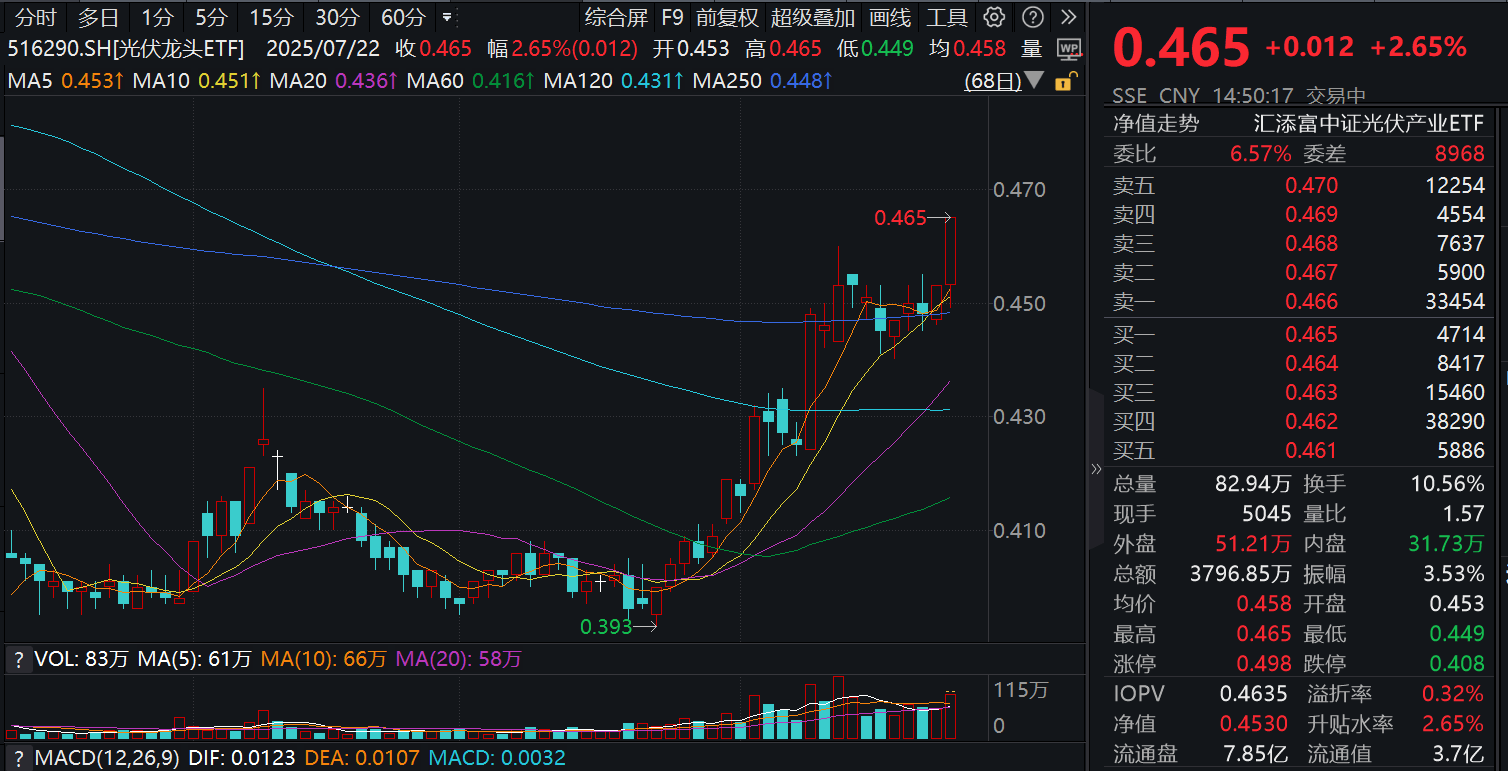
“反内卷”主线发酵,光伏板块午后拉升!费率最低档的光伏龙头ETF(516290)涨近3%,光伏供给侧出清怎么看?
Sou Hu Cai Jing· 2025-07-22 07:16
Group 1 - The core viewpoint of the article highlights the significant upward movement in the stock prices of leading photovoltaic companies, with notable gains in companies such as TBEA and Tongwei [2][3] - The photovoltaic sector is currently facing challenges related to the elimination of outdated production capacity, with a focus on supply-side reforms and technological advancements [4][5] - The photovoltaic glass segment is expected to undergo supply adjustments starting from July 2025, aiming to alleviate inventory pressures and restore price stability within the industry [4] Group 2 - Technological advancements in the battery module segment are anticipated to redefine industry standards for advanced production capacity, with a focus on cost reduction and efficiency improvements [5] - The photovoltaic sector is projected to experience a fundamental recovery, with positive sentiment expected to shift towards the right side, particularly for leading photovoltaic ETFs [5] - The photovoltaic leading ETF (516290) is noted for its low management and custody fees, making it an attractive option for investors [5]
全市场唯一煤炭ETF(515220)涨超5%,规模超60亿元,近10日净流入超14亿元!
Mei Ri Jing Ji Xin Wen· 2025-07-22 06:00
相关机构表示,动力煤价格持续反弹,截至 7 月 18 日,秦港 Q5500 动力煤平仓价为 642 元/吨,今年上 半年最低价格为 609 元,已累计上涨 5.4%。目前动力煤基本面持续利多:从供给端来看,国内生产方 面,截至 7 月 13 日,晋陕蒙三省442 家煤矿开工率 81.1%,仍处于年内较低水平。从库存端来看,港 口库存持续回落,截至 7 月 17 日,环渤海库存 2695.5 万吨,今年上半年最高库存为 3316.3 万吨,已累 计下跌 18.7%,与去年同期基本一致。从需求端来看,电煤方面,截至 7月 17 日,沿海八省电厂日耗 合计 241.9 万吨,涨幅 12.62%,七月以来高温天气带动用电需求提升,煤电日耗需求提高,季节性持 续上涨。 截至 7 月 18 日,京唐港主焦煤报价 1440 元/吨,环比上涨 90 元/吨,涨幅 6.67%,上周开始从 1230 元 的底部反弹;焦煤期货反弹更为明显,从 6 月初的 719 元反弹至当前的 926 元,累计涨幅达到 28.8%。 当前焦煤基本面反映出"强预期但弱现实"的特征。从供给端来看,国内焦企生产积极性恢复,开工率上 涨,蒙煤市场报价坚挺 ...
光伏50ETF(159864)涨超2.1%,行业政策与价格回暖提振市场信心
Mei Ri Jing Ji Xin Wen· 2025-07-22 06:00
华创证券指出,近期光伏板块反内卷呼声高涨,硅料收储、光伏玻璃减产、高层反内卷会议等事件使得 光伏供给侧改革预期增强。目前光伏行业报价已出现全面上调,硅料环节价格大幅上涨,N型复投料、 N型颗粒硅成交均价分别环比上涨12.4%、15.2%,主要因企业长期亏损后为符合"不低于成本销售"要求 而提价。硅片环节价格同步上调,182-210mm N型硅片价格环比涨幅达13.6%-15%,部分头部企业已封 仓待涨。随着硅片环节报价上涨,预计将传导至电池组件环节。2025年1-6月电池组件出口量约 177GW,同比+6%;逆变器出口量约153GW,同比+22%,其中6月江苏逆变器出口额环比大幅增长 59%。未来随着行业自律推进及供给侧政策落地,行业供需有望改善,带动产业链价格及盈利修复。 光伏产业ETF(159864)跟踪的是光伏产业指数(931151),该指数由中证指数有限公司编制,从沪深 市场中选取涉及光伏产业链上下游的上市公司证券作为指数样本,覆盖硅材料、光伏组件、光伏设备及 系统等相关领域。该指数全面反映中国光伏产业相关上市公司证券的整体表现,具有显著的行业集中度 和成长性特征。 没有股票账户的投资者可关注国泰中证 ...
供给侧改革再临,债市是否重蹈覆辙?
Nan Hua Qi Huo· 2025-07-22 05:47
供给侧改革再临,债市是否重蹈覆辙? 徐晨曦(投资咨询资格证号:Z0001908) 投资咨询业务资格:证监许可【2011】1290号 2025年7月22日 自7月初中央财经委会议提出"治理企业低价无序竞争,推动落后产能有序退出"以来,市场炒作"供给侧改 革"的热度再起,股市与商品相关板块反应积极,而7月18日工信部在新闻发布会上宣布十大重点行业淘汰落 后产能的消息将行情推向了新的高度。这不禁令人想起2016-2017年供给侧改革给工业品带来的巨大牛市,而 与此同时10年国债在2.6%-3.0%区间震荡了三个季度后爆发债灾难,此后步入熊市。如今供给侧改革再度来 临,债市是否会重蹈覆辙? 图1.国债收益率与南华工业品指数 数据来源:Wind、南华研究 从基本面来看,上一轮供给侧改革开启之时,PPI已经历了四年多的负增长,产能过剩及其明显,亟需 去产能、去库存来扭转局面。彼时居民与地方政府资产负债表尚无太大问题,搭配供给侧改革,政策方面启 动了货币化棚改,迅速推升了房地产需求,房地产开工面积在2016年一季度一举转正,并在此后两年保持了 较高增速。供给缩减加上需求扩张促使PPI自2016年三季度开始转正,摆脱了通缩态 ...