
供给侧改革

Search documents
金融期货早评-20250722
Nan Hua Qi Huo· 2025-07-22 05:28
Report Industry Investment Ratings No relevant content provided. Core Views of the Report - The RMB exchange rate is likely to remain stable in the short term, with an expected operating range of 7.15 - 7.20 this week [1]. - The stock index is expected to continue its upward trend in the short term, and long - position holders can continue to hold [3]. - The shipping index (European line) futures prices are likely to oscillate slightly downward [5]. - Copper prices may be slightly stronger in the short term but face potential risks in the medium term [6]. - Shanghai aluminum is expected to oscillate at a high level in the short term, while alumina is expected to be strong, and cast aluminum alloy will oscillate at a high level [8][9][10]. - Zinc is expected to oscillate widely, with a long - term downward trend [12]. - Nickel and stainless steel are expected to have upward momentum due to macro - level factors [15]. - Tin prices are recommended for inventory hedging [16]. - Lithium carbonate is expected to oscillate strongly, and enterprises are advised to lock in future production plans [18]. - Industrial silicon is expected to be in an oscillating and slightly stronger state, while polysilicon is expected to oscillate widely in the short term [20]. - Lead is expected to oscillate [22]. - Steel products are expected to remain strong before the Politburo meeting in July, but there is a risk of a pullback [25]. - Iron ore is expected to be strong in the short term, but there may be an over - rise and subsequent correction [26]. - Coking coal and coke are expected to oscillate strongly in the short term, and long - term risks to steel mill profits should be noted [29]. - Ferroalloys are expected to be optimistic in the short term, but the implementation of policies needs to be monitored [32]. - Crude oil is in an oscillating and slightly weak pattern, and there is a risk of a downward turn [35]. - PX - PTA is expected to remain strong in the short term [38]. - Methanol is recommended for a wait - and - see approach [40]. - PP is expected to face resistance in the upward trend, and the recovery of downstream demand and policy implementation need to be focused on [43]. - PE is in a pattern of "weak reality + strong expectation", and this pattern is expected to continue [45]. - PVC is recommended to avoid risks and reduce short positions [47]. - Pure benzene is expected to be strong in the short term, and a wait - and - see approach is recommended [48]. - Styrene's supply - demand pattern has weakened, and short - selling should be cautious [49]. - Fuel oil can be considered for trading the FU09 - 01 spread [51]. - Low - sulfur fuel oil is recommended for a wait - and - see approach [51]. - Asphalt is expected to oscillate in the short term, and the peak season is expected in the long term [52]. - Urea's 09 contract is expected to oscillate strongly [54]. - Soda ash is in a pattern of strong supply and weak demand, and glass is expected to be strong, but the impact of policies needs to be noted [55][56]. - Logs can be considered for a bullish covered strategy [58]. - Pulp is recommended to cautiously chase long positions if the pressure level is effectively broken [61]. - For live pigs, a short - selling approach at high prices is recommended [62]. - For oilseeds, a long - position strategy for far - month contracts is recommended [64]. - Old - crop corn prices are expected to be stable and oscillate narrowly [65]. - Cotton prices are expected to be strong in the short term, but the upper space may be limited [67]. - Sugar prices face upward pressure in the short term [69]. - Apples are expected to maintain a strong pattern in the short term [70]. - Red dates are expected to oscillate slightly in the short term [71]. Summaries by Relevant Catalogs Financial Futures RMB Exchange Rate - **Market Review**: The on - shore RMB against the US dollar closed at 7.1768 at 16:30 yesterday, down 2 basis points from the previous trading day, and closed at 7.1707 at night. The central parity rate of the RMB against the US dollar was reported at 7.1522, down 24 basis points [1]. - **Important Information**: Trump has no plan to fire Powell, and US Treasury Secretary Yellen believes that interest rates should be lowered if inflation data is low [1]. - **Core Logic**: The US dollar index is likely to continue its weak trend, and the RMB exchange rate is expected to remain stable in the short term [1]. Stock Index - **Market Review**: The stock index was strong yesterday, with small and medium - cap stock indices performing better. The trading volume of the two markets increased by 1289.37 billion yuan [2]. - **Important Information**: The US Treasury Secretary believes that the Fed's policy needs to be re - examined, and trade negotiations will prioritize quality [3]. - **Core Logic**: The stock index rose with increasing volume, and is expected to continue its upward trend in the short term [3]. Shipping Index (European Line) - **Market Review**: The prices of shipping index (European line) futures contracts oscillated upward in the morning and fell in the afternoon [3]. - **Spot Market**: The quotes of Maersk and CMA CGM showed different trends, with CMA CGM's quotes falling [4]. - **Important Information**: The Israeli military expanded its military operations in Gaza [4]. - **Core Logic**: The decline in CMA CGM's quotes brought negative sentiment, and the futures prices are likely to oscillate slightly downward [5]. Commodities Non - ferrous Metals - **Copper**: The copper index rose significantly on Monday. The anti - involution policy affected the non - ferrous metal sector, and copper prices may be slightly stronger in the short term but face risks in the medium term [6]. - **Aluminum Industry Chain** - **Aluminum**: Macro - level factors boosted sentiment, and low inventory supported prices. Shanghai aluminum is expected to oscillate at a high level in the short term [8][9]. - **Alumina**: The decline in warehouse receipts and macro - policies led to strong sentiment, and alumina is expected to be strong in the short term [10]. - **Cast Aluminum Alloy**: High scrap aluminum prices supported costs, but demand was weak. It is expected to oscillate at a high level [11]. - **Zinc**: The macro "anti - involution" sentiment drove prices up, but the supply was gradually shifting from tight to surplus, and demand was weak. Zinc is expected to oscillate widely and decline in the long term [12]. - **Nickel and Stainless Steel**: The prices were affected by macro - level and supply - side factors. The market is expected to have upward momentum [13][15]. - **Tin**: The rise in tin prices was due to the impact of the anti - involution policy on the non - ferrous metal sector. It is recommended for inventory hedging [16]. - **Lithium Carbonate**: The futures prices oscillated strongly. The reduction in warehouse receipts and strong macro - sentiment supported prices. Enterprises are advised to lock in future production plans [17][18]. - **Industrial Silicon and Polysilicon** - **Industrial Silicon**: Demand provided some support, but high inventory limited the upward space. It is expected to be in an oscillating and slightly stronger state [20]. - **Polysilicon**: The macro - sentiment was strong, but there was a risk of "strong expectation, weak reality". It is expected to oscillate widely in the short term [20]. - **Lead**: The macro "anti - involution" policy drove prices up. Supply was tight, and demand was weak. Lead is expected to oscillate [22]. Black Metals - **Rebar and Hot - Rolled Coil**: The prices rose to a new high. The policy and the start of the hydropower project in the lower reaches of the Yarlung Zangbo River strengthened the market's expectations of supply contraction and demand expansion [23][25]. - **Iron Ore**: The prices were strong. The increase in iron ore production and the tight supply - demand balance supported prices, but there was a risk of over - rise [26]. - **Coking Coal and Coke**: The second round of price increases was initiated. The macro - environment was favorable, but there were potential risks to steel mill profits in the long term [28][29]. - **Ferroalloys**: The profit of ferroalloys was repaired, and the demand was supported by iron ore production. The prices are expected to be optimistic in the short term, but the implementation of policies needs to be monitored [30][32]. Energy and Chemicals - **Crude Oil**: The prices decreased slightly, with shrinking trading volume. The market was in an oscillating and slightly weak pattern, and there was a risk of a downward turn [33][35]. - **PTA - PX**: The fundamentals had limited driving force, and the prices were expected to be strong in the short term due to the anti - involution policy [36][38]. - **Methanol**: The inventory was accumulating, and the market was affected by the anti - involution policy. A wait - and - see approach was recommended [39][40]. - **PP**: The prices rose due to macro - level factors, but the supply pressure was high, and demand was in the off - season. The upward trend may face resistance [41][43]. - **PE**: The market was in a pattern of "weak reality + strong expectation", and this pattern is expected to continue [44][45]. - **PVC**: The anti - involution sentiment drove prices up, but the fundamentals were poor. It is recommended to avoid risks and reduce short positions [45][47]. - **Pure Benzene**: The supply and demand showed different trends, and the prices were expected to be strong in the short term [48]. - **Styrene**: The supply - demand pattern weakened, and short - selling should be cautious [49]. - **Fuel Oil**: The supply was tight, and demand was strong. The FU09 - 01 spread can be considered [50][51]. - **Low - Sulfur Fuel Oil**: The supply decreased, and demand improved slightly. A wait - and - see approach was recommended [51]. - **Asphalt**: The supply increased slightly more than expected, and demand was in the off - season. The prices are expected to oscillate in the short term, and the peak season is expected in the long term [51][52]. - **Urea**: The anti - involution policy supported prices. The 09 contract is expected to oscillate strongly [53][54]. - **Glass and Soda Ash** - **Soda Ash**: The supply was in a narrow - range fluctuation, and demand was weak. The market was in a pattern of strong supply and weak demand [55]. - **Glass**: The anti - involution expectation drove prices up, and the market was in a weak balance [56]. Others - **Logs**: The valuation was repaired, and the prices are expected to be strong. A bullish covered strategy can be considered [57][58]. - **Pulp**: The demand from the downstream paper industry was weak, and the supply was stable. Pulp prices are recommended to cautiously chase long positions if the pressure level is effectively broken [59][61]. Agricultural Products - **Live Pigs**: The futures prices rose, and the spot prices showed different trends in different regions. A short - selling approach at high prices is recommended [62]. - **Oilseeds**: The prices of external and internal markets showed different trends. A long - position strategy for far - month contracts is recommended [63][64]. - **Corn and Starch**: The corn prices were stable, and the starch inventory decreased. Old - crop corn prices are expected to be stable and oscillate narrowly [65]. - **Cotton**: The ICE cotton futures prices fell, and the domestic cotton prices were supported by low inventory but faced pressure from weak demand. The prices are expected to be strong in the short term but with limited upward space [66][67]. - **Sugar**: The international and domestic sugar prices faced pressure. Sugar prices are expected to face upward pressure in the short term [69]. - **Apples**: The futures prices rose slightly, and the spot prices were stable. The prices are expected to maintain a strong pattern in the short term [70]. - **Red Dates**: The second - crop fruit setting was better than expected, and the third - crop was in a critical period. The prices are expected to oscillate slightly in the short term [71].
研究所日报-20250722
Yintai Securities· 2025-07-22 05:19
Group 1 - The introduction of the "Housing Rental Regulations" aims to standardize rental activities and promote high-quality development in the housing rental market, marking a significant step towards establishing a dual housing system of purchase and rental [2] - Central Huijin's investment of 200 billion yuan in 10 broad-based ETFs during Q2 is expected to boost market confidence and support A-shares, particularly after the recent market fluctuations [3] - The construction of 14 major projects in China, with a total investment of 136.2 billion yuan, indicates a critical bidding window in the next 3-5 years, as the controlled nuclear fusion sector enters a phase of intensive infrastructure development [4] Group 2 - The National Energy Administration reported a 5.4% year-on-year increase in total electricity consumption in June, indicating strong domestic electricity demand and potential growth in related power generation capacities [5] - The upcoming World Robot Conference and World Humanoid Robot Games in Beijing are expected to showcase advancements in robotics, potentially driving investment opportunities in the humanoid robot sector [5] - UBS's analysis suggests that the "anti-involution" policies may lead to improved supply-demand relationships and enhanced corporate profitability, with a focus on industries like new energy vehicles and solar energy [6][8] Group 3 - The report highlights that stock prices typically respond positively to incremental policies, with significant outperformance observed in related sectors during the initial phases of policy implementation [6] - The initial correlation between stock prices and commodity prices tends to decouple over time, with significant price increases observed in commodities during capacity reduction efforts [7] - The distinction between "anti-involution" measures and supply-side reforms suggests that current adjustments may be more market-driven, focusing on emerging industries dominated by non-state enterprises [8] Group 4 - The construction materials, building decoration, and steel industries have shown the highest growth rates recently, indicating strong performance in these sectors [24] - The mechanical equipment, construction materials, and electric equipment sectors have seen significant net capital inflows, reflecting investor interest and confidence in these areas [26] - The recent changes in market turnover and trading volume suggest a dynamic shift in investor behavior and sector performance, with notable fluctuations in the TMT and cyclical sectors [31]
新世纪期货交易提示(2025-7-22)-20250722
Xin Shi Ji Qi Huo· 2025-07-22 05:16
Industry Investment Ratings - Iron ore: Upward [2] - Coking coal and coke: Upward [2] - Rolled steel and rebar: Bullish [2] - Glass: Upward [2] - Soda ash: Bullish [2] - CSI 300 Index Futures/Options: Sideways [4] - SSE 50 Index Futures/Options: Rebound [2] - CSI 500 Index Futures/Options: Upward [4] - CSI 1000 Index Futures/Options: Upward [4] - 2-year Treasury Bonds: Sideways [4] - 5-year Treasury Bonds: Sideways [4] - 10-year Treasury Bonds: Rebound [4] - Gold: Bullish sideways [6] - Silver: Bullish [6] - Pulp: Sideways with a bullish bias [6] - Logs: Bullish sideways [6] - Soybean oil: Sideways correction [6] - Palm oil: Sideways correction [6] - Rapeseed oil: Sideways correction [8] - Soybean meal: Sideways with a bullish bias [8] - Rapeseed meal: Sideways with a bullish bias [8] - Soybean No. 2: Sideways with a bullish bias [8] - Soybean No. 1: Sideways with a bullish bias [8] - Live pigs: Sideways with a bearish bias [8] - Rubber: Sideways [10] - PX: On the sidelines [10] - PTA: On the sidelines [10] - MEG: On the sidelines [10] - PR: On the sidelines [10] - PF: Sideways with a bearish bias [10] Core Views - The anti-involution policy has boosted the sentiment of the black market, but the long-term supply-demand surplus pattern of iron ore remains unchanged. The coking coal and coke market is expected to be bullish in the short term, and the steel and glass markets are supported by macro and policy factors. The stock index futures market shows a mixed trend, and the bond market is expected to rebound slightly. The precious metals market is expected to be bullish, and the pulp and log markets are expected to be bullish sideways. The oil and fat market may correct in the short term, and the agricultural products market shows a mixed trend. The soft commodities market is expected to be sideways, and the polyester market is on the sidelines [2][4][6][8][10] Summary by Categories Black Industry - Iron ore: The global iron ore shipment volume increased, and the supply is still abundant. The iron ore port inventory increased slightly, and the short-term fundamentals are acceptable. The long-term supply is expected to increase, and the demand is relatively low. The price has broken through the previous high and is expected to be bullish [2] - Coking coal and coke: After the second round of price increases, the cost pressure of coke remains, and the market is expected to be bullish. The current fundamentals are healthy, and the price is expected to be bullish in the short term. The coking plant's operation is stable, and the supply is slightly tight. The downstream demand is weak, but the steel mill's procurement enthusiasm has increased [2] - Rolled steel and rebar: The anti-involution policy has boosted the supply-side sentiment, and the steel industry's stable growth expectation has pushed up the market sentiment. The construction material demand has declined in the off-season, but the profit of the five major steel products is acceptable, and the supply-demand contradiction is not prominent. The total demand is expected to be low, and the price is supported by macro and policy factors [2] - Glass: The anti-involution trading may continue, and the macro environment is neutral to bullish. The demand for glass deep processing orders has weakened, but the speculative demand is strong. The supply is expected to increase, and the pressure remains. The downstream inventory is low, but the rigid demand has not recovered. The long-term demand is difficult to increase significantly, and the price is expected to be bullish in the short term [2] Financial Industry - Stock index futures/options: The previous trading day, the CSI 300 Index rose 0.67%, the SSE 50 Index rose 0.28%, the CSI 500 Index rose 1.01%, and the CSI 1000 Index rose 0.92%. The construction materials and engineering machinery sectors saw capital inflows, while the education and banking sectors saw capital outflows. The European leaders' visit to China and the stable LPR have boosted the market sentiment. The market risk aversion has eased, and it is recommended to hold long positions in the stock index [4] - Treasury bonds: The yield of the 10-year Treasury bond increased by 1bp, and the market interest rate was stable. The central bank conducted 170.7 billion yuan of 7-day reverse repurchase operations, with a net withdrawal of 5.55 billion yuan. The bond market is expected to rebound slightly, and it is recommended to hold long positions in Treasury bonds [4] Precious Metals Industry - Gold: The pricing mechanism of gold is shifting from the traditional real interest rate to central bank gold purchases. The currency, financial, and hedging attributes of gold are prominent. The US debt problem and the trade tension have supported the price of gold. The Fed's interest rate and tariff policies may be short-term disturbances, and the price is expected to be bullish sideways [6] - Silver: The price of silver is expected to be bullish. The inflation data shows resilience, and the market uncertainty before the new tariff deadline has increased the demand for hedging funds. The Fed's interest rate cut expectation in September has supported the price of silver [6] Light Industry - Pulp: The spot market price of pulp is rising, but the cost is falling, which weakens the support for the price. The papermaking industry's profitability is low, and the demand is in the off-season. The anti-involution policy has boosted the market sentiment, and the price is expected to be sideways with a bullish bias [6] - Logs: The daily出库 volume of logs has increased, and the cost has risen, which strengthens the support for the price. The supply pressure is not large, and the anti-involution policy has boosted the market sentiment. The price is expected to be bullish sideways [6] Oil and Fat Industry - Soybean oil, palm oil, and rapeseed oil: The production of Malaysian palm oil decreased in June, but the inventory increased. The export may slow down in July. The production of US biodiesel is increasing, which supports the demand for soybean oil. The domestic inventory of the three major oils is rising, and the supply is abundant. The demand is in the off-season, but the biodiesel expectation has boosted the price. The price may correct in the short term [6][8] Agricultural Products Industry - Soybean meal, rapeseed meal, soybean No. 2, and soybean No. 1: The estimated yield of US soybeans has been reduced, but the end-of-year inventory has increased. The growth of US soybeans is good, and the consumption of soybean meal is expected to increase. The domestic supply of soybeans is abundant, and the price is expected to be sideways with a bullish bias [8] - Live pigs: The average trading weight of live pigs is decreasing, and the price has risen slightly but is expected to decline. The supply of live pigs is increasing, and the consumption demand is restricted by high temperatures. The slaughtering enterprise's operating rate is expected to decline slightly [8] Soft Commodities Industry - Rubber: The raw material supply of natural rubber is tight due to rainfall, and the price has risen. The tire industry's capacity utilization rate has recovered, but the growth is restricted by the market demand. The inventory of natural rubber is increasing, and the price is expected to be sideways [10] Polyester Industry - PX: The geopolitical situation has eased, which has pressured the oil price. The short-term supply of PX is tight, and the price follows the oil price [10] - PTA: The cost is sideways, and the supply has increased. The downstream polyester factory's operating rate has decreased slightly, and the medium-term supply-demand is expected to weaken. The price follows the cost in the short term [10] - MEG: The recent arrival volume is small, and the port inventory has decreased slightly. The terminal demand is weak, and the supply pressure has eased. The medium-term supply-demand is expected to be balanced. The cost has rebounded, and the price is expected to be bullish sideways [10] - PR: The cost is supportive, but the downstream demand is rigid. The polyester bottle sheet market is expected to be sorted out narrowly [10] - PF: The support is weak, and the industry supply pressure is large. The polyester staple fiber market is expected to be sideways with a bearish bias [10]
新能源及有色金属日报:强宏观弱需求,现货升水快速走弱-20250722
Hua Tai Qi Huo· 2025-07-22 05:04
Report Summary 1. Report Industry Investment Rating - Unilateral: Neutral [4] - Arbitrage: Neutral [4] 2. Core View - Strong macro and weak demand lead to a rapid decline in spot premiums. Although the downstream开工率 shows relative resilience and overall consumption is not bad, it cannot offset the high growth on the supply side, resulting in a rapid decline in spot premiums in the spot market, which have now generally turned into discounts. The overseas inventory has the expectation of delivery risk, and the domestic social inventory shows a trend of accumulation, which is expected to remain unchanged in the second half of the year. After the emotional disturbance, the pattern of oversupply may re - dominate the price trend [3] 3. Summary by Related Catalogs Important Data - **Spot**: LME zinc spot premium is $4.75/ton. SMM Shanghai zinc spot price rose by 500 yuan/ton to 22,820 yuan/ton compared with the previous trading day, and the spot premium decreased by 55 yuan/ton to - 65 yuan/ton. SMM Guangdong zinc spot price rose by 540 yuan/ton to 22,820 yuan/ton, and the spot premium decreased by 15 yuan/ton to - 65 yuan/ton. SMM Tianjin zinc spot price rose by 500 yuan/ton to 22,780 yuan/ton, and the spot premium decreased by 55 yuan/ton to - 105 yuan/ton [1] - **Futures**: On July 21, 2025, the main SHFE zinc contract opened at 22,420 yuan/ton and closed at 22,925 yuan/ton, up 625 yuan/ton from the previous trading day. The trading volume was 251,405 lots, an increase of 100,339 lots from the previous trading day. The positions were 133,314 lots, an increase of 17,346 lots from the previous trading day. The intraday price fluctuated, with the highest point reaching 22,945 yuan/ton and the lowest point reaching 22,415 yuan/ton [1] - **Inventory**: As of July 21, 2025, the total inventory of zinc ingots in seven regions monitored by SMM was 92,700 tons, a decrease of 400 tons from the same period last week. As of July 21, 2025, the LME zinc inventory was 118,225 tons, a decrease of 875 tons from the previous trading day [2] Market Analysis - In the spot market, due to the policy - driven rise in absolute prices and weak consumption, the spot premium further declined. On the cost side, the imported ore TC continues to rise, and the smelting profit is maintained, with the expectation of an increase in supply remaining unchanged. Smelters have sufficient raw material reserves and are not very enthusiastic about purchasing from the ore end. On the consumption side, although the downstream开工率 shows relative resilience, it cannot offset the high growth on the supply side [3] Strategy - Unilateral: Neutral [4] - Arbitrage: Neutral [4]
东海证券晨会纪要-20250722
Donghai Securities· 2025-07-22 04:30
Group 1: Key Recommendations - Nvidia has resumed sales of its H20 chips to China, which is expected to alleviate the domestic market's computing power shortage in the short term. AMD has also resumed sales of its MI308 chips to China. The long-term trend indicates a push towards self-sufficiency in AI chip development in China [6][7] - TSMC reported Q2 2025 revenue exceeding $30 billion, with a year-on-year growth of 44.4% and a net profit increase of 60.7%. The revenue from 7nm and below process nodes accounted for 74% of total revenue, with high-performance computing revenue growing by 14% quarter-on-quarter [8] - Global smartphone shipments grew by 1% year-on-year in Q2 2025, while shipments in China declined by 4%. The overall demand in the electronics sector is in a phase of mild recovery, with a focus on AIOT, AI-driven technologies, and consumer electronics [10][11] Group 2: Industry Insights - The Ministry of Industry and Information Technology is set to introduce a growth stabilization plan for key industries such as steel, non-ferrous metals, and petrochemicals, which may positively impact the chemical industry [13] - A fire at Covestro's plant in Germany has disrupted TDI supply, leading to price increases. The TDI price is expected to rise due to supply constraints from Covestro, maintenance in Asia, and increased overseas demand [14][15] - The pharmaceutical and biotechnology sector saw a 4% increase last week, outperforming the broader market. The 11th batch of national drug procurement has been initiated, focusing on mature drugs, which may enhance the industry's growth prospects [20][21]
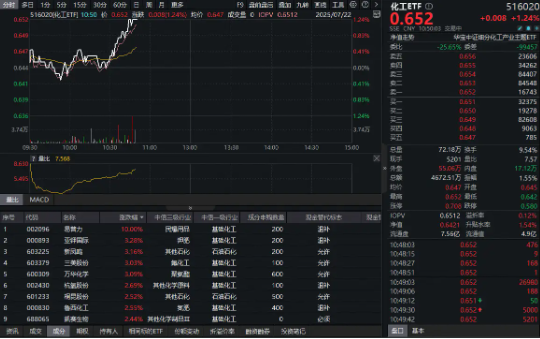
化工股爆发,易普力涨停!政策暖风+估值十年低位,板块抢筹正当时?
Xin Lang Ji Jin· 2025-07-22 03:11
Group 1 - The chemical sector is experiencing a strong rally, with the chemical ETF (516020) rising by 1.24% as of the latest update [1] - Key stocks such as Yipuli and Yara International have seen significant gains, with some stocks increasing over 3% [1] - The current situation in the chemical industry is reminiscent of the supply-side reforms of 2014-2015, suggesting a potential turning point for the sector [2] Group 2 - Domestic policies frequently emphasize supply-side requirements, while international factors like rising raw material costs and capacity exits in Europe and the U.S. add uncertainty to chemical supply [3] - The Chinese chemical industry is expected to leverage its competitive advantages in cost and technology to fill gaps in the international supply chain [3] - The implementation of new policies aimed at stabilizing growth in key industries, including chemicals, is anticipated to lead to structural adjustments and the elimination of outdated capacities [3] Group 3 - The chemical ETF (516020) tracks the CSI Sub-Industry Chemical Index, with nearly 50% of its holdings in large-cap stocks, providing an efficient way to invest in the sector [4] - The ETF includes a diverse range of chemical sub-sectors, allowing investors to capture various investment opportunities within the chemical industry [4]





化工“反内卷”系列报告(开篇):“反内卷”势在必行,化工行业新一轮供给侧改革呼之欲出
KAIYUAN SECURITIES· 2025-07-22 02:38
Investment Rating - The investment rating for the chemical industry is "Positive (Maintain)" [1] Core Viewpoints - The chemical industry is facing intensified competition leading to profit pressure, necessitating a "de-involution" approach to improve the competitive landscape and achieve normal profit levels [5][15] - Domestic demand is expected to stabilize and recover, while export demand growth may be limited due to frequent anti-dumping cases against Chinese chemical products [6][59] - The current valuation of the basic chemical and petrochemical sectors is at historical lows, indicating a need for policy-driven valuation recovery [70] Summary by Sections 1. Supply Side: - The chemical industry has seen increased competition since 2025, resulting in continuous profit pressure. The Chemical Product Price Index (CCPI) decreased by 6.95% from the beginning of 2025 [16] - From January to May 2025, the chemical raw materials and products industry achieved a revenue of 3.70 trillion yuan, a year-on-year increase of 2.1%, but the total profit decreased by 4.7% [16] - The overall capacity utilization rates for chemical raw materials and chemical fiber manufacturing were 71.90% and 85.60%, respectively, showing a decline [16][20] 2. Demand Side: - The 2025 Government Work Report emphasizes boosting consumption and investment efficiency, which is expected to gradually restore domestic demand [6][50] - In the first half of 2025, the sales area of commercial housing decreased by 3.5%, indicating a narrowing decline [50][53] - The automotive sector showed growth, with vehicle and new energy vehicle sales increasing by 10.8% and 36.2%, respectively, in the first half of 2025 [50][58] 3. Cost Side: - Since 2025, international oil prices have experienced significant fluctuations, with Brent and WTI crude oil prices down by 5.73% and 4.56% respectively from the beginning of 2025 [64] - Domestic coal and natural gas prices have also seen a downward trend, with coal prices down by 19.45% compared to the beginning of 2025 [64] 4. Valuation: - As of July 11, 2025, the price-to-earnings (P/E) ratios for the basic chemical and petrochemical sectors were 25.37 and 16.74, respectively, indicating they are at historical low levels [70][73]
钢铁ETF(515210)昨日净流入超2.2亿,螺纹钢价格回升或提振板块预期
Mei Ri Jing Ji Xin Wen· 2025-07-22 02:27
Group 1 - The core viewpoint is that rebar prices have reached a new high since April, with a week-on-week increase of 0.93%, and national blast furnace capacity utilization has risen by 0.99 percentage points to 90.89% [1] - The price difference between medium-thick plates and rebar is at a relatively high level, with the price difference between hot-rolled and rebar being 110 yuan per ton [1] - The Ministry of Industry and Information Technology revised the "Steel Industry Normative Conditions" in February 2025, implementing a two-tier evaluation system, which is expected to help restore steel sector profitability to historical average levels under the policy direction of better adapting supply to demand changes [1] Group 2 - The Steel ETF (515210) tracks the CSI Steel Index (930606), which selects listed companies involved in the entire industrial chain of iron ore mining, steel smelting, and product manufacturing to reflect the overall performance of the steel industry [1] - The index serves as an important reference indicator for observing the development trends of the Chinese steel industry, covering key upstream, midstream, and downstream segments of the steel industry chain [1] - Investors without stock accounts can consider the Guotai CSI Steel ETF Connect C (008190) and Guotai CSI Steel ETF Connect A (008189) [1]
建信期货铝日报-20250722
Jian Xin Qi Huo· 2025-07-22 02:10
1. Report Industry Investment Rating - No relevant information provided. 2. Core View of the Report - The macro - atmosphere boost pushed up aluminum - related varieties. Alumina was most significantly affected, but its over - supply pattern remained unchanged, so it's necessary to be cautious about chasing high prices. The rise of aluminum prices was more of a follow - up to the general increase in the sector, and the upside space was difficult to open for now. In the traditional off - season, both supply and demand of electrolytic aluminum were weak, while smelting profits were still high. The market would run strongly in the short - term due to the high macro - atmosphere, and attention should be paid to the performance near the previous high resistance level [8]. 3. Summary by Relevant Catalogs 3.1行情回顾与操作建议 - On the 21st, alumina once hit the daily limit, with the main contract 2509 reaching 3405 yuan/ton, and closing up 8.39% at 3386 yuan/ton. Shanghai aluminum 2509 rose 1.63% to 20840 yuan/ton, and the total open interest of the index increased by 38002 to 674818 lots. The 08 - 09 premium was reported at 30. Cast aluminum alloy 2511 rose 1.41% to 20165, and the AD - AL negative spread widened to - 540 [8]. - The fundamentals of the aluminum industry chain had no significant changes. The market was mainly stimulated by the news from the Ministry of Industry and Information Technology after the market closed on Friday. A work plan for stabilizing growth in ten key industries such as steel, non - ferrous metals, and petrochemicals was about to be introduced [8]. - Currently in the traditional off - season, the domestic electrolytic aluminum operating capacity remained at a high level, and the demand side was still troubled by the off - season. The operating rate of the aluminum processing link was still weak. With the high absolute price of aluminum, the negative feedback effect on terminal consumption was expected to reappear, and the demand side was expected to continue the weak atmosphere [8]. - The alumina futures price soared, but the spot price increase was limited for the time being. The smelting profit of the electrolytic aluminum industry had exceeded 4200 yuan/ton, at a high level [8]. 3.2行业要闻 - China's primary aluminum (electrolytic aluminum) output in June 2025 was 3.81 million tons, a year - on - year increase of 3.4%. In June, the domestic electrolytic aluminum operating capacity changed slightly due to the second - phase replacement of electrolytic aluminum from Shandong to Yunnan. In July, the domestic electrolytic aluminum operating capacity remained at a high level, and the second - batch replacement project in Yunnan was put into operation [9]. - The Ministry of Housing and Urban - Rural Development's research team went to Guangdong and Zhejiang for research, emphasizing promoting the stable, healthy, and high - quality development of the real estate market, and required accelerating the construction of "good houses" and taking multiple measures to stabilize the market [9]. - Alcoa expected its San Ciprián aluminum smelter in Spain to restart in mid - 2026, with an expected net loss of about $90 million to $110 million in 2025. The restart was postponed due to a nationwide power outage in Spain in April, and it restarted on July 14 after the Spanish government provided detailed reports and consultations on power outage reasons and grid resilience improvement measures [9][10].
建信期货铜期货日报-20250722
Jian Xin Qi Huo· 2025-07-22 02:10
Report Information - Report Name: Copper Futures Daily Report [2] - Date: July 22, 2025 [3] - Researcher: Zhang Ping, Yu Feifei, Peng Jinglin [4] Industry Investment Rating - No relevant information provided Core View - The macro - level is the main reason for the recent rise in copper prices. The Ministry of Industry and Information Technology is about to introduce a plan to stabilize growth for industries such as non - ferrous metals, which has raised market expectations for a new round of supply - side reform. With the short - term hype points of copper supply - side reform and a relatively strong fundamental situation, copper prices are expected to rise further [12] Summary by Directory 1. Market Review and Operation Suggestions - Shanghai copper prices rose, with total positions increasing by 14,000 lots and trading volume significantly expanding. The market maintained a near - month contango structure and a far - month ack structure, and the spot premium rose to 220 due to tight market supply. Domestic social inventories decreased by 24,700 tons to 118,600 tons over the weekend, and low inventories began to affect the spot premium. The LME market had a slight inventory reduction of 100 tons, and the expectation of inventory accumulation continued to suppress the 0 - 3 contango structure. The overseas market was affected by the upcoming US tariff on copper, showing a pattern of strong domestic and weak overseas fundamentals [12] 2. Industry News - In June 2025, China's copper enameled wire exports were 12,222.29 tons, a year - on - year increase of 18.35% and a month - on - month increase of 0.93%. From January to June, the total exports were 69,586.5 tons, a cumulative year - on - year increase of 25.32% [13] - In June 2025, China imported 34,700 tons of scrap copper ingots (red/purple copper ingots), a month - on - month decrease of 5% and a year - on - year increase of 71%. From January to June, the cumulative imports were 226,700 tons, a cumulative year - on - year increase of 111% [13] - In June 2025, China imported 68,500 tons of anode copper, a month - on - month decrease of 1.26% and a year - on - year increase of 2.38%. From January to June, the cumulative imports were 382,700 tons, a cumulative year - on - year decrease of 17.56% [13]