
股债跷跷板

Search documents
债市接连下跌 什么情况?
Zheng Quan Shi Bao· 2025-12-09 00:17
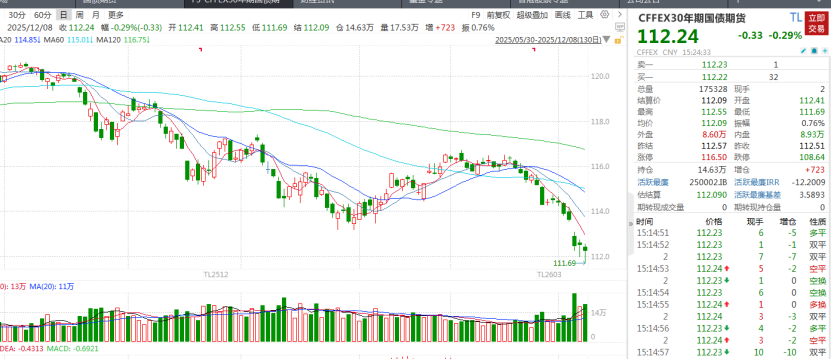
Group 1 - The bond market has experienced significant volatility and downward pressure this year, leading to a decline in the net value of bond funds and increased redemption pressure [1] - The 30-year treasury futures have seen a cumulative decline of over 8% since their peak in February, with other maturities also experiencing price drops, albeit to a lesser extent [2] - The recent downturn in the bond market is attributed to year-end profit-taking by institutions and a lack of clear positive catalysts, resulting in strong selling pressure [2][3] Group 2 - Over 200 bond funds have reported negative annual returns, with 13 funds showing returns below -5% and 215 funds below -1% [4] - The performance of convertible bond funds and mixed equity-bond funds has been relatively strong, benefiting from the performance of the equity and convertible bond markets [4] - The current market conditions suggest that the bond market may face continued downward pressure, with a lack of willingness among major institutional investors to take a bullish stance [4][5]
债市接连下跌,什么情况?
Zheng Quan Shi Bao· 2025-12-08 13:53
Core Viewpoint - The bond market has experienced significant volatility and downward pressure in 2023, leading to declines in bond fund net values and increased redemption pressures for investors [1] Group 1: Market Performance - The 30-year government bond futures have seen a cumulative decline of over 8% since their peak in February, with other maturities also experiencing price drops, albeit to a lesser extent [2] - As of December 5, nearly 800 bond funds reported negative annual returns, with 13 funds showing returns below -5% and 215 funds below -1% [6] Group 2: Market Influences - The recent downturn in the bond market is attributed to year-end profit-taking by institutions and a lack of clear positive catalysts, leading to increased selling pressure [4] - The stock market's weakness has also contributed to selling pressure in the bond market, which has not exhibited the typical "stock-bond seesaw" behavior, particularly in the long-end bonds [4] Group 3: Regulatory and Policy Impact - The "anti-involution" policy has led to an increase in bond yields, with new regulatory proposals adding to market uncertainty and prompting institutions to sell off bonds to avoid volatility [5] - The central bank's actions regarding government bonds are seen as more symbolic than substantive, with expectations of increased cooperation in the new year as fiscal measures are anticipated [7] Group 4: Future Outlook - Analysts suggest that the bond market's downward trend may continue due to a lack of willingness among major institutional investors to take a bullish stance [7] - There is a recommendation for investors to focus on short- and medium-term bond funds that are more sensitive to liquidity, while maintaining a cautious approach towards longer-term bonds until market trends become clearer [7]


债市接连下跌,什么情况?
证券时报· 2025-12-08 13:31
Core Viewpoint - The bond market has experienced significant volatility and downward pressure in 2023, leading to net value declines for bond funds and increased redemption pressures for investors [1][5]. Group 1: Market Performance - Since the beginning of the year, the bond market has shown frequent fluctuations, with the 30-year treasury futures price retreating over 8% from its peak in February [2][3]. - As of December 5, nearly 800 bond funds reported negative annual returns, with 215 funds yielding less than -1% [7][8]. Group 2: Causes of Market Decline - The recent decline in the bond market is attributed to year-end profit-taking by institutions, a lack of clear positive catalysts, and selling pressure from the stock market affecting bond prices [5][6]. - The bond market has not exhibited the typical "stock-bond seesaw" behavior, particularly in the long-duration bonds, which have shown significant interest rate increases [5][6]. Group 3: Future Outlook - Analysts suggest that the bond market may face continued downward pressure due to a lack of willingness among major institutional investors to take a bullish stance [9]. - Despite the current challenges, there is potential for a rebound in the bond market after year-end adjustments, as institutions may still have a demand for increased allocations [9][10].


流动性充裕难掩情绪脆弱
Southwest Securities· 2025-12-08 13:14
1. Report Industry Investment Rating - Not provided in the document 2. Core Viewpoints of the Report - Last week, the traditional "stock-bond seesaw" effect failed again, with both the stock and bond markets rising and falling together. Long-term interest rates fluctuated sharply between the "reality of loose money" and the "frustration of strong expectations," and the oversold of ultra-long-duration assets reflected the crowding of market funds and the fragility of market sentiment [3][91]. - In the last four trading weeks of the year, the fact that the "sales new rules" have not fully "landed" remains the main market concern, but the approaching important meetings have restored the "loose money" expectation. The focus of market gaming may still be the emotional fluctuations caused by marginal policy changes [3][92]. - The report maintains the judgment of a recovery market in December but expects the downward space of interest rates to be relatively limited. It is recommended to adopt a left-side layout configuration rhythm, prioritize switching positions to medium - and short - term treasury bonds and policy financial bonds, and pay attention to trading opportunities of secondary perpetual bonds of the same term. As the meeting window approaches, gradually increase the offensive nature of the portfolio, control the overall duration center of the portfolio within the medium - to long - term range of 5 - 7 years, and avoid high - congestion assets [3][92][93]. 3. Summary According to the Directory 3.1 Important Matters - On December 5, 2025, the central bank will conduct a 1000 - billion - yuan 3 - month (91 - day) fixed - quantity, interest - rate - tendered, multi - price - winning bidder - selected买断式逆回购 operation. The net investment of the central bank in treasury bonds in November was 5 billion yuan, far lower than the market's relatively optimistic expectation of 100 billion yuan. On December 5, 2025, six major banks stopped selling 5 - year large - denomination certificate of deposit products [6][9]. 3.2 Money Market 3.2.1 Open Market Operations and Fund Interest Rate Trends - From December 1 to 5, 2025, the central bank's 7 - day reverse repurchase operation had a net investment of - 84.8 billion yuan. It is expected that the basic currency will have a maturity withdrawal of 66.38 billion yuan from December 8 to 12, 2025. At the beginning of the month, the fund market was generally loose, and DR001 fell below 1.3% for the first time this year [14][15]. 3.2.2 Certificate of Deposit Interest Rate Trends and Repurchase Transaction Situations - In the primary market, the issuance scale of inter - bank certificates of deposit last week was 495.91 billion yuan, a decrease of 63.54 billion yuan from the previous week. The net financing scale was 47.1 billion yuan, an increase of 289.69 billion yuan from the previous week. The issuance interest rates of inter - bank certificates of deposit generally increased last week. In the secondary market, the yields of inter - bank certificates of deposit generally increased last week [25][31][34]. 3.3 Bond Market - In the primary market, the supply scale of interest - rate bonds decreased last week, with an actual issuance of 430.717 billion yuan and a net financing of 128.844 billion yuan. As of December 5, 2025, the cumulative net financing scale of various treasury bonds in 2025 was about 6.23 trillion yuan, and that of various local bonds was about 7.11 trillion yuan, showing a significant increase compared with the average values from 2021 to 2024. As of last week, the issuance scale of special refinancing bonds in 2025 had reached 2.29 trillion yuan, mainly with long - term and ultra - long - term maturities [38][44][48]. - In the secondary market, at the beginning of the month, the short - term interest rates were stable, while the ultra - long - term interest rates continued to be affected by market noise and increased significantly. The yields of 1 - year, 3 - year, 5 - year, 7 - year, 10 - year, and 30 - year treasury bonds changed by - 0.01BP, - 1.46BP, 1.39BP, 0.17BP, 0.68BP, and 7.20BP respectively. The 10Y - 1Y treasury bond yield spread increased from 43.95BP to 44.64BP. The yields of the same - term CDB bonds also changed, and the 10Y - 1Y CDB bond yield spread increased from 34.94BP to 37.66BP. The implied tax rate of 10 - year CDB bonds increased slightly [51]. 3.4 Institutional Behavior Tracking - Last week, the leveraged trading scale was generally stable due to the relatively loose fund market. In the cash bond market, state - owned banks significantly increased their holdings of treasury bonds within 5 years and local bonds within 10 years; rural commercial banks mainly increased their holdings of 5 - 10 - year policy financial bonds and treasury bonds over 5 years; insurance companies continued to prefer local bonds over 10 years; securities firms and funds were the main sellers last week [68][73]. - In October 2025, the leverage ratio of all institutions in the inter - bank market was about 118.77%, an increase of about 0.06 percentage points from September. The leverage ratios of commercial banks, securities companies, and other institutions in the inter - bank market in October 2025 were about 110.31%, 191.29%, and 132.17% respectively [68]. 3.5 High - Frequency Data Tracking - Last week, the settlement price of rebar futures increased by 2.47% week - on - week, the settlement price of wire rod futures remained flat, the settlement price of cathode copper futures increased by 5.02% week - on - week, the cement price index decreased by 0.40% week - on - week, and the South China Glass Index decreased by 4.70% week - on - week. The CCFI index decreased by 0.62% week - on - week, and the BDI index increased by 9.92% week - on - week. In terms of food prices, the wholesale price of pork decreased by 0.84% week - on - week, and the wholesale price of vegetables increased by 3.31% week - on - week. The settlement prices of Brent crude oil futures and WTI crude oil futures increased by 0.09% and 1.91% respectively week - on - week. The central parity rate of the US dollar against the RMB was 7.07 last week [88]. 3.6 Market Outlook - The report maintains the judgment of a recovery market in December but expects the downward space of interest rates to be relatively limited. It is recommended to adopt a left - side layout configuration rhythm, prioritize switching positions to medium - and short - term treasury bonds and policy financial bonds, and pay attention to trading opportunities of secondary perpetual bonds of the same term. As the meeting window approaches, gradually increase the offensive nature of the portfolio, control the overall duration center of the portfolio within the medium - to long - term range of 5 - 7 years, and avoid high - congestion assets [3][92][93].
国债期货:震荡略偏空
Ning Zheng Qi Huo· 2025-12-08 09:02
Report Industry Investment Rating - The investment rating for the bond market is slightly bearish with a strong oscillatory nature [2][3] Core Viewpoints - The year - end capital market disturbances have emerged, with most money market interest rates rising. The marginal tightening of the capital market adds negative factors to the bond market [2] - The stock index may attempt to break through the trend line again, and the stock - bond seesaw effect may be negative for the bond market [2] - In November, China's economic prosperity level was generally stable, and the probability of large - scale stimulus policies at the end of the year is low. The economic fundamentals do not support the bond market to break through the oscillatory range [3] Summary by Relevant Catalogs 1. Market Review and Outlook - As of December 8, most money market interest rates rose, with the overnight silver - deposit pledged repurchase weighted average rate up 0.06BP to 1.3003%, the 7 - day rate up 0.04BP to 1.438%, the 14 - day rate up 2.68BP to 1.5116%, and the 1 - month rate up 2.4BP to 1.6158% [2] - The stock index may try to break through the trend line again, and the stock - bond seesaw effect may be negative for the bond market [2] 2. Macroeconomic Fundamentals - In November, China's manufacturing PMI was 49.2%, up 0.2 percentage points from the previous month; non - manufacturing PMI was 49.5%, down 0.6 percentage points; the composite PMI output index was 49.7%, down 0.3 percentage points. China's economic prosperity level was generally stable [3] - China's S&P composite PMI in November was 51.2 (previous value 51.8), and the S&P services PMI was 52.1 (previous value 52.6). The new order index continued to grow, and new export orders improved significantly [3] 3. Policy Aspect - The central bank achieved a net capital injection in November, with a net purchase of 500 million yuan of treasury bonds in the open market, a net injection of 254 million yuan through pledged supplementary loans, a net injection of 1.15 billion yuan through other structural monetary policy tools, and a net injection of 1 billion yuan through medium - term lending facilities [3] 4. Factors to Watch - The factors to watch include the stock - bond seesaw effect, economic data, and the tightness of the year - end capital market [4]
周观:如何应对12月的债市调整以度过年末?(2025年第47期)
Soochow Securities· 2025-12-07 13:35
1. Report Industry Investment Rating - Not provided in the content 2. Report's Core View - In December, the bond market adjusted. The 10 - year Treasury active bond yield decreased by 0.05bp to 1.8285% from last Friday. The stock and bond markets have been weak, not showing a complete "stock - bond seesaw" effect, especially for ultra - long bonds with a significant interest rate increase. Due to factors like the "anti - involution" policy and the fund fee rate new regulation draft, institutions may sell in advance to avoid fluctuations. In the context of the "asset shortage," it is recommended to gradually increase bond allocation when the 10 - year Treasury active bond yield reaches 1.85%, but shorten the duration [1][14]. - Overseas, the market is pricing in the Fed's interest rate cut. The Bank of Japan's possible interest rate hike on December 19 is a focus. The US EIA Cushing crude oil inventory decreased, the manufacturing PMI continued to contract, and the Fed is focused on interest rate cut expectations and the change of the chairman. The probability of a 25bp interest rate cut in December 2025 is 86.20%, and the probability of another cut in January 2026 has decreased [15][24]. 3. Summary by Relevant Catalogs 3.1 One - Week View - **Domestic Bond Market**: The 10 - year Treasury active bond yield decreased by 0.05bp to 1.8285% from last Friday. The yield fluctuated throughout the week due to various factors such as market expectations of the central bank's bond - buying volume, policy expectations, and news from the Financial Times [1][10]. - **Overseas Market**: The market is pricing in the Fed's interest rate cut. The Bank of Japan's possible interest rate hike on December 19 is a focus. The US EIA Cushing crude oil inventory decreased by 457,000 barrels from the week of November 21 to November 28. The manufacturing PMI continued to contract, and the Fed is focused on interest rate cut expectations and the change of the chairman. The probability of a 25bp interest rate cut in December 2025 is 86.20%, and the probability of another cut in January 2026 has decreased [15][24]. 3.2 Domestic and Overseas Data Summary - **Liquidity Tracking**: In the open - market operations from December 1 to December 5, 2025, the net investment was - 84.8 billion yuan. The money market interest rates showed some changes, with some rates decreasing and others increasing slightly [30][31]. - **Domestic and Overseas Macroeconomic Data Tracking**: Steel prices showed mixed changes, and LME non - ferrous metal futures official prices also fluctuated. The prices of commodities such as coal, oil, and vegetables also changed to varying degrees [49]. 3.3 Local Bond One - Week Review - **Primary Market Issuance Overview**: In the primary market, 56 local bonds were issued with a total amount of 108.717 billion yuan, including 58.277 billion yuan of refinancing bonds, 39.049 billion yuan of new special bonds, and 11.392 billion yuan of new general bonds. The net financing amount was 60.493 billion yuan, mainly invested in comprehensive, strategic development, and shantytown renovation projects [75]. - **Secondary Market Overview**: The stock of local bonds was 54.01 trillion yuan, with a trading volume of 31.0134 billion yuan and a turnover rate of 0.57%. The top three provinces with the most active trading were Hubei, Guangdong, and Shandong. The top three active trading maturities were 30Y, 20Y, and 10Y. The local bond yields generally increased [91][93]. 3.4 Credit Bond Market One - Week Review - **Primary Market Issuance Overview**: A total of 291 credit bonds were issued in the primary market, with a total issuance of 232.914 billion yuan, a total repayment of 174.89 billion yuan, and a net financing of 58.024 billion yuan, a decrease of 31.825 billion yuan from last week. Among them, the net financing of urban investment bonds was - 14.491 billion yuan, and that of industrial bonds was 72.515 billion yuan [98][99]. - **Issuance Interest Rate**: The actual issuance interest rates of various bond types showed different changes, with some increasing and some decreasing [109]. - **Secondary Market Transaction Overview**: The total turnover of credit bonds was 531.676 billion yuan. The trading volume of each bond type varied, with medium - term notes having the largest trading volume [110]. - **Yield to Maturity**: The yields to maturity of various bonds, including national development bonds, short - term financing bills, medium - term notes, corporate bonds, and urban investment bonds, generally increased [110][111][112]. - **Credit Spread**: The credit spreads of short - term financing bills and medium - term notes showed a divergent trend, while the credit spreads of corporate bonds also showed a general divergent trend, and the credit spreads of urban investment bonds generally narrowed [114][119][122]. - **Rating Spread**: The rating spreads of short - term financing bills and medium - term notes showed a divergent trend, and the rating spreads of corporate bonds and urban investment bonds generally narrowed [125][127][129]. - **Trading Activity**: The top five most actively traded bonds of each type were listed, and the industrial sector had the largest weekly trading volume of bonds [133][134]. - **Subject Rating Change**: There were no bonds with rating or outlook upgrades or downgrades this week [135][136]
长债大跌后,供需成为焦点
ZHONGTAI SECURITIES· 2025-12-07 12:43
Group 1: Report Industry Investment Rating - The industry rating is not explicitly mentioned in the report regarding the specific investment rating for the bond market [17] Group 2: Core View of the Report - The supply - demand contradiction of ultra - long bonds next year is prominent, and there is a need for the spread to widen. The market is currently trading this trend in advance, and the focus has shifted from short - term factors to long - term supply - demand issues, which is a long - term negative for the market. However, there may be short - term over - selling [3][15] Group 3: Summary by Related Catalogs Bond Market Performance This Week - Ultra - long bonds had a deep decline this week. The 30 - year active bond yield rose from 2.18% last week to 2.28% (up 10BP). The 10 - year bond was relatively stable, with a maximum decline of about 3BP this week and has fluctuated between 1.8% - 1.85% since October. Ultra - long bonds deviated from the stock - bond seesaw, with multiple days of simultaneous decline in stocks and bonds [3][5] New Factors This Week - The Ministry of Finance's positive stance on future fiscal policy has led to market expectations for next year's deficit rate. There are concerns about fund dividends at the end of the year, increasing the pressure on bond fund redemptions. The market's focus is shifting from short - term redemption issues to long - term bond market supply - demand issues, and the supply - demand of ultra - long bonds/local bonds is evolving from point - like to "framework - like" problems, with the spread of ultra - long bonds being re - evaluated [3][5] Demand Side Analysis - **Insurance**: Due to slower liability expansion, asset allocation changes, lower premium income growth (the cumulative year - on - year growth rate of premium income in October 2025 dropped to 7.99%) due to falling predetermined interest rates, more marginal incremental funds flowing to the equity market, and the promotion of dividend - type insurance (with premiums exceeding 700 billion by the end of Q3 2025, up over 10% year - on - year), the demand for ultra - long bonds has significantly weakened. Currently, insurance mainly buys ultra - long bonds from a trading perspective, and local bonds have higher cost - effectiveness than national bonds [3][6] - **Banks**: Constrained by interest rate indicators, banks are difficult to take on a large amount of ultra - long bonds. Due to the large issuance of ultra - long - term government bonds in the past two years, the duration gap of banks' assets and liabilities has been magnified. Under the IRRBB regulatory framework, the interest rate risk of bank books is relatively large. As of the end of 2024, the average economic value sensitivity of state - owned banks (ΔEVE/primary capital) was 12.34%, and some banks' indicators were close to the regulatory attention level of 15%. Banks may mainly buy short - term bonds in secondary bond allocation [3][8] - **Trading Desk (Funds)**: The large redemption pressure of funds and the end of the unilateral bond market have weakened the trading enthusiasm for ultra - long bonds. Since the second half of this year, bond funds have continuously sold ultra - long bonds. When the bull - bond trend ends, a large amount of funds will withdraw from such assets [3][9] Supply Side Analysis - **Policy Tone**: In early December, the Minister of Finance mentioned in a signed article that "beyond - expected" policy measures would be introduced, which may increase the supply of ultra - long bonds [3][13] - **Supply Scale**: If the deficit rate is further raised from this year's 4.0% level, the supply of government bonds may increase by nearly one trillion yuan [3][13] - **Supply Maturity**: Since 2024, the issuance scale of long - term and ultra - long - term government bonds has increased significantly, and the proportion of government bonds with a maturity of over 10 years has risen from 20% in 2021 to 26% in 2025. If this trend continues next year, the supply pressure of ultra - long bonds will increase. However, if the demand for ultra - long - term bonds in the secondary market weakens, it may affect primary issuance, and the maturity structure of local bonds may be adjusted first [3][13]
【银行理财】资管协会更名筑牢协同根基,理财打新聚焦硬科技赛道——银行理财周度跟踪(2025.11.24-2025.11.30)
华宝财富魔方· 2025-12-03 10:03
Core Viewpoints - The article discusses the recent changes in the asset management industry in China, particularly the renaming of the "China Banking and Insurance Asset Management Association," which signifies a shift towards a more integrated self-regulatory framework in the asset management sector [5][6][7]. Regulatory and Industry Dynamics - The official renaming of the "China Banking and Insurance Asset Management Association" has been completed, marking a significant step in the association's integration process [5]. - The association's membership has expanded to include various financial institutions, indicating a move towards a cross-industry self-regulatory platform [6]. - The evolution of the association reflects a shift from "institutional regulation" to "functional regulation" in China's asset management industry, particularly following the implementation of the asset management new regulations in 2018 [6][7]. Innovations in the Industry - On November 24, the domestic GPU company, Moer Thread, launched its IPO on the Sci-Tech Innovation Board with an issue price of 114.28 yuan per share, raising 8 billion yuan, marking the largest IPO on the board in 2025 [8]. - Ningyin Wealth Management and Xingyin Wealth Management participated in the IPO, with Ningyin's six products receiving approximately 3.93 million yuan in allocations, the highest among wealth management companies [8]. - Zhongyou Wealth Management has introduced a multi-asset and multi-strategy product series aimed at addressing investment challenges in the current low-interest-rate environment [10]. Performance of Financial Products - Cash management products recorded a 7-day annualized yield of 1.28%, a 1 basis point increase week-on-week, while money market funds saw a decline to 1.16% [11]. - The bond market experienced fluctuations, with yields generally rising due to mixed market factors, including expectations of interest rate cuts and ongoing economic pressures [12]. - The current environment for the bond market remains generally favorable, but significant constraints exist, including low sensitivity to fundamental factors and ongoing uncertainties related to public fund sales regulations [12][5]. Tracking of Net Asset Value - The net asset value of bank wealth management products rose to 2.32%, an increase of 1.12 percentage points week-on-week, while credit spreads widened by 5.11 basis points [20]. - The relationship between net asset value and credit spreads indicates potential redemption pressures when net asset values exceed 5% and credit spreads widen significantly [20].

12月固定收益月报:12月债市能迎来“顺风局”吗?-20251130
Western Securities· 2025-11-30 12:30
1. Report Industry Investment Rating No relevant content found. 2. Core Viewpoints - 11 - month bond market was in a volatile pattern without strong policy and fundamental drivers, and 12 - month important meetings and key economic data will be key variables for market direction [2][9] - 12 - month stock market's impact on the bond market may weaken due to recent weak equity market performance and year - end institutional factors [2][9] - 12 - month interest rates are likely to decline, but the continuation of the calendar effect needs further information [2][10] - Market bulls still have concerns, and the year - end allocation market awaits the implementation of redemption rules [3][13] 3. Summary by Directory 12 - month Bond Market Outlook - After 10 - month trading, the year - end bond market tends to be conservative. In November, the bond market was volatile, and future direction depends on 12 - month meetings and data [9] - The impact of the stock market on the bond market in December may weaken, and interest rates are likely to fall [2][9][10] - Market participants' concerns remain, and the start of the year - end allocation market depends on redemption rules [3][13] 11 - month Bond Market Review 2.1 Bond Market Trend Review - Throughout November, the 10Y treasury bond rate had different trends each week, influenced by various factors such as policies, data, and stock market performance [24][25] 2.2 Funding Situation - The central bank net - injected 438 billion yuan. In November, the funding situation was generally balanced, with early convergence and month - end easing [26] 2.3 Secondary Market Performance - In November, bond yields fluctuated upwards. Most key - term treasury bond rates increased, and most term spreads widened [34] 2.4 Bond Market Sentiment - In November, bond fund durations slightly decreased, and the 50Y - 30Y treasury bond spread significantly widened. Bank - to - bank leverage decreased, while exchange leverage increased [42] 2.5 Bond Supply - In November, the net financing of interest - rate bonds increased, while the net repayment of inter - bank certificates of deposit rose. The issuance scale of different types of bonds had various changes [52][53][57] Economic Data - In October, the growth rate of industrial enterprise profits slowed down. Since November, real - estate transactions have been weak year - on - year, while port throughput has been strong [63] Overseas Bond Market - The Fed's "Beige Book" showed a decline in US consumer spending, and the expectation of Fed rate cuts has increased. US bonds rose, while bond markets in China, Japan, and South Korea fell [73][74] Major Asset Classes - In November, the Shanghai Gold Index strengthened, while the Shenzhen Component Index and the South China Pig Index weakened. The performance ranking of major asset classes was Shanghai Gold > Chinese - funded US dollar bonds > Shanghai Copper > US dollar > Chinese bonds > Rebar > Convertible bonds > Crude oil > CSI 1000 > CSI 300 > Pig [79] Policy Summary - Multiple policies were introduced in November, covering areas such as real - estate investment trusts, medical insurance, science - finance cooperation, consumption support, and capital market reform. Future impacts of these policies need to be monitored [82][83][84]
债券市场周报:对跨年行情的再思考-20251129
ZHESHANG SECURITIES· 2025-11-29 13:30
1. Report's Investment Rating for the Industry The provided content does not mention the investment rating for the bond market industry. 2. Core Viewpoints of the Report - From the perspective of the first - principle of the bond market, the current short - term and medium - term adjustment trends may resonate, so caution is prioritized at the end of the year. This year's seasonal pattern has clearly failed, and the pre - conditions for the cross - year market are different from previous years, so one should not stick to old methods [1][38]. 3. Summary According to the Table of Contents 3.1 Bond Market Weekly Observation - **11 - month bond "decline": Reduced sensitivity to positive factors**: Since November, the bond market has shown a "decline", with continuous weakening market sentiment, a persistently bearish market theme, and continuous redemption of liability funds. The news influencing bond pricing has been mostly repetitive, leading institutions to adopt a conservative approach. The relationship between the stock and bond markets has become more complex, with an asymmetric feedback in the stock - bond seesaw effect, indicating the fragility of bond market sentiment [2][13][14]. - **Technical analysis: Potential C - wave adjustment of treasury bond futures at the end of the year**: Since July, TL has shifted from a five - wave upward trend to a three - wave adjustment pattern through an M - top formation, currently in a typical C - wave adjustment. If the decline in the C - wave is assumed to be the same as that in the A - wave, the low point of the C - wave may be around 109 yuan for the TL main contract. The adjustment may last until around the Spring Festival next year [3][19][20]. - **Low bond market volatility: Lack of emotional resonance for the cross - year market**: Despite the increased bond market volatility in the past week, the adjustment amplitude is still small compared to 2023 and 2024. Due to factors such as the stable long - term outlook based on fundamentals, consistent expectations of long - term loose monetary policy, and compressed term spreads, the low - volatility characteristic of interest rates is likely to continue and intensify. The convergence of pure - bond strategies has also led to less differentiation in the returns of pure - bond funds [4][22][26]. - **Institutional behavior: The main theme at the end of the year, with attention to the superposition of three pressures**: In December, institutional behavior may be the main logic driving the bond market. Key factors include the year - end assessment pressure on banks' financial markets, the redemption pressure on the liability side of funds, and the critical node of the rectification of the smoothing mechanism of wealth management trusts. These factors may lead to increased selling pressure in the bond market [5][30][35]. - **Bond strategy: Abandon inertial thinking and approach the cross - year market with caution**: Given the potential resonance of short - term and medium - term adjustment trends, caution is needed at the end of the year. The cross - year market lacks effective driving forces this year, and the end of the "low - volatility + decline" characteristic of the bond market depends on the implementation of fund regulations and loose monetary policy [38]. 3.2 Bond Market Asset Performance The content mainly presents various charts related to bond market asset performance, such as the yield curve of treasury bonds, the yield of inter - bank certificates of deposit, and the spread between government - owned development bonds and treasury bonds, but no specific text summary is provided in the given content. 3.3 High - Frequency Entity Tracking - **Price - related**: The content includes charts of the Southern China Agricultural Products Index, international crude oil prices, average wholesale prices of vegetables and fruits, and average wholesale prices of meat, which are used to track price trends [51][52][54]. - **Industry - related**: Charts of the Southern China Industrial Products Index, closing prices of glass and coking coal, blast furnace operating rates, and petroleum asphalt operating rates are presented to monitor industrial conditions [56][62][69]. - **Investment and real estate - related**: Information on the transaction area of land in 100 large - and medium - sized cities, the transaction area of commercial housing in 30 large - and medium - sized cities, the second - hand housing listing price index, and the cumulative value of housing completion area is provided to track the real estate market [66][67][71]. - **Travel and consumption - related**: Charts of subway passenger volume, movie box office revenue, passenger car retail volume, and the number of domestic flights are used to monitor travel and consumption trends [76][81][83].