
PMI指数

Search documents
集运日报:SCFIS虽大幅上涨,但部分多头止盈离场,盘面偏弱震荡,符合日报反弹预期,不建议加仓,设置好止损。-20251028
Xin Shi Ji Qi Huo· 2025-10-28 03:12
Report Summary 1. Investment Rating No investment rating for the industry is provided in the report. 2. Core View - SCFIS has risen significantly, but some long - position holders have taken profits and left the market, leading to a weak and volatile market, which is in line with the daily report's rebound expectation. It is not recommended to increase positions, and stop - loss should be set [2]. - The tariff issue has a marginal effect, and the core is the trend of spot freight rates. The main contract may be in the bottom - building process, and it is recommended to participate with a light position or wait and see [7]. 3. Summary by Relevant Content 3.1 Shipping Indexes - **SCFIS**: On October 27, the Shanghai Export Container Settlement Freight Index (SCFIS) for the European route was 1312.71 points, up 15.1% from the previous period; for the US - West route, it was 1107.32 points, up 28.2% from the previous period [3]. - **SCFI**: On October 24, the Shanghai Export Container Freight Index (SCFI) was 1403.46 points, up 93.14 points from the previous period. The SCFI price for the European line was 1246 USD/TEU, up 8.8% from the previous period; for the US - West route, it was 2153 USD/FEU, up 11.2% from the previous period [4]. - **NCFI**: On October 24, the Ningbo Export Container Freight Index (NCFI) composite index was 977.21 points, up 2.17% from the previous period; for the European route, it was 822.3 points, up 2.38% from the previous period; for the US - West route, it was 1293.75 points, up 3.13% from the previous period [5]. - **CCFI**: On October 24, the China Export Container Freight Index (CCFI) composite index was 992.74 points, up 2.0% from the previous period; for the European route, it was 1293.12 points, up 2.0% from the previous period; for the US - West route, it was 736.23 points, up 1.5% from the previous period [5]. 3.2 Economic Data - **Eurozone**: In September, the preliminary manufacturing PMI was 49.5, falling below the boom - bust line, lower than analysts' expectations and the previous value of 50.7. The preliminary services PMI rose from 50.5 to 51.4, exceeding the expected 50.5. The preliminary composite PMI was 51.2, exceeding analysts' expectations. The Sentix investor confidence index was - 9.2, with an expected - 2 and a previous value of - 3.7 [6]. - **China**: In August, the manufacturing PMI was 49.4%, up 0.1 percentage points from the previous month, indicating an improvement in manufacturing prosperity. The composite PMI output index was 50.5%, up 0.3 percentage points from the previous month, remaining above the critical point, showing that the overall expansion of enterprise production and operation activities has accelerated [6]. - **US**: In September, the preliminary S&P Global manufacturing PMI was 52 (the final value in August was 53); the preliminary services PMI was 53.9 (the final value in August was 54.5); the preliminary composite PMI was 53.6 (the final value in August was 54.6) [6]. 3.3 Market Strategy - **Short - term Strategy**: The main contract is weak, and the far - month contracts are strong, which is in line with the bottom - building judgment. Risk - preferring investors have been advised to try to build positions in the EC2512 contract below 1500. Pay attention to the subsequent market trend, do not hold losing positions, and set stop - loss [7]. - **Arbitrage Strategy**: Against the backdrop of international turmoil, each contract still follows the seasonal logic with large fluctuations. It is recommended to wait and see or try with a light position [7]. - **Long - term Strategy**: It has been recommended to take profits when the contracts rise, wait for the callback to stabilize, and then judge the subsequent direction [7]. 3.4 Market Conditions - On October 27, the main contract 2512 closed at 1775.0, with a decline of 2.79%, a trading volume of 27,700 lots, and an open interest of 28,000 lots, a decrease of 2254 lots from the previous day [7]. - Sino - US trade shows signs of easing, but the overall long - position sentiment has subsided. Coupled with some long - position holders taking profits and leaving the market, the market is weakly volatile. Attention should be paid to tariff policies, the Middle - East situation, and spot freight rates [7]. 3.5 Contract Adjustments - The daily limit for contracts 2508 - 2606 has been adjusted to 18%. - The company's margin for contracts 2508 - 2606 has been adjusted to 28%. - The daily opening limit for all contracts 2508 - 2606 is 100 lots [7].
【有色】9月电解铝产能利用率续创历史新高水平——金属周期品高频数据周报(2025.10.4-10.10)(王招华/戴默)
光大证券研究· 2025-10-15 00:41
Summary of Key Points Core Viewpoint - The report highlights significant trends in liquidity, infrastructure, real estate, and industrial sectors, indicating a mixed economic outlook with specific areas of concern such as low PMI indices and fluctuating commodity prices. Group 1: Liquidity - The BCI small enterprise financing environment index for August 2025 is at 46.37, showing a month-on-month increase of 0.61% [4] - The M1 and M2 growth rate difference is at -2.8 percentage points in August 2025, with a month-on-month increase of 0.4 percentage points [4] - The current price of London gold is at $4018 per ounce [4] Group 2: Infrastructure and Real Estate Chain - The steel PMI index for September is at 45.2%, marking a six-month low [5] - Weekly price changes include rebar up by 0.62%, cement price index down by 0.89%, rubber down by 1.35%, coke up by 3.65%, coking coal up by 0.30%, and iron ore down by 1.01% [5] - The average daily crude steel output from key enterprises in late September decreased by 8.88% month-on-month [5] Group 3: Real Estate Completion Chain - Prices for titanium dioxide and glass increased by 0.77% and remained unchanged, respectively, while glass gross profit is at -58 yuan/ton and titanium dioxide gross profit is at -1082 yuan/ton [6] - The operating rate for flat glass this week is at 76.01% [6] Group 4: Industrial Chain - The operating rate for semi-steel tires is at a five-year low of 46.51%, down by 27.07 percentage points [7] - Major commodity price changes include cold-rolled steel down by 0.50%, copper up by 5.02%, and aluminum up by 0.91% [7] Group 5: Subcategories - The capacity utilization rate for electrolytic aluminum continues to reach historical highs [8] - The price of electrolytic aluminum is at 21020 yuan/ton, with a calculated profit of 3854 yuan/ton (excluding tax), up by 5.14% month-on-month [8] - The price of electrolytic copper is at 86830 yuan/ton, up by 5.02% [8] Group 6: Price Relationships - The price ratio of London spot gold to silver has reached a 14-month low [9] - The price ratio of rebar to iron ore is at 4.06 this week [9] - The price difference between hot-rolled and rebar steel is 140 yuan/ton, while the price difference between cold-rolled and hot-rolled steel is 440 yuan/ton, up by 50 yuan/ton [9] Group 7: Export Chain - The new export orders PMI for China in September 2025 is at 47.80%, with a month-on-month increase of 0.6 percentage points [10] - The CCFI comprehensive index for container shipping rates is at 1014.78 points, down by 6.68% [10] - The capacity utilization rate for U.S. crude steel is at 77.20%, down by 0.90 percentage points [10] Group 8: Valuation Percentiles - The CSI 300 index decreased by 0.51%, with the best-performing sector being industrial metals, up by 5.35% [11] - The PB ratio for ordinary steel and industrial metals relative to the CSI 300 is at 40.18% and 97.52%, respectively [11] - The current PB ratio for the ordinary steel sector is 0.54, with the highest value since 2013 being 0.82 [11]


9月电解铝产能利用率续创历史新高水平:——金属周期品高频数据周报(2025.10.4-10.10)-20251014
EBSCN· 2025-10-14 12:42
Investment Rating - The report maintains an "Overweight" rating for the steel and non-ferrous metals sectors [5]. Core Insights - The report highlights that the utilization rate of electrolytic aluminum production has reached a historical high in September 2025, indicating strong demand in the sector [2]. - The steel PMI index dropped to 45.2% in September, marking a six-month low, which reflects challenges in the construction and real estate sectors [24][45]. - The report notes that the profitability of titanium dioxide and flat glass remains low, with significant negative margins reported [78]. Summary by Relevant Sections Liquidity Indicators - The London gold spot price reached a historical high of $4018 per ounce, reflecting increased global liquidity and risk appetite [11]. - The BCI small and medium enterprise financing environment index was at 46.37 in August 2025, showing a month-on-month increase of 0.61% [20]. Infrastructure and Real Estate Chain - The national steel PMI index for September was reported at 45.2%, the lowest in six months, indicating a slowdown in construction activity [24][45]. - The average daily crude steel production for key enterprises in late September decreased by 8.88% month-on-month [45]. Industrial Products Chain - The operating rate for semi-steel tires was at a five-year low, with a significant month-on-month decline of 27.07 percentage points [2]. - The price of electrolytic aluminum was reported at 21,020 yuan per ton, with a month-on-month increase of 0.91% [10]. Subsector Performance - The report indicates that the profitability of titanium dioxide was negative at -1,082 yuan per ton, while flat glass had a negative margin of -58 yuan per ton [78]. - The operating rate for flat glass was reported at 76.01% [78]. Price Comparisons - The report notes that the price ratio of London spot gold to silver reached a 14-month low, indicating shifts in market dynamics [3]. - The price of rebar was reported at 3,260 yuan per ton, with a slight increase of 0.6% [10]. Export Chain - The new export orders PMI for China in September 2025 was reported at 47.80%, reflecting a slight month-on-month increase [3].
【环球财经】9月俄罗斯制造业PMI指数为48.2点
Xin Hua Cai Jing· 2025-10-03 09:19
Core Insights - The manufacturing PMI index in Russia for September 2025 is reported at 48.2, a decline from 48.7 in August, marking four consecutive months of decrease [1] - A PMI index below 50 indicates a contraction in business activity, while above 50 signifies growth [1] Manufacturing Sector Analysis - The rate of decline in new manufacturing orders in Russia has accelerated, attributed to financial difficulties and indecisiveness among customers, leading to weak market demand [1] - Export new orders also saw a decrease due to deteriorating demand in key export markets [1] - The current low capacity utilization in the Russian manufacturing sector has resulted in a reduction in employment numbers, with the decline being the most significant in three months [1] - The volume of unfinished work continues to decrease due to a reduction in new order inflows, although the decline is at a slow pace [1]
稳增长!国家统计局节前发布重要数据!
Zheng Quan Ri Bao Zhi Sheng· 2025-09-30 04:13
Core Insights - The manufacturing Purchasing Managers' Index (PMI) rose to 49.8% in September, indicating a slight improvement in economic activity [1][2] - The non-manufacturing business activity index remained stable at 50.0%, showing a slight decline from the previous month [1][5] - Overall, the composite PMI output index increased to 50.6%, suggesting a slight acceleration in economic output [1] Manufacturing Sector - Manufacturing production activities accelerated, with the production index reaching 51.9%, the highest in nearly six months [2] - The new orders index improved to 49.7%, indicating a slight recovery in market demand [2] - Key industries such as food and beverage, automotive, and aerospace showed strong production and new orders indices above 54.0% [2][3] - Small enterprises saw a PMI increase to 48.2%, while large enterprises maintained a stable expansion with a PMI of 51.0% [2] Non-Manufacturing Sector - The service sector's business activity index was at 50.1%, indicating continued expansion [5] - The construction sector's business activity index slightly improved to 49.3%, reflecting a marginal recovery [5] - The business activity expectation index for the service sector remained optimistic at 56.3%, indicating stable growth expectations [5][6] Market Outlook - Analysts expect macroeconomic conditions to improve in the fourth quarter, driven by policy support and seasonal demand factors [4][6] - The manufacturing sector is anticipated to continue its stable growth, supported by favorable market prices and completion of annual business targets [4] - The construction and service sectors are expected to see a rebound in activity due to year-end effects and holiday demand [6]
2025年9月PMI数据点评:生产旺季带动9月制造业PMI指数回升
Dong Fang Jin Cheng· 2025-09-30 03:08
Manufacturing PMI Insights - In September 2025, China's Manufacturing PMI rose to 49.8%, an increase of 0.4 percentage points from August, exceeding market expectations[1] - The New Orders Index increased by 0.2 percentage points to 49.7%, while the Production Index surged by 1.1 percentage points to 51.9%, marking a six-month high[2] - Seasonal recovery, improved consumer demand due to policy incentives, and positive outcomes from the China-US trade talks contributed to the PMI increase[2] Price and Economic Trends - The Producer Price Index (PPI) is expected to narrow its year-on-year decline to approximately -2.3% in September, influenced by last year's lower base[3] - The Manufacturing PMI for high-tech sectors stood at 51.6%, while the Equipment Manufacturing PMI rose significantly by 1.4 percentage points to 51.9%[4][5] - The Consumer Goods Manufacturing PMI also increased by 1.4 percentage points to 50.6%, supported by government subsidies and stable export growth[5] Service and Construction PMI - The Services PMI decreased to 50.1%, down 0.4 percentage points from August, reflecting seasonal trends and the impact of the upcoming Mid-Autumn Festival[6] - The Construction PMI was at 49.3%, up 0.2 percentage points, but remained in contraction territory due to a cooling real estate market and weak infrastructure investment[7] Economic Outlook - The overall macroeconomic environment shows slight improvement, with a projected GDP growth rate of around 4.7% year-on-year for Q3, a decrease of 0.5 percentage points from Q2[7] - Looking ahead, the Manufacturing PMI is expected to slightly decline to approximately 49.6% in October, influenced by high tariffs and ongoing adjustments in the real estate market[8]
印度9月PMI较8月高点回落,服务业增速放缓至6个月新低
Hua Er Jie Jian Wen· 2025-09-23 10:07
Core Insights - India's September PMI index has declined from August's peak, influenced by a 50% tariff imposed by the US on Indian exports, leading to the slowest growth in new export orders in six months, while domestic new orders have increased [1][3] Group 1: PMI Performance - The composite PMI output index for India in September is at 61.9, down from August's final value of 63.2 [1] - The services PMI business activity index for September is at 61.6, compared to August's final value of 62.9 [1] - The manufacturing PMI output index for September is at 62.7, down from August's final value of 63.7, while the manufacturing PMI index itself is at 58.5, down from August's 59.3 [1][3] Group 2: Sectoral Trends - There is a divergence between services and manufacturing sectors, with services growth slowing to the lowest level in six months, while manufacturing growth has accelerated [3] - Despite a continued increase in private sector employment at the end of Q2, the pace of expansion has slowed compared to August, with both manufacturing and services growth rates declining [3] Group 3: Cost Pressures and Inflation - Significant cost pressures remain in the services sector, contrasting with the recovery in manufacturing, with reports of rising prices for cotton, electronic components, oil, steel, vegetables, and timber [3] - In September, the increase in manufacturers' selling prices outpaced that of service providers, with the slowdown in the services economy lowering the overall inflation rate [4] Group 4: Future Outlook and Tax Changes - Private sector assessments of future output are very optimistic, with overall confidence levels rising to a seven-month high, partly due to the reduction in Goods and Services Tax (GST) [4] - The GST council has implemented a simplified two-tier tax structure, effective September 22, with the basic tax rate reduced to 5% and 18%, and some essential goods and services seeing tax reductions or exemptions, which is expected to stimulate consumption [4]
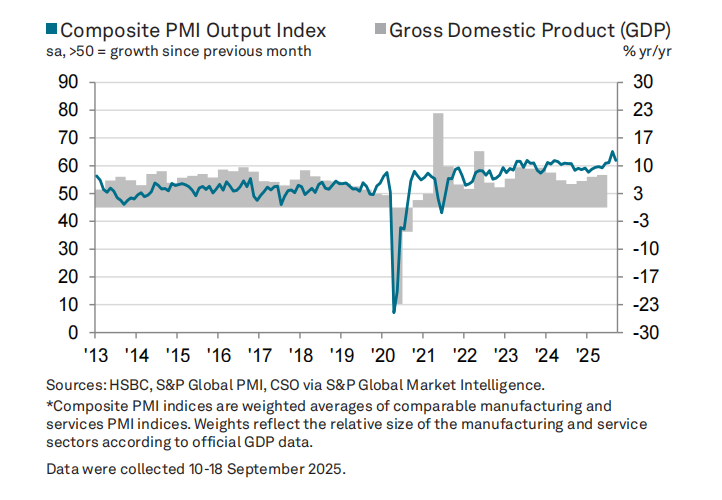
PMI指数回升释放经济扩张积极信号
2 1 Shi Ji Jing Ji Bao Dao· 2025-09-01 22:46
Group 1 - The Purchasing Managers' Index (PMI) for manufacturing, non-manufacturing business activity index, and comprehensive PMI output index all showed recovery in August, indicating that the Chinese economy maintains overall expansion despite complex external conditions [1] - Manufacturing PMI slightly increased, with production index remaining in the expansion zone for four consecutive months, reflecting a continuous acceleration in manufacturing activities [1] - The service sector's business activity index rose to 50.5%, the highest level this year, indicating a significant recovery in service sector sentiment, driven by increased consumer activity during the summer [2] Group 2 - The high-tech manufacturing PMI and equipment manufacturing PMI were reported at 51.9% and 50.5% respectively, significantly above the overall level, showcasing the potential of new growth drivers in the economy [3] - The recovery in manufacturing and service sectors is supported by effective policy measures, including tax incentives and R&D expense deductions, creating a favorable environment for high-tech manufacturing [3] - The construction sector's business activity index declined, reflecting both seasonal factors and the slow recovery in related industries such as real estate [3] Group 3 - Macro policies need to focus on precision and continuity to sustain economic stability, with an emphasis on tax reductions and financing support for small and medium-sized enterprises [4] - The release of the "Opinions on Promoting High-Quality Urban Development" by the Central Committee of the Communist Party and the State Council aims to activate existing resources and support the real estate sector, promoting a positive interaction between urban development and economic transformation [4]
2025年8月PMI点评:边际回升但压力仍存
Hua Yuan Zheng Quan· 2025-09-01 08:05
Report Industry Investment Rating - The report does not explicitly provide an investment rating for the industry. Core Viewpoints - In August, the three major PMI indices showed marginal improvements, but the manufacturing PMI remained below the boom-bust line. The overall expansion of enterprise production and business activities accelerated slightly, and the endogenous economic momentum continued to improve. However, the manufacturing PMI still needed continuous repair, and there was a risk of increased economic downward pressure in the second half of the year. Short-term bond markets might be suppressed by sentiment, but the bond market was expected to rise in September [2]. Summary by Related Content Manufacturing PMI - In August, the manufacturing PMI rose 0.1 pct month-on-month to 49.4%, staying below the boom-bust line for five consecutive months. The production and demand-related indices improved, and the price indices continued to rise, though the marginal increase weakened. The PMI of consumer goods industries decreased by 0.3 pct to 49.2%. The new export orders index and the import index were 47.2% and 48.0% respectively, up 0.1 pct and 0.2 pct month-on-month, indicating a possible improvement in foreign trade [2]. - The business climate of different types of enterprises continued to diverge. The PMIs of large and small enterprises increased by 0.5 pct and 0.2 pct respectively, reaching 50.8% and 46.6%. The small enterprises had been in the contraction range for 16 consecutive months. The PMI of medium-sized enterprises dropped 0.6 pct to 48.9% [2]. Non - manufacturing PMI - In August, the non-manufacturing business activity index was 50.3%, up 0.2 pct month-on-month. The non-manufacturing business climate had been at or above the critical point since January 2023, remaining relatively stable. The construction business activity index was 49.1%, down 1.5 pct month-on-month, possibly due to natural factors such as high temperatures and heavy rains. The service business activity index was 50.5%, up 0.5 pct month-on-month, reaching the highest value this year. The business activity expectation index remained at a relatively high level of 57.0%, up 0.4 pct month-on-month, indicating that enterprises were optimistic about the market outlook in September [2]. Economic Outlook and Bond Market - The economic negative cycle of "plummeting housing prices, plummeting stock markets - shrinking wealth - consumption downgrade" in the past two years might come to an end. However, there was still pressure on profit improvement, and the manufacturing PMI below the boom-bust line in August reflected growth pressure. Consumption and exports might face certain pressures in the second half of the year [2]. - The short-term bond market might be suppressed by sentiment, but the bond market was expected to rise in September. The economic downward pressure in the second half of the year might increase, and the central bank's continuous easing and banks' self - operated allocation needs provided support. After September, the net issuance of government bonds was expected to be no more than 25% of the annual plan, and the interest rate bonds might have a repair window. The report continued to be bullish on the 10Y treasury bond yield in the second half of the year, which was expected to be between 1.6% - 1.8%, and the 10Y treasury bond was considered to have high cost - effectiveness at around 1.8%. It was expected that the 10Y treasury bond yield would return to around 1.65% in the next six months, and the 5Y secondary capital bonds of state - owned and joint - stock banks would fall below 1.9% [2].
8月份PMI三大指数均有所回升 我国经济景气水平继续保持扩张
Jing Ji Ri Bao· 2025-09-01 01:34
Group 1: Manufacturing Sector - In August, the Manufacturing Purchasing Managers' Index (PMI) was reported at 49.4%, indicating a slight increase of 0.1 percentage points from the previous month, but still below the expansion threshold [1] - The New Orders Index for manufacturing was at 49.5%, up by 0.1 percentage points, suggesting a stabilization in market demand [1] - The Production Index rose to 50.8%, an increase of 0.3 percentage points, marking the fourth consecutive month above the critical point [1] Group 2: Non-Manufacturing Sector - The Non-Manufacturing Business Activity Index stood at 50.3%, reflecting a 0.2 percentage point increase, indicating continued expansion in the non-manufacturing sector [2] - The Business Activity Expectation Index for non-manufacturing reached over 56%, showing improved business sentiment and stability in supply and demand [2] - The Service Sector Business Activity Index increased to 50.5%, the highest point of the year, with several industries, including capital market services, showing strong growth [2] Group 3: Economic Outlook - Experts suggest that the slight recovery in the manufacturing PMI indicates the initial effects of policies aimed at expanding domestic demand and reducing competition [3] - There is a call for increased macroeconomic policy adjustments to stimulate market orders and enhance production investment, employment, and consumption [3] - The expectation for September and the fourth quarter is that policy-driven growth will continue, with a focus on stabilizing demand and fostering effective demand increments [3]