反内卷

Search documents
2026首周行情利好,躁动的资本能走多远?
Sou Hu Cai Jing· 2026-01-11 14:03
Group 1 - Global stock markets, commodities, and credit markets have shown strong performance in the first trading week of 2026, with the S&P 500 index rising 1.6% to reach a historical high and the Russell 2000 small-cap index surging 4.6% [2] - The A-share market has also performed exceptionally well, with the Shanghai Composite Index breaking through 4100 points and achieving a "16 consecutive days of gains," with a single-day trading volume reaching 3.15 trillion yuan, marking the fifth highest in history [2][5] - The commodities market has seen significant movements, with oil experiencing its largest single-day increase since October of the previous year, silver rising 10% over the week, and gold nearing historical highs [2] Group 2 - Short-term liquidity is identified as a key factor driving asset prices, with the Federal Reserve's balance sheet expansion and fiscal account releases potentially bringing about approximately $600 billion in liquidity in the first quarter [3] - The market sentiment has shifted from defensive assets to cyclical stocks and high-risk varieties, supported by policies from the Trump administration [3] Group 3 - There is a noted disconnect between current optimistic sentiment and the underlying fundamentals, raising concerns about potential market volatility due to future expectation adjustments [4] - The A-share market's performance is characterized by a broad-based rally, with over 3900 stocks rising, indicating a healthier market structure compared to previous years [18] Group 4 - The significant increase in trading volume and financing balance suggests that new capital, particularly leveraged funds, is actively positioning for a new economic cycle rather than engaging in speculative behavior at market peaks [19][20] - The market is undergoing a healthy rotation of funds, with outflows concentrated in previously high-performing sectors while inflows are directed towards emerging sectors like media and home appliances [21][22] Group 5 - The current market environment is seen as a historical resonance point between "stock optimization" and "new capital entry," with domestic institutions actively reallocating assets while new capital is being attracted to the market [23] - The upcoming period is expected to maintain a favorable environment for bullish sentiment, supported by a friendly monetary environment and expectations of policy support ahead of important domestic meetings [26] Group 6 - Post-Spring Festival, the market is anticipated to transition into a highly structured value discovery process rather than a broad-based bull market, focusing on sectors that resonate with "global nominal growth" [27][28] - Key sectors include high-end manufacturing that can capture overseas capital expenditure needs, as well as traditional industries undergoing necessary adjustments that may present unexpected investment opportunities [30][32]


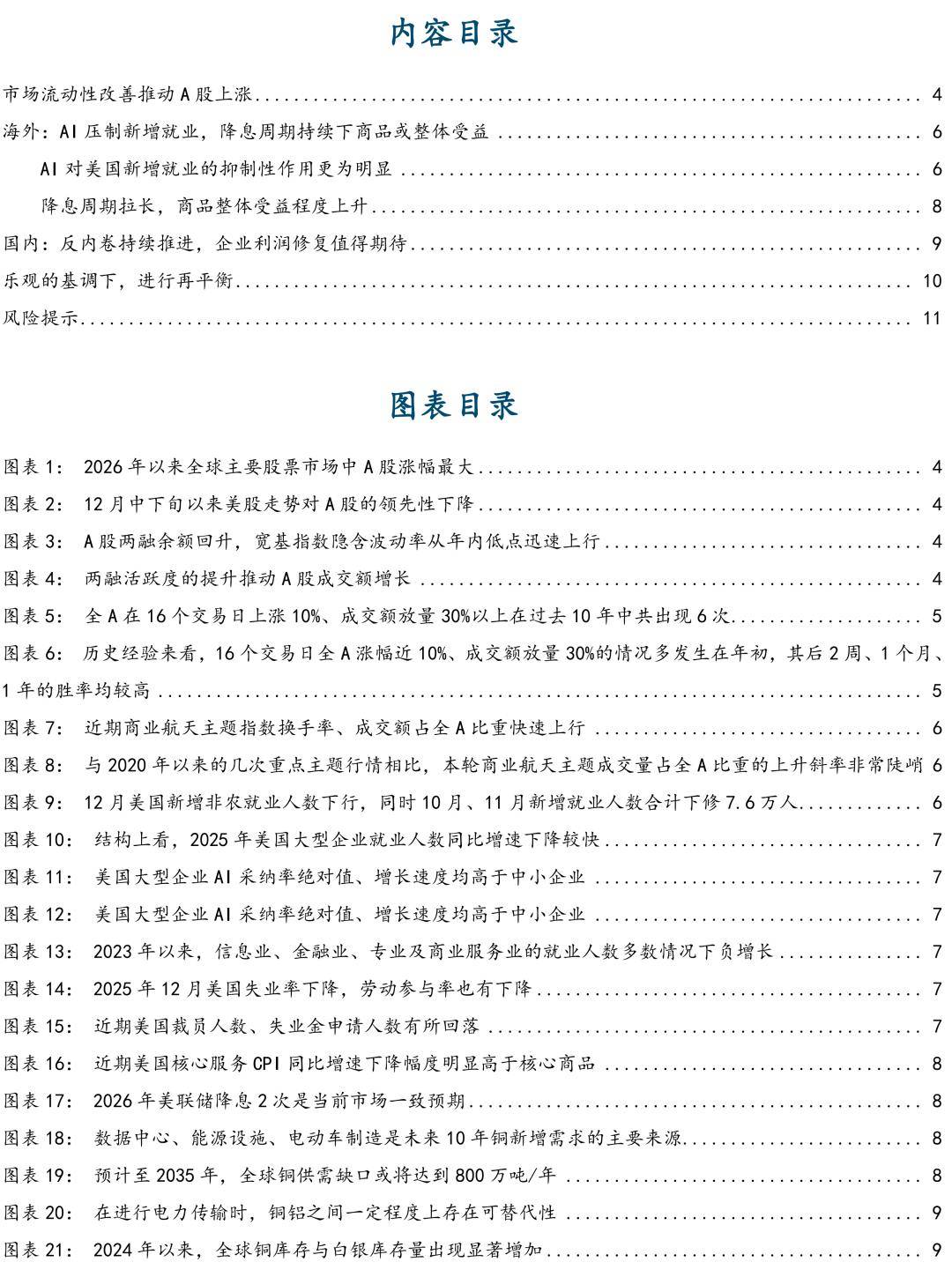
A股策略周报20260111:趋势仍在,结构再平衡-20260111
SINOLINK SECURITIES· 2026-01-11 13:41
Group 1: Market Liquidity and A-Share Performance - The improvement in market liquidity has been a direct catalyst for the recent rise in A-shares, with margin trading balances increasing by over 125 billion yuan in just half a month, leading to a more than 35% increase in trading volume across the A-share market [3][13][22] - Historical data shows that similar situations, where the A-share market rose by nearly 10% over 16 trading days with trading volume expanding by over 30%, have occurred six times in the past decade, predominantly at the beginning of the year [3][18][22] - The recent surge in the commercial aerospace index has led to a significant increase in turnover rates and trading volume proportions, indicating a potential structural overheating in the market [3][22] Group 2: AI Impact on Employment and Economic Policy - The U.S. job market continues to face pressure, with December's non-farm payrolls adding only 50,000 jobs, below expectations, and a downward revision of 76,000 jobs for October and November [4][26][33] - The adoption of AI by large U.S. companies has significantly suppressed employment growth, particularly in the information, finance, and professional services sectors, which have collectively lost 344,000 jobs over the past three years [4][26][33] - The Federal Reserve's extended rate-cutting cycle is expected to benefit commodity markets, as inflation concerns related to AI investments are easing [4][40][41] Group 3: Domestic Economic Recovery and Policy Optimization - The Producer Price Index (PPI) for industrial enterprises in December showed a year-on-year increase, indicating a shift from price drag to price support for corporate revenues [5][56] - The Consumer Price Index (CPI) has also risen, with the core CPI maintaining its highest level in five years, reflecting a smoother transmission of prices from enterprises to consumers [5][56] - The ongoing anti-involution policies are expected to enhance corporate profitability, with regulatory measures aimed at preventing monopolistic practices and promoting fair competition [5][62] Group 4: Rebalancing and Investment Recommendations - The report suggests a positive outlook for A-shares, driven by improved liquidity and favorable domestic and international economic conditions [6][63] - Recommended investment areas include industrial resource products like copper, aluminum, and lithium, as well as sectors benefiting from the recovery of domestic manufacturing and consumer spending [6][63] - The report emphasizes the importance of capturing opportunities in sectors such as aviation, duty-free, and food and beverage, which are expected to benefit from increased consumer income and tourism recovery [6][63]
国泰君安期货能源化工玻璃纯碱周度报告-20260111
Guo Tai Jun An Qi Huo· 2026-01-11 13:28
1. Report Industry Investment Rating No relevant content provided. 2. Report's Core View - **Soda Ash**: The market is expected to be in a mid - term sideways trend. Supply surplus, high forward premium in futures, and potential downstream production cuts are the core driving forces of pressure. The price is supported by limited downside space and suppressed by supply surplus and glass industry cuts. The trading rhythm follows glass, with lower volatility [2][4]. - **Glass**: In the short term, it is weak; in the medium term, it is in a sideways trend, and over - bearish views are not advisable. The market will switch between rising driven by production cut expectations and falling due to weak demand and weak basis. The valuation factor will be crucial in the future [5][7]. 3. Summary by Relevant Catalogs Glass Supply - In the week, one float glass production line each in Southwest and Central China was shut down for cold repair, resulting in a week - on - week decline in production. As of January 8, 2026, the daily output of national float glass was 150,100 tons, a decrease of 0.96% compared to January 1st [5]. - In 2025, the total daily melting volume of cold - repaired production lines was 21,330 tons/day, and the total daily melting volume of ignited production lines was 15,010 tons/day. Potential new ignition production lines have a total daily melting volume of 14,490 tons/day, potential old - line复产 production lines have a total of 9,370 tons, and potential cold - repair production lines have a total of 9,420 tons/day [10][11][12]. - The current in - production capacity is about 150,000 tons/day, and the peak capacity in 2021 was 178,000 tons/day [16]. Demand As of December 31, 2025, the average order days of national deep - processing sample enterprises was 8.6 days, a week - on - week decrease of 10.7% and a year - on - year decrease of 16.1%. Engineering orders are gradually ending, and home - decoration orders are mainly low - value single orders [6]. Inventory As of January 8, 2026, the total inventory of national float glass sample enterprises was 55.518 million heavy boxes, a week - on - week decrease of 1.348 million heavy boxes, a decrease of 2.37%, and a year - on - year increase of 27.04%. The inventory days were 24.1 days, a decrease of 1.5 days compared to the previous period [6]. Price and Profit - Market prices are mostly stable, with some regions showing increases. The price in Shahe is about 1,000 - 1,020 yuan/ton (up 10 - 20 yuan/ton), in Central China's Hubei region is 1,020 - 1,060 yuan/ton (up 20 yuan/ton), and in East China's Jiangsu and Zhejiang regions, the prices of some large manufacturers are 1,110 - 1,250 yuan/ton (mostly stable, some slightly up 10 - 20 yuan/ton) [19][23]. - The profit with petroleum coke as fuel is about - 7 yuan/ton, and the profits with natural gas and coal as fuels are about - 186 and - 74 yuan/ton respectively [28][32]. Photovoltaic Glass Price and Profit - Market transactions have weakened recently, and this situation is expected to continue. The mainstream order price of 2.0mm coated panels is 10.5 - 11 yuan/square meter, and that of 3.2mm coated panels is 17.5 - 18.5 yuan/square meter, both remaining unchanged week - on - week [44][46]. Capacity and Inventory - There are 400 in - production production lines nationwide, with a total daily melting volume of 87,620 tons/day, a week - on - week decrease of 0.36% and a year - on - year decrease of 2.31%. As of Thursday this week, the sample inventory days were about 40.17 days, a week - on - week increase of 2.66%, with the growth rate narrowing by 0.16 percentage points [51][56]. Soda Ash Supply and Maintenance - Some soda ash production plants have carried out phased maintenance and production reduction. The current capacity utilization rate is 84.4%, and the weekly output of heavy soda ash is about 405,000 tons. The inventory is about 1.5727 million tons. As of January 8, 2026, the total inventory of domestic soda ash manufacturers was 1.5727 million tons, a year - on - year increase of 6.93% [60][62][69]. Price and Profit - The low - end price in Shahe area is 1,180 yuan/ton, showing an increase. Most manufacturers' ex - factory prices are stable, with prices in Shandong increasing by 30 - 50 yuan/ton. The profit of the joint - alkali method in East China (excluding Shandong) is - 40 yuan/ton, and the profit of the ammonia - alkali method in North China is - 58 yuan/ton [77][78][84]. Basis and Month - to - Month Spread The rise in futures has led to a weakening of the basis [80].
烧碱:偏弱震荡,PVC:偏弱震荡PVC
Guo Tai Jun An Qi Huo· 2026-01-11 13:27
1. Report Industry Investment Rating - Not provided in the content 2. Core Views - Both caustic soda and PVC face oversupply, high inventory, and low - profit situations. In late 2025, both reduced production, but due to the off - season for winter maintenance, the overall supply reduction was weak. They face significant inventory accumulation pressure during the Spring Festival, and high - level inventory needs to be continuously digested in the first half of 2026 [152] - Although the domestic chlor - alkali production capacity is in a loss, large - scale capacity elimination is difficult. In a low - profit situation, production cuts of PVC and caustic soda can drive a quick profit recovery, but it may not be sustainable for more than three months [152] - On the demand side, caustic soda is affected by the negative feedback from the low profit of alumina, while PVC faces the weak real - estate demand [152] - In terms of valuation, both have many supporting factors in 2026. Caustic soda has high volatility, and its forward futures prices between 2150 - 2300 have long - allocation value. PVC has large profit losses, but the forward premium restricts the market from trading low - valuation factors [152] - In 2026, caustic soda and PVC are expected to have a wide - range volatile market. Affected by maintenance expectations, differential electricity prices, and anti - involution sentiment, the continuous decline space is limited, but it is difficult to rise continuously before the fundamentals improve substantially. Caustic soda has stronger price elasticity than PVC [152] 3. Summary by Directory 3.1 Basics and View Overview - Caustic soda: Expected to be in a weak and volatile state. The current supply shows high production and high inventory. The average capacity utilization rate of Chinese caustic soda sample enterprises with a capacity of 200,000 tons or more is 86.8%, a week - on - week increase of 0.4%. The demand from the alumina industry is difficult to expand significantly, and non - aluminum demand is facing a decline in the off - season. The valuation may be on the high side, and the short - term trend is likely to be weak. The recommended strategies are unilateral short, calendar spread reversal, and no cross - variety strategy [5] - PVC: Expected to run weakly. The current situation is high production and high inventory. As of January 8, 2026, the capacity utilization rate of PVC production enterprises is 79.67%, a week - on - week increase of 1.03% and a year - on - year decrease of 1.33%. Domestic demand is weak, especially related to the real - estate industry. The cancellation of export tax rebates will increase long - term export competition pressure. The recommended strategy is unilateral range - bound operation for the 05 contract, with an upper pressure level of 4900 and a lower support level of 4600 - 4700, and no calendar spread or cross - variety strategies [7] 3.2 Caustic Soda Price and Spread - Short - sellers' main logic: High supply and high inventory, with the inventory of caustic soda sample enterprises up 76% year - on - year; continuous alumina production cut expectations; about 3% of new capacity in the next year, while most non - aluminum downstream demand only grows at 2 - 3%; slowdown in export growth, limited support from the 50 - alkali to 32 - alkali spread structure; changes in delivery areas and delivery premiums/discounts [10] - Long - sellers' main logic: Anti - deflation and anti - involution are trends, with low profits, low absolute prices, and a small forward premium, offering high potential returns; significant losses in the integrated profit of caustic soda + PVC, with possible more - than - expected maintenance or production cuts in 2026; shutdown of overseas chlor - alkali plants, continuous expansion of the export market [10] - Core contradictions: Weak willingness to cut production on the supply side, and demand expansion is affected by low profits [12] - The basis of caustic soda 03 is weakening, and the 3 - 5 spread is also weakening [13] - Although the export market still has support, it is also facing structural adjustment. In 2025 from January to November, the cumulative export volume of caustic soda was 3.74 million tons, a year - on - year increase of 36.7%. The development of wet - process nickel may lead to large - scale application of the magnesium oxide precipitation process, which may replace caustic soda to some extent [17][20] - The FOB price in Northeast Asia has declined, currently around $350 per dry ton. The CIF price in Southeast Asia is $400 per dry ton, a decrease of $20 per dry ton from December 23. There is little market discussion, and Southeast Asian customers have not started new inquiries for spot orders [21][25] - The regional arbitrage space between Shandong and Guangdong is acceptable, and the spread between flake caustic soda and liquid caustic soda is also acceptable. The spread between 50 - alkali and 32 - alkali is declining, which is negative for caustic soda. The spread between 50 - alkali and 32 - alkali has always been an advanced indicator of the market, and the current spread of 10 yuan per ton is a negative signal [27][31][34] 3.3 Caustic Soda Supply - Market structure: Rising production and rising inventory. The average capacity utilization rate of Chinese caustic soda sample enterprises with a capacity of 200,000 tons or more is 86.8%, a week - on - week increase of 0.4%. The factory inventory of fixed - liquid caustic soda sample enterprises with a capacity of 200,000 tons or more nationwide is 495,200 tons (wet tons), a week - on - week increase of 1.96% and a year - on - year increase of 76.03% [38][40] - Maintenance situation: There is less maintenance in January 2026. Some enterprises have ongoing or planned maintenance, such as Wuhai Chemical in the Northwest, Zhejiang Juhua and Ningbo Wanhua in the East, etc. [43][44] - New capacity: In 2026, caustic soda capacity will continue to be put into production, with a growth rate of over 3%. The total planned new capacity is 2.94 million tons [46] - Cost: In January 2026, the large - scale industrial electricity price in Shandong Province decreased, and the cost of caustic soda has limited support. The marginal cost of Shandong's caustic soda production is calculated to be 2,122 yuan per ton. The price of liquid chlorine has not provided significant subsidies, and the cost support for caustic soda is limited [47][50][51] - Downstream of chlorine consumption: The production of propylene oxide, epichlorohydrin, dichloromethane, and chloroform is stable, and the profits are recovering. The stable operation of the downstream of chlorine consumption has less impact on the production reduction of caustic soda enterprises [54][59][64] 3.4 Caustic Soda Demand - Alumina industry: In 2025, the alumina capacity expanded significantly, with an expected new capacity of 9.5 million tons. In 2026, the new capacity is expected to reach 13.9 million tons, with more concentrated production in the first half of the year. However, the alumina industry is currently operating at a high level, with rising inventory and losses. The alumina plants may reduce production in the future, which will suppress the demand for caustic soda [72][74][76] - Other industries: The demand in the pulp industry is in the off - season, and the terminal profits are continuously being compressed. Although new pulp capacity is being put into production, the demand for caustic soda is not expected to increase significantly. The production of viscose staple fiber has increased, while the dyeing and finishing industry has declined. The water treatment industry and the ternary precursor industry have also seen a decline in production, resulting in a decrease in the overall demand for caustic soda [86][98][100] 3.5 PVC Price and Spread - Short - sellers' main logic: High supply and high inventory, with the PVC social inventory sample increasing nearly 40% year - on - year; weak domestic demand, especially in the real - estate sector; slowdown in export growth and reduced export competitiveness due to the cancellation of export tax rebates [107] - Long - sellers' main logic: Anti - deflation and anti - involution are trends, with low profits and low absolute prices; significant losses in the integrated profit of caustic soda + PVC, with the marginal device in Shandong approaching the cash - flow cost in December 2025; no new PVC capacity will be put into production in 2026; shutdown of overseas chlor - alkali plants, continuous expansion of the export market [108] - Core contradictions: The large forward premium of futures contracts [110] - The basis of the PVC main contract is oscillating strongly [111] 3.6 PVC Supply and Demand - Supply: The PVC production capacity utilization rate is 79.67%, a week - on - week increase of 1.03% and a year - on - year decrease of 1.33%. There is less maintenance in January 2026. In 2026, except for the capacity release of Jiahua, there will be no new PVC capacity. The comprehensive profit of chlor - alkali plants is recovering [118][121][123] - Demand: The real - estate terminal demand has not significantly improved. The overall downstream PVC operating rate has declined month - on - month. The PVC export expectation has weakened. The single - month export volume decreased by 11.78% month - on - month, although it increased by 29.64% year - on - year, and the cumulative export volume increased by 47.17% year - on - year. The cancellation of export tax rebates from April 1, 2026, will increase future competition pressure. The demand from Southeast Asia and Central Asia is stable. The PVC warehouse receipts have declined but are still at a high level [130][136][143]
电力设备与新能源行业研究:太空光伏停车接人,出口退税调整回归反内卷本质
SINOLINK SECURITIES· 2026-01-11 13:09
Investment Rating - The report maintains a positive outlook on the electric new sector, particularly highlighting "space photovoltaic" as the strongest main line for 2026 [2][6]. Core Insights - The space photovoltaic sector is gaining market recognition due to its significant value, inflation trends, and high barriers to entry, with expectations for continued market expansion [2][6]. - The report emphasizes the importance of energy storage and lithium battery price increases, as well as the growth potential in wind power and green hydrogen under the "14th Five-Year Plan" [2][3][12]. - The cancellation of export tax rebates for photovoltaic products is expected to create a "rush" for shipments, which may help mitigate the impact of seasonal demand fluctuations in Q1 [9][10]. Summary by Sections Photovoltaics & Energy Storage - The space photovoltaic sector is recognized as a core branch of commercial aerospace, with its advantages becoming increasingly acknowledged by the market [2][6]. - The cancellation of export tax rebates is set for April 1, 2026, which is anticipated to lead to a surge in shipments to counteract seasonal demand dips [9][10]. - The report suggests actively participating in the space photovoltaic market, as the trend is expected to continue [2][6]. Wind Power - The report forecasts continued growth in domestic wind power installations in 2026, with an expected increase in offshore and onshore installations [12][13]. - The global wind power demand is projected to maintain a long-term positive outlook, driven by AI and electrification trends [13][14]. - Key recommendations include focusing on manufacturers with improved profitability and those benefiting from domestic and international market expansions [12][32]. Lithium Batteries - The report notes a reduction in the export tax rebate for battery products from 9% to 6% starting April 1, 2026, with a complete cancellation set for January 1, 2027 [16][17]. - Price negotiations for lithium iron phosphate (LFP) have seen significant increases, with most customers accepting a processing fee hike of 1,000 yuan per ton [16][20]. - The lithium battery sector is expected to experience continued demand growth, particularly in the context of rising prices and expanding production capacities [18][33]. Hydrogen and Fuel Cells - Bloom Energy has secured a $2.65 billion order, indicating strong demand for solid oxide fuel cells (SOFC) and validating their commercial viability [29][30]. - The report highlights the potential for green hydrogen and related technologies to experience significant growth, driven by policy support and increasing demand [30][31]. - Key investment opportunities include companies involved in green methanol production and hydrogen fuel cell components [30][32]. Grid & Industrial Control - Significant investments in grid infrastructure are planned, with Southern Power Grid expecting over 20% growth in Q1 2026 [23][24]. - The report identifies opportunities in the industrial control sector, particularly for companies involved in robotics and automation technologies [28][24]. - Recommendations include focusing on companies that are well-positioned to benefit from technological advancements and increased demand in the automation market [28][32].
——基础化工行业周报:多晶硅、丁二烯价格上涨,关注反内卷和铬盐-20260111
Guohai Securities· 2026-01-11 13:03
Investment Rating - The report maintains a "Recommended" rating for the chemical industry [1] Core Insights - The chemical industry is expected to experience an upward cycle due to the implementation of "anti-involution" policies in China and the accelerated exit of some European facilities [29] - The report highlights the potential for domestic substitution of semiconductor materials from Japan due to rising geopolitical tensions, which could benefit various companies in the sector [5] - The chromium salt industry is undergoing a value reassessment driven by increased demand from AI data centers and commercial aircraft engines, with a projected supply-demand gap of 340,900 tons by 2028 [8] Summary by Sections Industry Performance - The chemical industry has shown strong relative performance with a 1-month increase of 10.7%, 3-month increase of 9.6%, and a 12-month increase of 45.1%, outperforming the CSI 300 index [3] Price Trends - Key products such as lithium carbonate and polysilicon have seen significant price increases, supported by policy guidance and industry self-discipline [12] - The price of chromium salts has remained stable, with metal chromium priced at 82,000 CNY/ton as of January 9, 2026 [15] Investment Opportunities - Focus on companies with low-cost expansion capabilities, such as Wanhu Chemical and Hualu Hengsheng, as well as those in sectors with improving market conditions like chromium salts and phosphates [6][9] - High dividend yield opportunities are identified in state-owned enterprises like China Petroleum and China National Chemical [10] Key Company Tracking - Companies such as Dongfang Shenghong and Huabei Yihua are highlighted for their earnings potential, with projected EPS growth for 2026 [30] - The report tracks specific price movements for various chemicals, including a notable increase in the price of ammonium phosphate and a stable price for urea [17][19]



烧碱:偏弱震荡,PVC:偏弱运行
Guo Tai Jun An Qi Huo· 2026-01-11 12:58
1. Report Industry Investment Rating - Not provided in the given content 2. Core Views of the Report - Both caustic soda and PVC face oversupply, high inventory, and low - profit situations. In late 2025, production cuts were made, but the overall supply - side reduction was weak due to the winter maintenance off - season. They will face significant inventory accumulation during the Spring Festival, and high - level inventory needs to be continuously digested in the first half of 2026 [155]. - Although domestic chlor - alkali production capacity is in a loss situation, large - scale capacity elimination is difficult. Low - profit production cuts of PVC and caustic soda can drive rapid profit repair, but it is not sustainable for more than 3 months [155]. - On the demand side, caustic soda is affected by the negative feedback from low alumina profits, while PVC faces the weak real estate demand pattern [155]. - In terms of valuation, both have many supporting factors in 2026. Caustic soda has high volatility, with an annual volatility of over 30% in recent years, and its forward futures price between 2150 - 2300 has long - allocation value. PVC has large profit losses, but the forward premium restricts the market from trading low - valuation factors [155]. - Overall, in 2026, caustic soda and PVC will mainly show a wide - range volatile market. Affected by maintenance expectations, differential electricity prices, and anti - involution sentiment, the continuous decline space is limited. But it is also difficult to rise continuously before the fundamental situation improves substantially. Caustic soda has stronger price elasticity than PVC [155]. 3. Summary According to Relevant Catalogs 3.1 Caustic Soda 3.1.1 Price and Spread - Short - term caustic soda may be weak. The 03 basis and the 3 - 5 month spread are weakening [13]. - The export market has support but is also undergoing structural adjustment. In 2025, the cumulative export volume from January to November was 3.74 million tons, a year - on - year increase of 36.7%. The Northeast Asian FOB price has declined to about $350 per dry ton, and the Southeast Asian CIF price is $400 per dry ton, a decrease of $20 per dry ton compared to December 23 [17][20]. - The Shandong - Guangdong regional arbitrage space and the flake - liquid caustic soda spread are acceptable. The flake - liquid caustic soda spread is rising, which is beneficial for caustic soda, while the 50 - 32 caustic soda spread is falling, which is negative for caustic soda [27][30]. 3.1.2 Supply - The market structure shows rising production and inventory. The average capacity utilization rate of Chinese caustic soda sample enterprises with a capacity of 200,000 tons or more is 86.8%, a week - on - week increase of 0.4%. The factory inventory of fixed liquid caustic soda sample enterprises is 495,200 tons (wet ton), a week - on - week increase of 1.96% and a year - on - year increase of 76.03% [38][40]. - There are few caustic soda maintenance plans in January 2026. In 2026, caustic soda will continue to see new production, with a capacity growth rate of over 3%, and the planned and under - construction production capacity to be put into operation totals 2.94 million tons [44][46]. - In January 2026, the large - scale industrial electricity price in Shandong Province decreased, and the cost support for caustic soda was weak. Liquid chlorine did not provide significant subsidies, and the cost support for caustic soda was limited [47][51]. 3.1.3 Demand - In 2025, the alumina production capacity expanded significantly, with an expected new capacity of 9.5 million tons. In 2026, the new production in the first half of the year is relatively concentrated, and the annual new capacity may reach 13.9 million tons. However, the alumina industry is currently operating at a high level with rising inventory and losses, and there is an expectation of production cuts in the future [73][75]. - The paper pulp industry is in a demand off - season, with continuous compression of terminal profits, but new pulp production capacity is continuously being put into operation. The finished paper industry has stable operation. The viscose staple fiber industry has rising operation, while the printing and dyeing industry has declining operation. The water treatment industry and the ternary precursor industry have declining production [88][94]. 3.2 PVC 3.2.1 Price and Spread - PVC may be weak in the short term. The main contract basis is oscillating and strengthening [113]. - Short - term PVC may be weak. The main contract basis is oscillating and strengthening. The short - term PVC market may face pressure due to factors such as high inventory and weak demand. The strengthening of the main contract basis may reflect the current market's short - term supply - demand relationship [113]. 3.2.2 Supply and Demand - PVC production enterprises' capacity utilization rate is 79.67%, a week - on - week increase of 1.03% and a year - on - year decrease of 1.33%. There are fewer PVC maintenance plans in January 2026. In 2026, except for Jiahua's capacity release, there is no new capacity [120][123]. - The comprehensive profit of chlor - alkali plants has rebounded. PVC production enterprises are accumulating inventory, and social inventory is at a high level and continues to accumulate. The real estate terminal demand has not shown obvious improvement, the overall downstream PVC operation has decreased month - on - month, and the PVC export expectation has weakened. Since April 1, 2026, the VAT export tax rebate for PVC and other products has been cancelled, which will increase the competition pressure in the future [127][131][146].
反内卷预期再起,关注后续供给侧积极变化
GOLDEN SUN SECURITIES· 2026-01-11 12:51
Investment Rating - The report maintains an "Increase" rating for the construction materials sector [4] Core Views - The construction materials sector saw a 1.89% increase from January 5 to January 9, 2026, with cement up 1.62%, glass manufacturing up 3.10%, fiberglass manufacturing up 0.75%, and renovation materials up 2.57% [13] - The People's Bank of China emphasized promoting high-quality economic development and reasonable price recovery as key monetary policy considerations [13] - Local government bond issuance decreased significantly in December 2025, indicating potential easing of fiscal pressure and opportunities for municipal engineering projects [13] - The supply-demand imbalance in float glass is expected to ease due to self-regulated production cuts by photovoltaic glass manufacturers [13] - The cement industry is experiencing a demand bottoming process, with increased efforts in staggered production halts [13] Summary by Sections Cement Industry Tracking - As of January 9, 2026, the national cement price index was 349.52 CNY/ton, down 0.58% week-on-week, with cement output at 2.7175 million tons, down 4.55% [2] - The capacity utilization rate for cement clinker kilns was 43.53%, up 5.1 percentage points from the previous week [2] - The overall recovery in cement demand is contingent on the rollout of funding for major infrastructure projects and stabilization in the real estate market [2] Glass Industry Tracking - As of January 8, 2026, the average price of float glass was 1121.92 CNY/ton, with a slight increase of 0.06% week-on-week [3] - The inventory of raw glass in 13 provinces was 51.95 million weight boxes, down 183 thousand from the previous week [3] - The market is expected to see price fluctuations due to changes in supply-side dynamics [3] Fiberglass Industry Tracking - The market for non-alkali fiberglass remained stable, with no significant changes in supply or demand [6] - The average price of electronic yarn G75 increased by 1.79% week-on-week, indicating a positive trend in high-end product demand [6] Consumer Building Materials - The demand for consumer building materials continues to show signs of weak recovery, with fluctuations in upstream raw material prices [7] - The price of carbon fiber remained stable, with production costs slightly decreasing, although many companies are still operating at a loss [7] Key Stocks - Recommended stocks include: - Yao Pi Glass (Buy) with projected EPS growth from 0.12 CNY in 2024 to 0.27 CNY in 2027 [8] - Yinlong Co. (Buy) with projected EPS growth from 0.28 CNY in 2024 to 0.75 CNY in 2027 [8] - Puhua Co. (Buy) with projected EPS growth from 0.12 CNY in 2024 to 0.51 CNY in 2027 [8] - San Ke Tree (Buy) with projected EPS growth from 0.45 CNY in 2024 to 2.20 CNY in 2027 [8] - Beixin Building Materials (Buy) with projected EPS growth from 2.14 CNY in 2024 to 2.34 CNY in 2027 [8]


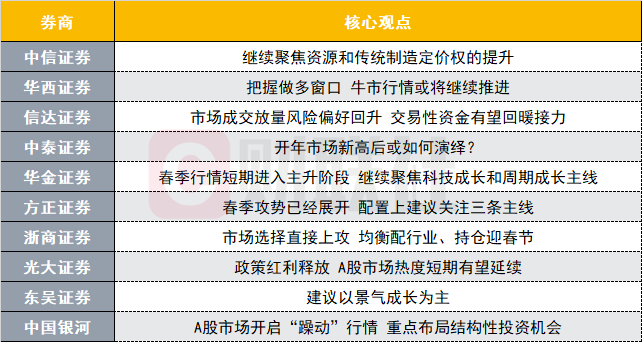
A股春季行情短期进入主升阶段?投资主线有哪些?十大券商策略来了
Xin Lang Cai Jing· 2026-01-11 11:04
Group 1 - Major brokerages have released their latest strategic views, focusing on resource and traditional manufacturing pricing power, with a bullish outlook for the spring market [1][2] - The A-share market is expected to continue its upward trend, supported by strong PMI and inflation data, as well as increased willingness of external funds to enter the market [2][3] - The market has seen a significant increase in trading volume, with the Shanghai Composite Index reaching 4100 points, indicating a recovery in risk appetite [3][4] Group 2 - The spring market is characterized by a strong performance of technology and cyclical growth sectors, with a focus on themes such as commercial aerospace and brain-computer interfaces [4][5] - The current market environment suggests a potential for continued upward momentum, driven by liquidity and favorable policies, with a recommendation to focus on sectors like AI applications and renewable energy [6][7] - The market is expected to maintain its heat in the short term, with policy support likely to bolster investor confidence and attract various types of capital [8][9] Group 3 - The "fifteen five" planning year is anticipated to bring focus to new productivity sectors, with technology innovation and growth sectors expected to see significant opportunities [12] - Key investment themes include industrial metals and chemicals, driven by price recovery expectations and structural improvements in supply and demand [12] - The commercial aerospace sector is highlighted as a key area for investment, supported by systemic policy deployments and increasing capital inflows [11][12]



国金策略:趋势仍在,结构再平衡
Sou Hu Cai Jing· 2026-01-11 10:59
Group 1 - The recent improvement in market liquidity has driven the A-share market's rise, with historical patterns suggesting a strong performance in the upcoming period [1][5] - The A-share market has seen a significant increase in trading volume, with a 35% growth in total trading volume and a 10% rise in the overall A-share index over the past 16 trading days [2][14] - There is a notable structural overheating in the market, particularly in the commercial aerospace index, which has seen a sharp increase in turnover and trading volume [2][14] Group 2 - AI's negative impact on the U.S. employment market is becoming evident, with December's non-farm payrolls falling short of expectations and a downward revision of previous months' data [3][20] - The prolonged interest rate cut cycle by the Federal Reserve is expected to benefit commodity markets, as the demand for resources related to AI and new energy industries is increasing [3][33] - Geopolitical tensions are altering inventory behaviors among market participants, leading to increased stockpiling and a rise in copper and silver inventories [3][35] Group 3 - Domestic policies aimed at reducing "involution" are being implemented, with industrial prices showing signs of recovery, leading to improved corporate profitability [4][43] - The recent regulatory focus on the photovoltaic industry has raised concerns about the commitment to anti-involution policies, but the overall direction remains focused on improving corporate fundamentals [4][49] - The government is actively working on regulatory frameworks to support innovation while preventing monopolistic practices, which is expected to enhance corporate profitability in the long run [4][51] Group 4 - The report maintains an optimistic outlook for the A-share market, suggesting that the combination of improved liquidity, AI investments, and domestic policy support will lead to a favorable investment environment [5][52] - Recommended sectors include industrial resource products like copper, aluminum, and lithium, as well as equipment exports and consumer sectors benefiting from recovery trends [5][52]