
反内卷

Search documents
三大外卖平台集体表态:积极配合市场竞争状况调查
Xin Lang Cai Jing· 2026-01-09 23:50
Core Viewpoint - The State Administration for Market Regulation of China has announced an investigation into the competitive landscape of the food delivery platform service industry, with major platforms expressing their support and commitment to cooperate with the investigation [1][2][3]. Group 1: Company Responses - Meituan has publicly stated its support for the investigation and aims to use this opportunity to collaborate with other platforms to fulfill market responsibilities and promote fair competition [1]. - Taobao Shanguo emphasized the importance of fair competition as a core principle of market economy and expressed its commitment to cooperate with the investigation while enhancing service quality [1]. - JD.com also expressed strong support for the investigation, advocating for fair competition and the protection of consumer and operator rights, while focusing on high-quality development in the food delivery sector [2]. Group 2: Industry Context - The investigation comes amid ongoing issues in the food delivery industry, including aggressive subsidy wars and price competition, which have been criticized for harming the real economy and intensifying "involution" competition [3]. - Despite previous regulatory discussions aimed at fostering fair competition, the competitive dynamics among platforms remain intense, with ongoing market battles and subsidy strategies [2]. - The investigation will involve various methods such as on-site verification, interviews, and surveys to gather comprehensive insights into competitive behaviors and stakeholder opinions within the industry [3].

道指创新高,英特尔涨超10%;美最高法院暂缓对关税案裁决;最高100万!证券期货违法行为“吹哨人”奖金提高;反内卷,外卖平台表态丨每经早参
Mei Ri Jing Ji Xin Wen· 2026-01-09 23:04
Group 1 - The State Council of China, led by Premier Li Qiang, is implementing a package of policies to promote domestic demand through fiscal and financial collaboration [3] - The U.S. stock market saw all three major indices rise, with the Dow Jones and S&P 500 reaching historical closing highs, while Intel experienced a significant increase of over 10% [3] - International oil prices rose, with WTI crude oil increasing by 1.77% to $58.78 per barrel, and Brent crude oil rising by 1.66% to $63.02 per barrel [4] Group 2 - The European stock indices closed higher, with Germany's DAX up by 0.58%, France's CAC40 up by 1.44%, and the UK's FTSE 100 up by 0.8% [5] - The Chinese food delivery industry is facing intensified competition, prompting the State Council's antitrust office to investigate the market conditions of delivery platforms [6][7] - The Chinese Ministry of Finance and the State Taxation Administration announced the cancellation of VAT export tax rebates for photovoltaic products starting April 1, 2026 [8] Group 3 - The China Securities Regulatory Commission has increased the reward for whistleblowers reporting securities and futures violations, raising the maximum reward from 10,000 yuan to 100,000 yuan for significant cases [9] - The Ministry of Commerce has issued a plan to expand service industry openings in nine cities, including Dalian and Shenzhen, with 159 pilot tasks aimed at enhancing service sector development [10] - Beijing has launched a free HPV vaccination program for girls aged 13 and above, aiming to improve public health [11] Group 4 - Shanghai aims to add 100 manufacturing enterprises with an annual output value exceeding 1 billion yuan by 2028, contributing to the growth of the industrial chain [12] - The passing of a new regulation by the U.S. Supreme Court regarding tariffs imposed by the Trump administration has been delayed [13] - Meta Platforms has signed agreements to extend and expand operations at three nuclear power plants, positioning itself as a significant corporate buyer of nuclear energy in the U.S. [22]





数据点评 | 输入性通胀的影响在升温(申万宏观·赵伟团队)
Xin Lang Cai Jing· 2026-01-09 16:42
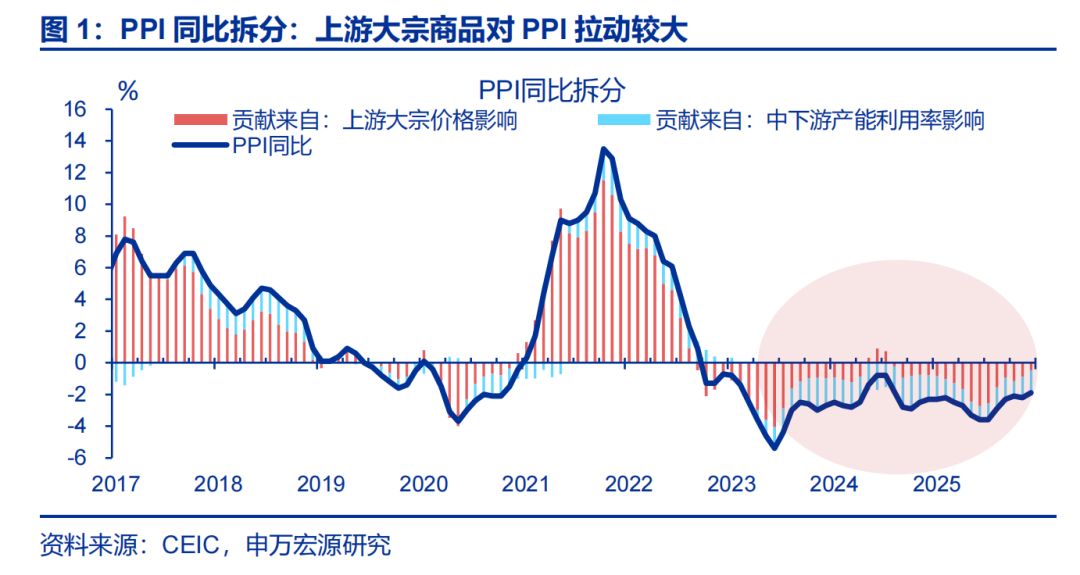
Core Insights - The inflation data for December 2025 shows a year-on-year CPI increase of 0.8%, up from 0.7% in the previous month, and a PPI decrease of -1.9%, improving from -2.2% [1][4] CPI Analysis - The CPI increase is primarily driven by rising gold prices, which have a significant impact on core goods CPI, while excluding gold, the core goods CPI remains low [2][11] - The food CPI rose by 1.1%, with a notable increase of 0.9 percentage points from the previous month, largely due to supply constraints affecting fresh vegetables and fruits [16][38] - The core service CPI decreased by 0.1 percentage points to 1%, influenced by weak rental demand, which has led to a decline in rental prices [22][48] PPI Analysis - The PPI increase is mainly attributed to rising copper prices, which rose by 7.9% month-on-month, contributing positively to the PPI [1][4] - Other commodity prices and downstream PPI performance remain weak, with the overall PPI showing a month-on-month increase of 0.2% [1][4] - The decline in international oil prices negatively impacted domestic oil prices, contributing to a PPI decrease of -0.05% [1][4] Future Outlook - The effectiveness of anti-involution policies in stimulating downstream prices is crucial for future PPI performance, as commodity prices have only explained about 30% of PPI fluctuations in the past three years [30] - The high gold prices and improvements in service consumption may support a rise in core CPI, but the high base effect from the Spring Festival may limit the CPI increase in January [30]
多晶硅巨头“约谈”风波:未来光伏如何“反内卷”?
Zhong Guo Jing Ying Bao· 2026-01-09 16:40
Core Viewpoint - The recent meeting minutes reveal that the Chinese regulatory authority has raised concerns about potential monopolistic practices in the polysilicon industry, leading to a significant market reaction and stock price declines for major companies in the sector [1][2]. Group 1: Regulatory Actions - On January 6, 2026, the State Administration for Market Regulation held discussions with key players in the polysilicon industry, including Tongwei Co., GCL-Poly Energy, Daqo New Energy, and others, to address reported monopolistic risks and suggested corrective measures [1][2]. - The meeting minutes indicated that since July 2025, there have been allegations of companies colluding to raise polysilicon prices under the guise of self-regulation, which included signing commitment letters and forming a platform company for capacity integration [2]. Group 2: Market Impact - Following the regulatory discussions, stock prices for major polysilicon companies fell significantly, with declines of 3.83% for Tongwei, 7.89% for GCL-Poly, 6.1% for Daqo, and 7.81% for Xinte Energy as of January 9 [1]. - Analysts suggest that the recent price increases in polysilicon, which had risen to over 60,000 yuan per ton, may not be sustainable due to the regulatory scrutiny and potential dismantling of price-fixing agreements among companies [5]. Group 3: Industry Perspectives - Industry experts emphasize the need for a legal and market-driven approach to combat "involution" and monopolistic practices, highlighting that the recent regulatory actions are a response to industry reports and not a rejection of the efforts made towards self-regulation [2][4]. - The establishment of the Beijing Guanghe Qiancheng Technology Co., viewed as a platform for capacity integration, has been criticized, with some industry insiders suggesting that its objectives may no longer be necessary [3][4]. Group 4: Future Outlook - The polysilicon market is expected to experience further price adjustments, with predictions that prices may eventually trend towards 40,000 yuan per ton as market competition intensifies and supply-demand dynamics remain loose [5]. - The ongoing discussions about "anti-involution" and regulatory compliance will likely shape the future strategies of companies within the polysilicon sector, as they navigate the balance between competitive pricing and regulatory frameworks [4][5].


反内卷趋势无忧,太空光伏产业提速
Yin He Zheng Quan· 2026-01-09 15:34
Investment Rating - The report maintains a "Recommended" rating for the electric equipment industry [1] Core Insights - The report highlights that the trend of anti-involution is not a concern, and the space photovoltaic industry is accelerating [1] - The report discusses the recent regulatory actions in the photovoltaic sector, emphasizing the prohibition of monopolistic behaviors such as price and capacity coordination, while allowing compliance with cost-based sales and technology standard improvements [4] - The report notes a continued upward trend in industry prices, with expectations for profit recovery in 2026 as terminal demand gradually improves [4] - The rise of commercial space ventures is accelerating the development of space photovoltaic technology, with significant plans for satellite energy networks and high-efficiency energy generation [4] Summary by Sections Regulatory Environment - The market regulatory authority has halted self-regulatory actions related to the photovoltaic industry's silicon material integration platform, citing monopolistic concerns [4] - A collaborative governance framework is being established among enterprises, power generation entities, and associations to ensure compliance and quality standards [4] Industry Price Trends - The average transaction price for N-type silicon material has increased to 59,200 CNY per ton, reflecting a week-on-week increase of 9.83% [4] - Prices for N-type silicon wafers and battery cells have also seen upward adjustments, indicating a recovery in the industry [4] Space Photovoltaic Development - Elon Musk has announced plans to deploy a 100GW solar-powered satellite energy network annually, while China aims to establish gigawatt-level space data centers by 2035 [4] - Space photovoltaic technology is expected to achieve commercial viability within the next 10-15 years, driven by advancements in battery technology and reduced launch costs [4] Investment Recommendations - The report suggests focusing on companies with technological reserves in space photovoltaic, such as Junda Co., JinkoSolar, Trina Solar, and others [4] - It also recommends monitoring leading companies with strong advantages in new technologies, as well as those benefiting from anti-involution policies in the silicon material segment [4]
国投期货黑色金属日报-20260109
Guo Tou Qi Huo· 2026-01-09 15:21
Report Industry Investment Ratings - Thread steel, hot-rolled coil: Not clearly defined in the given rating system [1] - Iron ore: Not clearly defined in the given rating system [1] - Coke: ★☆☆, representing a bullish bias but limited trading operability [1] - Coking coal: ★☆☆, representing a bullish bias but limited trading operability [1] - Silicon manganese: ★★☆, indicating a clear bullish trend and the market is evolving [1] - Ferrosilicon: ★★☆, indicating a clear bullish trend and the market is evolving [1] Core Viewpoints - The overall domestic demand for steel is still weak, and the steel market is mainly in a range-bound pattern. The iron ore market has a loose supply - demand relationship and high - level volatility risks. Coke and coking coal prices are likely to be strongly volatile. Silicon manganese and ferrosilicon are recommended to buy on dips [2][3][7] Summary by Directory Steel - The steel futures market declined today. Thread steel's apparent demand decreased, production slightly increased, and inventory started to accumulate. Hot - rolled coil demand fell, production continued to rise slightly, and inventory decreased slowly. Steel mill profits improved marginally, blast furnaces gradually resumed production, and hot metal output increased in the short term. Downstream industries' investment showed a weak trend, and steel exports remained high. The market is expected to be range - bound [2] Iron Ore - The iron ore futures market was weakly volatile. Supply decreased seasonally globally, domestic arrivals remained high, and port inventories increased significantly. Demand was weak in the off - season, steel mill profits declined, and hot metal production increased but was difficult to significantly recover in the short term. Steel mills' imported ore inventories increased but were still low, with winter storage expectations. The market is at risk of increased high - level volatility [3] Coke - Coke prices fluctuated within the day. The fifth round of price cuts was postponed, coking profits were average, and daily production increased slightly. Coke inventory remained almost unchanged. Carbon supply is abundant, downstream hot metal output is likely to bottom out and rebound, and the demand for raw materials is at an off - season level. Steel mills still have a strong desire to lower raw material prices. The price is likely to be strongly volatile [4] Coking Coal - Coking coal prices fluctuated after rising within the day. Yesterday, the Mongolian coal customs clearance volume was 1,291 vehicles. Coking coal mine production decreased slightly, and mines resumed production well after the New Year. Spot auction transactions were okay, and transaction prices increased slightly. Terminal inventories increased slightly, and total coking coal inventories increased significantly. The price is likely to be strongly volatile [6] Silicon Manganese - Silicon manganese prices rebounded after hitting the bottom. Manganese ore spot prices increased. There are structural problems in manganese ore port inventories. Demand for semi - carbonate ore may increase. Hot metal production decreased seasonally, silicon manganese weekly production and inventory decreased slightly. It is recommended to buy on dips [7] Ferrosilicon - Ferrosilicon prices rebounded after hitting the bottom. Affected by relevant policies, the price was relatively strong. There are expectations of a decline in power costs and semi - coke prices. Hot metal production rebounded to a high level, export demand decreased slightly, and magnesium metal production increased. Ferrosilicon supply decreased significantly, and inventory decreased slightly. It is recommended to buy on dips [8]
通胀数据点评:输入性通胀的影响在升温
Shenwan Hongyuan Securities· 2026-01-09 14:42
Inflation Data Summary - The CPI for December 2025 increased by 0.8% year-on-year, up from 0.7% in the previous month, matching expectations, and rose by 0.2% month-on-month[1][7] - The PPI for December 2025 recorded a year-on-year decline of -1.9%, an improvement from -2.2% previously, with a month-on-month increase of 0.2%[1][7] Key Influences on CPI and PPI - Copper and gold prices significantly influenced the December inflation, with copper prices rising 7.9% month-on-month, contributing positively to PPI[2][8] - The contribution of coal prices to PPI was relatively minor, while international oil prices declined, negatively impacting domestic oil prices and dragging PPI down by -0.05%[2][8] Food and Service CPI Trends - Food CPI rose by 1.1% year-on-year, with a notable increase of 0.9 percentage points from the previous month, driven by supply constraints in fresh vegetables and fruits[3][23] - Service CPI decreased by 0.1 percentage points to 0.6%, primarily due to weak rental demand affecting housing costs[25] Future Outlook - The ability of anti-involution policies to sustain upward pressure on downstream prices is critical, as commodity prices have only explained about 30% of PPI fluctuations in the past three years[4][29] - High gold prices and improvements in service consumption may support a rise in core CPI, but the high base effect from the Spring Festival could limit January's CPI increase[4][29]
碳讨 | 时隔四十天 锂电池新年再掀“反内卷”
Xin Jing Bao· 2026-01-09 14:41
Core Viewpoint - The lithium battery industry is undergoing a "reverse involution" phase, with recent meetings by government bodies aimed at regulating competition and promoting high-quality development in the sector [1][2]. Group 1: Meeting Overview - The recent meeting involved 16 companies, including 13 from the power and energy storage battery sectors, and focused on preventing overcapacity and promoting self-discipline and intellectual property protection [1][2]. - Key participants included major battery manufacturers such as CATL, BYD, and others, indicating a comprehensive representation of the industry's leading players [2][4]. Group 2: Industry Challenges - The lithium battery industry is facing severe "involution" challenges, characterized by irrational competition and overcapacity, which threaten sustainable development [1][3]. - The meeting emphasized the need for market regulation, price enforcement, and enhanced quality supervision to combat these issues [3][5]. Group 3: Regulatory Measures - Proposed measures include strengthening market oversight, optimizing capacity management, and supporting industry self-regulation through associations [3][5]. - The government aims to guide companies in rational capacity layout and promote fair competition in the market [5][6]. Group 4: Industry Performance - The lithium battery sector reported revenues of 1.78 trillion yuan in the first three quarters of 2025, reflecting a year-on-year growth of 12.81% [6]. - The demand for energy storage batteries has surged, with projections indicating that by 2025, nearly one-third of batteries produced will be for energy storage applications [6][7]. Group 5: Market Dynamics - There is a notable disparity in profitability among companies, with leading firms maintaining high capacity utilization rates while smaller firms struggle [7]. - The industry is expected to see a rationalization of capacity expansion, with potential price increases in underperforming segments [7][8].


数据点评 | 输入性通胀的影响在升温(申万宏观·赵伟团队)
申万宏源宏观· 2026-01-09 14:30
Core Viewpoint - The surge in copper and gold prices, influenced by input factors, has led to a continued rise in inflation for December [2][8] - December's PPI increased primarily due to the rise in copper prices, while other commodity prices and mid-to-lower stream PPI showed weak performance [2][8] - The CPI for December rose year-on-year, supported by high gold prices, although core CPI excluding gold remained low [2][8] Inflation Data Summary - On January 9, the National Bureau of Statistics released December 2025 inflation data: CPI year-on-year at 0.8%, previous value 0.7%, expected 0.8%, month-on-month at 0.2%; PPI year-on-year at -1.9%, previous value -2.2%, expected -2%, month-on-month at 0.2 [1][7][71] PPI Analysis - December PPI increased by 0.2% month-on-month, driven by a 7.9% rise in copper prices, which was the strongest contributing factor [2][8] - Coal prices contributed positively to PPI, while international oil prices declined, negatively impacting domestic oil prices [2][8] - The utilization rate in mid-to-lower stream sectors did not improve significantly, leading to a failure in price transmission from upstream to downstream [2][8] CPI Analysis - December CPI rose year-on-year by 0.1 percentage points to 0.8%, with core CPI rising to 2% mainly due to high gold prices [2][8] - Excluding gold, the remaining core CPI continued to decline, with a slight increase of 0.1 percentage points to -0.7% [2][8] - The CPI for food items increased by 0.9 percentage points to 1.1%, with fresh vegetables and fruits seeing significant price increases due to supply constraints [3][23][72] Service CPI Insights - The service CPI fell by 0.1 percentage points to 0.6%, with weak rental demand dragging down housing rent CPI [3][29][72] - Core service CPI also decreased by 0.1 percentage points to 1%, while dining out CPI saw a slight decline [3][29][72] Future Outlook - The ability of anti-involution policies to sustain price increases in mid-to-lower stream sectors is crucial for future inflation trends [4][40] - Over the past three years, commodity prices have only explained about 30% of PPI fluctuations, with more influence from price "over-declines" in mid-to-lower stream sectors [4][40] - High gold prices and improvements in service consumption may support core CPI, but the high base effect from the Spring Festival may limit January's CPI increase [4][40]
光伏出口退税全面取消,企业拟加班抢出货,业内称长短期影响不一
Di Yi Cai Jing· 2026-01-09 14:03
Core Viewpoint - The cancellation of the export tax rebate for photovoltaic (PV) products, effective April 1, 2026, signifies the end of the "rebate subsidy era" for the industry, leading to increased costs for export companies [1]. Group 1: Impact on Industry - The current export tax rebate rate for PV products is 9%, down from 13% as of December 1, 2024, which indicates a significant reduction in financial support for exporters [1]. - Analysts predict that the cancellation will primarily impact PV module manufacturers, resulting in increased direct costs and reduced price competitiveness [1]. - The cancellation is expected to reduce profit margins for exporters, with estimated profit reductions of 46 to 51 yuan per 210R PV module, compressing export gross margins [1]. Group 2: Short-term and Long-term Effects - In the short term, there may be a surge in orders from overseas clients as they seek to capitalize on the remaining rebate period, potentially alleviating pessimistic expectations within the supply chain [2]. - However, long-term projections indicate a potential decline in PV module exports by 5% to 10% due to the removal of the rebate, leading to a significant drop in overseas demand [2]. - The cash flow of export companies is anticipated to become a major risk factor as profit margins decrease [2]. Group 3: Industry Reactions and Adjustments - Some industry insiders express that the cancellation will have a substantial impact on all companies, not just small and medium-sized enterprises, as many rely heavily on the rebate for profitability [2]. - Companies are expected to ramp up production and shipping to overseas markets in anticipation of price increases post-cancellation, potentially leading to a supply-demand imbalance [2]. - The cancellation is viewed as a measure to combat unhealthy price competition within the industry, encouraging companies to abandon low-price strategies [3]. Group 4: Regulatory Perspective - The Chinese Photovoltaic Industry Association supports the adjustment of export tax rebates as a means to promote rational pricing in foreign markets and reduce trade friction risks [3]. - The association acknowledges that while adjusting export tax rebates is not the sole solution to external competition issues, it is beneficial for stabilizing export prices and mitigating trade disputes in the long run [3].