
反内卷政策

Search documents
能源化工甲醇周度报告-20250928
Guo Tai Jun An Qi Huo· 2025-09-28 09:34
国泰君安期货·能源化工 甲醇周度报告 国泰君安期货研究所 黄天圆 投资咨询从业资格号: Z0018016 杨鈜汉 投资咨询从业资格号: Z0021541 日期:2025年09月28日 Guotai Junan Futures all rights reserved, please do not reprint 资料来源:隆众资讯,钢联,国泰君安期货研究 本周甲醇总结:短期震荡运行 | 供应 | • | 本周(20250919-0925)中国甲醇产量为1872675吨,较上周增加59510吨,装置产能利用率为82.53%,环比涨3.28%。本周国内甲醇恢复涉及产能产出量多于 | | --- | --- | --- | | | | 检修、减产涉及产能损失量,导致本周产能利用率上涨。下周,中国甲醇产量及产能利用率周数据预计:产量201.52万吨左右,产能利用率88.81%左右, | | | | 较本期上涨。下周计划检修及减产涉及产能少于计划恢复涉及产能,因此或将导致产能利用率上涨,产量增加。(隆众资讯) | | | • | 烯烃:华东地区烯烃企业整体负荷略有提升,神华新疆以及宁夏宝丰三期装置重启,行业开工率明显上涨 ...
2025年8月工业企业利润分析:企业盈利增速转正
CMS· 2025-09-27 15:20
Profit Growth Analysis - In August 2025, the cumulative year-on-year profit growth rate of industrial enterprises was 0.9%, a significant recovery of 2.6 percentage points from July 2025's -1.7%[1] - The cumulative year-on-year revenue growth rate for industrial enterprises in August 2025 was 2.3%, unchanged from July 2025[1] - The year-on-year profit growth rate for industrial enterprises in August 2025 was 20.4%, a substantial increase from the previous month's -1.5%[1] Contributing Factors - The profit growth shift from negative to positive was primarily supported by a low base effect from the previous year[1] - The Producer Price Index (PPI) recorded a cumulative year-on-year decline of -2.9%, while the cumulative year-on-year industrial added value growth rate was 6.2%[1] - The cost per 100 yuan of revenue was 85.58 yuan, an increase of 0.19 yuan year-on-year, indicating rising costs[1] Industry Performance - The upstream mining sector continued to be the largest drag on overall industry profits, with most sectors experiencing negative profit growth except for non-ferrous metal mining[1] - The profit growth rate for the raw materials manufacturing sector improved significantly, with a cumulative year-on-year increase of 22.1%, contributing 2.5 percentage points to the overall profit growth of industrial enterprises[1] - The equipment manufacturing sector recorded a cumulative profit growth rate of 7.2%, also contributing 2.5 percentage points to overall profit growth[1] Future Outlook - The profit growth for industrial enterprises is expected to continue rising in the coming month due to an extremely low base of -27.1% from the previous year[1] - Ongoing "anti-involution" policies are expected to support price improvements in various industries, particularly in raw materials manufacturing[1] - However, downstream demand remains insufficient, and the transmission of price increases from upstream to downstream may face obstacles, necessitating policy support for demand recovery[1]
申万宏源交运一周天地汇:油散二手船价上涨,航运底部抬升,新造船传导在即,推荐苏美达
Shenwan Hongyuan Securities· 2025-09-27 14:12
Investment Rating - The report maintains a positive outlook on the shipping and shipbuilding sectors, recommending specific companies such as China Merchants Energy Shipping and China Shipbuilding Industry Corporation [4][5]. Core Insights - The report highlights a stabilization in second-hand ship prices, with VLCC (Very Large Crude Carrier) prices increasing by $1 million to $88 million and bulk carrier prices rising by $3.5 million to $50 million. The shipping sector is expected to recover, with a focus on companies like China Merchants Energy Shipping and China Shipbuilding Industry Corporation [4]. - The report emphasizes the resilience of VLCC freight rates, which have shown a 9% decline week-on-week but remain strong at around $81,884 per day. The demand for crude oil is expected to remain robust, supported by China's refinery operations and OPEC's production adjustments [4]. - The report notes that the logistics sector is entering a new phase of competition, with a focus on price stability and potential mergers and acquisitions in the express delivery industry. Companies like Shentong Express and YTO Express are highlighted for their competitive advantages [4][5]. Summary by Sections Shipping Sector - Second-hand ship prices have stabilized, with VLCC prices up by $1 million to $88 million and bulk carrier prices up by $3.5 million to $50 million. The shipping sector is expected to recover, with recommendations for China Merchants Energy Shipping and China Shipbuilding Industry Corporation [4]. - VLCC freight rates have shown resilience, currently at $81,884 per day, despite a 9% week-on-week decline. The demand for crude oil is expected to remain strong due to refinery operations in China and OPEC's production adjustments [4]. Logistics Sector - The express delivery industry is entering a new phase of competition, focusing on price stability and potential mergers and acquisitions. Companies like Shentong Express and YTO Express are highlighted for their competitive advantages [4][5]. Transportation Sector - The transportation index has decreased by 2.03%, underperforming the Shanghai Composite Index by 3.10 percentage points. The cross-border logistics sector showed the highest increase of 0.21%, while the road freight sector experienced the largest decline of 6.94% [5].


【新华解读】同比增速转正!8月份我国规上工业企业利润缘何向好?
Xin Hua Cai Jing· 2025-09-27 10:33
Core Insights - The profit growth of China's industrial enterprises has turned positive, signaling an improvement in the industrial economy [1][5] - In August, the profit of large-scale industrial enterprises increased by 20.4% year-on-year, marking a significant recovery from a decline of 1.5% in July [1][2] - The positive trend is attributed to both base effect from last year's natural disasters and the effectiveness of macroeconomic policies [1][2] Group 1: Profit and Revenue Trends - From January to August, the profit of large-scale industrial enterprises grew by 0.9%, reversing a 1.7% decline in the first seven months [1] - The revenue of large-scale industrial enterprises increased by 2.3% year-on-year from January to August, with August's revenue growth accelerating to 1.9% [2][4] - The profit margin for large-scale industrial enterprises improved to 5.83%, up by 0.90 percentage points year-on-year [5] Group 2: Policy Impact - The "anti-involution" policy has positively influenced industrial pricing and competition, contributing to improved profit margins [3][4] - The ongoing construction of a unified national market and large-scale equipment updates are key factors driving the recovery of industrial enterprise profits [1][5] - Local governments have actively supported enterprises, which has also aided in improving profit data for August [4][5] Group 3: Industrial Production and Price Dynamics - The Producer Price Index (PPI) ended an eight-month decline, remaining flat month-on-month in August, with a year-on-year decrease of 2.9% [2][3] - Industrial added value grew by 6.2% year-on-year from January to August, with August's growth at 5.2% [2] - Equipment manufacturing saw an 8.1% increase in added value, significantly outpacing the overall industrial growth rate [3][4] Group 4: Future Outlook - Experts anticipate further improvement in profits for large-scale industrial enterprises, driven by seasonal consumption peaks and government support measures [5] - The upcoming "Golden September and Silver October" period is expected to boost consumer spending, potentially increasing orders for industrial enterprises [5]
信达证券:反内卷政策或带来双重拐点
智通财经网· 2025-09-27 09:17
Core Insights - The current implementation of the "anti-involution" policy focuses on capacity regulation and price guidance, which may lead to a dual turning point in the market [1][3] - The "anti-involution" policy is expected to promote a downward turning point in excess capacity and an upward turning point in the Producer Price Index (PPI) as the process of resolving excess capacity accelerates [1][3] Policy Development - The "anti-involution" policy began with the Central Political Bureau meeting in July 2024, which first proposed preventing "involution-style" vicious competition, and has since evolved into specific corrective actions by December 2024 [2] - The policy has become a frequent topic in high-level meetings this year, with related measures being implemented, including the construction of a unified market and ten industry stabilization plans [2] Industry-Specific Measures - Different industries may adopt varying approaches to "anti-involution," but the overarching focus remains on capacity regulation and price guidance [2] - The main strategies include controlling new capacity, eliminating outdated capacity, and encouraging mergers and acquisitions, all aimed at regulating capacity and guiding prices [2] Market Implications - The successful implementation of the "anti-involution" policy, supported by effective demand expansion measures, is expected to provide bullish support for the capital market [1][3]

民生证券:8月工业企业利润超预期高增 谁是“幕后推手”?
智通财经网· 2025-09-27 07:27
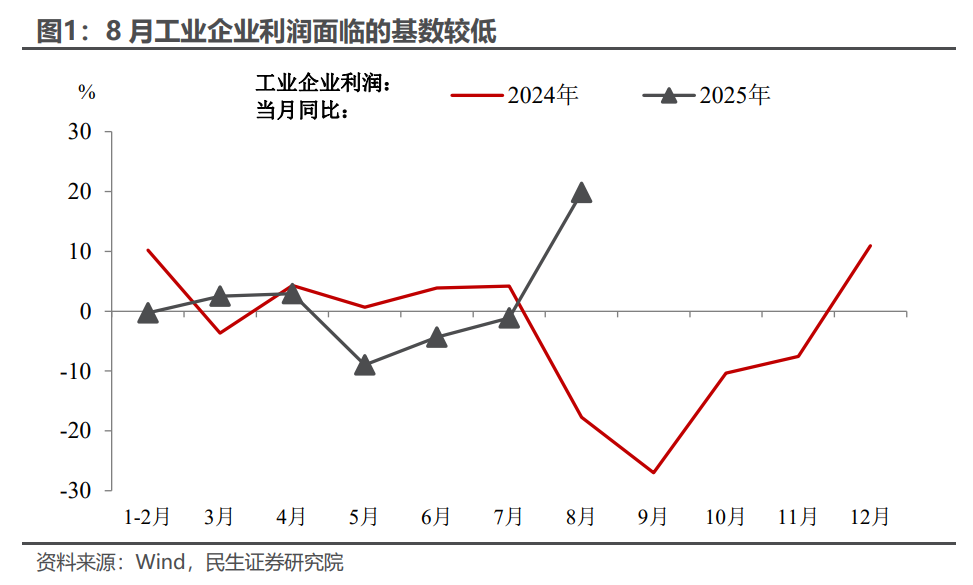
Core Insights - In August, industrial enterprises' profits surged from negative to a growth rate of 20.4%, marking the highest increase since December 2023. However, when excluding the low base effect, profit growth showed a marginal slowdown, decreasing from 1.3% in July to -0.5% in August when using a two-year average compound growth rate [1][2][12]. Group 1: Profit Growth Analysis - The significant profit increase in August is attributed to the "anti-involution" policy, which is reshaping profit distribution logic. This profit report provides key insights into these changes [2][7]. - The breakdown of volume, price, and profit margin in August indicates a scenario of "increased volume, decreased price, and positive profit margin growth." This represents a clear reversal from previous trends, with weakening support from industrial added value and reduced drag from PPI [5][12]. Group 2: Industry Dynamics - The "anti-involution" policy's effects are beginning to show, with some industries experiencing a restructuring of profit patterns. While external trade uncertainties may impact certain companies, the economic data from August suggests immediate price support from the policy [7][12]. - The analysis of volume and price data in August categorizes industries into four quadrants based on their response to the "anti-involution" dynamics, highlighting varying levels of competition and profitability across sectors [8][11]. Group 3: Sector-Specific Performance - Upstream industries have shown the most notable improvement in profits, with a narrowing decline to -1.9% in August from -12.7% in July, marking the best performance of the year for these sectors [12]. - In contrast, the midstream sector's profit growth remained stable, while downstream industries, particularly pharmaceuticals and automotive manufacturing, exhibited lackluster profit growth [12][13].

2025年8月工业企业利润点评:缘何强势反弹?
Minsheng Securities· 2025-09-27 06:51
Profit Performance - In the first eight months of 2025, China's industrial enterprises achieved a total profit of CNY 46,929.7 billion, a year-on-year increase of 0.9%[1] - In August, the profit of industrial enterprises turned from a decline of 1.5% in July to a growth of 20.4%, marking the highest growth rate since December 2023[1] - When excluding the low base effect, the profit growth rate showed a marginal slowdown, decreasing from 1.3% in July to -0.5% in August[1] Factors Influencing Profit Growth - The significant improvement in revenue profit margins in August was primarily explained by the low base effect, with a performance of "volume up, price down, profit margin positive growth"[2] - The overall profit decline in upstream industries narrowed to -1.9% in August from -12.7% in July, indicating the best performance of upstream industries this year[2] - The profit growth rates for state-owned enterprises and private enterprises in August were 50.0% and 13.2%, respectively, highlighting a stronger response from state-owned enterprises to the "anti-involution" policy[5] Industry Dynamics - The "anti-involution" policy has begun to reshape profit distribution, with upstream industries showing the most notable profit improvements due to quicker production adjustments[2] - The midstream profit growth rate remained stable at 10.3% in August, compared to 8.9% in July, while downstream sectors like pharmaceuticals and automotive manufacturing showed lackluster performance[5] - The analysis categorized industries into four quadrants based on their response to the "anti-involution" policy, indicating varying levels of price and production dynamics across sectors[5]
板块轮动月报(2025年10月):大盘成长超长续航波动上升,顺周期与科技板块均衡配置-20250927
ZHESHANG SECURITIES· 2025-09-27 06:17
Core Insights - The report indicates that the growth style of the market has shone brightly in September, aligning with previous predictions of reaching a peak. It suggests that in October, the growth style will continue to thrive but with increased volatility, advocating for a balanced allocation between cyclical and technology sectors [1][2][3] Sector Rotation: Focus on Broad Growth Direction, Cyclical and Consumer Sectors - The market style is leaning towards mid and large-cap stocks, with growth outperforming value. The cyclical and consumer sectors are expected to be relatively dominant in October [2][12] - The probability of a Federal Reserve rate cut in October remains high at 91.9%, which is anticipated to create a favorable financial environment for growth stocks [2][33] Industry Allocation: Focus on Technology, Cyclical, and Large Financial Sectors - The top ten industries based on scoring include electric power equipment and new energy, non-ferrous metals, machinery, communication, agriculture, electronics, non-bank financials, basic chemicals, consumer services, and computers [4][46] - The report emphasizes a "win rate" approach, favoring investments in electric power, electronics, non-ferrous metals, and basic chemicals, while a "odds" approach suggests focusing on underperforming sectors like brokerage firms and real estate [4][47] Next Month's Sector Allocation Recommendations - The report recommends a focus on broad growth styles, particularly in cyclical and consumer sectors. It highlights the importance of investing in electric power, electronics, non-ferrous metals, and basic chemicals, while also considering underperforming sectors like brokerage firms and real estate [5][46]
反内卷政策或带来双重拐点
Xinda Securities· 2025-09-26 12:35
Policy Development - The "anti-involution" policy was first proposed in July 2024 during a Central Political Bureau meeting, aiming to prevent "involutionary" competition[1] - By December 2024, the focus shifted from risk warning to specific rectification actions, indicating a move towards comprehensive governance[1] - In 2025, the policy became a frequent topic in high-level meetings, with actionable measures being implemented across various industries[1] Industry-Specific Measures - Different industries have varied approaches to "anti-involution," focusing on capacity control and price guidance[1] - Key strategies include controlling new capacity, eliminating outdated capacity, and encouraging mergers and acquisitions[1] - The coal industry aims to control total production and ensure that long-term contracts cover over 80% of output[12] - The steel industry is focusing on low emissions and halting new capacity replacements to curb disordered expansion[15] Expected Outcomes - The "anti-involution" policy may lead to a dual inflection point: a downward trend in capacity surplus and an upward trend in the Producer Price Index (PPI)[1] - As of Q2 2025, the growth rate of industrial capacity has slightly fallen below GDP growth, indicating a potential acceleration in resolving capacity surplus[24] - The relationship between capacity surplus and PPI suggests that as capacity surplus decreases, PPI is likely to rise[24] Risks - Potential risks include slower-than-expected implementation of "anti-involution" policies, geopolitical risks, and the possibility of historical patterns failing to hold[30]
铝季报:宏观偏乐观铝价下方存支撑
Zhong Hang Qi Huo· 2025-09-26 11:52
Group 1: Report Industry Investment Rating - There is no information provided in the report regarding the industry investment rating. Group 2: Core Viewpoints of the Report - The macro - environment is relatively optimistic, and there is support at the lower end of aluminum prices [1]. - In the fourth quarter, the macro sentiment at home and abroad is positive, providing price support for non - ferrous metals [66]. - For electrolytic aluminum, supply will have a small increase, and the price will first rise and then fall, with the upper pressure at 22,000 and the lower support at 20,000. Attention should be paid to the demand - side support [68]. - The short - term supply - demand fundamentals of aluminum alloy change little, and its price still fluctuates with the aluminum price. It is recommended to take a long - position on dips [68]. Group 3: Summary by Relevant Catalogs 1. Market Review - The electrolytic aluminum price showed a three - stage trend in the current period. From January to mid - March, it oscillated upward due to factors such as the Fed's interest - rate cut expectation, Trump's assumption of office, and pre - holiday stocking demand. From late March to early April, it oscillated downward as the Fed's interest - rate cut expectation faded and concerns about Trump's tariff policy emerged. From mid - April to the present, it oscillated upward after the US tariff policy was implemented and counter - measures were taken in China, along with other factors like supply disturbances from Guinea's bauxite and the Fed's interest - rate cut expectation [6]. 2. Macro - aspect - The Fed restarted interest - rate cuts, and liquidity became more relaxed. The US economic data showed changes in employment, inflation, etc. The tariff impact was temporarily alleviated, and attention should be paid to the time point in November. China's anti - involution policy was advanced, and future inflation might stabilize and rebound [8][10][14]. 3. Fundamental Aspect Supply - side - **Bauxite**: In July, China's bauxite production increased year - on - year. Guinea's supply was disturbed, but the impact was expected to be limited. The domestic port inventory was high, suppressing the transaction price. The bauxite price might have a seasonal correction but had support at 70 dollars/ton [18][22][24]. - **Alumina**: The supply was loose. In 2025, there was a large - scale new - investment capacity. Although some projects were postponed, there was still 440 million tons of new - investment capacity in the fourth quarter. The production capacity utilization rate was at a historical high, but there might be seasonal production cuts in winter in Shanxi and Henan [25][27]. - **Electrolytic Aluminum**: In August, the production was 3.8 million tons, a year - on - year decrease of 0.5%. In the fourth quarter, the production was expected to be about 11.283 million tons, a month - on - month increase of 0.4% and a year - on - year increase of 2.39%, showing a stable operation [30]. - **Aluminum Alloy**: In July, the import volume of un - forged aluminum alloy hit a four - year low, mainly due to price inversion and the off - season of demand. The export volume increased year - on - year. The weekly inventory of Chinese aluminum alloy increased [59][60][64]. Demand - side - **Downstream Processing**: As of September 18, the operating rate of domestic aluminum downstream processing leading enterprises increased by 0.1 percentage points to 62.2% week - on - week, but decreased by 1.3 percentage points compared with the same period last year. Different sectors had different trends [31]. - **Export**: In August, China's export of un - forged aluminum and aluminum products was 530,000 tons, a year - on - year decrease of 10.2%. From January to August, the cumulative export was 4 million tons, a year - on - year decrease of 8.2%. The export was under pressure due to tariff policies [34]. - **New Energy**: In the photovoltaic field, the annual photovoltaic installation was expected to increase year - on - year, and the photovoltaic aluminum consumption in the fourth quarter was expected to decrease year - on - year but still maintain positive growth for the whole year. In the power grid field, the cable aluminum demand continued to grow, and it was expected to maintain high - growth in the fourth quarter [39]. - **Automobile**: In August, the production and sales of automobiles and new - energy vehicles increased both month - on - month and year - on - year. The demand for aluminum in the automobile industry increased significantly, and new - energy vehicles were expected to drive aluminum consumption in the fourth quarter [46]. - **Real Estate**: In August, the real - estate sales, investment, new construction, and completion areas decreased year - on - year. However, the new policies in first - tier cities might support the market demand, and the new - house transaction area in 38 cities increased year - on - year in early September [41]. Inventory - As of September 19, the inventory of SHFE electrolytic aluminum decreased slightly, LME inventory increased, and COMEX inventory decreased slightly. The overall inventory was in a low position historically. The social inventory of electrolytic aluminum was expected to show a "slow de - stocking" pattern in the fourth quarter [48][51]. - The production of recycled aluminum alloy decreased slightly in August and was expected to continue to decline slightly in September. The operating rate of recycled aluminum alloy increased by 0.4 percentage points week - on - week as of September 18, and it was expected to remain stable in September [54][57]. 4. Future Outlook - The macro - environment is favorable for non - ferrous metals. The bauxite price may have a seasonal correction but has support. The alumina supply is in surplus, and the electrolytic aluminum price will first rise and then fall. The aluminum alloy price fluctuates with the aluminum price [66][68].